Dispersion interaction between two bodies of arbitrary shape
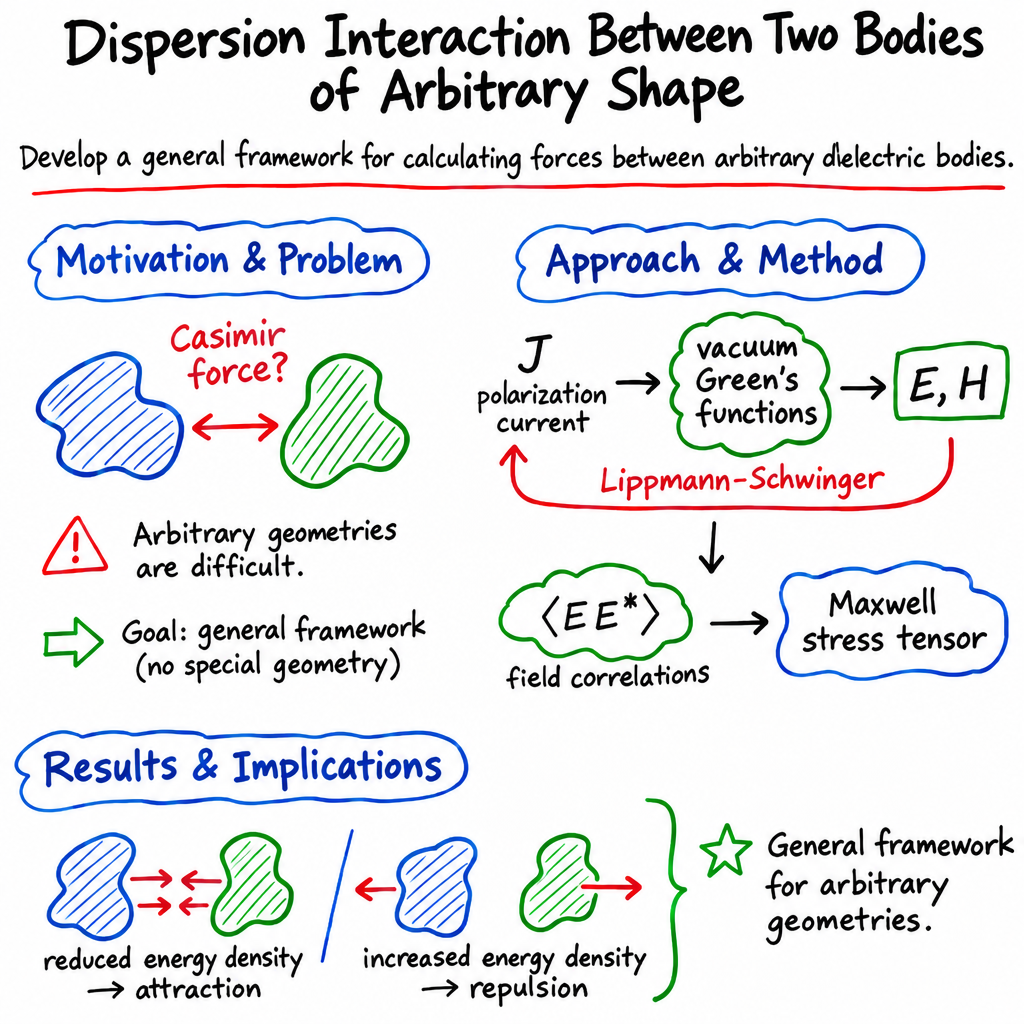
Abstract: Based on the vacuum tensor Green's functions of electrodynamics, the Lippmann-Schwinger-type equations were derived for the correlations of electromagnetic fields. These correlations were applied within the Maxwell stress tensor and the Lorentz force formula to determine Casimir dispersion forces for two arbitrary bodies. The analysis is performed by the excitation of bodies by electric and magnetic dipoles.
Paper Prompts
Sign up for free to create and run prompts on this paper.
Explain it Like I'm 14
1. What is this paper about?
This paper studies a very small force that can act between two objects even when they are not touching. This force is called a dispersion force, or, in an important special case, the Casimir force.
The force comes from tiny, constantly changing electromagnetic fields. These fields exist because of:
- heat and thermal radiation,
- random electromagnetic waves,
- and quantum “vacuum fluctuations,” which are small energy changes that exist even in empty space.
The main goal of the paper is to develop a method for calculating this force between two objects with any shape—for example, curved, uneven, or oddly shaped objects.
Most older calculations worked best for simple shapes, such as two flat plates. This paper tries to create a more general approach.
2. What questions does the research ask?
The paper mainly asks:
- How can we calculate the force between two objects of arbitrary shape?
- How do the objects’ shape, material, temperature, and distance affect the force?
- Can the force be calculated using either the electric and magnetic fields around the objects or the currents produced inside them?
- Can the same method work for objects that are uneven, magnetic, anisotropic, or surrounded by another material?
Here, anisotropic means that a material behaves differently in different directions—for example, it may conduct electricity well from left to right but poorly from top to bottom.
3. How was the research carried out?
The paper is mainly a mathematical and theoretical study. It does not report a laboratory experiment. Instead, the authors build equations that can be used to calculate the force.
Describing the materials
The objects are described using quantities called:
- Permittivity: how a material responds to an electric field.
- Permeability: how a material responds to a magnetic field.
These properties tell the equations how electromagnetic waves behave inside and around each object.
Treating materials as tiny sources
The authors imagine that the material contains many tiny changing electric currents. These currents act somewhat like thousands of extremely small radio antennas.
The currents produce electric and magnetic fields. By adding together the effects of all these tiny sources, the researchers can estimate the total field around the objects.
Green’s functions: a map of the field’s response
A major tool in the paper is the Green’s function.
A Green’s function is like a detailed map answering this question:
If a tiny electric or magnetic source is placed at one point, what field will it create at another point?
An everyday analogy is dropping a stone into water. The Green’s function describes how the ripples travel from the point where the stone fell to other parts of the pond.
The paper uses tensor Green’s functions, which keep track of direction as well as strength. This is needed because electric and magnetic fields point in different directions.
Lippmann–Schwinger equations
The authors use equations called Lippmann–Schwinger integral equations. These equations combine:
- the field that would exist without the objects, and
- the extra field created when the objects disturb that original field.
This is similar to predicting the sound in a room by combining the original sound with the echoes caused by the walls.
The equations can be solved approximately. The researchers describe a step-by-step process:
- First, pretend the objects do not change the field.
- Use that estimate to calculate the first correction.
- Use the corrected result to calculate another correction.
- Continue until the answer is accurate enough.
This works especially well when the material is only slightly different from empty space.
Measuring the force with the Maxwell stress tensor
The paper calculates the force using the Maxwell stress tensor.
Although the name sounds complicated, it is essentially a bookkeeping tool for electromagnetic pressure. It describes how much electromagnetic momentum flows through a surface.
The researchers imagine drawing an invisible surface around one object. They calculate how the electromagnetic field pushes on that surface. The total push gives the force on the object.
This is similar to measuring wind pressure on a sail by adding up all the pushes from the air over the sail’s surface.
Another force calculation
The paper also discusses a second method based directly on the force acting on:
- electric charges on the surface of an object, and
- electric currents inside the object.
The authors argue that this method and the Maxwell stress tensor method should give the same result because both follow the law of conservation of momentum.
Using electric and magnetic dipoles
The paper also studies what happens when an object is excited by a tiny electric or magnetic dipole.
A dipole can be imagined as two tiny opposite charges separated by a small distance. A magnetic dipole is similar to a very small bar magnet.
By calculating the fields produced by these dipoles, the authors obtain information about the random field correlations around the objects. These correlations tell us how the fluctuating fields at two locations are related.
4. What are the main findings?
The paper’s main result is a general theoretical framework for calculating dispersion forces between two objects of almost any shape.
The important conclusions are as follows.
The method can handle complicated shapes
Unlike formulas designed only for two flat plates, the proposed method can include:
- curved surfaces,
- irregular objects,
- objects with different sizes,
- materials that vary from place to place,
- anisotropic materials,
- magnetic materials,
- and objects placed in a surrounding medium.
The shape affects the calculation in two ways:
- It changes the volume where electromagnetic currents exist.
- It changes the surface over which the final force is calculated.
Both electric and magnetic fluctuations matter
The force depends on correlations between electric fields and between magnetic fields. In simple terms, the researchers must consider how random electric and magnetic waves behave near the two objects.
These fluctuations can produce either attraction or repulsion.
The paper explains the idea using energy density:
- If the field energy between the objects is lower than outside them, the objects tend to be pulled together.
- If the energy between them is higher, they may be pushed apart.
Temperature can affect the force
The paper includes both:
- thermal fluctuations, caused by heat, and
- vacuum fluctuations, which exist even at zero temperature.
At low temperatures, vacuum fluctuations may be especially important. At higher temperatures and larger distances, thermal radiation can become more important.
The authors also explain that if two objects have different temperatures, they may exchange radiation and heat. This makes the problem more complicated because the system is no longer in complete thermal equilibrium.
Infinite vacuum energy must be removed carefully
Quantum theory predicts that empty space contains fluctuations at all frequencies. If all of these are added together, the total energy becomes infinite.
The paper says that the part of this energy that is the same everywhere should be removed. This is because it does not depend on the objects’ shape or distance and therefore does not create a force between them.
Only the change caused by placing the objects in space is relevant to the interaction.
The forces on the two objects are opposite
The paper uses conservation of momentum to argue that the force on the first object is equal in size and opposite in direction to the force on the second object.
This is similar to two people pushing against each other on ice: if one person moves one way, the other moves the opposite way.
5. Why is this research important?
Many tiny machines and modern technologies contain parts that are very close together. At these small distances, dispersion forces can become important.
The method described in the paper could eventually help scientists and engineers understand or design:
- microchips,
- tiny mechanical devices,
- sensors,
- nanotechnology,
- graphene structures,
- carbon nanotubes,
- and systems involving thermal radiation.
For example, in a very small machine, two parts might accidentally stick together because of these forces. Engineers need to predict this effect when designing the machine.
The method could also help researchers study unusual situations where the force is changed by:
- using different materials,
- changing the temperature,
- changing the shape of the objects,
- placing the objects in a liquid or another substance,
- or using magnetic and anisotropic materials.
6. Overall assessment
In simple terms, the paper creates a mathematical “toolkit” for finding how two oddly shaped objects push or pull on each other because of tiny electromagnetic fluctuations.
Its main achievement is the attempt to move beyond simple flat plates and develop equations for objects with arbitrary shapes. However, the paper mostly presents the theory and general equations. It does not give many specific numerical examples or experimental tests in the text provided.
The next step would be to apply the method to particular objects—such as two curved particles, graphene sheets, or nanotubes—and compare the predictions with experiments or with other established calculations.
Practical Applications
Immediate Applications
- Numerical modeling of dispersion forces for nonplanar components — nanotechnology, MEMS, and robotics. The paper provides a Green-function and Maxwell-stress-tensor workflow for calculating fluctuation-induced forces between bodies with arbitrary geometry. This can be incorporated into electromagnetic simulation software to estimate attraction or repulsion between curved, irregular, or closely spaced components, including microgears, cantilevers, membranes, nanotubes, and particle–surface systems. Potential output: a geometry-to-force simulation module based on volume integral equations, tensor Green functions, and surface integration of the stress tensor. Dependencies: accurate complex permittivity and, where relevant, permeability ; numerical treatment of singular Green functions; sufficient spatial and frequency resolution; validation against planar or spherical benchmarks.
- Casimir-force prediction in nanomechanical device design — MEMS/NEMS. Designers can use the method to evaluate unwanted stiction, pull-in, and mechanical instability caused by dispersion forces in nanoscale gaps. Conversely, the same calculations can help engineer useful attraction or repulsion for switches, resonators, actuators, and tunable mechanical elements. Workflow: represent each device component as a dielectric volume, solve the Lippmann–Schwinger equation, calculate field correlations, and integrate the Maxwell stress tensor over one component. Dependencies: the paper’s assumptions of linear, local, homogeneous materials may need modification for strongly dispersive, lossy, anisotropic, or spatially nonlocal materials.
- Analysis of graphene and layered two-dimensional materials — materials science and nanoelectronics. The paper explicitly identifies graphene sheets and finite-thickness flat layers as tractable applications. The method can be used to estimate interaction forces between graphene membranes, layered van der Waals heterostructures, and suspended two-dimensional devices. Potential products: design tools for predicting membrane adhesion, layer separation, nanoscale friction, and mechanically induced deformation. Dependencies: realistic frequency-dependent conductivity or permittivity, finite temperature, substrate effects, surface roughness, and possible nonlocal electronic response.
- Calculation of thermal fluctuation forces in nanostructures — thermal engineering and photonics. The fluctuation-correlation formulation includes the temperature-dependent oscillator energy and can therefore support equilibrium thermal Casimir-force calculations. Engineers can assess how device temperature changes modify forces in closely spaced components. Applications: thermal switches, temperature-sensitive resonators, nanoscale gap control, and passive thermal-mechanical sensors. Dependencies: thermal equilibrium or quasi-equilibrium, stable body temperatures, and reliable treatment of thermal radiation and zero-point contributions.
- Force evaluation for arbitrary dielectric inclusions in complex media — optical and electromagnetic engineering. Section 4 extends the force formulation to a medium between the bodies with dispersive permittivity and permeability. This can be used to study particle–surface interactions in liquids, dielectric coatings, immersion environments, and engineered optical media. Potential workflow: replace vacuum Green functions with Green functions parameterized by and , then compute surface and volumetric force contributions. Dependencies: the medium must be modeled consistently, including absorption, dispersion, and possible magnetic response; hydrodynamic and electrostatic forces may also need to be separated experimentally.
- Cross-validation of electromagnetic-force calculations — computational physics and academia. The paper presents two conceptually related routes: integration of the Maxwell stress tensor and a force calculation based on induced surface charges and polarization currents. These can be implemented as independent numerical checks for existing Casimir or fluctuation-electrodynamics codes. Benefit: agreement between the two methods can reveal discretization errors, omitted self-interaction terms, incorrect boundary handling, or failure to subtract configuration-independent vacuum contributions. Dependencies: both formulations must use consistent conventions, regularization, material models, and surface orientations.
- Educational and research software for fluctuation electrodynamics. The equations provide a framework for teaching and prototyping calculations involving Green functions, fluctuating currents, dipole excitation, and stress tensors. A practical implementation could begin with flat sheets or finite layers, where Fourier transformation reduces the integral equations to algebraic systems, and then extend to arbitrary shapes using Galerkin or Ritz discretization. Dependencies: the manuscript contains notation and transcription ambiguities, so implementation requires independent verification of signs, tensor indices, Fourier conventions, and dimensional consistency.
- Measurement planning for nanoscale force experiments. The predicted dependence on body shape, separation, material dispersion, and temperature can guide experiments using atomic-force microscopy, microcantilevers, or optical trapping. Researchers can compare measured force–distance curves with calculations based on the actual three-dimensional geometry rather than a proximity-force approximation. Dependencies: surface roughness, patch potentials, electrostatic charging, contamination, thermal gradients, and calibration uncertainty may dominate the measured signal.
Long-Term Applications
- Design of Casimir-force-engineered MEMS/NEMS with controlled attraction or repulsion — micro- and robotics engineering. Once the arbitrary-shape formalism is numerically validated and combined with optimization algorithms, it could support inverse design of components whose geometry and materials produce a target force profile. Examples include noncontact clamps, bistable switches, self-aligning components, and low-friction microactuators. Required development: large-scale optimization over shape, separation, temperature, and material spectra; robust treatment of fabrication tolerances; experimental verification of repulsive or sign-changing force regimes.
- Thermal management and near-field energy–force co-design — energy and photonics. The same fluctuating-current and Green-function machinery could be extended to jointly calculate radiative heat transfer and mechanical force between bodies at different temperatures. This would enable designs in which thermal radiation is used to control mechanical motion or where force and heat flow are optimized simultaneously. Potential systems: thermally driven nanogaps, radiative heat engines, thermal actuators, and tunable near-field radiative devices. Dependencies: nonequilibrium fluctuation electrodynamics, finite heat capacity, transient temperature evolution, and accurate treatment of radiation emitted and absorbed by each body.
- Geometry-optimized manipulation of nanoparticles and biological objects — biophysics and nanomedicine. Arbitrary-shape calculations could eventually be applied to dielectric particles, nanowires, biomolecules, membranes, or patterned substrates. The predicted fluctuation forces could be combined with optical, electrostatic, or hydrodynamic forces to design noncontact trapping and assembly systems. Required development: inclusion of liquid environments, thermal noise, Brownian motion, molecular-scale material response, surface chemistry, and experimentally measurable force scales. Macroscopic permittivity models may be inadequate for very small or molecular objects.
- Casimir-based positioning and alignment in precision robotics. Carefully designed curved or asymmetric surfaces could use fluctuation forces for passive alignment, docking, or gap stabilization in micro-robotic systems. The paper’s momentum-conservation framework is relevant because it calculates the net force on each body while preserving equal-and-opposite interaction forces for the two-body system. Dependencies: sufficiently strong force relative to adhesion, friction, electrostatic effects, and environmental disturbances; fabrication of surfaces with nanometer-scale tolerances; reliable dynamic rather than purely static modeling.
- Multiphysics simulation platforms for complex materials. A mature implementation could combine the proposed method with anisotropic, inhomogeneous, magnetic, and spatially dispersive material models. This would be valuable for metamaterials, photonic crystals, plasmonic structures, magnetic composites, and multilayer devices. Required development: tensor-valued fluctuation correlations, nonlocal constitutive relations, volumetric charge densities arising from , and stable discretization of strongly resonant systems.
- Policy and standards for nanoscale force modeling. Government laboratories, standards organizations, and regulatory bodies could use validated implementations to establish recommended procedures for reporting Casimir-force calculations in nanodevice safety and reliability studies. Such standards could specify geometry representation, material-data sources, vacuum-energy subtraction, temperature assumptions, and uncertainty quantification. Dependencies: independent benchmark datasets, reproducible open-source implementations, agreement with experimental measurements, and resolution of theoretical and numerical ambiguities in the formulation.
- Automated inverse design of fluctuation-induced interactions. Coupling the Green-function solver to machine learning, topology optimization, or differentiable electromagnetic simulation could produce geometries that maximize, minimize, or spatially localize dispersion forces. This could lead to databases of force-engineered shapes and materials. Dependencies: differentiable and numerically stable solvers, large validated training datasets, physically constrained optimization, and protection against designs that exploit numerical artifacts or unrealistic material properties.
- Integration into future nanoscale manufacturing workflows. In the long term, the method could be connected to computer-aided engineering and digital-twin systems for predicting whether fabricated nanoscale gaps will remain stable under thermal and quantum fluctuation forces. This would be particularly relevant for semiconductor packaging, layered sensors, nanophotonic components, and flexible nanoelectromechanical devices. Dependencies: process-specific geometry reconstruction, uncertainty-aware material characterization, roughness and contamination models, and experimental feedback during fabrication.
Glossary
- Anisotropic: Having material properties that vary with direction. “In general, they are tensor, and the bodies are anisotropic.”
- Bose–Einstein function: A statistical distribution describing the occupation of quantum states by bosons. “expressed in terms of the Bose-Einstein function”
- Casimir force: A quantum-mechanical force arising from changes in vacuum fluctuations between objects. “Casimir forces or dispersion forces are considered for the interaction of two dielectric bodies”
- Correlation function: A function measuring statistical dependence between values of a fluctuating quantity at different times or positions. “then its correlation”
- Dielectric permittivity: A material property describing how a medium responds to an electric field. “described by macroscopic permittivity (DP)”
- Dispersion force: An interaction force caused by fluctuating electromagnetic fields, including van der Waals and Casimir interactions. “determine [PERSON_NAME] dispersion forces for two arbitrary bodies”
- Dyson equation: An integral equation relating a full Green’s function to a reference Green’s function and interaction terms. “it is possible to formulate a Dyson-type equation for such a GF.”
- Electromagnetic Green’s function: A response function giving the electromagnetic field produced by a localized source. “Based on the vacuum tensor Green's functions of electrodynamics”
- Far zone: The region sufficiently distant from a source where radiation fields have their asymptotic behavior. “the fields from the bodies are represented by outgoing spherical waves and decrease.”
- Fluctuation source: A random current or field source used to model thermal or quantum electromagnetic fluctuations. “third-party fluctuation sources”
- Galerkin method: A weighted-residual numerical method that approximates solutions using a finite set of basis functions. “using the Galerkin method”
- Gibbs ensemble: A statistical-mechanical ensemble representing a system through averages over possible microscopic states. “Correlations are understood as Gibbs ensemble averages”
- Langevin thermostat: An idealized thermal reservoir that maintains a prescribed temperature through stochastic interactions. “we consider radiation as a Langevin thermostat with infinite heat capacity.”
- Lippmann–Schwinger integral equation: An integral equation expressing a field as the sum of an incident field and the field scattered by material interactions. “the Lippmann-Schwinger integral equation (LSIE) should be solved.”
- Macroscopic quantum electrodynamics: A formulation of quantum electrodynamics describing electromagnetic fields interacting with continuous material media. “Description of dispersion interactions is possible within the framework of macroscopic quantum electrodynamics”
- Maxwell stress tensor: A tensor whose surface integral gives the electromagnetic force on an enclosed object. “They are included in the Maxwell stress tensor”
- Magnetic permeability: A material property describing a medium’s response to magnetic fields. “magnetic permeability (MP)”
- Momentum conservation theorem: The physical principle relating electromagnetic momentum transfer to forces on matter. “Formula (21) is determined by the momentum conservation theorem”
- Planck spectral radiation density: The frequency-dependent energy density of thermal electromagnetic radiation. “There is a Planck spectral radiation density”
- Polarization current: An effective electric or magnetic current generated by the response of a material to an electromagnetic field. “the densities of the electric current of polarization”
- Proximity force approximation: An approximation that estimates forces between curved surfaces by locally treating them as parallel surfaces. “the so-called proximity force applications”
- Quantum vacuum fluctuations: Ground-state electromagnetic fluctuations that persist even at zero temperature. “They contain energies of all frequencies ”
- Ritz variational method: A numerical technique that approximates a solution by minimizing a variational functional over a finite-dimensional trial space. “the Ritz type variational method”
- Rytov–Levin concept: A fluctuational-electrodynamics framework representing thermal radiation through stochastic sources inside dissipative media. “We will use the Rytrov-Levin concept”
- Scattering matrix: A matrix relating incoming wave amplitudes to outgoing wave amplitudes in a scattering problem. “the theory of matrix representations of fields using scattering matrices”
- Spatial dispersion: Dependence of a material’s electromagnetic response on the wavevector as well as frequency. “described by a tensor DP with spatial dispersion (SD).”
- Spectral power density: The distribution of the power or variance of a fluctuating quantity over frequency. “Here is the spectral power density”
- Stefan–Boltzmann constant: The proportionality constant relating blackbody radiative power density to the fourth power of temperature. “is the Stefan-Boltzmann constant.”
- Tensor Green’s function: A Green’s function whose values are tensors and that maps vector sources to vector fields. “The difficulties of the classical description are related to the need to construct a tensor Green's functions”
- Thermal equilibrium: A state in which temperature and relevant macroscopic thermodynamic properties are uniform and stationary. “in a thermal equilibrium Planck field”
- Vector potential: A vector field from which electromagnetic fields can be derived through spatial and temporal derivatives. “It creates a vector potential”
- Virtual photon: A non-observable intermediate excitation used in quantum-field descriptions of interactions. “the number of virtual photons is infinite.”

