The k-Clique hypothesis is dead, for good
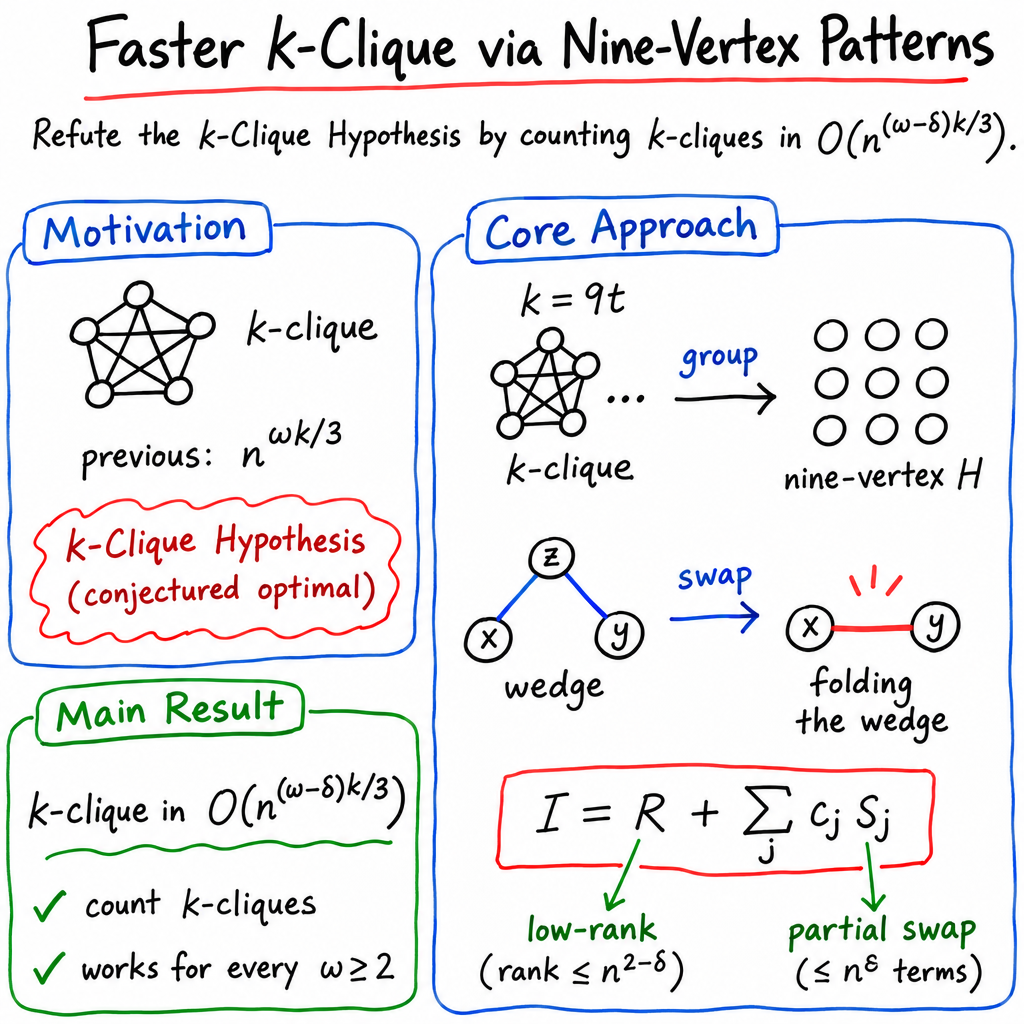
Abstract: We present an algorithm that solves the -Clique problem for any large enough and any -vertex graph in time, where is the matrix multiplication exponent and is a positive constant independent of both and . This refutes the long-standing -Clique conjecture, regardless of the value of the matrix multiplication constant, even if . In fact, our algorithm solves the more general problem of counting weighted -Cliques.
Paper Prompts
Sign up for free to create and run prompts on this paper.
Explain it Like I'm 14
1. What is this paper about?
This paper studies a famous computer science problem called -Clique.
A clique is a group of people, computers, or other objects where everyone is connected to everyone else. In a graph, a -clique is a group of vertices with an edge between every pair.
For example, a 4-clique is four vertices where all six possible connections are present.
The main claim of the paper is surprising:
For sufficiently large , -cliques can be found faster than researchers previously believed possible.
For many years, computer scientists believed that the best possible running time was roughly
where:
- is the number of vertices in the graph.
- is the size of the clique.
- describes how quickly computers can multiply large matrices.
This belief was called the -Clique Hypothesis. The paper argues that this hypothesis is false.
2. What questions are the researchers asking?
The paper focuses on several related questions:
- Can large cliques be found faster than the standard method?
- Can the long-standing -Clique Hypothesis be disproved?
- Can the number of cliques be counted, rather than merely checking whether one exists?
- Can the improvement work no matter how fast matrix multiplication eventually becomes?
- Can the same ideas improve other difficult problems, such as Max-Cut and Max-2-SAT?
The strongest part of the result is that the improvement works even in the hypothetical situation where matrix multiplication is as fast as theoretically possible, with .
3. How did the researchers approach the problem?
Turning a large clique into a smaller problem
The researchers begin with a standard idea. Suppose we want to find a clique with vertices.
They divide those vertices into groups of three. Each group can be treated like one large “super-vertex.” Then the problem becomes similar to finding a triangle among these groups.
This is useful because triangle-finding can be connected to matrix multiplication, which computers can perform very efficiently.
For example, when is divisible by 3, the usual method takes about
time.
The paper’s goal is to improve the exponent slightly, making the algorithm polynomially faster.
Counting weighted patterns
Instead of only looking for cliques, the researchers solve a more general problem.
Imagine that:
- Every vertex has a value or weight.
- Every edge also has a weight.
- The weight of a pattern is found by multiplying all of its vertex and edge weights.
The algorithm adds up the weights of all copies of a particular pattern in a graph.
This sounds harder than just finding a clique, but solving this broader problem gives the researchers more flexibility. A normal clique can be represented using carefully chosen weights.
Dividing a 9-vertex pattern into three groups
The central part of the algorithm works with patterns containing nine vertices.
The nine vertices are split into three groups of three. Each possible assignment of graph vertices to one group is treated like one entry in a large matrix.
The researchers then use three matrices and multiply them together. This is similar to checking whether three groups fit together to form the desired pattern.
The ordinary approach takes about
time for a 9-vertex pattern.
The paper finds a way to make this process slightly faster.
The “wedge folding” idea
A key shape in the graph is called a wedge:
1 |
x — z — y |
It consists of two edges sharing a middle vertex.
The researchers use a special operation called a swap. In simple terms, the swap changes how two copies of part of the pattern are matched together.
This causes the two edges of a wedge to behave like one combined edge. The wedge is said to be folded, reducing the number of edges in the pattern.
This is helpful because the researchers use induction:
- First, they solve simpler patterns with fewer edges.
- Then they reduce more complicated patterns to those simpler ones.
- They repeat this process until every pattern can be handled.
A low-rank remainder
The swap operation alone does not give the exact answer. Therefore, the researchers split the original calculation into two parts:
- A small number of easier problems involving folded patterns.
- A special leftover part that can be represented using a low-rank matrix.
A low-rank matrix is a matrix that can be described using fewer basic pieces than a general matrix. An everyday analogy is a large picture that can be reconstructed from a relatively small number of simple layers.
Because the leftover matrix is low-rank, the researchers can process it faster than a completely general matrix.
Why use two wedges?
Using only one wedge would give an improvement when , but the improvement would disappear if .
To avoid this problem, the algorithm looks for two separate wedges:
1 |
x₁ — z₁ — y₁ x₂ — z₂ — y₂ |
Reducing both wedges at the same time makes two parts of the matrix smaller. This produces a speedup even when matrix multiplication has the fastest theoretically possible exponent, .
4. What are the main findings?
The paper’s main theorem says that there are positive constants and such that, for every , -Clique can be solved in
time.
The important point is the subtraction of . The old expected running time was approximately
The new algorithm is faster by a fixed amount in the exponent.
The constant :
- Does not depend on .
- Does not depend on the value of .
- Remains positive even if future discoveries prove that .
The researchers also show that they can count the number of -cliques, which is at least as powerful as simply detecting whether one exists.
Their intermediate result is that any weighted pattern on nine vertices can be counted in roughly
time for some constant . This is faster than the previous bound.
Other problems that improve
The same technique can also improve algorithms for:
- Max-2-CSP, a general class of problems involving pairs of Boolean variables.
- Max-Cut, where the goal is to divide a graph into two groups while cutting as many edges as possible.
- Max-2-SAT, where the goal is to satisfy as many two-variable logic clauses as possible.
- Counting copies of fixed patterns in graphs.
- Some constraint-satisfaction and statistical-physics problems.
For example, the paper improves a previous type of running time from
to
for some positive constant .
5. Why is this important?
The -Clique Hypothesis had been used for many years as a foundation for proving that other algorithms could not be much faster.
Researchers had created reductions from -Clique to many other problems. A reduction is a way of transforming one problem into another. If someone found a very fast algorithm for the second problem, it might also solve -Clique quickly.
Because this paper disproves the hypothesis, some of those earlier arguments must be reconsidered. Problems previously thought to require matrix-multiplication-style running times might also have faster algorithms.
The result is especially important because it does not depend on knowing the exact value of . The exact fastest possible matrix multiplication algorithm is still unknown, so results depending too closely on can become outdated. This paper avoids that problem by proving a fixed improvement over the true value of .
Conclusion
In simple terms, the paper discovers a clever way to reorganize the calculations used to find large fully connected groups in graphs.
Its main ideas are:
- Break a large clique problem into smaller pieces.
- Represent the pieces using matrices.
- Use special swaps to fold away parts of the graph.
- Handle the remaining calculations with low-rank matrices.
- Apply the process repeatedly to obtain a faster algorithm.
The result overturns a long-standing belief in theoretical computer science: sufficiently large -cliques can be found and counted faster than the traditional method suggested.
The broader impact is that several other difficult problems may also become faster, because they were connected to -Clique through the now-disproved hypothesis.
Practical Applications
Immediate Applications
The paper’s main contribution is a faster exact algorithm for weighted counting of fixed nine-vertex patterns and, through reductions, sufficiently large -cliques. Its most realistic immediate uses are in research software, benchmarking, and specialized workloads rather than general consumer applications, because the improvement is asymptotic and the constants and threshold are not optimized.
- Exact counting of large cliques in graph-analysis pipelines — Graph analytics, cybersecurity, bioinformatics, and social-network analysis. Implement the weighted nine-vertex pattern algorithm as a subroutine for counting or detecting dense subgraphs, especially when graphs are dense and the target clique size is large enough for the reduction to be beneficial. Weighted edges can represent confidence scores, interaction strengths, similarity values, or probabilities. Dependencies: The implementation must support the required arithmetic field or a suitable exact/integer representation. The asymptotic improvement may not outperform existing sparse-graph or branch-and-bound methods on moderate-size instances.
- Weighted motif and pattern counting — Network science, knowledge graphs, computational biology, and fraud detection. The theorem applies to every nine-vertex pattern , not only . This enables a reusable motif-counting engine for exact weighted counts of graph patterns, including patterns with missing edges and vertex weights. A potential product is a library that accepts a pattern graph, host graph, and weight tables, then automatically selects the recursive folding and low-rank decomposition strategy. Dependencies: The current result is for fixed-size patterns and assumes suitable arithmetic operations. Practical gains depend on graph density, memory layout, parallelization, and the size of the hidden constants.
- Exact counting and optimization for dense Max-2-CSP instances — Optimization software, scheduling, circuit design, and constraint programming. The paper states an improvement from approximately to for dense Max-2-CSP, including Max-Cut and Max-2-SAT. This can be incorporated into exact solvers as a specialized backend for instances with a moderate number of Boolean variables where exhaustive or meet-in-the-middle methods are still feasible. The same framework can count optimal assignments, not merely return an optimum. Dependencies: The approach is most relevant to dense, unrestricted instances. Sparse-instance solvers, approximation algorithms, SAT heuristics, and integer-programming methods may remain faster in practice.
- Improved exact Max-Cut and Max-2-SAT workflows — Combinatorial optimization and verification. A solver can encode variable assignments into weighted instances, invoke the improved weighted counting algorithm, and recover optimum scores or the number of optimal solutions. This could support exact verification of heuristic solutions and exhaustive analysis of small hard instances. Dependencies: The current theorem gives an unspecified constant saving ; a practical solver requires explicit constants, careful numerical handling, and an implementation optimized for machine arithmetic.
- Counting solutions to polynomial constraint systems — Theoretical computer science and symbolic computation. The paper connects the method to polynomial CSPs, Ising partition functions, cut-counting, and graph bisection. Researchers can use the decomposition as a drop-in algorithmic component in existing matrix-multiplication-based counting frameworks. Dependencies: The stated results concern exact algebraic computation and may require characteristic-zero fields or sufficiently large integer domains. Translating the method to modular arithmetic, floating-point computation, or application-specific semirings requires additional validation.
- Benchmarking and redesign of fine-grained reductions — Algorithms research and complexity-theory tooling. Existing reductions that rely on the -Clique Hypothesis should be re-evaluated. The paper supplies a faster algorithm for sufficiently large , so researchers can build updated benchmarks and automated reduction analyzers that distinguish between hardness based on small cliques, Boolean matrix multiplication, and large-clique assumptions. Dependencies: Refuting the hypothesis does not automatically yield fast algorithms for every problem previously called “-Clique-hard.” Each reduction must be revisited, and the resulting algorithm may only improve exponents when polynomial overheads are controlled.
- Academic teaching and experimentation with algebraic graph algorithms — Computer science education and research training. The swap/folding framework provides a concrete example of combining graph counting, matrix multiplication, low-rank decompositions, tensor-like contractions, and induction over pattern edges. It can be implemented as a laboratory exercise or used to explore how algebraic identities change combinatorial counting problems. Dependencies: The complete proof and implementation details are technically demanding, and the supplied paper text ends before the full decomposition proof. Reproducible educational materials would need the complete formal specification.
- Policy and public-sector network analysis — Financial regulation, criminal-network analysis, epidemiology, and infrastructure monitoring. Agencies could use exact weighted motif counts to identify recurring interaction structures, coordinated activity, or high-confidence dense subgraphs in transaction, communication, or contact networks. The algorithm is particularly relevant when exact counts are required for auditability or legal defensibility. Dependencies: Privacy-preserving computation, data provenance, interpretability, and domain-specific definitions of edge weights are essential. The algorithm itself does not establish that a detected clique represents causation, collusion, or risk.
Long-Term Applications
The following opportunities require further work because they depend on explicit constants, broader computational models, scalable implementations, or adaptation to practical data regimes.
- Production-scale exact clique analytics — Cybersecurity, fraud detection, recommendation systems, and knowledge graphs. A future system could combine the paper’s large- algorithm with sparse-graph indexing, GPU or accelerator kernels, distributed matrix multiplication, and approximate prefilters. The workflow would first eliminate impossible candidate regions, then apply the exact weighted algorithm to dense residual subgraphs. Dependencies: The theorem is asymptotic and applies to sufficiently large ; the useful threshold is unspecified. Distributed implementations must also manage communication costs, which may dominate arithmetic operations.
- General-purpose weighted subgraph-counting engines — Graph databases and data-science platforms. The result could contribute to a query optimizer for graph databases. Given a fixed pattern query, the optimizer could choose among join plans, color-coding, matrix multiplication, sparse enumeration, and the rank-or-swap decomposition. Weighted counts could support probabilistic graph queries and uncertain knowledge graphs. Dependencies: The paper considers fixed nine-vertex patterns and pairwise/unary weights. Extending the approach to variable-size query patterns, higher-arity relations, dynamic graphs, or arbitrary database semirings requires new theory.
- Faster exact algorithms for large-k clique-hard problems — Scheduling, string algorithms, geometry, parsing, and dynamic programming. Many fine-grained reductions use the -Clique Hypothesis to argue conditional lower bounds. Once those reductions are combined with the new upper bound, some target problems may inherit faster algorithms. In particular, reductions with only polynomial overhead could become algorithmically meaningful when instantiated with the improved large- routine. Dependencies: This is not automatic. Each target problem needs a compatible reduction, and the improvement must exceed the reduction’s overhead. Some lower-bound results may need to be reformulated rather than simply discarded.
- Exact statistical-physics computation — Physics, probabilistic modeling, and machine learning. The stated connection to Ising partition functions suggests improved exact computation for selected small or structured models. A future implementation could use the method to calculate partition functions, correlations, or the number of configurations at each energy level. Dependencies: The result concerns particular polynomial-constraint formulations and fixed structural decompositions. Scaling to lattices, sparse physical systems, nonzero-temperature approximations, or continuous variables requires additional reductions and numerical analysis.
- Counting and inference in probabilistic graphical models — Healthcare, reliability engineering, and AI. Weighted graph sums can represent partition functions or marginal-likelihood components in pairwise probabilistic models. If the decomposition can be generalized to the relevant semirings and factor structures, it could support exact inference on dense small-variable models, such as diagnostic or reliability networks. Dependencies: The current algorithm is formulated over characteristic-zero fields and exact weighted sums. Probabilities may underflow, require normalization, or involve transcendental quantities; practical inference would need stable numerical variants and a proof that the decomposition preserves the required semantics.
- Hardware accelerators for algebraic graph counting — High-performance computing and specialized AI/graph hardware. The algorithm’s repeated matrix contractions, sparse rank-one projections, and structured partial swaps could motivate FPGA, GPU, or ASIC implementations. A specialized accelerator might store the sparse vectors , perform projected contractions, and exploit parallel recursive calls on sparser patterns. Dependencies: The benefit depends on whether the computation is arithmetic-bound or memory/communication-bound. The theorem’s exponent improvement does not by itself imply hardware efficiency, and the decomposition’s constants and data-access patterns must be characterized experimentally.
- Extensions beyond fields and exact arithmetic — Combinatorial optimization and semiring algorithms. A significant long-term direction is to determine whether the rank-or-swap technique works over finite fields, rings, tropical semirings, Boolean algebra, or approximate numerical domains. Such extensions could broaden its use in shortest-path-like optimization, probabilistic counting, and Boolean query evaluation. Dependencies: Rank, interpolation, and the identity decomposition are field-dependent concepts. The characteristic-zero assumption and the use of algebraic cancellation may fail over other domains.
- Improved counting for variable-size induced subgraphs — Biological network analysis and graph mining. The paper indicates that the approach extends to counting induced copies of fixed -vertex graphs. With additional research, this could become a toolkit for exact induced-subgraph statistics, including motif distributions and graphlet-based feature extraction. Dependencies: The current result is strongest for fixed patterns. Variable , repeated queries, labeled constraints, and dynamic updates may erase the asymptotic savings unless preprocessing or amortization techniques are developed.
- Policy use in auditable combinatorial decision systems — Public procurement, market surveillance, and infrastructure planning. Exact counts of weighted configurations could eventually support transparent policy analyses, such as enumerating all feasible allocations, detecting coordinated bidding structures, or evaluating network vulnerability scenarios. The ability to count all optimal solutions is particularly relevant for fairness and sensitivity analysis. Dependencies: Computational acceleration does not resolve legal, ethical, or causal-interpretation issues. Deployment would require explainable encodings, privacy safeguards, bias analysis, and validation that the graph model accurately represents the policy domain.
- Daily-life applications through embedded optimization tools — Routing, resource allocation, and personal scheduling. If the Max-2-CSP improvement becomes practical, it could support exact small-scale scheduling applications such as selecting compatible activities, assigning binary preferences, or optimizing household and workplace resource choices. It may also improve the verification stage of consumer-facing planning software. Dependencies: Most daily-life instances are small enough for existing solvers or structured heuristics. The paper’s asymptotic improvement is unlikely to be directly visible to users unless software combines it with strong preprocessing and targets unusually dense, difficult instances.
Overall, the paper’s clearest near-term impact is on algorithmic research and specialized exact graph/constraint solvers. Broader industry, policy, and daily-life deployment depends on making the saving constant explicit, determining the practical threshold for , implementing the decomposition efficiently, and comparing it against sparse, heuristic, distributed, and approximate alternatives.
Glossary
- Algebraic decomposition: A representation of a matrix or algebraic object as a combination of simpler components with useful computational properties. “Our proof makes central use of an algebraic decomposition lemma”
- Arithmetic complexity: The number of arithmetic operations required by an algorithm, considered independently of bit-level costs. “the arithmetic complexity implies a similarly efficient algorithm in the word-RAM model”
- Basis transformation: An operation that changes the coordinate representation of vectors or matrices from one basis to another. “The vectors belong to an explicit basis whose corresponding basis transformation requires only time.”
- Binary specialization: An adaptation of a construction to objects represented using binary strings or binary choices. “The algebraic construction itself is essentially a binary specialization of a matrix decomposition”
- Black-box: An algorithmic component used through its input-output behavior without examining its internal implementation. “using square matrix multiplication as a black-box”
- Boolean Matrix Multiplication (BMM): Matrix multiplication over the Boolean semiring, where addition is logical OR and multiplication is logical AND. “Boolean Matrix Multiplication (BMM, whose best algorithms are the same as for [PERSON_NAME])”
- Characteristic zero: A property of a field in which no positive integer multiple of the multiplicative identity equals zero. “over any field of characteristic zero”
- Color-coding: A randomized or combinatorial technique that assigns colors to vertices to enforce distinct roles in subgraph-counting algorithms. “Via standard color-coding we can assume that the host graph is partitioned”
- Concentration bound: An inequality that limits the probability that a random variable deviates substantially from its expected value. “a concentration bound for the binomial distribution”
- Contraction: The summation or combination of tensor or matrix dimensions to produce a scalar or lower-dimensional object. “the resulting contraction can be evaluated”
- Fine-grained complexity: The study of precise computational-time bounds and reductions between problems with closely related running times. “Fine-grained complexity then developed many reductions from -Clique”
- Field: An algebraic system in which addition, subtraction, multiplication, and division by nonzero elements are defined. “over any field of characteristic zero”
- Graph bisection: The problem of partitioning a graph’s vertices into two specified-size parts while optimizing the number or weight of crossing edges. “solving graph bisection”
- Induced copy: A subgraph whose edges and nonedges exactly match those of a specified pattern graph. “counting induced copies of any fixed -vertex graph”
- Inductive step: The part of an inductive proof that derives a claim for one case from its validity for a preceding case. “reducing solving the problem for a pattern to solving it on patterns with fewer edges as the inductive step”
- Matrix multiplication exponent: The infimum exponent governing the asymptotic running time of multiplying square matrices. “where is the matrix multiplication exponent”
- Matrix rigidity: The study of how many entries of a matrix must be changed to reduce its rank under specified constraints. “polynomial interpolation techniques previously used in matrix rigidity”
- Max-2-CSP: A constraint satisfaction problem with Boolean variables and constraints involving at most two variables, often maximizing the total satisfied weight. “Max-2-CSP on Boolean variables can be solved”
- NP-hard: A classification for problems at least as difficult as every problem in NP under polynomial-time reductions. “The problem is NP-hard when the desired clique size is part of the input.”
- Partial swap: A generalized swap operator that fixes selected bit positions while applying swap constraints to the remaining positions. “A partial swap is defined by choosing a set of bit positions”
- Permutation matrix: A matrix obtained by permuting the rows or columns of an identity matrix, with exactly one 1 in each row and column. “It is a permutation matrix, and unlike , it does change the computed value.”
- Polynomial interpolation: The reconstruction or evaluation of polynomials from selected values or coefficients, often used to create algebraic decompositions. “using little more than repeated applications of , elementary polynomial interpolation”
- Polynomial overhead: An additional multiplicative or exponent-related computational cost bounded by a polynomial in the input size. “when the reduction has some polynomial overhead”
- Rank-one decomposition: A representation of a matrix as a sum of matrices, each formed from the outer product of two vectors. “ admits an explicit rank-one decomposition”
- Rank-or-swap decomposition: A matrix decomposition into a low-rank remainder and a small collection of partial-swap operators. “We now state the algebraic decomposition that we need.”
- Rectangular matrix multiplication: Matrix multiplication in which the input matrices have unequal dimensions. “using rectangular matrix multiplication for the cases when is not divisible by $3$”
- Semiring: An algebraic structure resembling a ring but not necessarily containing additive inverses, such as the Boolean or tropical semiring. “Boolean Matrix Multiplication (BMM, whose best algorithms are the same as for [PERSON_NAME])”
- Subcubically equivalent: Having algorithms with truly subcubic running times that can be transformed into one another through reductions. “triangle detection (which is subcubically equivalent to BMM”
- Tensorized: Extended to a tensor-product representation, usually by combining an operator with an identity matrix on an additional variable. “the matrix should be tensorized with ”
- Trace: The sum of the diagonal entries of a square matrix; equivalently, the sum of closed walks represented by a matrix product. “we finish by computing the trace of the matrix product .”
- Unary weight: A function assigning a weight to a single vertex or variable. “Unary weights are assigned to any one of the two matrices containing their corresponding vertex”
- Vertex-disjoint: Having no vertices in common. “Two wedges are disjoint if they have no common vertex.”
- Weighted -clique sum: The sum of the products of edge weights over all -cliques in a graph. “we solve a potentially harder weighted -clique sum problem”
- Word-RAM model: A computational model in which memory words hold bits and standard word operations take constant time. “in the word-RAM model with bit words”
- Wedge: A length-two path consisting of two edges sharing a central vertex. “A wedge is a triple of distinct vertices for which .”