Patch-Based Generalized Neural Texture Upscaling
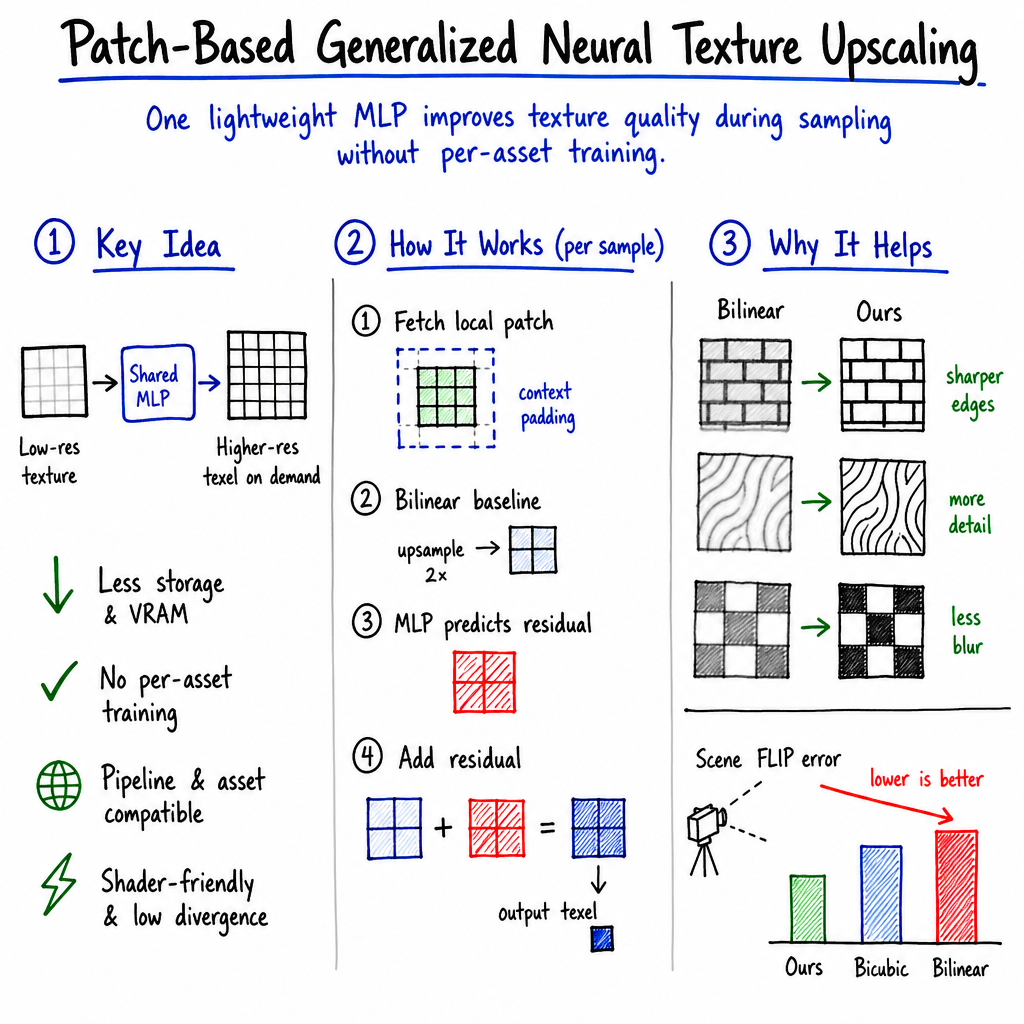
Abstract: We propose a lightweight neural texture upscaling method. A single generalized MLP is trained on a diverse collection of texture patches and integrated into the texture sampling stage, upscaling low-resolution textures on-the-fly at rendering time. Because the model is generalized rather than overfit to specific content, no per-asset training is required - the same model applies to any existing scene without modifying texture data or the asset pipeline. Storing lower-resolution base textures reduces disk footprint, upscaling at sampling time eliminates the need to store high-resolution textures in VRAM, and sharing a single set of model weights across all textures ensures non-divergent GPU execution. We evaluate our method across multiple texture classes, demonstrating consistent improvement over analytic upscaling methods in perceptual quality.
Paper Prompts
Sign up for free to create and run prompts on this paper.
Explain it Like I'm 14
1. What is this paper about?
This paper presents a way to make textures in video games and 3D graphics look sharper without storing very large texture files.
A texture is an image placed on a 3D object. For example, a game might use a texture to make a wall look like brick or metal. Higher-resolution textures usually look better, but they require more:
- Storage space on a computer or console
- Download time
- Graphics memory, called VRAM
- Processing power during rendering
The researchers use a small artificial-intelligence model called a neural network to enlarge low-resolution textures while a scene is being rendered.
Their method is called Patch-Based Generalized Neural Texture Upscaling.
2. What questions did the researchers investigate?
The researchers wanted to find out whether one small neural network could:
- Make low-resolution textures look better than ordinary methods such as bilinear or bicubic resizing.
- Work directly during rendering instead of requiring a long preparation step.
- Be used with many different textures without training a new model for every texture.
- Reduce the amount of texture data stored on disk and in graphics memory.
- Run efficiently on a GPU when many different textures are being used at once.
In simple terms, they were asking:
Can one small, reusable AI model make many different game textures look sharper, without making the game-development process much more complicated?
3. How did the method work?
Using small patches
Instead of enlarging an entire texture at once, the method looks at a tiny square section, or patch, of the texture.
For example, it examines a small 3 × 3 group of texels. A texel is like a pixel, but it belongs to a texture used on a 3D object. The model then produces a 2 × 2 group of higher-resolution texels.
This is similar to looking through a small window at a painting and deciding what extra details should be drawn inside that window.
The surrounding texels are also included so that the new details do not look like separate square blocks. The model uses this surrounding area as context, but only keeps the newly created center area.
Combining ordinary resizing with AI
The system first uses a simple resizing method called bilinear interpolation. This produces a reasonable basic enlargement, but it often looks blurry.
The neural network then predicts the missing sharp details. The final result is:
basic bilinear enlargement + AI-predicted details
This is called a residual approach. It is like asking the AI to correct a rough drawing instead of creating the entire drawing from nothing.
The neural network
The model is a small multi-layer perceptron, or MLP. This is a type of neural network made from layers of mathematical connections. It learns patterns from examples.
The researchers trained one general model using many texture types, including:
- Diffuse textures, which describe basic color
- Normal textures, which describe small surface bumps
- ARM textures, which describe properties such as shadows, roughness, and metalness
The model was trained on texture collections from several sources, including Poly Haven and scenes named Hangar, Victorian, and Museum.
Importantly, the same model was trained once and then tested on textures it had not specifically memorized.
Measuring quality
The researchers compared their method with:
- Bilinear upscaling
- Bicubic upscaling
- Lanczos upscaling
- PFT, a much larger and more advanced image-upscaling model
- NTC, another neural texture method
They used several measurements. One important measurement was LPIPS, which tries to estimate how different two images look to people. A lower LPIPS score means the result looks more like the original high-resolution image.
They also rendered complete 3D scenes to see how the method worked in realistic situations.
4. What did they discover?
The AI method usually looked sharper
The proposed method generally produced sharper textures than bilinear, bicubic, and Lanczos resizing.
Ordinary resizing methods tend to blur edges and small patterns. The neural method was better at restoring sharp-looking details, especially in:
- Brick and stone textures
- Metal surfaces
- Floor tiles
- Normal maps with sharp edges
Across the tested datasets, the method generally achieved lower LPIPS scores than the ordinary resizing methods.
It sometimes approached a much larger AI model
PFT produced very high-quality results, but it is much larger and slower. It is designed to process complete images before rendering, rather than operating during each texture lookup.
The proposed method was much smaller and faster in design. Even so, it sometimes produced results close to PFT, especially for certain normal and diffuse textures.
This is important because the researchers were trying to balance image quality with real-time speed.
It worked with one general model
The researchers found that a single model trained on diffuse, normal, and ARM textures could work reasonably well across all three categories.
A separate model trained only for one particular texture or asset sometimes performed slightly better. However, that approach requires extra training for every asset.
The general model avoids this extra work. Developers could use it with existing textures without changing the texture-making process.
It can reduce storage and VRAM use
Because the original low-resolution textures are stored instead of full-resolution versions:
- Game downloads could become smaller.
- Less disk space would be needed.
- High-resolution texture copies would not need to remain in VRAM.
The high-resolution texture is created only when the renderer needs it.
It avoids a GPU problem found in some other neural methods
Some neural texture systems use a different neural network for every texture. When a GPU processes many textures at the same time, this can cause execution divergence. That means different GPU threads must perform different instructions, which can reduce efficiency.
The proposed method uses one shared set of neural-network weights for every texture. Therefore, all GPU threads can use the same instructions more easily.
The paper argues that this could make the method more suitable for real-time rendering, although the authors did not complete a full runtime-speed study.
It cannot create truly unknown details
The method has an important limitation: it cannot reliably recover tiny details that were completely lost when the texture was reduced.
For example, if a small scratch or thread pattern disappears from the low-resolution texture, the model has no guaranteed way to know that it was there. It may produce a believable-looking detail, but it cannot perfectly restore information that no longer exists.
This is a general limitation of image upscaling.
5. Why is this research important?
The main contribution is not simply making images larger. It is designing a method that could fit into a real-time graphics system.
Compared with other approaches, this method aims to provide a useful combination of:
| Feature | Proposed method |
|---|---|
| Works during rendering | Yes |
| Requires training for every texture | No |
| Uses one model for many textures | Yes |
| Reduces the need for high-resolution VRAM textures | Yes |
| Usually sharper than ordinary resizing | Yes |
| Creates all missing original details perfectly | No |
| Fully measured for real-world frame-rate cost | Not yet |
For game developers, this could mean that existing games might use smaller texture files while still displaying sharper surfaces. It could also be added by replacing the normal texture-sampling step rather than rebuilding every texture asset.
Conclusion
This paper describes a small AI system that enlarges texture patches as they are needed during rendering. It first performs simple bilinear resizing and then uses a neural network to add sharper details.
The experiments show that the method usually looks better than traditional resizing techniques and can work with many different kinds of textures using one shared model. Its biggest advantages are easier integration, lower storage needs, lower VRAM requirements, and potentially better GPU behavior.
However, the method still has limits. It cannot perfectly recreate details that were removed from the original texture, and the paper does not yet provide a complete measurement of how much it affects game frame rates.
Overall, the research suggests that small, general-purpose neural networks could help future games and real-time 3D applications use smaller textures without sacrificing as much visual quality.
Practical Applications
Immediate Applications
- Real-time game texture upscaling (Gaming and interactive entertainment) — Integrate the generalized MLP into a game engine’s texture-sampling shader as a replacement for bilinear, bicubic, or Lanczos filtering. Existing low-resolution diffuse, normal, and ARM textures can be rendered at approximately twice their source resolution without retraining each asset or changing the asset pipeline. Potential product/workflow: an engine-level “neural texture sampler” or GPU driver feature enabled through a rendering-quality setting. Dependencies and assumptions: the target GPU must execute the MLP efficiently at texture-sampling time; the shader must support the required random-access patch fetches; frame-time overhead must be validated, since the paper does not provide a complete runtime performance study.
- Reducing game download and installation sizes (Gaming, digital distribution, cloud gaming) — Ship lower-resolution base textures and reconstruct higher-resolution samples at runtime. This can reduce packaged asset size and potentially shorten downloads, particularly for texture-heavy games. Potential product/workflow: an asset packaging mode that stores neural-upscalable textures at reduced resolution while retaining a shared model in the engine or game binary. Dependencies and assumptions: storage savings depend on the chosen downsampling ratio, texture compression format, and model size. The method cannot reconstruct detail that was removed from the source texture, so visually important assets may still require native high-resolution versions.
- Lowering VRAM requirements for texture-heavy applications (Gaming, visualization, CAD, digital twins) — Keep low-resolution textures in VRAM and generate higher-resolution texels on demand, avoiding storage of full-resolution texture copies. Potential product/workflow: a memory-saving rendering mode for entry-level GPUs, laptops, handheld consoles, and integrated graphics systems. Dependencies and assumptions: reduced texture memory may be offset by neural inference cost and additional texture fetches. The benefit is strongest when VRAM is the bottleneck rather than shader throughput.
- Drop-in quality improvement for existing scenes and assets (Game engines and graphics middleware) — Because the model is generalized and does not require per-asset optimization, developers can apply it to already-authored scenes by replacing the sampler rather than regenerating textures. This is particularly useful for remasters, backward-compatible releases, and large legacy asset libraries. Potential product/workflow: an engine plugin or renderer backend supporting a global neural-sampling switch. Dependencies and assumptions: texture coordinate conventions, mipmapping, border handling, color spaces, and PBR channel semantics must be implemented consistently. The paper evaluates RGB patches but does not fully specify production handling for all texture formats.
- Sharper reconstruction of PBR texture classes (Materials, games, virtual production) — Use the model for diffuse, normal, and ARM textures, where experiments show lower LPIPS values and sharper perceptual results than analytic interpolation across multiple datasets. Normal maps and material masks with sharp edges are especially plausible beneficiaries. Potential product/workflow: automatic neural filtering for material libraries and runtime material streaming. Dependencies and assumptions: a single unified model offers balanced performance but is not optimal for every texture class; class-specific models may improve quality at the cost of additional model management.
- Selective neural upscaling based on rendering importance (Real-time rendering optimization) — Apply the MLP only to close-up, glossy, or high-visibility surfaces, while using ordinary low-resolution sampling for distant surfaces or indirect diffuse reflections. The paper explicitly suggests omitting MLP execution where high quality is unnecessary. Potential product/workflow: a material- or shader-level quality policy driven by screen-space size, roughness, viewing distance, or ray type. Dependencies and assumptions: the renderer must expose sampling context and correctly avoid visible transitions between neural and conventional filtering.
- Runtime material previews and asset browsers (Digital content creation and 3D production) — Use the lightweight sampler to improve the appearance of materials in viewport previews without generating permanent high-resolution texture derivatives. This could reduce preview memory usage in tools for modeling, level design, and virtual production. Dependencies and assumptions: interactive latency must remain acceptable, and viewport renderers must support the required GPU shader path.
- Research and teaching infrastructure for neural rendering (Academia) — The patch-based formulation provides a relatively compact experimental platform for studying local neural filters, residual learning, PBR texture reconstruction, and GPU-executable MLPs. Researchers can reproduce comparisons against bilinear, bicubic, Lanczos, and offline super-resolution methods using LPIPS, PSNR, SSIM, and rendered-image metrics such as FLIP. Dependencies and assumptions: the reported datasets and implementation details must be made available, and further benchmarking is needed across GPUs, texture formats, scenes, and camera distances.
- Practical perceptual-quality evaluation of texture filters (Graphics research and production QA) — Adopt LPIPS and rendered-image comparisons, rather than relying exclusively on PSNR or SSIM, when evaluating texture upscaling. The paper shows that pixelwise metrics can favor blurry results even when sharper reconstructions are judged better visually. Potential product/workflow: automated visual-regression tests comparing neural and analytic texture pipelines under representative lighting and camera configurations. Dependencies and assumptions: perceptual metrics should be combined with human review and task-specific measures, especially for normal and ARM maps where image-space similarity may not fully reflect material correctness.
- Low-resolution texture deployment for interactive visualization (Architecture, engineering, cultural heritage, training simulators) — Large environments such as museums, industrial facilities, and architectural models can use the method to reduce texture downloads and memory pressure while retaining sharper close-range surfaces. Dependencies and assumptions: the training distribution must represent the target material domain; unusual surfaces or textures with strong stochastic detail may generalize less reliably.
Long-Term Applications
- Hardware- and driver-level neural texture filtering (GPU architecture and graphics APIs) — The shared-weight, non-divergent design is compatible in principle with matrix-core-oriented GPU execution. A graphics API or GPU driver could expose neural texture upscaling as a standardized sampling mode, potentially accelerating the MLP through cooperative matrix or tensor operations. Dependencies and assumptions: the paper does not yet measure throughput, occupancy, cache behavior, or energy cost. Hardware support would require optimized kernels, stable model formats, and predictable behavior across vendors.
- Integrated neural mipmapping and anisotropic filtering (Rendering systems) — Extend the method beyond a simple two-times local upscaling step to jointly handle mip selection, anisotropic footprints, texture filtering, and level-of-detail transitions. This could improve quality for oblique surfaces and reduce aliasing in motion. Dependencies and assumptions: the current method uses small local patches and does not present a complete mipmap or anisotropic-filtering design. Larger footprints may increase fetch and inference cost.
- Higher upscale ratios and multi-stage neural reconstruction (Games, simulation, visualization) — Build cascaded models for , , or adaptive resolution increases, allowing a very small base texture to support high-resolution displays or immersive headsets. Dependencies and assumptions: repeated upscaling can amplify hallucinated or incorrect detail. New training data, anti-aliasing strategies, and perceptual evaluation at different viewing distances would be required.
- Hybrid generalized-plus-personalized texture models (Commercial game development and asset pipelines) — Use the generalized MLP by default, then optionally apply lightweight per-asset adaptation for hero assets or difficult materials. The paper reports consistent, though generally modest, gains from overfitting. Potential product/workflow: a two-tier pipeline in which ordinary assets use the shared model and selected assets receive small adapter weights or residual corrections. Dependencies and assumptions: adaptation must remain sufficiently small to preserve the storage and execution advantages of shared weights. It also reintroduces training, validation, and asset-versioning overhead.
- Texture-class-aware or material-aware neural samplers (PBR authoring and rendering) — Develop specialized models or conditional inputs for diffuse, normal, roughness, metallic, and ambient-occlusion channels. A model could select different priors based on texture class while retaining a common deployment interface. Dependencies and assumptions: separate models may increase memory use and can reintroduce execution divergence; conditioning must improve quality enough to justify the additional complexity.
- Compressed texture formats combining neural priors with hardware block compression (Texture codecs and storage systems) — Combine the generalized reconstruction prior with BC/ASTC-style representations or other block-compressed bases. The neural model could reconstruct detail while hardware decoders handle the low-level compressed representation. Dependencies and assumptions: the approach must preserve random access, mipmapping, platform compatibility, and acceptable error behavior. It may inherit quality limitations from block compression while adding shader cost.
- Adaptive sampling for ray tracing and path tracing (Ray-traced games, film previews, scientific rendering) — Use neural upscaling selectively for primary visibility, glossy reflections, or rays whose material textures are perceptually important, while bypassing it for low-contribution rays. The reported improvements in glossy reflections suggest potential value in high-frequency material appearance. Dependencies and assumptions: ray-type-dependent quality must be studied carefully; inconsistent reconstruction across neighboring samples could introduce temporal instability or noise.
- Cloud and remote rendering optimization (Cloud gaming and streamed visualization) — Store or transmit lower-resolution textures and perform neural reconstruction at the client or rendering server. This could reduce asset bandwidth and improve scalability when many users access the same scenes. Dependencies and assumptions: the shared model must be distributed or hardware-accelerated at the endpoint. Bandwidth savings must outweigh model distribution, inference cost, and possible latency.
- Energy-efficient rendering on mobile, embedded, and XR devices (Mobile GPUs, AR/VR, robotics visualization) — Lower VRAM traffic and texture bandwidth could reduce power consumption, while neural reconstruction maintains apparent material detail. Dependencies and assumptions: neural inference may consume more energy than conventional filtering on some devices. Device-specific profiling, quantization, and reduced-width models are necessary before claiming an energy benefit.
- Neural texture sampling for robotics and simulation (Robotics, autonomous systems, synthetic data) — Use compact texture assets in simulators and synthetic-data generation pipelines where many environments must be streamed or rendered under memory constraints. Higher-quality reconstructed materials could improve visual realism for perception-system training. Dependencies and assumptions: this is not a direct improvement to sensor realism; any reconstructed details must be validated to avoid introducing visual artifacts or biases into learned perception models.
- Large-scale digital-twin and metaverse asset streaming (Industrial visualization, virtual worlds, education) — A shared neural sampler could support large environments with reduced storage and streaming requirements, including architectural walkthroughs, museums, factories, and virtual campuses. Dependencies and assumptions: deployment requires robust generalization beyond the paper’s texture datasets, deterministic output across platforms, and safeguards against temporal or view-dependent artifacts.
- Standardized benchmarks and production tooling for neural texture filters (Academia, standards bodies, graphics vendors) — Establish benchmarks that jointly report perceptual texture quality, rendered-scene quality, VRAM use, disk savings, shader occupancy, frame-time impact, divergence, and energy consumption. Dependencies and assumptions: current evidence is strongest for perceptual quality relative to analytic upsampling; practical adoption depends on the unresolved runtime-performance and scalability measurements identified by the authors.
Glossary
- Ablation study: An experiment that systematically removes or varies components or parameters to measure their individual effects. “We also studied the effect of other parameters, which are summarized in Table~\ref{tab:ablation}.”
- Analytic upscaling: Image enlargement performed using mathematically defined interpolation or reconstruction filters rather than learned models. “We used three major analytic methods (bilinear, bicubic, Lanczos) and PFT”
- ARM texture: A physically based rendering texture grouping ambient occlusion, roughness, and metallic channels. “diffuse, normal, and ARM textures”
- Block compression: Texture compression that encodes data in fixed-size blocks to support efficient hardware decoding and random access. “Block compression (BC) formats come in a wide variety depending on the number of channels and quality”
- Convolutional neural network (CNN): A neural network architecture that uses convolutional filters to process spatially structured data such as images. “The trend has shifted from CNN-based upscaling methods such as SRCNN”
- Cosine annealing: A learning-rate scheduling strategy that gradually changes the learning rate according to a cosine-shaped curve. “Optionally, a cosine annealing scheduler is applied to decay the learning rate to over the course of training.”
- Divergence: A GPU execution condition in which threads within the same execution group follow different control-flow paths or use incompatible computation patterns. “concurrent sampling of multiple texture sets within a single GPU wavefront causes execution divergence”
- End-to-end training: Training a complete model directly from inputs to desired outputs using a single optimization process. “The model is trained end-to-end using the [PERSON_NAME] optimizer with a learning rate of .”
- FLIP: A perceptual image-difference metric designed to estimate visible errors between rendered or reference images. “FLIP scores are $0.052$ and $0.057$.”
- Generalization: The ability of a trained model to perform well on previously unseen data or content. “The results we have seen are obtained using generalized models: a single model is trained and applied to different test textures.”
- GPU shader: A program executed on a graphics processing unit to perform rendering or computational operations. “the model to be executed directly as a GPU shader”
- Hidden dimension: The number of feature values or neurons in an intermediate layer of a neural network. “The model configuration we used for the experiments other than ablation studies is hidden dimension”
- Implicit neural representation (INR): A neural network that represents a signal by mapping coordinates or encoded inputs to values of that signal. “Implicit neural representations (INRs) are increasingly being used as tools to map coordinates to signals”
- Inference: The process of applying a trained model to input data to produce predictions or outputs. “This makes it difficult to execute NTC efficiently on the GPU when there are divergences in the execution”
- L1 loss: A training objective based on the absolute difference between predicted and target values. “We use an L1 loss between the predicted and ground-truth high-resolution patches”
- Lanczos interpolation: A windowed-sinc resampling method used to reconstruct or resize sampled image data. “Bilinear, bicubic, and Lanczos are the popular choices for the interpolation.”
- Latent grid: A grid of learned, compressed feature values used to reconstruct a texture or signal. “The result from NTC () is the equal-size comparison using a latent grid.”
- LPIPS: Learned Perceptual Image Patch Similarity, a metric that estimates perceptual distance between images using deep neural features. “Therefore, we use LPIPS as the main metric for further discussion in this paper.”
- Matrix cores: Specialized GPU hardware units optimized for parallel matrix operations, commonly used to accelerate neural-network computation. “unfavorable for the matrix cores that are the key to GPU inference performance”
- Mipmapping: A texture-filtering technique that stores or selects progressively lower-resolution versions of a texture for efficient rendering. “-mipmap, should be applicable”
- Multi-Layer Perceptron (MLP): A feed-forward neural network composed of fully connected layers and nonlinear activation functions. “We train a single generalized Multi-Layer Perceptron (MLP) on a diverse collection of texture patches”
- Neural Texture Block Compression (NTBC): A method that uses a neural network to generate textures in standard hardware block-compression formats. “Neural Texture Block Compression (NTBC) combines neural network-based encoding with standard GPU-hardware block-compression formats”
- Neural Texture Compression (NTC): A texture-compression method that represents a texture set with a compact neural network decoded during texture sampling. “Neural Texture Compression (NTC) takes a fundamentally different approach by representing each texture set as a compact neural network decoded on-the-fly at texture sampling time.”
- Non-divergent execution: GPU execution in which threads follow a uniform computational path without branching or model-dependent behavior. “GPU execution remains non-divergent regardless of how many texture sets are active simultaneously.”
- Overfitting: Training a model so closely on particular data that it specializes in that data rather than generalizing broadly. “Under some situations, we may want to overfit a model to the texture set as NTC does.”
- Patch-based execution: Processing a small spatial region of a texture rather than the entire texture at once. “This patch-based execution is what makes our method easier to deploy.”
- Perceptual metric: An evaluation measure intended to correspond to human visual judgments rather than solely to numerical pixel differences. “To prove it, we confirmed that the LPIPS perceptual metric follows naturally with our visual evaluation”
- Physically based rendering (PBR): A rendering approach that models material appearance using parameters intended to approximate real physical light behavior. “particularly when compressing correlated texture sets used in physically based rendering (PBR)”
- Positional Encoding Projected Sampling (PEPS): An encoding method that projects positional-encoding components into sampled points or features for neural signal representation. “we compressed a single diffuse texture from the [ADDRESS] test set using Positional Encoding Projected Sampling (PEPS) with four frequencies”
- PSNR: Peak signal-to-noise ratio, a pixel-based measure of reconstruction fidelity commonly expressed in decibels. “Although there are no huge differences in PSNR or SSIM”
- Random access: The ability to retrieve individual data elements without processing the entire data structure sequentially. “they are not designed to run at rendering time because of the computational cost and missing capability of random access”
- Residual block: A neural-network module that adds a block’s transformed output to its input, typically through a skip connection. “Each residual block applies two linear layers with a [ADDRESS] activation between them”
- Residual connection: A shortcut connection that adds a layer’s or block’s input directly to its output. “The model then predicts the residual using an MLP, and the final output is the sum of the bilinear-upscaled texels and the residual.”
- SIMT execution: Single-Instruction, Multiple-Threads execution, a GPU model in which groups of threads execute the same instruction sequence on different data. “which is a different programming pattern from SIMT execution”
- SSIM: Structural Similarity Index Measure, an image-quality metric that compares luminance, contrast, and structural information between images. “Although there are no huge differences in PSNR or SSIM”
- Super-resolution: The reconstruction of a higher-resolution image or texture from lower-resolution input. “These methods are general-purpose image upscalers that learn the image characteristics to reconstruct missing finer details.”
- SVBRDF: Spatially varying bidirectional reflectance distribution function, a material representation describing how surface reflectance varies across position, viewing direction, and lighting direction. “to super-resolve SVBRDF maps by optimizing a local MLP filter per material”
- Texel: A texture element, analogous to a pixel but associated with a texture map. “Given a low-resolution input patch of texels”
- Texture sampling: The process of retrieving texture values during rendering using texture coordinates. “the model is integrated into the texture sampling stage”
- Transformer: A neural-network architecture based primarily on attention mechanisms for modeling relationships among input elements. “to transformer-based upscaling methods such as SwinIR”
- Upsampling: Increasing the spatial resolution of sampled image or texture data. “They are also called resampling or upsampling.”
- Wavefront: A GPU execution group whose threads are scheduled together and generally execute in lockstep. “concurrent sampling of multiple texture sets within a single GPU wavefront causes execution divergence”