On Khovanov local equivalence groups
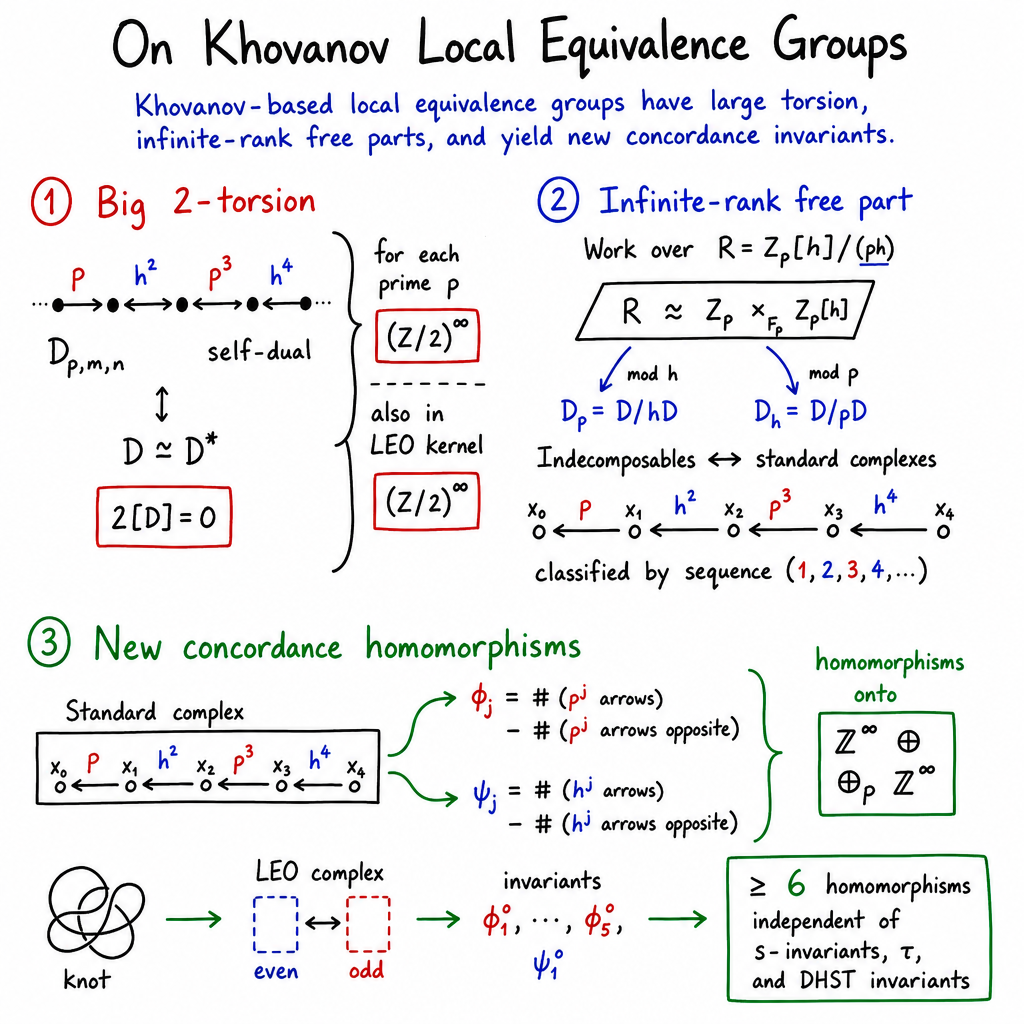
Abstract: Inspired by work in Seiberg--Witten and Heegaard Floer homology, Dunfield, Schütz, and the author constructed an abelian "local equivalence group" built from pairs of chain complexes, and a homomorphism from the smooth concordance group to this group that uses the odd Khovanov complex and the Bar-Natan deformation of the even Khovanov complex. Lewark independently gave a related local equivalence group and concordance invariant, using only the Bar-Natan deformation. In this paper, we construct subgroups of Lewark's local equivalence group and the kernel of the map from our local equivalence group to Lewark's, as well as direct summands of Lewark's group and this kernel, invisible to the -invariants. The construction gives at least six -valued concordance homomorphisms linearly independent from , , and Dai--Hom--Stoffregen--Truong's invariants.
Paper Prompts
Sign up for free to create and run prompts on this paper.
Explain it Like I'm 14
1. What is the paper about?
This paper studies mathematical objects built from Khovanov homology, a tool that helps mathematicians understand knots.
A knot is like a loop of string that may be tangled. Two knots are considered closely related if one can be changed into the other by moving the string through space without cutting it. The paper focuses on an even finer question:
How can we tell whether a knot is genuinely complicated, rather than just a simple loop?
The author studies special groups called local equivalence groups. These groups organize information about knots and help compare different knots.
2. Main questions and goals
The paper asks what the internal structure of these local equivalence groups looks like. In particular, it investigates:
- Do these groups contain elements that behave like objects of order 2?
- Are there infinitely many independent examples?
- Can these groups detect information that older knot measurements, such as Rasmussen’s -invariant, cannot detect?
- Can the groups produce new measurements of knots that are independent of well-known invariants such as and ?
One way to think about this is to imagine that every knot is given a complicated “code.” The paper asks whether there are many different codes that look identical to simpler tests but can still be told apart by more powerful tests.
3. How the research was carried out
Building algebraic models of knots
The author replaces each knot with a mathematical structure called a chain complex. A chain complex is a collection of boxes containing algebraic information, connected by arrows. The arrows describe how information in one box changes into information in another.
This is similar to a map in a board game: each position has possible moves to other positions. Studying all the moves reveals important properties of the original object.
For knots, these chain complexes come from versions of Khovanov homology, including:
- odd Khovanov homology,
- even Khovanov homology,
- the Bar–Natan deformation.
Comparing complexes locally
Two complexes are considered locally equivalent if they contain the same essential information after ignoring parts that become unimportant in a certain simplified setting.
The paper then puts locally equivalent complexes into groups. The group operation is based on combining two complexes using a mathematical product called a tensor product. Informally, this is like combining two codes into one larger code.
Each complex also has a dual, which acts like its inverse in the group. Combining a complex with its dual gives something equivalent to the simplest possible object.
Using different number systems
The author studies these complexes over several kinds of number systems, including:
- ordinary integers,
- -adic integers, which focus on divisibility by a particular prime ,
- systems where certain products, such as , are declared to be zero.
Using -adic integers is somewhat like using a special microscope that focuses only on powers of one prime number. This allows the author to detect patterns that ordinary calculations might miss.
Constructing examples and invariants
The paper creates explicit examples of chain complexes, including five-generator examples called . The author checks that these examples:
- really represent valid knot-like complexes,
- are not equivalent to the simplest complex,
- sometimes become trivial when combined with themselves.
The paper also defines new tests, called invariants, to distinguish complexes. An invariant is a feature that stays the same under the allowed equivalence rules—similar to how the number of holes in a shape stays the same even if the shape is stretched.
Some arguments use algebraic calculations, while others classify the possible forms of the complexes. The paper also discusses computer searches and notes that artificial-intelligence systems helped with parts of the research and checking.
4. Main findings
Infinitely many independent elements of order 2
The paper proves that Lewark’s local equivalence group contains elements of order 2.
An element has order 2 if combining it with itself gives the identity:
The author proves something much stronger: for every prime number , there are infinitely many independent order-2 elements. Together, these form a group resembling
This means there are infinitely many separate “yes-or-no” pieces of information, each of which cannot be produced from the others.
More order-2 elements hidden from the usual group
The paper also finds infinitely many order-2 elements in the kernel of a map from one local equivalence group to another.
A kernel consists of elements that become invisible when passed through a particular map. In everyday language, these are examples that one system cannot see, even though a larger system can detect them.
This shows that the more detailed local equivalence group contains information that disappears when we simplify it.
Infinite-rank information missed by -invariants
The paper proves that, for every prime , the local equivalence group contains a subgroup resembling
This means it has infinitely many independent integer-valued directions.
Importantly, these directions lie in the kernel of all the usual -invariants. Therefore, all of the -invariants may give the same answer for two objects, while the new information in the paper can still distinguish them.
This is one of the paper’s most important conclusions:
The -invariants do not capture all of the information contained in Khovanov-type local equivalence groups.
At least six new knot measurements
The paper obtains at least six homomorphisms from the smooth knot concordance group that are linearly independent of:
- Rasmussen’s -invariants,
- the knot invariant ,
- the invariants developed by Dai, Hom, Stoffregen, and Truong.
A homomorphism here is a measurement that respects the way knots are combined. Saying that these measurements are linearly independent means that none of them can be recreated by simply adding or subtracting the others.
A useful classification result
For certain -adic versions of the theory, the author proves that the local equivalence group is totally ordered. This means that any two elements can be compared: one is always at least as large as the other according to the mathematical ordering.
The paper also shows that many complexes can be reduced to a unique essential piece. This makes the complicated objects easier to classify and compare.
5. Why the results matter
Knot theory has many different tools for measuring how complicated a knot is. The well-known -invariant is useful, but it cannot detect everything.
This paper shows that local equivalence groups contain a much larger amount of information. In particular:
- infinitely many different knot features are invisible to standard -invariants;
- new measurements can distinguish knots that older measurements treat as identical;
- the structure of the groups is richer than previously known;
- the methods may help prove that certain knots are not smoothly slice.
A knot is called slice if it can be regarded as the boundary of a smooth disk in four-dimensional space. Determining whether knots are slice is a major problem, and stronger invariants can provide new evidence that a knot is not slice.
Overall, the paper expands the mathematical “toolbox” for studying knots. It shows that Khovanov-based methods contain many layers of information—some simple and visible, and others hidden until more advanced algebraic tests are used.
Practical Applications
Immediate Applications
- Computational concordance testing in knot theory and topology — The explicit complexes , the associated local-equivalence invariants, and the maps to provide a practical framework for testing whether a knot is slice or whether two knots are concordant.
- Workflow: compute the reduced Bar–Natan complex of a knot, reduce or base-change it over suitable rings such as or , then compare its local-equivalence class using the paper’s invariants.
- Sector: computational topology and mathematical software.
- Dependencies: implementations must correctly construct chain complexes, preserve gradings, perform tensor products, and calculate local maps. The method provides obstructions, not a complete decision procedure for sliceness.
- Detection of concordance information invisible to Rasmussen’s -invariant — The paper proves that the local-equivalence groups contain infinite-rank summands in the kernels of all -invariants. This supports concrete analyses of knots with identical -invariants but different concordance behavior.
- Potential tool: a knot-invariant dashboard reporting , , Dai–Hom–Stoffregen–Truong invariants, and the new local-equivalence homomorphisms simultaneously.
- Sector: knot tables, concordance databases, and computational research.
- Dependencies: the new homomorphisms must be implemented for sufficiently broad classes of knots; computational complexity may grow rapidly with diagram size.
- Prime-sensitive torsion classification — The construction of independent subgroups indexed by primes gives a practical way to distinguish local-equivalence classes through -adic base change.
- Use case: when ordinary integral or mod-2 calculations fail to distinguish complexes, researchers can localize at a selected prime and use -adic valuation-type invariants such as .
- Sector: algebraic topology and symbolic algebra.
- Dependencies: the complexes must be representable over the relevant -adic rings, and the valuation calculations must be performed with sufficient precision.
- Automated search for new torsion examples — The explicit small-rank complexes and the self-duality criterion give a search strategy for computer-assisted discovery of torsion in local-equivalence groups.
- Workflow: enumerate graded differentials satisfying , impose knot-like and self-duality conditions, and test nontriviality with , -adic valuations, and reductions modulo powers of .
- Sector: computer algebra and AI-assisted mathematical experimentation.
- Dependencies: exhaustive searches may be expensive; candidate examples require independent mathematical verification, particularly because the paper itself notes the use of computer-generated constructions.
- Refined invariants for knot and concordance databases — Existing knot databases can be extended with local-equivalence data, including torsion coordinates and the new integer-valued homomorphisms. This can reveal families of knots indistinguishable by , , or standard polynomial invariants.
- Sector: academic data infrastructure and topology software.
- Dependencies: normalization conventions for gradings, coefficient rings, orientations, and reduced versus unreduced complexes must be standardized.
- Reusable algebraic framework for filtered or deformed chain complexes — The definitions of knot-like complexes, local maps, tensor products, duals, and base-change homomorphisms can be used as a general computational pattern for other homological invariants.
- Potential product: a software library for local equivalence of graded chain complexes over polynomial, localized, and -adic coefficient rings.
- Sector: software for homological algebra.
- Dependencies: the current results are specific to the stated rings and knot-like hypotheses; generalization requires proving that the relevant local-equivalence constructions retain group and order structures.
- Pedagogical tools for advanced algebraic topology — The explicit five-generator and nine-generator complexes provide compact examples for teaching local equivalence, chain homotopy, duality, torsion, -adic methods, and base change.
- Sector: graduate education and research training.
- Dependencies: the examples require substantial background in Khovanov homology, chain complexes, and concordance theory.
Long-Term Applications
- A stronger computational obstruction theory for smooth sliceness — The paper’s new homomorphisms from the smooth concordance group could become part of a scalable obstruction package capable of proving nonsliceness for knots that evade , , and existing Floer-theoretic tests.
- Potential workflow: combine Khovanov complexes with local-equivalence reduction, prime-specific torsion tests, and the new -valued coordinates.
- Sector: low-dimensional topology and automated theorem proving.
- Dependencies: explicit algorithms for all new homomorphisms, complexity bounds, and systematic validation on large knot families are still needed.
- Classification and structural theory of local-equivalence groups — The existence of subgroups, direct summands, and total orders after base change suggests a program to determine more of the algebraic structure of and the LEO group.
- Potential outcome: classification theorems, canonical normal forms, and decision procedures for equivalence classes of knot-like complexes.
- Dependencies: the paper leaves much of the global structure unknown; surjective maps and detected summands do not by themselves establish a full decomposition.
- Canonical normal-form algorithms over -adic and fiber-product rings — The indecomposable decomposition and the result that locally equivalent indecomposable complexes are isomorphic over and could support canonical representatives for local-equivalence classes.
- Potential tool: a normal-form engine reducing a complex to its unique indecomposable representative and extracting ordered coordinates.
- Sector: computational algebra and formal verification.
- Dependencies: effective algorithms for decomposition, chain-map normalization, -adic convergence, and handling large matrices must be developed.
- Transfer of methods to other homology theories — The paper adapts ideas from Seiberg–Witten and Heegaard Floer homology, particularly the use of local equivalence, canonical representatives, and ordered groups. Similar constructions may apply to other deformed or filtered homology theories.
- Potential sectors: Heegaard Floer variants, monopole Floer homology, equivariant homology, and categorified representation theory.
- Dependencies: each theory must provide a suitable tensor product, duality, deformation parameter, and notion of localization that yields a meaningful local-equivalence relation.
- New invariants for concordance and cobordism problems — The independent homomorphisms may eventually yield quantitative lower bounds for cobordism complexity, genus, or filtration phenomena, especially when combined with existing concordance invariants.
- Sector: 4-manifold topology and geometric topology.
- Dependencies: the paper establishes independence and nontriviality but does not by itself prove new genus or cobordism bounds; such applications require additional geometric interpretations of the homomorphisms.
- Policy and institutional support for reproducible AI-assisted mathematics — The paper’s methodology, which combines AI-generated constructions and proofs with human checking, could motivate reproducible standards for computational mathematics: release of code, machine-verifiable chain-complex certificates, proof logs, and independent verification of conjectured examples.
- Sector: academic publishing and research integrity.
- Dependencies: AI-generated arguments may contain subtle errors, and computational claims such as indecomposability or require independently checkable certificates.
- Broader mathematical databases and machine-learning systems for conjecture generation — The explicit parametrized families , base-change behavior, and invariant calculations provide structured training data for systems that search for algebraic patterns or conjecture new relations in concordance groups.
- Sector: mathematical AI and symbolic computation.
- Dependencies: generated patterns must be distinguished from proven results; sufficient labeled data and formal verification pipelines are essential.
- No direct applications to healthcare, finance, energy, robotics, or daily consumer life are supported by the paper — The results are foundational and specific to algebraic topology, knot theory, and computational homological algebra. Any translation to those sectors would be speculative rather than a practical consequence of the findings.
Glossary
- Abelian concordance group: A group whose elements are concordance classes of knots, with connected sum as the group operation. “a homomorphism from the concordance group to”
- Acyclic complex: A chain complex whose homology is trivial. “the others of which become acyclic after inverting .”
- Bar-Natan deformation: A deformation of the Khovanov chain complex obtained by introducing an additional formal variable. “the Bar-Natan deformation of the even Khovanov complex”
- Base change: The process of extending scalars along a homomorphism between coefficient rings. “The base-change homomorphisms in Point~\ref{item:base-change} send to ”
- Bigrading: A grading indexed by two integers, here homological and quantum grading. “We typically suppress the bigradings from the notation”
- Chain homotopy equivalence: A pair of chain maps that are inverses up to chain homotopy. “is a chain homotopy equivalence.”
- Chain-like complex: A graded algebraic object equipped with modules and differentials satisfying the chain-complex relations. “A knot-like complex over is a finitely generated cochain complex”
- Cochain complex: A sequence of modules connected by degree-increasing maps whose consecutive compositions vanish. “a finitely generated cochain complex of free graded -modules”
- Connected complex: A canonical or structurally distinguished representative of a local-equivalence class of complexes. “the existence of the connected complex in involutive Heegaard Floer homology”
- Concordance invariant: A quantity that is unchanged under smooth knot concordance. “The Rasmussen -invariant $s_{\mathbb{F}$ over any field is a function on these local equivalence groups”
- Contractible complex: A chain complex chain-homotopy equivalent to the zero complex. “one can cancel the contractible subcomplex spanned by and ”
- Direct summand: A subgroup or module that appears as one component of a direct-sum decomposition. “the group admits a direct summand in the kernel”
- DVR: A discrete valuation ring, namely a principal ideal domain with a unique nonzero maximal ideal. “which is again a fiber product of two DVRs.”
- Euler characteristic: The alternating sum of the ranks or dimensions of the graded pieces of a chain complex. “the Euler characteristic of is $1$.”
- Fiber product: A ring formed from two rings equipped with compatible maps to a common quotient. “which is again a fiber product of two DVRs.”
- Free graded module: A module with a basis compatible with a grading. “ is a finitely generated, free chain complex over ”
- Hensel’s lemma: A lifting principle that constructs solutions over complete local rings from approximate solutions modulo powers of the maximal ideal. “We use completeness of and a Hensel's Lemma-style lifting argument”
- Homological grading: The grading that records a chain complex’s chain degree. “where has grading ”
- Homomorphism: A structure-preserving map between algebraic groups or modules. “there is a surjective homomorphism”
- Indecomposable complex: A complex that cannot be expressed as a nontrivial direct sum of complexes. “Here, by indecomposable we mean that no splits further as a direct sum.”
- Inverting an element: Forming a localization in which a specified element becomes multiplicatively invertible. “Write for the result of inverting .”
- Knot-like complex: A finitely generated free graded complex whose localization has the homology of the coefficient ring in a specified grading. “A knot-like complex over is a finitely generated cochain complex”
- Local equivalence: An equivalence relation defined using maps that become homotopy equivalences after localization. “We say that and are locally equivalent if and .”
- Local equivalence group: An abelian group of local-equivalence classes of knot-like complexes under tensor product. “Lewark constructed a local equivalence group ”
- Local map: A chain map that induces a chain homotopy equivalence after a specified localization. “a chain map over is a local map”
- Maximal ideal: The unique largest proper ideal in a local ring. “with maximal ideal .”
- Minimal complex: A complex whose differential has image contained in the maximal-ideal multiple of the complex. “Call a complex minimal if .”
- Monoid: An algebraic structure with an associative binary operation and identity, but not necessarily inverses. “tensor product makes into a partially ordered abelian monoid”
- Partial order: A relation that is reflexive, antisymmetric, and transitive. “The partial order on is a total order.”
- P-adic integers: The completion of the integers with respect to powers of a prime . “ (where is the -adic integers)”
- Quantum grading: A grading associated with the polynomial variable and preserved or shifted by differentials in a graded complex. “We will typically call the grading on the quantum grading.”
- Reduced Bar-Natan complex: A reduced chain complex associated with a knot in Bar-Natan’s deformation of Khovanov homology. “the reduced Bar-Natan complex of a knot”
- Self-dual complex: A complex isomorphic, or suitably equivalent, to its dual. “The complex is self-dual”
- Seiberg–Witten homology: A gauge-theoretic homology theory arising from solutions to the Seiberg–Witten equations on manifolds. “Inspired by work in Seiberg--Witten and Heegaard Floer homology”
- Split injection: An injective map admitting a left inverse. “ is a split injection”
- Tensor product: An algebraic construction combining two modules or complexes over a common ring. “Let denote the tensor product of and over .”
- Torsion element: An element of a group that becomes zero after multiplication by a positive integer. “There is $2$-torsion in .”
- Total order: A partial order in which every pair of elements is comparable. “This local equivalence group is totally ordered”
- Valuation: A function measuring divisibility by a prime or other distinguished element. “let be the largest ”
- Vector representation: A matrix or coordinate description of a graded complex relative to chosen bases. “with respect to the vector representation~\eqref{eq:vector-rep}”
- Yoneda-style lifting: A construction that extends approximate algebraic data to a complete or larger algebraic setting. “a Hensel's Lemma-style lifting argument”

