The Free Scalar as a Thermal Envelope for Three-Dimensional CFTs
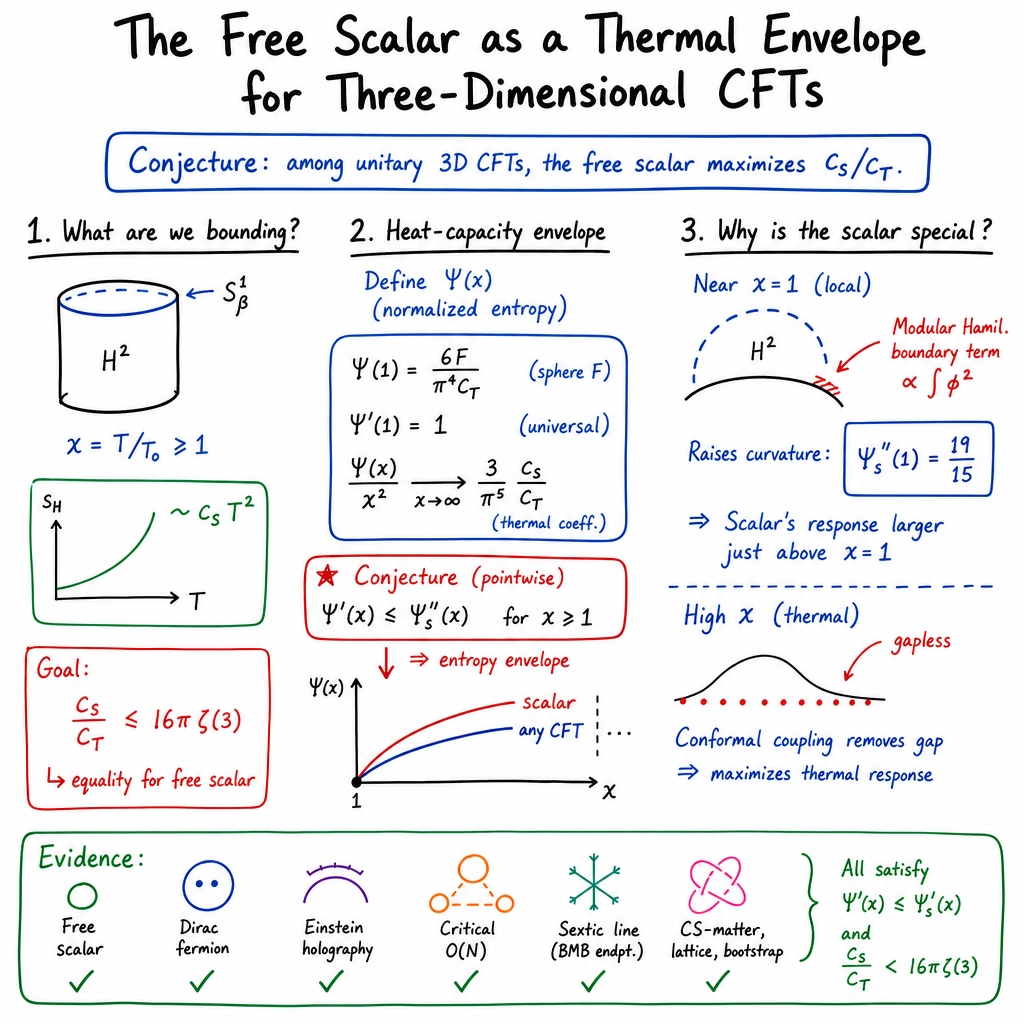
Abstract: We conjecture that every unitary three-dimensional conformal field theory obeys , where is the thermal entropy density and the stress-tensor two-point coefficient, with equality for free scalars. We embed this in a stronger conjecture: on , the -normalized hyperbolic heat capacity is bounded above by that of the free scalar for all . Near the conformal temperature, for theories smooth from the high-temperature side and without boundary terms in the modular Hamiltonian, the heat-capacity bound follows from conformal-collider positivity. We test the conjectures in free, interacting large-, and holographic theories. Monte Carlo data for the three-dimensional Ising and models also obey the flat-space bound.
Paper Prompts
Sign up for free to create and run prompts on this paper.
Explain it Like I'm 14
1. What is this paper about?
This paper asks a big question:
Is there a limit to how much thermal “stuff” a three-dimensional conformal field theory can contain?
A conformal field theory, or CFT, is a theory whose rules look the same at every scale. These theories are useful for describing systems near critical points, such as magnets changing phase.
The authors focus on two numbers:
- : a measure of how much entropy the theory has when it is hot.
- : a measure of how strongly the theory’s stress-energy behaves, somewhat like a measure of its number of basic degrees of freedom.
They propose that the ratio of these two numbers can never be larger than it is for a single free scalar field:
In simple language, the paper suggests that:
Among all unitary three-dimensional CFTs, the free scalar field is the most thermally efficient theory when compared with its stress-energy strength.
The authors also propose a stronger version of this idea involving the theory’s heat capacity on a curved space called hyperbolic space.
2. What questions are the researchers asking?
The paper mainly investigates four questions:
- Does the free scalar give the largest possible value of ?
- Can this possible bound be strengthened into a bound on heat capacity at every temperature?
- Why might the free scalar be special?
- Do different examples—free theories, interacting theories, holographic theories, and computer simulations—support the proposed bounds?
The stronger proposed statement is that, after normalizing by , the free scalar has the largest hyperbolic-space heat capacity for temperatures at or above a special temperature .
The authors write this idea using a function , where
The conjecture is
where the subscript means “free scalar.”
You can think of this as saying:
If different theories start with the same standard reference point, the free scalar’s heat-capacity curve stays above the curves of the other theories.
3. How did they study the problem?
The researchers used several approaches rather than one single experiment.
Comparing important physical quantities
They compared and in many theories. The quantity comes from the high-temperature entropy,
where is the entropy per unit area.
The number comes from how the stress-energy tensor behaves at two different points. Although the formula looks technical, it is basically a way to measure the strength of the theory’s gravitational or energy fluctuations.
The ratio lets the authors compare theories fairly. It is similar to comparing how much useful output different machines produce for the same amount of basic machinery.
Studying theories on curved space
The authors place the theories on a space called
Here:
- is a circle representing imaginary time, which is a mathematical way of describing temperature.
- is a two-dimensional negatively curved space, somewhat like a saddle-shaped surface.
This setting is useful because several different quantities—entropy, heat capacity, sphere free energy, and stress-tensor data—can all be described using one function, .
The special temperature is
where is the curvature radius of .
Using mathematical constraints from CFTs
The authors examine the behavior close to . They use information about three-point correlations of the stress tensor, written as .
They also use conformal-collider positivity. This is a set of rules saying that energy measured in any physical direction must be nonnegative. It is similar to requiring that no detector can measure a physically impossible negative amount of energy.
These constraints limit the second derivative of near .
Testing specific examples
The paper studies:
- A free scalar field.
- A free Dirac fermion.
- The interacting critical model at large .
- The large- sextic scalar theories.
- Einstein gravity and holographic theories.
- Large- Chern–Simons matter theories.
- The three-dimensional Ising model.
- Other models, using Monte Carlo simulations and bootstrap calculations.
For interacting theories, the authors often calculate or estimate a thermal mass. This is an interaction-generated energy gap that makes low-energy particles harder to excite. An analogy is putting a weight on very soft springs: the springs can still move, but they no longer respond freely to tiny forces.
4. What did they find?
The free scalar gives the largest tested ratio
For a free scalar,
Several other theories give smaller values:
| Theory | |
|---|---|
| Free scalar | $60.42$ |
| Bardeen–Moshe–Bander endpoint | $52.87$ |
| Critical model at | $48.34$ |
| Einstein holography | $45.34$ |
| Free Dirac fermion | $45.32$ |
| Three-dimensional Ising model | $51.08(13)$ |
The Ising and results come from combining Monte Carlo measurements with independent estimates of . They also remain below the free-scalar value.
The stronger heat-capacity bound passed all tested examples
In every theory where the full hyperbolic-space response could be calculated, the free scalar’s normalized heat capacity was larger for .
This includes:
- Free fermions.
- Einstein holographic theories.
- Critical models at large .
- Interacting sextic scalar theories.
So the evidence supports the stronger statement:
For temperatures above the conformal temperature, the free scalar acts like an upper envelope for the heat capacity.
“Upper envelope” means that if all the curves were plotted, the free-scalar curve would lie above the others.
The free scalar is special near the reference temperature
Near , the free scalar has an unusually large curvature in its heat-capacity function. The paper explains this using a special boundary contribution in the modular Hamiltonian.
A modular Hamiltonian is a mathematical object that describes the energy associated with a chosen region of space. For a free scalar, an extra term involving appears at the boundary of the region.
This extra term increases the scalar’s response near . Without it, the ordinary energy-positivity rules would give a lower upper limit.
The free scalar is also special at high temperature
At high temperature, the free scalar has very low-energy modes because its spectrum on hyperbolic space reaches all the way down to zero energy.
This happens because the scalar’s conformal coupling cancels the natural energy gap caused by the curvature of .
As a result, the scalar’s entropy grows especially efficiently. It even has a small logarithmic correction:
The logarithm is another sign that the scalar has many very low-energy excitations.
By contrast, interactions usually create a thermal mass, which removes or reduces these low-energy modes. This lowers the thermal response.
Local information is not enough to determine the full bound
The authors point out that two theories can have the same leading stress-tensor data, including similar behavior, but different thermal coefficients.
This means that knowing only a few local correlation functions cannot prove the full high-temperature bound. The complete thermal spectrum contains additional information.
The bound could fail if there were a thermal phase transition
The stronger heat-capacity conjecture is more delicate than the flat-space ratio bound.
If a theory had a first-order phase transition at some , its heat capacity could contain a sudden spike. Such a spike might rise above the free-scalar curve, violating the stronger point-by-point conjecture.
The authors have not found such a counterexample, but they emphasize that this possibility must be considered.
5. Why are these results important?
If the main conjecture is correct, it would give a universal rule for three-dimensional CFTs:
This would be valuable because and are different kinds of information:
- describes thermal behavior.
- describes stress-energy fluctuations.
The bound would show that these quantities are not completely independent. It would also imply that the free scalar has the greatest possible number of thermally active degrees of freedom per unit stress-tensor strength.
The result can also be expressed using the vacuum energy on a circle. In that language, the paper proposes a bound on a type of Casimir energy, which is the energy caused by restricting a quantum field to a finite or curved geometry.
The research may eventually help physicists:
- Classify possible three-dimensional CFTs.
- Check whether proposed theories are physically consistent.
- Understand how interactions reduce thermal behavior.
- Find deeper connections between temperature, entanglement, vacuum energy, and operator counting.
- Discover a new general principle similar to the powerful bounds known in two-dimensional CFTs.
Simple conclusion
The paper proposes that the free scalar field is the most thermally responsive three-dimensional conformal theory, when its thermal behavior is compared with its stress-energy strength.
The authors do not prove the conjecture in complete generality. However, they test it in many different settings, including exact calculations, large- theories, holography, and numerical studies of the Ising and models. All of these tests support the idea.
The main message is:
Interactions usually make a theory less thermally efficient, while the free scalar remains the strongest known example.
The next important step would be to find a general proof—or to discover a theory that breaks the proposed bound.
Practical Applications
Immediate Applications
- Benchmarking degrees of freedom in three-dimensional quantum field theories (theory, mathematical physics) — Use the proposed ratio
as a consistency check for candidate unitary 3D CFTs. Given a thermal entropy coefficient and stress-tensor normalization , researchers can test whether a proposed theory, numerical bootstrap result, lattice estimate, or perturbative calculation is compatible with the conjectured bound.
Dependencies: The inequality is conjectural rather than proven globally. It assumes a unitary, conformal theory in three dimensions and consistent normalization of and .
- Cross-validating Monte Carlo and bootstrap results (statistical mechanics, computational physics) — Convert periodic-slab Casimir amplitudes into thermal coefficients using
and combine them with bootstrap estimates of . This provides an independent validation workflow for simulations of the 3D Ising and models and for future strongly interacting systems.
Potential workflow: Monte Carlo measurement of → extraction of → bootstrap determination of → comparison with the scalar upper envelope.
Dependencies: Finite-size effects, boundary conditions, statistical uncertainties, and the use of the Neveu–Schwarz sector must be controlled.
- Using hyperbolic heat capacity as a diagnostic of CFT data (quantum field theory, entanglement) — Numerically or analytically compute
and test the proposed pointwise envelope
This creates a stronger diagnostic than the flat-space ratio alone because it probes the full thermal response on .
Potential tools: Spectral-integral codes, lattice calculations on curved spaces, large- saddle solvers, and holographic black-hole thermodynamics packages.
Dependencies: The relevant hyperbolic saddle must be thermodynamically dominant, and possible phase transitions or boundary contributions must be identified.
- Extracting thermal coefficients from vacuum Casimir measurements (condensed matter, lattice field theory) — Use the cycle-exchange relation
to infer from vacuum energies or critical Casimir amplitudes rather than directly simulating finite-temperature entropy.
Potential applications: Analysis of critical slab systems, numerical quantum magnets, and lattice realizations of 3D universality classes.
Dependencies: The spatial circle must use the appropriate antiperiodic fermionic, or Neveu–Schwarz, spin structure when fermions are present. Periodic and antiperiodic sectors correspond to different Casimir problems.
- Improving comparisons among free, interacting, and holographic models (high-energy theory, holography) — Use the free scalar, free fermion, critical , sextic large-, and Einstein-holographic results as standardized reference points. For example, the ratios
observed across several examples provide a practical normalization range for comparing theories with different microscopic descriptions.
Dependencies: The range is empirical and model-dependent, not a universal experimentally established interval.
- Developing computational tests of thermal mass effects (many-body theory, large- methods) — Implement the gap equations for critical and sextic models to study how an interaction-generated thermal mass suppresses hyperbolic heat capacity relative to the gapless free scalar. This can serve as a reusable numerical benchmark for interacting bosonic theories.
Potential output: A library that solves gap equations, evaluates spectral entropy integrals, and checks monotonicity of , , and .
Dependencies: The conclusions apply to the specified large-, vacuum-connected saddle and may fail if competing saddles dominate.
- Constraining operator-spectrum growth (conformal bootstrap, spectral theory) — Translate the thermal conjecture into an asymptotic bound on the number of local operators:
Bootstrap studies can use this as a high-energy consistency condition on proposed spectra and operator-counting models.
Dependencies: This constrains asymptotic growth rather than individual low-dimension operators. The relation assumes the stated thermal spectral interpretation and appropriate treatment of descendants and spin multiplicities.
- Guiding experimental analysis of quantum critical systems (condensed matter, quantum simulation) — In systems believed to flow to a 2+1-dimensional CFT, measurements of low-temperature entropy, energy density, or critical Casimir forces can be combined with an estimate of the stress-tensor normalization to form an experimentally meaningful dimensionless ratio.
Potential observables: Thermal entropy, specific heat, pressure, finite-size free energy, and universal slab amplitudes.
Dependencies: A clean quantum-critical regime, negligible irrelevant-operator corrections, known velocity normalization, and a reliable mapping between experimental observables and relativistic CFT quantities are required.
Long-Term Applications
- A universal “thermal envelope” classification of 3D CFTs (theoretical physics, conformal bootstrap) — If the pointwise conjecture is proven, the free scalar would provide an upper envelope for normalized hyperbolic heat capacity:
This could become a classification principle for admissible CFT thermodynamics, analogous to central-charge bounds in two dimensions.
Required developments: A nonperturbative proof, likely involving reflection positivity, modular properties, spectral positivity, or a variational principle for . First-order transitions and competing hyperbolic saddles must be incorporated.
- A universal bound on thermal degrees of freedom (quantum field theory, model building) — A proven inequality would limit the amount of high-temperature entropy per unit stress-tensor normalization. This could constrain families of candidate fixed points, emergent sectors, and proposed strongly coupled conformal theories before detailed dynamical calculations are completed.
Potential use: Rejecting inconsistent effective theories or narrowing the parameter space of hypothetical 3D CFTs.
Dependencies: The bound may require restrictions such as unitarity, stability, conformal invariance, and absence of persistent thermal symmetry breaking.
- Improved holographic constraints on black-brane thermodynamics (holography, quantum gravity) — The Einstein-scalar analysis suggests that regular, isotropic, source-free planar black branes obey
This could be extended to broader gravitational systems, including higher-derivative theories, anisotropic geometries, charged branes, and models with nontrivial scalar potentials.
Potential products: Automated holographic consistency checkers that use warp-factor monotonicity and null-energy-type conditions to bound entropy production and thermal coefficients.
Dependencies: The present argument assumes two-derivative Einstein gravity, positive-definite scalar kinetic terms, regular solutions, isotropy, and source-free asymptotics. Higher-derivative corrections or charge may invalidate the bound.
- A curved-space lattice and quantum-simulation program (lattice field theory, quantum computing) — The formulation suggests direct numerical study of CFT thermodynamics on negatively curved spaces. Future quantum simulators or tensor-network methods could approximate hyperbolic lattices and measure and .
Potential workflow: Construct a hyperbolic lattice realization → measure energy and entropy response → normalize by an independently estimated → compare with the scalar envelope.
Dependencies: Discretization of hyperbolic space, control of curvature and finite-volume effects, and a faithful realization of replica or thermal boundary conditions.
- Sharper relations between entanglement and thermal observables (quantum information, field theory) — Since
and the high-temperature limit encodes , one thermal function simultaneously contains sphere free energy, stress-tensor data, and flat-space entropy. A future theory could use this structure to connect entanglement measurements, Rényi entropies, and thermal response in a unified experimental or numerical pipeline.
Dependencies: Smoothness near the conformal temperature and the absence, or explicit treatment, of modular-Hamiltonian boundary terms. The free scalar is exceptional because its boundary term changes the second derivative.
- Extensions to higher dimensions (higher-dimensional CFTs, perturbative field theory) — The paper proposes a natural -dimensional analogue in which the free scalar has
Perturbative studies near four dimensions could test whether this remains an upper bound for broader classes of fixed points.
Dependencies: Thermal ordering, infrared contributions from static Matsubara modes, and symmetry-breaking phases can modify the sign of corrections. The current evidence does not establish a general higher-dimensional theorem.
- New bootstrap bounds involving thermal OPE coefficients (conformal bootstrap, mathematical physics) — Because
the conjecture implies
This could motivate bootstrap sum rules or thermal Lorentzian inversion methods designed to bound finite-temperature OPE data directly.
Dependencies: Thermal OPE coefficients are not generally positive, and the paper explicitly notes that existing inversion-formula structures do not yet provide an obvious positive measure. Additional analytic input is required.
- A possible policy framework for universal quantum-critical benchmarks (science policy, technology assessment) — If independently confirmed, the bound could become a common benchmark for comparing quantum simulators, materials, and numerical models that realize distinct 2+1-dimensional universality classes. Policy or funding programs supporting quantum-critical platforms could use standardized reporting of , , Casimir amplitudes, and uncertainty budgets.
Dependencies: This is a future standardization application, not an immediate policy instrument. It requires experimentally accessible definitions of , agreement on normalization conventions, and broad empirical confirmation of the conjecture.
- Constraints on theories with thermal phase transitions on hyperbolic space (phase-transition theory, quantum gravity) — A first-order transition at would introduce a positive delta-function contribution to , potentially violating the proposed envelope. Systematic searches for such transitions could therefore test the conjecture while also mapping the phase structure of CFTs on curved backgrounds.
Dependencies: The conjecture may need modification in the presence of latent heat, competing saddles, persistent thermal symmetry breaking, or nonanalytic behavior at .
Glossary
- AdS curvature radius: The length scale characterizing the curvature of anti-de Sitter spacetime. “ the AdS curvature radius”
- Bardeen–Moshe–Bander (BMB) point: A special endpoint of a large- conformal sextic theory where scale symmetry has distinctive nonperturbative behavior. “ending at the Bardeen--Moshe--Bander point”
- Casimir energy: Vacuum energy generated by imposing finite-size or boundary conditions on a quantum field. “The conjecture bounds the Casimir energy on a circle in units of .”
- Casimir amplitude: The coefficient governing finite-size Casimir free energy in a critical system. “Finite- interacting CFTs can also be tested using critical Casimir amplitudes.”
- Central charge: A coefficient characterizing the number of degrees of freedom or the normalization of correlation functions in a conformal field theory. “the leading thermal free energy is fixed by the central charge”
- Chern–Simons (CS) vector model: A three-dimensional gauge theory containing a Chern–Simons term and matter fields in a vector representation. “Large- Chern--Simons (CS) vector models provide further tests.”
- Collider disk: The allowed region of stress-tensor three-point-function parameters imposed by conformal-collider positivity. “the pair lies inside the collider disk”
- Conformal collider positivity: Positivity constraints on energy measurements in conformal field theories. “For parity-even theories conformal-collider positivity gives .”
- Conformal coupling: A curvature-dependent coupling chosen so that a field theory remains conformally invariant on curved spacetime. “The conformal coupling cancels the gap”
- Conformal field theory (CFT): A quantum field theory invariant under conformal transformations. “every unitary three-dimensional conformal field theory”
- Conformal map: A transformation preserving angles and the local form of the metric up to scale. “The vacuum density matrix reduced to a disk of radius is conformally equivalent”
- Conformal-collider parameter: A parameter specifying a tensor structure of a stress-tensor three-point function and constrained by energy positivity. “the standard conformal-collider parameter ”
- Conformal temperature: The temperature associated with the thermal representation of the vacuum state on hyperbolic space. “above the conformal temperature”
- Conformal vacuum saddle: A semiclassical or large- solution connected to the conformal vacuum. “On the conformal vacuum saddle, and retain their free-field leading values.”
- Critical model: A conformal field theory describing an interacting -component scalar model at criticality. “the critical model at ”
- Descendant: An operator obtained by acting on a primary operator with translation or other conformal generators. “Descendants multiply the contribution of a primary”
- Dimensionally reduced theory: An effective lower-dimensional theory obtained by integrating out modes associated with a compactified direction. “the dimensionally reduced theory on may then enter an ordered phase”
- Entangling surface: The spatial boundary separating a region from its complement in an entanglement calculation. “the spherical entangling surface”
- Euclidean signature: The formulation of a theory using a positive-definite metric, commonly used for thermal and path-integral calculations. “In Euclidean signature this state is represented by .”
- Flat direction: A direction in field space along which the potential remains constant or vanishes. “an emergent flat direction leaves the thermal coefficient equal to that of free scalars”
- Holography: A duality relating a gravitational theory in a higher-dimensional spacetime to a quantum field theory on its boundary. “Einstein holography gives”
- Hubbard–Stratonovich field: An auxiliary field introduced to rewrite an interacting theory, often converting a composite interaction into a quadratic one. “the Hubbard--Stratonovich field ”
- Hyperbolic heat capacity: The thermal response, normalized here by , of a theory placed on hyperbolic space. “the normalized hyperbolic heat capacity itself”
- Hyperbolic Schwarzschild–AdS black hole: An asymptotically anti-de Sitter black hole whose horizon has hyperbolic geometry. “the hyperbolic Schwarzschild-AdS black hole”
- Infrared contribution: A contribution arising from low-energy or long-distance degrees of freedom. “One is an infrared contribution at from the static Matsubara modes”
- Large- saddle: A dominant semiclassical configuration obtained in an expansion in the inverse number of field components. “Some large- saddles”
- Latent heat: Energy released or absorbed during a first-order phase transition. “a first-order transition at with positive latent heat”
- Matsubara mode: A discrete frequency mode arising from imposing periodic or antiperiodic Euclidean-time boundary conditions at finite temperature. “Static Matsubara modes give an opposing correction”
- Modular Hamiltonian: The operator whose exponential gives the reduced density matrix of a quantum subsystem. “the modular Hamiltonian has no boundary term”
- Neveu–Schwarz sector: The fermionic spin structure with antiperiodic boundary conditions around a spatial or thermal circle. “the vacuum form of the conjecture refers specifically to this Neveu--Schwarz sector”
- Operator product expansion (OPE): An expansion expressing products of nearby operators as sums of local operators. “its thermal two-point function on admits an OPE”
- Parity-violating theory: A theory whose dynamics are not invariant under spatial reflection. “For parity-violating theories the pair lies inside the collider disk”
- Planar order: The leading order in a large-rank expansion, typically with taken large while a coupling such as is fixed. “At planar order the flat-space bound holds analytically”
- Planar black brane: A black-hole solution with a translationally invariant, noncompact horizon. “homogeneous planar Einstein-scalar black branes”
- Principal-series momentum: The continuous spectral parameter labeling modes in the principal-series decomposition of fields on hyperbolic space. “ is the dimensionless principal-series momentum on .”
- Replica geometry: A multi-sheeted geometry used to compute Rényi and entanglement entropies. “the -sheeted replica geometry”
- Rényi entropy: A one-parameter family of entropy measures computed from powers of a reduced density matrix. “The Rényi index is therefore .”
- Reflection positivity: A Euclidean quantum-field-theory condition encoding Hilbert-space positivity and unitarity. “whether reflection positivity, modular covariance, or a vacuum variational principle”
- Scaling dimension: The eigenvalue describing how an operator transforms under dilations. “the scaling dimension of the codimension-two twist defect”
- Sextic coupling: A coupling multiplying a sixth-order interaction in scalar fields. “For the interaction ”
- Sphere free energy: The finite universal part of the free energy of a conformal field theory on a sphere. “The sphere free energy ”
- Static Matsubara mode: The zero-frequency thermal mode, which can dominate infrared behavior. “These modes are massless at tree level”
- Stress-tensor three-point function: A three-point correlation function of stress tensors encoding additional conformal data beyond . “its second derivative is determined by an integrated three-point function of the stress tensor”
- Thermal mass: A temperature-dependent effective mass generated by interactions in a thermal state. “no thermal mass screens these low-energy modes”
- Thermal OPE coefficient: The coefficient of an operator contribution in an operator-product expansion evaluated in a thermal state. “Further thermal-OPE and operator-counting formulations of the bound”
- Thermal ordering: A finite-temperature phase in which a symmetry is spontaneously broken or fields acquire a nonzero expectation value. “More seriously, persistent thermal symmetry breaking”
- Thermal saddle: A dominant field configuration determining thermodynamic quantities in a semiclassical or large- approximation. “The conventional saddle generates a dimensionless thermal mass”
- Thermodynamic stability: The requirement that thermal response functions, such as heat capacity, have physically allowed signs. “The heat-capacity conjecture is stronger than ordinary thermodynamic stability.”
- ’t Hooft coupling: A large- coupling held fixed in a planar limit, usually formed from rank divided by gauge level or coupling. “Write for the 't Hooft coupling”
- Twist defect: A codimension-two defect implementing replica boundary conditions in entanglement calculations. “the codimension-two twist defect that implements the -fold replica construction”
- Unitarity: The quantum-mechanical condition that probabilities are conserved and the Hilbert-space norm is positive. “every unitary three-dimensional conformal field theory”
- Vacuum density matrix: The reduced density matrix obtained by restricting the vacuum state to a spatial subregion. “The vacuum density matrix reduced to a disk of radius ”
- Warp-factor monotonicity: A gravitational constraint in which the radial warp factor obeys a monotonicity or concavity condition. “This follows from warp-factor monotonicity”
- Wilson–Fisher fixed point: An interacting scale-invariant fixed point of a scalar theory in dimensions slightly below four. “For the scalar Wilson--Fisher CFT”
- Witten-type Chern–Simons matter theory: A three-dimensional theory combining Chern–Simons gauge fields with matter degrees of freedom. “The regular-boson (RB) theory also has a marginal sextic coupling”

