Rational analytic prismatization
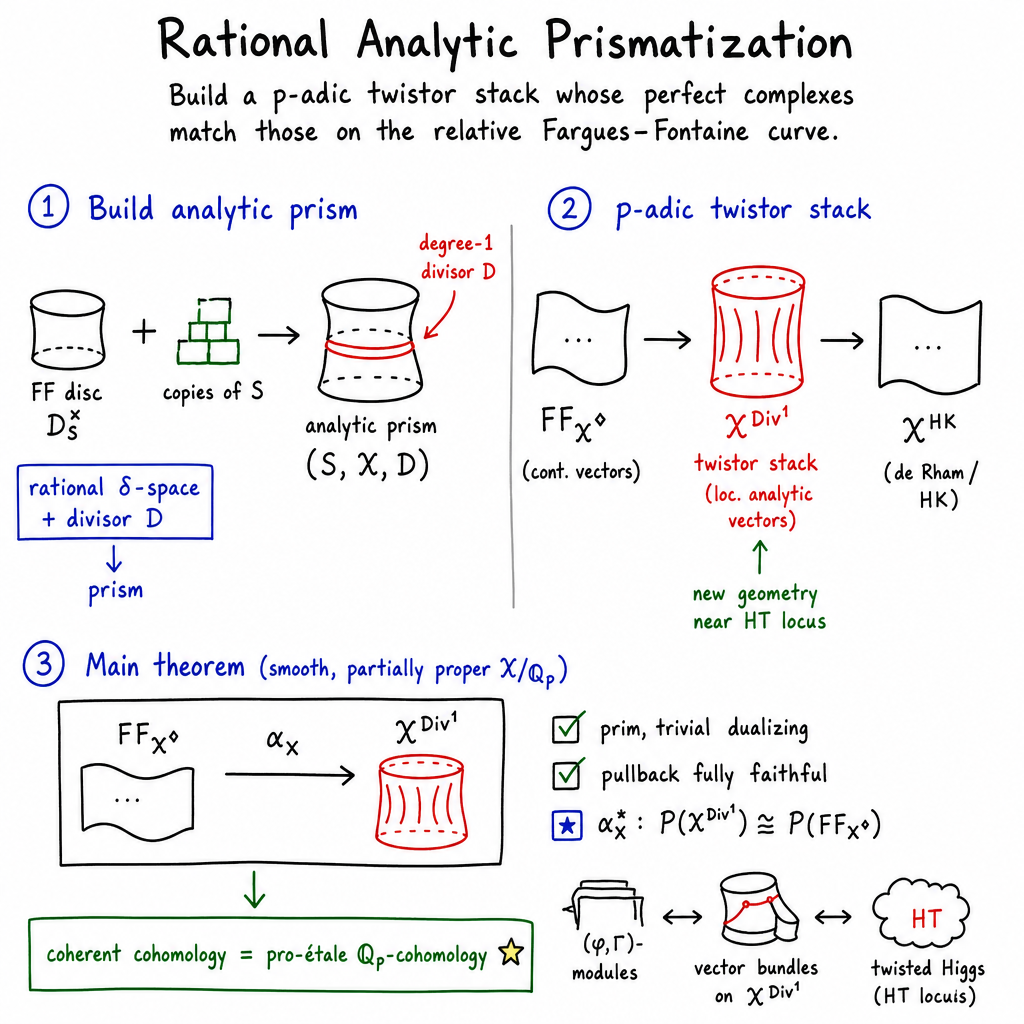
Abstract: We develop a general theory of analytic prismatization with -coefficients in rigid analytic geometry over . We prove an equivalence of perfect complexes on the perfect analytic prismatization modulo Frobenius with perfect complexes on the relative Fargues--Fontaine curve for any smooth partially proper rigid analytic variety. In particular, we explain how this equivalence conceptualizes the decompletion techniques by passing to locally analytic vectors which appear in (geometric) Sen theory
Paper Prompts
Sign up for free to create and run prompts on this paper.
Top Community Prompts
Explain it Like I'm 14
1. What is this paper about?
This paper develops a new mathematical framework called rational analytic prismatization.
The main goal is to create a bridge between several important areas of modern number theory:
- -adic geometry, which studies numbers and shapes using the prime number ;
- prismatic cohomology, a way of collecting different kinds of information about geometric objects;
- Fargues–Fontaine curves, special geometric spaces used in -adic Hodge theory;
- -adic Hodge theory, which compares different ways of studying shapes defined over -adic numbers;
- Sen theory, which studies how -adic Galois groups act on mathematical objects.
The paper focuses on geometry over the -adic numbers . Its main achievement is to construct a new space, called the -adic twistor stack, and show that it contains essentially the same information as the relative Fargues–Fontaine curve for a large class of rigid analytic spaces.
In simple terms, the authors build a new “translation device” between different mathematical languages and prove that the information survives the translation.
2. What questions are the authors asking?
The paper investigates several connected questions:
- Can prismatic geometry be extended from algebraic or formal objects to analytic spaces? Earlier versions of prismatization mainly worked with algebraic objects defined using power series and formal schemes. The authors ask whether a similar construction can be made for analytic spaces over .
- Can this construction connect analytic geometry with Fargues–Fontaine curves? These curves are central objects in modern -adic mathematics. The authors want to understand whether the new analytic prismatization naturally produces them.
- Does the new construction explain decompletion? In -adic mathematics, “decompletion” means recovering simpler, locally analytic information from a more complicated completed object. The authors ask whether this process has a geometric explanation.
- Can the construction organize -adic cohomology and coefficient objects? They want to see whether vector bundles, local systems, and cohomology theories can all be studied on one common geometric space.
- Can it provide a geometric version of Sen theory? Sen theory studies how continuous group actions become locally analytic. The paper asks whether this change can be understood as moving between two related geometric spaces.
3. How did the authors approach the problem?
The paper is mainly theoretical. It does not use experiments or numerical data. Instead, the authors define new mathematical objects and prove theorems about them.
Building a suitable kind of analytic geometry
The authors work with Gelfand stacks, which are a flexible form of analytic space. A useful analogy is:
- an ordinary geometric space is like a map or landscape;
- a stack is like a landscape that also remembers symmetries and different ways of describing the same point.
Gelfand stacks allow the authors to handle both ordinary analytic spaces and more complicated objects that appear in -adic geometry.
Defining rational -spaces
The authors introduce rational -spaces. These are analytic objects equipped with a version of the Frobenius map.
The Frobenius is a transformation that, roughly speaking, raises quantities to their th power. It is one of the most important symmetries in -adic mathematics.
A rational -space contains:
- a perfectoid space in characteristic ;
- an analytic thickening of a Fargues–Fontaine-type space;
- a Frobenius operation connecting these pieces.
The word rational means that the construction uses -coefficients rather than integral -coefficients. This makes the theory technically simpler.
Defining analytic prisms and prismatization
An analytic prism is a rational -space together with a special divisor of degree one. A divisor can be thought of as a chosen subspace inside a larger space, similar to choosing a surface inside a three-dimensional object.
Given an analytic space , the authors construct its analytic prismatization, written informally as .
The idea is to study all possible prisms that map into . This is somewhat like studying a shape by looking at all the different “probes” that can be placed inside it.
They then repeatedly apply Frobenius and take a quotient by Frobenius. The resulting object is called the -adic twistor stack, written as .
The word twistor comes from an analogy with twistor spaces in complex geometry. Here, it is a space that connects different -adic viewpoints.
Studying locally analytic vectors
A major technical tool is the study of locally analytic vectors.
Suppose a -adic Lie group acts on a space. A function on that space might only be continuous, or it might vary in a particularly smooth and analytic way near each point. Locally analytic vectors are the objects with this stronger type of behavior.
The authors compare:
- objects with a continuous group action;
- objects obtained by keeping only their locally analytic parts.
This process is called decompletion. The authors prove conditions under which decompletion does not lose important information, especially for perfect complexes.
An everyday analogy is compressing a large file into a more organized format. Normally compression might lose information, but under the paper’s hypotheses, the important mathematical information can still be recovered.
Comparing the twistor stack with the Fargues–Fontaine curve
For a smooth, partially proper rigid space , the authors construct a natural map
where is a relative Fargues–Fontaine curve.
They then study how mathematical objects such as vector bundles and perfect complexes move along this map.
4. What are the main results?
The twistor stack and the Fargues–Fontaine curve contain the same perfect-complex information
The central theorem says that, for a smooth partially proper rigid space over ,
Here, means the category of perfect complexes. These are well-behaved algebraic objects that can be thought of as finite-dimensional, nicely controlled systems of equations or vector spaces varying over a space.
The symbol means that the two categories are equivalent: although the spaces look different, they support the same kind of perfect mathematical data.
This is the paper’s most important conclusion.
The construction explains decompletion
The authors prove a general decompletion theorem for a -adic Lie group acting on a Berkovich space .
Under suitable assumptions, perfect complexes on the quotient by the continuous action are equivalent to perfect complexes built from locally analytic vectors. In simplified form,
This gives a geometric explanation for why locally analytic vectors can replace completed objects without changing the essential perfect-complex information.
The Hodge–Tate stack behaves like a twisted version of the original space
The authors define the analytic Hodge–Tate stack .
For a smooth rigid space , this stack is a gerbe over
A gerbe is a space that looks locally like another space but may be globally twisted by hidden symmetry. An analogy would be a collection of identical-looking puzzle pieces that cannot be assembled into one globally consistent picture without making extra choices.
This result connects the Hodge–Tate stack with:
- twisted Higgs bundles;
- the Faltings extension;
- the -adic Simpson correspondence;
- Sen operators.
The twistor stack computes pro-étale cohomology
For a smooth partially proper rigid space , the authors obtain
In plain language, the cohomology of the structure sheaf on the -adic twistor stack agrees with the pro-étale -cohomology of .
Cohomology measures hidden features of a space, such as holes, twists, or ways of gluing local pieces together. Thus, the twistor stack gives a geometric home for important -adic cohomology information.
The paper proves a form of Poincaré duality
The authors also prove cohomological smoothness and a version of Poincaré duality.
Poincaré duality is a principle saying that cohomology in one degree is related to cohomology in a complementary degree. It is similar to how the holes of different dimensions in a sphere are related to one another.
In this setting, the duality includes a -adic twist and a degree shift. For a smooth map of relative dimension , the dualizing object has the form
The notation represents a -adic version of changing weights and shifting degrees.
5. Why are these results important?
The paper brings several theories into one framework.
The main relationships can be summarized as follows:
| Mathematical viewpoint | What it helps describe |
|---|---|
| Analytic prismatization | A geometric version of prismatic ideas |
| Fargues–Fontaine curves | -modules and -adic Hodge theory |
| Hodge–Tate stack | Twisted Higgs-type information |
| Locally analytic vectors | Decompletion and Sen theory |
| Twistor stack | A bridge between these viewpoints |
| Pro-étale cohomology | -adic topological information |
The result is important because mathematicians often have several different ways to describe the same object. One description may be good for calculating, while another may make hidden structures easier to see.
This paper shows that the -adic twistor stack can act as a common meeting point for these descriptions.
6. Possible impact of the research
The work could have several long-term effects.
First, it may provide a more geometric explanation of -adic Hodge theory. Instead of treating different cohomology theories as separate tools, mathematicians may be able to see them as different views of one larger geometric object.
Second, it may help organize -adic local systems, -modules, Higgs bundles, and related coefficient systems. This could make it easier to move between these theories.
Third, the decompletion results may clarify parts of geometric Sen theory and the -adic Simpson correspondence, which connect group actions, differential equations, and vector bundles.
Fourth, the cohomological results may lead to new versions of duality, Riemann–Hilbert correspondences, and six-functor formalisms in -adic geometry.
The authors also clearly state the limits of the paper. Their theory is currently developed with -coefficients. They do not yet give the full integral theory with -coefficients, nor do they develop all refined versions of prismatization.
Simple conclusion
The paper creates a new -adic geometric space called the twistor stack. It shows that this space and the Fargues–Fontaine curve describe the same well-behaved mathematical objects, even though they are built in different ways.
The deeper message is that several difficult theories—prismatic cohomology, -adic Hodge theory, Sen theory, and pro-étale cohomology—are not isolated subjects. They can be connected through one common geometric framework. This may give mathematicians a clearer way to understand and calculate with complicated -adic objects in the future.
Knowledge Gaps
Knowledge gaps, limitations, and open questions
- Integral prismatization is not developed. The constructions are restricted to -coefficients and rational geometry; an integral theory over —including the required Witt-vector and nilpotent-thickening machinery—remains open.
- The relationship with sheared prismatization is not established. The paper identifies analytic prismatization as being conceptually closer to sheared prismatization but does not provide a precise comparison or equivalence.
- Characteristic- analytic geometry is largely unexplored. The rational theory for analytic spaces in characteristic , and its relation to rigid cohomology of schemes over characteristic , is deferred to future work.
- Filtered and syntomic refinements are absent. The paper does not construct or analyze filtered prismatization, syntomification, Nygaard-type structures, or other refined variants within the analytic setting.
- The scope of the geometric category is limited. The main prismatization construction is formulated for Berkovich spaces, with only a conditional extension to certain -cohesive Gelfand stacks; a general theory for analytic stacks, singular spaces, and broader derived Gelfand stacks is not provided.
- The dependence on the auxiliary Gelfand/arc formalism is not fully clarified. The paper does not determine how its constructions compare with alternative analytic, diamond, condensed, or v-stack formulations, nor whether the resulting stacks are independent of the chosen presentation.
- The prismatization of non-reduced spaces remains poorly understood. The paper explicitly notes that twistor-stack cohomology and pro-étale -cohomology differ for arbitrary non-reduced Berkovich spaces, but does not characterize this discrepancy or identify the correct cohomological theory for such spaces.
- The equivalence on perfect complexes has restrictive hypotheses. The main equivalence is proved for smooth, partially proper rigid spaces, leaving open whether analogous results hold for non-smooth, non-partially-proper, non-quasi-compact, or singular spaces.
- The extension from perfect complexes to larger coefficient categories is incomplete. It remains unclear whether the equivalence between and extends to all quasi-coherent complexes, ind-coherent objects, coherent sheaves, or suitable derived categories beyond dualizable/perfect objects.
- A full six-functor formalism is not established. Although smooth pullbacks, dualizing complexes, and Poincaré duality are proved, the paper does not construct the complete six operations, including general , , tensor, internal Hom, and base-change theorems for arbitrary morphisms.
- Functoriality under general morphisms is unresolved. The behavior of analytic prismatization and twistor stacks under proper, étale, open, closed, and non-smooth morphisms is not systematically established.
- The global locally analytic quotient description is conjectural in general. The authors do not know whether, for a general perfectoid pro-étale torsor , one has an isomorphism
Only related statements about global sections and certain Hodge–Tate cases are proved.
- The hypotheses ensuring local analytic decompletion are not fully characterized. The strong decompletion conditions used to obtain equivalences of perfect complexes are technical and verified only in selected examples; intrinsic geometric or representation-theoretic criteria for these conditions are not known.
- Higher locally analytic vectors are not understood in general. The vanishing of higher locally analytic vectors is assumed or verified in particular settings, but a general theory describing when higher derived locally analytic vectors vanish is lacking.
- The relation between continuous and locally analytic quotient stacks needs broader validation. The comparison between and is developed under strong assumptions, leaving open its behavior for non-affinoid spaces, non-compact groups, and more general -adic Lie actions.
- The full geometric Sen theory is not developed. The paper gives a stack-theoretic interpretation of Sen operators and decompletion, but does not establish a comprehensive geometric Sen correspondence for arbitrary -adic Lie groups, coefficients, or families.
- The non-abelian -adic Hodge-theoretic consequences remain incomplete. The relationship between vector bundles on the twistor stack, -modules, pro-étale local systems, and -adic Simpson objects is described as a weak form of the correspondence; criteria for untwisting the gerbe and recovering a full -adic Simpson correspondence are not given.
- The Hodge–Tate gerbe is not generally shown to split. The paper identifies as a gerbe banded by the twisted tangent bundle, but does not determine when this gerbe is neutral, how splittings are classified, or what geometric conditions guarantee a splitting.
- The relation to the Faltings extension is not fully generalized. The Faltings extension controls the Hodge–Tate neighborhood in the settings considered, but its precise relative, integral, singular, and non-proper generalizations remain open.
- Relative base-change compatibility is incomplete. A relative version over a perfectoid base is mentioned, but systematic compatibility with arbitrary base change, descent, and families is not established.
- The theory of coefficients beyond is missing. The paper does not treat integral coefficients, torsion coefficients, general -adic coefficient rings, or -adic analogues, so the extent to which the constructions depend essentially on rational coefficients remains unresolved.
- Comparison with other approaches to analytic thickenings is incomplete. No precise comparison is made with inscribed v-sheaves, the Simpson gerbe formalism, or other theories of finite-flat or nilpotent thickenings of Fargues–Fontaine curves.
- Motivic and realization-theoretic properties are not addressed. Although the paper discusses analogies with Hyodo–Kato and Betti theories, it does not establish motivic functoriality, realization maps, or a universal cohomological characterization of the twistor stack.
- The behavior of the construction under singularities and derived structures is unclear. The paper focuses on smooth spaces in its main applications and does not determine how singularities, derived intersections, or nontrivial derived nilpotents affect the geometry and cohomology of analytic prismatizations.
- The geometric meaning of the radius map and its fibers is incomplete. The generic Hyodo–Kato identification and Hodge–Tate behavior are described, but a detailed classification of intermediate-radius fibers and their associated cohomological or differential structures is not provided.
- Explicit calculations are limited to basic examples. Beyond , the rigid multiplicative group, and affine-space-type charts, there is no broad catalogue of explicit prismatizations, twistor stacks, or coefficient categories for important classes such as curves, abelian varieties, or general proper rigid varieties.
Practical Applications
Immediate Applications
- Computational framework for relative -adic Hodge theory — academia and mathematical software.
- -adic étale and pro-étale cohomology;
- de Rham and Hyodo–Kato-type constructions;
- Fargues–Fontaine curves;
- Hodge–Tate and Sen-theoretic structures;
- relative -modules.
- A practical output would be a formalized library in Lean, Coq, or a specialized computer-algebra system implementing rational -spaces, Frobenius quotients, and perfect-complex pullbacks. This is deployable as a research infrastructure project, although the underlying mathematics remains highly specialized.
- A geometric workflow for computing pro-étale -cohomology — arithmetic geometry and computational number theory. For a smooth, partially proper rigid space , the paper identifies
Thus, instead of computing pro-étale cohomology directly, one can: 1. construct the -adic twistor stack; 2. replace it by the relative Fargues–Fontaine geometry ; 3. compute coherent or perfect-complex cohomology there. This suggests algorithms and symbolic workflows for explicit rigid spaces, especially tori, affinoid charts, and spaces admitting perfectoid covers.
- Geometric organization of -modules — -adic representation theory. The equivalence
allows relative -modules to be represented as perfect complexes on the -adic twistor stack. In concrete terms, this can improve the organization of: - -adic Galois representations; - families of -adic representations over rigid spaces; - Robba-ring modules; - cohomological invariants of relative representations. For , with finite, the result gives a geometric interpretation of decompletion for -modules over the Robba ring.
- Locally analytic decompletion of equivariant analytic data — representation theory and -adic functional analysis. The locally analytic vectors theorem gives a systematic method for replacing continuous -actions by locally analytic -actions when is a -adic Lie group. Under the paper’s decompletion hypotheses, perfect complexes on
can be recovered from perfect complexes on
This can be used immediately in research workflows involving: - locally analytic representations; - completed cohomology; - -adic automorphic forms; - analytic vectors in Banach representations; - equivariant sheaves on perfectoid covers.
- Geometric interpretation of Sen operators and canonical Higgs fields — -adic Hodge theory.
- extracting Sen operators from torsors;
- interpreting geometric Sen theory via cotangent complexes;
- studying twisted Higgs bundles;
- comparing -vector bundles with Hodge–Tate data.
- The construction is immediately usable conceptually and in explicit examples, but not yet a general-purpose computational tool.
- Poincaré duality for pro-étale cohomology — arithmetic geometry. The cohomological smoothness results provide a geometric explanation for dualizing complexes of the form
for relative dimension . This can be incorporated into proofs and calculations of: - geometric pro-étale Poincaré duality; - arithmetic pro-étale duality; - duality for families of smooth rigid spaces; - compactly supported cohomology and trace maps. The practical benefit is a reusable geometric formalism rather than a new numerical algorithm.
- A reusable cyclotomic and toric local model — education, research, and software testing.
- validate implementations of analytic prismatization;
- test locally analytic quotient constructions;
- illustrate the relation between continuous and locally analytic vectors;
- build examples for graduate courses or research seminars in -adic geometry.
- The cyclotomic prism and prismatic logarithm are particularly suitable as benchmark examples.
- Interpretation of -adic Riemann–Hilbert constructions — non-abelian -adic Hodge theory.
- -adic local systems;
- Higgs-type objects;
- vector bundles on the twistor stack;
- analytic -modules on Fargues–Fontaine-type spaces.
- This can guide the construction and classification of coefficient objects in current -adic Hodge-theoretic research.
Long-Term Applications
- A general-purpose -adic Hodge-theoretic coefficient platform — healthcare, finance, and other applied sectors indirectly.
- cryptographic parameter spaces;
- arithmetic statistics;
- -adic dynamical systems;
- formal verification of number-theoretic protocols;
- mathematical models involving -adic differential equations.
- Such applications would require substantial translation from abstract rigid geometry into domain-specific algorithms, as well as efficient implementations of derived and stack-theoretic operations.
- Algorithms for families of -adic Galois representations — computational number theory and arithmetic geometry.
- construction of relative -modules;
- comparison between étale, de Rham, crystalline, and Hodge–Tate realizations;
- computation of cohomology in parameterized families;
- detection of decompletion and local analyticity conditions.
- Dependencies include effective descriptions of , computable affinoid coverings, algorithms for locally analytic vectors, and manageable models for derived categories.
- A geometric form of the -adic Simpson correspondence — non-abelian geometry. The Hodge–Tate gerbe and its twisted Higgs-bundle interpretation suggest a route toward a broader -adic Simpson correspondence. A mature theory could provide a pipeline
$\text{%%%%50%%%%-adic local systems} \longleftrightarrow \text{relative %%%%51%%%%-modules} \longleftrightarrow \text{twisted Higgs bundles}.$
Potential outputs include moduli spaces of -adic local systems, deformation theories, and geometric classifications of non-abelian -adic representations. Major dependencies are the resolution of twisting and integrality issues, together with stronger conditions under which the relevant gerbes can be split.
- Integral analytic prismatization over — arithmetic geometry and mixed-characteristic applications.
- integral -adic Hodge theory;
- crystalline and prismatic cohomology with torsion;
- integral comparison theorems;
- mod- and mixed-characteristic deformation problems;
- integral families of Galois representations.
- This requires controlling Witt vectors, torsion, nilpotent thickenings, and the difference between analytic and perfect analytic prismatization.
- Six-functor formalisms and derived coefficient systems — advanced mathematical infrastructure.
- pullback, pushforward, and exceptional functors;
- compactly supported -adic cohomology;
- base-change theorems;
- intersection-style constructions for analytic stacks;
- functorial operations on -adic local systems and -modules.
- Feasibility depends on extending the current results beyond perfect complexes and establishing robust finiteness, descent, and base-change theorems.
- Non-abelian and locally analytic -adic Langlands programs — representation theory.
- moduli of -torsors;
- geometric parameter spaces for locally analytic representations;
- cohomological constructions of -adic automorphic representations;
- geometric Sen operators for non-abelian families.
- This is speculative and depends on extending decompletion results to broader classes of groups, spaces, and coefficient categories.
- Relative and family-valued -adic Hodge theory — moduli and arithmetic geometry.
- eigenvarieties and eigenfamilies;
- deformation spaces of Galois representations;
- moduli of -adic local systems;
- variation of Hodge–Tate weights and Sen operators;
- parameterized Riemann–Hilbert correspondences.
- Required developments include stronger relative descent, effective control of perfectoid bases, and compatibility with integral and filtered structures.
- Extension to characteristic and rigid cohomology — arithmetic geometry.
- rigid cohomology of varieties over characteristic ;
- Frobenius modules and slope decompositions;
- comparisons between characteristic- and mixed-characteristic realizations.
- This depends on constructing the appropriate characteristic- analytic theory and proving comparison theorems.
- Formalized and scalable computational geometry for -adic stacks — software engineering.
Prismatization(X);TwistorStack(X);HodgeTateStack(X);LocallyAnalyticVectors(Y, G);PerfectComplexes(FF_X).- Such tooling would require finite or symbolic representations of Berkovich spaces, perfectoid covers, Frobenius actions, derived sheaves, and quotient stacks. Without these advances, the theory remains primarily a conceptual and research-level framework rather than an industrial software technology.
- Applications to ordinary daily life — currently none directly. The findings do not presently yield deployable consumer applications, medical procedures, policy instruments, or household workflows. Any eventual practical impact would most plausibly be indirect, through advances in arithmetic geometry, cryptography, formal verification, or computational number theory. The main feasibility constraints are the highly abstract mathematical setting, the restriction to smooth partially proper rigid spaces in key theorems, and the current absence of efficient computational realizations.
Glossary
- Analytic de Rham stack: A stack encoding de Rham-theoretic information in an analytic or derived-geometric setting. “Its right adjoint, the analytic de Rham stack functor , is especially interesting”
- Analytic prismatization: A geometric construction that represents prismatic cohomological data for analytic spaces. “We develop a general theory of analytic prismatization with -coefficients in rigid analytic geometry over .”
- Arc-stack: A stack associated with the arc or perfectoidization perspective on non-Archimedean geometry. “Any Gelfand stack gives rise to an arc-stack over ”
- Berkovich space: A type of non-Archimedean analytic space defined using multiplicative seminorms. “ is a Berkovich space with an endomorphism ”
- Breuil–Kisin twist: A -adic Hodge-theoretic twist associated with the cyclotomic character and Breuil–Kisin modules. “where refers to the Breuil--Kisin twist on ”
- Cartier divisor: A codimension-one geometric subobject locally defined by a single non-zero-divisor equation. “A (derived) Cartier divisor on is of degree $1$”
- Cohomologically smooth: A property ensuring a theory of smooth pullbacks and dualizing complexes for derived or stacky cohomology. “The morphism is prim with trivial codualizing sheaf and cohomologically smooth”
- Codualizing complex: A complex governing the duality behavior of a morphism in derived geometry. “The morphism is prim with trivial codualizing complex”
- Condensed anima: A homotopy-theoretic form of condensed mathematical objects, used here to model underlying topological information. “the perfectoidization functor is really taking the ‘underlying topological space’ (or, rather, condensed anima)”
- Crystalline cohomology: A -adic cohomology theory for schemes in characteristic that captures infinitesimal structure. “crystalline cohomology (of the special fiber)”
- -ring: A ring equipped with an arithmetic Frobenius lift encoded by a -operation. “This relies classically on the key definitions of -rings and prisms.”
- -space: A geometric object modeled on a Frobenius-equipped analytic space and a punctured Fargues–Fontaine disc. “A rational -space is a triple”
- Decompletion: The process of recovering locally analytic or finite-level objects from completed -adic representations or modules. “we explain how this equivalence conceptualizes the decompletion techniques”
- Derived Berkovich space: A derived enhancement of a Berkovich analytic space. “the category of derived Berkovich spaces over ”
- Derived Cartier divisor: A Cartier divisor defined in a derived geometric setting, allowing derived structure in its defining map. “A (derived) Cartier divisor ”
- Derived category: A category that retains chain-complex and homological information rather than merely morphisms of objects. “Let denote the Gelfand algebra”
- Diamond: A geometric object in -adic geometry obtained by sheafifying perfectoid spaces in the pro-étale topology. “inducing an isomorphism of diamonds ”
- Dualizable object: An object in a monoidal category possessing a categorical dual, analogous to a finite-dimensional vector space. “induces an equivalence of dualizable objects”
- Fargues–Fontaine curve: A -adic geometric curve constructed from a perfectoid space and used to study -adic representations. “The quotient of the perfect -space associated to by Frobenius will be denoted ”
- Fargues–Fontaine disc: The punctured or unpunctured analytic space underlying the construction of a Fargues–Fontaine curve. “occasionally call them the (punctured) Fargues--Fontaine disc relative to .”
- Faltings’ extension: An extension encoding the relationship between differentials and -adic Hodge–Tate structures. “the Hodge--Tate stack, and even the overconvergent neighborhood of inside , is controlled by a familiar object in -adic Hodge theory: the Faltings' extension of .”
- Frobenius: An endomorphism acting as a -power map or its geometric analogue in characteristic . “called ‘the Frobenius of the -space’”
- Gelfand ring: A solid -algebra used as the foundational ring object in Gelfand analytic geometry. “The category of Gelfand rings is a subcategory of the category of solid -algebras”
- Gelfand stack: A sheaf-like geometric object on Gelfand rings for the descendable topology. “a Gelfand stack is (in first approximation) a sheaf of anima on ”
- Gerbe: A stack locally equivalent to a classifying stack, often encoding twisted forms or torsors. “ realizes as a gerbe over ”
- Hodge–Tate stack: The Cartier-divisor locus of analytic prismatization associated with Hodge–Tate phenomena. “The analytic Hodge-Tate stack of is the Gelfand stack”
- Hyodo–Kato stack: A stack encoding Hyodo–Kato cohomological data in the analytic setting. “the quotient by Frobenius on this locus is the Hyodo--Kato stack of .”
- Locally analytic vectors: Vectors in a representation whose orbit maps are locally analytic for a -adic Lie group. “decompletions by (derived) locally analytic vectors”
- Nilperfectoid ring: A ring whose quotient by its dagger-nilradical is perfectoid. “a Gelfand ring is nilperfectoid if its quotient by its -nilradical is perfectoid.”
- Nygaard filtration: A filtration on prismatic or related cohomology reflecting Frobenius divisibility. “encoding extra structures on prismatic cohomology, such as the Nygaard filtration or the Frobenius.”
- Perfect complex: A derived complex locally quasi-isomorphic to a bounded complex of finite projective modules. “We prove an equivalence of perfect complexes”
- Perfectoid space: A highly complete non-Archimedean space with Frobenius-surjective tilt, central to modern -adic geometry. “The perfectoid space over is the tilt of ”
- Perfectoidization: A functor replacing an analytic object by its associated perfectoid or diamond object. “The reader can think of the perfectoidization of a Gelfand stack as analogous to taking the topological manifold underlying a complex manifold.”
- Prism: A pair consisting of a -ring and a distinguished ideal satisfying conditions that support prismatic cohomology. “the key definitions of -rings and prisms.”
- Prismatic cohomology: A -adic cohomology theory unifying de Rham, crystalline, and étale cohomologies. “Prismatic cohomology has been defined in \cite{bhatt_scholze_prisms_and_prismatic_cohomology} as a new cohomology theory for -adic formal schemes”
- Prismatization: A stack-valued construction whose coherent cohomology recovers prismatic cohomology. “the coherent cohomology of the stack recovers the prismatic cohomology of .”
- Pro-étale cohomology: Cohomology computed on the pro-étale site, particularly suited to perfectoid and rigid-analytic geometry. “the -adic twistor stack geometrizes pro-étale -cohomology”
- Quasi-coherent sheaf: A sheaf of modules locally presented by modules over the structure sheaf, generalized to stacks and derived spaces. “the pullback on quasi-coherent sheaves is fully faithful”
- Rigid analytic space: A non-Archimedean analytic space defined using admissible affinoid coverings. “for any smooth partially proper rigid analytic variety.”
- Sen theory: The theory relating -adic Galois representations to locally analytic group actions and Sen operators. “which appear in (geometric) Sen theory.”
- Sheafification: The process of converting a presheaf into a sheaf satisfying descent. “the sheafification in Gelfand stacks”
- Solid algebra: A generalized topological algebraic object designed to encode completed tensor products and analytic phenomena. “The category of Gelfand rings is a subcategory of the category of solid -algebras”
- Spectral stack: A stack built from ring spectra or derived rings, retaining homotopical information. “The realization functor on -stacks is the colimit preserving functor”
- Syntomification: A refined prismatic construction incorporating syntomic or related filtration data. “such as the filtered prismatization or the syntomification.”
- Tilt: The characteristic- perfectoid space or ring associated with a mixed-characteristic perfectoid object. “The perfectoid space over is the tilt of .”
- Twistor stack: A stack interpolating between Hodge–Tate, de Rham, and related -adic structures. “the -adic twistor stack of ”
- Uniform completion: A completion of a ring with respect to its uniform analytic structure, producing a Banach algebra. “any Gelfand ring admits a uniform completion ”
- v-vector bundle: A vector-bundle-like object on a perfectoid or diamond space in the v-topology. “an equivalence between twisted Higgs bundles ... and v-vector bundles”
- Witt vectors: A construction associating a characteristic-zero ring to a characteristic- ring while retaining Frobenius information. “the Witt vectors functor on -nilpotent rings.”

