Ergodicity of the geodesic flow on surfaces of nonpositive curvature
Abstract: We give a full proof that the geodesic flow of a closed surface of genus at least two with a (C{3+\mathrm{Lip}}) metric of nonpositive curvature is ergodic with respect to Liouville measure. In a forthcoming paper, we will present the corresponding result for smooth rank-one manifolds in every dimension.
Paper Prompts
Sign up for free to create and run prompts on this paper.
Top Community Prompts
Explain it Like I'm 14
1. What is this paper about?
This paper studies how geodesics— the “straightest possible” paths on a curved surface—move over time.
Imagine an ant walking in a straight line on a strange, curved planet. Its path is called a geodesic. The geodesic flow describes the ant’s position and direction as it moves.
The paper proves that, on many closed curved surfaces, geodesic motion is ergodic. In simple terms, this means that a typical geodesic eventually explores the surface in a very even and unpredictable way. Over a long time, it spends time in different regions according to their sizes, rather than staying trapped in one particular area.
The authors study closed surfaces:
- with no boundary,
- having a genus of at least two, meaning they have several “handles,” like a pretzel,
- whose curvature is never positive,
- and whose shape is smooth enough for the mathematical tools to work.
2. What questions are the researchers asking?
The main question is:
Does the geodesic flow on every such surface behave ergodically?
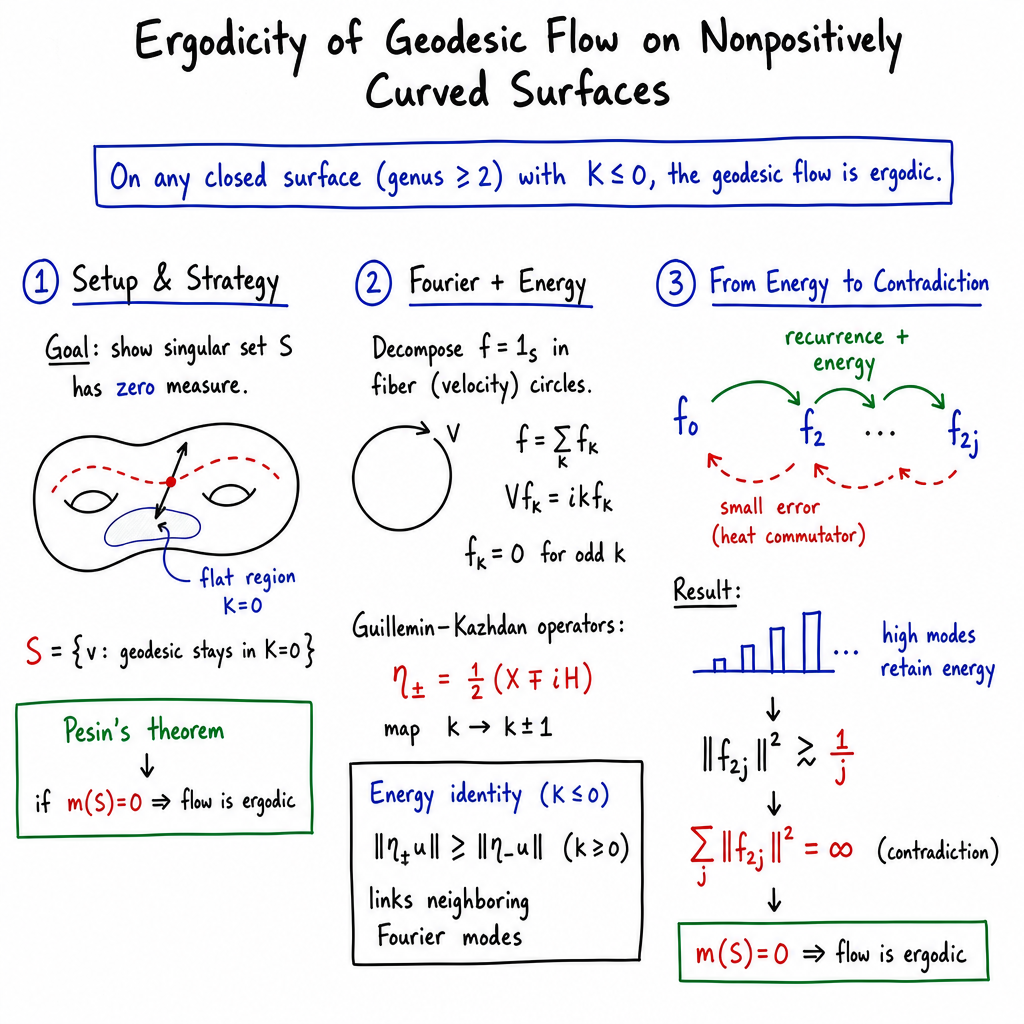
The authors focus on a special collection of geodesics called the singular set. These are geodesics that travel only through places where the surface has zero curvature.
The key idea is that an earlier theorem already shows that the geodesic flow is ergodic outside this singular set. Therefore, the paper only needs to answer:
Does the singular set have zero size, when measured using the natural notion of area and direction?
If the answer is yes, then the singular geodesics are too rare to affect the overall behavior, and the entire geodesic flow is ergodic.
3. How did the researchers approach the problem?
The proof uses several advanced mathematical tools. Here is the basic strategy in everyday language.
Step 1: Assume the singular set is not tiny
The researchers begin by assuming, for contradiction, that the singular set is large enough to have positive measure.
They represent this set using a function called an indicator function. This function is:
1for directions belonging to the singular set,0for all other directions.
Because the singular set does not change when a geodesic moves, this function stays constant along every geodesic.
Step 2: Break the function into circular patterns
At every point on the surface, there is a whole circle of possible directions. The authors analyze how the indicator function changes as the direction turns around this circle.
They use a mathematical version of the Fourier transform, which is similar to breaking a musical sound into different notes. Here, the function is broken into different “angular frequencies,” called Fourier modes.
The mode with frequency zero describes the average amount of the singular set above each point on the surface. The authors call the region where this average is nonzero F.
They show that:
Flies entirely in the zero-curvature region,Fis not the whole surface,- but
Fhas positive size if the singular set does.
Step 3: Study how heat spreads from this region
The researchers then use a mathematical process called the heat equation.
A helpful analogy is to imagine placing a drop of heat on the region F. As time passes, the heat spreads outward. The authors study a special heat-spreading operator that acts separately on each Fourier mode.
They prove that heat does not spread too quickly away from F. The reason is that the curvature and its change are very small near F.
More precisely, if a point is distance d from F, then the curvature is at most roughly proportional to d², and its gradient is at most roughly proportional to d. This means the curvature becomes extremely flat near the zero-curvature region.
Step 4: Compare neighboring Fourier modes
The geodesic-flow equation creates a relationship between neighboring Fourier modes. Roughly speaking, the information in one mode controls the information in the next.
The heat process slightly weakens this relationship. The authors carefully estimate this error and show that it is small.
They then repeatedly compare the modes:
- the zero mode controls the second mode,
- the second mode controls the fourth mode,
- the fourth mode controls the sixth mode,
- and so on.
Because the errors are small, every even-numbered Fourier mode must remain large enough.
Step 5: Reach a contradiction
The authors prove that the size of the mode with frequency 2j must be at least about
But the Fourier modes come from one square-integrable function. A basic result called Parseval’s identity says that the sum of the squares of all these mode sizes must be finite.
The problem is that
does not remain finite—it grows without limit.
This contradiction shows that the original assumption was wrong. Therefore, the singular set must have measure zero.
4. What are the main findings?
The main result is:
For every closed surface of genus at least two with sufficiently smooth, nonpositive curvature, the geodesic flow is ergodic with respect to Liouville measure.
The proof has two important parts:
- A known theorem says that the geodesic flow is already ergodic away from the singular set.
- This paper proves that the singular set has measure zero.
Together, these facts show that the entire geodesic flow is ergodic.
This is important because surfaces with nonpositive curvature can contain flat regions. Flat regions might seem capable of trapping geodesics into simple, predictable behavior. The paper proves that, although such special geodesics can exist, they are too rare to matter statistically.
5. Why does this matter?
The result tells us that long-term geodesic motion on these surfaces is highly mixed.
For a typical starting position and direction, a geodesic does not remain confined to one small part of the surface. Instead, over a long period, it explores the surface in a way that reflects the surface’s geometry.
This has several possible impacts:
- It improves our understanding of chaotic motion on curved spaces.
- It shows that flat parts of a nonpositively curved surface do not destroy overall randomness.
- It provides techniques that may work in higher-dimensional spaces.
- It supports future research on rank-one manifolds, a broader class of spaces where some geodesics are genuinely unstable or non-flat.
In short, the paper proves that even when a curved surface contains special flat behavior, the motion of most geodesics is still thoroughly mixed and statistically unpredictable.
Knowledge Gaps
The paper establishes ergodicity only in a specific setting and leaves the following issues unresolved:
- Higher-dimensional extension is not proved in this paper. The authors state that the corresponding result for smooth rank-one manifolds of nonpositive sectional curvature in every dimension will appear separately, but no proof or detailed argument is provided here.
- The optimal regularity assumption remains unknown. The theorem requires a metric. It is not determined whether ergodicity still holds for , , or weaker metrics, nor which parts of the argument impose the strongest regularity requirements.
- The role of the surface and orientation assumptions is not fully generalized. The proof applies to closed, connected, oriented surfaces of genus at least two; it does not address nonorientable surfaces or clarify whether an analogous argument can be formulated without passing to an oriented cover.
- The result does not cover noncompact surfaces, surfaces with boundary, or finite-area complete metrics. The effects of cusps, ends, boundary conditions, and possible infinite-volume Liouville measures remain unexplored.
- Only ergodicity is established; stronger statistical properties are not addressed. The paper does not determine whether the geodesic flow is mixing, Bernoulli, has a central limit theorem, or satisfies decay-of-correlation estimates for these potentially nonuniformly hyperbolic metrics.
- No quantitative information about the singular set is obtained. The argument proves that the set of geodesics remaining entirely in the zero-curvature locus has Liouville measure zero, but gives no Hausdorff dimension, fractal structure, geometric description, or quantitative measure estimates.
- The dynamics and geometry of the singular set remain largely unexplored. The proof does not classify zero-curvature geodesics, describe their organization into flat strips or other invariant subsets, or determine how the structure of the zero-curvature region affects dynamical behavior.
- The proof does not provide effective ergodicity estimates. The contradiction argument is qualitative and yields no explicit bounds on convergence of time averages, recurrence rates, or the size of exceptional sets.
- The dependence of constants is not made quantitative in geometric parameters. Although several estimates are uniform in the Fourier degree and heat time in the stated sense, the paper does not track dependence on curvature bounds, injectivity radius, diameter, or the regularity modulus of the metric.
- The applicability of Pesin’s ergodicity theorem is used as a black box. The paper does not fully analyze the regular set’s Lyapunov exponents or verify in detail all hypotheses of the cited theorem within the stated framework.
- The method’s applicability beyond Liouville measure is unknown. It does not address ergodicity or statistical properties for other invariant measures, such as equilibrium states, measures of maximal entropy, or measures supported near the singular set.
- The argument does not clarify whether analogous Fourier–heat methods work in variable-curvature settings with weaker sign assumptions. In particular, extensions to metrics with some positive curvature, no focal points, or related partially hyperbolic geometries remain open within the paper’s framework.
- The connection between the analytic estimates and the higher-dimensional rank-one problem is not developed. The paper does not identify which parts of the surface argument survive in higher dimensions and which must be replaced because the scalar Fourier-mode decomposition is unavailable.**
Practical Applications
The paper establishes that the geodesic flow on a closed, oriented surface of genus at least two with a metric and nonpositive Gaussian curvature is ergodic with respect to Liouville measure. Its main practical contribution is therefore a rigorous foundation for treating long geodesic trajectories as statistically representative, while its Fourier, heat-flow, commutator, and propagation estimates provide reusable analytical and computational tools.
Immediate Applications
- Statistical sampling of geodesic trajectories in computational geometry and dynamical systems. On surfaces satisfying the paper’s assumptions, a sufficiently long generic geodesic trajectory can be used to estimate Liouville-measure averages of observables on the unit tangent bundle. This supports workflows for estimating quantities such as average directional travel time, trajectory occupancy, angular distributions, and correlations without explicitly sampling all initial conditions. Sector: computational geometry, dynamical-systems simulation, scientific computing. Potential tools: ergodic trajectory samplers, numerical benchmarks for geodesic-flow solvers, and Monte Carlo estimators based on one long trajectory. Dependencies: numerical trajectories must remain accurate over long times; the result applies to the ideal geodesic flow, not automatically to discretized, forced, noisy, or boundary-constrained systems.
- Validation of numerical solvers for geodesic flow. The theorem gives a qualitative benchmark: simulations on appropriate nonpositively curved closed surfaces should reproduce Liouville-statistical behavior for almost every initial condition. Researchers can compare empirical distributions from long simulations against the predicted invariant measure. Sector: software engineering for scientific computing and numerical differential geometry. Dependencies: the simulated metric must preserve the required curvature and regularity conditions, and finite-time convergence rates are not supplied by the theorem.
- Construction of reproducible test cases for dynamical-systems software. Closed higher-genus surfaces with nonpositive curvature can serve as demanding test environments for integration methods, invariant-measure estimation, phase-space visualization, and chaos-detection algorithms. The proof’s decomposition into Fourier modes and the operators and also suggests structured diagnostics for testing implementations. Sector: academic software, computer graphics, robotics simulation. Dependencies: practical implementations require a concrete coordinate representation of the surface and reliable handling of topology, curvature, and periodic identification.
- Analytical tools for inverse problems and geometric tomography. The Guillemin–Kazhdan operators, connection Laplacians, and Fourier-mode recurrences are directly relevant to tensor tomography, geodesic X-ray transforms, and inverse problems on curved surfaces. The paper’s estimates can be reused to control invariant or nearly invariant distributions and to analyze how smoothing interacts with directional differentiation. Sector: medical imaging research, geophysical imaging, inverse problems. Dependencies: additional assumptions are generally needed for stable reconstruction, boundary conditions, measurements, and noise models; ergodicity alone does not produce an imaging algorithm.
- Improved understanding of singular trajectories in geometric dynamics. The proof shows that the set of geodesics remaining entirely in the zero-curvature region has zero Liouville measure. This can justify treating such trajectories as negligible in statistical models of geodesic motion, provided the model uses Liouville measure as its sampling distribution. Sector: geometric modeling, dynamical-systems theory, statistical mechanics. Dependencies: “measure zero” does not mean that singular trajectories do not exist or cannot matter in worst-case, adversarial, or deliberately initialized experiments.
- Teaching and research workflows for ergodic theory and geometric analysis. The paper provides a concrete example connecting Pesin’s ergodicity theorem, Fourier analysis on the unit tangent bundle, elliptic operators, heat semigroups, finite-propagation wave estimates, and commutator methods. These ingredients can be incorporated into graduate courses, formal proof exercises, and seminars on smooth dynamics or Riemannian geometry. Sector: academia and mathematical education. Dependencies: the result is highly specialized and requires background in differential geometry, functional analysis, and ergodic theory.
- Benchmarking invariant-measure estimation methods. The Liouville measure gives a principled target distribution for comparing histogram, kernel-density, neural, and symbolic estimators operating on simulated geodesic data. This is useful for evaluating whether an algorithm correctly captures directional and positional statistics on curved spaces. Sector: machine learning for scientific computing and statistics. Dependencies: the theorem provides invariance and ergodicity, but not a convergence rate or a prescription for choosing trajectory length, burn-in time, or estimator bandwidth.
Long-Term Applications
- Statistically grounded motion planning on curved environments. The result could support motion-planning systems that use geodesic trajectories as exploration or coverage paths on closed curved surfaces. In the long term, ergodicity-based planning could generate trajectories whose long-run coverage approximates a desired geometric measure. Sector: robotics, autonomous vehicles, drone navigation, and planetary-surface exploration. Potential products: geodesic coverage planners, manifold exploration libraries, and curvature-aware path-generation modules. Dependencies: real robots operate with controls, obstacles, disturbances, energy constraints, and often boundaries. Extending the result from uncontrolled geodesic flow to controlled or dissipative systems requires new theory.
- Coverage and exploration of non-Euclidean configuration spaces. Many robotic configuration spaces are manifolds rather than flat domains. Techniques inspired by the paper could help design exploration dynamics whose trajectories sample configuration space in a measure-aware manner, especially when the configuration manifold has suitable curvature properties. Sector: robotics and motion planning. Dependencies: configuration spaces may have singularities, boundaries, positive curvature, or noncompact regions; the paper’s closed-surface assumptions are restrictive.
- Ergodic sampling algorithms on manifolds. The theorem may inform the design of deterministic alternatives to random sampling, in which a single trajectory approximates integration over a geometric state space. Combined with adaptive reweighting or control, such methods could be useful for Bayesian computation, uncertainty quantification, and optimization on manifolds. Sector: finance, statistics, machine learning, and engineering design. Dependencies: deterministic geodesic flow samples Liouville measure, not an arbitrary target distribution. Target-specific potentials, thermostats, or feedback controls would require separate invariant-measure and ergodicity proofs.
- Generalization to higher-dimensional rank-one manifolds. The authors state that a corresponding result for smooth rank-one manifolds in every dimension will be presented separately. If established and accompanied by effective estimates, this could broaden applications from two-dimensional surfaces to higher-dimensional state spaces and geometric models. Sector: high-dimensional geometry, robotics, physics, and data science. Dependencies: higher-dimensional dynamics involve more complicated singular sets, sectional curvature structures, and analytic estimates. The present paper does not itself establish those applications.
- Long-time transport and mixing models in curved media. Ergodic geodesic motion can serve as an idealized baseline for transport of rays, particles, or signals in curved environments. Future work could incorporate scattering, attenuation, reflections, or weak random perturbations to model transport more realistically. Sector: acoustics, optics, wave propagation, and geophysics. Potential tools: curvature-aware ray-tracing models and effective transport solvers. Dependencies: the theorem concerns geodesic flow rather than the full wave equation or physical transport equation; quantitative mixing and decay rates would be needed for predictive modeling.
- Curvature-aware data analysis and manifold learning. The paper’s use of Fourier modes on the unit tangent bundle and connection Laplacians suggests future algorithms for analyzing directional data on curved spaces, such as orientation fields, fiber directions, or motion trajectories. Heat smoothing could provide a principled regularization method that respects the manifold connection. Sector: computer vision, medical imaging, climate science, and geometric machine learning. Dependencies: practical data are noisy, sampled discretely, and often live on manifolds with boundaries or unknown metrics. The analytical estimates must be translated into stable discrete algorithms with error guarantees.
- Policy and infrastructure planning for networked curved spaces. In abstract settings where movement occurs on a curved geographic or infrastructure surface, ergodic trajectory models could help assess average exposure, directional utilization, or coverage. Such use would be indirect: the theorem could justify statistical modeling assumptions rather than prescribe a policy. Sector: urban planning, transportation, telecommunications, and environmental monitoring. Dependencies: real transportation systems are governed by preferences, congestion, costs, and constraints, none of which are represented by free geodesic flow. Empirical calibration and behavioral modeling would be essential.
- Formal verification of geometric-dynamics claims. The paper’s explicit operator identities and energy estimates could be formalized in proof assistants or used to build certified numerical arguments for special surfaces. This could improve reliability in mathematical software and provide machine-checked versions of key analytic steps. Sector: formal methods, theorem proving, and certified scientific computing. Dependencies: formalization of Sobolev spaces, weak derivatives, spectral calculus, and Riemannian geometry remains technically substantial; the paper itself does not provide a formal verification artifact.
Overall, the strongest near-term value is theoretical and computational: the result supplies a rigorous ergodicity benchmark and reusable analytic machinery for geodesic-flow simulations, inverse problems, and manifold-based numerical methods. More ambitious applications in robotics, transport, and machine learning require extensions to boundaries, controls, noise, noncompact spaces, quantitative rates, and discretization error.
Glossary
- Absolutely continuous: A function whose variation can be represented by integrating an integrable derivative. “Thus E is absolutely continuous.”
- Admissible test section: A section suitable for use in a weak or variational formulation of a differential equation. “Here the Lipschitz weight times wr is an admissible H1 test section”
- Cauchy–Schwarz inequality: An inequality bounding an inner product by the product of the norms of its arguments. “By the Cauchy–Schwarz inequality and Parseval’s identity (2.2)”
- Closed quadratic form: A quadratic form whose associated norm makes its domain complete. “We use its nonnegative self-adjoint realization defined by the closed quadratic form ∥∇ku∥2”
- Covariant derivative: A derivative operation on sections of a vector bundle that accounts for the bundle’s connection. “Horizontal differentiation of u = a(x)eikθ is represented by ∇ka = da − ikωa.”
- Duhamel’s formula: An integral formula expressing the solution of a perturbed evolution equation in terms of the unperturbed propagator. “Duhamel’s formula gives”
- Elliptic operator: A differential operator whose principal symbol is invertible away from the zero section, generally yielding strong regularity properties. “Thus Lk = ∇∗k∇k is elliptic.”
- Ergodic flow: A dynamical flow for which every invariant measurable set has either zero measure or full measure. “Its geodesic flow is ergodic with respect to Liouville measure.”
- Fourier component: The projection of a function onto a particular frequency or mode. “These local expressions define global Fourier components.”
- Fourier degree: The integer indexing a function’s angular Fourier mode. “In estimates involving a Fourier degree k or a heat time t”
- Fourier recurrence: A relation connecting neighboring Fourier modes of a function. “Such Fourier recurrences are used by Guillemin–Kazhdan [3]”
- Form domain: The domain of a closed quadratic form associated with an operator. “The integral in (3.6) converges in the form domain”
- Gauss–Bonnet theorem: A theorem relating the integral of Gaussian curvature over a compact surface to its Euler characteristic. “The Gauss–Bonnet theorem and the genus assumption imply {K < 0}̸ = ∅.”
- Gaussian curvature: The intrinsic curvature assigned to each point of a two-dimensional Riemannian manifold. “equipped with a C3+Lip Riemannian metric of nonpositive Gaussian curvature K.”
- Geodesic flow: The dynamical system describing the motion of unit tangent vectors along geodesics. “We give a full proof that the geodesic flow of a closed surface”
- Guillemin–Kazhdan operators: Differential operators that raise or lower the angular Fourier degree on the unit tangent bundle. “Define the Guillemin–Kazhdan operators”
- Heat operator: An operator describing diffusion or heat evolution, commonly written as an exponential of a negative Laplacian. “These are contractions on Ωk, preserve the Fourier degree”
- Heat–wave formula: An integral representation of heat evolution using solutions of a wave equation. “The heat–wave formula of Kannai [4] is”
- Horizontal differentiation: Differentiation in directions tangent to the base manifold rather than along the fibers of a bundle. “Horizontal differentiation of u = a(x)eikθ is represented by”
- Invariant distribution: A generalized function unchanged by the action of a dynamical system. “If X is the geodesic vector field, then (2.1) Xf = 0 in distributions”
- Liouville measure: The natural measure on a unit tangent bundle preserved by the geodesic flow. “Its geodesic flow is ergodic with respect to Liouville measure.”
- Lipschitz: A regularity condition requiring a function to change no faster than a fixed constant times the distance between points. “The distance function dF is Lipschitz”
- Nonpositive curvature: A curvature condition in which the sectional or Gaussian curvature is everywhere less than or equal to zero. “with a C3+Lip Riemannian metric of nonpositive Gaussian curvature K.”
- Nonnegative self-adjoint realization: The operator-theoretic realization of an operator that is self-adjoint and has spectrum contained in the nonnegative reals. “We use its nonnegative self-adjoint realization defined by the closed quadratic form”
- Parseval’s identity: An identity equating the squared norm of a function with the sum of the squared norms of its Fourier components. “Reversal invariance and Parseval’s identity give”
- Pesin’s ergodicity theorem: A theorem establishing ergodicity under suitable hyperbolicity and regularity conditions on a dynamical system. “Following Pesin’s ergodicity theorem on the regular set [7]”
- Principal symbol: The highest-order part of a differential operator represented in cotangent variables, used to classify the operator. “Thus Lk = ∇∗k∇k is elliptic.”
- Quadratic form: A functional, typically involving an operator and an inner product, used to define energy and weak solutions. “defined by the closed quadratic form ∥∇ku∥2”
- Rank-one manifold: A manifold possessing at least one geodesic without a nonzero parallel normal Jacobi field. “Here rank one means that some geodesic admits no nonzero parallel normal Jacobi field”
- Regular set: The portion of a dynamical or geometric space where the relevant structure has no singular behavior. “it suffices to prove that the singular set S = {v ∈ SM : K(πgsv) = 0 for every s ∈ R} has zero Liouville measure.”
- Self-adjoint operator: An operator equal to its adjoint, ensuring real spectral values under appropriate conditions. “These are contractions on Ωk, preserve the Fourier degree”
- Singular set: The subset of the unit tangent bundle consisting of vectors whose geodesics remain in zero curvature. “it suffices to prove that the singular set S = {v ∈ SM : K(πgsv) = 0 for every s ∈ R} has zero Liouville measure.”
- Spectral calculus: A method for defining functions of self-adjoint operators using their spectral decompositions. “By spectral calculus, w(r) = sin(r√Lk)√Lkfk”
- Spectral theorem: A theorem providing a decomposition of self-adjoint operators in terms of their spectral measures or eigenvectors. “Their construction uses the spectral theorem for nonnegative self-adjoint operators.”
- Strong convergence: Convergence in norm, or convergence of an operator sequence on every vector, depending on context. “and converge strongly to the identity as t ↓ 0.”
- Unit tangent bundle: The manifold consisting of all unit tangent vectors to a Riemannian manifold. “Write SM for the unit tangent bundle”
- Wave equation: A hyperbolic partial differential equation describing wave propagation. “We will use the wave equation for the same connection Laplacian”
- Weak covariant derivative: A distributionally defined derivative of a section, usually obtained through integration by parts. “taking its weak covariant derivative therefore gives”