AI and The Enclosure of the Scientific Commons
Abstract: The scientific literature can be viewed as an "information commons:" an intangible resource that "no one owns and is shared by everyone." There are well-established economic and political frameworks for understanding such commons, emerging from the history of agricultural common lands found in places like preindustrial England. This article provides a primer on the history and these frameworks, and considers a key difference between the information commons and the fields of yore: while information commons are robust and immensely valuable --- some can be said to rank among humanity's greatest achievements --- the English agricultural commons no longer meaningfully exist. The latter are gone not because of the well-known "tragedy of the commons," but rather a phenomenon known as the enclosure movement (~1600--1800) that transformed the common lands into private property. Many observers, then and now, judge enclosure to have been theft at a societal scale. This article argues that AI provides precisely the tools needed to enable a previously-infeasible enclosure of the information commons. Although AI-enabled enclosure does not operate identically to physical enclosure, it shares the key features of turning the commons into private wealth and undermining the social systems that support them (via "slop spam"). The concepts presented in this article can provide a scholarly basis for interrogating the foreboding feeling that AI may represent not just a smash-and-grab, but an attack upon a whole way of life.
Paper Prompts
Sign up for free to create and run prompts on this paper.
Top Community Prompts
Explain it Like I'm 14
Overview
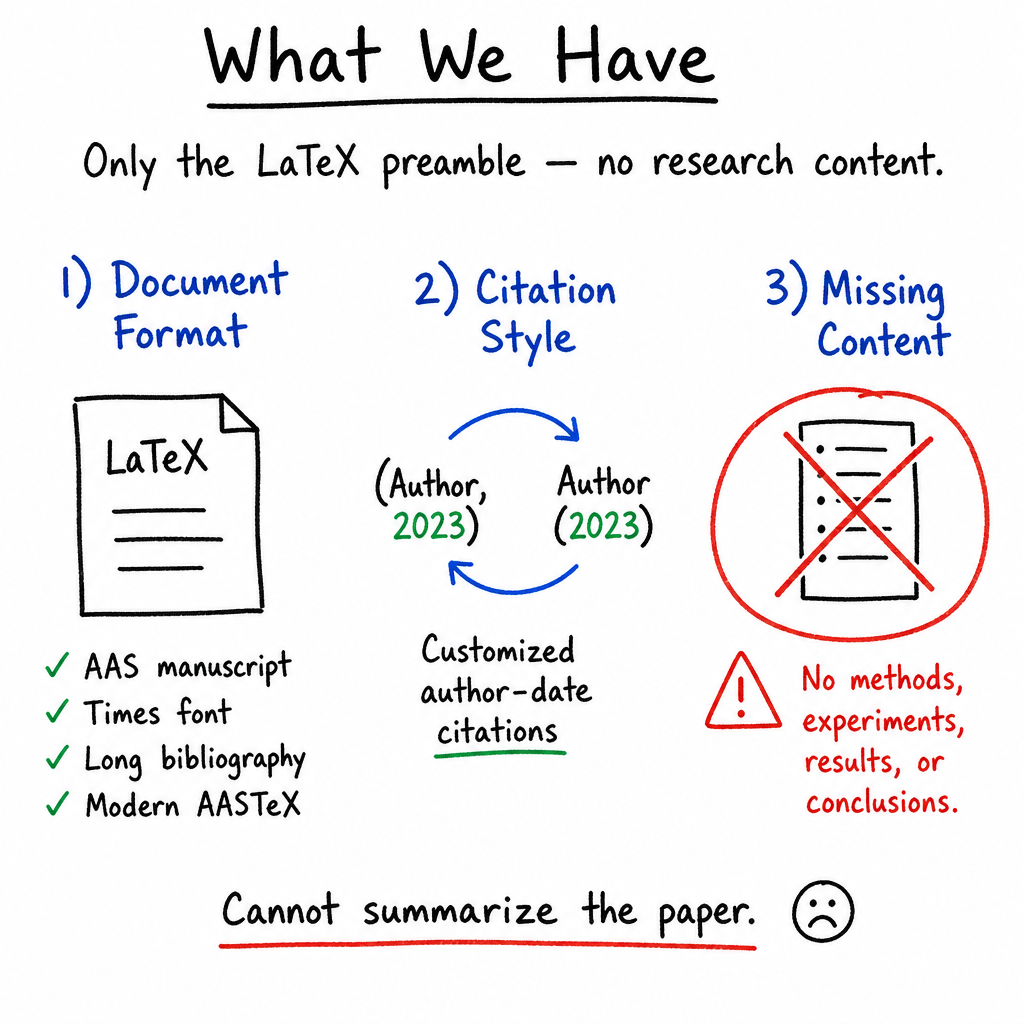
The provided text is not the actual academic paper. It is only the beginning of a LaTeX file, which is a computer document used to format scientific papers.
Because the main text is missing, we cannot explain the paper’s topic, research questions, methods, findings, or conclusions.
What the provided text does
The code prepares a document for publication in an astronomy journal. Several parts suggest this:
aastex701is a document style made for papers in the American Astronomical Society format.bibliographystyle{aasjournalv7}sets the style for the paper’s list of references.- Commands involving
NAT@citexchange how citations appear in the text. \textbfand\textitare shortcuts for making words bold or italic.\begin{document}marks where the actual paper should begin.
An easy analogy is that this code is like setting up the pages, fonts, citation rules, and cover design for a school report. It prepares the report, but it does not include the report’s actual content.
Research questions and methods
The provided excerpt does not contain:
- The paper’s subject or purpose
- Any research questions
- Information about data or experiments
- Descriptions of scientific methods
- Results or conclusions
The only possible clue is that the paper may relate to astronomy, because it uses an astronomy journal format. However, this does not tell us what the research is actually about.
Findings and importance
There are no scientific findings in the supplied text. It contains formatting instructions rather than observations, measurements, or explanations of discoveries.
Implications
No conclusions or real-world effects can be discussed from this excerpt alone. To provide the requested explanation, the paper’s main content is needed—especially its title, abstract, introduction, methods, results, and conclusion.
Please provide the rest of the paper or at least its abstract, and it can then be explained in clear language suitable for a 14-year-old reader.
Knowledge Gaps
Knowledge gaps, limitations, and open questions
The supplied content contains only a LaTeX preamble and the beginning of a document; it does not include the paper’s title, abstract, main text, methods, results, discussion, or references. Therefore, no domain-specific knowledge gaps can be identified. The unresolved issues are:
- The paper’s research question, objectives, and hypotheses are not provided.
- The scientific topic, study context, and target population or dataset are unspecified.
- The methods, experimental or observational design, and analytical procedures are absent, preventing assessment of methodological limitations.
- No results or statistical evidence are included, so the robustness, uncertainty, and reproducibility of the findings cannot be evaluated.
- The paper’s conclusions and their evidentiary support are unavailable.
- The scope, generalizability, and external validity of the claimed findings cannot be determined.
- Potential biases, confounding factors, measurement errors, and limitations are not discussed.
- No future research directions or unresolved theoretical or empirical questions are stated.
- The bibliography is not included, so the paper’s relationship to prior research and any gaps in the existing literature cannot be assessed.
Practical Applications
Immediate Applications
The provided text contains only a partial LaTeX preamble and the beginning of a document; it does not include a research question, methods, results, discussion, or conclusions. Therefore, no evidence-based real-world applications can be derived from scientific findings.
The only limited, directly supported applications concern document preparation:
- Academic publishing — journal-style manuscript preparation: The document uses the
aastex701class and theaasjournalv7bibliography style, indicating an intended workflow for preparing manuscripts in an astronomy-journal format.- Potential tool or workflow: Authors can use this template to produce manuscripts compatible with the target journal’s formatting and citation conventions.
- Feasibility assumptions: The required LaTeX class, bibliography style, and associated packages must be installed and compatible with the author’s TeX distribution.
- Academic writing — citation and hyperlink formatting: The
\patchcmdmodifications appear intended to alter how author–year citations and hyperlinks are rendered.- Potential tool or workflow: A customized citation-formatting template could be integrated into research-group writing workflows or journal submission templates.
- Feasibility assumptions: The patches depend on internal LaTeX commands and may break across package or class versions. They should be tested against the specific
natbib, hyperlinking, and journal-template versions in use.
- Technical documentation — reusable LaTeX templates: The use of shorthand commands such as
\bfor bold text and\ifor italics illustrates how teams can create reusable macros for consistent document production.- Potential tool or workflow: Research laboratories, publishers, or educational institutions could maintain shared LaTeX templates that standardize formatting.
- Feasibility assumptions: Custom macros must be documented and checked for conflicts with existing LaTeX commands or journal requirements.
Long-Term Applications
Because the supplied content ends before the document body and contains no scientific contribution, there is insufficient information to identify defensible long-term applications in sectors such as healthcare, software, robotics, energy, finance, policy, or daily life.
Potential applications could only be assessed after receiving the complete paper, including:
- the research objective and problem definition;
- the proposed methods, models, or experiments;
- empirical results and validation;
- limitations and assumptions; and
- the authors’ conclusions.
Any claims about scientific or societal applications beyond LaTeX-based manuscript preparation would be speculative and unsupported by the provided text.
Glossary
- AASTeX: A LaTeX document class and package system designed for formatting papers in astronomy and astrophysics. “
\documentclass[times, longbib, modern]{aastex701}” - Bibliography style: A specification that determines how bibliographic references are formatted and ordered. “
\bibliographystyle{aasjournalv7}” - Citation: A reference to a source within an academic document. “
\NAT@citex” - Document class: A LaTeX template that defines a document’s overall layout, structure, and formatting rules. “
\documentclass[times, longbib, modern]{aastex701}” - Hyperlink: A clickable reference connecting one document location to another location or resource. “
\hyper@natlinkbreak” - LaTeX: A typesetting system widely used to produce structured technical and scientific documents. “
\begin{document}” - Macro: A named command that expands into a predefined sequence of typesetting instructions. “
\renewcommand{\bibpreamble}{\RaggedRight}” - Modern document class option: A configuration parameter that selects a particular formatting variant of a LaTeX document class. “
modern” - NATBib: A LaTeX citation-management system that supports author–date and numerical citation formats. “
\NAT@date” - Patch command: A macro that modifies the implementation of an existing command by replacing one code fragment with another. “
\patchcmd” - Preamble: The portion of a LaTeX document before
\begin{document}where packages, commands, and formatting settings are defined. “\makeatletter” - Ragged-right alignment: Text alignment in which the left margin is even while the right margin remains uneven. “
\RaggedRight” - TeX category code: An internal TeX classification that determines how characters are interpreted during macro processing. “
\makeatletter” - Typesetting: The process of arranging text and symbols for publication or presentation. “
\renewcommand\deg{\ensuremath{^\circ}” - Bibliography preamble: Formatting instructions inserted before the bibliography entries in a generated reference list. “
\bibpreamble” - BibTeX-style bibliography processing: Automated generation and formatting of bibliographic references from structured source data. “
\bibliographystyle{aasjournalv7}”

