Brennan's Conjecture and the Universal Integral Means Spectrum
Abstract: In October 2026, OpenAI released two preprints \cite{openai-brennan,openai-kraetzer}, establishing Brennan's celebrated conjecture~\cite{brennan,brennan2} and disproving Kraetzer's more general conjecture \cite{kraetzer, kraetzer-thesis}. While validating these results, we observed that much of their argument is redundant and arrived at a drastically shorter proof of a significantly stronger statement. The goal of this note is to give a short and concise presentation of the reborn proof, sacrificing some of the context and consequences for brevity, and relegating them to a follow-up work. In this particular case the human-AI interaction was fruitful and quite satisfactory, and hoping for a similar future in other subjects, we would paraphrase Rick Blaine: {\em ``AI, we hope this is the beginning of a beautiful friendship.''}
Paper Prompts
Sign up for free to create and run prompts on this paper.
Top Community Prompts
Explain it Like I'm 14
1. What is this paper about?
This paper studies a difficult problem in complex analysis, a branch of mathematics that investigates functions involving numbers such as .
The main subject is how much a special kind of function can stretch or distort shapes. These functions are called conformal maps. They preserve angles, so they act like smooth maps that may stretch objects but do not bend them locally.
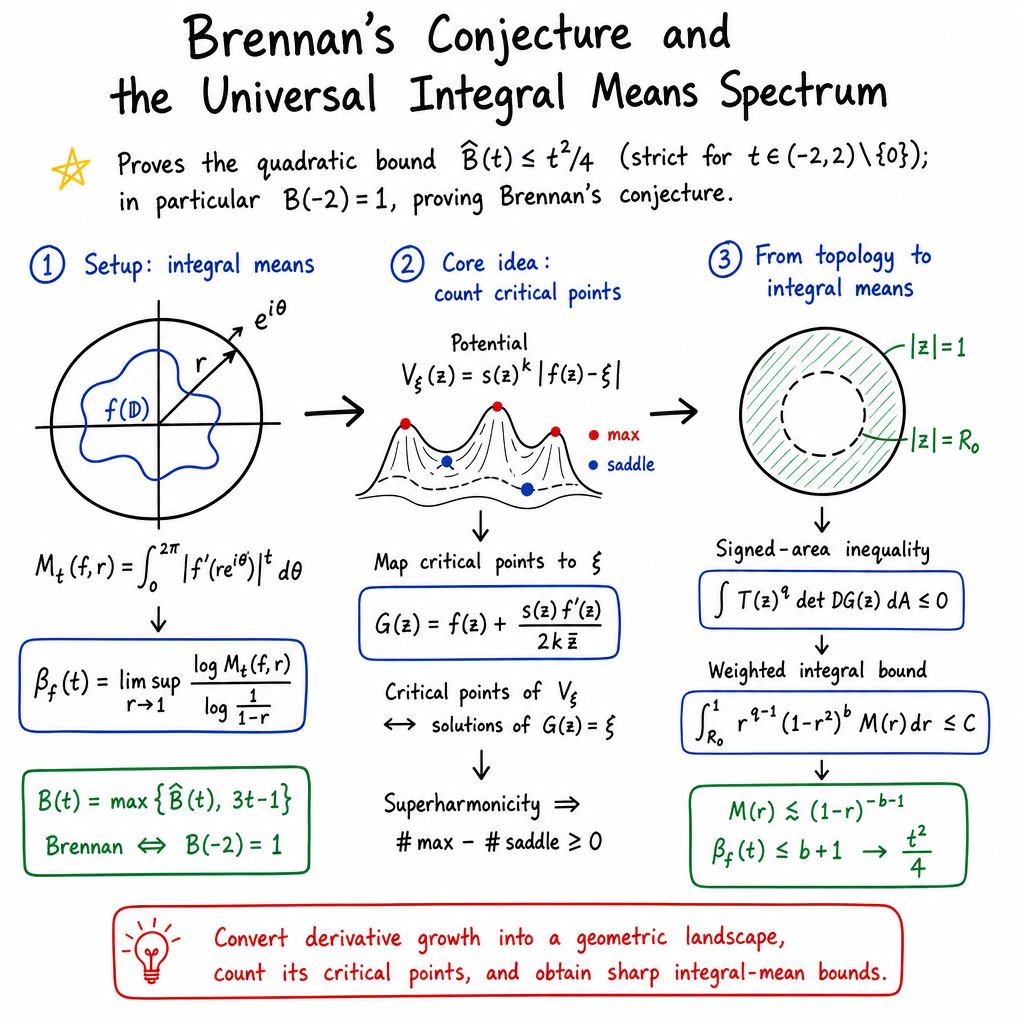
The paper gives a shorter proof of a strong result about the universal integral means spectrum. This result helps settle a famous problem called Brennan’s conjecture, which concerns how large the derivative of a conformal map can become near the edge of a shape.
The authors also discuss earlier work produced with the help of artificial intelligence. They argue that the AI proofs contained many unnecessary steps and that they found a shorter proof of an even stronger statement.
2. What questions are the researchers asking?
The paper focuses on several connected questions:
- How extreme can the stretching of a conformal map be?
- If a conformal map sends a complicated region to the unit disk, can its derivative become so large that a certain area integral becomes infinite?
- How large can the average value of become near the boundary of the unit disk?
- Can the authors prove a general upper limit for this growth?
Brennan’s conjecture says that if maps a suitable region conformally onto the unit disk, then
whenever
$3 Here, measures how strongly the map stretches near the point , and means that we are adding over area. A simple example helps explain the difficulty. Near the end of a narrow slit, the map may behave approximately like
Therefore,
which becomes very large near the slit’s endpoint. The question is whether more complicated shapes with many slits can make the stretching even worse. The authors study a univalent function , meaning a function that is one-to-one, defined on the unit disk . They measure the average stretching around a circle of radius using
As gets closer to $1$, the circle approaches the boundary of the disk. The researchers then record how quickly grows. This growth is represented by the beta spectrum
You can think of this as a score describing how rapidly the average stretching increases near the edge. They then take the worst possible score among all suitable functions. This produces the universal spectrum. The paper mainly studies the bounded version, written as in the paper. For each point outside the boundary image of the disk, the authors define a function
This is called a potential. It can be imagined as a landscape over the disk: The factor forces the potential to become small near the boundary. This makes its high regions stay inside the disk. The logarithm of this potential is superharmonic. Informally, this means the landscape cannot have an ordinary valley in the interior. This restriction gives the researchers strong information about how hills and saddle points can appear. The authors construct an auxiliary map . Its important property is that points satisfying
are exactly the critical points of the potential, apart from a few special cases. They then use the index theorem, a tool from topology. In simple terms, this theorem says that the numbers of different kinds of critical points must balance each other in a predictable way. The result is that, above any suitable height, there are at least as many maxima as saddle points. A saddle point is like a mountain pass: the landscape rises in one direction but falls in another. This balance leads to a signed-area inequality. The researchers compare areas where the auxiliary map behaves like a maximum with areas where it behaves like a saddle. The comparison shows that the saddle contribution cannot dominate. The authors then calculate how changes as changes. These calculations involve and , the first and second derivatives of . A specially chosen expression, called in the paper, collects the difficult terms. After integration by parts, most of the complicated interior terms disappear or become part of a boundary correction. The remaining inequality gives an estimate of the form
This means that the average stretching cannot grow faster than a certain power of the distance to the boundary. Finally, the authors choose the parameter as small as allowed. This makes the exponent as strong as possible and gives
for
The central theorem says that the bounded universal spectrum satisfies
The paper claims something stronger as well: the inequality is strict for
In other words, except at the central value , the actual growth is smaller than the proposed upper limit. Using a known identity relating the bounded and unrestricted spectra, the authors also obtain a strict bound for the full universal spectrum over a further interval:
for
The value is especially important. The paper explains that Brennan’s conjecture can be rewritten as the statement
Thus, the new spectrum estimate proves Brennan’s conjecture. The result is important because it places a firm limit on how violently conformal maps can stretch regions near their boundaries. It also disproves the broader formula proposed by Kraetzer, at least in the cases where the new estimates are stronger than that formula. This research improves our understanding of how complicated shapes behave under conformal maps. Such maps are important in areas including: The main lesson is that even though a conformal map can stretch parts of a shape enormously, there is still a universal limit on how extreme this stretching can be on average. The paper also illustrates how different mathematical ideas can work together: Finally, the paper presents an example of humans and AI contributing to mathematical research. According to the authors, AI helped produce an important but overly long argument. The human researchers then understood the central idea, removed unnecessary parts, and obtained a shorter proof of a stronger result. However, they also say that the method does not yet fully explain which shapes are the most extreme, so important questions remain open.3. What methods did the paper use?
Measuring stretching near the boundary
Introducing a potential function
Counting maxima and saddle points
Connecting the geometry to integral means
4. What are the main results?
5. Why does this matter?
Knowledge Gaps
Knowledge gaps, limitations, and open questions
- The paper does not provide the deferred details needed to establish the strict inequality for ; in particular, the proposed perturbation of the weight in equation (6) and the “averaged positivity” argument are only sketched.
- It remains unresolved whether the proof can yield quantitative strictness: no explicit gap, such as with a computable , is derived.
- The argument does not identify or characterize extremal or near-extremal conformal maps for the upper bound .
- It is unclear whether the method can produce a sharp upper estimate for the universal integral means spectrum, despite the authors’ statement that it “clearly can give better estimates.”
- The proof establishes the quadratic bound only for the bounded spectrum on and derives a corresponding restricted improvement for ; it does not determine the full universal spectrum outside the interval covered by the argument.
- The paper does not resolve the status of Kraetzer’s conjecture beyond the reported failure at ; the correct form of and the location and structure of any deviations from remain unknown.
- The relationship between the new bounds and the sharp spectrum of harmonic measure is not developed, even though the introduction identifies this as an equivalent or closely related perspective.
- The critical-point counting argument relies on regular values, Sard’s theorem, and nondegenerate critical points, but the paper does not fully explain how the signed-area inequality extends to degenerate critical points, critical values, and singular limiting configurations.
- The treatment of the possible pole and the omitted origin is concise; a complete analysis of how these singularities affect the index count and area formula in all limiting cases is not provided.
- The proof assumes that the conformal map extends analytically to a neighborhood of the closed disk and argues that this is harmless by radial approximation, but the passage to general bounded univalent maps leaves technical details unresolved, especially regarding uniformity in and the limiting behavior of all error terms.
- The uniform estimate in equation (24) depends on the assertion that the relevant compactness bounds are independent of ; the paper does not give a detailed proof that these bounds remain uniform for the entire approximating family.
- The choice of the auxiliary parameter is eventually sent to the endpoint , but the paper does not analyze whether the limiting procedure preserves any strictness, stability, or quantitative constants.
- The proof treats and separately but does not address in detail the endpoint , including whether the bound there is attained, how it relates to Brennan’s conjecture, and whether the method gives any endpoint improvement.
- The paper does not determine whether the bound is attained or only approached by sequences of bounded univalent maps.
- No examples are constructed to test the strength of the new inequality beyond the slit-map heuristic; comparisons with known extremal candidates, quasidisks, snowflake maps, or other explicit families are absent.
- The topological interpretation of maxima and saddles is not connected to a broader theory of critical-point distributions or persistence structures for conformal maps, despite the introduction citing Morse theory and zero-dimensional persistence.
- The authors state that discarded parts of the AI-generated proof might be useful elsewhere, but do not identify which redundant arguments contain potentially reusable ideas or formulate general principles abstracted from them.
- The proposed probabilistic and positive-operator methods from the preceding AI proofs are not incorporated into the final argument, leaving open whether they can yield stronger bounds, stability results, or results for random conformal maps.
- The paper does not investigate whether the signed-area method extends to unbounded maps, multiply connected domains, non-univalent maps, or other classes of conformal or quasiconformal mappings.
- The dependence of the method on boundedness is not isolated: it remains unclear which parts of the argument survive under weaker assumptions, such as finite area, controlled growth, or prescribed geometric conditions on the image domain.
- The claimed implications for Brennan’s conjecture are not accompanied by a separate discussion of sharpness of the integrability range or by a classification of domains for which the endpoint behavior is extremal.
- The paper defers computationally intensive results to a separate preprint, so it does not provide numerical evidence, computational algorithms, or experiments that could test the new bounds and identify likely near-extremizers.
- The paper does not establish whether the method can be adapted to obtain lower bounds for the spectrum, which are necessary for determining rather than merely bounding it from above.
- The impact of the strict inequality on related quantities—such as harmonic-measure dimension, asymptotic variance, quasicircle dimension, or multifractal spectra—is left unexplored.
Practical Applications
Immediate Applications
- Numerical stability bounds for conformal-mapping software — Software, computational geometry, engineering. The bound
constrains how rapidly derivatives of bounded univalent maps can concentrate near the boundary. Existing conformal-mapping packages can use this as a theoretically justified regularity prior when computing maps from the disk to domains with corners, narrow channels, slits, or fractal-like boundaries. Potential workflow: estimate boundary derivative growth, compare it with the universal spectrum bound, and flag numerical solutions exhibiting implausibly strong singularities. Dependencies: reliable discretization of boundary derivatives; the theorem applies to genuinely univalent maps and does not automatically cover approximate or non-injective numerical maps.
- Error control for harmonic-measure and boundary-concentration computations — Computational potential theory, geophysics, environmental modeling. Since the integral-means spectrum is connected to multifractal behavior of harmonic measure, the result supplies upper bounds on the concentration of harmonic measure near complicated boundaries. This can be incorporated into adaptive mesh refinement: regions predicted to have high derivative concentration can receive finer discretization, while the theorem provides a worst-case benchmark. Dependencies: translating an asymptotic spectrum bound into finite-resolution error estimates requires additional quantitative analysis; the paper itself proves asymptotic statements rather than implementation-ready constants.
- Benchmarking extremal-domain simulations — Mathematical software and numerical research. Researchers investigating slit domains, snowflake boundaries, quasidisks, or other candidate extremizers can use the strict inequality
for nonzero as a falsification test. A computed example appearing to attain the quadratic bound in the interior range likely reflects discretization error, insufficient resolution, or an incorrect normalization. Dependencies: the strict result is qualitative in the paper; it does not specify a universal numerical gap from .
- Improved validation of Brennan-type integrability claims — Complex analysis, PDE, fluid and electrostatic modeling. The paper establishes the key spectral estimate underlying Brennan’s conjecture, namely the finiteness of area integrals of conformal derivatives in the relevant exponent range. This can be used when validating analytical assumptions in models that transform Laplace, elasticity, electrostatic, or incompressible-flow problems through conformal coordinates. Dependencies: practical models must satisfy the required domain and conformality assumptions. The theorem does not by itself provide finite-domain constants or stability estimates for noisy geometries.
- Training material for advanced mathematics and AI-assisted theorem proving — Academia and mathematical education. The proof offers a compact case study combining superharmonic potentials, critical-point maps, Jacobian signs, index theory, area formulas, integration by parts, and integral-means estimates. It can support graduate courses, reading groups, or benchmark datasets for proof assistants and mathematical AI systems. Potential tools: annotated proof graphs, tactic-generation benchmarks, and human-readable versus machine-generated proof comparisons. Dependencies: the paper notes that some derivations in the original AI-generated argument were redundant or mysterious, so educational use requires expert verification and careful exposition.
- Human–AI research workflows for mathematical discovery — Academic research and AI tooling.
The reported workflow—AI-generated or AI-assisted proofs followed by human simplification, verification, and strengthening—can be adopted as a practical protocol for research teams. A useful workflow would separate:
- automated conjecture and proof exploration;
- independent human checking;
- removal of redundant arguments; and
- extraction of stronger or more general statements. Dependencies: rigorous proof verification remains essential. The paper does not establish that the method generalizes reliably beyond this problem.
Teaching and visualization of critical-point topology — Education and scientific visualization. The potential
and the critical-point map provide a concrete way to visualize maxima, saddles, level sets, and signed Jacobian areas. Interactive demonstrations could help students understand how Morse-type counting and area formulas yield analytic inequalities. Dependencies: visualizations would illustrate the proof but would not replace the regularity, Sard-theorem, and limiting arguments required for rigorous conclusions.
Long-Term Applications
- Adaptive conformal-mesh algorithms for singular geometries — Scientific computing, CAD, fracture mechanics, and PDE simulation. A future solver could combine integral-means estimates with local boundary geometry to predict where conformal coordinates will amplify gradients. Such a solver might automatically refine meshes near slits, cusps, corners, or screened boundary components while avoiding excessive refinement elsewhere. Dependencies: this requires local, finite-scale versions of the asymptotic spectrum bounds and a practical relationship between and discretization error.
- Quantitative regularity theory for transformed PDEs — PDEs, fluid dynamics, heat transfer, elasticity, and electromagnetics. Conformal changes of variables often transfer boundary singularities into derivative weights. Stronger and quantitative forms of the paper’s estimates could yield improved integrability classes for transformed solutions and sharper conditions for finite energy, flux, or dissipation. Dependencies: additional estimates are needed for constants, non-asymptotic scales, and domains that are not simply connected or exactly conformally represented.
- Characterization of extremal or near-extremal conformal domains — Pure mathematics and geometric analysis. The authors state that the current argument does not identify the extremal map and may not provide a sharp upper estimate. A future theory could determine which domains nearly saturate the universal spectrum bounds. This could lead to libraries of extremal test geometries for numerical conformal mapping and harmonic-measure algorithms. Dependencies: solving the extremizer problem likely requires new compactness, rigidity, or variational methods; strictness alone does not identify the maximizing sequence.
- Algorithms based on positive growth operators and thermodynamic formalism — Fractal geometry, random conformal maps, and stochastic simulation. The probabilistic component of the related AI proofs uses a positive growth operator encoding derivative moments across scales. If formalized and made computational, this could produce algorithms for estimating spectra of random conformal snowflakes, iterated slit constructions, or other stochastic boundary models. Dependencies: operator discretization, convergence guarantees, invariant-measure construction, and computational complexity remain unresolved. The paper explicitly says that further progress may be computationally intensive.
- Improved models of harmonic-measure multifractality — Fractal transport, porous media, aggregation, and environmental science. Since universal integral-means spectra control aspects of harmonic-measure concentration, future extensions could constrain models of diffusion-limited aggregation, transport through porous structures, or random interface growth. The result could serve as a universal upper envelope against which experimentally or computationally estimated multifractal spectra are compared. Dependencies: physical systems are often nonconformal, noisy, finite, or three-dimensional. Applying the theorem requires a justified reduction to planar conformal geometry.
- Formal verification pipelines for research-level analysis — Formal methods and AI for mathematics. The proof’s modular structure—potential construction, critical-point classification, signed-area inequality, radial integral identity, and limiting argument—could be translated into a formally verified library for conformal maps and subharmonic functions. This would help assess future AI-generated proofs and detect hidden assumptions or redundant steps. Dependencies: substantial formalization work is required for complex analysis, Sard’s theorem, area formulas, boundary limits, and measure-theoretic convergence. Human-readable proof compression must not remove indispensable hypotheses.
- Generalization to broader mapping classes and domains — Geometric function theory and applied analysis. Long-term research could investigate whether analogous inequalities hold for quasiconformal maps, multiply connected domains, harmonic mappings, or mappings with controlled distortion. Such extensions could broaden applicability to realistic geometries that cannot be represented by a single univalent map from the disk. Dependencies: injectivity, boundedness, simply connectedness, and conformality are used substantially in the paper; relaxing them may require entirely different critical-point and area-counting arguments.
- Policy and research-governance standards for AI-generated mathematics — Research institutions, publishers, and funding agencies. The paper illustrates a reproducible model in which AI contributes to discovery while humans independently simplify, verify, and author the final exposition. This could inform institutional standards requiring disclosure of AI involvement, independent proof checking, provenance of derivations, and explicit separation between verified theorems and speculative consequences. Dependencies: such standards would need consensus on authorship, accountability, reproducibility, and acceptable evidence for AI-assisted mathematical claims.
Glossary
- Affine-covariant probability law: A probability distribution preserved under an appropriate affine transformation. “a derivative-weighted affine-covariant probability law”
- Analytic continuation: Extension of an analytic function beyond its original domain. “our conformal map can be extended to be analytic in a neighborhood of the closed unit disk”
- Area formula: A change-of-variables theorem relating integrals over a domain to integrals over its image, accounting for the Jacobian. “Apply the real area formula separately on and .”
- Bergman space: A function space of analytic functions that are integrable with respect to area measure, often with a weight. “Hedenmalm and Shimorin’s weighted Bergman-space approach”
- Beta spectrum: A growth-rate function measuring the asymptotic behavior of integral means of derivatives of conformal maps. “we define the beta spectrum by”
- Borel function: A function measurable with respect to the Borel -algebra generated by open sets. “For every Borel function ”
- Cauchy estimate: An inequality bounding derivatives of an analytic function using bounds on the function itself. “The weight is bounded, hence Cauchy estimate gives a disk ”
- Conformal dimension: A fractal-dimension concept based on the infimum of dimensions obtainable under suitable conformal transformations. “On coefficient problems for univalent functions and conformal dimension.”
- Conformal map: A map that preserves angles locally, typically represented by a holomorphic function with nonzero derivative. “for every conformal map ”
- Conformal metric: A metric obtained by multiplying a base metric by a positive position-dependent scale factor while preserving angles. “critical points of conformal metrics”
- Conformal snowflake: A randomly or iteratively constructed conformal map whose boundary exhibits snowflake-like fractal behavior. “positive-operator method for random conformal snowflakes”
- Critical point: A point where the derivative or gradient of a function vanishes, often corresponding to an extremum or saddle. “A critical-point map records the target associated with each critical point”
- Derivative moment: An averaged or integrated power of the magnitude of a derivative, used to quantify growth across scales. “encodes derivative moments at successive scales”
- Diffeomorphism/Jacobian sign: The sign of a map’s Jacobian determinant, which can distinguish orientation-preserving from orientation-reversing local behavior. “the sign of its Jacobian distinguishes maxima from saddles”
- Harmonic measure: A probability measure describing the likelihood that Brownian motion or a related process first exits a domain through a given boundary set. “the multifractal spectra of harmonic measure”
- Harmonic obstruction: A contradiction or limitation arising from the properties of harmonic or subharmonic functions. “The strict inequality is guaranteed by a global harmonic obstruction.”
- Hessian: The matrix of second partial derivatives of a scalar function, used to classify critical points. “”
- Index theorem: A theorem relating the indices of a vector field’s zeros to the topology of the domain. “The index theorem gives”
- Integral means spectrum: A function describing the asymptotic growth of circular averages of powers of the derivative of a conformal map near the boundary. “Brennan’s conjecture reduces to the study of the integral means spectrum of conformal maps”
- Invariant-measure averaging: Averaging with respect to a measure unchanged by a transformation or dynamical system. “The construction of the law parallels invariant-measure averaging”
- Inverse-square bound: An estimate involving a quantity proportional to the inverse square of a parameter or variable. “Brennan’s conjecture and sharp inverse-square integral means”
- Jordan domain: A domain whose boundary is a Jordan curve, meaning a simple closed curve. “Then every component of is a Jordan domain”
- Kraetzer’s conjecture: A conjectured formula for the bounded universal integral means spectrum. “Kraetzer’s conjecture (5) was shown to be false at .”
- Lebesgue area measure: The standard two-dimensional measure on the plane, denoted in the paper by . “the area integral satisfies”
- Makarov’s identity: The relation expressing the universal spectrum as the maximum of the bounded spectrum and a linear function. “Makarov’s identity [23, Theorem 5.4] states that”
- Mass-transport principle: A method that equates expected mass sent and received in a stationary or invariant random system. “averaged transport with transport of stationary random measures”
- Mellin-type growth exponent: An exponent obtained from the asymptotic growth of weighted integral moments; in the paper this is encoded by . “we define the beta spectrum by”
- Morse theory: A framework relating the critical points of smooth functions to the topology of the spaces on which they are defined. “Morse theory and, more recently, zero-dimensional persistence naturally describe the topological bookkeeping”
- Multifractal spectrum: A function describing the distribution of local scaling exponents across a geometrically complex measure or set. “the multifractal spectra of harmonic measure”
- Nondegenerate critical point: A critical point whose Hessian is nonsingular, so that its local behavior is structurally stable. “For almost every , Sard’s theorem and compactness give finitely many, all non-degenerate, solutions of (11).”
- Palm pair: A pair of random measures or configurations used to study a typical point in a stationary random measure. “Palm pairs and the general mass-transport principle.”
- Positive growth operator: An operator that preserves nonnegative functions and describes scale-dependent growth or averaging. “A positive growth operator encodes derivative moments at successive scales”
- Quasiconformal reflection: A reflection-like mapping with controlled distortion that is quasiconformal rather than exactly conformal. “The critical maps have antecedents in quasiconformal reflection”
- Quasicircle: The image of a circle under a quasiconformal homeomorphism, generally forming a possibly fractal Jordan curve. “Quasicircles of dimension do not exist.”
- Real area formula: The area change-of-variables formula for real differentiable maps, involving the absolute Jacobian determinant. “Apply the real area formula separately on and .”
- Sard’s theorem: A theorem stating that the set of critical values of a sufficiently smooth map has measure zero. “For almost every , Sard’s theorem and compactness give finitely many”
- Signed-area inequality: An inequality obtained by integrating area contributions with signs determined by the orientation or Jacobian. “we obtain the signed area inequality (19)”
- Simply connected domain: A domain containing no holes, so every closed curve in it can be continuously contracted to a point. “from a simply connected proper plane domain”
- Stationary random measure: A random measure whose distribution is invariant under translations or another group of transformations. “transport of stationary random measures”
- Subharmonic function: A function whose value at each point does not exceed the average over surrounding circles; equivalently, its Laplacian is nonnegative in the smooth case. “ is subharmonic”
- Superharmonic function: A function whose value at each point is at least the average over surrounding circles; equivalently, its Laplacian is nonpositive in the smooth case. “The proofs in [25, 26] rely on a family of potentials whose logarithms are superharmonic.”
- Thermodynamic formalism: A collection of methods connecting dynamical systems with statistical mechanics through pressure, invariant measures, and growth rates. “The operator approach has predecessors in thermodynamic formalism”
- Univalent function: An analytic function that is one-to-one on its domain. “For a univalent map of a unit disk ”
- Universal spectrum: The supremum of the beta spectrum over a specified class of univalent maps. “We define the universal spectra by”
- Weighted signed-area inequality: An area inequality in which regions are weighted and contributions are signed according to local map behavior. “gives a weighted signed-area inequality”
- Zero-dimensional persistence: A topological persistence method tracking connected components across changing levels of a function. “Morse theory and, more recently, zero-dimensional persistence naturally describe the topological bookkeeping”