LLM-jp-4 Technical Report
Abstract: This paper presents LLM-jp-4, a family of Japanese sovereign LLMs developed with an emphasis on transparency, reproducibility, and practical usability. LLM-jp-4 comprises an 8B dense model and a 32B-A3B mixture-of-experts model, both trained from scratch on approximately 12 trillion tokens. To support independent verification and reproduction, we establish explicit criteria for selecting training data, external models, and software, and make the development process publicly available. Evaluation results demonstrate substantial improvements over previous LLM-jp models and competitive performance against open-weight models of similar scale. By documenting the development principles, training procedures, and empirical findings of LLM-jp-4, we aim to provide a reference for future sovereign AI development.
Paper Prompts
Sign up for free to create and run prompts on this paper.
Top Community Prompts
Explain it Like I'm 14
1. Paper overview
This paper introduces LLM-jp-4, a family of LLMs designed especially for Japanese and other languages.
A LLM, or LLM, is an AI system trained on huge amounts of text so it can answer questions, write text, translate languages, solve problems, and write computer code.
The researchers wanted to build an AI model that was:
- Strong at Japanese and other languages
- Open for researchers and developers to study
- Possible for others to reproduce or rebuild
- Careful about copyright and software licenses
- Useful for Japan’s own independent AI development
The models were trained using about 12 trillion tokens. A token is a small piece of text, such as a word, part of a word, or punctuation mark.
LLM-jp-4 includes two main models:
- An 8-billion-parameter dense model
- A 32-billion-parameter mixture-of-experts model, with about 3.8 billion parameters active for each piece of text
The models are released under the Apache 2.0 license, a common open-source license.
2. Main goals and research questions
The researchers were mainly asking:
- Can they build a powerful Japanese-focused LLM from scratch?
- Can they make the entire development process open and reproducible?
- Can they use training data and software with clear legal and licensing conditions?
- Which kinds of data help the model improve at Japanese, mathematics, and programming?
- Can the models compete with other open models of a similar size?
- Can the models be designed so that people can easily use, study, and improve them?
The idea of building AI independently is called sovereign AI. It means that a country or community can develop and control important AI systems instead of depending completely on a few foreign companies.
3. How the research was carried out
Choosing the training data
The researchers gathered text from many sources, including:
- Japanese books, websites, government documents, and news
- English books, academic papers, websites, and encyclopedias
- Chinese and Korean text
- Mathematics documents
- Computer-programming code
They carefully checked whether the data could legally be used to train a public model. They also checked how some datasets had been created. For example, if another dataset had been produced using a model with restrictive rules, LLM-jp-4 might not use it.
The researchers divided datasets into five permission levels. Only the first three levels were used for training the publicly released models.
This is similar to checking the rules on ingredients before cooking a meal that will be sold to the public. It is not enough to know that an ingredient is available; you must also know whether you are allowed to use and share the finished meal.
Creating high-quality datasets
The team used computer models to judge the quality of documents. For example, they created FineWeb-Rescored, a dataset in which web pages were given scores for educational value.
They also created a mathematics dataset called MegaMath-Web-Pro-Max-OSS. It was made using an openly licensed AI model rather than a model with restrictions that might affect the final model.
Small experiments were used to decide how much of each type of data should be included. For example, the researchers tested whether adding more Japanese, mathematics, or programming data improved performance.
Building the model structures
LLM-jp-4 uses two kinds of model designs.
Dense model
In a dense model, nearly all parts of the model work on every piece of text. It is like asking every student in a classroom to help solve every problem.
Mixture-of-experts model
In a mixture-of-experts, or MoE, model, different parts called “experts” specialize in different tasks. For each piece of text, only some experts are used.
This is like having a classroom where a math specialist helps with equations, a language specialist helps with writing, and a programming specialist helps with code. The teacher chooses which specialists are needed for each question.
The 32B-A3B model contains about 32 billion parameters in total, but only about 3.8 billion are active at one time. This can make it more efficient to run.
Teaching the models
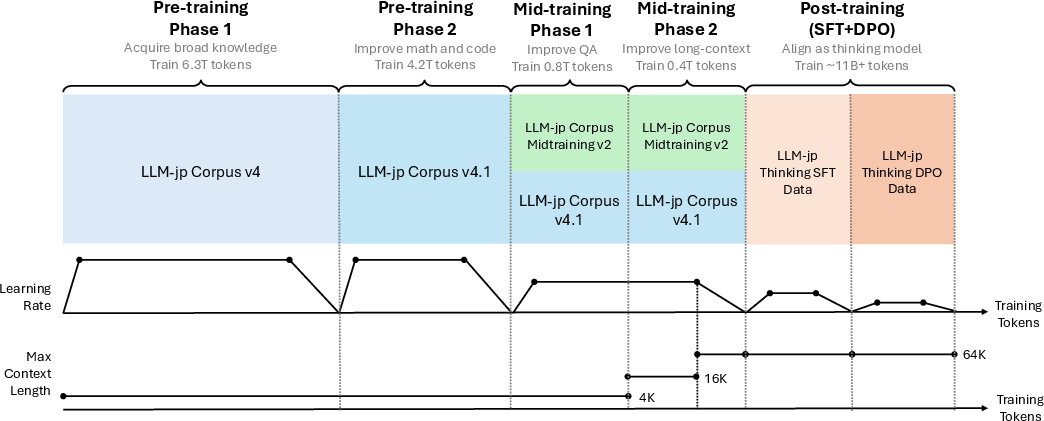
Training happened in several stages:
- Pre-training: The models read a huge amount of text and learned general patterns, facts, language, mathematics, and code.
- Mid-training: The models were trained to work better with questions and longer documents.
- Post-training: The models were adjusted to answer more helpfully and to reason through problems.
The paper excerpt describes the first major training stages in detail. During pre-training:
- Phase 1 used about 6.3 trillion tokens from a broad collection of data.
- Phase 2 used about 4.2 trillion more tokens, with extra mathematics and programming data.
The researchers also tested different training settings before starting the full training. For example, they tested different batch sizes, learning-rate schedules, and ways of processing documents.
A batch is a group of examples processed together. A smaller batch can sometimes help a model learn more effectively, but it may use computer hardware less efficiently.
A learning rate controls how much the model changes after each lesson. If it is too large, the model may learn chaotically. If it is too small, learning may take too long.
Testing the models
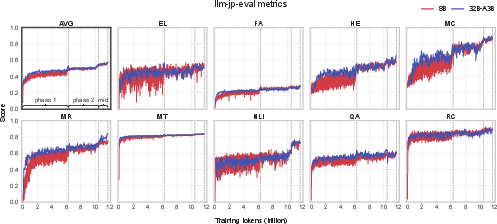
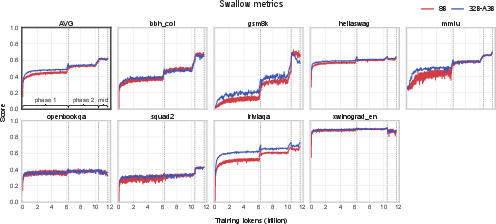
The researchers used evaluation suites, or collections of tests, such as:
- Japanese reading and language tasks
- Question answering
- Mathematics
- Programming
- General knowledge
- English-language tasks
They also performed smaller experiments to compare different training-data choices. For example, they tested whether adding a mathematics dataset improved the model’s scores.
4. Main findings
LLM-jp-4 was much better than earlier LLM-jp models
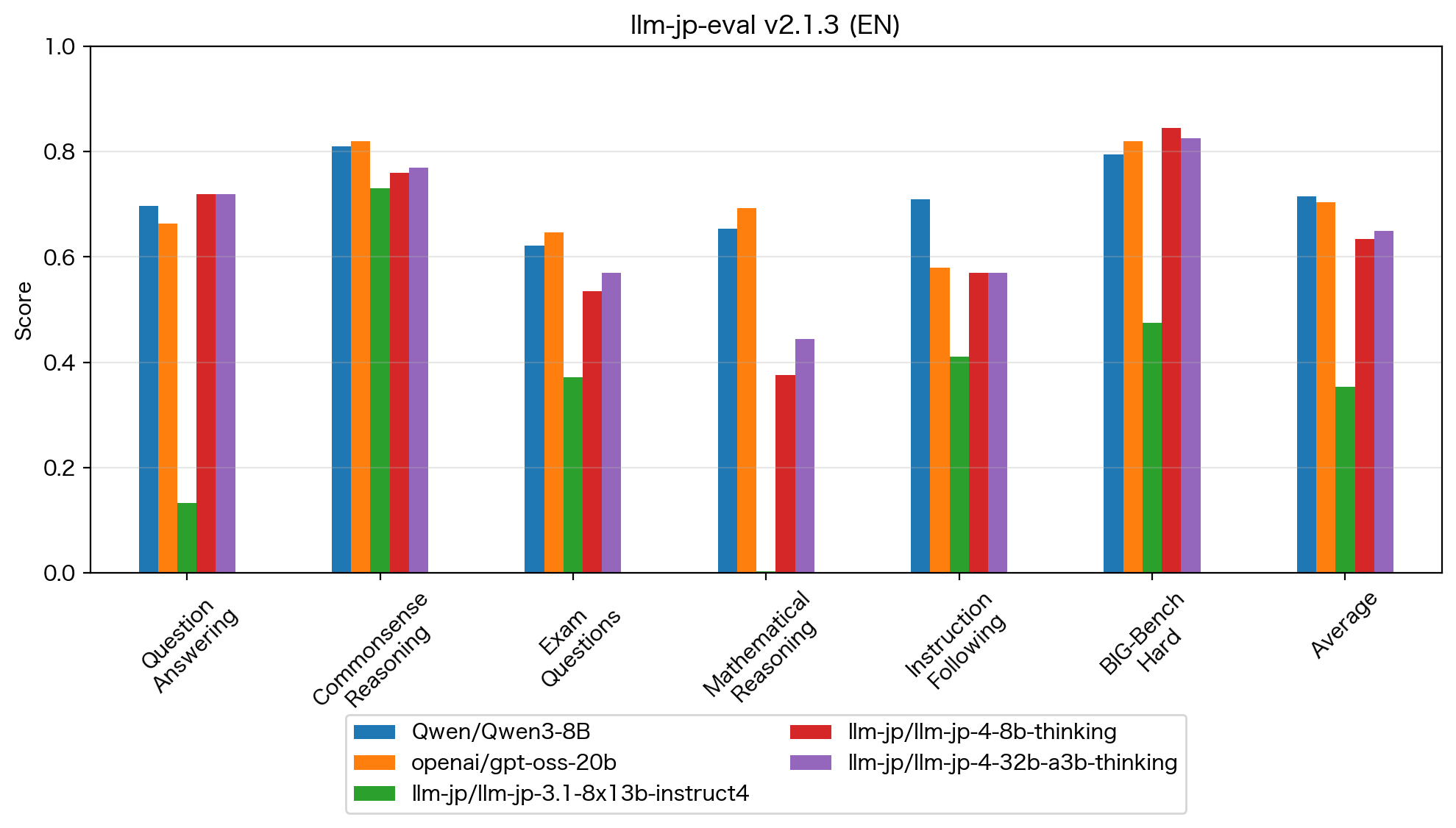
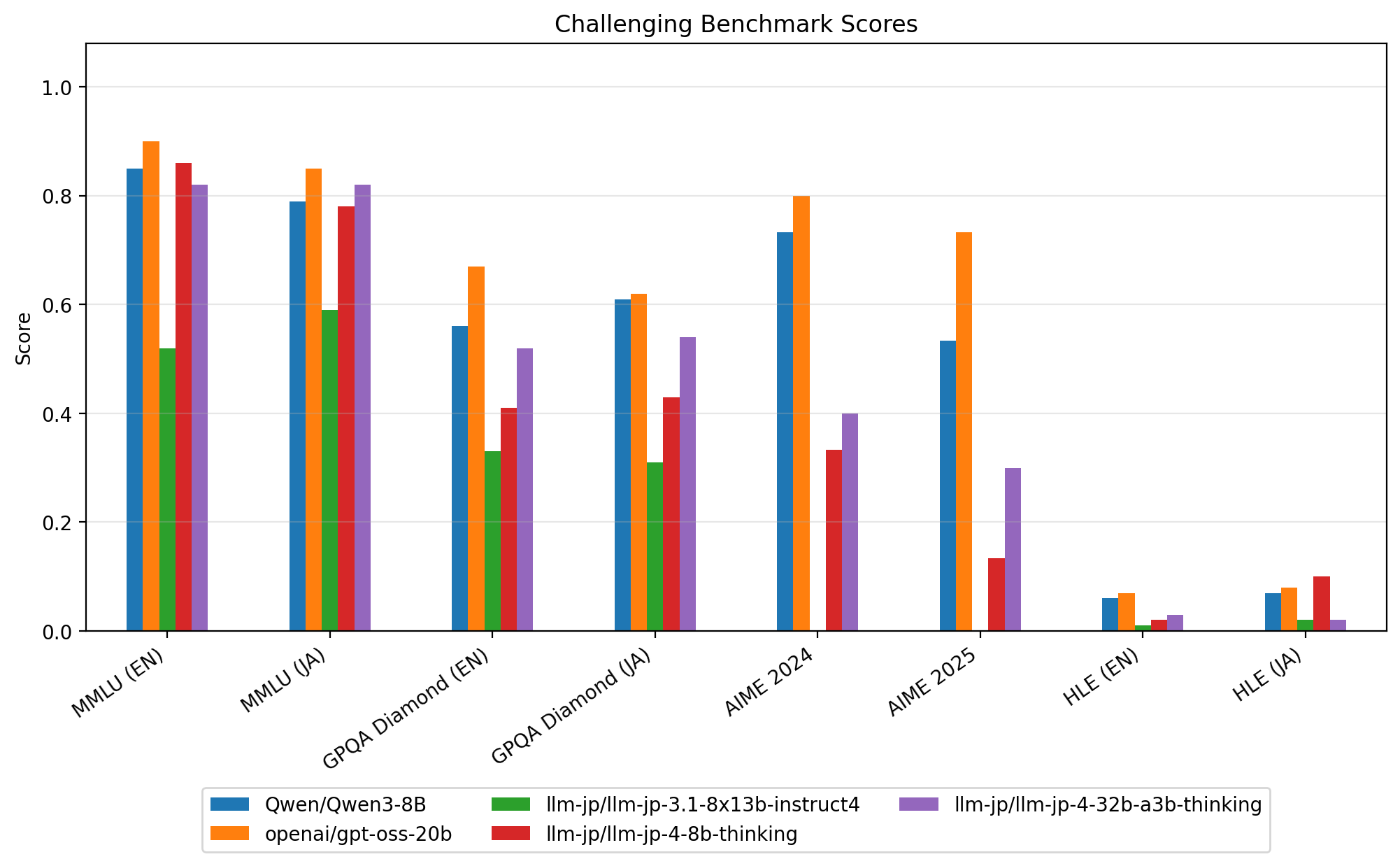
The paper reports that LLM-jp-4 made substantial improvements over previous versions of the LLM-jp family.
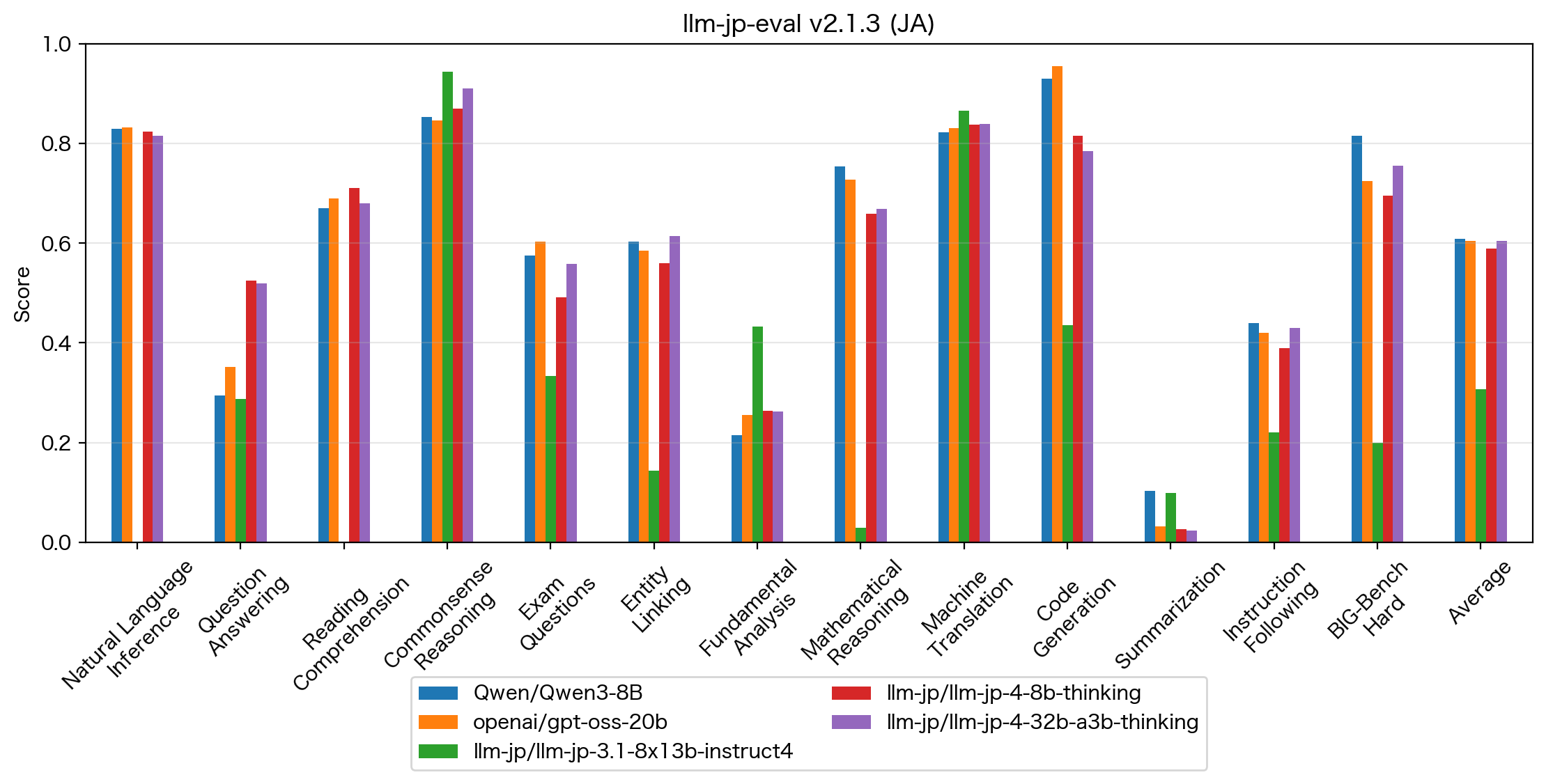
It also reached performance similar to strong open models of a similar size, especially on Japanese benchmarks.
This is important because it shows that an openly developed Japanese model can be competitive with models made by much larger companies.
Mathematics and programming data helped
The researchers found that adding the MegaMath-Web-Pro-Max-OSS dataset gave a clear improvement on one of their evaluation tests.
Replacing the older programming dataset with a newer one did not improve every test overall, but it helped on some tasks involving:
- Programming
- Understanding code
- General academic knowledge
Because of these improvements, the researchers decided to use the newer programming dataset.
The experiments also suggested that adding more mathematics and code data did not clearly harm general language abilities.
Careful data selection mattered
The study showed that the amount of data is not the only important factor. The quality and type of data matter too.
For example:
- Curated books and academic papers received higher sampling weights.
- High-quality web pages were used more often than low-quality web pages.
- Japanese data was deliberately increased because Japanese ability was a major goal.
- Mathematics and code data were increased during the second training phase.
This is similar to studying for an exam: reading ten excellent textbooks may be more useful than reading one hundred random pages from the internet.
The models were designed for practical use
The researchers chose model designs based on widely used open-source systems. This means that existing software can help people run, modify, and further train LLM-jp-4.
The models can process contexts of up to 65,536 tokens, allowing them to work with long documents.
The new tokenizer also supports Japanese, English, Chinese, and Korean. A tokenizer is the part of a LLM that breaks text into smaller pieces before the model reads it.
The tokenizer was designed to:
- Handle all normal UTF-8 text
- Preserve spaces and formatting
- Work efficiently with computer code
- Split numbers into individual digits, which helped mathematical performance
- Avoid turning unfamiliar text into an unknown symbol
Transparency was a central achievement
The researchers did not release only the final model files. They also described:
- Which data they used
- How they processed the data
- Which outside models they allowed
- Which software they used
- How they trained the models
- How they selected training settings
This makes it easier for other researchers to check the work, repeat the experiments, or build improved versions.
5. Why the research matters
LLM-jp-4 could have several important effects.
First, it gives Japan and other researchers an open foundation for developing AI that works well with Japanese. This may reduce dependence on a small number of private companies or foreign systems.
Second, the project helps scientists understand how LLMs learn. If the training process is hidden, it is difficult to know why a model is good at some tasks, weak at others, or likely to make certain mistakes. Open development makes these questions easier to study.
Third, the project provides models that universities, companies, and individual developers can use and adapt. The Apache 2.0 license makes the legal rules relatively easy to understand.
However, openness does not automatically make an AI system safe or correct. The models can still make mistakes, produce biased answers, or be used irresponsibly. Users must check important answers and avoid using the models for harmful or legally problematic activities.
Simple conclusion
LLM-jp-4 is an effort to build powerful Japanese-focused AI in a transparent and open way. The researchers trained two models on enormous amounts of carefully selected multilingual data, with special attention to Japanese, mathematics, and programming.
The main lesson is that good AI depends not only on making a bigger model, but also on choosing good data, testing training methods, following clear legal rules, and sharing the development process.
The project may help Japan and the wider research community create AI that is more independent, understandable, and useful.
Knowledge Gaps
Knowledge gaps, limitations, and open questions
- The paper text ends during the pre-training evaluation section, so the final evaluation methodology, results, and conclusions for LLM-jp-4 are not available for independent assessment.
- The claimed competitiveness with similarly sized open-weight models is not substantiated in the provided text because comparative results, baselines, statistical significance, and confidence intervals are absent.
- The evaluation coverage is unclear beyond
LLM-jp-evaland the Swallow benchmark; performance on safety, factuality, robustness, calibration, multilingual tasks, long-context tasks, and real-world applications is not reported. - The paper does not establish whether the models’ capabilities generalize beyond Japanese benchmarks, despite including English, Chinese, Korean, mathematics, and code in the training corpus.
- The effects of the training-data composition are not isolated at production scale. The corpus-mixture studies use 7.7B or 8B proxy models and substantially smaller token budgets than the final runs, leaving uncertain whether the findings transfer to the 32B-A3B MoE model and 10.5T-token training regime.
- The Phase 1 mixture search is explicitly heuristic rather than systematic, with only 13 candidate configurations; the globally or near-optimally balanced corpus composition therefore remains unknown.
- The Phase 2 fractional-factorial design has Resolution III, meaning that main effects are aliased with two-factor interactions. The reported effects of replacing Stack v1, reducing FineWeb, and adding other corpora cannot therefore be cleanly separated from interaction effects.
- The Phase 2 ablations are evaluated after approximately 210B tokens of continued pre-training from a checkpoint, which may not predict the effects of the same modifications over the full 4.2T-token Phase 2 schedule.
- The decision to retain all five Phase 2 modifications despite none meeting the predefined criteria on
LLM-jp-evalis not fully justified, particularly for the Laboro ParaCorpus and FinePDFs additions. - The paper does not quantify how much each corpus contributes to specific capabilities after controlling for token count, data quality, duplication, language, and domain overlap.
- The reproducibility of automatically constructed datasets remains incomplete because the paper acknowledges that some implementation details of MegaMath-Web-Pro-Max could not be reproduced from public information.
- The impact of replacing proprietary or restricted teacher models with open models such as Qwen3-32B and
gpt-oss-120bis not systematically measured. It remains unclear whether the resulting datasets preserve the quality and distribution of the originals. - The educational-value classifier used for FineWeb-Rescored is trained from labels generated by Qwen3-32B, but the paper does not report inter-model agreement, human validation, classifier accuracy, or demographic and topical biases in those labels.
- The legal status and provenance of the full corpus are described through release levels, but the paper does not provide a complete audit of copyright claims, opt-outs, personally identifiable information, data contamination, or jurisdiction-specific compliance.
- The practical meaning and enforceability of the L1–L3 release levels are not empirically evaluated, particularly when source datasets have complex licenses or uncertain upstream construction histories.
- The paper does not investigate whether strict exclusion of data produced with models such as Llama, GPT, or Claude causes measurable losses in capability relative to less restrictive data-selection policies.
- The models are released under Apache 2.0, but the paper does not analyze whether all training data, generated annotations, tokenizer components, and software modifications are compatible with the legal and licensing implications of that release.
- The claim that the development process is reproducible is not demonstrated through an independent third-party reproduction, including reproduction of the full corpus, preprocessing pipeline, training run, and final evaluation scores.
- The computational, financial, and environmental costs of training the 8B and 32B-A3B models are not reported, limiting assessment of whether the approach is practically reproducible for other sovereign-AI initiatives.
- The paper does not report training stability, expert utilization, routing imbalance, token dropping, or expert specialization for the MoE model, despite emphasizing router stabilization techniques.
- The relative advantages of the 32B-A3B MoE architecture over the 8B dense model are not isolated from differences in parameter count, active parameters, training throughput, batch size, and optimization settings.
- The architectural choices are motivated partly by preliminary experiments, but the paper does not provide ablations for GQA, QK normalization, expert count, expert width, routing losses, initialization scale, or the wide-and-shallow MoE design.
- The tokenizer comparison is incomplete: the paper reports that SuperBPE-style tokens harmed downstream performance in preliminary experiments but does not specify datasets, model sizes, token budgets, statistical variation, or the magnitude of the degradation.
- The tokenizer’s multilingual balance is optimized using compression metrics, but the paper does not establish whether these metrics correlate with downstream quality, fairness, or generation efficiency across Japanese, English, Chinese, and Korean.
- The effects of preserving whitespace, disabling normalization, allowing whitespace-only pieces, and splitting digits are not individually disentangled; the reported tokenizer ablations do not show which design choices drive the observed mathematical or code performance.
- The consequences of the 196,608-token vocabulary for embedding size, inference memory, sequence efficiency, and low-resource-language performance are not quantified.
- The paper does not assess how well the 65,536-token context window is actually utilized. There are no reported long-context retrieval, reasoning, positional-generalization, or “needle-in-a-haystack” experiments.
- The model is trained primarily with 4K-token sequences and extended to 64K during mid-training, but the paper does not establish whether this procedure preserves short-context performance or supports reliable long-document reasoning.
- The effects of continuous position IDs and attention across packed-document boundaries remain uncertain because the reported hyperparameter study did not show consistent gains, but possible cross-document contamination or undesirable attention behavior was not directly measured.
- The choice of common data curriculum for the dense and MoE models may not be optimal for either architecture; architecture-specific curricula and training schedules are not explored.
- The learning-rate conclusions are based partly on proxy-model experiments and limited decay-length comparisons, leaving uncertainty about optimal WSD schedules at the final model scales and across both architectures.
- The hyperparameter study varies only a limited set of optimization choices, so the sensitivity of the final models to learning rate, weight decay, warmup, optimizer variants, gradient accumulation, and batch-size scaling remains unresolved.
- The paper does not report loss curves, data-mixture-specific loss, memorization measures, or scaling-law analyses that would clarify whether the models are undertrained, data-limited, or compute-limited.
- The extent of training-data contamination in the evaluation benchmarks is not reported, especially for widely used datasets such as GSM8K, MMLU, code benchmarks, and Japanese evaluation sets.
- No systematic analysis of memorization, verbatim reproduction, privacy leakage, or extraction risk is provided, despite training on web pages, books, news, government documents, code, and social-media data.
- Safety alignment is described only generally; the paper does not specify the SFT and DPO datasets, prompts, preference-collection procedures, annotator characteristics, filtering rules, or training hyperparameters.
- The effectiveness and side effects of the post-training alignment procedure are not established because pre-training-only and post-training checkpoints are not compared across helpfulness, refusal behavior, factuality, and harmful-use evaluations.
- The models’ behavior under adversarial prompting, jailbreaks, prompt injection, misinformation requests, cyber-abuse requests, and dual-use scientific queries is not evaluated.
- Biases and representational harms related to gender, ethnicity, nationality, religion, dialect, political viewpoints, and social groups are not measured, despite the paper’s emphasis on Japanese societal use.
- The paper does not evaluate Japanese-specific risks such as dialectal inequity, honorific misuse, culturally sensitive content, legal misinformation, or performance differences across demographic and regional varieties of Japanese.
- No evidence is provided regarding reliability in high-stakes domains such as medicine, law, education, public administration, or professional decision support.
- The practical usability claims are not supported by measurements of inference latency, memory consumption, throughput, quantization quality, fine-tuning performance, serving cost, or hardware portability.
- The models’ behavior after quantization, distillation, parameter-efficient fine-tuning, retrieval augmentation, or deployment on non-H200 hardware remains unexplored.
- The paper does not compare the models’ energy efficiency or total cost of ownership with proprietary systems or other open-weight models, including comparisons based on active rather than total parameters for the MoE model.
- The release of weights and training configurations does not by itself establish long-term maintainability; the paper leaves open how dataset versioning, source removal requests, security updates, and future model revisions will be handled.
- The societal effects of releasing an unrestricted Apache-licensed model are acknowledged but not empirically studied, including whether openness improves research autonomy more than it increases misuse, fragmentation, or governance challenges.
Practical Applications
Immediate Applications
The paper demonstrates that LLM-jp-4 is publicly available under the Apache 2.0 license, supports Japanese and other Asian languages, uses standard Transformer/MoE architectures, and provides publicly documented training data, code, and procedures. These properties enable the following applications now, subject to task-specific validation.
- Japanese-language enterprise assistants — Industry, software, customer service
- Deploy the 8B model for on-premises or private-cloud applications such as internal search, document drafting, email assistance, meeting summarization, FAQ answering, and workflow automation.
- Japanese organizations can adapt the model to company terminology using supervised fine-tuning, parameter-efficient fine-tuning, or retrieval-augmented generation (RAG).
- Dependencies: The model’s outputs still require factual verification, access controls, prompt-injection defenses, and evaluation on the organization’s documents. Apache 2.0 licensing simplifies commercial integration, but training-data and downstream-use obligations should still be reviewed.
- Privacy-preserving local inference — Healthcare, finance, government, legal services
- Run the 8B model within an organization’s infrastructure for processing confidential Japanese documents without sending data to an external model provider.
- Potential workflows include clinical-document drafting, financial-report analysis, public-sector correspondence, legal-document classification, and secure internal knowledge assistants.
- The 32B-A3B MoE model may provide stronger capabilities while activating approximately 3.8B parameters per token, potentially improving the quality–inference-cost trade-off.
- Dependencies: MoE inference requires compatible serving infrastructure and expert-routing support. Neither model should be used as an autonomous medical, legal, financial, or administrative decision-maker without qualified human review.
- Japanese and multilingual document processing — Publishing, government, research, and business operations
- Use the multilingual tokenizer and model for classification, summarization, translation assistance, semantic search, named-entity extraction, and document routing across Japanese, English, Chinese, and Korean.
- The reversible tokenizer, character coverage, and byte fallback are useful for heterogeneous text containing unusual symbols, technical terminology, code, or preserved whitespace.
- Dependencies: Translation quality and cross-lingual performance should be tested for the specific domain, dialect, document format, and direction of translation. Sensitive personal information must be handled in accordance with applicable privacy law.
- Code assistance and software engineering tools — Software development
- Integrate LLM-jp-4 into code completion, code explanation, test generation, documentation, refactoring, issue triage, and repository search.
- The training curriculum includes substantial code data and a Phase 2 update using The Stack v2; the tokenizer explicitly preserves indentation and whitespace patterns important for source code.
- A practical product could combine the model with an IDE plugin, repository-level RAG, static analysis, and automated test execution.
- Dependencies: Generated code must be compiled, tested, security-scanned, and reviewed. Organizations should track license compatibility of generated or retrieved code and avoid treating benchmark performance as proof of production reliability.
- Mathematics and technical-content assistance — Education, research, and engineering
- Use the model to generate worked examples, explain mathematical concepts in Japanese, transform technical notes into structured explanations, or provide first-pass assistance with symbolic and quantitative problems.
- The Phase 2 corpus places increased emphasis on mathematics, including the reproduced MegaMath-Web-Pro-Max-OSS corpus, and digit-level tokenization was reported to improve mathematical performance.
- Dependencies: The system should be connected to calculators, symbolic solvers, or code execution environments for numerical verification. Generated derivations may contain plausible but incorrect steps.
- Academic research on transparent and reproducible LLMs — Academia
- Reproduce the training pipeline, examine the effects of corpus composition, study multilingual tokenization, compare dense and MoE architectures, and investigate how mathematical and code-focused data affect downstream capabilities.
- The publicly released weights, training configurations, data-selection criteria, and open-source software create a practical experimental foundation for controlled research.
- Dependencies: Full reproduction requires substantial compute, storage, engineering expertise, and access to the specified datasets. Results may vary because of hardware, software versions, data snapshots, and undocumented implementation details.
- Development of Japanese evaluation and safety workflows — Academia, government, and industry
- Use LLM-jp-4 as a baseline for Japanese-language benchmarking, red-teaming, bias analysis, hallucination measurement, toxicity testing, and domain-specific evaluation.
- The transparent training process allows researchers to relate observed behavior to corpus sources, language ratios, tokenizer decisions, and post-training procedures.
- Dependencies: Evaluation suites must cover real operational risks, not only general benchmarks. Model behavior can change after fine-tuning, quantization, RAG integration, or deployment under different prompts.
- Public-sector and civic information interfaces — Policy and government
- Build prototypes for querying government publications, Diet minutes, patents, public regulations, and educational resources in Japanese.
- A RAG workflow can index authorized public documents and require the model to cite retrieved passages, improving traceability over unconstrained generation.
- Dependencies: Retrieval permissions differ by corpus release level; data used for public-model training is not necessarily authorized for redistribution or retrieval. Official sources, update schedules, accessibility, and human approval processes are essential.
- Educational tutoring and study support — Education and daily life
- Offer Japanese-language tutoring, reading assistance, language practice, practice-question generation, and explanations adapted to a learner’s level.
- The model’s inclusion of educationally filtered web data and mathematics-oriented data provides a basis for such tools, although the paper does not establish classroom effectiveness.
- Dependencies: Educational content must be age-appropriate and curriculum-aligned. Teachers or guardians should review high-stakes feedback, and systems should limit collection of student data.
- Local personal productivity tools — Daily life
- Run the 8B model locally for drafting Japanese messages, organizing notes, summarizing personal documents, extracting tasks, and interacting with offline knowledge bases.
- Local execution can reduce dependence on foreign cloud providers and limit transmission of personal information.
- Dependencies: Consumer hardware may require quantization or memory optimization. Users need clear warnings that generated text can be inaccurate, biased, or inappropriate.
Long-Term Applications
The following applications are plausible extensions of the paper’s innovations but require further research, domain validation, scaling, or infrastructure development.
- Japanese sovereign AI infrastructure — Policy, public services, and national research
- Establish a shared national or regional model stack based on openly documented data, software, weights, evaluation tools, and deployment infrastructure.
- Possible components include government-hosted inference services, certified domain adaptations, public-sector RAG platforms, and open Japanese-LLM benchmarks.
- Dependencies: Long-term sustainability requires recurring compute funding, maintenance of data and model versions, cybersecurity, governance, incident response, and independent audits. Sovereignty is not achieved by model weights alone; hardware and supply-chain dependencies also matter.
- Regulated-domain foundation models — Healthcare, law, finance, and public administration
- Fine-tune LLM-jp-4 on carefully governed Japanese domain data to create models for clinical documentation, legal research, regulatory compliance, financial analysis, or administrative casework.
- The transparent corpus and Apache 2.0 release could support auditable model-development pipelines and sector-specific documentation.
- Dependencies: Further work is needed on expert supervision, privacy-preserving training, data provenance, calibration, explainability, bias testing, and regulatory approval. Human professionals must retain responsibility for consequential judgments.
- Efficient large-scale multilingual serving — Cloud infrastructure and edge computing
- Develop inference platforms that exploit GQA, MoE sparsity, quantization, batching, and standard tools such as vLLM to serve Japanese and multilingual applications at lower cost.
- The 32B-A3B architecture is a candidate for high-capability serving where only a subset of experts is activated per token.
- Dependencies: The paper’s training efficiency does not automatically imply inference efficiency. Real-world gains depend on routing overhead, memory bandwidth, concurrency, quantization quality, hardware support, and workload distribution.
- Robotics and embodied systems — Robotics, manufacturing, and service automation
- Adapt LLM-jp-4 as a language and planning component for Japanese-speaking service robots, warehouse systems, industrial assistants, or human–robot interfaces.
- Its Japanese and multilingual capabilities could support voice-command interpretation, task decomposition, maintenance assistance, and interaction with Japanese technical documentation.
- Dependencies: The paper provides no evidence of grounded planning, real-time control, perception, or physical safety. Deployment would require multimodal integration, deterministic control layers, simulation, formal safety constraints, and extensive real-world testing.
- Energy and industrial operations assistants — Energy, manufacturing, and infrastructure
- Combine the model with sensor databases, maintenance records, manuals, and digital twins to support fault triage, predictive-maintenance explanations, shift handovers, and operator interaction in Japanese.
- Code and mathematics capabilities could assist with analysis scripts and engineering calculations.
- Dependencies: Integration must enforce read-only or approval-gated actions for safety-critical systems. Reliable operation requires current structured data, domain-specific evaluation, anomaly detection, and protection against incorrect recommendations.
- Open model-development methodology as a reusable template — Academia and industry
- Generalize the paper’s release-level data governance, open-model selection criteria, reproducible software pipeline, corpus-mixture experiments, and WSD training schedule to other languages or regions.
- This could produce legally auditable models for languages underserved by commercial providers while enabling comparative studies of data quality and training strategy.
- Dependencies: “Open” reproduction depends on the availability, licensing, provenance, and stability of all datasets and external models. Legal interpretations can differ across jurisdictions and may change over time.
- Continual and adaptive training systems — Research and enterprise AI
- Extend the WSD-based approach to maintain a stable training trajectory while periodically branching checkpoints for domain updates, new languages, code revisions, or refreshed knowledge.
- Enterprises could use this to compare model versions trained with updated internal corpora without restarting every experiment from the beginning.
- Dependencies: Continual training can cause catastrophic forgetting, data contamination, capability regressions, or safety drift. Reliable versioning, rollback, evaluation gates, and data-change monitoring are required.
- Auditable retrieval and provenance-aware assistants — Government, journalism, research, and compliance
- Combine the model with document-level provenance, citation generation, access-control policies, and retrieval filters that respect the paper’s dataset release levels.
- Such systems could answer questions about public policy, scientific literature, patents, or corporate procedures while exposing the source passages used.
- Dependencies: Retrieval grounding reduces but does not eliminate hallucination. Source freshness, conflicting documents, copyright permissions, citation correctness, and resistance to malicious documents require dedicated research.
- Community-driven safety and alignment research — Academia and civil society
- Use the openly released models to test alignment methods, Japanese-language refusal behavior, cultural and linguistic bias, privacy leakage, jailbreak resistance, and post-training alternatives without relying on proprietary APIs.
- Researchers could compare supervised fine-tuning, preference optimization, constitutional methods, and safety classifiers under reproducible conditions.
- Dependencies: Public weights increase research access but may also facilitate misuse. Responsible release practices, misuse monitoring, red-team collaboration, and clear separation between legal permissions and ethical responsibilities remain necessary.
- Cross-border Japanese–English and East Asian knowledge workflows — Research, trade, and international collaboration
- Build systems for bilingual technical writing, patent analysis, research discovery, translation-assisted programming, and collaboration among Japanese, Chinese, Korean, and English-speaking teams.
- The balanced multilingual tokenizer and multilingual corpus provide a foundation for such systems.
- Dependencies: Language balance in pre-training does not guarantee equal cultural coverage, translation fidelity, or absence of regional bias. Human translators and subject-matter experts remain necessary for legally or scientifically consequential material.
Glossary
- Ablation experiment: An experiment that removes or changes one component to measure its effect on performance. “In our ablation experiments, this single-digit segmentation improved mathematical performance.”
- AdamW: An optimization algorithm combining Adam with decoupled weight decay for training neural networks. “Optimizer & AdamW”
- Attention-softmax precision: The numerical precision used to compute the softmax operation within an attention mechanism. “Attention-softmax precision & float32 & float32”
- Bfloat16: A 16-bit floating-point format with a wide exponent range, commonly used for efficient deep-learning training. “Model computation used bfloat16 arithmetic”
- Byte fallback: A tokenizer mechanism that represents otherwise unknown text using individual bytes. “Byte fallback & enabled”
- Checkpoint: A saved snapshot of a model’s parameters and training state at a particular point in training. “Phase~2 initialized from the corresponding Phase~1 checkpoint”
- Corpus deduplication: The process of identifying and removing duplicate documents or passages from a training dataset. “We also performed deduplication across the entire Japanese corpus”
- Cosine decay: A learning-rate schedule that gradually decreases the learning rate according to a cosine function. “At the 100,000-step scale, a 20,000-step decay already achieved a lower final loss than cosine decay.”
- Cross-lingual balance: The degree to which multiple languages are represented proportionally and comparably in a dataset or model. “This design makes cross-lingual balance an explicit and tunable property of the training data”
- Data curriculum: An organized progression in which training data or tasks are presented according to a planned sequence. “We trained a dense 8B model and a sparse 32B-A3B mixture-of-experts (MoE) model under a common data curriculum.”
- Dense model: A neural network in which nearly all parameters participate in processing each input. “The dense model uses a standard Transformer architecture based on LLaMA 2”
- Distributed optimizer: An optimizer implementation that partitions optimizer states or computation across multiple devices. “To reduce optimizer-state memory and communication overhead, we used Megatron-LM's distributed optimizer”
- Document-boundary handling: The treatment of positional indices, attention masks, or other state when multiple documents are packed into one training sequence. “Resetting position IDs and attention masks at packed-document boundaries did not improve performance”
- Downstream evaluation: Assessment of a pretrained model on specific tasks performed after general pre-training. “At 500,000 steps, long WSD decays outperformed cosine decay in both loss and aggregate Japanese and English downstream evaluations.”
- Embedding model: A model that maps text or other objects into numerical vector representations. “We then fine-tuned a pre-trained BERT-based embedding model”
- Expert routing: The process of assigning each input token to selected specialized subnetworks in a mixture-of-experts model. “To improve routing stability, we applied the router -loss during training”
- Factorial design: An experimental design that evaluates combinations of multiple factors and their levels. “we constructed eight experimental configurations using a two-level Resolution III fractional factorial design”
- Fine-tuning: Further training of an already pretrained model on a particular dataset or objective. “We then fine-tuned a pre-trained BERT-based embedding model”
- Fractional factorial design: A reduced factorial experiment that tests only a subset of all possible factor combinations. “we constructed eight experimental configurations using a two-level Resolution III fractional factorial design”
- Fused token permutation: An optimized operation that rearranges tokens among experts while combining related computation into a single GPU kernel or process. “grouped matrix multiplications and fused token permutation were enabled to improve the efficiency of expert computation”
- Grouped matrix multiplication (GEMM): A batched computation that performs multiple matrix multiplications together, often to improve accelerator utilization. “the larger general matrix--matrix multiplication (GEMM) operations resulting from this design improved computational efficiency on GPUs”
- Grouped Query Attention (GQA): An attention mechanism in which multiple query heads share fewer key and value heads. “Both models use Grouped Query Attention (GQA)~\cite{ainslie2023gqa} as the attention mechanism.”
- Gradient clipping: Limiting the magnitude of gradients to stabilize neural-network training. “Gradient clipping & 1.0 & 1.0”
- Grid search: A method that evaluates a predefined collection of hyperparameter combinations. “We selected this mixture, together with the main tokenizer training hyperparameters, through a grid search over several candidate language ratios”
- Held-out text: Text reserved from training and used to evaluate generalization or select model settings. “optimizing per-language compression on held-out text as measured by both bytes per token and characters per token.”
- Hyperparameter: A training or model configuration value chosen externally rather than learned directly from data. “Table~\ref{tab:pretraining-hyperparameters} summarizes the model and optimization settings.”
- Identity normalizer: A text-normalization procedure that leaves input text unchanged. “Normalization is disabled using the identity normalizer”
- Inference: The process of using a trained model to generate predictions or outputs. “reducing the memory required for the KV cache during inference”
- Learning-rate schedule: A rule specifying how the optimizer’s learning rate changes during training. “Learning-rate schedule & WSD”
- Load-balancing loss: An auxiliary objective that encourages tokens to be distributed evenly among mixture-of-experts components. “The coefficients for the load-balancing loss and router -loss were and ”
- Mixture of Experts (MoE): An architecture containing multiple expert subnetworks, of which only a selected subset processes each input. “The LLM-jp-4 family comprises an 8B dense model and a 32B-A3B mixture-of-experts (MoE) model.”
- NFKC: Unicode Compatibility Decomposition followed by Composition, a standard text-normalization form. “with no NFKC mapping”
- Optimizer state: The auxiliary values maintained by an optimization algorithm, such as momentum and adaptive scaling statistics. “To reduce optimizer-state memory and communication overhead”
- Pre-tokenization: The initial segmentation of text before a tokenizer learns or applies subword units. “We retain standard whitespace pre-tokenization”
- Proxy model: A smaller or cheaper model used to approximate the behavior of a larger target model during experimentation. “Before adopting WSD for the production runs, we validated this schedule against cosine decay.”
- Quantitative ablation: An experimental comparison that measures the contribution of a particular component by modifying or removing it. “In our ablation experiments, this single-digit segmentation improved mathematical performance.”
- Router -loss: An auxiliary loss used in mixture-of-experts models to stabilize router logits and expert assignment. “To improve routing stability, we applied the router -loss during training”
- SentencePiece Unigram tokenizer: A subword tokenizer that selects a probabilistic vocabulary segmentation under a unigram language-model objective. “LLM-jp-4 uses a new SentencePiece Unigram tokenizer”
- Sparse model: A model in which only a subset of parameters is activated for each input, reducing computation relative to its total parameter count. “We trained a dense 8B model and a sparse 32B-A3B mixture-of-experts (MoE) model”
- Subcorpus: A distinct portion of a larger corpus, usually grouped by language, source, domain, or quality. “Table~\ref{tab:LLM-jp-corpus-v4} lists the subcorpora included in Phase 1.”
- Subword unit: A token representing a word fragment rather than necessarily a complete word. “the remaining learned subword units.”
- Tensor parallelism: Distributing the computation or parameters of a neural-network tensor across multiple devices. “we benchmarked feasible combinations of tensor, expert, pipeline, and data parallelism”
- Tokenization: The process of converting text into discrete units used as model inputs. “In addition to making tokenization faithful and reversible”
- Training throughput: The amount of training computation or data processed per unit of time. “the model, optimizer, global batch, and learning-rate settings in Table~\ref{tab:pretraining-hyperparameters} remained unchanged.”
- Warmup--stable--decay (WSD): A learning-rate schedule consisting of an initial warmup, a constant-rate interval, and a final decay. “We therefore used warmup--stable--decay (WSD)”
- Weight decay: A regularization technique that penalizes large model parameters during optimization. “Weight decay & 0.1 & 0.1”