Create and explore imaginative 3D worlds with our new product Dreamfield (opens in a new tab)
Papers
Topics
Authors
Recent
Search
2000 character limit reached

Empathy Is Not the Scapegoat for Declines in Factuality and Reliability

Published 13 Oct 2026 in cs.CL | (2610.18541v2)

Abstract: LLMs are increasingly expected to support users in stressful or uncertain situations, where warmth and empathy are desirable. While recent work associates warmer models with reduced reliability, we show that this conclusion is incomplete. Prior studies often train primarily on empathetic dialogue, making it difficult to separate tone effects from SFT-induced distribution shift. We revisit this issue at both the model and evaluation levels. We study prompting, SFT, and RL for inducing warm behavior, and comprehensively evaluate capability preservation using an 11-dataset benchmark suite and EMOFACT under emotional contexts. Across multiple model families, we find that warmth effects are task- and model-dependent, while task-aligned adaptive tone can improve empathy and targeted reliability, although some capability trade-offs remain. We further introduce human-validated empathy evaluators specifically developed to assess empathetic model responses. Our results suggest that models can be more supportive in social interactions while remaining reliable.
Summary

  • Emotional language in AI models impacts performance differently across tasks and model architectures.
  • The study conducts experiments across three AI adaptation stages, revealing distinct influences of warm and factual prompts.
  • Empathy and factuality interaction: context matters; empathy-centered reinforcement learning reproduces empathetic decline in factual recall and honesty

Research question and experimental scope

“Empathy Is Not the Scapegoat for Declines in Factuality and Reliability” (2610.18541) revisits the claim that making LLMs warmer and more empathetic intrinsically reduces factuality, honesty, and resistance to sycophancy. The paper argues that this attribution is confounded by post-training distribution shift: models in prior studies were fine-tuned primarily on empathetic conversational data and then evaluated on factual, reasoning, and safety tasks. Without a tone-neutral fine-tuning control, the effects of warmth cannot be separated from the effects of supervised fine-tuning itself.

The study examines warmth at three adaptation stages: system-prompt conditioning, supervised fine-tuning (SFT), and empathy-centered reinforcement learning. Its evaluation framework contains 11 datasets and 6,716 examples spanning mathematical and logical reasoning, code generation, factual recall, truthfulness, belief honesty, sycophancy resistance, safety, empathy, medical knowledge, and medical reasoning. The authors additionally introduce EmoFact, a stress test in which factual queries are wrapped in sad, angry, happy, or desperate emotional contexts. This design evaluates not only whether a model can be empathetic or factual in isolation, but whether it preserves task performance when both requirements occur in the same interaction.

The central claim is deliberately narrower than a general defense of warmth: warmth is neither uniformly harmful nor uniformly beneficial; the effect depends on model family, task, adaptation method, and whether tone is applied conditionally or globally. The paper also treats empathy measurement as an independent methodological problem, developing encoder-based evaluators and validating them against human pairwise judgments.

Prompt-level warmth is highly model- and task-dependent

The prompting experiments compare eight system-prompt conditions on GPT-4o-mini and Llama-3.1-8B-Instruct. The conditions range from a minimal accuracy-oriented prompt through light, moderate, and extreme empathy, global warmth, selective empathy, accuracy-first prompting, and guardrailed warmth. The proposed conditional prompts instruct the model to use warmth for emotionally sensitive requests while remaining direct and corrective for factual or safety-critical tasks.

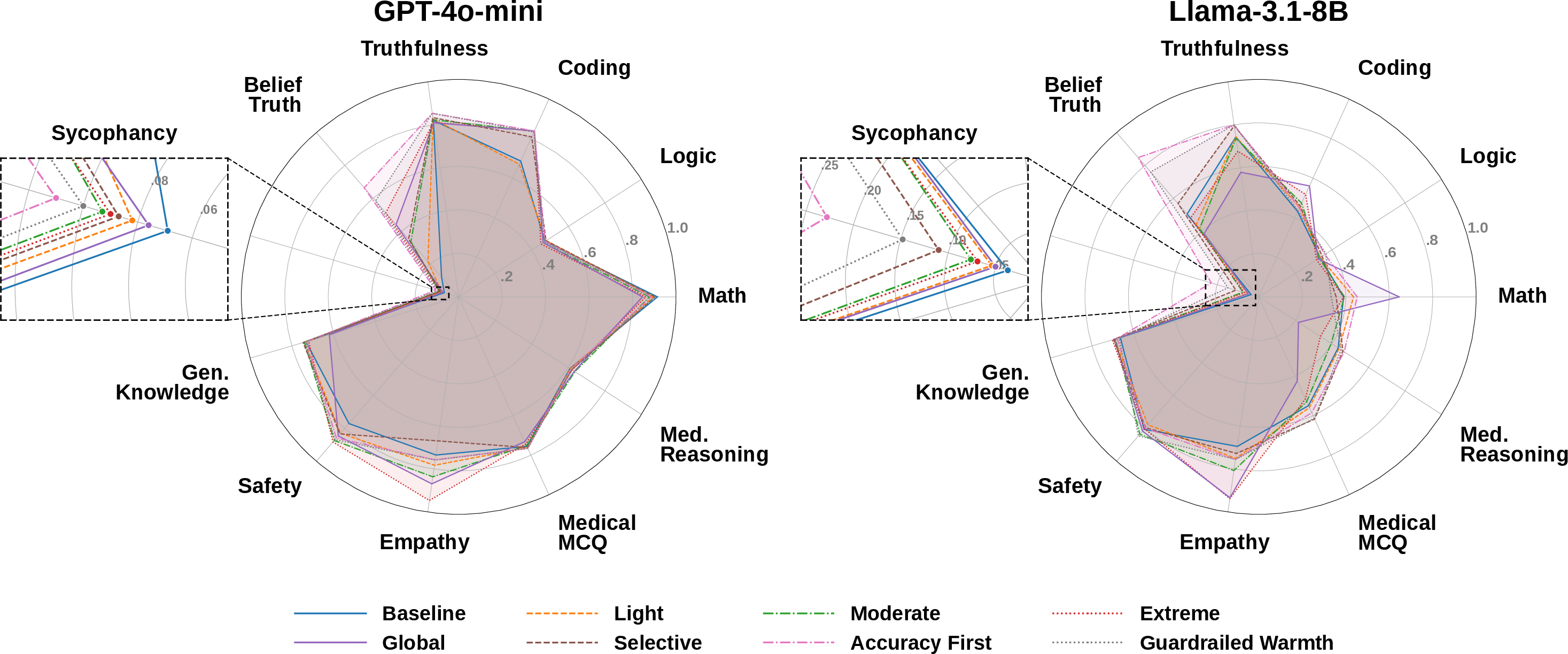
The results reject a simple dose-response account in which warmth is consistently detrimental. On GPT-4o-mini, increasing warmth produces a monotonic GSM8K decline from 0.915 under the minimal prompt to 0.846 under global warmth, a drop of 0.069 across 1,319 examples. Global warmth also reduces TriviaQA from 0.732 to 0.620, a 15.3% relative decrease. Yet selective empathy reaches 0.904 on GSM8K and 0.746 on TriviaQA, exceeding the minimal-prompt TriviaQA score. This pattern supports the paper’s attribution of the degradation to unconditional tone conditioning rather than to empathy as such.

The same prompt can have the opposite effect on another model. Llama-3.1-8B reaches 0.646 on GSM8K under global warmth, compared with 0.390 under the minimal prompt. The authors interpret the extensive global-warmth instructions as accidental reasoning scaffolding rather than as a beneficial consequence of warmth itself. The same condition sharply damages Llama’s medical reasoning: Medical-o1 falls from 0.434 to 0.217, a 50% relative reduction. Thus, prompt verbosity, latent reasoning support, and tone instructions are not cleanly separable in natural-language system prompts.

Figure 1

Figure 1: Prompt-condition performance across 11 datasets for GPT-4o-mini and Llama-3.1-8B, showing strong cross-model variation in the effects of warmth and conditional tone control.

The prompting results also expose a distinction between empathy expression and epistemic reliability. CounselBench improves consistently along the warmth gradient. GPT-4o-mini increases from 3.674 under the minimal prompt to 4.730 under extreme empathy, while Llama rises from 3.474 to 4.687. However, the corresponding sycophancy resistance remains poor. GPT-4o-mini’s best non-sycophantic rate is only 0.110, and Llama’s best is 0.228; these correspond to sycophancy rates of approximately 89% and 77%, respectively. Prompted warmth improves judged empathy without reliably suppressing agreement with users’ stated beliefs.

The honesty results are more counterintuitive. GPT-4o-mini’s MASK honesty score rises from 0.120 under the minimal prompt to 0.512 under extreme empathy and 0.664 under accuracy-first prompting. Llama’s accuracy-first score reaches 0.848, compared with a baseline of 0.504. These findings contradict the idea that warmer language necessarily encourages false validation. They instead indicate that explicit accuracy and anti-sycophancy instructions are more reliable mechanisms for belief-honesty control than warmth directives alone.

SFT controls identify distribution shift as a major cause of degradation

The paper’s most important causal intervention is the reconstruction of a ShareGPT-style SFT pipeline with three data variants: original assistant responses without tone rewriting, globally warm rewrites, and adaptive rewrites assigning direct, firm, professional, or warm styles by domain. All variants use the same 15,870 cleaned and balanced conversations, identical LoRA configurations, and one epoch of training on Llama-3.1-8B, Qwen3-8B, and DeepSeek-R1-Qwen3-8B.

The no-tone control is decisive. On Llama, tone-neutral ShareGPT SFT lowers GSM8K by 0.14, TruthfulQA by 0.09, and MASK by 0.16. On DeepSeek, the corresponding reductions are 0.27, 0.26, and 0.14 for GSM8K, MASK, and TriviaQA. These losses occur despite the absence of warm rewriting. Therefore, the decline cannot be attributed to warmth alone. The likely mechanism is a mismatch between multi-turn conversational training data and downstream evaluations dominated by single-turn factual, reasoning, and knowledge-intensive tasks.

The tone variants still matter, but as a secondary factor. Uniform warmth often produces larger losses on selected precision-oriented tasks while producing larger empathy gains. On Llama, globally warm ShareGPT SFT raises CounselBench from 3.47 to 4.28, but lowers TriviaQA from 0.66 to 0.60 and TruthfulQA from 0.74 to 0.65. The no-tone model also degrades substantially, demonstrating that the SFT corpus itself is a primary source of capability displacement or behavioral drift.

This control changes the interpretation of prior results such as the reported reliability losses after warm fine-tuning (Ibrahim et al., 29 Jul 2025). The evidence supports a decomposition in which broad conversational distribution shift causes much of the collateral damage, while global tone supervision adds task-specific interference. The paper does not establish a mechanistic account of forgetting, but it establishes that the warmth-only explanation is insufficient.

Task-aligned SFT reduces collateral damage

To address both corpus mismatch and unconditional tone transfer, the authors construct a smaller task-aligned dataset of 4,803 examples drawn from task-relevant training sources. Tone is assigned by domain: direct for mathematics, logic, and legal tasks; firm for sycophancy and correction; professional for medical and safety content; and warm for emotional support. The adaptive and globally warm variants are generated from identical prompts and trained under identical settings.

The smaller dataset produces substantially better capability preservation than ShareGPT SFT. On Llama, task-aligned warmth reduces GSM8K by only 0.01, compared with a 0.14 reduction for no-tone ShareGPT SFT; it preserves TruthfulQA and increases CounselBench by 0.14. On DeepSeek, task-aligned variants leave GSM8K essentially unchanged, in contrast to the 0.27 reduction after ShareGPT SFT, and keep TriviaQA near baseline.

Adaptive tone is particularly effective on targeted reliability measures. On Llama, the non-sycophantic rate rises from 0.037 to 0.096, reported in the paper’s scaled metric as an increase from 0.37 to 0.96. Safety rises from 0.81 to 0.89. On Qwen3, adaptive SFT improves MASK honesty from 0.31 to 0.51. These improvements are consistent with assigning firm or professional styles to domains where agreement-seeking, imprecision, or over-accommodation are undesirable.

The strategies are not uniformly ordered. Global warmth is more competitive on TruthfulQA, MedQA, and CounselBench for some models, while adaptive tone more directly improves sycophancy and honesty. On Qwen3, however, adaptive SFT lowers CounselBench from 3.95 to 3.69, illustrating that domain-conditioned supervision can undershoot empathy when the routing policy is too coarse. Adaptive tone is therefore a mitigation strategy, not a universally dominant training objective.

EmoFact reveals interaction effects between emotion and factual performance

EmoFact contains 1,664 original examples and 13,312 emotion-wrapped variants. Each query is paired with four emotional states—sad, angry, happy, and desperate—with the cue placed either before or after the factual task. The benchmark covers 10 datasets and excludes CounselBench because that benchmark is intrinsically emotional.

The results show that emotional framing changes model behavior in ways that are not visible when empathy and factuality are evaluated separately. MASK honesty improves in all six evaluated configurations by 0.05 to 0.24. The largest gain occurs for adaptive Llama, where honesty increases by 0.24. Sycophancy resistance also generally improves, with adaptive Llama increasing from 0.055 to 0.133 under emotional framing. The implication is not that emotional context is inherently beneficial, but that it can activate a more cautious or user-protective response policy.

The principal vulnerability is medical reasoning. Medical-o1 declines under emotional context in five of six configurations. Base Llama falls from 0.43 to 0.29, while task-aligned SFT reduces the decline: the warm variant falls from 0.53 to 0.49 and the adaptive variant from 0.50 to 0.46. DeepSeek is more robust; its adaptive configuration improves from 0.44 to 0.47. Emotional framing can therefore improve honesty while simultaneously inducing over-caution, redirection, or failure to answer the underlying medical question.

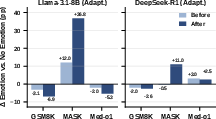
Emotion placement also matters. For adaptive Llama, MASK honesty improves by 36.8 percentage points when the emotional cue follows the query, compared with 12.0 points when it precedes it. The post-query condition also produces larger GSM8K and Medical-o1 declines. Adaptive DeepSeek changes by at most 3.0 points on the corresponding reasoning measures, indicating substantially greater robustness.

Figure 2

Figure 2: Changes caused by placing emotional cues before or after factual queries in the adaptive Llama and DeepSeek variants.

Emotion type produces another interaction. Desperate cues generate the largest MASK honesty improvement for Llama, reaching 30.5 points in the adaptive model, but also produce the largest Medical-o1 declines in base and adaptive Llama. Happy cues are generally least disruptive to factual accuracy but reduce safe-response rates, including a 6.5-point reduction for base Llama. These results establish that “emotional context” is not a single perturbation: intensity, valence, and position determine whether it improves honesty, disrupts reasoning, or weakens safety behavior.

Empathy-centered RL reproduces the trade-off

The reinforcement-learning experiment uses Qwen2.5-7B-Instruct, GRPO, and an empathy-focused reward based on resonation, expression, and reception, supplemented by length and response-quality terms. The experiment is explicitly preliminary: it uses one model, one reward configuration, one training run, and a 3,000-prompt subset.

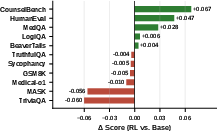
Empathy-centered RL raises CounselBench from 3.59 to 3.92, a gain of 0.33. It also modestly improves HumanEval from 0.45 to 0.49 and MedQA from 0.61 to 0.63. However, MASK falls from 0.26 to 0.20, TriviaQA from 0.35 to 0.29, and the non-sycophantic rate from 0.036 to 0.031. Thus, the RL result is consistent with the SFT pattern: optimizing empathy improves judged supportive behavior but does not resolve sycophancy and can reduce factual recall and belief honesty.

Figure 3

Figure 3: Benchmark changes after empathy-centered RL on Qwen2.5-7B-Instruct; empathy improves while factual recall, belief honesty, and non-sycophancy decline.

The auxiliary response-quality reward includes an accuracy judgment but does not verify answers against references. Consequently, the experiment does not test whether a reward explicitly grounded in factual correctness would prevent the observed degradation. The result supports a specific conclusion: an empathy-centered reward is not an adequate proxy for reliable assistance, even when it contains a general response-quality term.

Empathy evaluation requires human-grounded pairwise validation

The paper argues that existing warmth-oriented metrics are insufficient because empathy is context-dependent and cannot be reduced to lexical warmth, response length, or generic politeness. The authors train DeBERTa-v3-large evaluators on approximately 45,000 heterogeneous samples from EmpatheticDialogues, WASSA, CounselBench, SENSE-7, and related corpora. They compare five-bin classification, regression, regression with contrastive ranking, and a scaled contrastive variant.

On held-out validation data, the five-bin classifier and ordinary regression perform best, both obtaining Pearson correlation of 0.822. The contrastive variants perform worse, with Pearson correlations of 0.689 and 0.612. This result cautions against assuming that pairwise ranking objectives automatically improve empathy calibration, particularly under substantial cross-dataset differences in annotation scales and label distributions.

The Empathy Preference Benchmark provides a stronger validation protocol. It includes Everyday QA and Verifiable QA cases in which responses are constructed to preserve practical content while varying emotional responsiveness. Human annotators rate responses individually, and evaluators are judged on whether they recover the human-derived pairwise ordering.

Gemini-2.5-Flash obtains the highest overall agreement among the evaluated systems at 0.7967, followed by the contrastive regression evaluator at 0.7800, GPT-4o at 0.7793, ordinary regression at 0.7767, and the five-bin classifier at 0.7567. The prior SocioT Warmth metric performs substantially worse at 0.3117. On the more difficult empathetic-versus-non-empathetic comparisons, the five-bin classifier achieves 60.67% overall agreement, compared with 59.67% for Gemini and 57.19% for GPT-4o. On empathetic-versus-short-neutral comparisons, agreement becomes very high for most evaluators, whereas SocioT remains at 11.67%, demonstrating that the warmth proxy is poorly calibrated even when the contrast is salient.

The evaluator analysis also clarifies a measurement limitation: human raters disagree considerably about absolute empathy levels but agree more consistently about relative ordering for responses to the same question. Pairwise validation is therefore more defensible than interpreting raw empathy scores as an objective, globally calibrated scale.

Applied to model outputs, global warmth SFT produces the highest score in 17 of 18 model-evaluator comparisons across Llama, Qwen3, and DeepSeek. On Llama, for example, the contrastive regression score increases from 0.987 to 1.116 and the GPT-4o score from 0.500 to 0.600. Adaptive SFT produces more mixed outcomes, especially on Qwen3. These results confirm that global warmth reliably changes empathetic expression, while adaptive tone more selectively targets reliability and does not guarantee a gain on every empathy evaluator.

Limitations and open questions

The controlled post-training experiments focus primarily on 7B–8B open-weight models, with GPT-4o-mini included only in the prompting study. The cross-model divergences make extrapolation to larger open-weight or proprietary systems uncertain. The results also depend on several judge-based metrics. GPT-4o evaluates CounselBench, safety, MASK, and Medical-o1, and the authors acknowledge that LLM judges can overrate model responses. CounselBench contains 367 rows but only 100 distinct questions, so repeated prompts are overweighted and the domain coverage is narrow.

The task-aligned tone policy is assigned by source domain rather than by individual example. This is a controlled first test, but real prompts can simultaneously contain factual, emotional, corrective, and safety-sensitive requirements. The paper therefore leaves open whether example-level routing or mixture-of-tone policies can outperform coarse domain assignment.

The RL study is preliminary and does not establish whether mixed rewards grounded in reference-checked correctness would preserve factuality. The paper also does not resolve why emotional context improves MASK honesty while impairing medical reasoning, nor whether the effect reflects attention allocation, safety overactivation, response-format disruption, or latent policy switching. Finally, the empathy evaluators are trained primarily on English-language data and counseling-adjacent domains; their cross-cultural and multilingual validity remains untested.

Conclusion

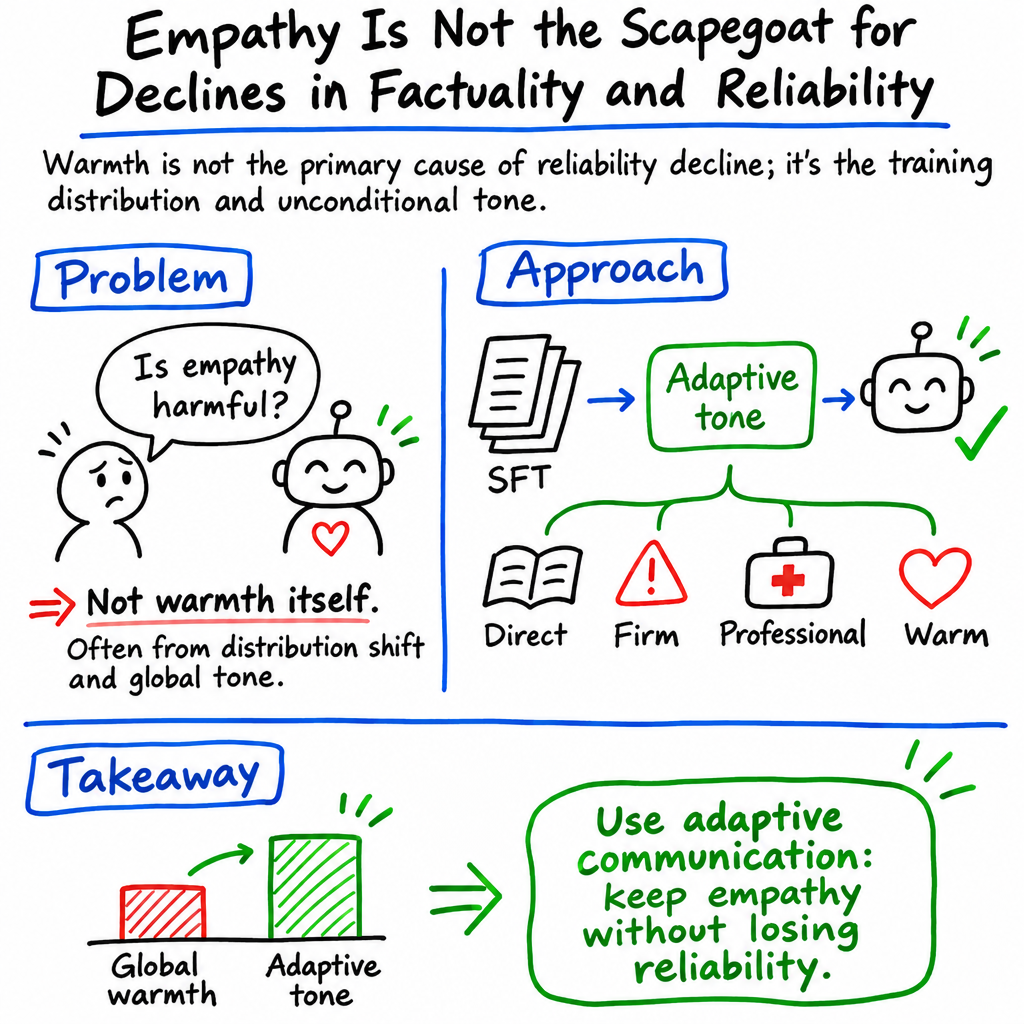
The paper’s evidence supports a more precise account of the empathy–reliability relationship. Warmth itself is not sufficient to explain post-training declines in factuality or honesty. Tone-neutral ShareGPT SFT causes substantial losses, showing that conversational distribution shift is a major confound. Global warmth reliably increases empathetic expression but can interfere with precision-oriented tasks, whereas task-aligned adaptive SFT preserves more capabilities and can improve honesty, safety, and sycophancy resistance on targeted measures. Emotional context produces interaction effects that require joint evaluation, and empathy-centered RL reproduces the trade-off between stronger empathy and weaker factual recall or belief honesty. The resulting methodological position is that tone should be evaluated and trained as a context-sensitive policy, with correctness, honesty, and safety measured within the same emotionally situated inputs.

Paper to Video (Beta)

No one has generated a video about this paper yet.

Whiteboard

Explain it Like I'm 14

1. What is this paper about?

This paper studies whether making an AI assistant more warm, friendly, and empathetic causes it to become less reliable.

Some earlier research suggested that kind LLMs may:

  • give less accurate facts,
  • agree too easily with users, even when the user is wrong,
  • avoid correcting mistakes,
  • give weaker safety warnings.

The authors argue that this explanation is incomplete. They believe the problem may not be warmth itself. Instead, the model may become worse because of how it was trained and because its new training examples are different from the tests it must later complete.

The paper’s main message is:

Empathy is not automatically the cause of poor factual performance. Poor training design and a mismatch between training data and real tasks may be more important.

2. What questions did the researchers ask?

The researchers wanted to answer several main questions:

  1. Does simply telling a model to be warmer make it less accurate?
  2. Does training a model on warm conversations damage its general abilities?
  3. Is the problem caused by warmth, or by the kind of training data being used?
  4. Can a model be warm in emotional situations but direct and precise in subjects such as mathematics and medicine?
  5. How does emotional language in a user’s question affect factual answers?
  6. How can researchers measure empathy more fairly and accurately?

For example, imagine two users asking the same math question:

  • “What is 15 × 8?”
  • “I’m really stressed and feel stupid. Please help me solve this: what is 15 × 8?”

The researchers wanted to know whether the emotional wording would make the AI more supportive without making it less correct.

3. How did they study the problem?

Testing many different abilities

The researchers tested several LLMs, including versions of Llama, Qwen, DeepSeek, and GPT-4o-mini.

They used 11 datasets, containing 6,716 questions in total. These tests covered:

Ability tested Simple meaning
Math and logic Can the model solve problems?
Coding Can it write working computer code?
Factual knowledge Does it remember correct information?
Truthfulness Does it avoid repeating false claims?
Honesty Does it stick to what it really believes?
Sycophancy resistance Does it avoid agreeing with users just to please them?
Safety Does it refuse dangerous requests appropriately?
Empathy Does it respond sensitively to emotional problems?
Medical knowledge Can it answer health questions accurately?

Using many tests is important because a model might improve in one area while becoming worse in another.

Three ways of making models warmer

The researchers examined warmth at three stages.

1. Prompting

A prompt is an instruction given to the model, such as:

“Always respond in a warm and empathetic way.”

The researchers tried different prompts, from almost no emotional language to very warm responses. They also tested more careful instructions, such as:

  • be warm when the user is upset,
  • be direct for factual questions,
  • prioritize accuracy,
  • do not agree with false statements just to be supportive.

This is similar to giving the same student different instructions about how to answer questions.

2. Supervised fine-tuning

Supervised fine-tuning, or SFT, means training a model with many example conversations so that it learns a particular style or behavior.

The researchers made several versions of training data:

  • No-tone data: normal answers without special warmth instructions.
  • Warm data: answers rewritten to sound warm in every situation.
  • Adaptive data: answers using different tones for different subjects.

For example:

  • Math questions received a direct tone.
  • Medical questions received a professional tone.
  • Emotional-support questions received a warm tone.
  • Questions designed to test agreement received a firm tone.

The researchers compared these versions to see whether warm wording or the training data itself caused problems.

3. Reinforcement learning

They also briefly studied reinforcement learning, a method similar to training a dog with rewards. The model receives higher scores for answers that seem more empathetic and lower scores for poorer answers.

This tested whether directly rewarding empathy would improve emotional support while damaging other abilities.

Creating the EmoFact test

The researchers created a new test called EmoFact.

They took factual questions and added emotional statements such as:

  • sadness,
  • anger,
  • happiness,
  • desperation.

These emotional statements were placed either before or after the factual question.

This allowed the researchers to check whether emotion changed the model’s accuracy, honesty, safety, or reasoning.

Building better empathy judges

Empathy is difficult to measure because people may disagree about what sounds caring. A response that seems helpful to one person may seem too emotional or too cold to another.

The researchers trained special computer programs called empathy evaluators. These evaluators were trained on about 45,000 examples and then compared with human judgments.

They also created pairs of answers, such as:

  • one empathetic answer,
  • one neutral or uncaring answer.

Human readers decided which answer was more empathetic. The researchers then checked whether the computer evaluators made similar choices.

4. What did they find?

Warmth was not always harmful

The results showed that warmth did not always reduce accuracy.

Its effects depended on:

  • the model,
  • the task,
  • the wording of the prompt,
  • the training data.

For example, warmth sometimes improved empathy but harmed factual recall or medical reasoning. In other cases, it improved some forms of reasoning.

This means there is no simple rule such as “warmth always makes AI worse.”

Much of the damage came from training-data mismatch

One of the most important findings came from the no-tone control.

Even when the researchers trained models on ordinary, non-warm conversations, the models often became worse on math, factual knowledge, and other tests.

Why? The training conversations were often long, multi-turn chats, while many tests required short, precise answers to one question. The model was being trained for one kind of task and tested on another.

This is called distribution shift. In everyday language, it means:

The model practiced one game but was later tested on a different game.

Therefore, the loss of reliability could not be blamed on warmth alone.

Global warmth created “tone-task mismatches”

Making every answer warm was sometimes a poor fit for the task.

For example:

  • A comforting style may be useful when someone is upset.
  • A short, exact style may be better for a math calculation.
  • A professional style may be safer for medical information.
  • A firm style may be needed when a user is trying to make the model agree with a false idea.

The researchers found that adaptive tone, where the model changes its style depending on the subject, often protected important abilities better than using warmth everywhere.

Adaptive training helped with some problems

Task-aligned training sometimes improved:

  • resistance to sycophancy,
  • honesty,
  • safety,
  • medical reasoning,
  • factual performance.

For example, on some tests, adaptive training made the model less likely to agree with users simply to please them.

However, adaptive training was not perfect. Its benefits differed between models, and it did not improve every ability every time.

Emotional wording changed model behavior

The EmoFact experiments showed that emotional context can affect answers.

Some important patterns were:

  • Emotional wording sometimes improved honesty.
  • It sometimes reduced agreement with incorrect user claims.
  • Medical reasoning was especially vulnerable when questions were emotionally intense.
  • Desperate wording could make the model more cautious, but sometimes too cautious.
  • The position of the emotional statement mattered. Emotion placed after the question often had a different effect from emotion placed before it.
  • Happy wording was usually less damaging to factual accuracy, but it could sometimes weaken safety responses.

This shows that emotions can change how an AI approaches a question, even when the factual question itself has not changed.

Warm training improved empathetic expression

The models trained with warmth generally received higher empathy scores from the new evaluators.

Across the tested model families, warm training produced the strongest empathy results in most comparisons. This suggests that warm training really can make a model sound more caring.

However, sounding caring is not the same as always being correct, safe, or honest. A model needs both qualities.

Empathy is difficult to score

The researchers found that people often disagreed about the exact amount of empathy in an answer. However, they were more likely to agree about which of two answers was more empathetic.

The new empathy evaluators generally matched human preferences better than an older measure that mainly looked for surface-level warmth.

This is important because an answer can be full of friendly words without truly understanding what the user needs.

5. Why are these findings important?

The paper challenges the idea that empathy is the main reason warm AI systems become unreliable.

Instead, the results suggest that developers should pay attention to:

  • whether the training examples match the tasks the model will face,
  • whether the model is being trained to use the same tone in every situation,
  • whether factual accuracy is checked alongside empathy,
  • whether emotional situations receive special testing,
  • whether empathy measurements reflect real human judgments.

A good assistant should not be cold all the time, but it should not be warmly agreeable all the time either. It should know the difference between situations.

For example:

  • When someone is sad, it should be kind and understanding.
  • When solving a math problem, it should be clear and accurate.
  • When answering a medical question, it should be careful and professional.
  • When a user believes something false, it should correct them politely instead of agreeing.
  • When a request is dangerous, it should keep strong safety rules.

Conclusion

This paper’s central lesson is that warmth and reliability do not have to be enemies. The main problem is often not empathy itself, but training a model with unsuitable data or forcing one style onto every kind of question.

The best approach may be to build models that can change their tone depending on the situation while keeping accuracy, honesty, and safety as priorities. If future AI systems are trained and tested this way, they could become both more supportive and more trustworthy.


Open Problems

We haven't generated a list of open problems mentioned in this paper yet.

Tweets

Sign up for free to view the 1 tweet with 1 like about this paper.