SplitJEPA: Learning Invariant and Variant Latent Worlds without Reconstruction
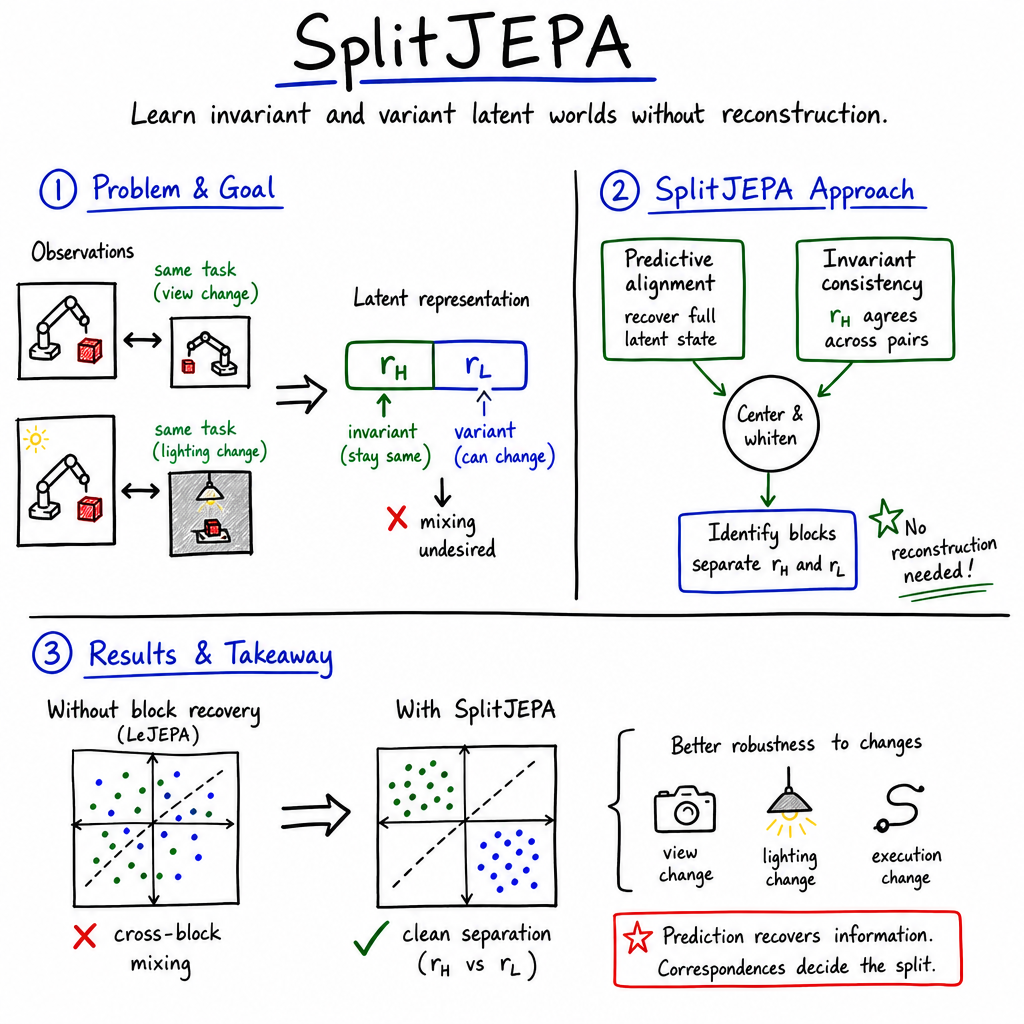
Abstract: Understanding a dynamical world calls for more than a latent state that summarizes its observations: the state should also be organized into the factors that stay shared across related observations and the factors that vary between them. For example, a robot pushing a cube to a goal should take the same action when the camera shifts or the lights dim, since nothing in the scene has moved. Existing approaches to this decomposition commonly obtain it through reconstruction, so the latent variables must first explain the entire observational world before their organization can be trusted. Joint embedding predictive architectures (JEPAs) model the latent state directly and never reconstruct, yet no existing result recovers the invariant and variant parts of the state they learn. How to learn the invariant-variant structure of the latent world without paying for its reconstruction therefore remains open. To close this gap, we introduce SplitJEPA, a JEPA that jointly recovers the latent state and its invariant and variant organization directly in representation space, without any reconstruction. We prove that, under stationary Gaussian predictive dynamics and a full-rank variation condition, SplitJEPA identifies the invariant and variant subspaces up to independent block-wise isometries, without introducing an observation decoder. Since the guarantee needs no decoder, the result extends reconstruction-free latent recovery to invariant-variant block identification. Experiments on synthetic nonlinear systems and robotic manipulation tasks support the theoretical results and show their practical value for both robustness and efficiency.
Paper Prompts
Sign up for free to create and run prompts on this paper.
Top Community Prompts
Explain it Like I'm 14
1. What is this paper about?
The paper introduces a machine-learning method called SplitJEPA. Its goal is to help computers understand the important parts of a changing world, especially when the same situation can look different.
For example, imagine a robot pushing a cube. The camera might move, the lighting might change, or the robot might approach from a different angle. These details change what the robot sees, but they may not change the real task: push the cube to the goal.
The paper tries to separate information into two groups:
- Invariant information: things that stay the same, such as the task or the cube’s goal.
- Variant information: things that can change, such as lighting, camera angle, or the robot’s exact movement.
The main idea is to learn this separation without rebuilding the original images or observations.
2. What questions are the researchers asking?
The paper focuses on several main questions:
- Can a computer learn a useful hidden description of the world without reconstructing the original images?
- Can it separate stable information from changing information?
- What kind of training data is needed to make this separation reliable?
- Will this separation help robots perform better when their surroundings look different from the training examples?
The researchers are especially interested in whether the computer can identify the correct groups of information, rather than simply remembering all the information in a mixed-up way.
3. How does the method work?
Learning a hidden description
A computer does not directly understand an image in the same way a person does. Instead, a neural network changes each observation into a list of numbers called a representation or latent state.
You can think of this as making a short summary of a picture:
- some numbers describe the important task,
- other numbers describe temporary details,
- and together they describe the whole situation.
The true world information is called the latent state, while the camera image or other input is called the observation.
Why reconstruction is not enough
Many systems learn by trying to recreate the original image. This is called reconstruction. It is similar to looking at a photograph, compressing it into a set of notes, and then trying to redraw the photograph from those notes.
Reconstruction can preserve many details, including details that are not useful. It also does not guarantee that the notes are organized into “stable” and “changing” information.
For example, a system might store the lighting information together with the task information. It could still redraw the picture correctly, but its internal organization would be messy.
Prediction in representation space
SplitJEPA is based on a method called a Joint-Embedding Predictive Architecture, or JEPA.
Instead of rebuilding images, JEPA tries to predict one hidden representation from another related observation. For instance, it may learn that two views of the same robot task should have related internal descriptions.
This is like comparing two summaries rather than trying to redraw both photographs.
The paper uses two types of relationships:
- Predictive pairs: observations that follow one another or are related in time. These help the system learn the complete hidden state.
- Invariant pairs: observations that share the same important content but differ in appearance. For example, two views of the same cube and task, taken with different cameras or lighting.
SplitJEPA is trained so that:
- Its whole representation can predict related observations.
- The part labeled “invariant” is similar for invariant pairs.
- The representation keeps enough variation and does not collapse into the same answer for everything.
What does “identifiable” mean?
A central technical idea in the paper is identifiability. In simple terms, this means that the method can recover the intended structure instead of producing many equally possible but confusing versions.
Imagine rotating a box of colored blocks. The blocks are still there, but their positions in the box have changed. A normal prediction method may learn the right information while mixing the stable and changing blocks together.
SplitJEPA uses the invariant pairs to determine which directions should belong to the stable group and which should belong to the changing group.
Why varied examples matter
The paired examples must show enough different kinds of change. This is called the sufficient variation condition.
For example, if the camera always moves upward and never sideways, the system may not learn everything about camera-related variation. But if the examples include many different camera movements and lighting changes, the system gets stronger evidence about which information is truly variable.
The paper’s mathematical result says that, if the variation covers all directions of the changing information, SplitJEPA can separate the two groups, except for harmless mixing within each group.
4. What did the researchers find?
The researchers tested SplitJEPA in two main settings.
Synthetic experiments
First, they created a controlled artificial world where they already knew which factors were invariant and which were variant. This allowed them to check whether the method recovered the correct answer.
The results showed:
- SplitJEPA recovered the invariant and variant groups very accurately.
- It had almost no mixing between the two groups.
- A standard predictive method, called LeJEPA, learned most of the information but mixed the two groups together.
- Shuffling the paired examples made the separation much worse.
For example, SplitJEPA’s block-purity score was about 0.9999, meaning its learned groups were almost perfectly organized in the artificial test.
This supports an important point: learning the complete hidden state is not the same as organizing that state correctly.
Robot experiments
The researchers then tested the method on simulated robot tasks called PickCube and PushCube. The robot had to pick up or push a cube using visual observations.
The robot was tested in situations with:
- the usual camera view,
- different camera positions,
- different lighting,
- other visual changes.
SplitJEPA generally performed better than the comparison methods, especially when the camera or appearance changed.
For the PushCube task, using only the invariant representation achieved about:
- 71.5% success under camera changes,
- 99.7% success under lighting changes,
- 64.5% success under broader visual changes.
Using both the invariant and variant representations performed even better in some cases, reaching about:
- 75.3% success under camera changes,
- 98.3% success under lighting changes,
- 70.2% success under visual changes.
The PickCube task was harder, but SplitJEPA still usually outperformed the comparison methods.
Why these findings matter
These results suggest that separating stable information from temporary appearance changes can make robots more reliable.
A robot that focuses on the invariant part may continue to perform the correct action even if:
- the camera moves,
- the lights become brighter or darker,
- the scene looks somewhat different.
The experiments also showed that the two parts are not always equally useful. Sometimes the robot benefits from using only the invariant part. In other situations, the changing information is also useful, so using both parts works better.
5. What are the broader implications?
SplitJEPA suggests that artificial intelligence can learn not only what information exists, but also how that information is organized.
This could be useful for robots and other systems that must work in changing environments. A robot could use the invariant part to make decisions that remain stable when appearance changes, while still using the variant part when details such as position or movement are important.
The method also avoids reconstructing images, which may make it:
- more efficient,
- less focused on unimportant visual details,
- easier to use for tasks that care about actions rather than perfect image reproduction.
However, the method has important limits. It needs paired examples that preserve the important information while showing enough different kinds of variation. If the training data does not include certain changes, the system may incorrectly treat them as invariant. The experiments were also relatively small, so it is not yet certain how well the approach will work in very large and complicated real-world environments.
Overall, the paper’s main message is:
A computer may understand a changing world better when it learns both the complete hidden state and the difference between what stays the same and what changes. SplitJEPA attempts to do this directly, without rebuilding the original observations.
Knowledge Gaps
Knowledge gaps, limitations, and open questions
The paper establishes reconstruction-free block identifiability under strong assumptions, but leaves the following issues unresolved:
- Generality beyond stationary Gaussian dynamics: The theoretical guarantee depends on isotropic, stationary Gaussian predictive dynamics with a context-dependent scalar correlation . It is unclear whether block identifiability holds for non-Gaussian, nonstationary, nonlinear, non-isotropic, or higher-order dynamical processes.
- Validity of the predictive-identification premise: The results assume that the predictive objective already recovers the complete latent state up to a global orthogonal transformation. The paper does not establish when this premise holds for finite neural networks, pixel observations, imperfect optimization, or realistic data distributions.
- Population-optimum versus trainable solutions: The main theorem applies to global population minimizers. It remains unknown whether gradient-based training reliably reaches solutions with the claimed block structure, particularly in the presence of nonconvexity, finite data, overparameterization, and competing loss terms.
- Finite-sample block-recovery guarantees: The paper provides a qualitative approximate-consistency bound, but does not derive sample-complexity or confidence guarantees for estimating the invariant and variant subspaces from finite paired data.
- Quantification of correspondence quality: The theory assumes exact invariant pairs sharing precisely the same . The practical experiments use approximate cross-trajectory correspondences, but the paper does not provide a formal identifiability or error bound for mismatched pairs.
- Robustness to false invariances: The method may force genuinely task-relevant factors into the invariant block when the pairing procedure incorrectly labels them as shared. The consequences of systematic pairing errors are not theoretically characterized.
- Known latent and block dimensions: The analysis assumes that the total dimension and both block dimensions and are known. Methods for selecting these dimensions, detecting unequal or changing dimensions, or handling overcomplete and undercomplete representations remain unexplored.
- Strength and interpretability of the sufficient-variation condition: Positive definiteness of is necessary for the stated argument, but the paper does not determine how much variation is sufficient in finite samples or how the smallest eigenvalue affects practical recovery beyond the basic error bound.
- Unobserved and weakly varying variant directions: Directions with zero or very small variation across available correspondences are theoretically indistinguishable from invariant factors, but the paper does not propose a way to identify, report, or safely handle such partially covered directions.
- Dependence between invariant and variant factors: The analysis does not clarify whether and may be statistically dependent, how such dependence affects predictive recovery, or whether dependence can cause leakage despite full-rank variant differences.
- Changing invariant–variant semantics across contexts: A factor may be invariant for one task or correspondence type but variant for another. The framework does not address context-dependent partitions or representations that must support multiple, potentially incompatible decompositions.
- Limits of the observation model: The theory assumes a smooth embedding and a continuously differentiable encoder. It does not cover non-injective observations, occlusion, discontinuities, sensor quantization, missing modalities, stochastic observation processes, or observations with irrecoverable information loss.
- Role of representation normalization in practice: Exact whitening is required by the theory, whereas the implementation uses finite-weight variance regularization and optional ZCA normalization. The relationship between covariance error and block-recovery error is not fully established.
- Interaction among objective terms: The paper does not characterize how the choice of , , batch size, predictor architecture, or normalization method changes identifiability and optimization stability.
- Potential collapse or information loss in the invariant block: Agreement losses encourage invariance but may discard task-relevant information that varies within the chosen correspondences. The paper does not give a criterion for balancing invariance against preserving all useful shared information.
- Block identification versus semantic factor identification: The guarantee recovers subspaces only up to independent within-block orthogonal transformations. It does not identify individual semantic factors, causal variables, or interpretable coordinates within either block.
- Scope of the robustness theorem: Theorem 3 concerns predictors that use only and perturbations that remain within the modeled support. It does not quantify robustness for finite distribution shifts, off-support perturbations, policy feedback loops, or predictors that use both and .
- Relationship between representation robustness and closed-loop control: The experiments show improved success rates, but the paper does not establish that block identifiability causes the control gains, nor does it analyze how representation errors propagate through long-horizon closed-loop dynamics.
- Limited empirical scale and diversity: Experiments use controlled synthetic systems and two ManiSkill manipulation tasks with 800 successful trajectories per task. Generalization to large-scale, real-world, multimodal, long-horizon, and failure-rich datasets remains untested.
- Limited environmental shifts: The robotic evaluation focuses mainly on camera, lighting, and visual changes. It does not test substantial changes in object geometry, dynamics, friction, distractors, robot morphology, action latency, camera calibration, or task goals.
- Dependence on successful-trajectory data: Because the robotic data consist of successful trajectories, it is unclear whether SplitJEPA remains effective with demonstrations containing failures, sparse rewards, exploratory behavior, or highly imbalanced correspondence classes.
- Approximate pairing and diversity trade-offs: The experiments suggest that broader variation can conflict with correspondence accuracy, but the paper does not provide an algorithm for optimizing this trade-off or a principled way to select useful pairings.
- Insufficient comparison with reconstruction-based and alternative disentanglement methods: The empirical evaluation primarily compares against Raw, R3M, LeJEPA, and shuffled pairs. It does not determine whether the proposed reconstruction-free approach outperforms strong reconstruction-based, contrastive, multiview, causal, or content–style baselines under matched compute and data budgets.
- Computational and scaling costs: Although reconstruction is avoided, the paper does not report detailed training time, memory usage, pair-construction cost, or scaling behavior relative to reconstruction-based methods and large JEPA models.
- Sensitivity to encoder pretraining and shared-encoder evaluation: The synthetic block-recovery experiment fixes a pretrained encoder for all methods, which isolates the spectral recovery stage but does not show whether end-to-end SplitJEPA consistently learns superior encoders from raw observations.
- Statistical significance and reproducibility at larger scale: Most experiments use five seeds, and the paper does not report broader uncertainty analyses, hyperparameter sensitivity, or independent replications across datasets and architectures.
- Use of ground-truth latents for evaluation: Synthetic metrics such as invariant and variant , cross-block leakage, and block purity require access to ground-truth latent variables. Practical diagnostics for determining whether learned blocks are correct when such latents are unavailable remain undeveloped.
- Multiple invariant correspondence structures: The framework considers one designated invariant block and one correspondence distribution. It remains open how to recover hierarchical, overlapping, multimodal, or more than two factor groups from several correspondence types.
- Causal interpretation of invariant factors: The paper uses “invariant” in a correspondence-relative statistical sense, but does not establish that the recovered block corresponds to causal mechanisms or remains stable under interventions outside the observed pairing distribution.
Practical Applications
Immediate Applications
- Robust visual robot control — robotics and manufacturing.
Deploy SplitJEPA-style encoders in behavior-cloning or model-predictive-control pipelines, using the invariant block
r_Hfor task-relevant decisions and optionally adding the variant blockr_Lwhen execution-specific information is useful. This can improve manipulation under camera, lighting, appearance, and viewpoint changes, as demonstrated forPickCubeandPushCube. Dependencies: reliable approximate correspondences between trajectories or views; sufficient variation across variant factors; calibration of the split dimensions; validation that a change is genuinely task-irrelevant rather than safety-critical. - Simulation-to-real transfer for embodied AI.
Train representations on simulated trajectories with matched task states but varied rendering conditions, then transfer policies to real robots. The reconstruction-free objective can reduce dependence on simulator-specific pixels and preserve the physical task content in
r_H. Dependencies: simulation must vary the same factors that change in deployment; simulated correspondences must preserve invariant task state; real-world dynamics and sensing must remain within the learned support. - Camera- and illumination-robust perception modules.
Use
r_Has an input to object localization, grasp selection, contact prediction, or navigation components that should remain stable under nuisance visual changes. User_Lseparately for viewpoint estimation, appearance modeling, or sensor adaptation. Dependencies: the definition of “invariant” is task-relative. A camera change that is irrelevant for grasping may be essential for viewpoint estimation, so the same representation should not automatically be used for every downstream task. - Efficient self-supervised representation learning — computer vision and video.
Replace or supplement autoencoder-based pipelines with reconstruction-free predictive training. The method can reduce decoder computation and avoid allocating representation capacity to pixel-level details that are not needed for prediction or control. A practical workflow is:
- collect predictive temporal pairs;
- collect matched invariant pairs;
- train a JEPA-style encoder with predictive, invariant-consistency, and variance-preserving losses;
- whiten or normalize the resulting representation;
- expose
r_Handr_Las separate features. Dependencies: the paper’s formal guarantee assumes stationary Gaussian predictive dynamics, centered and whitened representations, and population-level optimization. Real deployments require empirical monitoring of approximation error and representation collapse.
Robust offline behavior cloning. Train separate policies using
r_Handr_H + r_L, selecting between them according to the expected deployment shift. The experiments indicate thatr_Hcan retain much of the information needed for action prediction, while includingr_Lmay help in conditions where execution-specific details matter. Dependencies: invariant-only policies may discard information needed for grasping, fine manipulation, or collision avoidance. The split should therefore be evaluated under both in-distribution and anticipated out-of-distribution conditions.- Data-efficient representation diagnostics for machine-learning researchers. Use cross-block leakage metrics such as and , invariant and variant , block purity, and covariance error to evaluate whether a learned representation is genuinely organized rather than merely predictive. This provides a practical evaluation suite for world models and self-supervised encoders. Dependencies: ground-truth latent variables are not normally available, so real applications need proxy tests, intervention-based evaluations, or held-out correspondence data.
- Dataset and augmentation design tools. Construct matched pairs that preserve task content while varying appearance, camera pose, lighting, robot configuration, or execution trajectory. The paper shows that shuffled or insufficiently diverse pairs undermine block recovery, whereas complementary changes can collectively span the variant subspace. Dependencies: pairing quality is crucial. Incorrectly matched observations can force genuinely task-relevant information into the invariant block; narrow augmentations can leave some variant directions indistinguishable from invariant content.
- Policy and perception robustness testing.
Treat the learned variant factors as a structured perturbation space for stress testing. Generate changes in lighting, viewpoint, appearance, or execution style while holding the invariant state fixed, then measure whether predictions based on
r_Hremain stable. Dependencies: perturbations must stay within the modeled latent support; the guarantee does not cover changes that also alter the shared task state. - Academic research infrastructure for reconstruction-free identifiability. Implement SplitJEPA as a baseline for research on nonlinear representation learning, multimodal learning, temporal prediction, and world models. It offers a controlled way to compare three sources of information: predictive relations, invariant correspondences, and normalization. Dependencies: the theoretical result concerns subspace recovery up to independent within-block orthogonal transformations, not recovery of individual semantic coordinates.
- Early-stage policy and safety assessment for invariant AI systems. Use the framework to distinguish nuisance variation from operationally important variation in embodied systems. Regulators, auditors, or safety teams could require evaluations showing that models are insensitive to specified nuisance factors while remaining sensitive to hazards and task-state changes. Dependencies: the invariant/variant designation must be explicitly documented for each application; incorrect designations can produce unsafe invariances.
Long-Term Applications
- Large-scale visual world models with structured latent states. Extend SplitJEPA to long videos, multi-camera streams, language-conditioned tasks, and heterogeneous robot fleets. A world model could maintain a stable task or object-state block while separately representing camera, style, embodiment, and execution variation. This may support planning across environments without reconstructing every observation. Dependencies: scaling the theory beyond the paper’s stationary Gaussian setting; handling nonstationarity, partial observability, discrete events, long-horizon dependencies, and imperfect correspondences.
- Cross-robot transfer and embodiment-invariant control. Learn an invariant block representing object state, task goals, and contact relationships while isolating robot-specific morphology, joint configuration, and actuator behavior in the variant block. Policies could then transfer across robot arms or mobile manipulators. Dependencies: correspondence construction must preserve the same physical task state across embodiments; robot morphology may sometimes be causally relevant and cannot always be treated as a nuisance factor.
- Multi-sensor and multimodal fusion.
Apply the method to synchronized camera, depth, tactile, audio, force, and proprioceptive observations. Shared physical or semantic content could be represented in
r_H, while modality-specific and sensor-condition information could be represented inr_L. Dependencies: modalities must be temporally aligned or paired through a reliable correspondence relation; modality-specific signals may contain essential information and should not be removed from all downstream computations. - Healthcare monitoring under domain and device shifts. In principle, use matched measurements from different hospitals, devices, acquisition protocols, or patient views to separate clinically relevant patient-state factors from scanner, site, and measurement-style variation. The invariant block could support risk prediction, while the variant block could retain information for calibration or device correction. Dependencies: patient identity or clinical state must be aligned across pairs; privacy, consent, distribution shift, and clinical validation are substantial requirements. Device variation must not be incorrectly labeled irrelevant when it affects diagnosis.
- Financial forecasting and risk modeling.
Separate stable economic or borrower-state factors from market-regime, institution, geographic, or reporting-style variation. A predictor based on an invariant block could be more robust to changes in data collection or market presentation, while
r_Lcould support regime-sensitive strategies. Dependencies: financial environments are strongly nonstationary and rarely satisfy the paper’s stationary assumptions; invariant pairs must be defined carefully because regime changes may alter the causal relationship itself. - Personalized and domain-robust education systems. Represent relatively stable learning concepts, misconceptions, or mastery states separately from student-specific style, interface, language, and presentation variation. Educational assessments could use the invariant block for knowledge estimation and the variant block for personalization. Dependencies: constructing pairs with identical underlying knowledge but different presentation conditions is difficult; fairness requires checking that demographic or accessibility-related factors are not inadvertently discarded.
- Energy and industrial monitoring. Learn invariant equipment-health representations across sensors, weather, operating loads, and sites, while retaining variant information for forecasting demand or diagnosing environmental effects. This could support predictive maintenance and transfer of models between plants. Dependencies: operating conditions can be causally related to failures, so “variant” does not necessarily mean irrelevant. Coverage of all meaningful change directions and reliable temporal correspondence are required.
- Human–robot collaboration and adaptive interfaces.
Use
r_Hfor shared task intent and object state, andr_Lfor user-specific motion style, viewpoint, speed, or embodiment. Robots could maintain consistent task behavior while adapting interaction style to different users and environments. Dependencies: human behavior is highly nonstationary; invariant correspondences must not suppress safety-critical cues such as hesitation, fatigue, or unexpected motion. - Counterfactual and intervention-based simulation.
Once invariant and variant subspaces are estimated, systems could vary
r_Lwhile holdingr_Hfixed to generate structured counterfactual tests—for example, testing whether a policy changes when only lighting or viewpoint changes. This could support causal debugging and robustness certification. Dependencies: the learned representation is not automatically a causal model. Counterfactual validity requires that interventions in the latent blocks correspond to physically meaningful changes and remain within the data-generating support. - Structured foundation-model interfaces.
Future multimodal foundation models could expose separate latent channels for stable world state and context-dependent realization. Planning, memory, retrieval, and control modules could selectively consume
r_H,r_L, or both, reducing unwanted sensitivity to superficial changes. Dependencies: large-scale training may violate the assumed fixed dimensionality, Gaussianity, and exact whitening; semantic interpretation of the blocks requires additional supervision or intervention-based validation. - Formal robustness and certification workflows. The approximate-consistency bound suggests a route toward quantitative certification: if the invariant-pair error is and the variation covariance has minimum eigenvalue , residual cross-block leakage is bounded by approximately . This could become a practical audit metric for robustness claims. Dependencies: estimating reliably requires sufficiently diverse correspondence data; finite-sample error, encoder optimization failures, and distribution shift can make the population bound optimistic.
- Automated correspondence discovery. A future system could discover or refine invariant pairs from demonstrations, video, simulator metadata, language instructions, or known interventions instead of requiring manually paired trajectories. This would make SplitJEPA applicable to large uncurated datasets. Dependencies: automatically inferred pairs may encode spurious invariances. Pair discovery should be coupled with uncertainty estimation, human review, or downstream intervention tests before deployment.
Glossary
- Ablation: An experiment that removes or modifies a component to measure its contribution. “Figure 1 distinguishes the roles of prediction, correspondence and normalization.”
- Block identifiability: The ability to recover groups of latent variables, while allowing transformations within each group. “We prove that, under stationary Gaussian predictive dynamics and a full-rank variation condition, SplitJEPA identifies the invariant and variant subspaces up to independent block-wise isometries”
- Block purity: A measure of how exclusively learned representation dimensions correspond to their intended latent blocks. “We report Global , Invariant and Variant , cross-block leakage and , and block purity over five seeds.”
- Block-wise isometry: A distance-preserving transformation applied independently within separate representation blocks. “Our work thereby recovers both invariant and variant subspaces within the complete predictive representation, up to independent block-wise isometries and without an observation decoder.”
- Centered representation: A representation whose expected value is zero. “For centered and whitened population solutions, this takes the form , where .”
- Collapse: A degenerate representation in which inputs map to identical or insufficiently varying outputs. “The variance regularizer discourages collapse, while $\mathcal{L}_{\text{inv}$ encourages agreement of the designated invariant block across matched pairs.”
- Contrastive learning: Representation learning that uses relationships between related and unrelated examples to shape the learned features. “Contrastive objectives can reduce nonlinear latent ambiguities by exploiting relationships between observations under asymmetry assumptions”
- Cross-block leakage: Unintended information from one latent block appearing in another learned block. “Removing variance regularization and ZCA normalization increases covariance error and makes complementary-block recovery less stable.”
- Diffeomorphism: A smooth, invertible mapping whose inverse is also smooth. “so $V_{\text{leak}$ is a global smooth diffeomorphism.”
- Disentanglement: The separation of distinct underlying factors into distinct representation components. “This objective has inspired invariant representation learning from multiview and temporal robotic data”
- Downstream predictor: A model that uses a learned representation for a subsequent task. “Under the block identifiability established in Theorem 2, suppose a differentiable downstream predictor depends solely on the invariant representation .”
- Full-rank variation: Variation whose second-moment matrix has no zero eigenvalues, meaning every direction changes sufficiently. “We prove that, under stationary Gaussian predictive dynamics and a full-rank variation condition, SplitJEPA identifies the invariant and variant subspaces up to independent block-wise isometries”
- Gaussian predictive dynamics: A temporal or relational model in which latent states and their predictive noise follow Gaussian distributions. “Under stationary Gaussian predictive dynamics and appropriate representation normalization, it identifies the complete latent process”
- Global orthogonal transformation: A rotation or reflection applied to the entire representation that preserves Euclidean geometry. “prediction first reduces the ambiguity to a global orthogonal transformation, and variation across correspondences identifies its block partition.”
- Gradient isolation: The property that changes in one latent block produce no gradient effect on a computation based on another block. “Theorem 3 (Gradient Isolation).”
- Identifiable generative model: A generative model whose latent factors can be recovered, subject to specified allowable transformations. “Identifiable generative models address this ambiguity by introducing additional supervision”
- Invariant correspondence: A paired observation relationship in which selected latent factors are shared while others may vary. “The invariance is specific to this correspondence: is shared within an invariant pair but may change across predictive pairs.”
- Invariant representation: A representation component that remains unchanged under specified variations. “When a downstream computation uses only the invariant representation, changes confined to the variant latent factor have no path through its representation.”
- Isotropic: Having equal variance in every direction, typically represented by an identity covariance matrix. “Orthogonal transformations preserve distances, covariance, and the isotropic predictive structure.”
- JEPA (Joint-Embedding Predictive Architecture): A self-supervised architecture that predicts one embedding from another without reconstructing the original observation. “Joint-Embedding Predictive Architectures (JEPAs) learn informative representations by making predictions directly in representation space without reconstruction”
- Latent ambiguity: Uncertainty about which latent parameterization or factor organization generated the observations. “This result excludes the nonlinear mixing in Theorem 1, but a global rotation may still mix the two latent blocks.”
- Latent factor: An unobserved variable representing an underlying source of variation in observed data. “The ground-truth latent state consists of invariant and variant blocks that jointly generate the observations.”
- Latent subspace: A vector space spanned by a group of latent variables or representation directions. “Hence, the invariant and variant latent subspaces are identified up to independent within-block orthogonal transformations without reconstruction.”
- LeJEPA: A reconstruction-free predictive representation-learning method with theoretical latent-recovery guarantees under specified conditions. “LeJEPA provides a complementary result in this direction.”
- Nonlinear ICA: Independent component analysis for recovering latent sources when the observation-generating process is nonlinear. “This perspective also appears in nonlinear ICA, where contrastive and predictive objectives can achieve component-wise identifiability”
- Nonlinear reparameterization: A nonlinear change of coordinates in latent space that can preserve observations while altering the apparent factor structure. “Indeed, an invertible nonlinear reparameterization may preserve the complete observation distribution while mixing the underlying latent factors”
- Observation decoder: A function that maps a latent representation back into the observation space. “Since the guarantee needs no decoder, the result extends reconstruction-free latent recovery to invariant-variant block identification.”
- Orthogonal transformation: A linear transformation whose transpose is its inverse and that preserves lengths and angles. “For any orthogonal matrix , the representation belongs to the same equivalence class.”
- Population minimizer: A representation or model that achieves the lowest possible expected loss under the data distribution. “let be a global population minimizer of $\mathcal{L}_{\mathrm{pred}$”
- Predictive alignment: Learning representations so that related observations have appropriately related embeddings. “The variance regularizer discourages collapse, while $\mathcal{L}_{\text{inv}$ encourages agreement of the designated invariant block across matched pairs.”
- Pushforward distribution: A probability distribution obtained by transforming random variables through a specified mapping. “the pairs and $(\widetilde{f},P_{\widetilde{z})$ induce the same observed marginal distribution .”
- Representation normalization: Constraints imposed on a representation’s mean and covariance to fix its geometry. “Under stationary Gaussian predictive dynamics and appropriate representation normalization, it identifies the complete latent process”
- Reconstruction-free learning: Learning representations without decoding them to reproduce the original observations. “Reconstruction-free learning offers a promising foundation.”
- Smooth embedding: A differentiable mapping that preserves the structure of a latent space within the observation space. “we take to be a smooth embedding on the connected latent support”
- Stationary dynamics: Dynamics whose statistical properties do not change over time. “We prove that, under stationary Gaussian predictive dynamics and a full-rank variation condition”
- Sufficient variation: A condition ensuring that available paired changes cover every direction of the variant latent space. “Assumption 1 (Sufficient Variation).”
- Whitening: Transforming variables so that they have zero mean and identity covariance. “Finite-weight variance regularization encourages this normalized geometry but does not by itself impose exact whitening.”
- ZCA normalization: A whitening procedure that preserves the orientation of the original features as much as possible. “Removing variance regularization and ZCA normalization increases the representation covariance error.”