Abstract: The existential theory of the reals asks whether polynomial constraints with integer coefficients have a real solution. We give a proof placing this problem in the counting hierarchy. The first argument is intended to expose the essential steps, and a separate analysis lowers the bound to , the fourth level of the hierarchy. For each fixed , sentences with alternating real quantifier blocks lie in . We then treat exact semidefinite feasibility, PosSLP, square-root sum, geometric real counting, Euler characteristic, and complex feasibility in separate applications. The corresponding bounds include for general SDP, for PosSLP and square-root sum, and for total geometric real counting. Note: These proofs were discovered by ChatGPT after a series of conversations ending on September 29th 2026. A group of researchers has been working to digest the proof, and while the most essential arguments appear correct, we are endeavoring to give this result the treatment it deserves and a proper exposition and development to benefit of the community. However, on October 6th, OpenAI released a very similar result, with a slightly weaker bound. While we work to improve our exposition of this proof, the current version has been uploaded as a service to the community to compare the different proof techniques. While the listed author takes responsibility that the proofs appear to be correct, he has not played a nontrivial role in developing them, and believes the human value will be in good exposition and canonicalization of the results.
Paper Prompts
Sign up for free to create and run prompts on this paper.
Top Community Prompts
Explain it Like I'm 14
1. What is this paper about?
This paper studies a difficult mathematics problem called the existential theory of the reals, or ETR.
In simple terms, ETR asks:
Given equations and inequalities involving real numbers, is there at least one choice of real numbers that makes them all true?
For example, it might ask whether there are real numbers and such that
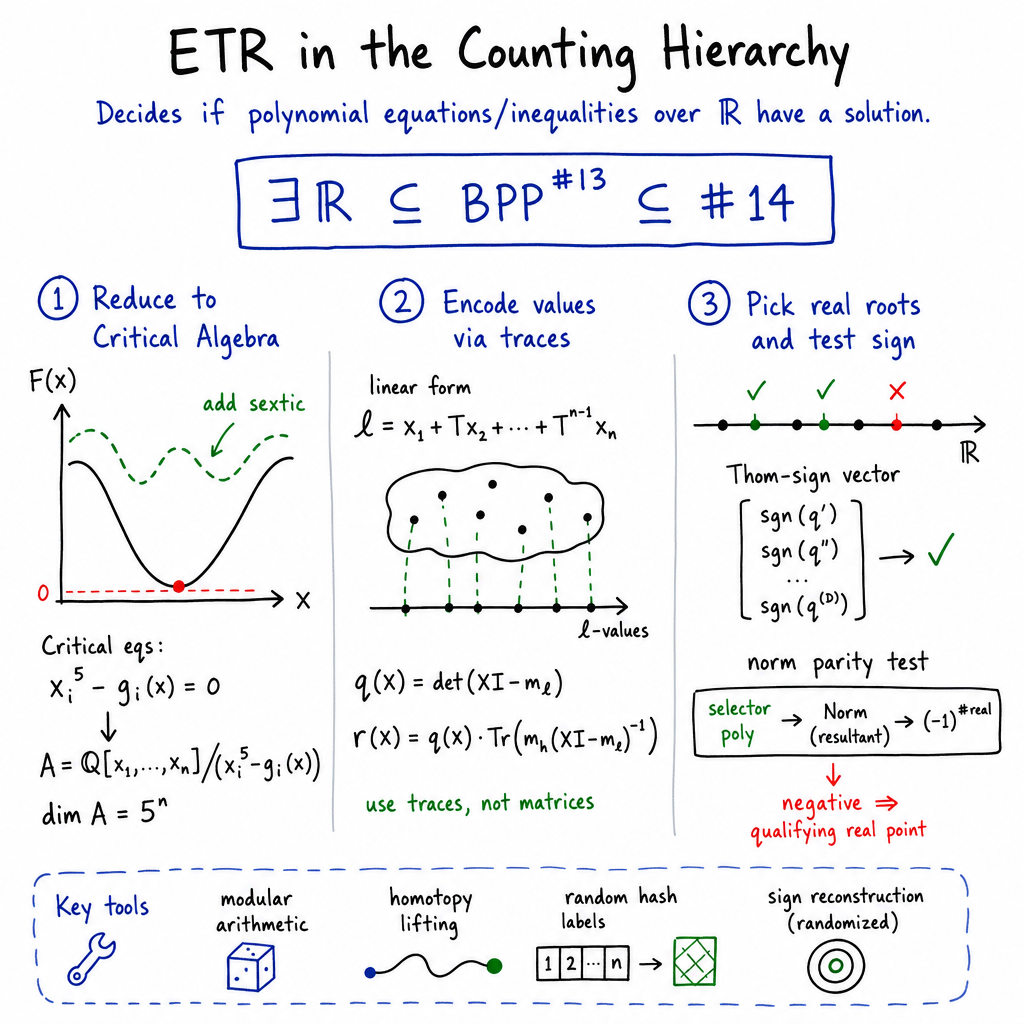
The paper’s main goal is to show that ETR belongs to the counting hierarchy, a group of computer-complexity classes designed to describe problems that involve counting extremely large numbers of possibilities.
The paper claims two important results:
- A broad result: .
- A sharper result: .
The symbols may look intimidating, but the basic message is:
Even though ETR can involve complicated real numbers that are impossible to write down directly, computers can still solve it using a controlled number of powerful counting steps.
2. What questions does the paper try to answer?
The paper focuses on several main questions.
Main question
Can the problem of deciding whether a system of polynomial equations and inequalities has a real solution be placed inside the counting hierarchy?
The authors also ask:
- Can the problem be placed at a low level of that hierarchy?
- How can we determine whether complicated algebraic solutions are actually real?
- How can we handle solutions that are repeated or “singular,” rather than nicely separated?
- Can similar methods be used for related problems, such as:
- semidefinite programming,
PosSLP, which asks whether a very large integer computed by a short program is positive,- the square-root-sum problem,
- counting geometric objects,
- and feasibility of polynomial systems over the complex numbers?
For systems with a fixed number of alternating groups of real quantifiers, the paper gives the bound
This means that each extra fixed group of “for every” or “there exists” real-number choices increases the required complexity by a predictable amount.
3. How does the research work?
The proof uses several connected ideas. They can be understood through an analogy.
Imagine that the original problem asks:
Is there a hidden treasure anywhere in a huge landscape?
The proof changes this into a series of easier questions:
- Build a landscape where the lowest points are important.
- Study all possible lowest points using algebra.
- Give each point a number so that different points can be told apart.
- Use signs and counting to determine whether one of the points has the desired property.
Step 1: Turn feasibility into finding a minimum
Suppose the original system contains equations such as
The paper forms a new function based on the sum of squares:
This function is always nonnegative. It equals zero exactly when all the original equations are satisfied.
So instead of asking whether the original equations have a solution, we can ask:
Does the function ever reach a minimum value of zero?
The paper adds extra terms to make sure that a minimum exists and that the function grows very large far away from the origin. A function with this behavior is called coercive. A useful everyday analogy is a bowl: no matter which direction you travel, eventually the sides rise, so the bowl must have a lowest point.
The paper also proves that if the minimum is not zero, it cannot be extremely close to zero. There is a definite gap between “zero” and “not zero.” This allows a computer to distinguish the two cases using exact arithmetic.
Step 2: Study the critical points
A lowest point usually occurs where all the derivatives are zero. The paper therefore studies equations of the form
These are called critical-point equations.
To make the system easier to control, the authors add special sixth-power terms. This produces equations resembling
These equations create a finite algebraic structure with a basis consisting of monomials such as
There are such monomials. This number may be exponentially large, but its index can still be described using only a polynomial number of bits.
The important point is that the proof does not try to write down every possible critical point. Instead, it works with the whole collection of points indirectly, using algebraic operations.
Step 3: Use traces instead of listing all points
The paper considers multiplication by a polynomial inside this finite algebra. For example, multiplying by a polynomial gives a linear transformation.
The trace of this transformation is related to the sum of the values of over all the algebraic points, including appropriate repetitions.
This is similar to learning about a large crowd by asking for totals and averages instead of interviewing every person individually.
The paper computes these traces using residue formulas. These are algebraic formulas that extract the needed information from polynomial coefficients. The authors emphasize that this works even when some solutions are repeated or singular.
From the traces, they reconstruct a univariate polynomial
where:
- represents an algebraic solution,
- is a number assigned to that solution,
- records how many times the solution is repeated.
This reduces a complicated many-variable problem to a one-variable polynomial problem.
Step 4: Separate the solutions
The paper chooses a linear expression such as
where is a sufficiently large integer.
This acts like a carefully designed label. Different solutions receive different labels, much like assigning different identification numbers to people in a crowd.
The paper proves that even though may be very large, it has a short description and can be handled by arithmetic circuits.
Step 5: Find which labels are real and useful
The polynomial may have real and nonreal roots. The original problem only cares about real solutions satisfying an additional condition such as
The proof uses derivative signs to identify real roots. For a real root , it examines the signs of
A result called Thom’s lemma says that this list of signs can distinguish different real roots.
The proof does not need to use the entire list. It guesses a short collection of derivative signs that isolates one desired root.
Finally, it uses a resultant or norm. Roughly speaking, this multiplies together information from all the roots. Nonreal roots occur in conjugate pairs and contribute positive quantities. A desired real root contributes a negative factor. Therefore, the sign of the final product reveals whether an odd number of suitable real roots exists.
Step 6: Improve the complexity bound
The first proof shows only that ETR belongs somewhere in the counting hierarchy.
The second proof is more carefully organized. It:
- constructs critical points that are simple and distinct,
- gives real roots ordered integer labels,
- uses random hashing to isolate one useful label,
- calculates huge integers through their residues modulo many smaller numbers,
- and reconstructs the sign of the huge integer probabilistically.
This produces the stronger bound
Here, BPP means a randomized algorithm that is very unlikely to make a mistake, while and represent specific levels of counting power.
4. What are the main findings?
ETR is in the counting hierarchy
The central theorem is
This is important because ETR was already known to lie between classes resembling NP and PSPACE, but the paper places it inside a hierarchy based on counting. This gives a new way to understand the computational difficulty of real algebraic problems.
A lower-level bound is claimed
The paper gives the more precise result
This says that ETR can be solved using randomized polynomial time together with a counting oracle of a fixed level.
The exact numbers are mainly important to complexity theorists. The general meaning is that the authors found a way to solve ETR with fewer layers of computational power than the broad proof initially suggested.
Singular solutions do not break the method
Many algebraic methods work only when all solutions are distinct and well-behaved. This paper specifically allows repeated roots and singular critical points.
That makes the result more robust: it applies to difficult systems where solutions may collide or have multiplicity.
Related problems also receive upper bounds
The paper applies similar techniques to other problems. Some of its claimed bounds include:
| Problem | Claimed complexity bound |
|---|---|
| General and strict semidefinite feasibility | |
PosSLP and square-root sum |
|
| Fixed real quantifier blocks | |
| Total geometric real counting |
For example, PosSLP asks whether a very large integer produced by a short arithmetic program is positive. The integer may have too many digits to write down, but the method works with modular information instead.
Convex problems become easier
For semidefinite programming and other closed convex problems, the paper uses a geometric fact about Euler characteristic. A nonempty compact convex set has a simple topological signature, so checking one bit of information can reveal whether the set is empty.
This leads to a lower complexity bound for exact semidefinite feasibility.
5. Why does this research matter?
The research could affect the way mathematicians and computer scientists understand problems involving real numbers.
Many important problems ask whether a geometric object exists:
- Can a collection of shapes be placed without overlapping?
- Can a graph be drawn with certain geometric restrictions?
- Does a system of physical or optimization constraints have a solution?
- Is a semidefinite program feasible?
- Does a complicated polynomial have a real root satisfying certain conditions?
These problems may involve real numbers that have enormous descriptions. A solution might require an algebraic number with a very high degree, so it cannot simply be written down as a short answer.
The paper shows that this difficulty does not necessarily make the problem impossible to analyze. Instead, one can:
- represent all candidate solutions indirectly,
- use traces and resultants instead of listing them,
- identify real solutions through sign information,
- and determine huge quantities using modular arithmetic and counting.
If the arguments are correct and the bounds are eventually improved or independently verified, they would give a more detailed map of the difficulty of real-algebraic computation. They might also help compare the complexity of geometry, optimization, algebra, and counting problems.
One important caution is that the paper itself is presented as a draft whose exposition and technical details are still being improved. Its results should therefore be treated as mathematical claims requiring careful checking, rather than as established facts merely because they appear in the manuscript.
Knowledge Gaps
Knowledge gaps, limitations, and open questions
- The paper’s central claims rely on a draft-level exposition with several results deferred to supplementary sections that are not included in the provided text; the completeness and correctness of those omitted arguments cannot be independently assessed here.
- The claimed bound depends on substantial technical interfaces—formal homotopy evaluation, Galois-ring arithmetic, randomized sign reconstruction, and ordered root labels—whose full proofs and uniformity details are not presented in the main text.
- The paper does not establish whether the level-$14$ upper bound is close to optimal, nor whether lies in a substantially lower level of the counting hierarchy.
- It remains unresolved whether the randomized bound can be made deterministic, for example by replacing the random affine hashing and randomized integer-sign reconstruction with deterministic procedures at comparable complexity.
- The use of randomized normalizers and affine hashes requires a high-probability simultaneous success guarantee over exponentially many algebraic roots and root differences; the exact failure probability, seed length, and amplification costs should be quantified more explicitly.
- The ordered-label construction assumes that the randomized rational normalizer preserves the required ordering properties for all relevant root pairs, but the robustness of this property under repeated roots, near-collisions, and specialization is not fully explored in the main paper.
- The paper does not clarify whether the formal homotopy constructions remain valid under all possible degeneracies of the critical system, including vanishing Jacobians, degree drops, nonreduced fibers, and nonunit elements in the finite rings used for modular evaluation.
- The transition from modular or residue representations to exact signs depends on known singly exponential height bounds; sharper or more generally applicable bounds for the constructed norms, resultants, and selector polynomials are not derived.
- The integer-sign reconstruction interface assumes residue representatives for every positive, polynomial-bit modulus, including prime powers; the paper does not fully characterize the minimum modulus family needed or whether restricting to a simpler family would preserve the stated complexity bound.
- The relationship between the paper’s “raw” signed counting representations and standard function-class definitions is not fully formalized, particularly when canonical residue extraction or weighted sums could introduce additional oracle levels.
- The claimed preservation of complexity under dense polynomial arithmetic on exponentially large objects depends on strong uniformity assumptions; the paper does not provide a complete machine-level construction for all indexed circuits and address-generation procedures.
- The treatment of coefficient extraction from arithmetic circuits does not fully resolve how sign cancellations, coefficient bounds, and Kronecker-substitution parameters are generated uniformly when the circuit has exponentially large degree.
- The residue-trace formula is extended from simple fibers to nonreduced fibers by a polynomial-specialization argument, but the conditions under which this specialization is valid for every subsequent trace and resolvent construction deserve a more explicit algebraic justification.
- The real-root selector detects an odd number of qualifying roots through a norm sign; the paper does not investigate whether an alternative selector could count roots directly or avoid the parity limitation.
- The root-selection lemma requires every qualifying real root to be simple in the auxiliary polynomial ; although the paper constructs derivative strata intended to ensure this, it does not analyze whether all edge cases involving multiplicities and coincident projected values are covered without hidden assumptions.
- The proof that a real projected root corresponds to a real point relies on separation by the linear form ; the quantitative separation bounds are extremely large, and their interaction with coefficient-height and circuit-size estimates is not fully optimized.
- The critical-point reduction introduces high-degree coercive objectives and exponentially large constants; the paper does not determine whether lower-degree objectives, smaller constants, or alternative compactification methods could reduce the counting-hierarchy depth.
- The reduction from arbitrary ETR instances to the bounded constraint language uses cited universality results, but the precise preservation of input size, coefficient encoding, and promise-free behavior is not fully detailed.
- The paper does not compare its upper bound rigorously with the contemporaneous OpenAI bound beyond stating that the former is lower; the relative technical assumptions and whether either proof subsumes the other remain unclear.
- The claimed containment for a fixed number of alternating real quantifier blocks, , is an accounting bound rather than an optimized one; no lower bounds or evidence are given for the linear coefficient $9$ or additive constant $17$.
- It remains open whether fixed-level real quantifier classes admit bounds independent of , or whether the dependence on the number of real quantifier blocks can be reduced substantially.
- The real-hierarchy construction relies on coherent algebraic sample representations across quantifier blocks; the paper does not provide an implementation-level analysis of representation duplication, root-address verification, and consistency checking for all nested branches.
- The use of formal infinitesimals for simultaneous specialization assumes effective degree and height bounds for the entire guarded sample tree; the dependence of these bounds on the quantifier-block structure is not fully instantiated.
- The paper does not establish whether the methods extend to input-dependent quantifier depth, rather than only to each fixed .
- The SDP application assumes exact rational input and uses a semialgebraic encoding of positive semidefiniteness via characteristic-polynomial coefficients; the behavior and complexity under floating-point, oracle, or approximate input models are not addressed.
- The claimed equivalence between general and strict SDP feasibility depends on effective infeasibility gaps, including weakly infeasible instances; the main text delegates the crucial quantitative construction to supplementary material.
- The extension to closed convex semialgebraic sets is stated for explicitly represented sets, but the limits of the result for succinct, circuit-defined, exponentially dimensional, or nonclosed convex sets are not characterized.
- The commuting-SDP bound depends on algebraic-number representations and PosSLP certificates; the paper does not establish whether analogous improvements hold for approximately commuting pencils or other structured matrix classes.
- The SDP extensions to algebraic coefficients explicitly exclude arbitrary nested algebraic-root DAGs and succinct exponentially large matrices; whether these exclusions are essential or merely technical is left open.
- The PosSLP and square-root-sum consequences are only partially developed in the provided text, so the precise reductions, promise conditions, and oracle-order arguments for those applications cannot be evaluated.
- The paper does not determine whether the stated bounds for PosSLP, square-root sum, geometric real counting, Euler characteristic, and complex feasibility are optimal, or whether the specialized constructions can be combined to obtain lower bounds for ETR itself.
- The Euler-characteristic approach for convex feasibility relies on compact truncation and exact parity computation; the robustness of this method for unbounded, nonclosed, or nonconvex sets is not explored.
- The paper does not provide hardness results within the counting hierarchy that would distinguish the complexity of general ETR, bounded ETR, SDP feasibility, and the other associated problems.
- Several claims use phrases such as “standard effective bounds,” “known bit-access theorem,” or “uniform circuits” without specifying exact parameterizations; a fully reproducible complexity analysis would need explicit bounds in terms of input length, degree, number of variables, and coefficient height.
- The manuscript does not include machine-checkable formalizations or independently verifiable implementations of the large arithmetic constructions, leaving open whether hidden representation or uniformity issues affect the claimed oracle levels.
- The paper’s priority and authorship discussion does not affect the mathematical results, but the comparison with an independently released proof raises an unresolved question about which parts of the techniques are genuinely new versus rediscovered or adapted from prior work.
Practical Applications
Immediate Applications
- Exact feasibility checking for polynomial constraint systems — software, geometry, verification
- The paper places the existential theory of the reals (ETR) in the counting hierarchy, with a stronger stated bound of .
- A practical workflow could encode a finite system of polynomial equalities and inequalities—such as geometric incidence, distance, orientation, or collision constraints—and use an exact algebraic decision engine to determine whether a real configuration exists.
- Relevant uses include:
- geometric planning and configuration-space analysis;
- art-gallery and visibility problems;
- rigid-body or linkage feasibility;
- circuit and mechanism design;
- formal verification of nonlinear constraints.
- Potential tool: an exact solver that converts a constraint system into a finite critical-point algebra, computes trace/resultant representations, and performs certified real-root sign tests without explicitly constructing exponentially large algebraic numbers.
- Dependencies: the input must have a finite binary representation and polynomial constraints with integer or rational coefficients. The complexity results are upper bounds, not evidence that large instances are practically tractable; the randomized implementation also requires error amplification and reliable integer-sign reconstruction.
- Exact semidefinite and convex feasibility — optimization, control, finance, machine learning
- The paper states that general and strict rational semidefinite feasibility belong to .
- This supports exact decision procedures for whether a rational linear matrix pencil
has a positive-semidefinite or positive-definite realization. - Possible applications include: - robust control and Lyapunov feasibility; - portfolio and risk-model constraints; - sum-of-squares certificates; - polynomial optimization relaxations; - quantum-information feasibility problems; - verification of convex relaxations in machine learning. - Potential workflow: use determinant-based polynomial encodings of positive semidefiniteness, apply the closed-convex feasibility procedure, and return an exact feasible/infeasible answer rather than a floating-point approximation. - Dependencies: matrices must be explicitly or suitably compactly represented; the result assumes exact rational or permitted algebraic coefficient encodings. Numerical conditioning, floating-point error, and exponentially large intermediate quantities remain engineering obstacles.
Strict-versus-general SDP preprocessing — optimization software and policy certification
- The paper gives a polynomial-time many-one equivalence between general rational SDP feasibility and strict SDP feasibility, including reductions that address weakly infeasible instances.
- An optimization platform could therefore normalize input problems into whichever form is better supported by its solver or certificate system.
- This may help build:
- preprocessing passes for conic optimization packages;
- exact feasibility certificates for regulatory or safety constraints;
- standardized benchmark reductions between weak, ordinary, and strict feasibility.
- Dependencies: the reduction uses effective bounds and very large encoded constants. The transformation is theoretically polynomial in input length, but the resulting constants may be too large for naïve numerical implementations.
- Commuting semidefinite programs — structured optimization
- For commuting rational matrix pencils, the paper gives a substantially lower bound involving , , and related classes.
- In structured applications where matrices share eigenvectors or generate a low-dimensional commutative algebra, feasibility can be reduced to a linear program over algebraic eigenvalues.
- Potential products: specialized SDP solvers for simultaneously diagonalizable systems, with exact algebraic-number certificates and Farkas-style infeasibility proofs.
- Dependencies: the commuting structure must be certified or given as part of the input. The result does not apply to arbitrary noncommuting matrix families.
- Sign evaluation for huge arithmetic expressions — software verification and symbolic computation
- The paper places
PosSLP—deciding whether an integer straight-line program evaluates to a positive number—in . - This directly concerns programs whose outputs may have exponentially many bits but are represented compactly by additions, subtractions, and multiplications.
- Applications include:
- certifying signs of symbolic determinant and resultant expressions;
- exact comparison of huge combinatorial quantities;
- checking positivity of arithmetic-circuit coefficients;
- validating intermediate predicates in algebraic geometry and optimization.
- Potential tool: a modular-residue engine that evaluates an arithmetic circuit modulo many short moduli and reconstructs the sign probabilistically.
- Dependencies: the output-size bound must be known or effectively bounded. Randomized correctness depends on sufficient modulus sampling, robust reconstruction, and appropriate failure-probability guarantees.
- The paper places
- Exact coefficient-sign queries for polynomial circuits — computer algebra and formal methods
- The same techniques apply to deciding the sign of a specified coefficient of a polynomial represented by a short arithmetic circuit, even when the coefficient index is given in binary.
- This could support:
- sparse symbolic expansion without materializing the full polynomial;
- sign checks in resultant and discriminant computations;
- algebraic invariant testing;
- formal verification of generated polynomial identities.
- Dependencies: the circuit must have uniform random-access descriptions and controlled degree and coefficient-growth bounds.
- Square-root-sum and related algebraic-number comparisons — number theory and exact algorithms
- The paper reports bounds of the form for
PosSLPand square-root-sum-type problems. - Exact comparison of expressions such as
is relevant to: - computational geometry, where distances and path lengths involve radicals; - geometric optimization; - exact shortest-path and packing comparisons; - symbolic numerical libraries. - Potential workflow: represent the comparison as a positivity problem for an arithmetic circuit and invoke modular sign reconstruction rather than repeated floating-point approximation. - Dependencies: the stated bounds concern exact discrete input models. They do not automatically provide a fast practical algorithm for arbitrary high-dimensional radical expressions.
- The paper reports bounds of the form for
Geometric real counting and Euler-characteristic tests — topology, geometry, and verification
- The paper discusses function-class bounds for total geometric real counting and an Euler-characteristic method for deciding nonemptiness of compact convex semialgebraic sets.
- This suggests exact tools for:
- counting connected components or real solutions;
- testing whether a bounded semialgebraic region is empty;
- verifying topological properties of feasible regions;
- analyzing configuration spaces in robotics.
- Potential tool: a real-algebraic sampling system that computes signed or parity-weighted counts through resultants and norms.
- Dependencies: compactness, closedness, convexity, and explicit coefficient bounds are important. Euler characteristic alone does not generally detect nonemptiness for arbitrary nonconvex sets.
- Complex polynomial feasibility — symbolic algebra and algebraic geometry
- The paper connects its methods with bounds for complex feasibility and Hilbert’s Nullstellensatz-related problems.
- Exact complex feasibility testing can support:
- symbolic equation solving;
- verification of algebraic model consistency;
- elimination pipelines;
- computational algebraic geometry software.
- Dependencies: complex feasibility does not by itself resolve the real-order and sign conditions required by ETR. Resultant computations may involve exponentially large degree and coefficient representations.
Long-Term Applications
- Scalable exact nonlinear optimization platforms — optimization, engineering, and energy
- A long-term system could combine the paper’s critical-point construction, residue-based trace computation, and real-root selection into a certified solver for nonlinear feasibility and optimization.
- Such a platform might support:
- exact verification of global feasibility;
- certification of whether a design constraint has any real realization;
- hybrid workflows in which numerical optimization proposes candidates and the algebraic engine certifies them.
- Required development: practical implementations must avoid explicit construction of the exponentially large finite algebra, exploit sparsity and problem structure, and manage coefficient growth.
- Assumptions: the theoretical bounds rely on uniform arithmetic circuits, singly exponential degree and height bounds, and exact integer operations. These conditions may fail for succinctly represented or heavily nested models.
- Certified robot motion and mechanism planning — robotics
- Many motion-planning and linkage problems can be expressed using polynomial distance, collision, orientation, and joint constraints.
- A future solver could:
- certify whether a collision-free configuration exists;
- determine whether a linkage can reach a target pose;
- count or isolate algebraic configuration modes;
- verify whether a robust motion-planning region is nonempty.
- Required development: encode temporal trajectories, inequalities, and collision avoidance without an uncontrolled increase in variables and degree; integrate exact algebraic decisions with approximate geometric meshes and sensor uncertainty.
- Dependencies: idealized rigid geometry and exact coefficients are strong assumptions. Real robots involve transcendental kinematics, tolerances, noise, and continuously varying controls.
- Formal verification of hybrid and cyber-physical systems — software, aerospace, automotive, energy
- Fixed-depth real quantifier formulas are placed in the counting hierarchy, with the stated bound
for each fixed number of alternating real-quantifier blocks. - This could eventually support exact verification of bounded-horizon properties such as: - “there exists a control input such that all safety constraints hold”; - “for every disturbance, there exists a controller response”; - reachability and invariant checking for polynomial dynamical models. - Potential workflow: represent algebraic sample points coherently across quantifier blocks, preserve root identities through guarded resultants, and evaluate the resulting finite Boolean predicate. - Dependencies: the quantifier depth must be fixed independently of input size. Input-dependent alternation, transcendental dynamics, undecidable continuous-time behavior, and noisy coefficients are outside the stated guarantee.
Exact robust control and worst-case certification — control and energy
- The combination of SDP feasibility, real quantifier handling, and sign reconstruction could yield exact certificates for robust stability and worst-case performance in polynomially parameterized systems.
- Possible future products include:
- certified Lyapunov-function search;
- exact robust feasibility under bounded parameter uncertainty;
- symbolic verification of controller constraints;
- safety-margin certificates for power-grid and energy systems.
- Dependencies: standard semidefinite relaxations may be conservative; exact feasibility of the relaxation does not necessarily prove feasibility of the original nonlinear control problem. Scaling to realistic models requires exploiting sparsity and decomposition.
- Algebraic decision engines for AI and machine learning — verification and symbolic model analysis
- Polynomial and semialgebraic constraints arise in neural-network verification, certified robustness, matrix-factorization constraints, and polynomial feature models.
- A future system could use the paper’s methods to determine whether:
- an adversarial input exists within a specified region;
- a set of polynomial fairness or safety constraints is jointly satisfiable;
- a symbolic model has a parameter setting satisfying exact requirements.
- Dependencies: current neural-network models commonly include piecewise-linear, exponential, normalization, or transcendental operations. The approach applies directly only after a faithful polynomial or semialgebraic encoding.
- Exact financial stress testing and model validation — finance
- Polynomial and semidefinite constraints can encode portfolio limits, covariance restrictions, factor exposures, and robust stress scenarios.
- Long-term applications could include:
- exact feasibility checks for regulatory portfolios;
- certified existence of allocations satisfying multiple nonlinear constraints;
- robust optimization under algebraically represented uncertainty.
- Dependencies: financial data are approximate and statistical rather than exact; the paper’s guarantees apply to exact finite inputs. Practical adoption would require certified interval or rationalization procedures and clear treatment of model uncertainty.
- Algebraic-number infrastructure for computer algebra systems — academia and industry
- The paper’s use of separating linear forms, multiplication traces, formal power series, resultants, and norm signs suggests a general architecture for manipulating exponentially complex algebraic objects through compact representations.
- A future computer algebra library could provide:
- random-access coefficient and trace queries;
- certified real-root selection;
- multiplicity-aware elimination;
- modular norm and sign evaluation;
- coherent algebraic sample representations across nested quantifiers.
- Dependencies: the paper’s complexity statements are upper bounds and do not establish practical running times. Implementations would need optimized modular arithmetic, parallel hardware, sparse representations, and rigorous randomized-error control.
- Policy and standards for exact optimization certificates — public-sector decision systems
- Government, infrastructure, and safety regulators could eventually use machine-checkable certificates for feasibility or infeasibility of algebraic and semidefinite models.
- Examples include:
- validating infrastructure design constraints;
- certifying resource-allocation feasibility;
- checking whether a public policy model has any parameter setting satisfying statutory requirements;
- independently auditing optimization software.
- Dependencies: adoption requires transparent certificate formats, independently verifiable proof objects, reproducibility standards, and assurance that the encoded mathematical model accurately reflects the real-world policy.
- Daily-life planning tools with certified constraints — consumer software
- In the long term, exact semialgebraic reasoning could support consumer tools for constrained layout, scheduling, energy use, and accessibility—for example, determining whether furniture, appliances, or ramps can be arranged while satisfying geometric and safety requirements.
- Dependencies: realistic applications require tolerance-aware rather than exact geometry, efficient handling of disjunctions and temporal constraints, and interfaces that translate informal user requirements into valid polynomial models.
Glossary
- Algebraic integer: A complex number that is a root of a monic polynomial with integer coefficients. “every coordinate of a complex point is an algebraic integer of degree at most .”
- Algebraic multiplicity: The multiplicity with which an eigenvalue or root occurs in a characteristic polynomial. “At a point of local dimension ”
- Affine hash: A hash function formed from an affine transformation, typically over a finite vector space. “Now hash the -bit labels by a random affine map”
- Arithmetic circuit: A circuit whose gates perform arithmetic operations on numbers or polynomials. “If have short circuits”
- Bézout identity: An identity expressing a greatest common divisor as a linear combination of two elements. “The -order is ”
- BitSLP theorem: A result stating that specified bits of the output of a straight-line program can be computed within the counting hierarchy. “We call this the BitSLP theorem.”
- Boolean alternation: Alternation between existential and universal quantification over Boolean objects. “Finally, fixed Boolean alternation and relativized Toda absorption cost at most two more.”
- Cauchy root bound: A bound on the absolute values of the roots of a polynomial based on its coefficients. “Cauchy's bound gives the upper estimate.”
- Characteristic polynomial: The determinant polynomial associated with a matrix. “its characteristic coefficients are computable in uniform ”
- Coercive function: A function that tends to infinity as the norm of its input tends to infinity. “Moreover , , and is coercive”
- Complex feasibility: The problem of determining whether a system of polynomial equations has a solution over the complex numbers. “the corresponding complex feasibility problem”
- Counting hierarchy: A hierarchy of complexity classes built from probabilistic counting classes such as . “The counting hierarchy is defined by”
- Critical fiber: The set of solutions associated with a critical value or parameter in an algebraic or geometric map. “This proof permits singular critical fibers”
- Critical point: A point at which the gradient of a differentiable function vanishes. “some real critical point of has .”
- Cusp-free? Wait no.
- Dense polynomial: A polynomial represented by explicitly listing coefficients for all monomials up to a specified degree. “exact resultant of two dense integer univariate polynomials”
- Dyadic multiplication: Arithmetic involving numbers whose denominators are powers of two. “Dyadic multiplication of this phase eventually makes its sign visible”
- Effective real-algebraic sampling: An algorithmic method for producing or bounding representative points of semialgebraic sets. “Standard effective real-algebraic sampling bounds”
- Euler characteristic: A topological invariant computed from the alternating sum of the numbers of cells or homology groups. “The Euler-parity algorithm of Theorem~\ref{app:euler}”
- Existential theory of the reals: The decision problem for whether a system of polynomial equalities and inequalities has a real solution. “The existential theory of the reals asks whether polynomial constraints with integer coefficients have a real solution.”
- Formal homotopy: A symbolic deformation between algebraic systems, often represented using a formal parameter. “It uses a common formal homotopy”
- Formal power series: An infinite algebraic series manipulated symbolically without requiring numerical convergence. “Exact formal power series and univariate resultants complete the calculation.”
- Fourier coefficient extraction: Recovering polynomial coefficients by evaluating a polynomial at structured points and applying a discrete Fourier transform. “Degree bounds permit Fourier coefficient extraction without aliasing.”
- Galois ring: A finite commutative ring that generalizes finite fields to prime-power characteristics. “the calculation takes place in a short unramified Galois ring.”
- GapP: A counting complexity class consisting of differences between two #P functions. “the final Fourier sum, kept as a signed sum”
- Gröbner basis: A specially structured generating set for a polynomial ideal that supports algorithmic reduction and elimination. “Their relatively prime leading monomials give a monic Gr\"obner basis”
- Hensel lifting: A method for lifting solutions of polynomial equations modulo a prime to solutions modulo higher prime powers or characteristic zero. “Hensel lifting gives simple characteristic-zero points.”
- Hilbert’s Nullstellensatz: A fundamental theorem relating polynomial ideals to their common zeros over algebraically closed fields. “Allender, B\"urgisser, Kjeldgaard-Pedersen, and Miltersen used this principle”
- Homogenization: The process of converting a polynomial into a homogeneous polynomial by adding a variable. “The evaluator includes points at infinity”
- Jacobian: The matrix of first partial derivatives of a vector-valued function, or its determinant. “Write for the Jacobian of ”
- Kronecker substitution: An encoding that replaces multivariate variables by powers of a single variable to pack coefficients into one integer or polynomial. “For each part, Kronecker substitution”
- Local algebra: The algebraic structure describing polynomial behavior near a particular point or prime ideal. “Over Az\mu_zPPPosSLP0,1,+,-,\times\operatorname{Tr}(M^j)NNA=[x_1,\ldots,x_n]/(x_i^5-g_i:1\le i\le n)A(x)\succeq0x$”
- Straight-line program: A sequence of arithmetic operations computing an integer or polynomial without branching or loops. “a polynomial-size arithmetic straight-line program”
- Sylvester resultant: A resultant traditionally computed as the determinant of a structured matrix formed from two polynomials. “the algorithm never computes this matrix determinant.”
- Thom’s lemma: A result stating that the signs of successive derivatives distinguish distinct real roots of a polynomial. “Thom's lemma says that the vectors”
- Threshold circuit: A Boolean circuit containing gates that output one when a weighted sum reaches a specified threshold. “polynomial-size, constant-depth Boolean circuits with unbounded majority gates”
- Trace reconstruction: The recovery of characteristic-polynomial coefficients from matrix power traces. “An exact, parallel replacement for Newton identities”
- Univariate resultant: A resultant applied to two polynomials in one variable, eliminating their common variable. “we do not require a multivariate resultant algorithm.”
- Valuation: A function measuring the divisibility or order of an element with respect to a prime or parameter. “Nonunits in a product are handled by their valuations”
- Weak infeasibility: In convex optimization, infeasibility without a positive separation gap from the feasible region. “including weakly infeasible inputs.”
- Witness: An object that certifies membership in a decision problem, such as a satisfying assignment. “its witnesses are real tuples.”

