QuadTok: Quadtree Visual Tokenizer for Autoregressive Image Generation
Abstract: We introduce QuadTok, a novel framework for visual tokenization and autoregressive image generation. Compared to traditional approaches using 2D grids or 1D token sequences, we propose a hierarchical quadtree structure, bridging the gap between 2D spatial binding and 1D sequence-level flexibility. The QuadTok tokenizer dynamically allocates representational capacity to visually intricate areas while leaving homogeneous regions at a coarse resolution. Compared with a fixed 256-token grid, our ImageNet-trained tokenizer saves approximately 10% of tokens on ImageNet and 9% when transferred zero-shot to the COCO dataset, while maintaining comparable reconstruction fidelity. Furthermore, the natural causality introduced by the tree structure seamlessly enables autoregressive image generation. Conditioned on a quadtree topology supplied before generation, our 947M GPT-style generative model achieves a 2.08 gFID on the ImageNet benchmark. Additionally, leveraging the strong spatial correlation preserved by the quadtree structure, the QuadTok generator enables zero-shot spatially controlled image generation capabilities. Code: https://github.com/myc634/QuadTok.
Paper Prompts
Sign up for free to create and run prompts on this paper.
Top Community Prompts
Explain it Like I'm 14
1. What is the paper about?
This paper introduces QuadTok, a new way for computers to understand and generate images.
Image-generation systems usually break an image into many small pieces called tokens. These tokens are like puzzle pieces that a computer can store, study, and use to create a new image.
Most systems divide every image into an identical grid. However, images do not contain the same amount of information everywhere. For example:
- A clear blue sky is simple and does not need many pieces.
- A person’s face, hair, or a crowded street contains many details and needs more pieces.
QuadTok tries to solve this problem by giving more tokens to complicated areas and fewer tokens to simple areas.
2. What questions are the researchers asking?
The researchers mainly want to know:
- Can images be represented more efficiently? Can the system use fewer image tokens without losing much visual quality?
- Can the system keep track of where each token belongs? A token representing a face should remain connected to the face, rather than becoming mixed up with unrelated parts of the image.
- Can this structure help create better images? Can a computer generate an image from large, general shapes to small details, in a way similar to how a person might draw?
- Can users control where objects appear? For example, can someone ask for a dog on the left side of an image instead of the middle?
3. How does QuadTok work?
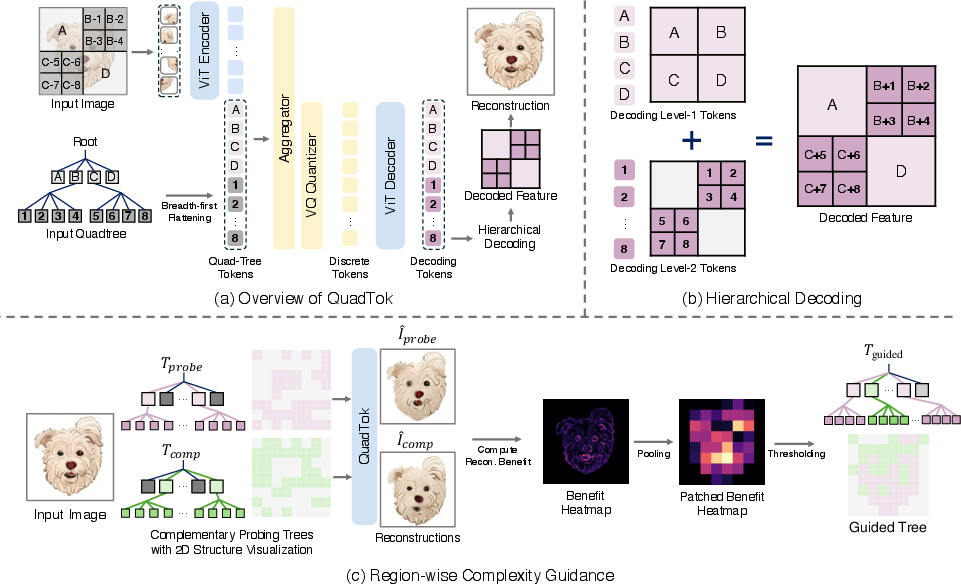
A quadtree: a map that divides areas only when needed
QuadTok uses a structure called a quadtree. Imagine starting with a large square representing the whole image. The square can be divided into four smaller squares. Any of those smaller squares can then be divided into four more squares if that area contains extra detail.
This is similar to using a map:
- You view a whole country from far away.
- You zoom in only on a busy city.
- You do not need to zoom in as much on an empty desert.
In QuadTok:
- Large, simple regions stay as large tokens.
- Detailed regions are divided into smaller tokens.
- Each token still knows its location in the image.
Turning an image into tokens
The system first examines the image using a Vision Transformer, or ViT. This is a computer model that looks at small image patches and learns what is in them.
QuadTok then creates a token for each selected image region. It stores these tokens in a learned dictionary called a codebook. This is like a box of visual symbols: the system chooses the symbol that best matches each region.
Rebuilding the image
To reconstruct the image, QuadTok works from coarse to fine:
- It uses large tokens to create the overall shape and layout.
- It adds smaller tokens to improve particular regions.
- It adds further detail where necessary.
This is similar to drawing a picture by first sketching the whole scene and then adding details to the face, clothing, trees, or buildings.
Choosing which regions need more detail
The researchers created Region-Wise Complexity Guidance. This method tests whether adding smaller tokens improves a particular region.
If a region becomes much better when refined, QuadTok gives it more tokens. If refinement barely helps, the region remains coarse.
The researchers also use a Kinship Causal Mask. This is a set of rules that controls which tokens can communicate with each other. A fine-detail token can learn from its larger parent region and from nearby “sibling” regions, but it cannot freely mix with every part of the image.
This helps preserve the connection between a token and its correct location.
Generating new images
QuadTok also includes an autoregressive generator. “Autoregressive” means that the model creates one token at a time, using the tokens it has already created—similar to writing a sentence one word at a time.
The model generates:
- Coarse tokens first, establishing the general layout.
- Finer tokens afterward, adding local details.
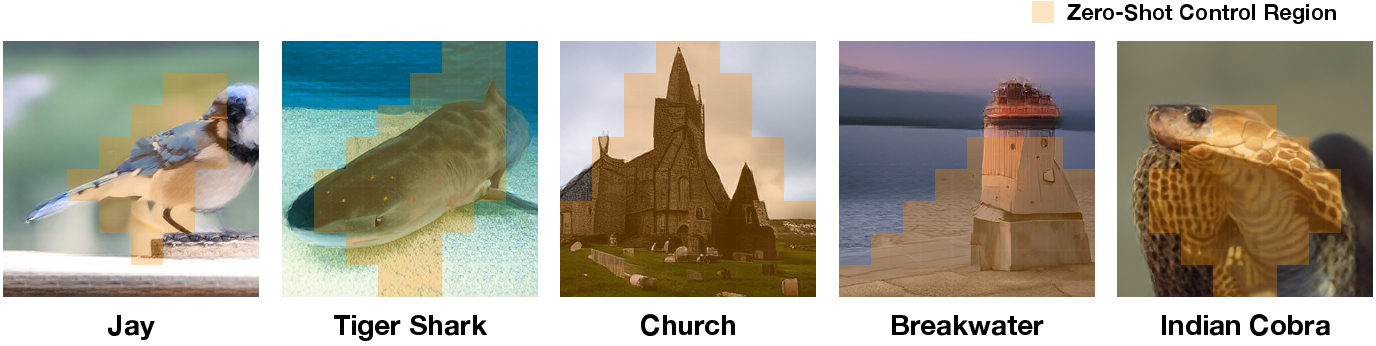
The researchers can provide a quadtree layout before generation. For example, they can mark the left side of an image for a subject, and the model may place the subject there.
4. What did the researchers find?
Fewer tokens with similar image quality
When trained on ImageNet, QuadTok used about 230 tokens on average, compared with 256 tokens for a fixed grid. This is about a 10% reduction.
When tested on the COCO dataset without retraining, it used about 232 tokens, saving approximately 9%.
Despite using fewer tokens, its reconstructed images had broadly similar quality to those made by fixed-grid systems. This suggests that QuadTok avoids wasting tokens on simple regions.
Better allocation of detail
The guidance method was especially useful. In one comparison:
- A fully detailed tree used about 320 tokens.
- The guided version used only 230 tokens.
- The guided version achieved nearly the same reconstruction quality.
In other words, the system placed its effort where it mattered most.
Strong image generation results
The largest QuadTok generator had about 947 million parameters. On the ImageNet image-generation test, it achieved a gFID score of 2.08.
gFID is a score used to compare generated images with real images. In general, a lower score means the generated images look more realistic and similar to the real dataset.
QuadTok performed better than the reported 2.15 score of a larger 1.4-billion-parameter RandAR model, although the paper explains that these comparisons use somewhat different settings.
Spatial control worked
The researchers tested whether QuadTok could control where an object appeared. They compared:
- A randomly chosen token layout.
- A layout designed to focus on the left, right, top, or bottom of the image.
The planned layouts improved the chances that the generated subject appeared in the requested area. For example, when the model was asked to place an object on the left, one location test improved from 29.6% to 58.3%.
The image quality changed very little, meaning that controlling the object’s position did not seriously damage the picture.
The spatial rules were important
When the researchers removed the Kinship Causal Mask, token changes spread across the image instead of staying in the correct region. Generation quality also became worse: the gFID score rose from 2.23 to 3.17 in one comparison.
This shows that preserving spatial relationships is an important part of QuadTok’s success.
5. Why does this research matter?
QuadTok suggests that image-generation systems do not need to treat every part of an image equally. Instead, they can spend more computing power on important or complicated regions and less on simple backgrounds.
This could lead to systems that are:
- More efficient, because they use fewer tokens and possibly less processing time.
- Better at preserving local details, such as faces, text, and objects.
- More controllable, because users can influence where objects appear.
- More flexible, because different images can use different numbers of tokens.
The method could also be useful for future text-to-image and multimodal systems. For example, a user might describe an image and specify that one object should appear in a certain part of the scene.
However, the paper mainly tests class-conditional ImageNet generation rather than full text-to-image generation. The authors therefore present text-guided image creation as an important direction for future work.
In simple terms, QuadTok is like an intelligent image organizer: it uses large pieces for simple parts of a picture, smaller pieces for detailed parts, and keeps track of exactly where every piece belongs.
Knowledge Gaps
The paper leaves the following knowledge gaps, limitations, and open questions unresolved:
- Limited dataset diversity: The tokenizer and generator are primarily evaluated on ImageNet, with reconstruction transferred only to COCO; robustness across domains such as medical, satellite, video, fine-grained, and highly textured natural images remains unknown.
- Restricted conditioning scope: Generation experiments focus on class-conditional ImageNet synthesis. The effectiveness of QuadTok for text-to-image, image-to-image, multimodal, unconditional, and compositional generation is not demonstrated.
- Unresolved scaling to higher resolutions: Although results are mentioned as supplementary experiments, the paper does not establish how token count, tree depth, memory use, and generation latency scale to substantially higher resolutions such as or beyond.
- Limited quadtree depth analysis: The main experiments emphasize two-level trees, while the three-level results increase both hierarchy depth and token budget. The independent effects of tree depth, spatial resolution, and token count are therefore not isolated.
- No comparison with non-quadtree adaptive partitions: The paper does not systematically compare quadtrees with alternatives such as octrees, rectangular partitioning, learned region proposals, irregular superpixels, or adaptive patch-merging schemes under matched token budgets.
- Fixed partition geometry: QuadTok can only subdivide regions into four axis-aligned quadrants. Its ability to represent elongated objects, diagonal boundaries, thin structures, and irregular object shapes is not evaluated.
- Dependence on topology supplied at inference: The generator requires a quadtree topology before sampling, but the paper does not provide a general method for automatically predicting an optimal topology from text, class labels, or other conditioning signals.
- Mismatch between training and deployment topologies: Unconditional generation samples random trees, whereas layout control uses manually or LLM-specified trees and reconstruction uses complexity-guided trees. The degree to which performance depends on the topology distribution seen during training remains unclear.
- Quality of generated topologies is unexplored: The paper does not quantify how errors, ambiguity, excessive refinement, or implausible user-defined layouts affect generation quality and spatial controllability.
- Weak localization evaluation: Spatial control is assessed mainly with half-plane targets and detector-derived centers. More demanding evaluations involving bounding boxes, multiple objects, object sizes, irregular masks, relative spatial relations, and precise boundary alignment are missing.
- Potential metric instability in layout control: The localization metrics rely on Grad-CAM, Grounding DINO, and SAM 2 outputs, whose detection failures and biases may affect reported hit rates. Human judgments or task-specific localization benchmarks are not provided.
- Limited evidence for semantic control: Refining a region improves spatial allocation, but it is unclear whether QuadTok can independently control object identity, attributes, pose, scale, and interactions among multiple objects.
- No downstream representation evaluation: The claim that spatially grounded tokens are useful for downstream tasks is not tested on segmentation, detection, classification, retrieval, visual question answering, or localization benchmarks.
- Unclear source of reconstruction gains: The experiments do not fully disentangle the contributions of the ViT encoder, hierarchical decoder, codebook, stochastic tree sampling, Region-Wise Complexity Guidance, and Kinship Causal Mask.
- Incomplete ablation of the guidance mechanism: The guidance method uses LPIPS, complementary probing trees, and a threshold , but the paper does not comprehensively compare alternative complexity measures, learned predictors, region sizes, probing budgets, or adaptive thresholds.
- Potential computational overhead of probing: The complexity-guidance procedure requires multiple reconstructions for each image. Its additional training and inference cost, especially at high resolutions or with deeper trees, is not quantified against the savings from shorter sequences.
- No rate–distortion characterization: Results report average token counts and reconstruction metrics, but do not provide complete rate–distortion curves across thresholds, token budgets, tree depths, and image categories.
- Average token counts may conceal uneven allocation: The paper does not analyze the distribution of token counts across images, classes, or regions, nor identify cases in which the method allocates too many or too few tokens.
- No worst-case analysis: Failure cases involving fine repetitive textures, small objects, low contrast, clutter, occlusion, or multiple disconnected details are not systematically reported.
- Codebook behavior is insufficiently analyzed: Codebook utilization, token perplexity, dead codes, spatially dependent code usage, and whether different tree levels require distinct codebooks remain unexamined.
- Quantization errors across tree levels are unclear: The paper does not determine whether coarse and fine nodes experience different quantization distortions or whether a shared codebook is optimal for all spatial scales.
- Causal-mask design remains heuristic: The Kinship Causal Mask imposes parent and sibling restrictions, but there is no theoretical or systematic study of alternative attention graphs, softer constraints, cross-region interactions, or learned masks.
- Possible loss of long-range spatial dependencies: Restricting same-level interactions to siblings may hinder modeling of repeated structures or relationships between distant regions; this trade-off is not evaluated.
- Autoregressive ordering is not compared fairly: BFS is used by default, but DFS, coarse-to-fine region ordering, learned orderings, and content-dependent traversal strategies are not systematically compared.
- Generation efficiency claims are incomplete: The paper reports lower latency at reduced token budgets but does not fully separate token count, model size, parallelization, GPU type, memory consumption, decoding optimizations, and sampling steps.
- Autoregressive error propagation is not studied: Errors in coarse tokens may affect all descendant regions, yet the paper does not analyze error accumulation, recovery mechanisms, or the sensitivity of fine-level synthesis to incorrect parent codes.
- Limited generative evaluation: ImageNet gFID, IS, precision, and recall do not fully assess perceptual quality, diversity, memorization, object fidelity, compositional correctness, or human preference.
- No robustness analysis for out-of-distribution generation: The generator’s behavior on classes, visual styles, resolutions, or topologies outside the ImageNet training distribution remains unknown.
- Comparisons are not fully controlled: Reported baselines differ in tokenizer type, parameter count, resolution, token budget, training procedure, and sampling strategy, making the independent advantage of the quadtree representation difficult to isolate.
- Training stability and reproducibility are underreported: The paper does not sufficiently report sensitivity to random seeds, optimization settings, codebook initialization, tree-sampling probability, threshold selection, or model-training duration.
- No study of adaptive topology prediction during generation: The topology is fixed before token sampling. Allowing the model to decide dynamically which regions to refine could reduce unnecessary tokens, but this possibility is left unexplored.
- Semantic complexity and perceptual complexity may diverge: LPIPS-based reconstruction benefit may prioritize visually salient texture while neglecting semantically important small objects or attributes; this distinction is not investigated.
- Failure behavior under user-specified layouts is unclear: The paper does not examine conflicting, implausible, overly sparse, overly dense, or out-of-distribution spatial instructions.
- No analysis of token allocation fairness across image content: It remains unknown whether the complexity-guidance mechanism systematically underrepresents certain object categories, backgrounds, textures, or culturally specific visual patterns.
- Extension to temporal or 3D data is untested: Whether the quadtree representation can generalize to video, multi-view images, or 3D scenes without losing temporal or geometric consistency remains an open question.
- The claimed compatibility with multimodal pipelines is prospective: Text-to-image and other multimodal applications are stated as future work, but no architecture or experiments establish how language conditioning should interact with topology selection and spatial token generation.
Practical Applications
Immediate Applications
The paper’s main deployable contribution is an adaptive, spatially grounded image-tokenization and generation pipeline. The reported benefits—approximately 9–10% fewer tokens at comparable reconstruction quality, lower latency at reduced token budgets, and zero-shot spatial steering—support the following applications, subject to validation outside the reported benchmarks.
- Efficient image storage and transmission — software, media, and edge computing.
QuadTok can serve as a content-adaptive image representation: homogeneous regions remain encoded coarsely, while textured or semantically important regions receive additional tokens. A practical workflow would be:
- encode an image into a quadtree;
- transmit the tree topology and discrete code indices;
- progressively decode coarse content first and local refinements afterward. This could support progressive image previews, bandwidth-aware media delivery, and compressed image caches. The reported reduction from 256 tokens to roughly 230–232 tokens suggests a modest but potentially useful efficiency gain.
Dependencies: the tokenizer and decoder must be optimized for production hardware; token-count savings must offset the overhead of transmitting tree structure; quality must be evaluated at higher resolutions and on natural, non-curated data.
- Progressive image rendering and preview generation — web, mobile, and visualization tools. Because QuadTok reconstructs images coarse-to-fine, applications could display a low-resolution global preview and selectively refine regions as bandwidth, computation, or user attention becomes available. This is suitable for image galleries, remote desktop systems, map interfaces, scientific visualization, and mobile applications.
Dependencies: decoding must support partial trees and random-access refinement; perceptual quality should remain acceptable when only a subset of regions is decoded.
- Lower-cost autoregressive image generation — generative-AI infrastructure. The open-source implementation can be used to prototype image-generation services that process fewer visual tokens than fixed-grid autoregressive models. This may reduce inference latency, GPU memory use, and serving costs, particularly for applications where moderate-resolution images are sufficient.
Dependencies: the reported results are primarily on ImageNet at resolution and use large Transformer models. Real-world cost advantages depend on end-to-end measurements, including tree construction, token sampling, decoding, batching, and hardware utilization.
- Spatially controlled image-generation interfaces — design, advertising, and content creation. A user interface could allow a user to draw a rough region—such as “place the car on the left” or “put the product in the lower-right corner”—and convert that region into a quadtree topology. The generator would then allocate fine-grained visual capacity to the selected area. The paper reports improved localization hit rates for prescribed layouts relative to random trees.
Potential products include: - layout-aware thumbnail and poster generators; - advertising mock-up tools; - game asset and concept-art interfaces; - presentation and social-media design assistants.
Dependencies: the demonstrated control is limited mainly to spatial allocation and ImageNet-style class conditioning, not full text-to-image composition. The system may not guarantee object identity, boundaries, scale, occlusion, or photorealistic placement.
- Region-of-interest image reconstruction — healthcare and scientific imaging prototypes. The quadtree representation could be used to preserve more detail in selected regions, such as a suspected lesion in a medical image, a defect in an industrial photograph, or a feature in a microscopy image. A human or upstream detector could specify regions for refinement while leaving unimportant background areas compressed.
Dependencies: this is not clinically deployable based on the paper alone. Medical use would require domain-specific training, lossless or diagnostically validated reconstruction, robustness testing, privacy controls, and regulatory approval. The ImageNet-trained tokenizer should not be assumed to preserve clinically relevant features.
- Region-aware computer-vision data pipelines — academia and machine learning engineering. Researchers can use the released code as a baseline for studying adaptive visual representations, variable-length multimodal inputs, and spatially structured autoregressive modeling. The tokenizer could reduce storage or preprocessing costs in experiments involving large image collections.
Dependencies: reproducibility may be affected by the preprint’s implementation details, training costs, code maturity, and the incomplete or malformed paper source. Independent evaluation is needed on diverse datasets and tasks beyond reconstruction and class-conditional generation.
- Educational tools for hierarchical vision and generative modeling — education and training.
- the selected quadtree;
- token counts and estimated reconstruction benefit;
- progressive reconstructions;
- the effect of removing the Kinship Causal Mask.
Dependencies: educational deployment requires simplified models and visualization tooling; the method should be presented as a research prototype rather than a generally superior image codec.
Long-Term Applications
The following applications are plausible extensions of the paper’s methods but require additional research, larger-scale validation, or domain-specific development.
- Text-to-image generation with explicit layout planning — generative media and creative software. A future multimodal system could combine a LLM, segmentation or scene-graph planner, and QuadTok generator. Text such as “a person standing beside a bicycle, with the bicycle on the right” could be converted into a spatial hierarchy before visual tokens are sampled. The quadtree would provide a structured interface between language-level layout plans and image synthesis.
Dependencies: the current paper explicitly leaves multimodal and text-to-image integration for future work. Progress would require grounding language in reliable regions, handling multiple objects and relations, and preventing conflicts between semantic conditioning and topology.
- Interactive, region-level image editing — design, photography, and creative tools. A future editor could refine only selected regions, regenerate a local object, or preserve coarse background tokens while resampling fine tokens inside a mask. The spatial binding demonstrated by the Kinship Causal Mask is a foundation for localized editing and inpainting.
Dependencies: localized token perturbations must be shown to preserve boundaries and global consistency. Current results demonstrate spatial steering during generation, not high-quality editing or guaranteed preservation of unedited content.
- Adaptive visual perception for robotics and autonomous systems — robotics. Robots could allocate more visual computation to regions containing manipulable objects, obstacles, human hands, or navigation hazards, while representing uniform walls or floors coarsely. Quadtrees could therefore support variable-resolution perception under limited compute or communication budgets.
Dependencies: real-time latency, temporal consistency, camera motion, and safety-critical recall must be established. The current experiments are static and single-image; robotic deployment would require video-aware and uncertainty-aware extensions.
- Bandwidth-efficient remote robotics and teleoperation — robotics and industrial automation. A camera mounted on a robot could transmit coarse scene structure continuously and refine only regions relevant to the operator or control policy. This may reduce communication requirements in warehouses, drones, underwater systems, and remote inspection.
Dependencies: delayed or missing fine tokens must not produce unsafe decisions. The system would need error bounds, prioritization policies, temporal prediction, and fail-safe behavior.
- Adaptive medical-image and scientific-data compression — healthcare and research infrastructure. A domain-trained version could allocate tokens according to diagnostic or scientific importance rather than generic perceptual complexity. For example, a radiology workflow could retain higher resolution around abnormalities while compressing uniform tissue regions; microscopy systems could refine cell boundaries or rare structures.
Dependencies: perceptual metrics such as LPIPS are not sufficient for diagnostic fidelity. The method would require task-based evaluation, calibrated uncertainty, lossless modes, auditability, and formal validation with domain experts.
- Hierarchical visual memory for multimodal foundation models — AI systems and software infrastructure. QuadTok could provide variable-length image inputs to vision-LLMs, enabling a model to represent simple images compactly while preserving detail in complex regions. A LLM might also request additional refinement for a region during inference, creating an adaptive visual retrieval workflow.
Dependencies: multimodal pretraining, variable-length attention interfaces, and stable cross-modal alignment are required. Token savings could be offset if downstream models need to process full-resolution features or repeatedly request refinements.
- Adaptive video coding and streaming — telecommunications and media. Extending the quadtree to time-dependent representations could support coarse-to-fine video transmission, with additional tokens assigned to moving objects, faces, text, or regions selected by viewers. The hierarchy may also support scalable streaming in which a client receives progressively better detail.
Dependencies: the paper evaluates still images only. Video introduces motion compensation, temporal coherence, bitrate control, latency constraints, and error propagation; naïvely applying QuadTok frame by frame could cause flicker and unstable token layouts.
- Policy and public-sector infrastructure for bandwidth-aware visual services — government and digital inclusion. A validated adaptive representation could reduce the cost of distributing maps, educational imagery, public information graphics, or disaster-response imagery over constrained networks. Coarse global context could be distributed broadly, with local refinements requested by emergency personnel or analysts.
Dependencies: public-sector adoption would require interoperability standards, transparent quality guarantees, accessibility testing, and protection against visually misleading compression—especially for maps, infrastructure inspections, and emergency information.
- Learned visual codecs and standards research — communications and storage. QuadTok could motivate a codec design in which the bitstream contains a tree topology followed by hierarchical code indices. Such a codec could offer scalable decoding, region-of-interest access, and content-adaptive bitrate allocation.
Dependencies: learned codebooks must be benchmarked against established codecs, including rate–distortion performance, energy use, hardware support, robustness to transmission errors, and compatibility with standard containers and streaming protocols.
- Hierarchical planning for generative agents — autonomous software and simulation. Agents generating scenes, interfaces, or simulated environments could first establish a coarse global layout and then refine selected regions. This may improve controllability and allow an agent to spend computation where task-relevant detail is needed.
Dependencies: the current generator is class-conditional and does not demonstrate agentic planning, semantic scene consistency, or long-horizon interaction. Additional mechanisms are needed to connect task objectives to quadtree expansion decisions.
- Privacy- and utility-aware image release — data governance and analytics. A future system could selectively preserve task-relevant regions while suppressing or coarsening sensitive background content, such as faces, license plates, or private documents. Conversely, it could preserve a research target while minimizing unrelated personal information.
Dependencies: coarse representation does not guarantee privacy; sensitive information may remain inferable from context or low-resolution tokens. Formal privacy analysis, adversarial testing, and explicit redaction mechanisms would be necessary before policy or compliance use.
Glossary
- Adaptive token allocation: Dynamically assigning different numbers of visual tokens to image regions according to their complexity. “The QuadTok tokenizer dynamically allocates representational capacity to visually intricate areas while leaving homogeneous regions at a coarse resolution.”
- Autoregressive generation: Sequentially generating each output token conditioned on previously generated tokens. “Furthermore, the natural causality introduced by the tree structure seamlessly enables autoregressive image generation.”
- Breadth-first search (BFS) traversal: Visiting tree nodes level by level, processing parents before their descendants. “The quadtree is serialized into a 1D sequence using breadth-first search (BFS) traversal.”
- Causal attention mask: An attention constraint that prevents a token from using information from future tokens. “The topology is selected before sampling, but node instructions are presented in BFS order.”
- Codebook: A learned collection of embedding vectors used to convert continuous representations into discrete token indices. “The node embeddings are quantized using a learned codebook .”
- Content-adaptive tokenization: Tokenization that changes the representation according to the visual complexity of the input content. “This strategy allocates tokens to visually complex regions while keeping simple regions at coarse resolution, enabling efficient adaptive tokenization.”
- Continuous latents: Real-valued vector representations used instead of discrete token indices. “xAR and FlowAR use continuous 2D latents.”
- Coarse-to-fine synthesis: Generating a broad, low-resolution structure before progressively adding localized details. “Coarse tokens appear first, establishing the global structure, after which finer tokens progressively refine local details and textures.”
- Decoder-only Transformer: A Transformer architecture composed only of attention layers that generate outputs sequentially from prior context. “We parameterize this distribution using a LLaMA-style decoder-only Transformer with a standard causal attention mask.”
- Dense visual features: Feature vectors computed at many or all spatial positions in an image. “Given an input image , we first extract dense visual features using a Vision Transformer(ViT) encoder.”
- Diffusion transformer: A Transformer-based model used within a diffusion-style generative process. “Its variable-length latents support image synthesis with a diffusion transformer.”
- Discrete code: A categorical or integer-valued representation selected from a finite vocabulary or codebook. “The resulting discrete token sequence constitutes the image representation.”
- Downsampling factor: The ratio by which spatial image resolution is reduced when producing a lower-resolution representation. “ denotes the LlamaGen downsampling factor.”
- Embedding: A learned vector representation of an object, token, position, or structural attribute. “The instruction embedding is .”
- Entropy model: A model that estimates or represents the probability distribution and information content of symbols. “DPAR uses an entropy model to group discrete tokens into variable-length patches.”
- FID (Fréchet Inception Distance): A distributional metric comparing generated and real images using statistics of neural image features. “The QuadTok 947M autoregressive generator achieves a gFID of 2.08 on the ImageNet benchmark.”
- Flow matching: A generative modeling method that learns a continuous vector field transporting one probability distribution to another. “FlowAR combines scale-wise autoregression with flow matching.”
- Global conditioning: Information supplied to a generative model that influences the entire generated output, such as a class label. “ denotes the conditioning signal (\eg a class label).”
- Grad-CAM: A gradient-based visualization method that identifies image regions influencing a neural network’s prediction. “We measure target-region hit rates using the intended-class Grad-CAM center of mass.”
- Hierarchical decoding: Reconstructing an output by progressively combining representations from multiple levels of a hierarchy. “To reconstruct the image from the discrete token sequence, we reverse the tokenization process through a coarse-to-fine hierarchical decoding procedure.”
- Image tokenizer: A model that converts an image into a sequence or set of learned tokens. “We introduce QuadTok, a visual tokenizer that represents images using an adaptive quadtree structure.”
- Inception Score (IS): A metric evaluating generated images using classifier confidence and diversity of predicted classes. “We evaluate class-conditional ImageNet generation using gFID, Inception Score (IS), and precision/recall.”
- Kinship Causal Attention: QuadTok’s topology-aware attention mechanism that restricts interactions according to parent–child and sibling relationships. “To preserve the hierarchical topology, we introduce Kinship Causal Attention, a topology-aware masking strategy that constrains attention according to the quadtree structure.”
- Latent representation: An encoded internal representation that captures information about an input in a lower-dimensional or transformed space. “Beyond fixed spatial grids, TiTok represents images as compact 1D sequences.”
- LPIPS: A perceptual image-comparison metric based on distances between deep neural network features. “We compute a spatial LPIPS loss map between each reconstruction and the original image .”
- Localization: Determining the spatial position of an object or semantic region in an image. “This spatial correspondence supports the zero-shot spatial control in \cref{sec:zero_shot_layout}.”
- Multimodal pipeline: A processing or generation system that combines multiple modalities, such as text and images. “While this work focuses on class-conditional generation, QuadTok is compatible with multimodal pipelines and text-to-image generation.”
- Perceptual fidelity: The degree to which a reconstructed or generated image resembles the original according to human- or feature-based visual judgments. “A positive indicates that expansion reduces reconstruction error relative to the input image.”
- Perceptual realism: The extent to which an image appears visually plausible or natural. “Without the mask, the tokenizer degenerates toward a sequential 1D code: rFID is slightly lower (), but PSNR drops by over a point (), trading spatial fidelity for perceptual realism.”
- Quantization: Mapping a continuous vector to a discrete representative, typically selected from a learned codebook. “The node embeddings are quantized using a learned codebook .”
- Quadtree: A hierarchical data structure that recursively divides two-dimensional regions into four subregions. “Quadtrees recursively partition two-dimensional space and have been used for image processing, compression, and adaptive visual computation.”
- Region-wise complexity guidance: A method that estimates the benefit of refining each image region and uses it to select a content-adaptive tree. “To tackle this, we propose Region-Wise Complexity Guidance, a data-driven strategy to select a content-adaptive tree for each image based on reconstruction benefit.”
- Residual feature map: A feature map containing information added to an existing representation to refine or correct it. “The patches from the same level are placed at their corresponding spatial locations on a canvas to form a residual feature map .”
- Self-attention: An attention mechanism in which elements of a sequence compute interactions with other elements in that same sequence. “Through self-attention, each region-indexed instruction token reads from the dense, globally contextualized ViT feature map.”
- Spatial correspondence: An explicit relationship between a representation and the image location it describes. “QuadTok focuses on assigning discrete tokens to regions within an image while retaining an explicit spatial correspondence.”
- Spatial topology: The structural arrangement and neighborhood relationships among spatial regions or nodes. “The generator predicts visual codes under the supplied topology, enabling layout-controlled synthesis from user-defined or algorithmically constructed trees.”
- Token budget: The permitted or used number of tokens for representing an input. “Compared with a fixed 256-token grid, our ImageNet-trained tokenizer saves approximately 10\% of tokens on ImageNet.”
- Topology-aware attention: Attention whose allowed interactions depend on the structural relationships in a topology, such as a tree. “Its topology-aware attention preserves structured interactions among tokens.”
- Vector quantization: A quantization procedure that replaces a continuous vector with the nearest vector from a finite learned set. “To obtain discrete tokens compatible with autoregressive modeling, the node embeddings are quantized using a learned codebook.”
- Vision Transformer (ViT): A Transformer architecture that processes an image as a sequence of patch representations. “Given an input image , we first extract dense visual features using a Vision Transformer(ViT) encoder.”
- Zero-shot transfer: Applying a model to a new dataset or task without additional task-specific training. “Transferred zero-shot to COCO, the same tokenizer uses 232 tokens on average, saving approximately 9\%.”
- Zero-shot spatial control: Controlling the spatial placement of generated content without training specifically for that control task. “We also show a consistent scaling behavior on our generator across different model scales.”

