Invariant Primes in Lubin-Tate Space and Hovey-Strickland at Every Height
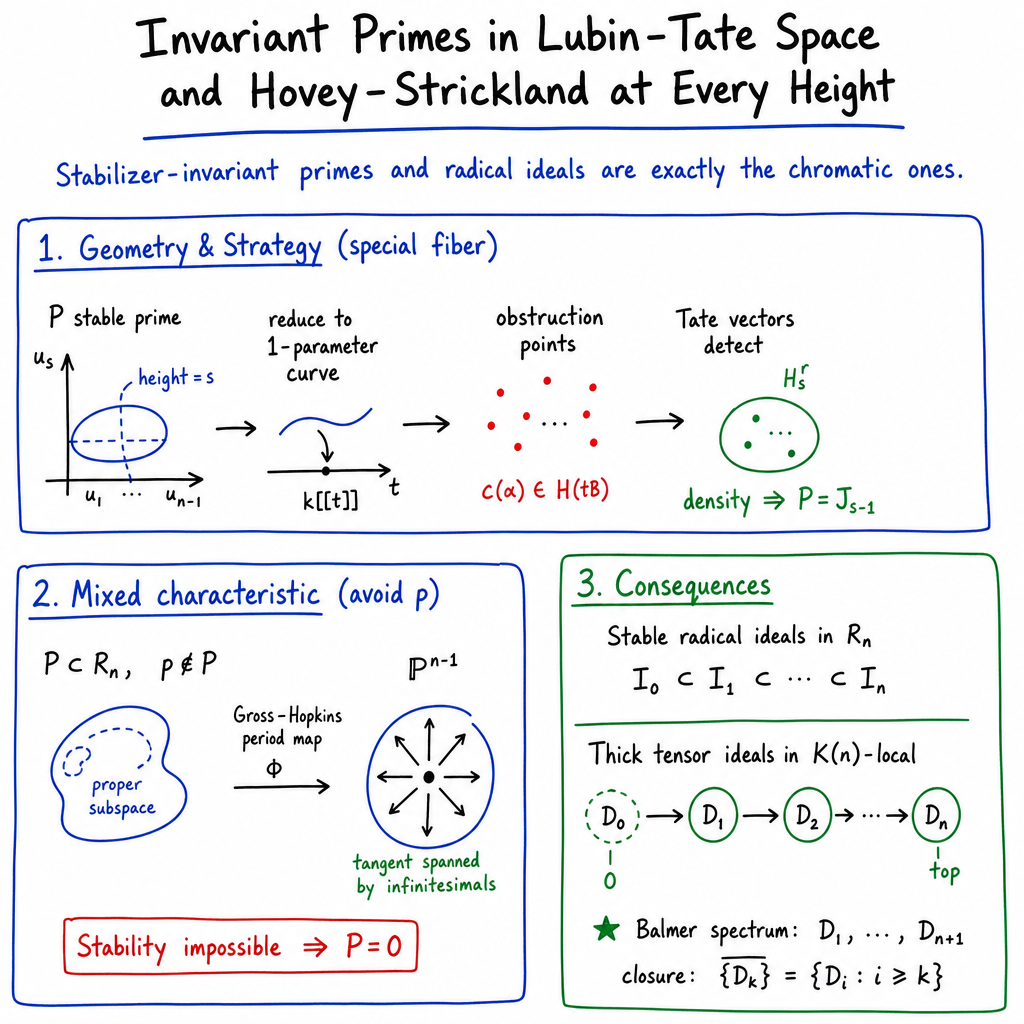
Abstract: Let be the one-dimensional Honda formal group of height over and let [ R_n=W(\mathbf F_{pn})[[u_1,\ldots,u_{n-1}]],\qquad A_n=R_n/(p). ] We prove, for every height and every prime , that the prime ideals of stable under an open subgroup of the Morava stabilizer group are exactly the height ideals . We also prove that a stable prime of avoiding is zero. The resulting radical-ideal classification implies the Hovey-Strickland classification of thick tensor ideals in the category of dualizable -local spectra via the forward implication of Barthel-Heard-Naumann. The special-fiber argument is local and geometric. After cutting an invariant prime by a one-parameter curve, we construct from the Cartier structure equation a smooth formal quotient and a distinguished subgroup . The generic fiber of is identified with the deformation space of connected-étale extensions. A Cartier obstruction map from the full Honda endomorphism order is compared with evaluation on Tate vectors through completed universal covers. Fargues-Fontaine vector bundles give a period-detection statement. Chai's rigidity theorem then promotes detection by homomorphisms to formal Zariski density after a renormalization of the valuation. A uniform fixed-jet argument transfers this density to Morava-stabilizer orbits. The generic-fiber assertion is proved separately from the Gross-Hopkins period map.
Paper Prompts
Sign up for free to create and run prompts on this paper.
Top Community Prompts
Explain it Like I'm 14
1. What is this paper about?
This paper studies Lubin–Tate space, a mathematical space that records all the different ways a special kind of algebraic object called a formal group can be changed, or deformed.
The main question is:
Which equations or geometric parts of this space stay unchanged when acted on by the Morava stabilizer group?
The authors prove that the only such stable parts are the obvious ones: the parts where the first few deformation coordinates are set equal to zero. They also use this result to classify certain important collections of spectra in stable homotopy theory, connecting the work to the Hovey–Strickland classification.
In simple terms, the paper shows that a very complicated-looking mathematical space has a surprisingly simple list of symmetry-preserving pieces.
2. Main objectives and research questions
The paper focuses on several related questions.
First, it asks:
- If a prime ideal in the deformation space is unchanged by a sufficiently large subgroup of symmetries, what can that ideal be?
- Are there any “hidden” symmetry-preserving subspaces besides the standard height subspaces?
- What happens in the version of the space where the prime number has not been set equal to zero?
- Can this geometric information be used to classify thick tensor ideals of certain spectra?
The main theorem gives a precise answer. In the characteristic- setting, the only stable prime ideals are
These ideals describe the different height levels of the formal groups.
A second result says that in the mixed-characteristic setting, any stable prime ideal that does not contain must be the zero ideal.
3. Background in everyday language
A few technical ideas help explain the paper.
Formal groups and height
A formal group is a mathematical object that behaves somewhat like a group, but only near its identity element. Instead of describing its points directly, mathematicians describe its behavior using power series.
The height of a formal group measures how complicated its multiplication-by- operation is in characteristic . Roughly speaking:
- Low height means the group becomes nonzero quickly under repeated multiplication by .
- High height means it remains more deeply hidden and has more complicated behavior.
The paper begins with a particular height- formal group, called the Honda formal group, and studies all of its possible deformations.
Lubin–Tate deformation space
The deformation space has coordinates
You can think of these coordinates as dials that control how the formal group changes. Setting the first few dials equal to zero produces special height regions:
The paper proves that these are exactly the regions preserved by the relevant symmetries.
Morava stabilizer group
The Morava stabilizer group is a group of symmetries of the Honda formal group. It acts on the deformation space by changing the coordinates.
An ideal is called stable if applying one of these symmetries does not change it. The paper studies prime ideals with this stability property.
4. How the research was carried out
The proof uses several advanced ideas, but its overall strategy can be described in stages.
Step 1: Reduce the problem to a one-dimensional path
The deformation space has many coordinates, so studying it all at once is difficult. The authors first choose a carefully selected one-parameter curve through the space.
This is like studying a complicated landscape by walking along a specially chosen path. If a supposedly new stable subspace existed, it would still leave evidence along this path.
Step 2: Study connected and étale parts
Along the chosen curve, the relevant algebraic object can be separated into two pieces:
- A connected part, which is tightly linked to the identity.
- An étale part, which behaves more like a discrete collection of points.
The paper studies extensions of the étale part by the connected part. An extension is like joining two structures together without necessarily making the result a simple product.
These extensions form a new geometric object called a formal group . Inside it is a special subgroup , which records the part related to the change in height.
Step 3: Measure which symmetries still work
The authors construct an obstruction map. For each symmetry of the original Honda formal group, this map produces a point of .
The meaning is:
- If the obstruction is zero, that symmetry still lifts to the deformed object.
- If it is nonzero, the symmetry no longer works perfectly after deformation.
Thus, the obstruction points record how the stabilizer group moves around the deformation space.
Step 4: Prove that the obstruction points are widespread
The authors then show that these obstruction points are formally Zariski dense. This means that they are spread out so thoroughly that no nonzero formal equation can vanish on all of them.
An everyday analogy is a set of dots on a sheet of paper. A few dots might lie on a line, but a sufficiently dense set of dots cannot all lie on any smaller curve or shape.
To prove this, the paper uses:
- Evaluation on Tate vectors, which are compatible systems of -power roots.
- The Fargues–Fontaine curve, a powerful geometric tool for studying -adic objects.
- Chai’s rigidity theorem, which says that certain symmetry-preserving shapes must actually come from algebraic subgroups.
- Dieudonné–Manin theory, which helps classify those subgroups.
Step 5: Transfer the result back to the stabilizer action
The authors show that the obstruction points accurately reflect the actual movements caused by stabilizer elements.
They use a technical “fixed-jet” argument. A jet is a finite approximation to a power series. Since the deformation space has infinitely many coordinates, the authors prove that enough finite-order information can be controlled uniformly.
This step is important because it connects the auxiliary formal group calculations back to the original Lubin–Tate space.
Step 6: Handle the generic fiber separately
For prime ideals that avoid , the authors use the Gross–Hopkins period map. This map sends the deformation space into projective space while preserving the stabilizer action.
The key idea is that the infinitesimal directions created by the endomorphism algebra are so numerous that they fill all the tangent directions of projective space. Therefore, a proper nonzero stable subspace cannot exist.
5. Main findings
Only the standard height ideals are stable
The central result is that the stable prime ideals in the special fiber are exactly
So there are no unexpected stable prime ideals hiding in the deformation space.
These ideals correspond to the natural height strata:
- gives the largest, most general part.
- gives the next height condition.
- gives a more special condition.
- Continuing this way leads to .
This is important because it says the symmetry is strong enough to rule out almost all possible geometric patterns.
No nonzero stable prime avoids
In the full deformation ring
the paper proves that a stable prime ideal not containing must be zero.
In other words, once the prime is kept visible, there are no additional proper stable subspaces in the generic, characteristic-zero direction.
Classification of radical ideals
From the prime-ideal result, the authors classify all proper radical ideals that are stable under an open subgroup of the stabilizer group. They are exactly
These are the natural ideals obtained by imposing successive height conditions.
Consequence for stable homotopy theory
The paper then applies this geometric classification to the category of dualizable -local spectra.
It proves that every thick tensor ideal is one of the standard chromatic ideals
Very roughly, a thick tensor ideal is a collection of spectra closed under the usual constructions, such as taking suitable pieces, extensions, and tensor products.
The result says that these collections are completely controlled by chromatic type, a measure of how much information a spectrum contains at each height.
6. Why the results matter
The importance of the paper is both geometric and homotopy-theoretic.
On the geometric side, it gives a complete description of the symmetry-invariant prime pieces of Lubin–Tate space. This tells mathematicians that the obvious height strata are not just examples—they are all the possibilities.
On the stable homotopy side, the result confirms the expected Hovey–Strickland classification for dualizable -local spectra. This means that complicated collections of spectra can be organized using a simple height-based system.
A simple way to summarize the impact is:
The symmetries of the deformation space are so powerful that they force all stable structures to follow the standard height pattern.
The proof is technically very advanced, involving formal groups, -adic geometry, vector bundles, and deformation theory. However, its final message is clear: despite the enormous complexity of the objects involved, their invariant substructures are surprisingly orderly and can be classified completely.
Knowledge Gaps
Knowledge gaps, limitations, and open questions
The paper establishes a broad classification theorem, but the provided text leaves the following issues unresolved or insufficiently explored:
- Completeness of the proof is not verifiable from the provided text. The paper excerpt ends during the proof of Proposition 5.4 and does not include the subsequent arguments in Sections 5–9 or Appendix A, so the density theorem, stabilizer-displacement argument, mixed-characteristic case, and Hovey–Strickland deduction cannot be independently assessed here.
- The fixed-jet argument is only summarized rather than fully justified. The passage from infinitely many Cartier coordinates to finite-order Taylor data is identified as a point where the original proof contained an error, but the excerpt does not provide the detailed estimates needed to verify that Appendix A uniformly controls all finite jets.
- The dependence on Chai’s rigidity theorem is substantial but not fully unpacked. The exact hypotheses of the cited rigidity result—such as reducedness, irreducibility, scalar stability, and the absence of trivial subquotients—are asserted to hold in the relevant setting, but the compatibility of these hypotheses with the renormalized field and formal schemes is not fully demonstrated in the excerpt.
- The construction of the asymptotic valued field depends on a nonprincipal ultrafilter. It is not explained whether the resulting formal-density statement, or any intermediate geometric object, is independent of the choice of ultrafilter.
- The relationship between the ultraproduct field and ordinary algebraic or analytic geometry remains unclear. The renormalized field is used to detect formal equations, but the paper does not discuss whether the argument can be reformulated over a more canonical valued field or whether the ultraproduct construction has intrinsic geometric meaning.
- Formal Zariski density is proved only for the specific obstruction points constructed from the full Honda order. It remains open whether analogous density holds for smaller endomorphism subrings, individual stabilizer conjugacy classes, or other naturally defined families of points.
- The obstruction map is not shown to have a simple algebraic or geometric description. Although detects whether an endomorphism lifts, the structure of its kernel, image, fibers, and dependence on the chosen deformation curve is not characterized beyond the stated properties.
- The dependence of the obstruction construction on the chosen one-parameter curve is not fully analyzed. The curve is explicitly only a test curve and need not be stabilizer invariant, but the paper does not establish whether obstruction periods obtained from different curve specializations are canonically related.
- The curve-specialization lemma may lose geometric information. Reducing a potentially high-dimensional invariant prime to a single valuation curve is sufficient for the claimed contradiction if all subsequent arguments work, but the method does not describe the geometry of the original prime or explain whether stronger structural information can be recovered.
- The connected–étale extension identification is established in a specialized setting. The isomorphism is developed for the one-parameter degeneration considered; its functoriality under arbitrary base change and its behavior for more general families are not explored.
- The use of Fargues–Fontaine theory is not accompanied by quantitative detection results. Proposition 4.9 shows that every nonzero homomorphism detects some obstruction period, but it does not bound the complexity, valuation, or algebraic size of a detecting endomorphism .
- The integral comparison between analytic evaluation and Fargues–Fontaine global sections requires delicate hypotheses. The excerpt relies on crystallinity, completed universal covers, and integral Honda projections, but does not fully clarify the extent to which these identifications remain valid over nonperfect residue fields, nonalgebraically closed fields, or more general valuation rings.
- The generic-fiber argument is comparatively short relative to the special-fiber argument. The claim that an invariant rigid subspace has tangent directions containing the full infinitesimal action of is not developed in enough detail to rule out issues involving singularities, nonreduced subspaces, or the distinction between analytic and algebraic tangent spaces.
- The generic-fiber proof does not explicitly treat nonreduced invariant closed subschemes. The argument is phrased in terms of a proper subspace and tangent dimensions, while the theorem concerns prime ideals; the precise reduction from prime ideals to the relevant rigid-analytic geometric object is not fully explained.
- The classification is stated for primes stable under an open subgroup, not for arbitrary stabilizer-invariant subsets or ideals. It remains unclear which parts of the method extend to ideals or closed subschemes invariant under the full stabilizer only set-theoretically, under a non-open subgroup, or under the extended stabilizer group including Galois automorphisms.
- The result for radical ideals is limited to proper ideals. The behavior of nonradical stable ideals, their primary decompositions, and possible nilpotent or infinitesimal invariant structures is not classified.
- The passage from prime classification to radical-ideal classification is not elaborated. In particular, the argument that every stable radical ideal is determined solely by the listed invariant primes would benefit from an explicit treatment of infinite intersections and stability under open subgroups.
- The Hovey–Strickland consequence uses only the forward implication of Barthel–Heard–Nauhmann. The paper does not establish whether the converse implication can be proved in this setting, whether the classification can be obtained independently of that theorem, or whether the result extends beyond dualizable -local spectra.
- The categorical conclusion is restricted to dualizable -local spectra. The paper does not address thick tensor ideals in the entire -local category, in larger compactly generated subcategories, or in related categories of module spectra.
- The treatment of height-one and small-height edge cases is not explicit. Although the theorem claims validity for every , the special-fiber construction involves parameters such as and subgroups of dimension ; the degeneracies at , , or should be separately verified.
- The role of the extended stabilizer group is left unexplored. The theorem is formulated using open subgroups of , while is introduced but not used in the stated classification.
- No effective or computational version of the classification is provided. The proof is highly nonconstructive, using formal density, ultrafilters, and period methods; it does not give algorithms for testing whether a given equation or ideal is stable.
- The method’s applicability beyond Lubin–Tate space is not investigated. It is unclear whether the Cartier–extension–period strategy applies to deformation spaces of higher-dimensional formal groups, general -divisible groups, Rapoport–Zink spaces, or Shimura varieties.
- The paper does not compare the method in detail with the independently claimed approaches. The introduction mentions an independent proof by Ningyi Li and another purportedly related work, but no mathematical comparison is given concerning hypotheses, techniques, strengths, or limitations.
Practical Applications
Immediate Applications
- Classification of chromatic tensor ideals in stable homotopy theory — academia and research software
- The theorem gives an explicit classification of thick tensor ideals in the category of dualizable -local spectra:
together with the corresponding Balmer spectrum. - Actionable use: researchers can determine whether a dualizable -local spectrum belongs to a given thick tensor ideal by comparing its chromatic type with the sequence . - Potential tools: automated classification routines for finite spectra, formal databases of chromatic localizations, and proof-assistant libraries encoding the Hovey–Strickland classification. - Dependencies: the result applies specifically to dualizable -local spectra and relies on the forward implication of the Barthel–Heard–Naumann theorem. It does not by itself classify arbitrary non-dualizable spectra.
Algorithmic detection of stabilizer-invariant loci in Lubin–Tate space — computational number theory
- The paper proves that the only prime ideals in
stable under an open subgroup of the Morava stabilizer group are the height ideals
- Actionable use: computations involving invariant closed subsets, orbit closures, or formal subschemes of Lubin–Tate space can immediately reduce candidate loci to the standard height strata. - Potential tools: symbolic-algebra routines that test stabilizer invariance by checking whether an ideal equals one of the height ideals; databases of chromatic height strata; automated simplification of invariant deformation problems. - Dependencies: the ideal must be prime and stable under an open subgroup, not merely under an isolated stabilizer element or an arbitrary subgroup.
Simplification of invariant deformation problems — arithmetic geometry
- The result that a stable prime of avoiding is zero implies that there are no nontrivial open-stabilizer-invariant prime subspaces in the mixed-characteristic generic fiber.
- Actionable use: when studying a deformation family over
researchers can rule out proposed proper invariant generic-fiber subspaces without performing a full geometric analysis. - Potential workflow: first determine whether a proposed invariant equation contains ; if it does not, the theorem forces the associated stable prime to be zero. - Dependencies: the conclusion concerns prime ideals stable under an open subgroup. Non-prime, non-radical, or merely set-theoretically invariant equations require passage to radicals and verification of the relevant hypotheses.
Canonical organization of height-based moduli computations — algebraic geometry and moduli theory
- The classification identifies the standard ideals
as the complete list of proper radical invariant ideals in . - Actionable use: calculations involving height filtrations, supersingular or special-fiber loci, and chromatic vanishing conditions can be organized around this finite chain rather than arbitrary invariant ideals. - Potential products: software for stratifying formal moduli spaces, invariant-locus visualization, and computer-assisted verification of height conditions in deformation rings. - Dependencies: the result applies to radical ideals stable under an open subgroup; arbitrary ideals may contain additional nilpotent or embedded-structure information.
Reusable local method for studying invariant formal subvarieties — academia
- The proof supplies a concrete workflow: reduce to a one-parameter curve, construct a Cartier quotient , identify the distinguished subgroup , evaluate obstruction classes on Tate vectors, and apply formal density.
- Actionable use: this method can be adapted to related questions about invariant formal groups, -divisible groups, and deformation spaces where group actions are difficult to analyze directly.
- Potential research workflow: use Cartier normal forms to convert infinite-dimensional deformation data into finite formal coordinates, then use period maps or universal covers to detect nontrivial equations.
- Dependencies: successful transfer to another setting requires analogues of Cartier normal forms, Chai rigidity, a suitable period-detection theorem, and uniform finite-jet control.
- Improved proof automation for formal power-series arguments — computer algebra and formal verification
- Appendix A’s fixed-jet argument addresses the difficulty of passing from infinitely many Cartier coordinates to finite Taylor-order calculations.
- Actionable use: the technique can guide implementations that verify formal identities order by order while controlling tail errors uniformly.
- Potential tools: certified truncation algorithms for Cartier equations, formal-gauge solvers, and Lean/Coq/Isabelle libraries for convergent formal-group computations.
- Dependencies: automated verification would need explicit bounds on valuation growth, convergence, and stabilization of truncated gauge equations.
Long-Term Applications
- General invariant-subvariety classification for deformation spaces — arithmetic geometry
- The methods may extend beyond Morava stabilizer actions to other moduli spaces of formal groups, -divisible groups, or Shimura varieties.
- Possible outcome: a general theorem classifying invariant prime or radical ideals by geometric height or Newton-polygon strata.
- Potential sectors: Shimura-variety geometry, -adic moduli, automorphic forms, and arithmetic dynamics.
- Dependencies: one would need suitable analogues of the height-stratified local coordinates, a rigidity theorem for the acting group, and a period map with enough infinitesimal directions.
- Explicit computation of stabilizer orbits and orbit closures — computational number theory
- The density argument shows that obstruction points generated from Honda endomorphisms are sufficiently rich to detect nonzero formal equations.
- Possible development: numerical or symbolic algorithms for approximating Morava stabilizer orbits, testing orbit density, and computing equations of orbit closures at finite jet order.
- Potential tools: -adic orbit simulators, finite-level stabilizer representations, and certified approximations of Lubin–Tate formal schemes.
- Dependencies: practical computation would require effective bounds on the valuation renormalization, truncation order, and the choice of endomorphism elements .
- Period-based diagnostics for -divisible-group degenerations — arithmetic geometry and -adic Hodge theory
- The exact sequence
links connected–étale degeneration data with Fargues–Fontaine vector bundles. - Possible application: develop computational diagnostics that identify degeneration from the kernel, slope, or splitting behavior of associated vector bundles. - Potential products: software for analyzing -divisible groups through vector-bundle invariants, or databases matching deformation parameters with Fargues–Fontaine data. - Dependencies: this would require effective implementations of the Scholze–Weinstein correspondence, completed universal covers, and vector-bundle calculations on the Fargues–Fontaine curve.
Extension to broader localizing and tensor-ideal classification problems — stable homotopy theory
- The paper’s arithmetic classification feeds into the classification of thick tensor ideals, suggesting a template for other localized categories controlled by formal-group deformation geometry.
- Possible application: classify tensor ideals in categories associated with higher real -theories, equivariant localizations, or other structured ring spectra.
- Dependencies: new settings may lack a direct Lubin–Tate deformation model, a comparable stabilizer action, or a theorem connecting invariant radical ideals to tensor ideals.
- Machine-assisted theorem proving for advanced arithmetic geometry — academia and software
- The paper explicitly uses AI-assisted proof auditing and a fixed-jet repair, illustrating a workflow in which automated systems identify gaps in infinite-dimensional or asymptotic arguments.
- Possible application: build systems that check valuation estimates, formal substitutions, Cartier-coordinate recursions, and compatibility of truncations across inverse limits.
- Potential tools: domain-specific proof assistants for formal groups, automated counterexample search for flawed density arguments, and symbolic verification of deformation-theoretic diagrams.
- Dependencies: reliable automation requires formal encodings of -divisible groups, Cartier theory, valuation rings, Fargues–Fontaine bundles, and the relevant rigidity theorems. It would support, rather than replace, expert mathematical validation.
- Conceptual transfer to other symmetry-constrained moduli problems — policy and interdisciplinary research infrastructure
- The paper demonstrates a general principle: strong symmetry can force invariant geometric objects to coincide with a small, canonical stratification.
- Possible application: apply analogous workflows in moduli problems arising in coding theory, representation theory, or mathematical models with hierarchical phase or rank strata.
- Dependencies: this is a methodological rather than immediate practical transfer. It requires identifying a suitable symmetry group, proving an invariant-density result, and ensuring that the resulting strata have a meaningful interpretation in the target field.
Glossary
- Asymptotic field: A valued field constructed by rescaling valuations along a sequence, allowing rapidly shrinking points to retain meaningful limiting information. “We therefore renormalize by the natural scale .”
- Balmer spectrum: The space classifying prime thick tensor ideals of a tensor-triangulated category. “The Balmer spectrum consists of .”
- Barsotti–Tate group: Another name for a -divisible group, formed as an inductive system of finite flat group schemes. “To retain the full Barsotti–Tate structure, work over an Artinian quotient of the parameter ring.”
- Cartier module: An algebraic object encoding the structure of a formal group through operators such as Frobenius and Verschiebung. “For the Cartier module of the formal part of , the structure operator admits a normal-form theory.”
- Cartier quotient: A formal-group quotient obtained from a Cartier module by dividing out the image of its structure operator. “Proposition 3.8 (Cartier quotient as an extension space).”
- Chai’s rigidity theorem: A theorem asserting that suitably invariant formal subschemes of -divisible formal groups are themselves formal subgroups. “We use Chai’s rigidity theorem for -divisible formal groups.”
- Chromatic type: The level of periodic homotopy-theoretic complexity assigned to a finite spectrum. “where is any finite -local spectrum of chromatic type .”
- Connected–étale sequence: An exact sequence decomposing a -divisible group into its connected and étale parts. “Over the identity component has height , so there is a connected–étale sequence.”
- Completed universal cover: An inverse-limit construction that records compatible systems of successive -power roots, including information invisible on the reduced special fiber. “Using completed universal covers, the evaluation of an obstruction class is identified with the Honda projection of .”
- Covariant Dieudonné module: A module equipped with Frobenius and Verschiebung that classifies commutative group schemes or -divisible groups in characteristic . “Pass to the rational covariant Dieudonné modules.”
- Dieudonné–Manin classification: The classification of isocrystals by their slopes, together with semisimplicity within a fixed slope. “We also use the Dieudonne–Manin classification.”
- Dualizable spectrum: An object in a stable homotopy category possessing a tensor dual. “In the category of dualizable -local spectra.”
- Étale quotient: The étale component obtained from a group scheme or -divisible group after removing its connected part. “If is étale and is connected, there is a canonical isomorphism.”
- Fargues–Fontaine curve: A geometric curve used to translate -adic Hodge-theoretic and -divisible-group data into vector-bundle data. “On the Fargues–Fontaine curve this is encoded by an exact sequence.”
- Fargues–Fontaine classification: The classification of vector bundles on the Fargues–Fontaine curve by slope-theoretic data. “We use the Scholze–Weinstein fully faithful functor from -divisible groups up to isogeny to vector bundles on , together with the Fargues–Fontaine classification of vector bundles.”
- Formal group: A group object represented by a formal scheme, typically described through power-series coordinates near the identity. “It produces a smooth formal group .”
- Formal Zariski density: The property that a collection of points is not contained in any proper closed formal subscheme. “Hence the points are formally Zariski dense.”
- Frobenius: An endomorphism, usually raising coordinates to their th powers, fundamental to characteristic- algebra and Dieudonné theory. “The -term raises each input coordinate at least to its th power.”
- Gross–Hopkins period map: An equivariant map from a Lubin–Tate deformation space to a projective period domain. “The Gross–Hopkins period map is étale and equivariant.”
- Honda formal group: A standard one-dimensional formal group over a finite field characterized by a prescribed height and -series. “Let be the one-dimensional Honda formal group over .”
- Honda stabilizer group: The group of automorphisms of a Honda formal group, equivalently the units in its endomorphism order. “The Morava stabilizer and extended stabilizer groups are .”
- Isocrystal: A rationalized Dieudonné module, generally obtained by inverting , used to study -divisible groups up to isogeny. “The isogeny category in this fixed slope is semisimple.”
- Isogeny category: A category in which morphisms of -divisible groups are considered after allowing maps whose kernels and cokernels are finite. “The isogeny category in this fixed slope is semisimple by Dieudonne–Manin classification.”
- Lubin–Tate deformation space: The formal moduli space parametrizing deformations of a one-dimensional formal group of fixed height. “We prove, for every height and every prime , that the prime ideals of stable under an open subgroup of the Morava stabilizer group are exactly the height ideals.”
- Morava stabilizer group: The automorphism group of a height- formal group law over a finite field. “The topology on is the -adic topology inherited from the maximal order.”
- Neumann inverse: An inverse expressed as a convergent geometric-series expansion for an operator that is sufficiently contracting. “This is minus the identity plus a strictly -adically contracting operator on coefficient sequences, hence has an integral Neumann inverse.”
- Normal form: A canonical representative obtained by decomposing an element into an operator image and a restricted set of coordinate terms. “Every admits a unique decomposition.”
- Obstruction map: A map measuring whether an endomorphism of a special fiber lifts to an endomorphism of a deformation. “This gives .”
- Open subgroup: A subgroup that is open in the relevant profinite or -adic topology. “For every open subgroup , the -stable prime ideals of are exactly.”
- p-divisible group: An inductive system of finite commutative group schemes related by multiplication by . “For -divisible groups over a characteristic- field .”
- Period detection: The use of period maps or evaluation maps to determine nonzero homomorphisms from their values on selected points. “Proposition 4.9 (Every nonzero homomorphism detects a period).”
- Rigid generic fiber: The analytic space obtained from a formal scheme by passing to characteristic zero and applying rigid or adic geometry. “Its rigid generic fiber is a nonempty proper subspace of dimension at most .”
- Scholze–Weinstein functor: A fully faithful correspondence relating -divisible groups up to isogeny to vector bundles on the Fargues–Fontaine curve. “We use the Scholze–Weinstein fully faithful functor from -divisible groups up to isogeny to vector bundles on .”
- Slope: A rational numerical invariant describing the Frobenius or isocrystal structure of a -divisible group or vector bundle. “We use the covariant slope convention, so the sum of the slopes of a -divisible group equals its dimension.”
- Teichmüller operator: A Cartier-theoretic operation lifting elements of a residue field into Witt-vector or Cartier coordinates. “Here is the Teichmuller Cartier operator; it is not additive in .”
- Thick tensor ideal: A full subcategory closed under cofiber sequences, retracts, and tensoring with arbitrary objects. “Every thick tensor ideal is one of .”
- Tate vector: An element of the Tate module, representing a compatible system of -power torsion points. “An integral Tate vector defines an evaluation map.”
- Ultrafilter: A maximal filter used here to extract generalized limits from sequences of valuations. “Fix a nonprincipal ultrafilter .”
- Universal cover: The inverse limit of a -divisible group under multiplication by . “For a -divisible group write for the universal-cover sheaf.”
- Verschiebung: The operator dual to Frobenius in the theory of -typical formal groups and Dieudonné modules. “The standard Cartier relations in characteristic are , , .”
- Witt vector: An algebraic construction encoding characteristic-zero information from characteristic- rings. “Put .”
- Zariski density: The property that a set is not contained in any proper algebraic closed subset. “Chai’s rigidity theorem then promotes detection by homomorphisms to formal Zariski density after a renormalization of the valuation.”

