Unpaired Canonical Correlation Analysis
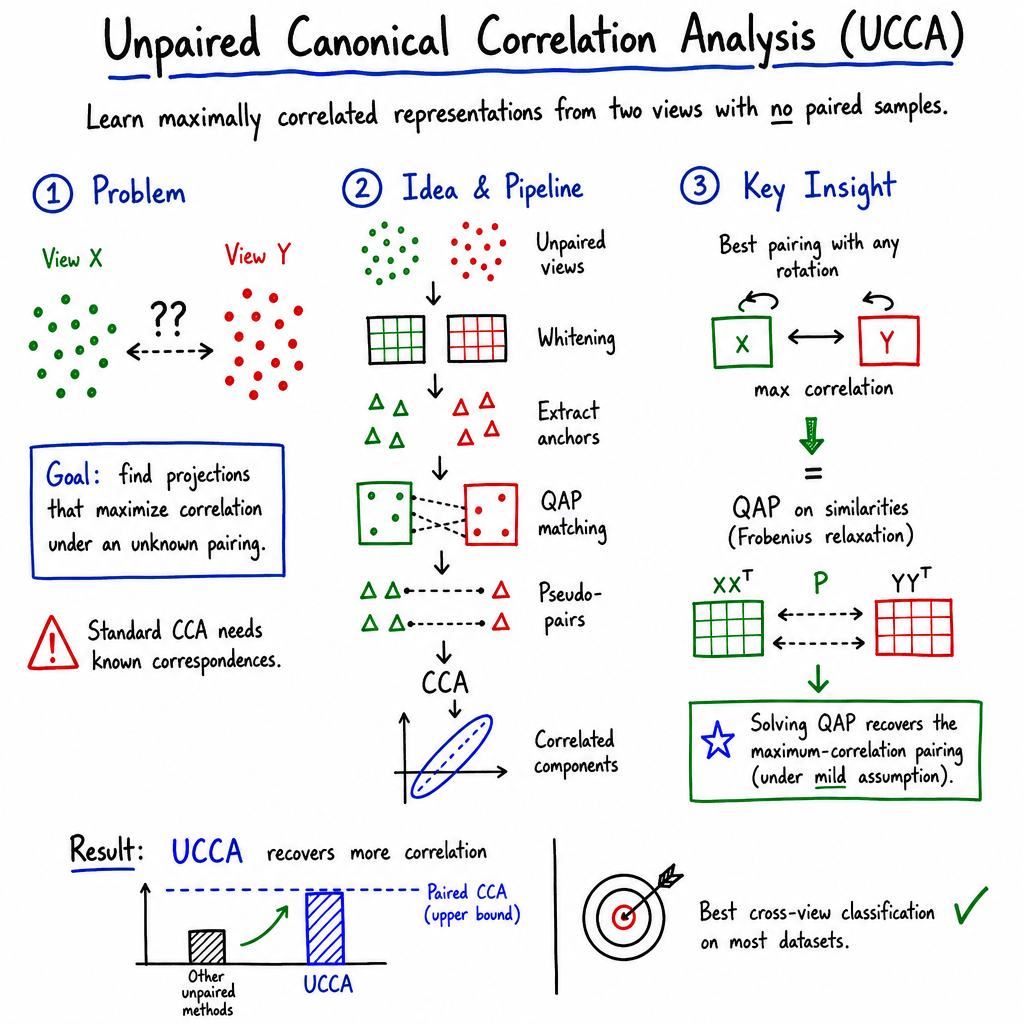
Abstract: Canonical Correlation Analysis (CCA) is a fundamental method for multiview shared space learning. However, its strict reliance on paired data poses a significant limitation, as such data is often difficult to obtain or entirely unavailable. In this paper, we present Unpaired CCA (UCCA), a novel method that learns linear projections to maximize the correlation of the true underlying pairing without access to any paired samples during training. We first establish theoretical results connecting the Quadratic Assignment Problem (QAP) to CCA. Leveraging these theoretical insights, we derive a practical method to maximize correlation exclusively from unpaired data. To the best of our knowledge, UCCA is the first approach to learn maximally correlated projections in a strictly unpaired setting. We validate UCCA on real-world multi-modal datasets, demonstrating that it significantly outperforms recent unpaired alignment baselines in recovering the underlying true correlation. This work fills a critical gap between traditional statistical multiview learning and the growing field of unpaired data learning.
Paper Prompts
Sign up for free to create and run prompts on this paper.
Top Community Prompts
Explain it Like I'm 14
1. What is this paper about?
This paper introduces a method called Unpaired Canonical Correlation Analysis, or UCCA.
The main idea is to find connections between two types of data even when the matching examples are unknown.
For example, imagine having:
- many photos in one folder, and
- many written descriptions in another folder,
but no information saying which description belongs to which photo.
Usually, a method called Canonical Correlation Analysis (CCA) needs matching pairs. UCCA tries to solve the problem without seeing any pairs during training.
The researchers show that it is still possible to discover shared information between two datasets using only unpaired examples.
2. What questions did the researchers ask?
The paper focuses on several main questions:
- Can we find relationships between two datasets without knowing which examples match?
- Can we learn a shared representation of the data? A shared representation is a new way of describing both types of data so that related information looks similar.
- Can unpaired data produce results close to ordinary CCA, which uses paired data?
- Can the problem be solved efficiently enough to work on real datasets?
The researchers were especially interested in data with two different “views” of the same underlying information. Examples include:
- images and captions,
- different measurements of the same biological cell,
- different ways of representing handwritten digits.
3. How did they approach the problem?
Ordinary CCA
First, it helps to understand standard CCA.
Suppose one dataset contains photographs and another contains captions. CCA tries to find mathematical transformations that make matching photos and captions as similar as possible.
It is like finding the best common language between two groups of objects.
However, ordinary CCA needs to know the correct pairs:
| Photo | Caption |
|---|---|
| Photo 1 | Caption 1 |
| Photo 2 | Caption 2 |
UCCA does not receive this table of matches.
Treating unknown matches as a rearrangement
The researchers assume that the examples in one dataset are related to the examples in the other, but their order has been mixed up.
They describe this unknown rearrangement using a permutation. A permutation is simply a rearrangement, like changing:
1 |
1, 2, 3, 4 |
into:
1 |
3, 1, 4, 2 |
The challenge is to discover a useful rearrangement without checking every possible arrangement. That would be extremely slow because the number of possible arrangements grows very quickly.
Using the Quadratic Assignment Problem
To find a good rearrangement, the researchers connect UCCA to the Quadratic Assignment Problem (QAP).
QAP is a type of matching problem. A simple example would be deciding which buildings should be placed on which locations so that buildings that interact often are placed near one another.
In this paper, the “buildings” are data examples, and the goal is to match examples whose relationships with other examples look similar.
QAP is technically NP-hard, meaning that finding the perfect answer can become impossibly slow for large datasets. However, there are algorithms that find very good approximate answers quickly.
Using representative “anchors”
Running QAP on every data point would still be expensive. To make the method practical, UCCA first selects a smaller number of representative examples called anchors.
The researchers use K-Means clustering to find these anchors. K-Means groups similar data points together and chooses a central point for each group.
An everyday analogy is sorting thousands of books into groups and then using one representative book from each group instead of comparing every book with every other book.
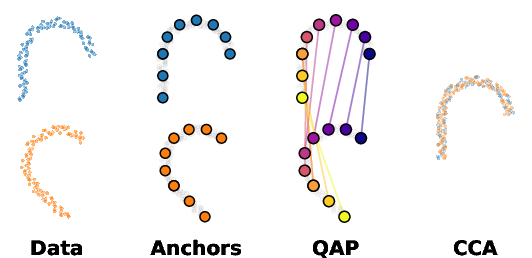
The UCCA process is roughly:
- Prepare and normalize the two datasets.
- Select representative anchors from each dataset.
- Use QAP to match the anchors.
- Treat the matched anchors as if they were paired examples.
- Apply ordinary CCA to these estimated pairs.
- Use the resulting transformations to create shared representations.
4. What did the researchers find?
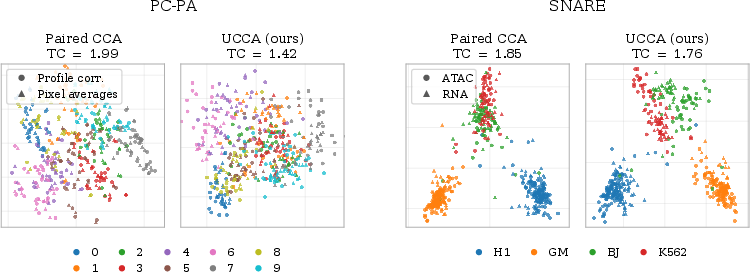
The researchers tested UCCA on six dataset settings involving several real-world datasets:
- SNARE, containing different types of biological measurements,
- Flickr and COCO, involving images and text,
- Handwritten digits, represented in several different ways.
During training, the researchers deliberately hid the true pairings. The method therefore had access only to separate collections of data.
UCCA recovered stronger relationships
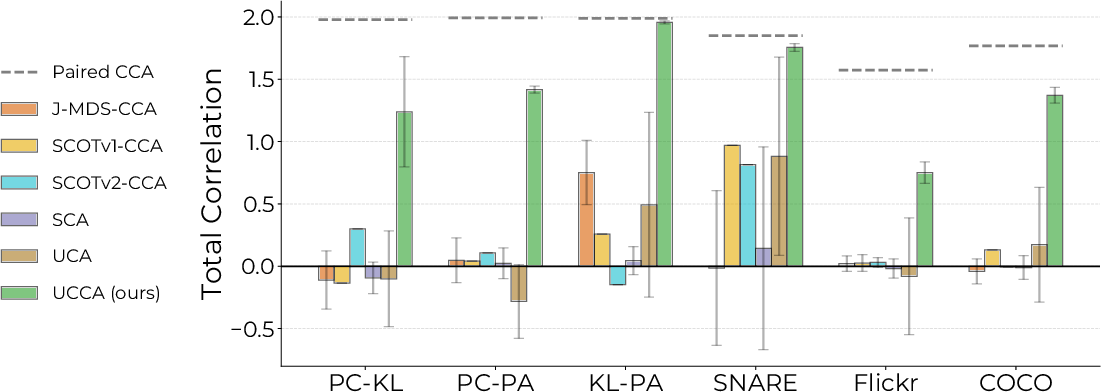
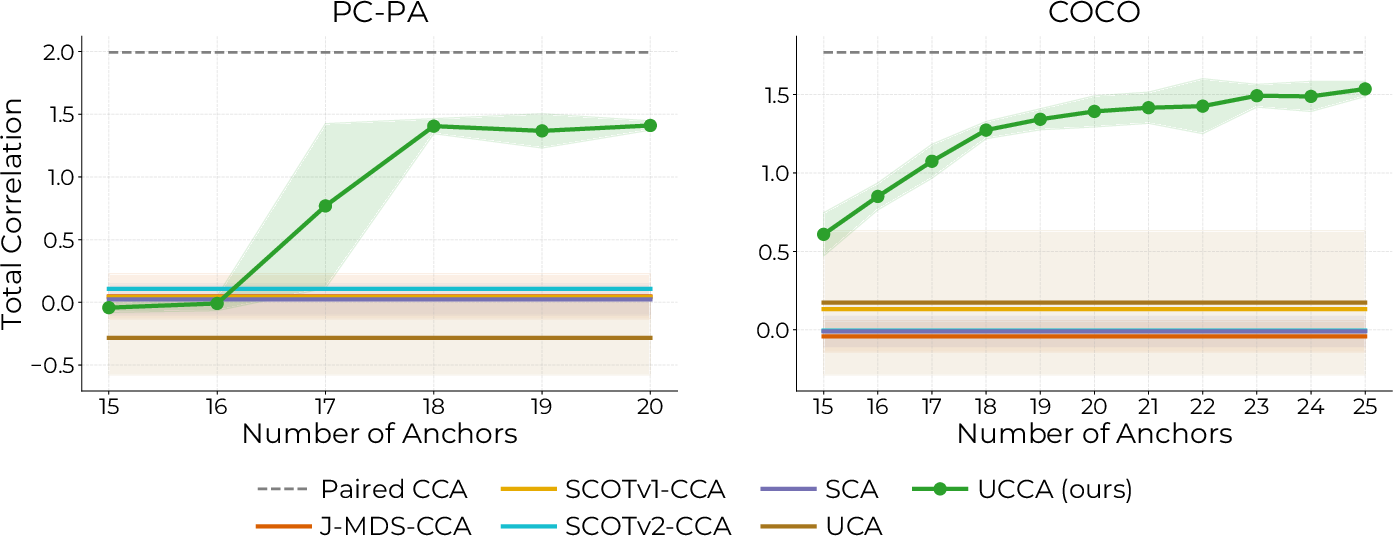
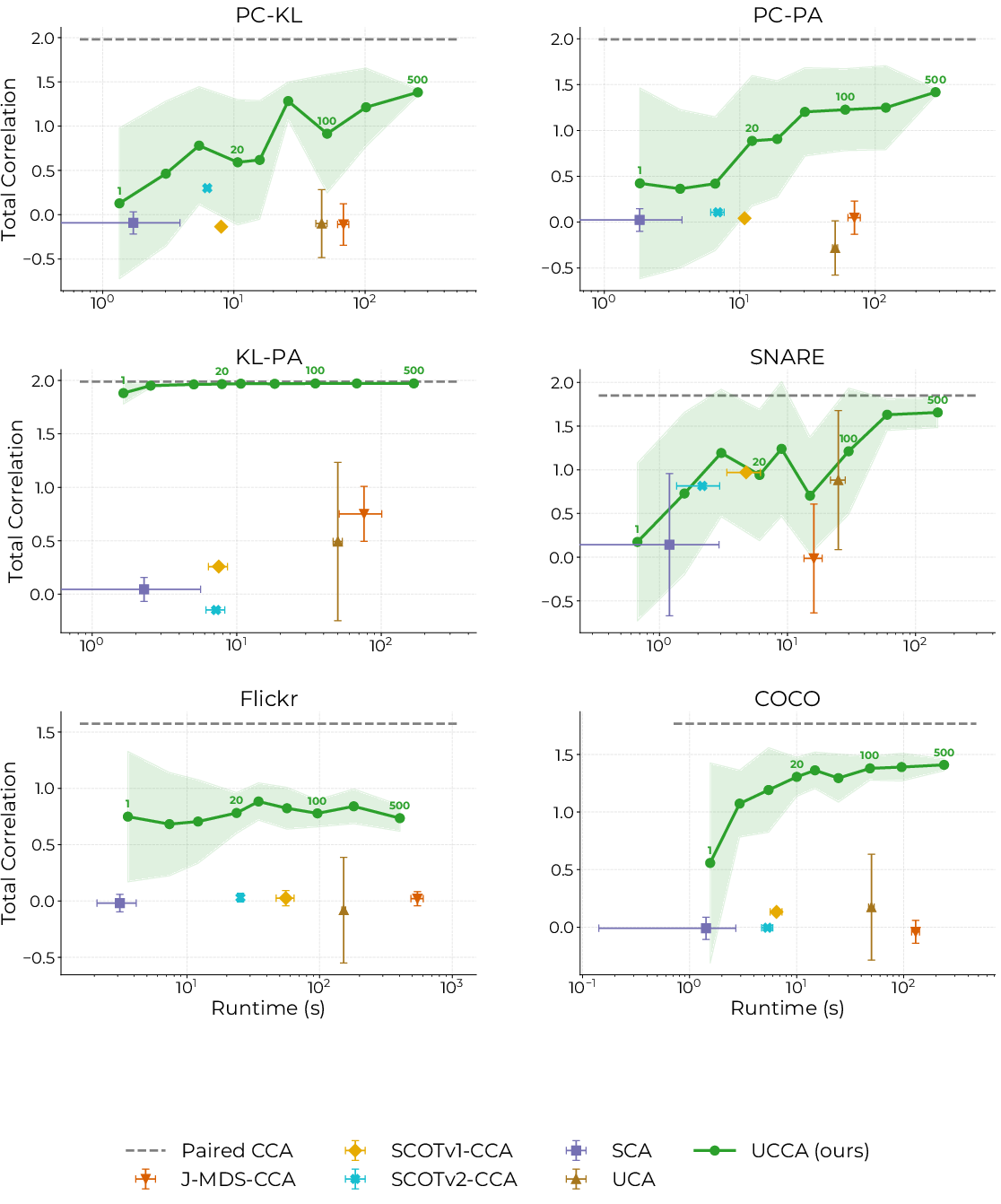
UCCA usually found much more strongly correlated components than the comparison methods.
In simple terms, it was better at discovering information that was genuinely shared between the two data types.
Its results were often close to those of paired CCA, even though paired CCA was given the correct matches and therefore had an important advantage.
Better performance on classification
The researchers also tested whether the shared representations were useful for classification.
They trained a simple k-nearest neighbors, or kNN, classifier using one view and tested it using another view. A kNN classifier predicts the class of a new example by looking at nearby examples whose classes are already known.
For example, the classifier might learn from one representation of handwritten digits and then classify digits using a different representation.
UCCA performed better than the other unpaired methods on four of the five reported classification datasets. On the remaining dataset, it had performance similar to the best method.
Some results from the table were:
| Dataset setting | UCCA accuracy |
|---|---|
| Handwritten PC–KL | 0.292 |
| Handwritten PC–PA | 0.315 |
| Handwritten KL–PA | 0.564 |
| SNARE | 0.849 |
| COCO | 0.232 |
These numbers show that UCCA was especially successful on the SNARE biological dataset and clearly improved over the other methods in several handwritten-digit settings.
More unpaired data helped
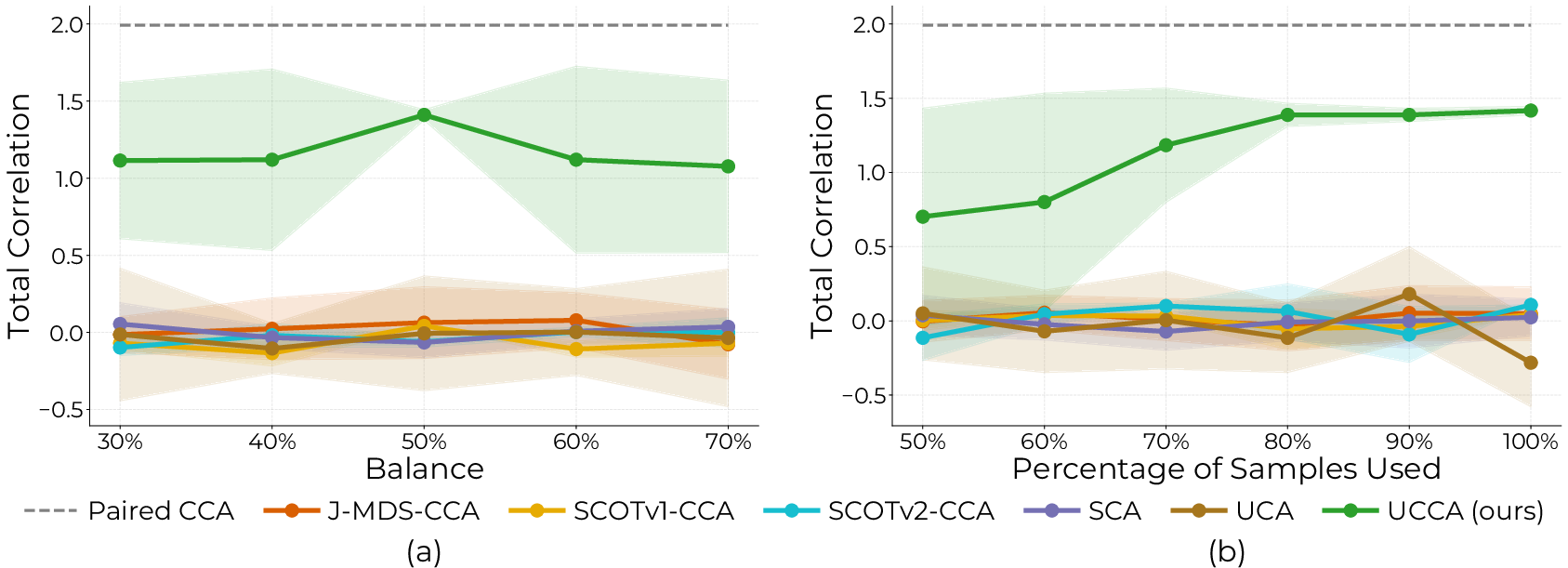
The experiments also showed that UCCA generally improved when more unpaired data was available.
It was also fairly robust when the two views contained different amounts of data. This is useful because, in real life, one type of measurement may be much easier to collect than another.
The theory supported the method
The paper does not only present experiments. It also proves mathematical results explaining why the method should work.
The main theoretical claim is that two different optimization goals—one connected to CCA and one connected to QAP—usually choose the same data matching under reasonable assumptions.
This gives a mathematical reason for using QAP as a practical way to perform unpaired CCA.
5. Why is this research important?
Many useful datasets are difficult or expensive to collect in matching pairs.
For example:
- It may be hard to collect an image and its exact medical measurement from the same subject.
- Different biological tests may be performed on different groups of cells.
- Large collections of images and text may exist, but their exact matches may be missing.
- Separate research teams may collect different kinds of measurements without using the same subjects.
UCCA suggests that these separate collections can still be connected. This could help researchers combine information from different sources without needing to label every matching pair.
Possible applications include:
- combining different types of medical and biological data,
- connecting images with text,
- comparing different sensor systems,
- learning from different versions of scientific measurements,
- finding common patterns in multimodal datasets.
Simple conclusion
The paper presents a way to perform CCA when matching pairs are unavailable. UCCA first estimates useful matches between representative examples using a graph-like matching problem called QAP. It then uses those estimated matches to learn shared features with CCA.
The experiments show that UCCA is usually much better than previous unpaired methods and can sometimes approach the performance of methods that are given the correct pairs.
However, it is not perfect. Its performance still has a gap compared with paired CCA, and the current method is designed mainly for connecting two views at a time. Future work could extend it to three or more types of data.
Overall, the research shows that large collections of unpaired data may contain enough hidden structure to reveal meaningful connections—even when the correct matches are never provided.
Knowledge Gaps
Knowledge gaps, limitations, and open questions
- Identifiability of the true correspondence is not established in general. The method assumes that the unknown pairing is a permutation and that maximizing correlation can recover a pairing equivalent to the ground truth, but it does not characterize when this is identifiable or when multiple fundamentally different pairings achieve the same objective.
- The assumption that the ground-truth permutation maximizes the CCA objective is not theoretically justified for broad data-generating processes. The paper does not provide sufficient conditions relating latent shared factors, view-specific noise, nonlinearities, or sampling distributions to this assumption.
- The weak-majorization assumption is only partially characterized. It is proven for the special case and asymptotically for random permutations, but its validity for finite samples, noisy views, unequal feature dimensions, and general cross-modal transformations remains unresolved.
- No finite-sample recovery or performance guarantees are provided. The paper does not quantify how sample size, feature dimension, noise level, signal-to-noise ratio, number of latent factors, or separation between candidate permutations affect pairing and canonical-correlation errors.
- The effect of non-unique QAP or CCA optima is not analyzed in depth. Although the text states that results remain valid by selecting a representative solution, it does not establish whether different optimal permutations produce equivalent projections or substantially different downstream representations.
- The permutation model excludes more realistic correspondence structures. UCCA assumes a one-to-one pairing, leaving unresolved how to handle duplicated samples, missing samples, unequal sample sizes, many-to-one correspondences, temporal misalignment, or soft and probabilistic matching.
- The method is restricted to linear relationships between views. Its behavior under nonlinear shared structure, nonlinear view-specific distortions, and heterogeneous feature representations is not theoretically or empirically established.
- Whitening requirements may be problematic in high-dimensional or ill-conditioned settings. The paper does not analyze numerical stability, regularized whitening, rank deficiency, or cases where the covariance matrices cannot be reliably estimated.
- The anchor-based approximation lacks formal error bounds. The relationship between the QAP solution on K-Means centroids and the solution on the full sample sets is not quantified, and conditions under which anchor matching preserves the optimal permutation remain unknown.
- The choice of K-Means centroids is not compared systematically with alternative anchor constructions. It remains unclear how performance changes with random subsampling, coresets, density-aware sampling, learned anchors, optimal-transport prototypes, or modality-specific clustering methods.
- The dependence on the number and quality of anchors is incompletely understood. Although an ablation is reported, there is no principled rule for selecting the number of anchors or determining when the anchors contain enough information to recover the relevant correlation structure.
- Approximate QAP solver behavior is insufficiently characterized. The paper does not report approximation gaps, convergence guarantees, sensitivity to initialization, or the frequency with which solver outputs differ from the exact QAP optimum.
- Computational scalability beyond the reported datasets remains uncertain. The stated runtimes use reduced anchor sets, but complexity and memory requirements for very large sample counts, high-dimensional data, or substantially larger anchor sets are not demonstrated.
- Robustness to outliers and mislabeled or contaminated samples is unexplored. Because QAP objectives aggregate pairwise similarities, a small number of atypical samples may distort the inferred permutation or anchor correspondence.
- The impact of distribution shift between the two unpaired datasets is not established. The experiments appear to use disjoint subsets of a common paired dataset, so the method’s reliability when the modalities are sampled from different populations or have unequal latent-factor distributions remains unknown.
- The experimental protocol does not fully represent naturally unpaired data collection. Splitting a paired benchmark into two disjoint subsets preserves a shared sampling population and known latent correspondence structure, which may make the task easier than alignment across independently collected datasets.
- The method’s robustness to class or factor imbalance is only partially evaluated. The reported imbalance ablation concerns data availability across views, but not substantial differences in the distributions of semantic classes, latent factors, or subpopulations.
- Performance on larger numbers of views is unresolved. The paper explicitly limits the framework to two views and does not specify how QAP objectives, permutation consistency, anchor construction, or CCA generalize to three or more modalities.
- The interaction between pairwise alignments in a multi-view extension is unknown. Independently matching each view to a reference could produce mutually inconsistent permutations, and no strategy for enforcing global multi-view consistency is proposed.
- The method’s relationship to nonlinear and deep CCA remains unexplored. It is unclear whether the QAP-based correspondence mechanism can be combined with learned nonlinear projections without introducing collapse, non-identifiability, or prohibitive optimization costs.
- The downstream evaluation is limited. Cross-view classification uses kNN and a small set of benchmark datasets; the paper does not evaluate retrieval, regression, clustering, generation, transfer learning, or robustness-oriented downstream tasks.
- The remaining gap to paired CCA is not explained. The paper reports that UCCA often approaches but does not reach the paired upper bound, yet it does not decompose this gap into anchor approximation error, QAP optimization error, incorrect pairing, whitening error, or information loss from unpaired sampling.
- The method may optimize correlation without recovering semantically meaningful correspondences. High total correlation does not necessarily imply correct instance-level alignment or preservation of task-relevant factors, and this distinction is not systematically examined.
- Sensitivity to hyperparameters and implementation choices is incompletely reported. The effects of whitening details, clustering initialization, number of clustering repetitions, QAP solver settings, CCA regularization, and component dimensionality are not comprehensively quantified.
- Statistical uncertainty is not fully assessed. Several baseline results have zero or very small reported standard deviations, and the paper does not provide confidence intervals, significance tests, or repeated-data-split analyses sufficient to establish the stability of comparative improvements.
- Comparisons with broader unpaired alignment methods are limited by adaptation choices. Some baselines are modified by fitting CCA to inferred pseudo-pairs, and the fairness and sensitivity of these adaptations are not systematically investigated.
- The method’s behavior when the views share only weak or partial information is unknown. The paper does not determine the minimum amount of shared signal required for reliable alignment or how view-specific nuisance variation affects QAP matching.
- Partial correspondence and missing latent factors are not addressed. It remains unclear whether UCCA can recover useful projections when only a subset of the samples or dimensions participate in the shared structure.
- No privacy, security, or leakage analysis is provided. Because the method infers correspondence from marginal data and similarity structure, its vulnerability to adversarial perturbations, membership leakage, or unintended re-identification is unexplored.
- Theoretical and empirical claims are not validated on fully independent real-world deployments. The experiments rely on benchmark datasets with available ground-truth pairings, leaving open whether UCCA works when correspondence cannot be evaluated retrospectively and data-generating assumptions are unknown.
Practical Applications
Immediate Applications
- Cross-modal representation learning for existing unpaired datasets — software and AI. Organizations can apply the released UCCA implementation to learn a shared linear embedding between two modalities collected independently, such as images and text, sensor streams and logs, or different feature representations of the same population. A practical workflow is: whiten each view, select K-Means centroids as anchors, solve approximate linear-kernel QAP matching, and run standard CCA on the resulting pseudo-pairs. This can support cross-modal retrieval, clustering, visualization, and transfer learning without manually labeling correspondences. Dependencies: The two datasets must describe a common or sufficiently similar underlying population; the views should be approximately related by a one-to-one latent correspondence; whitening and feature preprocessing must be appropriate; and the QAP solver and anchor count must be tuned for dataset size.
- Unpaired image–text alignment — computer vision, search, and digital media. Image collections and text corpora that lack image-caption pairs can be aligned in a shared space for image-to-text or text-to-image retrieval, dataset exploration, and weakly supervised indexing. UCCA is particularly relevant when paired captions are expensive to produce but large independent image and language datasets are available. Dependencies: The image and text corpora need comparable semantic coverage and sufficiently informative features. The paper evaluates COCO and Flickr-like settings, but production systems would require validation against held-out pairs or human judgments because UCCA can recover correlation without guaranteeing semantically correct individual matches.
- Integration of independently collected biomedical and multi-omics data — healthcare and life sciences. Researchers can use UCCA to align modalities such as single-cell RNA sequencing, ATAC-seq, imaging, proteomics, or clinical measurements when observations were collected in different cohorts and exact cell- or patient-level pairing is unavailable. The shared components can be used for exploratory analysis, cross-modality classification, biomarker discovery, and cohort harmonization. The SNARE experiment demonstrates direct relevance to single-cell multi-omics. Dependencies: The cohorts must share biological structure, and technical, batch, demographic, or disease-composition differences must not dominate the correlation signal. Clinical use would require external validation, privacy safeguards, and careful assessment of false biological associations; UCCA should initially be treated as an analysis tool rather than a diagnostic system.
- Cross-view classification and label transfer — education, healthcare, and industrial analytics. A classifier can be trained in one modality and evaluated in another after UCCA learns shared projections. Examples include classifying cells from one assay using labels derived from another, recognizing handwritten or scanned documents across feature formats, or transferring labels between different sensor configurations. The paper reports improved cross-view kNN classification on several benchmarks. Dependencies: Classes must be represented consistently across views, and the learned correlation must correspond to task-relevant structure rather than nuisance variation. A labeled validation set is still needed to select the number of canonical components and verify downstream utility.
- Alignment of independently trained model embeddings — machine learning infrastructure. UCCA can provide a lightweight linear alignment layer between embeddings produced by different models, vendors, languages, or training runs when example-level correspondence is unavailable. Potential uses include migrating search indexes, comparing model representations, consolidating legacy and modern feature stores, or aligning unimodal models before multimodal fusion. Dependencies: The embedding distributions must encode overlapping information and have compatible sample populations. A linear projection may be insufficient for nonlinear or highly shifted representations, and distributional similarity alone does not establish semantic equivalence or safety.
- Data integration for research and exploratory analytics — academia. Laboratories can use UCCA as a baseline and preprocessing stage for multimodal studies in which paired collection was not planned. It can generate pseudo-pairs for downstream CCA, clustering, visualization, regression, or hypothesis generation while avoiding costly manual correspondence annotation. The method is especially attractive for rapid feasibility studies because the reported runtime is on the order of minutes for benchmark-scale datasets. Dependencies: Approximate QAP is NP-hard and the runtime will increase with sample and feature dimensions. Results should be reported with multiple anchor initializations and stability analyses because approximate matching can produce different solutions.
- Policy and public-sector data linkage for aggregate analysis. Agencies could explore relationships between independently collected datasets—for example, mobility and environmental measurements, education and labor-market statistics, or public-health and demographic records—without initially exchanging row-level identifiers. UCCA may help identify shared linear factors and prioritize variables for subsequent, legally authorized linkage. Dependencies: This is not a substitute for formal record linkage, consent, or governance. The method assumes a latent one-to-one correspondence that may not hold for aggregate data, and privacy risks remain because shared representations can reveal sensitive structure.
- Practical workflow for reducing dependence on paired-data collection. Organizations can use UCCA as an initial alignment stage before deciding whether additional paired samples are worth collecting. A small, independently selected anchor set can identify whether the views contain recoverable common structure; later paired observations can then be used for calibration or evaluation. Dependencies: The paper’s results do not eliminate the value of paired validation data. Performance remains below the paired-CCA upper bound in some settings, and deployment should include held-out correspondence checks whenever ethically and operationally possible.
Long-Term Applications
- Multi-view and multi-omics integration beyond two modalities — healthcare and life sciences. The framework could be extended from bi-view UCCA to jointly align several unpaired modalities, such as genomics, transcriptomics, imaging, and clinical records. A future system might use multi-marginal or higher-order assignment methods to learn a common latent biological space and identify cross-modal biomarkers. Dependencies: Matching complexity grows rapidly with the number of views, and pairwise consistency does not guarantee a globally valid alignment. New theory is needed for identifiability, missing modalities, unequal cohort sizes, and conflicting biological signals.
- Unpaired medical imaging and longitudinal patient modeling — healthcare. A mature nonlinear or uncertainty-aware version could align CT, MRI, pathology, radiology reports, and wearable measurements collected from different patients or institutions. Potential products include cross-modality retrieval, population-level disease phenotyping, and decision-support systems that use whichever modality is available at inference time. Dependencies: Patient heterogeneity, acquisition protocols, disease prevalence, and confounding can cause spurious correlations. Clinical deployment would require prospective validation, regulatory review, calibrated uncertainty, and safeguards against transferring incorrect information between patients.
- Foundation models trained from large unpaired multimodal corpora — AI and software. UCCA could serve as a scalable initialization or alignment module for multimodal foundation models when paired web-scale data are sparse, noisy, or legally restricted. Its linear shared space could initialize contrastive learning, distillation, retrieval, or adapter training before using a smaller paired dataset for refinement. Dependencies: Current UCCA is linear and anchor-based, whereas foundation models require nonlinear, distributed, and often many-to-many alignment. Scaling QAP and preventing alignment collapse will require new approximations, distributed implementations, and objective functions that handle semantic ambiguity.
- Robotics and sensor fusion without synchronized observations — robotics and autonomous systems. Robots could align independently collected camera, lidar, radar, tactile, audio, and proprioceptive datasets when sensors were not synchronized or when data were recorded across different platforms. A shared representation could support cross-sensor localization, object recognition, fault diagnosis, or simulation-to-real transfer. Dependencies: Robotic observations are usually temporal, sequential, and many-to-many rather than simple permutations of static samples. Extensions must model time, dynamics, missing data, viewpoint changes, and safety-critical failure modes.
- Energy and industrial monitoring across sites — energy and manufacturing. Utilities and factories could align independently collected sensor streams from different plants, buildings, or equipment types to discover common operating modes, transfer anomaly detectors, and reduce the need for synchronized calibration data. A future product could automatically construct shared latent factors for predictive maintenance or demand forecasting. Dependencies: The paper assumes an underlying sample correspondence, whereas industrial data often have different operating regimes and sampling rates. Domain shift, sensor drift, temporal dependence, and cybersecurity constraints require robust and online variants.
- Financial analytics across institutions — finance. Banks, insurers, or exchanges could learn shared factors between independently held datasets for fraud detection, risk analysis, or market-regime comparison without directly exchanging row-level records. Privacy-preserving UCCA could potentially support collaborative modeling over protected or federated representations. Dependencies: Financial records are rarely one-to-one across institutions, and correlations can be unstable or confounded by common market conditions. Any deployment would require formal privacy guarantees, auditability, regulatory approval, robustness to adversarial manipulation, and methods for many-to-many or aggregate correspondence.
- Personalized cross-device and daily-life data integration — consumer technology. A future application could align a person’s smartphone, smartwatch, home sensors, calendar, and health applications even when the data were logged independently. This could enable unified activity recognition, adaptive recommendations, accessibility tools, and personal dashboards without requiring every device to record synchronized events. Dependencies: Daily-life data are highly temporal and sensitive, and incorrect alignments could lead to harmful recommendations or privacy leakage. On-device processing, user consent, uncertainty estimates, continual adaptation, and explicit controls over data sharing would be essential.
- Unpaired educational technology analytics — education. Independent datasets such as student interaction logs, assessment records, classroom audio, and learning-resource metadata could be aligned to identify shared learning patterns, transfer models between schools, or provide cross-platform learner support without requiring every event to be paired. Dependencies: Student identities and trajectories are protected, and educational data are affected by institutional and socioeconomic confounding. The method would need fairness auditing, longitudinal extensions, interpretable components, and safeguards against using inferred representations for high-stakes decisions.
- Privacy-preserving data collaboration and federated alignment — policy, healthcare, and industry. UCCA could be combined with secure aggregation, federated learning, or differential privacy to learn common projections from organizations that cannot share raw data or exact records. The QAP-based alignment may provide a way to extract shared structure while limiting direct disclosure of correspondences. Dependencies: The paper does not provide privacy guarantees. QAP objectives and learned projections may still leak information, and adding noise can impair permutation recovery. Formal privacy analysis, secure protocols, communication-efficient solvers, and threat-model evaluation are required.
- Theoretical foundations for identifiable unpaired correlation learning — academia. Future research can develop guarantees for noisy, non-isometric, nonlinear, unequal-size, and many-to-many settings; characterize when the weak-majorization assumption holds; and quantify error as a function of anchor quality, sample size, dimension, and QAP approximation error. Such work could turn UCCA from an empirically effective method into a dependable statistical procedure. Dependencies: The current guarantees rely on assumptions about latent permutations and the relationship between singular-value objectives. Real datasets may violate these assumptions, and empirical success on six configurations does not establish universal identifiability.
- Robust, nonlinear, and uncertainty-aware UCCA products — cross-sector. A next-generation toolkit could combine the paper’s QAP-based initialization with nonlinear projections, optimal transport, probabilistic matching, confidence scores, and human-in-the-loop validation. The resulting workflow could return not only a shared embedding but also alternative alignments and uncertainty estimates for each component or anchor pair. Dependencies: Nonlinear models may introduce non-identifiability and spurious solutions, while uncertainty estimates must reflect both approximate QAP optimization and model uncertainty. Extensive benchmarking against real correspondence labels and domain-specific safety criteria would be necessary before high-stakes use.
Glossary
- Anchor-based approach: A method that uses a selected subset of representative data points to reduce computational cost or facilitate matching. “To ensure scalability in practice, UCCA\ adopts an anchor-based approach”
- Canonical Correlation Analysis (CCA): A statistical technique that learns linear projections maximizing correlation between two data views. “Canonical Correlation Analysis (CCA) is a fundamental method for multiview shared space learning.”
- Cross-correlation matrix: A matrix whose entries quantify relationships between features from two datasets. “Let denote the cross-correlation matrix of and under permutation .”
- Cross-modal correlation: Statistical dependence between representations from different data modalities. “Our experimental design aims to validate UCCA's capacity to recover latent cross-modal correlations”
- Domain adaptation: The process of adapting a model trained in one data distribution or domain to another. “Similarly, broader techniques like domain confusion and domain adaptation align marginal distributions”
- Frobenius norm: The square root of the sum of the squared entries of a matrix. “The Frobenius and nuclear norms are denoted by ”
- Frobenius sphere: The set of matrices having a fixed Frobenius norm. “Therefore, we relax the optimization space from to a broader set: the (scaled) Frobenius sphere, .”
- Ground-truth pairing: The unknown correct correspondence between samples in two datasets. “In the unpaired scenario, we assume the rows (samples) of and are related by an unknown ground-truth permutation .”
- Isometry: A transformation that preserves distances or inner products, represented here by an orthogonal transformation. “Prop. \ref{prop:finite_assum_support} establishes that Assum. \ref{assum:weak_majorization} is satisfied when is an isometry of ”
- Kendall Tau distance: A measure of disagreement between two rankings based on the number of pairwise inversions. “We quantified the divergence between the resulting permutations using the Kendall Tau distance, which counts the number of pairwise inversions.”
- K-Means centroids: The representative center points produced by the K-Means clustering algorithm. “A standard and highly practical choice of anchors is the K-Means centroids”
- Karhunen–Loève coefficients: Coordinates obtained by projecting data onto principal directions, commonly associated with principal component analysis. “Karhunen-Loève coefficients (KL)”
- Latent correlation: A relationship between variables or representations that is not directly observed but inferred from data. “This section details the empirical evaluation of UCCA. Our experimental design aims to validate UCCA's capacity to recover latent cross-modal correlations”
- Linear-kernel QAP: A quadratic assignment formulation based on linear similarity or Gram matrices. “These results establish the equivalence between linear-kernel QAP and Unpaired CCA.”
- Marginal distribution: The probability distribution of one variable or data view considered independently of other variables. “Similarly, broader techniques like domain confusion and domain adaptation align marginal distributions”
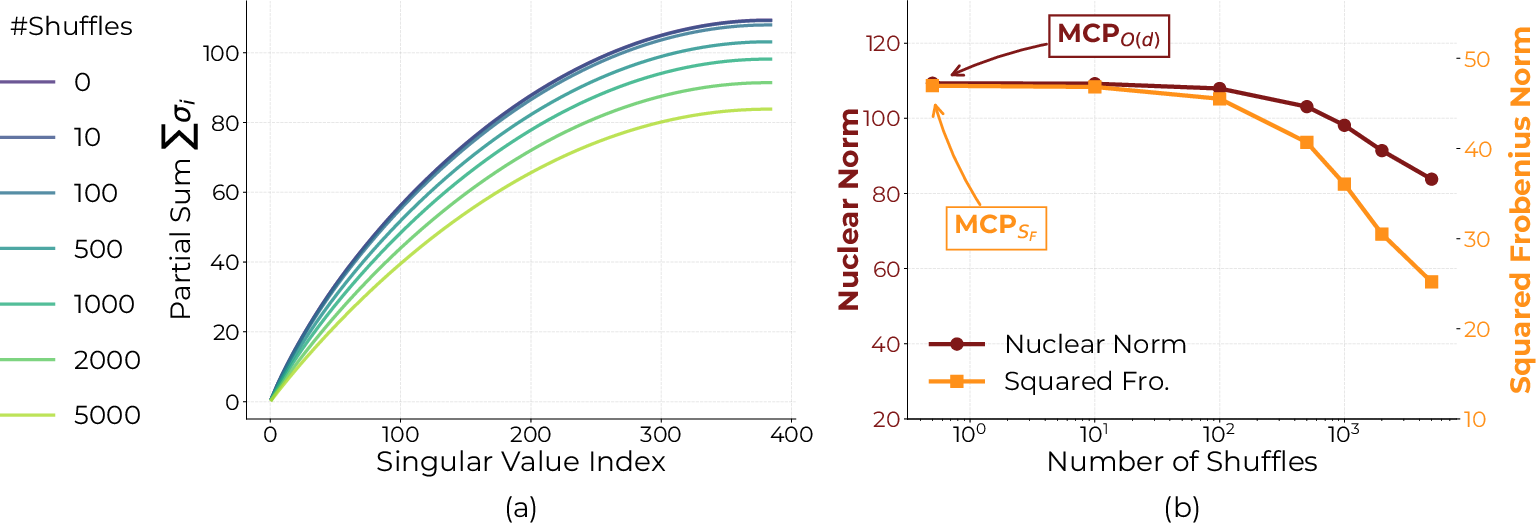
- Majorization: A partial ordering between vectors based on comparisons of their sorted partial sums. “In Assumption \ref{assum:weak_majorization} below, we assume this inequality holds not just for the total sum, but is preserved across all partial sums.”
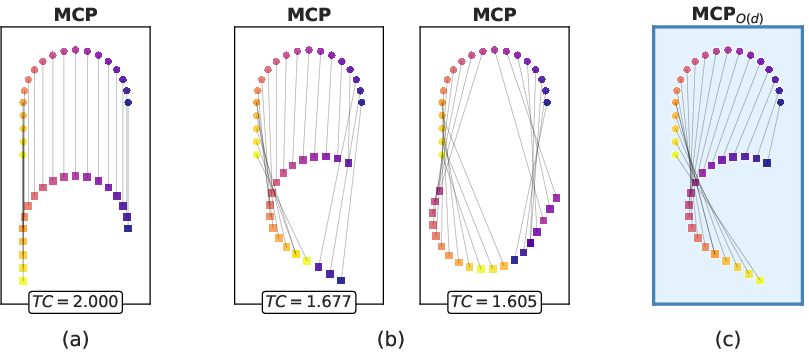
- Maximum Correlation Pairing (MCP): A procedure that selects the permutation maximizing correlation between two datasets. “We formally define this as the Maximum Correlation Pairing (MCP)”
- Multimodal representation learning: Learning a shared or coordinated representation from multiple data modalities. “CCA underpins a wide array of modern applications, including multimodal representation learning”
- Multiview learning: Learning from multiple representations or modalities of related data. “One of the most foundational methods for multiview shared-space learning is Canonical Correlation Analysis (CCA)”
- Nuclear norm: The sum of a matrix’s singular values, often used as a convex surrogate for matrix rank. “The Frobenius and nuclear norms are denoted by , respectively.”
- Orthogonal group: The set of square matrices whose transpose is their inverse, preserving Euclidean geometry. “Finally, we define the Orthogonal group ”
- Orthogonal projection: A transformation that preserves inner products or distances through an orthogonal matrix. “Unlike naive , (Fig. \ref{fig:mcp}c) is robust to orthogonal projections”
- Permutation matrix: A binary matrix containing exactly one 1 in every row and column, representing a rearrangement of samples. “We denote as the set of permutation matrices”
- Pseudo-pairs: Artificially constructed sample correspondences used as substitutes for true paired observations. “Finally, we treat these matched anchors as pseudo-pairs and apply standard CCA”
- Quadratic Assignment Problem (QAP): A combinatorial optimization problem that assigns entities to positions while maximizing structural similarity between two matrices. “The QAP seeks the optimal one-to-one assignment of entities to slots, maximizing the structural alignment between an interaction matrix and a similarity matrix .”
- Relaxation: The replacement of a difficult constrained optimization problem with a broader, more tractable one. “Therefore, we relax the optimization space from to a broader set”
- Singular values: Nonnegative values that characterize the scaling effect of a matrix along orthogonal directions. “For a matrix , represents the vector of all singular values”
- Sparse CCA: A form of CCA that imposes sparsity to reduce the number of features used in the learned projections. “Most relevant to our context are sparse CCA methods”
- Strictly unpaired setting: A learning scenario in which no corresponding samples across views are available during training. “To the best of our knowledge, UCCA\ is the first approach to learn maximally correlated projections in a strictly unpaired setting.”
- Total correlation: The aggregate correlation obtained by summing correlations across learned components or feature dimensions. “The total correlation (TC) of and is defined as”
- Unpaired data: Data from multiple modalities or views for which sample-level correspondences are unknown or unavailable. “In contrast, unpaired data is abundantly accessible”
- Whitening: A preprocessing transformation that rescales and decorrelates features so that their covariance is typically the identity matrix. “Let represent whitened datasets”
- Weak majorization: A vector ordering in which every sorted partial sum of one vector is at least as large as the corresponding partial sum of another. “Namely, ”
- Whitened dataset: A dataset transformed so its feature covariance has been normalized, commonly to the identity matrix. “Let represent whitened datasets consisting of samples with features.”

