Truly Subquadratic 3SUM and Truly Subcubic APSP via Triangles in Sparse Lopsided Graphs
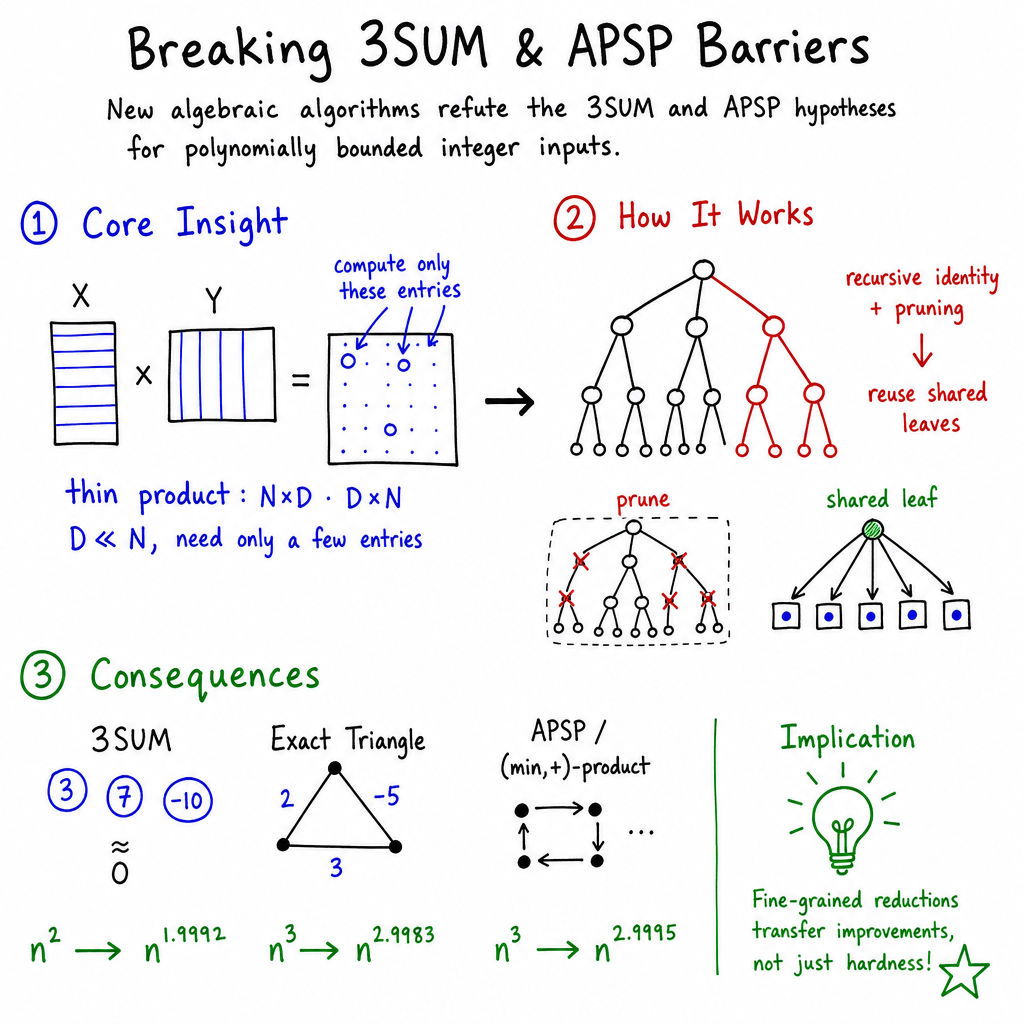
Abstract: We give the first polynomial improvements over the textbook algorithms for $3$SUM and All-Pairs Shortest Paths (APSP): we show how to deterministically solve $3$SUM on integers of polynomial size in time and APSP on directed -vertex graphs with polynomially bounded integer weights in time. This refutes the $3$SUM and APSP hypotheses. Using known reductions, we also refute the real-valued versions of the $3$SUM and APSP hypotheses, the Exact Triangle hypothesis, the Zero-Weight -Clique hypotheses, and the three rectangular hinted Online Matrix--Vector conjectures of van den Brand, Nanongkai, and Saranurak, and we give polynomial speedups for a variety of other problems. All of these results follow from a single new algorithm for thin matrix products. Let be an integer matrix and a integer matrix with , and let be any set of at most positions. We compute the entries , , in operations, which is polynomially less than the time needed to write down or to compute inner products one by one. We design this algorithm by modifying a variant of Coppersmith's rectangular matrix multiplication algorithm, built from a ten-multiplication identity of Schönhage, to perform only the operations needed for the entries in , and show that few operations are needed. Interpreted as a graph algorithm, this solves the All-Edges Sparse Triangle problem in truly subquadratic time on sparse lopsided tripartite graphs where two parts have vertices but one part has vertices for $\varepsilon<0.12$. By known reductions, Exact Triangle, and hence $3$SUM and APSP, reduce to this problem. We also give a data structure version that answers queries for single entries of , not known in advance.
Paper Prompts
Sign up for free to create and run prompts on this paper.
Top Community Prompts
Explain it Like I'm 14
1. What is this paper about?
This paper presents a new way to solve some very difficult computer science problems slightly faster than anyone could before.
The two most famous problems improved are:
- 3SUM: Given many numbers, are there three that add up to zero?
- All-Pairs Shortest Paths (APSP): Given a network, what is the shortest route between every pair of locations?
For a long time, researchers believed that the best possible algorithms needed about:
- steps for 3SUM
- steps for APSP
The paper shows that this is not quite true. Its algorithms are a little faster:
- 3SUM can be solved in about time.
- APSP can be solved in about time.
These improvements may look tiny, but in theoretical computer science, improving an exponent—even by a small amount—is a major result.
2. What questions did the researchers ask?
The researchers wanted to answer several related questions:
- Can 3SUM be solved in truly less than quadratic time? “Quadratic” means roughly work. The paper asks whether the exponent can be made smaller than 2 by a fixed amount.
- Can APSP be solved in truly less than cubic time? “Cubic” means roughly work. The paper asks whether the exponent can be reduced below 3.
- Can one new technique improve many difficult problems at once? Many problems are connected through mathematical translations called reductions. If one problem becomes easier, these connections may allow other problems to become easier too.
- Can the researchers compute only the answers they actually need, instead of calculating everything? This is the key idea behind their method.
3. How did they approach the problem?
A useful graph problem: finding triangles
The paper focuses on a graph problem called All-Edges Sparse Triangle.
Imagine a graph split into three groups of dots. The researchers want to know, for many pairs of dots, whether the two dots share a neighbor in the third group. Such a shared neighbor creates a triangle.
A normal method might check every possible combination. That can take too long.
The paper studies a special case where:
- Two groups are large.
- The third group is much smaller.
- Only some pairs of dots need to be checked.
This uneven shape is why the graph is called lopsided.
The matrix version
The same task can be written using matrices. A matrix is a rectangular table of numbers.
Suppose we multiply:
- an matrix
- by a matrix
Here, is much smaller than . The product normally has entries.
Instead of calculating the whole product, the researchers calculate only a selected set of entries—called the wanted entries.
This is like checking only certain squares in a huge multiplication table rather than filling in every square.
Their main result is that, under certain conditions, these selected entries can be computed in
steps.
The exact exponent is not the main point for a young reader. The important idea is that this is polynomially faster than , while still answering many questions.
A clever matrix multiplication technique
The method is based on an older technique for multiplying rectangular matrices, developed by Don Coppersmith. The researchers changed that method so it avoids calculations that affect entries nobody asked for.
A helpful analogy is this:
Suppose a teacher has a giant answer sheet but only asks you to find the answers to a few questions. Instead of solving every question, you organize your work so that you calculate only the requested answers.
The paper uses algebraic identities—special mathematical formulas—to share work between many calculations. This lets one operation help answer many questions at once.
Reductions: turning one problem into another
The researchers also use reductions. A reduction is a way to convert one problem into another.
For example:
- A 3SUM problem can be transformed into a triangle-finding problem.
- An APSP problem can also be transformed into a related triangle problem.
- The new triangle algorithm can then solve the transformed problem faster.
It is similar to translating a question into another language, solving it there, and translating the answer back.
4. What did they find?
Faster algorithms for 3SUM and APSP
The main numerical results are:
| Problem | Previous basic time | New time in the paper |
|---|---|---|
| 3SUM | About | About |
| APSP | About | About |
| Exact Triangle | About | About |
The paper also gives slightly different results for real numbers, using randomized methods whose answers are always correct but whose running time is expected to be fast. These are called Las Vegas algorithms.
Many other problems also improve
Because many problems reduce to 3SUM, APSP, or Exact Triangle, the new technique improves algorithms for several other tasks, including:
- shortest-path problems
- tree edit distance
- certain versions of set intersection
- weighted triangle problems
- some knapsack problems
- certain clique problems
- some matrix multiplication and convolution problems
- selected online matrix-vector problems
The paper does not improve every difficult problem. For example, the results do not directly refute the main conjectures about:
- CNF-SAT
- Orthogonal Vectors
- ordinary Online Matrix-Vector multiplication
- -SUM for
This is important because it shows that the new technique has limits.
Long-standing “hardness” beliefs are disproved
Computer scientists had proposed fine-grained complexity hypotheses. These are beliefs that certain problems cannot be solved noticeably faster than their known algorithms.
This paper disproves the 3SUM and APSP hypotheses for the stated types of inputs.
That does not mean 3SUM or APSP are now easy. The improvement is very small, and the new algorithms may be impractical for normal-sized inputs. However, it proves that the old running times were not the final mathematical limit.
The role of artificial intelligence
The paper says that an AI model called Claude discovered the main algorithm. The authors then checked, explained, improved, and extended the idea.
The paper also says that Claude helped verify the main results using Lean 4, a computer program that checks mathematical proofs very carefully.
The authors remain responsible for the final paper and its correctness.
5. Why are these results important?
The biggest lesson is that reductions are useful in two directions.
Before this work, researchers mainly used reductions to say:
“If problem A is difficult, then problem B must also be difficult.”
This paper shows another possibility:
“If problem B becomes easier, then the reduction gives us a faster algorithm for problem A.”
One new algorithm for a special triangle problem therefore improves many other problems connected to it.
The paper also teaches researchers to look more carefully at sparse information. Standard matrix multiplication calculates every entry of the answer, even when only a few entries matter. This research shows that avoiding unnecessary entries can lead to real improvements.
6. Simple conclusion
This paper makes a small but important crack in some long-standing barriers in algorithm design. It shows that 3SUM and APSP can be solved slightly faster than previously believed, and that one clever algebraic technique can help many related problems.
The algorithms are currently complicated and probably too slow for everyday use. Still, the discovery changes what researchers believe is possible. It may lead to:
- faster practical algorithms in the future,
- improved methods for sparse matrix calculations,
- new ways to solve graph and optimization problems,
- and a better understanding of which problems are genuinely difficult.
In short, the paper shows that problems once thought to be stuck at or time can sometimes be improved by calculating only what is needed and by using hidden connections between different problems.
Knowledge Gaps
Knowledge gaps, limitations, and open questions
The paper establishes polynomial improvements for several problems, but leaves the following issues unresolved:
- The optimal exponent for thin matrix products is unknown. The main algorithm applies when with and achieves a saving of , but it is unclear whether the method can handle larger values of , approach the known rectangular-multiplication threshold , or improve the savings beyond the stated constants.
- The structural reason for the threshold is not fully resolved. The limitation arises from the particular ten-multiplication Schönhage identity and its sparsity properties, but it remains open whether a different tensor identity or decomposition could extend the applicable range.
- The algorithm does not improve the balanced All-Edges Sparse Triangle problem. The balanced regime, including instances with roughly equal tripartite parts and the conditional barrier, remains unresolved.
- The important regime with two parts of size and a third part of size remains open. Even triangle detection, rather than the all-edges version, is not shown to admit an algorithm in this regime.
- The paper does not determine the true complexity of All-Edges Sparse Triangle across general sparsity patterns. It leaves open whether a unified algorithm can interpolate between lopsided, balanced, and intermediate regimes.
- The polynomial improvements are quantitatively small and may have very large hidden constants. The practical feasibility of the algorithms is not evaluated, and it is unknown whether the constructions can be simplified or implemented efficiently enough to outperform conventional algorithms at realistic input sizes.
- No combinatorial analogue of the main algebraic algorithm is known. The results rely on integer matrix multiplication and algebraic identities; whether truly subquadratic or subcubic combinatorial algorithms exist for the affected problems remains open.
- The paper does not establish lower bounds in the computational model used by the algorithm. Existing lower bounds for -product, path-comparison algorithms, and linear decision trees do not apply because the new algorithms transform weighted problems into unweighted counting or matrix-multiplication instances.
- The exact status of the original APSP and $3$SUM hypotheses after these results is not replaced by a new robust hypothesis. The paper refutes the stated hypotheses but does not identify the correct fine-grained complexity or a new conjectured optimal exponent for APSP, $3$SUM, or Exact Triangle.
- The results do not extend to CNF-SAT or Orthogonal Vectors. No reduction of these problems to the lopsided sparse-triangle setting is known, and the techniques do not address their apparently different dense color-triple or Boolean-vector structure.
- The standard, unhindered Online Matrix–Vector conjecture remains unaffected. The data-structure results refute hinted variants only for thin hints; they do not provide an improvement for ordinary OMv.
- The hinted OMv results cover only thin-hint parameter ranges. The conjectures remain open for the regimes relevant to several dynamic matrix inverse, dynamic distance, and dynamic graph lower bounds, particularly around hint dimensions near .
- Many 3SUM-hard and APSP-hard problems still lack faster algorithms. The paper emphasizes that one-way hardness reductions do not reverse into algorithms; examples include finding three collinear points, several geometric problems, and numerous dynamic graph problems.
- The complexity of -SUM and -XOR for remains unresolved. The techniques improve $3$SUM but do not yield algorithms near the usual baselines for larger .
- The lack of fine-grained self-reductions for -SUM and higher-arity -XOR remains a major obstacle. It is unknown whether suitable self-reductions exist and whether they would enable reductions or algorithms comparable to those for $3$SUM.
- The $3$SUM-Indexing conjecture is not affected. The paper does not provide a faster data structure for the parameter regimes in which this conjecture is posed.
- The real-valued algorithms are randomized and analyzed in expectation. The paper does not provide deterministic algorithms with comparable bounds for real-valued $3$SUM, APSP, or Exact Triangle.
- The robustness of the real-valued reductions under stricter numerical models is unresolved. The results use comparisons, additions, and subtractions, but do not establish comparable guarantees under finite-precision arithmetic, numerical noise, or practical real-number representations.
- The algorithms are restricted to polynomially bounded integer entries in their deterministic form. Their performance for larger integer magnitudes, arbitrary-precision inputs, or weights whose bit length is not logarithmic in the input size is not analyzed.
- The data-structure trade-off is not known to be optimal. The preprocessing bound and query bound are improvements over baseline methods, but no matching upper or lower bounds are given.
- The data-structure model does not address dynamic updates. The results concern static preprocessing and queries; the cost of supporting updates to , , or the underlying set system remains open.
- The paper does not clarify whether the sparse-output technique extends beyond counting products. It computes selected entries of ordinary integer matrix products, but analogous improvements for Boolean, min-plus, polynomial, or other semiring products are not established in general.
- The consequences for graph girth approximation remain conditional on a further breakthrough. The paper notes that solving the -middle-part triangle problem would affect girth approximation, but does not resolve either problem.
- The improvements for derived problems depend on the quality and applicability of existing reductions. Problems known only to reduce from $3$SUM, APSP, or Exact Triangle do not automatically receive faster algorithms, leaving the algorithmic status of those problems unresolved.
- The paper does not determine whether further improvements would propagate to currently unaffected conjectures. In particular, it remains unclear whether stronger sparse-triangle algorithms could eventually yield consequences for SETH, OV, unrestricted OMv, or higher-arity sum problems.
- The broader limits of reduction-based fine-grained complexity are left open. The paper demonstrates that conditional hardness webs can become algorithmic transfer mechanisms, but does not characterize which classes of reductions are most likely to yield future simultaneous improvements across many problems.**
Practical Applications
Immediate Applications
The paper’s strongest immediate value is as an algorithmic primitive for moderately thin, sparse matrix products and as a basis for improved exact algorithms. Although the asymptotic gains are currently small and the hidden constants may be large, the following uses are directly enabled by the reported results or by existing reductions.
- Faster exact
3SUMand related numerical-search workloads — computational geometry and data analysis.- Potential workflow: use the new algorithm as a batch-search backend after normalizing inputs to bounded integers or to comparison/addition/subtraction operations.
- Dependencies: inputs must satisfy the paper’s numerical assumptions; real-valued versions are randomized; the theoretical constants may make conventional sorting or hashing faster for practical input sizes.
- Practical sectors: computational geometry, collision detection, constraint checking, symbolic data analysis, and scientific computing.
- Improved exact APSP and )-product computation — graph analytics and operations research.
- Potential workflow: integrate the algorithm into exact graph-analysis libraries for dense or moderately dense directed networks, especially when all-pairs distances or min-plus products are required.
- Applications: route-planning benchmarks, network reliability analysis, dependency graphs, scheduling, and dynamic-programming formulations based on min-plus algebra.
- Dependencies: the improvements are polynomial but small; memory for storing distances remains unavoidable, and negative-cycle handling must still be performed or assumed absent.
- Faster exact algorithms for APSP-equivalent graph problems — network and infrastructure analysis.
- Potential products: graph-analysis toolkits offering exact diagnostic modules for transportation, communication, and dependency networks.
- Dependencies: many reductions may introduce substantial overhead; improvements apply to the stated weight and graph regimes and do not automatically improve every sparse-graph implementation.
- Improved directed unweighted APSP — software infrastructure and network services.
- Potential workflow: use it in batch reachability-distance services, static dependency analysis, and large directed network audits.
- Dependencies: the result is asymptotic and may not outperform highly optimized breadth-first-search implementations on sparse or moderate-sized graphs. The paper’s stated improvement is not a general breakthrough for online or dynamic shortest-path queries.
- Thin hinted matrix–vector computation — databases, recommendation systems, and batched inference.
- Potential workflow: preprocess a large collection of feature vectors or incidence matrices, then answer many restricted pairwise similarity, overlap, or count queries.
- Examples: sparse set-overlap search, Boolean incidence queries, small-feature-dimension recommendation filters, and batched lookup services.
- Dependencies: the dimension must be a sufficiently small power of ; the queried entries must be sparse or handled individually; integer-size and word-RAM assumptions apply.
- Offline set-disjointness and set-intersection counting — databases and information retrieval.
- Potential tools: a batch set-intersection engine, graph-neighborhood overlap service, or incidence-matrix query index.
- Applications: duplicate detection, document-term overlap, permission-set auditing, bipartite-neighborhood comparison, and join-like database workloads.
- Dependencies: the universe size must be small relative to the number of sets, approximately within the paper’s thin regime. Large-universe, highly skewed, or online-adversarial workloads are not covered.
- Triangle-through-edge counting in lopsided graphs — graph mining and anomaly detection.
- Potential workflow: represent entities in two large groups and a small mediator/category group; construct biadjacency matrices; query selected pair counts.
- Examples: shared suppliers between firms, shared tags between documents, common users between products, or common intermediaries in communication networks.
- Dependencies: the graph must be structurally lopsided, with the small part roughly below the stated threshold for the strongest general guarantee. Real-world graphs may not have this shape.
- Improved exact knapsack and approximate subset-sum routines — logistics and resource planning.
- Potential tools: capacity-indexed planning solvers, packing optimizers, and resource-allocation modules.
- Dependencies: these are parameterized by capacity and may be useful only when the capacity is much smaller than the naive quadratic regime. The paper notes that some variants, including randomized $0/1$ knapsack results, are not uniformly deterministic.
- Academic and policy use: revision of fine-grained complexity assumptions.
- Actionable consequence: papers and software claims should no longer describe these hypotheses as credible unconditional barriers in the regimes refuted here.
- Policy relevance: funding programs and algorithmic benchmark designers can treat these problems as active optimization targets rather than presumed-exponent frontiers.
- Dependency: the result does not refute SETH, Orthogonal Vectors, unrestricted OMv, -SUM for , or all 3SUM-hard problems. Lower-bound claims must be checked against the exact reduction direction and parameter regime.
Long-Term Applications
The following possibilities require further engineering, improved constants, extensions beyond the thin regime, or validation on realistic data.
- Production-grade sparse matrix and graph-processing libraries.
- Potential products: GPU/CPU libraries, compiler primitives, and graph-processing frameworks supporting “wanted-entry” matrix multiplication.
- Required development: practical versions of the Schönhage/Coppersmith-based construction, memory-efficient layouts, parallelization, cache-aware implementations, and hardware-specific integer arithmetic.
- Main obstacle: the paper explicitly notes enormous hidden constants and potentially impractical algebraic operations.
- Large-scale database join and triangle-query engines.
- Potential workflow: automatically detect lopsided join structure, convert relations into thin incidence matrices, compute only requested output pairs, and fall back to hash joins outside the valid regime.
- Dependencies: data skew, update frequency, memory bandwidth, and the need to support non-integer attributes or approximate predicates.
- Static recommendation, similarity, and bipartite-network analytics.
- Potential tool: a batch “common-neighbor query accelerator” for selected pairs rather than all pairs.
- Dependencies: privacy-preserving representations, rapidly changing data, and the requirement that the intermediary dimension remain sufficiently small. The paper provides no direct accuracy or privacy guarantees.
- Exact optimization engines based on min-plus algebra.
- Potential products: optimization solvers that select among classical dynamic programming, min-plus convolution, and the new algebraic routines based on parameter size.
- Required development: extension to broader numeric ranges, floating-point robustness, negative and infinite values, parallel execution, and practical crossover analysis.
- Dependency: algebraic speedups may be unsuitable when numerical stability or explainability is more important than asymptotic runtime.
- Faster computational biology and structured sequence comparison.
- Potential workflow: use the improved tree-edit-distance backend in RNA secondary-structure analysis or hierarchical document comparison.
- Dependencies: real biological scoring schemes may use arbitrary or floating-point costs; practical performance depends on the reduction from tree edit distance and may not match the asymptotic graph algorithm directly.
- Improved network planning and resilience analysis.
- Potential applications: identify critical roads or communication links, evaluate alternate routes, and measure network centrality under failures.
- Required development: adapt exact dense-graph algorithms to sparse, dynamic, geographically embedded, or streaming networks; provide approximation and incremental-update variants.
- Dependency: the paper’s improvements are primarily for static batch computation, not continuously changing infrastructure.
- Dynamic data structures with thin hints.
- Potential products: systems that preprocess a narrow family of possible updates or queries and then answer the realized query rapidly.
- Examples: dynamic reachability with restricted update domains, fast query serving for narrow feature spaces, and specialized attention computations with a small candidate dimension.
- Dependencies: the benefits occur only in thin-hint regimes. The paper explicitly leaves the main dynamic-matrix-inverse trade-offs, unrestricted OMv, and many dynamic graph lower bounds unaffected.
- Hardware and accelerator design for sparse-output algebra.
- Potential direction: FPGA, ASIC, or GPU accelerators for thin matrix products, modular arithmetic, and sparse output routing.
- Required development: map the ten-multiplication identity and its pruning strategy onto parallel hardware, control intermediate-expression growth, and compare against tensor-core multiplication.
- Dependency: hardware usefulness depends on workloads with stable dimensions and predictable wanted-entry patterns.
- New algorithms for broader parameter regimes.
- Research targets: balanced All-Edges Sparse Triangle, sparse-output rectangular multiplication for near , dynamic updates, and -SUM or -XOR for .
- Dependency: the current technique relies on sparsity properties of a particular algebraic identity and does not automatically generalize.
- Algorithmic benchmarking and education.
- Potential outputs: teaching modules on sparse-output matrix multiplication, benchmark instances for lopsided triangle counting, and research software comparing algebraic and combinatorial approaches.
- Dependency: benchmarks should report constants, memory use, numerical restrictions, randomization, and crossover sizes; asymptotic improvements alone may otherwise be misleading for daily computational practice.
Glossary
- All-Pairs Shortest Paths (APSP): The problem of computing shortest-path distances between every pair of vertices in a weighted graph. “Given an edge-weighted graph on vertices with no negative cycles, compute the shortest-path distance between every pair of vertices.”
- All-Edges Sparse Triangle: The problem of determining, for every edge in a sparse graph, whether that edge belongs to a triangle. “In graph terms, offline Set Disjointness is the All-Edges Sparse Triangle problem: given a graph with edges, decide for every edge whether it lies in a triangle.”
- Algebraic complexity: The study of computational complexity using algebraic operations and structures. “This also opens a number of research directions in fine-grained complexity, algorithm design, and algebraic complexity”
- Biadjacency matrix: A matrix representing adjacency relations between vertices in two parts of a bipartite graph. “if and are the two biadjacency matrices”
- Boolean matrix multiplication (BMM): Matrix multiplication over the Boolean semiring, using logical OR and AND instead of arithmetic addition and multiplication. “The known algorithms for combinatorial BMM”
- Coppersmith–Winograd identities: Algebraic identities used to derive fast matrix multiplication algorithms. “prior to this work, the authors had tried approaches like this using the Coppersmith--Winograd identities”
- Co-nondeterministic algorithm: An algorithm that efficiently verifies certificates proving that an instance is a NO-instance. “A nondeterministic algorithm for a decision problem verifies a proof for YES, and a co-nondeterministic algorithm verifies a given proof for NO.”
- Combinatorial algorithm: An algorithm whose main operations are combinatorial rather than algebraic, often excluding fast algebraic matrix multiplication. “The new algorithms are algebraic and potentially impractical in their current form”
- Convolution-3SUM: A constrained form of 3SUM involving indexed sequence elements whose indices add. “Convolution-3SUM (do satisfy for some ?)”
- Decision tree: A computational model in which a problem is solved through a sequence of branching tests on the input. “$3$SUM (and more generally -SUM) and also Exact Triangle have very efficient {\em linear decision trees}.”
- Exact Triangle: The problem of determining whether a weighted tripartite graph contains a triangle whose edge weights sum to zero. “given a tripartite graph with integer edge weights, is there a triangle whose three weights sum to zero?”
- Fine-grained complexity: The study of computational complexity at the level of precise asymptotic exponents. “Both theories relate problems via reductions. FGC focuses on improvements in the exponent”
- Fine-grained reduction: A reduction that preserves sufficiently precise running-time exponents between problems. “a fine-grained reduction from problem to problem with respect to running times and ”
- Fredman’s trick: An algebraic rearrangement that converts comparisons involving sums into comparisons of differences, often useful for real-valued inputs. “uses only additions, subtractions, and comparisons (via Fredman's trick”
- Girth approximation: The approximation of the length of the shortest cycle in a graph. “would have consequences for girth approximation in undirected unweighted graphs”
- Hinted Online Matrix–Vector multiplication (OMv): An online matrix–vector problem in which partial information about an arriving vector is supplied in advance. “This allows us to refute the hinted Online Matrix--Vector (OMv) conjectures”
- Inner product: The sum of coordinate-wise products of two vectors. “computing inner products one by one”
- Las Vegas algorithm: A randomized algorithm that always returns a correct answer, with randomness affecting only its running time. “for real numbers, a Las Vegas algorithm with expected time”
- Linear decision tree: A decision tree whose tests are linear functions of the input values. “it is now known that for every , -SUM has $2k$-linear decision trees”
- Lopsided graph: A graph whose parts have substantially different sizes. “a lopsided version of All-Edges Sparse Triangle, in which the graph is tripartite and one of the three parts is significantly smaller than the other two.”
- Matrix multiplication exponent: The exponent governing the asymptotic time required for multiplying square matrices. “where is the matrix multiplication exponent.”
- Merlin–Arthur protocol: A randomized proof-verification framework in which a prover supplies a certificate that an algorithm checks probabilistically. “the Merlin--Arthur world where randomization is allowed.”
- Min-plus product: Matrix multiplication in which multiplication is replaced by addition and addition is replaced by minimum. “the -product of two matrices”
- Nondeterministic algorithm: An algorithm that verifies a certificate for a YES-instance rather than finding a solution deterministically. “A nondeterministic algorithm for a decision problem verifies a proof for YES”
- Orthogonal Vectors (OV): The problem of determining whether two Boolean vectors have no coordinate in which both contain a one. “Given Boolean vectors in dimensions, are two of them orthogonal?”
- Polynomial method: An algorithmic technique that represents combinatorial conditions using low-degree polynomials. “to design the fastest fine-grained algorithms for a number of problems using the polynomial method”
- Rectangular matrix multiplication: Matrix multiplication involving matrices with substantially different dimensions. “the exponent of multiplying an by an matrix.”
- Reduction: A transformation that converts instances of one computational problem into instances of another while preserving relevant properties. “a reduction from to ”
- Semiring: An algebraic structure supporting addition-like and multiplication-like operations without requiring additive inverses. “over the semiring”
- SETH: The Strong Exponential Time Hypothesis, which conjectures that CNF-SAT cannot be solved in substantially less than time. “the ``Strong Exponential Time Hypothesis,'' SETH”
- Sparse matrix product: A matrix product in which only a selected subset of output entries is computed. “computing a prescribed sparse set of entries of a dense product of thin matrices.”
- Sparse triangle: A triangle-finding problem in a graph with relatively few edges or a sparse set of relevant outputs. “All-Edges Sparse Triangle can be solved in time just by listing all triangles”
- Straight-line program: A sequence of arithmetic operations with no branching, used as a restricted computational model. “over the semiring, straight-line programs need operations”
- Thin matrix: A matrix with one dimension that is a small power of the other, particularly an matrix with small . “We call a product of an matrix by a matrix thin when is a small power of ”
- Truly subquadratic: Running in time for some constant . “meaning in time for some constant (truly subquadratic is defined similarly).”
- Truly subcubic: Running in time for some constant . “all of the following problems are solvable in truly subcubic time”
- Word RAM: A computational model in which memory words hold a logarithmic number of bits and basic word operations take constant time. “in the word RAM model of computation with -bit words”
- Zero-Weight -Clique: The problem of finding a -vertex clique whose edge weights sum to zero. “Zero-Weight -Clique folding”
- 3-linear degeneracy testing: Testing whether three input values satisfy a fixed linear relation. “all nontrivial variants of 3-Linear Degeneracy Testing”
- 3SUM hypothesis: The conjecture that no truly subquadratic algorithm exists for 3SUM. “the ``$3$SUM hypothesis''”
- 3XOR: A problem asking whether three vectors over XOR to the zero vector. “Given three lists of vectors in ”

