Level-of-Token Diffusion
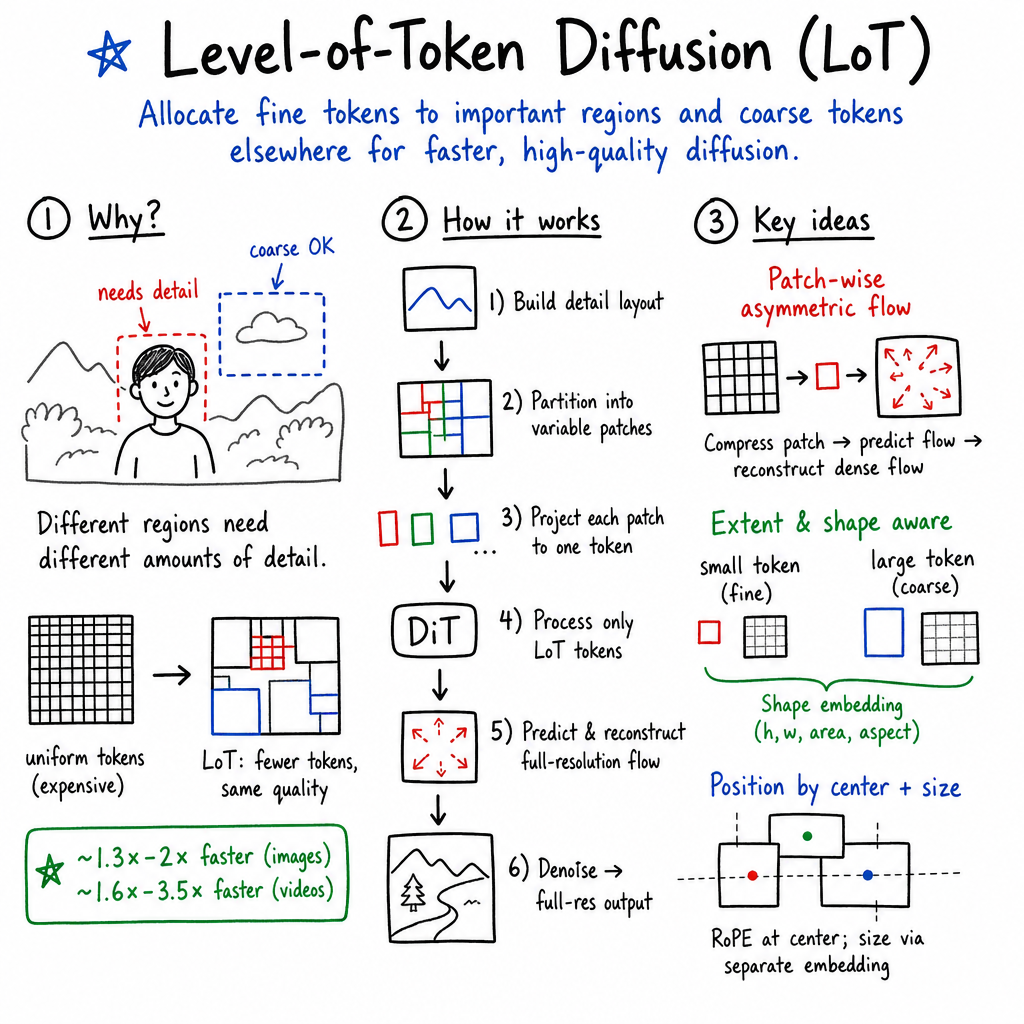
Abstract: Image and video diffusion models allocate equal computation to every region, even when the intended scene calls for varying levels of detail. The spatial distribution of detail can often be anticipated before generation, indicating where computation can be reduced. We introduce Level-of-Token (LoT) Diffusion, a framework that turns this knowledge into an explicit multiresolution token layout (Level-of-Token layout) for adaptive and efficient generation. Tokens represent rectangular patches of varying sizes and shapes, allocating finer tokens where detail is needed and coarser tokens elsewhere. We adapt pretrained diffusion transformers to LoT layouts through a patch-wise asymmetric flow parametrization and embeddings for multiresolution tokens, preserving full-resolution flow prediction at every denoising step while processing only a reduced token sequence. LoT Diffusion enables layout-adaptive generation while preserving pretrained generative priors. We demonstrate LoT with layouts derived from semantic masks, bounding boxes, texture variance, and depth-of-field cues, as well as agentic plans. Across image and video generation, LoT offers favorable quality-efficiency tradeoffs, with significant speedups determined by the layout's token budget. Our project website is at https://georgenakayama.github.io/lotdiffusion/.
Paper Prompts
Sign up for free to create and run prompts on this paper.
Top Community Prompts
Explain it Like I'm 14
1. What is this paper about?
This paper introduces a method called Level-of-Token Diffusion, or LoT Diffusion.
It is designed to make AI systems generate images and videos faster and more efficiently. The main idea is simple:
Not every part of an image needs the same amount of detail.
For example, a person’s face, a sign with writing, or a detailed machine may need many small pieces of information. However, a clear blue sky or a smooth wall may not need as much detail. LoT Diffusion gives more computing power to important or complicated areas and less computing power to simple areas.
This is similar to how a video game may render nearby objects in high detail but distant objects with fewer details.
2. What questions does the research ask?
The researchers wanted to find out:
- Can an image or video generator use different levels of detail in different areas?
- Can it generate pictures and videos using fewer pieces of information, called tokens?
- Can this make generation faster without making the results look much worse?
- Can existing, already-trained diffusion models be adapted to use this method?
- Can users control where the model spends more or less computing power?
The method can use several kinds of information to decide where detail is needed, including:
- Bounding boxes, which show where objects are located
- Semantic masks, which label regions such as “sky,” “road,” or “person”
- Texture information, which shows where surfaces are complicated or plain
- Depth, which indicates what is near or far from the viewer
- Plans created by an AI agent or a user
3. How did the researchers do it?
Diffusion models in simple terms
A diffusion model creates an image by starting with random visual noise and gradually cleaning it up. This happens over many steps until a clear image appears.
The model does not usually look at an entire image as one large object. Instead, it divides the image into small pieces called tokens. A token is similar to a small tile in a mosaic.
Most existing models use tiles that are all the same size. This means that a simple part of an image receives just as much computation as a complicated part.
The LoT approach
LoT Diffusion allows tokens to have different sizes:
- Small tokens are used where fine detail is important.
- Large tokens are used where less detail is acceptable.
For example, a picture could use small tokens for a person’s face and large tokens for the sky. The model still produces a full-resolution image, but it processes fewer tokens internally.
The researchers also added information about each token’s:
- Location
- Height and width
- Shape
- Amount of space it represents
This helps the model understand that one token may represent a small detailed patch while another represents a larger, simpler region.
Adapting existing models
The researchers tested LoT with pretrained diffusion models rather than building entirely new models from the beginning. They fine-tuned:
- FLUX.2 for image generation
- Wan2.1 for video generation
They used special mathematical techniques to turn the smaller number of tokens back into a full-resolution prediction. In everyday language, this is like using a rough sketch to guide the creation of a detailed final picture.
The researchers trained and tested the models on image and video datasets. They compared LoT with other methods that also try to reduce the number of tokens.
They measured:
- Generation speed
- Image and video quality
- How closely results matched human preferences
- Whether details and objects remained accurate
4. What did they find?
Faster generation
LoT made generation considerably faster.
For images, the method achieved speedups of about:
- 1.32 to 2.04 times faster in detailed comparisons
- Up to about 2.04 times faster on average in the reported experiments
For videos, it achieved:
- About 1.58 to 3.53 times faster generation
- Up to about 3.53 times faster on average
This matters because video and high-resolution image generation require a lot of computer power and can be slow.
Good quality despite using fewer tokens
LoT generally produced better quality than the comparison methods when using similar token budgets. The results kept more detail in important areas while allowing simpler areas to remain smoother or less detailed.
For example:
- Faces and objects could receive fine detail.
- Backgrounds, roads, skies, or blurred areas could use fewer tokens.
- The generated images and videos were less likely to become noisy or distorted than those made by some competing methods.
The image experiments showed that LoT often performed best on measures of image quality and similarity to human preferences. In the video experiments, it achieved the highest scores for some measures of visual appeal and image quality.
Layouts successfully changed where detail appeared
The results showed that LoT followed the supplied layouts. If the layout marked an area as important, the model used finer tokens there. If an area was marked as less important, it used larger tokens.
The researchers demonstrated this using:
- Object boxes
- Semantic labels
- Texture maps
- Depth maps
- Human or AI-created plans
Important limitations
LoT does not always provide large benefits. If every part of an image contains complicated textures or fine structures, then almost every region needs small tokens. In that situation, there is little computation to save.
Also, using too few tokens can reduce image quality. The method works best when the image or video has a mixture of detailed and simple areas.
5. Why is this research important?
The paper shows that AI image and video generators do not have to spend equal effort everywhere. They can use information about the planned scene to decide where detail matters most.
This could lead to:
- Faster image and video creation
- Lower costs for running large AI models
- Less electricity use
- More responsive creative tools
- Faster video generation for games and virtual worlds
- Quicker simulations for robotics and autonomous vehicles
- Better interactive systems that can revise a scene quickly
Another interesting possibility is that a scene plan could become an editable control panel. A user might tell the system:
- “Make the person’s face highly detailed.”
- “Keep the background simple.”
- “Use more detail on the robot and less on the floor.”
In short, LoT Diffusion connects visual detail with computing effort. It makes generation more efficient by focusing the model’s attention where it is most useful. However, it is most effective for scenes where some areas are detailed and others are simple.
Knowledge Gaps
Knowledge gaps, limitations, and open questions
- The paper does not establish how reliably different layout sources—semantic masks, bounding boxes, texture variance, depth, and agentic plans—predict where fine visual detail is actually required.
- It remains unclear how sensitive generation quality is to inaccurate, noisy, incomplete, or misaligned layouts, including incorrect object boundaries and erroneous depth or texture estimates.
- The method assumes that the desired spatial allocation of detail is known before generation; it does not investigate layouts that are inferred or updated dynamically from intermediate denoising states.
- The paper does not compare manually specified layouts with automatically optimized layouts under a fixed token budget, leaving the best strategy for allocating tokens unresolved.
- No principled optimization objective is provided for choosing the token budget or spatial allocation that maximizes perceptual quality subject to a latency or memory constraint.
- The relationship between token extent, semantic importance, spatial frequency, and perceived quality is demonstrated qualitatively but not quantitatively modeled.
- The experiments do not isolate the contribution of each layout source sufficiently to determine whether gains arise from the LoT architecture, the layout quality, or correlations in the fine-tuning data.
- Training uses mixed-source layouts, but the paper does not evaluate generalization to layout types, distributions, resolutions, or spatial configurations that were absent during training.
- The supported token extents are restricted to a small predefined set, and the ability to generalize to arbitrary patch sizes, aspect ratios, irregular regions, or non-axis-aligned shapes is not demonstrated.
- The rectangular, non-overlapping partition assumption may be poorly suited to thin, curved, fragmented, or highly irregular objects; the paper does not evaluate these cases.
- The extent-dependent input and output heads introduce a separate parameterization for each supported extent, but the scalability and parameter cost of supporting many more extents are not analyzed.
- The method’s compatibility with pretrained diffusion transformers is shown only for FLUX.2-Klein and Wan2.1; broader validation across architectures, modalities, latent spaces, and model scales is missing.
- The claimed preservation of pretrained generative priors is not directly measured through systematic comparisons with the original models on prompt fidelity, object identity, composition, style, and rare concepts.
- The fine-tuning requirements are substantial, yet the paper does not quantify training time, GPU memory, energy consumption, or data requirements relative to training from scratch or alternative adaptation methods.
- The reported speedups exclude layout construction and model loading; end-to-end latency, including prediction of depth, segmentation, texture maps, or agentic plans, remains unknown.
- Hardware-specific runtime behavior is not examined, including kernel utilization, memory bandwidth, padding overhead, irregular-batch efficiency, and performance on different accelerators.
- The relationship between token compression and actual computational cost is not fully characterized, particularly for attention, extent-dependent projections, dense flow reconstruction, and VAE decoding.
- The method preserves a full-resolution velocity field, but the paper does not analyze the memory and runtime overhead of reconstructing and storing this field at every denoising step.
- The evaluation considers a limited set of token budgets and does not establish whether quality degrades smoothly, abruptly, or differently across layouts as compression becomes more aggressive.
- The paper acknowledges that scenes requiring fine detail throughout offer limited compression opportunities, but it does not define a detector or criterion for identifying such scenes before generation.
- Failures under globally detailed content—such as dense text, crowds, foliage, patterned clothing, fine machinery, or repeated textures—are not systematically evaluated.
- Text rendering and small-object fidelity are not separately assessed, despite the paper identifying typography, faces, and intricate structures as regions that require fine tokens.
- Spatial quality is evaluated primarily with global metrics; the paper does not report region-level metrics that verify whether coarse regions lose quality while fine regions retain detail.
- It is unclear whether coarsely tokenized regions produce realistic low-frequency structure while fine regions remain spatially and semantically consistent with them, especially at boundaries between token scales.
- Boundary artifacts, discontinuities, texture leakage, and object distortion caused by abrupt changes in token resolution are not systematically analyzed.
- The paper does not investigate whether token layouts can cause inconsistencies across denoising timesteps, such as details appearing, disappearing, or shifting when coarse and fine regions interact.
- For video, the extension is described as using per-frame layouts, but temporal consistency of layouts and generated content is not thoroughly studied.
- The video experiments do not evaluate layout changes over time, moving objects crossing resolution boundaries, camera motion, scene cuts, or temporally varying depth and texture cues.
- The evaluation uses only 200 held-out text-video pairs, leaving uncertainty about robustness across longer videos, diverse motion patterns, resolutions, aspect ratios, and domains.
- The method’s behavior for long videos is unresolved because the reported experiments use 81-frame clips and do not test how token allocation interacts with temporal compression and memory growth.
- The paper does not compare LoT against combined systems that use token reduction together with timestep caching, distillation, progressive upsampling, or sparse attention, despite describing these methods as complementary.
- The baselines are not evaluated under fully equivalent training, implementation, hardware, and preprocessing conditions, limiting the strength of the claimed efficiency comparisons.
- The evaluation relies heavily on automated perceptual and preference metrics, with limited human assessment of whether users can perceive or accept quality differences across spatial regions.
- The paper does not measure user control accuracy: it remains unclear how precisely a requested fine-detail region is honored and how often detail is allocated outside the intended region.
- The implications of user-specified coarse regions are underexplored, including whether users can intentionally trade local fidelity for global composition, style, or generation speed.
- The agentic-plan demonstrations are preliminary and do not evaluate how planning errors, ambiguous instructions, iterative edits, or changes to the computational budget affect generation.
- LoT layouts are treated as static inputs, leaving open how users or multimodal agents could interactively edit layouts during sampling without restarting generation.
- The paper does not study whether a single model can support continuous or adaptive token budgets at inference time without retraining for each layout distribution.
- The theoretical justification for center-based RoPE and separate shape embeddings is limited; alternative positional encodings and representations of patch support are not systematically compared.
- The orthogonal-Procrustes basis and extent-specific scaling are fitted from aligned training data, but robustness to domain shifts and mismatch between training and inference latent statistics is not established.
- Numerical stability near is handled by clamping the denominator, but the effect of this approximation on final-sample accuracy and high-frequency detail is not quantified.
- The method’s ability to preserve stochastic diversity under different layouts and token budgets is not evaluated; compression may affect mode coverage or increase layout-dependent bias.
- Safety, fairness, and representational effects of allocating fewer tokens to semantically designated regions are not discussed, particularly when the layout generator systematically assigns lower detail to certain objects or regions.
- The paper does not provide an analysis of failure cases in which a semantically “unimportant” region becomes important for prompt fidelity, narrative context, or downstream visual understanding.
- The long-term practicality of using LoT in interactive systems remains uncertain because layout generation, model fine-tuning, hardware execution, and quality control are not evaluated in an end-to-end application setting.
Practical Applications
Immediate Applications
The paper’s method is most immediately applicable to image- and video-generation systems where spatial detail is unevenly distributed and a layout, mask, depth map, or bounding box is already available.
- Faster text-to-image generation for creative tools and design software (creative industries, advertising, e-commerce) LoT Diffusion can allocate fine tokens to faces, product labels, logos, or foreground objects while using coarse tokens for skies, walls, and other low-detail regions. A design application could expose a “detail budget” or allow users to mark important regions before generation. The reported image speedups of approximately 1.3–2.0× make this suitable for faster previews and iterative editing. Dependencies: The target diffusion model must be adapted or fine-tuned for LoT layouts; quality may decline if important detail is incorrectly assigned a coarse token budget.
- Interactive image editing and inpainting (content creation, UI/UX, digital asset production) A user could provide a segmentation mask or bounding box for the region being edited, assigning high resolution to the edited object and lower resolution elsewhere. This could reduce latency for object replacement, background modification, relighting, and localized style transfer. Dependencies: Reliable masks or object detectors are needed, and the system must maintain spatial consistency between edited and unedited areas.
- Efficient product visualization and catalog generation (retail, manufacturing, e-commerce) LoT layouts can prioritize product geometry, branding, text, and material texture while rendering backgrounds more coarsely. Retail platforms could generate multiple product scenes or advertising variants at lower inference cost. Dependencies: Fine tokenization must be enforced around small text and brand marks; the current results do not establish guaranteed typography or regulatory labeling accuracy.
- Lower-latency video generation for previews and storyboarding (film, animation, marketing, game development) Video systems can assign fine tokens to actors, objects, or action regions and coarse tokens to skies, roads, and uniform backgrounds. The reported video speedups of roughly 1.6–3.5× could support rapid storyboard iteration, shot exploration, and low-cost preview rendering. Dependencies: Temporal consistency must be preserved across changing layouts and frames. The demonstrated results use selected video datasets and do not prove robust performance for very long clips.
- Resource-aware generation on constrained hardware (mobile devices, edge computing, cloud inference) A serving platform could select a token budget based on device capability, latency requirements, or cloud cost. For example, a low-power device could generate coarse backgrounds while retaining detail in a user-selected subject. Dependencies: End-to-end gains depend on layout construction, memory movement, VAE decoding, and hardware support; the paper’s speed measurements exclude model loading and layout construction.
- Efficient generation for virtual and augmented reality assets (AR/VR, gaming, simulation) Depth maps, saliency maps, or viewing-region information can define finer tokens near the user’s focal area and coarser tokens elsewhere. This resembles foveated rendering, but applied to generative image or video synthesis. Dependencies: The layout must track the viewer’s gaze or viewpoint with low latency. Incorrect saliency estimates could place insufficient detail in perceptually important regions.
- Autonomous-driving and robotics simulation content (robotics, transportation, synthetic data) Semantic masks can prioritize vehicles, pedestrians, road obstacles, traffic signals, robot grippers, and manipulated objects while reducing computation for sky, roads, or flat surfaces. The paper explicitly demonstrates layouts based on driving scenes and robot-object regions. Dependencies: Safety-critical objects must never be mistakenly assigned coarse representations. Generated data should be validated before being used for training or testing perception and control systems.
- Fast synthetic-data generation for computer-vision research (academia, industrial ML development) Researchers could use LoT to generate larger image/video datasets under fixed compute budgets, concentrating detail on target classes or rare objects. Bounding boxes, semantic masks, and depth maps can be automatically converted into layouts. Dependencies: Synthetic-data diversity and label fidelity must be measured; computational savings do not automatically imply improved downstream model performance.
- A controllable compute-budget interface for multimodal systems (software platforms, agentic AI) An image or video agent could produce a structured plan containing objects, regions, and importance levels, then convert that plan into a LoT layout. This enables explicit tradeoffs between visual quality, latency, and cost. Dependencies: The agent’s plan must accurately identify where detail matters. The paper demonstrates agentic layouts but does not yet establish reliable autonomous layout planning across domains.
- Educational and research tools for spatially adaptive generative modeling (academia, education) The method can serve as a practical framework for studying adaptive tokenization, multiresolution representations, flow matching, and compute allocation. Students or researchers could compare uniform, merged, pruned, and LoT-based generation under matched token budgets. Dependencies: Reproducibility requires access to compatible pretrained diffusion models, fine-tuning data, GPU resources, and the implementation details of extent-specific projection heads.
Long-Term Applications
The following applications are promising but require further validation, scaling, or integration with other systems before dependable deployment.
- Real-time generative simulation for robotics (robotics, industrial automation, embodied AI) In a robot simulator, LoT could generate high-detail content around the robot’s arm, gripper, manipulated object, or collision boundary while simplifying irrelevant background regions. This could enable faster imagined rollouts, interactive planning, and environment randomization. Dependencies: Real-time operation requires stable temporal generation, predictable latency, physically plausible outputs, and integration with differentiable or conventional simulators. Visual quality alone is insufficient for safety-critical control.
- Adaptive video generation for autonomous vehicles and drones (transportation, defense, aerial robotics) A system could allocate tokens according to depth, object motion, semantic risk, or the vehicle’s planned trajectory. Near-field obstacles and road users could receive finer treatment than distant sky or road regions. Dependencies: The approach needs guarantees against missing small or partially occluded hazards, robust temporal layouts, and extensive validation under adverse weather, low light, and distribution shifts.
- Generative digital twins and industrial inspection (manufacturing, energy, engineering) LoT could accelerate the generation of high-resolution views of machinery, infrastructure, or operating environments, concentrating detail on cracks, valves, welds, control panels, or other inspection targets. Dependencies: Inspection use requires physically and geometrically faithful outputs. Texture-variance or semantic importance is not necessarily equivalent to defect probability, so domain-specific layout predictors and calibrated uncertainty are needed.
- Personalized foveated generation for AR glasses and remote rendering (AR/VR, telecommunications, edge computing) Future systems could use eye tracking, head pose, depth, and task context to generate only the visual detail likely to be perceived. This could reduce bandwidth and cloud inference costs for immersive environments. Dependencies: Eye-tracking latency, gaze prediction, motion-to-photon constraints, privacy, and perceptual artifacts must be addressed. The current paper evaluates spatial layouts but not interactive gaze-contingent generation.
- Hierarchical generation of long-form video (media production, simulation, games) LoT could be combined with temporal caching, progressive upsampling, sparse attention, and distillation to produce long videos at practical cost. High detail could be reserved for salient actions or keyframes, with coarse representations for transitions and static backgrounds. Dependencies: Combining multiple acceleration techniques may introduce compounded artifacts, temporal flicker, or inconsistent detail levels. Long-duration quality and memory behavior remain untested in the paper.
- Editable intermediate representations for human–AI collaboration (design, education, enterprise workflows) A LoT layout could become an editable scene-planning layer: users or agents would specify objects, spatial locations, importance, and compute budgets before rendering. This could support “draft cheaply, refine selectively” workflows. Dependencies: The representation needs interoperable formats, intuitive editing tools, predictable visual effects, and mechanisms for revising layouts without introducing discontinuities.
- Compute-aware policy for large-scale generative services (cloud infrastructure, public-sector AI policy) Cloud providers could use LoT budgets to expose quality–latency–energy tiers, report compute savings, and route requests according to spatial complexity. This could contribute to energy-efficiency standards for generative media. Dependencies: Reported speedups must be independently benchmarked across hardware, batch sizes, resolutions, and complete pipelines. Policy use would also require standardized measures of energy consumption, quality degradation, and fairness across content types.
- Energy-efficient generative AI infrastructure (data centers, sustainability) Since LoT reduces the number of processed tokens, it could lower accelerator utilization, inference cost, and energy consumption when scenes contain large low-detail regions. The approach could be combined with model quantization, caching, and few-step samplers. Dependencies: Actual energy savings depend on hardware utilization and memory overhead rather than token count alone. Scenes requiring uniformly fine detail will provide limited benefit, as acknowledged by the paper.
- Adaptive medical and scientific visualization (healthcare, life sciences) A future system could allocate fine tokens to lesions, anatomical boundaries, microscopy structures, or regions of scientific interest while representing homogeneous areas coarsely. This might accelerate visualization or hypothesis generation. Dependencies: Medical and scientific applications require validated geometry, uncertainty estimates, traceability, and strict separation between synthetic visualization and diagnostic evidence. The paper provides no clinical validation.
- Finance, education, and enterprise presentation generation (finance, education, business software) LoT could prioritize charts, equations, faces, diagrams, or text-heavy regions while simplifying decorative backgrounds in automatically generated presentations, reports, and instructional videos. Dependencies: Small text and numerical graphics are highly sensitive to token compression. Reliable OCR-aware layout construction and deterministic rendering would be necessary before use in financial or educational materials.
- Learned layout planners that jointly optimize quality and compute (machine learning research) A next step is a model that predicts LoT layouts directly from prompts, reference images, depth, saliency, task objectives, or user budgets. The planner could optimize a formal objective such as visual quality subject to a token or latency constraint. Dependencies: Such planners need training data linking spatial importance to perceptual and task-specific value. They must also avoid systematically underrepresenting backgrounds, minority subjects, or semantically important but visually subtle regions.
- Safety-aware adaptive generation (public policy, robotics, healthcare, critical infrastructure) Future systems could assign minimum token budgets to protected categories such as human faces, warning signs, road hazards, medical structures, or legally required text, while allowing aggressive compression elsewhere. Dependencies: This requires formal guarantees, certified layout generators, adversarial testing, and domain-specific definitions of “important detail.” The current work demonstrates flexible allocation but does not provide such guarantees.
Glossary
- Adaptive image and video representations: Visual representations whose resolution or computational allocation varies according to content. “adaptive image and video representations”
- Agentic plans: Plans produced or informed by an autonomous computational agent to specify intended content or spatial importance. “as well as agentic plans”
- Asymmetric flow matching: A flow-matching formulation that predicts a lower-rank or projected velocity and reconstructs the full-rank velocity. “asymmetric flow matching (AsymFlow)”
- Attention maps: Matrices describing the attention weights assigned between tokens in a transformer. “sparse patterns in the attention maps”
- Axial RoPE: Rotary positional encoding applied separately along multiple spatial axes. “multi-axis RoPE”
- Bounding box: A rectangular region specifying the location and spatial extent of an object. “semantic masks, bounding boxes, texture variance, and depth maps”
- Content-adaptive tokenization: Tokenization that allocates different numbers or sizes of tokens according to visual content. “Content-adaptive tokenization is an orthogonal and complementary axis”
- Consistency-based samplers: Sampling procedures designed to generate results consistently while using fewer denoising steps. “faster solvers and consistency-based samplers”
- Diffusion model: A generative model that learns to reverse a noise-adding process to synthesize data. “pretrained diffusion models”
- Diffusion transformer (DiT): A transformer architecture used to model the denoising process in diffusion generation. “diffusion transformers (DiT)”
- Denoising step: One iteration in which a generative model removes some noise from an intermediate sample. “at every denoising step”
- Depth-of-field cue: Visual information indicating which regions should appear focused or blurred based on their apparent depth. “depth-of-field cues”
- Distillation: Training a smaller or faster model to approximate the behavior of a pretrained model. “distillation and sampler-based approaches”
- Embedding: A learned numerical representation of an input, token, position, or conditioning signal. “embeddings for multiresolution tokens”
- Extent-dependent output head: An output layer whose dimensionality and parameters depend on a token patch’s spatial extent. “Extent-dependent output heads”
- Feature caching: Reusing previously computed intermediate representations to avoid repeating computation. “feature caching methods reuse intermediate features”
- Flow matching: A generative-training method that learns a velocity field connecting noise and data distributions. “Flow matching defines a probability path”
- Flow velocity: The direction and rate of change predicted by a flow-based generative model. “The flow model vθ predicts the flow velocity”
- Full-rank velocity: A velocity representation containing information across the complete feature dimension rather than a reduced subspace. “we recover a full-rank velocity for the patch”
- Generative prior: Knowledge learned by a generative model about the structure and distribution of plausible data. “preserving pretrained generative priors”
- Hidden dimension: The dimensionality of the internal feature vectors processed by a neural network. “where dmodel is the DiT’s hidden dimension”
- Latent grid: A spatial grid of compressed feature representations used instead of raw pixels. “the full-resolution latent grid”
- Level-of-detail rendering: Rendering that varies geometric or visual detail according to a region’s importance or distance. “level-of-detail rendering”
- Level-of-Token layout: A spatial arrangement of variable-sized tokens that allocates finer or coarser computation to different regions. “an explicit multiresolution token layout (Level-of-Token layout)”
- LoRA: A parameter-efficient fine-tuning method that learns low-rank updates to pretrained model weights. “We adapt the pretrained transformer projections with LoRA”
- Low-rank: Having a representation or matrix whose effective dimensionality is substantially smaller than its original dimensionality. “the model learns to predict the flow velocity from low-rank noise”
- Multiresolution token: A token representing a spatial region at one of several possible levels of detail. “embeddings for multiresolution tokens”
- Orthogonal Procrustes: An optimization procedure for finding an orthogonal transformation that best aligns two sets of vectors. “using orthogonal Procrustes”
- Patchify: To divide an image or latent grid into non-overlapping patches and convert them into tokens. “where Patchify flattens each non-overlapping”
- Patch-wise asymmetric flow: Application of asymmetric flow prediction independently to each spatial patch. “patch-wise asymmetric flow parameterization”
- Permutation equivariant: Having outputs that transform correspondingly when the order of inputs is permuted. “self-attention is permutation equivariant”
- Positional encoding: Information added to tokens to represent their spatial or sequential positions. “adapts to token embeddings and positional encoding”
- Pretrained generative prior: A previously learned distribution of plausible content provided by a pretrained generative model. “while leveraging their generative priors”
- Progressive upsampling: Gradually increasing spatial resolution during generation rather than processing the final resolution throughout. “Other progressive-upsampling methods grow the spatial resolution”
- Rotary position embedding (RoPE): A positional encoding method that applies position-dependent rotations to query and key vectors. “encode each token’s spatial position”
- Semantic mask: A spatial map assigning semantic categories or labels to image regions. “layouts derived from semantic masks”
- Semi-orthonormal basis: A rectangular matrix whose columns or rows are orthonormal, despite the matrix not being square. “we fit a semi-orthonormal basis”
- Self-attention: A transformer operation in which tokens compute interactions with other tokens in the same sequence. “the quadratic cost of self-attention”
- Sparse attention: Attention that computes interactions only for selected token pairs rather than all pairs. “sparse attention mechanisms exploit sparse patterns”
- Spatial conditioning: Supplying spatial information to guide where or how content is generated. “Spatial conditioning methods”
- Spatial token: A token representing a particular region or patch of an image or video. “long sequences of spatial tokens”
- Timestep conditioning: Providing the current diffusion time or denoising step as an input to the model. “the pretrained DiT’s shared-timestep conditioning”
- Token compression: Reducing the number of tokens used to represent or process an image or video. “we refer to token compression relative to the pretrained DiT”
- Token pruning: Removing tokens judged to be redundant or unimportant. “token merging and pruning techniques”
- Token sequence: An ordered collection of tokens processed by a transformer. “processing only a reduced token sequence”
- Uniform token layout: A representation in which all spatial patches have the same size and shape. “A pretrained DiT uses a fixed size”
- Variable-rate shading: Allocating different shading or rendering effort to different image regions. “variable-rate shading”
- Variational autoencoder (VAE): A neural network that encodes data into a latent representation and decodes latent representations back into data. “the pretrained VAE decoder”
- Velocity field: A function assigning a direction and rate of change to every point in a state space. “a dense asymmetric velocity field”
- Vignette/foveated generation: Generation that concentrates computational resources in selected regions while representing peripheral regions more coarsely. “Foveated Diffusion”

