Local Support Learning
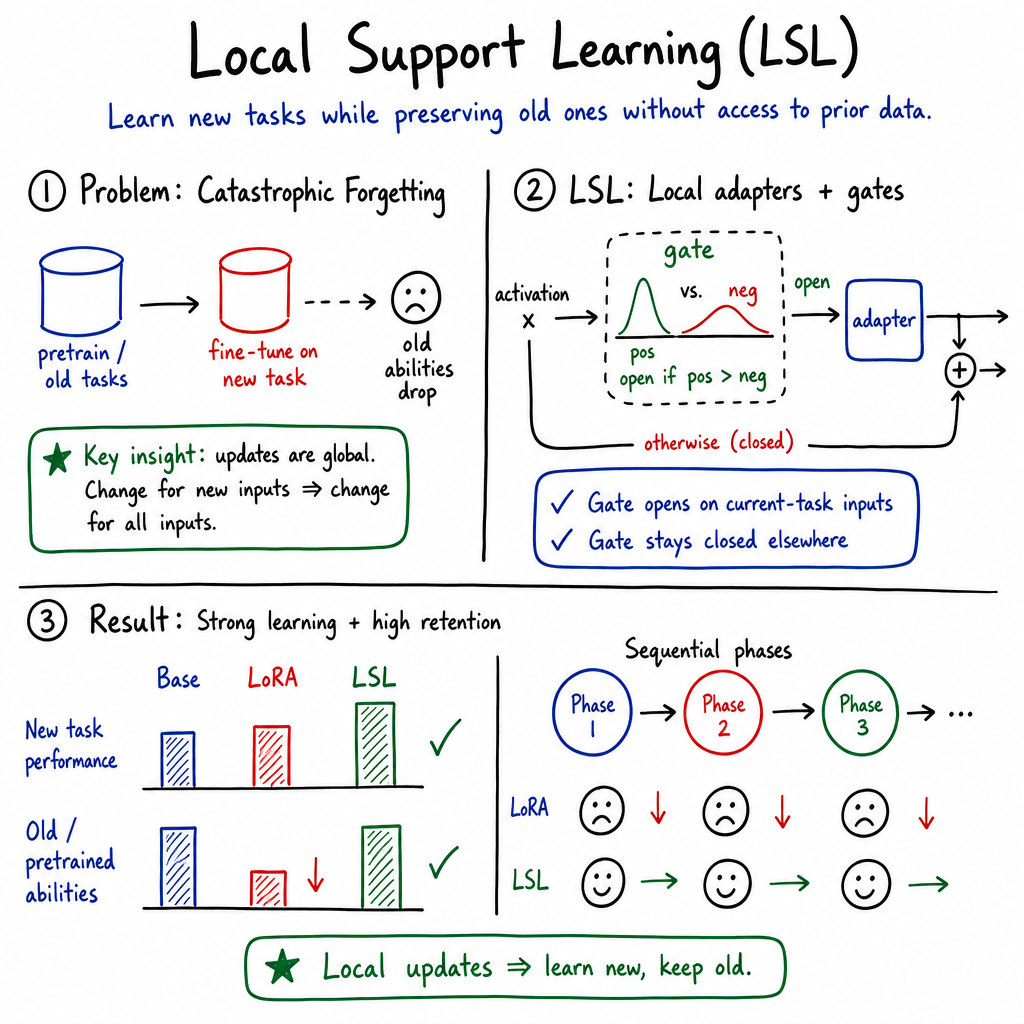
Abstract: We explore catastrophic forgetting in the context of large pre-trained models. By considering forgetting as a geometric problem in the input space of each weight matrix, we uncover a natural retention objective under which updates produced by gradient-based optimizers are suboptimal. Following this observation, we propose Local Support Learning (LSL), a general-purpose framework that augments gradient-based training for retention of prior capabilities without access to prior data. During a new learning phase, LSL pairs two components with distinct roles: a standard weight adapter, trained as usual to minimize the loss, and a gating function that enables the adapter only on input activations from its own training distribution, making the update local to that distribution. The key challenge is that this gate must route data from all learning phases while training only on data from the current one. We address this with a gate based on a Gaussian Mixture Model (GMM), whose likelihood decays rapidly away from its training data, giving it a natural tendency to stay closed on data from prior phases. We show that this post-training approach can resolve forgetting in LLMs of up to 7 billion parameters, retaining both pretrained and finetuned capabilities across multiple training phases, while being efficient in memory and compute, robust to hyperparameter choice, and showing scaling potential.
Paper Prompts
Sign up for free to create and run prompts on this paper.
Top Community Prompts
Explain it Like I'm 14
1. What is this paper about?
This paper studies a problem called catastrophic forgetting in LLMs.
A LLM is usually trained in stages:
- It first learns many general skills from a huge dataset. This is called pretraining.
- It is then trained on smaller, special datasets, such as chemistry, cybersecurity, or translation. This is called fine-tuning.
The problem is that learning something new can cause the model to lose skills it already had. For example, after learning chemistry, a model might become worse at mathematics or coding.
The paper introduces a method called Local Support Learning, or LSL, designed to help models learn new skills without damaging old ones.
2. What questions are the researchers asking?
The researchers focus on several main questions:
- Why does fine-tuning cause a model to forget old abilities?
- Can a model learn a new task while changing only the parts of its behavior connected to that task?
- Can this be done without keeping or revisiting the old training data?
- Does the method work for LLMs with billions of parameters?
- Can it preserve skills over several fine-tuning stages, rather than just one?
- Does it use a reasonable amount of memory and computing power?
The central idea is that an update made for a new task should affect only inputs that resemble the new task’s training examples.
3. How does the method work?
The problem with ordinary fine-tuning
During ordinary fine-tuning, a model changes its weights using an optimization method based on gradients. A weight is a number inside the model that helps it make decisions.
These changes are useful for the new task, but they can also affect many other kinds of inputs. In other words, the update is applied too broadly.
Imagine a school notebook with many subjects. You want to add notes about chemistry, but instead of writing only on the chemistry pages, you accidentally write over parts of the math and history pages too. The new information is added, but some old information is damaged.
This is similar to what can happen during standard fine-tuning.
Adapters: separate add-on modules
LSL uses a small extra component called an adapter. The adapter learns the new task while the original model remains available.
Adapters are like removable add-on notebooks: one can contain chemistry knowledge, another can contain translation knowledge, and so on.
However, adapters alone are not enough. An adapter may still change the model’s behavior on inputs that have nothing to do with the task it learned.
Gates: deciding when an adapter should be used
LSL adds a gate in front of each adapter. The gate decides whether the adapter should be active for a particular input.
The gate asks something like:
“Does this input look like the kind of data this adapter was trained on?”
- If the answer is yes, the adapter is turned on.
- If the answer is no, the adapter stays off, and the original model handles the input.
This makes the adapter’s influence local: it mostly affects the region of the model’s input space connected to its own training data.
Gaussian Mixture Models
To build the gate, the researchers use a statistical tool called a Gaussian Mixture Model, or GMM.
A GMM can be imagined as placing several soft, bell-shaped clouds around the training examples. Inputs near these clouds are considered similar to the adapter’s training data. Inputs far away are considered different.
The researchers use two GMMs:
- A positive model, trained on the current task’s data.
- A negative model, trained on a small, general reference dataset.
The gate compares the two models:
- If the input looks more like the current task, the adapter opens.
- If it looks more like general or unrelated data, the adapter remains closed.
The negative model does not need to be the model’s original pretraining data. It only needs to help show what “outside the current task” looks like.
Temporal smoothing
For language, decisions are made one token at a time. Sometimes a gate might make a mistake for a single token.
To reduce this problem, LSL uses temporal smoothing. This means it prefers to keep the gate’s decision stable across nearby tokens, rather than switching on and off constantly.
This is similar to a traffic light that avoids changing colors every second. It makes the system’s behavior steadier.
4. What experiments did the researchers perform?
The researchers tested LSL in two main ways.
First, they used a small, artificial classification problem to show how forgetting happens. They compared:
- Normal fine-tuning
- Fine-tuning with LSL
Second, they tested LLMs, including a model with up to 7 billion parameters. They fine-tuned the model on several tasks:
- English-to-Igbo translation
- Cybersecurity instructions
- Chemistry questions
They then tested whether the model still performed well on older abilities:
- Math reasoning, using GSM8K
- Code generation, using HumanEval
- Instruction following, using IFEval
They compared LSL with other approaches, including:
- LoRA, a popular adapter method
- OP-LoRA, another method that tries to reduce harmful updates
- Learning without Forgetting, which tries to keep the model’s outputs similar to the original model
They also tested the model through multiple training phases, one after another.
5. What did the researchers find?
LSL preserved old skills much better
LSL learned the new tasks successfully while keeping most of the model’s previous abilities.
By comparison, ordinary adapter methods such as LoRA often caused noticeable forgetting. The model could improve at the new task, but its performance on math, coding, or instruction following fell.
The paper reports that LSL retained about 96.6% of the original performance in one major experiment. With temporal smoothing, retention increased to about 98.8%.
It worked across several training phases
When the model learned translation, then chemistry, and then cybersecurity, ordinary methods caused earlier abilities to decline.
With LSL:
- Pretrained abilities stayed strong.
- Translation ability remained after later training.
- Chemistry ability remained after the cybersecurity phase.
- New skills did not overwrite old ones as severely.
This is important because real AI systems may be updated many times during their lives.
It allowed strong learning and strong retention at the same time
Usually, researchers face a trade-off:
- Stronger training on a new task can cause more forgetting.
- Protecting old knowledge too much can make the model learn the new task poorly.
LSL reduced this trade-off. The model could learn the new task at high ability while still protecting older abilities.
It worked at different model sizes
The method was tested on models ranging from 1.5 billion to 7 billion parameters. LSL worked at all tested sizes, and its retention generally improved as the model became larger.
It used relatively little extra memory
The GMM gates added only about 13.8 MB of memory in one test. This is very small compared with the model itself, which used roughly 14 GB of memory.
Training the gates made training about 1.64 times longer in the reported test, but the extra cost was still considered practical. The adapters also added some time during use because the model must decide which adapters to activate.
The gates were more useful than a simple classifier
The researchers compared the GMM gate with a normal neural-network classifier.
The ordinary classifier performed reasonably well on familiar data, but it often stayed open for unfamiliar data. That caused more forgetting.
The GMM gate was better at recognizing when data was outside the adapter’s training distribution and therefore keeping the adapter closed.
6. Why are these findings important?
The main lesson is that where an update is used matters as much as what the update learns.
Normal fine-tuning spreads a change across many types of inputs. LSL tries to keep the change in the small region where it is needed.
This could help create AI systems that can:
- Learn new subjects without losing general knowledge
- Be updated repeatedly over time
- Add separate abilities for different users or tasks
- Avoid storing huge amounts of old training data
- Preserve important skills such as mathematics, coding, and following instructions
For example, a company might teach a LLM about medicine without damaging its general reasoning abilities. Later, it could add legal or engineering knowledge while keeping the earlier skills.
7. Limitations and possible future impact
The paper is promising, but LSL is not perfect.
Each training phase adds another adapter and gate. As the number of phases grows, the model may need more computation during use. The adapters also cannot simply be merged into the original model weights.
The method depends on the model’s internal representations being organized well enough for a GMM to recognize different kinds of data. The authors also provide a formal analysis mainly for a single weight matrix, while real LLMs contain many layers and matrices.
Finally, the results come from experiments on particular models and tasks. More testing is needed on larger models, other types of data such as images and speech, and very long sequences of updates.
Overall, the research suggests a useful new way to think about continual learning:
Instead of trying to remember every old example, let each new update affect only the inputs it was meant to handle.
If this approach continues to work at larger scales, it could make AI systems safer and more practical to update without repeatedly destroying what they already know.
Knowledge Gaps
The paper leaves the following knowledge gaps, limitations, and open questions unresolved:
- Limited scale validation: LSL is evaluated only on models up to 7B parameters; its memory, latency, and retention behavior at substantially larger model sizes remain unknown.
- Limited model diversity: Experiments focus primarily on Qwen2.5-Instruct models, leaving unclear whether LSL generalizes across architectures, tokenizers, pretrained objectives, and models with weaker or differently structured representations.
- Unexplored modalities: The method is not evaluated for vision, speech, multimodal, or non-autoregressive models, despite the framework being presented as general-purpose.
- Unclear dependence on representation quality: The paper observes that larger models achieve better retention, but does not quantify which properties of the learned representations determine successful GMM-based gating or establish failure criteria for weak representations.
- No formal multilayer guarantee: The theoretical analysis applies to a single weight matrix; there is no formal characterization of how errors and interactions across gates and layers affect the function of the complete network.
- Unproven optimality of GMM gates: The density-estimation argument motivates local gates under explicit assumptions, but the paper does not establish that the proposed two-GMM likelihood comparison is optimal for realistic high-dimensional neural activation distributions.
- High-dimensional density-estimation risks: The robustness of GMM fitting under highly anisotropic, multimodal, sparse, or non-Gaussian activation distributions is not systematically studied.
- Reference-data dependence: Although the negative GMM uses a small generic pretraining sample, the required sample size, domain coverage, selection strategy, and sensitivity to the reference dataset remain insufficiently characterized.
- Potential information leakage from reference data: The method assumes access to generic pretraining-like data, but the privacy, licensing, availability, and deployment implications of obtaining such data are not examined.
- Threshold and calibration sensitivity: The paper replaces a manually tuned density threshold with positive-versus-negative likelihood comparison, but does not fully analyze sensitivity to covariance estimation, mixture initialization, numerical regularization, or calibration choices.
- Distribution-overlap failure modes: It remains unclear how LSL behaves when a new task substantially overlaps with prior-task activation regions, when a new task is a small subset of a prior distribution, or when old and new tasks require modifying the same internal features.
- Trade-off between retention and useful generalization: Restricting updates to the current support may prevent beneficial transfer to related but unseen inputs; this possibility is not measured.
- Gate error characterization: The paper reports aggregate gate behavior, but does not provide a systematic analysis of false positives, false negatives, and their respective effects on task learning, retention, and generation quality across layers.
- Adversarial and distribution-shift robustness: The gates are not tested against adversarial inputs, prompt manipulation, covariate shifts, synthetic mixtures of tasks, or inputs specifically designed to trigger an old adapter.
- Temporal smoothing assumptions: Exponential smoothing assumes that task identity is temporally coherent; performance under rapidly interleaved tasks, code-switching, dialogue context changes, shuffled tokens, or streaming data with frequent task transitions remains unknown.
- Phase-boundary detection: LSL assumes that training proceeds in identifiable phases, but the paper does not address how gates should be trained when task boundaries are unknown, gradual, or continuously changing.
- Long-horizon phase scaling: The experiments cover only a small number of phases. The claimed applicability to hundreds of phases is not demonstrated, particularly with respect to accumulated latency, memory, gate interference, and routing errors.
- Inference-cost growth: Adapter computation grows linearly with the number of phases, but the paper does not establish practical latency or energy limits, nor does it propose a principled phase-pruning, compression, or distillation strategy.
- No adapter merging solution: LSL adapters cannot be merged into the base weights without losing locality; whether approximate merging, compilation, quantization, or conditional weight fusion can preserve retention remains open.
- Training-cost scalability: GMM fitting increases training time by a reported factor of 1.64 on one hardware configuration, but scaling of fitting cost with model width, sequence length, number of layers, mixture components, and phase count is not evaluated.
- Interaction with full fine-tuning: The experiments primarily use adapters. It remains unclear whether LSL can support full-model updates, partially frozen models, or other adaptation mechanisms without excessive gate or optimization costs.
- Interaction with reinforcement learning: The method is not evaluated with RLHF, RLAIF, policy optimization, preference optimization, or other objectives whose data distributions and token-level credit assignment differ from supervised finetuning.
- Continual learning under online feedback: The paper assumes IID access within each phase, but does not study non-IID streams, feedback loops, class imbalance, evolving labels, or online data arriving one example at a time.
- Retention evaluation coverage: Retention is assessed using GSM8K, HumanEval, and IFEval, which may not capture factual knowledge, multilingual ability, safety behavior, calibration, robustness, long-context reasoning, or less visible pretrained capabilities.
- Dependence on benchmark choice: The reported near-perfect retention may not extend to capabilities whose activation distributions overlap strongly with the finetuning tasks; broader capability suites and behavioral evaluations are needed.
- Limited baseline comparison: The study omits several replay-based, rehearsal-free, functional-regularization, routing, and continual-learning methods, making it difficult to determine the conditions under which LSL is superior.
- No comparison with replay under matched memory budgets: Since replay methods are excluded primarily for scalability reasons, the paper does not establish how LSL compares with small, compressed, synthetic, or selectively curated replay buffers under equal memory constraints.
- Joint-task phase design: The paper notes that multiple tasks can be learned jointly within one phase, but does not quantify how phase granularity affects retention, transfer, adapter capacity, or total inference cost.
- Capacity allocation across phases: There is no principled method for selecting adapter rank, mixture complexity, or parameter allocation per phase based on task difficulty or expected interference.
- Catastrophic forgetting of the adapters themselves: Although prior task performance is measured, the study does not analyze whether later phases alter, misroute, or indirectly degrade earlier adapters and gates.
- Error accumulation across sequential phases: The effect of repeatedly training with previously mounted adapters active is not formally analyzed, including whether small routing errors compound over many phases.
- Security and isolation risks: The possibility that malicious or unusual inputs could activate multiple adapters, bypass intended task isolation, or induce undesirable behavior is not investigated.
- Reproducibility of GMM fitting at scale: The sensitivity of results to EM initialization, random seeds, covariance constraints, numerical precision, and implementation details is not fully reported.
- Evaluation of calibration and uncertainty: The likelihood scores are used as routing decisions, but the paper does not evaluate whether they provide calibrated confidence or whether uncertainty-aware routing could improve safety and retention.
- Lack of deployment studies: Real-world effects such as batching, variable-length requests, concurrent users, cache reuse, quantized inference, hardware specialization, and serving throughput are not evaluated.
- Knowledge integration versus isolation: LSL is designed primarily to prevent interference, but the paper does not determine when localized updates should be deliberately shared across phases to enable transfer and coherent knowledge integration.
Practical Applications
Immediate Applications
The paper’s results suggest that Local Support Learning (LSL) can be integrated into existing adapter-based fine-tuning workflows, particularly for models up to the tested scale of 7 billion parameters. The following applications appear deployable with current tooling, subject to validation on the target model and data.
- Continual domain adaptation of LLMs — Industry / Software
- Organizations can fine-tune a foundation model sequentially for domains such as cybersecurity, chemistry, legal assistance, customer support, or technical documentation without substantially degrading general capabilities.
- A practical workflow would maintain the pretrained model, train a LoRA-like adapter for each new domain, fit a per-layer GMM gate on the domain’s activation distribution, and activate the adapter only when the input resembles that domain.
- This could produce model packages containing a shared base model plus independently managed domain adapters rather than repeatedly creating fully fine-tuned model copies.
- Dependencies: The base model must provide sufficiently separable representations, and each phase must have enough representative data for reliable GMM estimation. Gate errors could route an input to the wrong adapter or leave a relevant adapter inactive.
- Sequential enterprise model customization — Industry / Enterprise AI
- A company could first adapt a model for internal documentation, then add separate adapters for finance, human resources, engineering, and security procedures while preserving earlier capabilities.
- LSL’s phase-specific routing could support controlled deployment in which each adapter is activated only for relevant requests.
- This may simplify governance because an adapter can be audited, updated, rolled back, or removed independently of the base model.
- Dependencies: Domain boundaries need to be sufficiently distinguishable in activation space. Ambiguous or multi-domain queries may require simultaneous adapter activation or an additional policy layer.
- Low-resource and multilingual language support — Translation / Public-sector technology
- LSL can be used to add a low-resource translation capability, such as English-to-Igbo translation, without sacrificing the model’s general instruction-following, coding, or reasoning performance.
- This is relevant to national-language services, educational translation tools, public-information systems, and localization platforms where new language data becomes available incrementally.
- Dependencies: Translation quality still depends on the size and quality of the low-resource corpus. Retention of the base model does not guarantee fairness, linguistic accuracy, or cultural appropriateness.
- Specialized coding and cybersecurity assistants — Software / Cybersecurity
- Organizations can add specialized adapters for secure-code generation, vulnerability analysis, incident-response procedures, or internal programming frameworks.
- Separate adapters could be trained for different programming languages, cloud platforms, or security standards while preserving general coding ability.
- This could support a workflow in which the system routes security-related inputs to a cybersecurity adapter and ordinary programming queries to the base model or another adapter.
- Dependencies: Security-critical deployment requires evaluation against adversarial prompts, distribution shifts, data leakage, and unsafe recommendations. GMM-based routing should not be treated as a security boundary by itself.
- Chemistry and scientific-assistance models — Healthcare / Research / Chemical industry
- A general LLM can be adapted to chemistry instructions, molecular notation such as SMILES, laboratory documentation, or scientific literature while retaining general-purpose behavior.
- Separate adapters could support chemistry, materials science, biology, or medical terminology without overwriting the shared model.
- Potential products include laboratory copilots, scientific search interfaces, experiment-documentation assistants, and domain-specific educational tools.
- Dependencies: The reported evidence concerns chemistry instruction tuning rather than validated scientific discovery or clinical decision-making. Outputs require expert review, and domain-specific hallucinations remain possible.
- Model customization without replaying private or unavailable pretraining data — Privacy / Enterprise infrastructure
- LSL can provide a retention-oriented alternative when the original pretraining corpus is inaccessible, proprietary, or too large to replay.
- This is useful for organizations adapting third-party foundation models using only new proprietary data, since the method does not require storing a large replay buffer of old examples.
- A small generic reference dataset can be used to fit the negative GMM, reducing storage relative to example-based continual-learning methods.
- Dependencies: The reference dataset is only an approximation of the broad prior distribution. It may not protect against all types of interference, especially for unusual or poorly represented prior capabilities.
- Adapter-based model lifecycle management — MLOps / Cloud software
- Existing LoRA deployment systems could be extended with LSL metadata: adapter weights, per-matrix GMM parameters, shared negative GMM parameters, and optional temporal-smoothing state.
- This enables domain adapters to be versioned, tested independently, deployed selectively, and disabled without retraining the base model.
- The reported memory overhead—approximately 13.8 MB for the GMMs in one 7B-model experiment—and parallelizable inference make prototype integration practical.
- Dependencies: Inference cost increases with the number of stored phases. Production systems would need optimized kernels, adapter caching, routing observability, and safeguards against excessive adapter accumulation.
- Safer post-training of instruction-following assistants — Consumer software / Education
- Developers can add new behavioral or instructional capabilities while reducing degradation in mathematics, coding, and general instruction following.
- Educational assistants, writing tools, and customer-service systems could receive periodic updates through new adapters instead of replacing or globally modifying the main model.
- Temporal smoothing may be useful in conversational systems because it reduces token-level routing instability.
- Dependencies: Conversation context may contain multiple domains, and token-level routing may not always correspond to the user’s intended task. Human evaluation is needed for consistency, refusal behavior, and unintended behavioral changes.
- Academic continual-learning research platform — Academia
- LSL provides a reproducible baseline for studying catastrophic forgetting under realistic large-model constraints: streaming phases, bounded memory, no access to the original pretraining corpus, and multiple sequential tasks.
- Researchers can compare alternative local gates, density estimators, routing strategies, adapter architectures, and calibration methods using the paper’s reported benchmarks and code.
- The method also offers a practical experimental instrument for measuring how changes in activation-space locality affect functional retention.
- Dependencies: The paper’s formal analysis focuses primarily on individual weight matrices, while the full-network behavior is supported mainly empirically. Independent replication across architectures and modalities is required.
- Policy and governance evaluation of model updates — Public policy / AI assurance
- Regulators and internal governance teams can require pre- and post-update testing of both new-task performance and retention of previously certified capabilities.
- LSL’s adapter-and-gate structure supports change logs that identify which phase-specific component is responsible for a behavioral update.
- This could improve rollback procedures and make incremental model updates easier to audit than repeated full-model fine-tuning.
- Dependencies: Retention benchmarks must be defined for the deployment context. Preserving benchmark performance does not establish safety, legal compliance, absence of bias, or preservation of all real-world behaviors.
Long-Term Applications
The following applications depend on larger-scale validation, improvements to routing and efficiency, or extension beyond the settings directly evaluated in the paper.
- Hundreds of sequential learning phases and long-lived personal assistants — Consumer AI / Enterprise AI
- A model could accumulate separate adapters for a user’s changing projects, interests, languages, tools, and workflows without repeatedly overwriting earlier capabilities.
- This could enable a personal assistant that learns new preferences and task skills over months or years while retaining prior skills.
- Dependencies: Inference overhead grows approximately with the number of phases, and adapter storage and routing complexity may become significant. Research is needed on adapter consolidation, pruning, hierarchical routing, and conflict resolution.
- Test-time training and continuously updating agents — Robotics / Software agents
- LSL could make test-time or online adaptation more predictable by restricting updates to the activation regions associated with newly observed data.
- Agents operating in changing environments could learn local procedures, tool APIs, or user preferences while reducing the risk of damaging general competence.
- Dependencies: Online data may be noisy, adversarial, nonstationary, or insufficient to fit stable density models. Reliable confidence estimation, safety constraints, rollback mechanisms, and rapid adaptation algorithms are necessary.
- Multimodal continual learning — Vision, speech, robotics
- The local-support principle could be applied to vision, speech, audio-language, or embodied models, for example by learning adapters for new visual domains, accents, sensors, environments, or robot platforms.
- Potential systems include robots that learn new workplaces, speech assistants that adapt to new accents, and vision systems that add manufacturing or medical domains without erasing prior recognition abilities.
- Dependencies: Activation distributions in high-dimensional multimodal networks may not be well modeled by simple GMMs. Modality-specific density estimators, temporal models, and robust OOD detection would likely be required.
- Continual reinforcement learning without destructive policy updates — Robotics / Games / Operations
- LSL could be adapted to reinforcement-learning objectives so that policies learn new environments or tasks while retaining earlier policies.
- A robot might acquire new manipulation skills without losing previously learned behaviors, or an operations agent could adapt to new demand patterns without discarding prior strategies.
- Dependencies: Reinforcement-learning data is correlated and non-IID, unlike the paper’s stated phase assumptions. Exploration, safety constraints, delayed rewards, and distribution shift create additional routing and stability challenges.
- Energy-efficient foundation-model maintenance — Cloud computing / Energy
- If adapters preserve existing capabilities, organizations may avoid repeated full-model retraining and reduce memory, data-replay, and compute requirements for model updates.
- Shared base weights with lightweight phase-specific adapters could lower the energy and hardware cost of maintaining multiple specialized models.
- Dependencies: The claimed efficiency benefits depend on the number of phases, inference frequency, and hardware optimization. Many active adapters may eliminate the advantage unless routing and parallel execution are highly optimized.
- Modular expert systems with learned activation-space routing — Software / AI infrastructure
- LSL could evolve into a modular architecture where each adapter represents a domain, skill, policy, or organization-specific capability and local gates act as per-layer expert routers.
- Unlike a single front-end router, the paper’s per-matrix routing could use progressively richer contextual representations at different network depths.
- Dependencies: The system needs mechanisms for composing multiple adapters, resolving contradictory updates, calibrating gate confidence, and preventing harmful combinations of experts. The paper shows that a single router can underperform per-matrix routing, so scalable multi-router infrastructure is needed.
- Continual learning in healthcare and regulated domains — Healthcare / Finance / Legal services
- Domain adapters could enable controlled updates for new medical guidelines, financial regulations, legal procedures, or institutional protocols while preserving earlier capabilities.
- A regulated organization could evaluate a new adapter independently, deploy it to a limited population, and roll it back without replacing the entire model.
- Dependencies: These domains require rigorous validation, traceability, privacy protections, bias assessment, and human oversight. LSL reduces one form of forgetting but does not solve factual reliability, accountability, or regulatory certification.
- Model editing and knowledge retention from incremental sources — Knowledge systems / Enterprise search
- New facts, policies, or procedures could be stored in localized adapters rather than globally modifying the model.
- This may support institution-specific knowledge updates while reducing unintended changes to general knowledge and prior behaviors.
- Dependencies: The paper studies task and domain adaptation rather than precise factual editing. Future work must test whether LSL can reliably encode isolated facts, resolve contradictions, and remove outdated or sensitive information.
- Formal guarantees for whole-network retention — Academia / AI safety
- The paper’s geometric analysis could motivate formal retention guarantees for multilayer networks, such as bounds on functional change outside the current activation support.
- Such results could support certified update procedures in safety-critical or regulated applications.
- Dependencies: Extending the single-matrix analysis to nonlinear, multilayer models is nontrivial. It would require assumptions about activation distributions, layer interactions, gate calibration, and the relationship between local parameter updates and end-to-end behavior.
- Alternative local-support estimators beyond GMMs — Machine learning research
- Future systems could replace GMMs with normalizing flows, kernel density estimators, energy-based models, compact support estimators, learned geometric regions, or conformal predictors.
- The paper’s ablation results suggest that locality—not necessarily the GMM architecture itself—is the central design principle.
- Dependencies: Any replacement must remain closed on prior or OOD inputs despite being trained only on current-phase data, use bounded memory, and avoid excessive computation during inference. Calibration under high-dimensional distribution shift is a central unresolved issue.
- Daily-life adaptive assistants with persistent but compartmentalized learning — Consumer technology
- In the longer term, phones, home assistants, and productivity software could learn new routines, applications, and user preferences while maintaining older capabilities.
- Local adapters could separate work, education, travel, household, and accessibility-related behaviors, potentially allowing users to inspect or delete individual learned components.
- Dependencies: Personal data protection, user control, consent, secure storage, and robust handling of mixed-context requests are essential. The method would need strong defenses against malicious data designed to trigger or poison a particular gate.
Glossary
- Adapter rank: The dimensionality or effective size of a parameter-efficient weight adapter. “we sweep the learning rate, adapter rank, and batch size”
- Adversarial pretraining sample: A deliberately challenging or strategically located training example intended to expose weaknesses in a learning method. “adversarial pretraining samples could exist at any region outside the current data’s support”
- Catastrophic forgetting: The loss of previously learned capabilities after a model is trained on new data. “a phenomenon known as catastrophic forgetting”
- Continual learning: A learning setting in which a model processes multiple data phases sequentially while retaining earlier knowledge. “continual learning admits the trivial solution of storing all previously seen data in a replay buffer”
- Contextual feature: A representation whose meaning depends on surrounding input or processing depth. “Per-matrix gates instead decide from contextual features at every depth”
- Covariance matrix: A matrix describing the variances and pairwise correlations among dimensions of a multivariate distribution. “each gaussian N has mean μk, covariance matrix Σk, and mixing weight πk”
- Decision boundary: A surface separating regions assigned to different classes or predictions. “the decision boundaries from the first phase are heavily deformed”
- Density estimator: A statistical model that approximates the probability distribution of observed data. “a density estimator can recover an optimal gate”
- Domain specialization: Adaptation of a general model to a particular subject area or application domain. “domain specialization”
- Exponential moving average: A recursively computed weighted average that gives greater influence to recent values. “We address this with a simple exponential moving average that smooths decisions over time”
- Expectation-Maximization (EM): An iterative procedure for estimating parameters in probabilistic models with latent variables. “The GMM is fit via the Expectation-Maximization (EM) algorithm.”
- Fine-tuning: Additional training of a pretrained model on data for a particular task or domain. “We continually train the model on two other classes.”
- Gradient interference: Harmful interaction between parameter updates associated with different tasks or data distributions. “the analysis of gradient interference”
- Gradient-based optimizer: An optimization algorithm that updates parameters using derivatives of a loss function. “updates produced by gradient-based optimizers often act outside this support”
- Gaussian Mixture Model (GMM): A probabilistic model representing a distribution as a weighted combination of Gaussian distributions. “We address this with a gate based on Gaussian Mixture Models (GMMs).”
- Gating function: A function that determines whether a model component or parameter update is activated for a given input. “a gating function that estimates the support of the current data in the adapter’s input space”
- Global-support update: A parameter update that affects the model’s mapping for inputs throughout the entire input space. “Global-Support Updates Cause Forgetting.”
- Hypothesis class: The set of functions or models considered possible by a learning procedure. “other factors such as the hypothesis class can control it under explicit conditions”
- Inductive bias: A built-in modeling preference that guides generalization beyond the observed training data. “providing the gate an inductive bias to stay closed on inputs it has never seen”
- Inference latency: The time required for a model to produce an output from an input. “A LSL adapter adds only 86ms of inference latency per forward pass”
- In-context learning: The ability of a model to perform a task based on examples or instructions supplied within the input context. “enabling in-context learning in language”
- Input activation: The numerical representation produced when an input is processed by a neural-network layer. “the gate applies the adapter only to tokens whose activations fall within that support”
- Input-output mapping: The function implemented by a model component that transforms inputs into outputs. “we can analyze the effect of an update on the full input-output mapping of the matrix”
- Interference: An unwanted alteration of knowledge or behavior caused by learning another task or phase. “resulting with a perfect classifier”
- Latent variable: An unobserved variable inferred indirectly from observed data; in mixture models, it may indicate component membership. “The GMM is fit via the Expectation-Maximization (EM) algorithm.”
- Likelihood: The degree to which a statistical model considers an observation probable under its parameters. “each input x is classified according to the GMM that gives it a larger likelihood”
- Logit: An unnormalized score produced by a classifier before conversion into probabilities. “The change in logits for each sample is”
- Low-Rank Adapter (LoRA): A parameter-efficient fine-tuning module that represents weight updates using low-rank matrices. “Low-Rank Adapters (LoRA) (Hu et al., 2021) accumulate updates in a small subspace”
- Memory footprint: The amount of memory required to store and operate a model or method. “In practice, a small per-phase memory footprint is what would allow scaling to many phases.”
- Mixture weight: A coefficient specifying the contribution of one component distribution in a mixture model. “each gaussian N has mean μk, covariance matrix Σk, and mixing weight πk”
- Multilingual adaptation: Modification of a model so that it performs effectively across multiple languages. “multilingual adaptation”
- Orthogonal complement: The set of vectors orthogonal to every vector in a specified subspace. “restricting new updates to its orthogonal complement”
- Out-of-distribution (OOD): Describing data whose distribution differs from that of the data used for training. “it must stay closed when encountering out-of-distribution (OOD) data”
- Parametric gate: A gating mechanism represented by a fixed set of learned parameters rather than an explicit list of stored examples. “we propose a much more efficient parametric gate”
- Post-training: Training performed after pretraining to adapt a model to tasks, behaviors, or domains. “Development typically proceeds in phases: large-scale pretraining, followed by post-training”
- Replay buffer: Stored examples from earlier training phases that are revisited during later training. “a replay buffer representative of pretraining is infeasible to curate”
- Retention objective: A training objective designed to preserve previously learned model capabilities. “this perspective yields a natural retention objective”
- Sequential task learning: Learning multiple tasks in sequence while attempting to preserve performance on earlier tasks. “has been studied as a sequential task learning problem”
- Singular vector: A direction associated with the singular-value decomposition of a matrix. “Other works constrain updates to subspaces orthogonal to the top-k singular vectors”
- Support: The region of an input space where a probability distribution has non-negligible density. “the support of the current phase’s distribution”
- Temporal smoothing: The process of stabilizing time-varying decisions by incorporating information from preceding time steps. “Temporal Smoothing”
- Token routing: The process of directing individual input tokens to selected model components based on their representations. “The routing decision of adapter i is based on the smoothed value.”
- Weight space: The mathematical space whose coordinates represent the parameters of a model. “A common approach restricts change in weight space”
- Zero-shot performance: Performance on a task without task-specific training examples or adaptation. “the zero-shot performance on task 3 (cybersecurity) falls by 11%”

