What math means to me
Abstract: This is a personal essay about how I see math, what I value about it, and what it means to me.
Paper Prompts
Sign up for free to create and run prompts on this paper.
Top Community Prompts
Explain it Like I'm 14
1. Main topic
This paper is a personal essay by mathematician Larry Guth about what mathematics means to him. It is not a report of one experiment or a single mathematical discovery. Instead, Guth explains why he enjoys mathematics, how mathematicians think, and what values guide their work.
He focuses on several ideas:
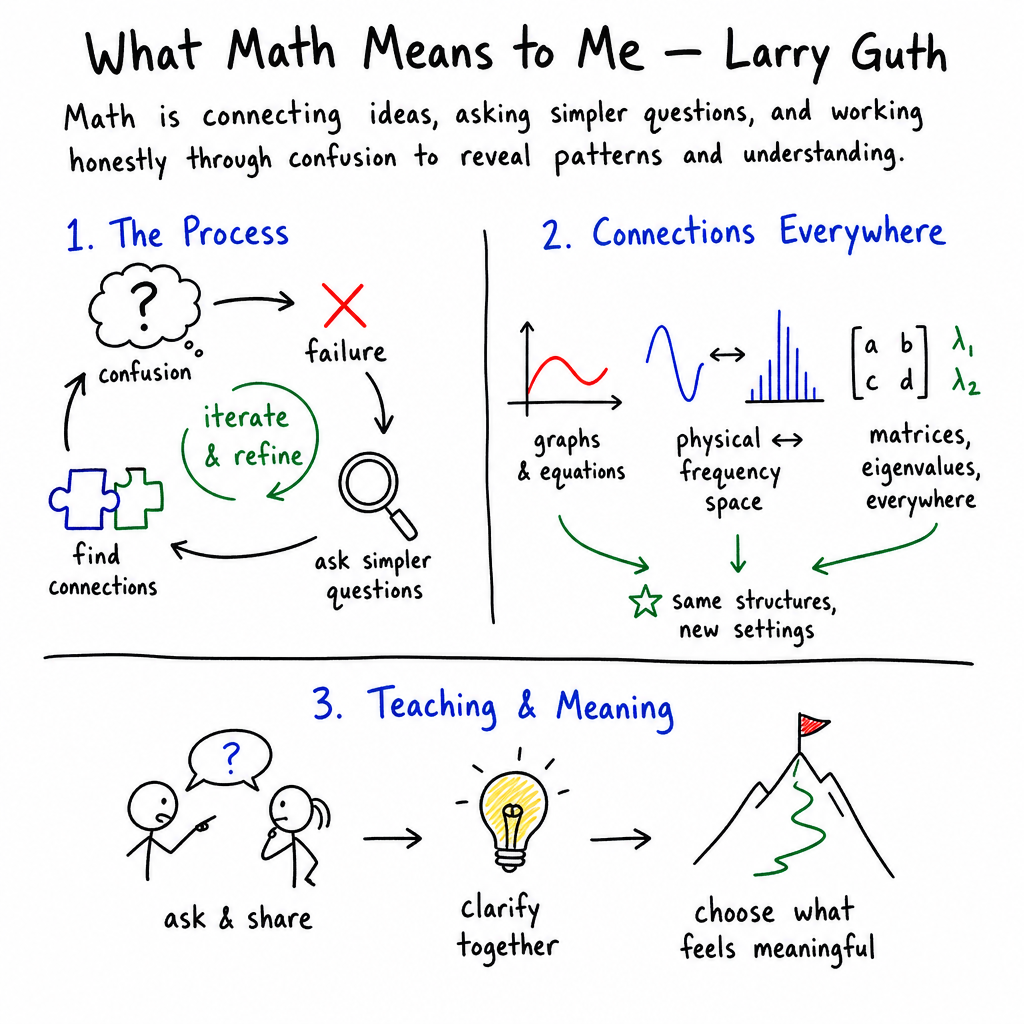
- Mathematics helps different ideas fit together.
- Confusion and mistakes are normal parts of learning.
- Good questions are often more important than quick answers.
- Mathematics can help us understand the natural world.
- Teaching and learning mathematics are shared activities.
- Mathematicians must choose meaningful problems to study.
2. Main questions and objectives
The essay explores questions such as:
- Why does mathematics feel connected, even when its subjects seem very different?
- Why are confusion, failure, and being wrong useful?
- How do mathematicians find good questions?
- How can mathematics help us understand science and nature?
- What makes a mathematical problem worth studying?
- How should teachers and students work together?
- How can people choose what they want to investigate?
Guth is not trying to prove one specific theorem. His goal is to describe the experience and values of doing mathematics.
3. How the author develops his ideas
Personal examples
The author mainly uses memories and examples from his own life. For example, he describes watching his son learn to count. A child may be able to say numbers in order but still not understand that five people need five spoons. Learning to count requires several ideas to come together:
- the people,
- the spoons,
- the number words,
- and the idea that each person should receive one spoon.
Guth uses this example to show that even basic mathematics is a deep learning process.
Examples from mathematics
He also explains connections between different areas of mathematics. For example:
- Equations can describe lines and circles.
- Calculus connects formulas with slopes and areas.
- Fourier analysis looks at the same object in two ways, such as a wave’s shape and its different frequencies.
- Ideas from pure mathematics can also appear in physics, engineering, computer science, and biology.
A useful analogy is looking at a city using different maps. One map might show roads, another might show subway lines, and another might show population. Each map gives different information about the same city. Similarly, different mathematical viewpoints can make different features easier to understand.
Reflective discussion
The paper also describes the author’s feelings while doing research. He compares research to a roller coaster or to the cartoon character Wiley E. Coyote: a mathematician may develop an exciting plan, only to discover that it fails.
Rather than hiding these failures, Guth treats them as an important part of the method. Mathematicians:
- Ask a question.
- Try an idea.
- Check whether the idea really works.
- Find mistakes or weaknesses.
- Change the idea or ask a simpler question.
- Try again.
This is similar to testing a design or solving a mystery: each failed attempt gives information about what does not work.
Technical examples in simple terms
The essay mentions several advanced topics:
- Fourier analysis: a way to study complicated patterns, especially waves, by breaking them into simpler repeating patterns.
- The Kakeya problem: a geometry problem about how many long, thin shapes can overlap while pointing in many directions.
- Restriction problems: questions about how waves combine and form patterns.
- Combinatorics: the study of arrangements and patterns, such as networks.
- Bipartite graphs: networks with two groups of points, where connections only go between the groups.
- Finite fields: special number systems with a limited number of values, useful for building carefully organized mathematical examples.
These examples are not presented as experiments performed for this essay. They are examples from mathematics that support Guth’s larger message: ideas from very different subjects can turn out to share the same hidden structure.
4. Main ideas and findings
Because this is an essay rather than an experimental research paper, it does not have results in the usual sense. Instead, Guth presents several conclusions based on his experience.
Mathematics is about connections
Guth believes mathematics is not divided into completely separate subjects. Counting, geometry, calculus, waves, prime numbers, computer algorithms, and scientific problems can all be connected.
These connections are important because a difficult problem may become easier when viewed from another direction.
Being confused and wrong is useful
Mathematical research often involves failed ideas, doubt, and frustration. Guth argues that this is not a sign that someone is bad at mathematics. It is part of the process.
Being wrong can teach people to:
- check their beliefs carefully,
- separate facts from wishes,
- admit mistakes honestly,
- and improve their ideas.
This is valuable beyond mathematics. It can help people become better writers, scientists, students, and decision-makers.
Good questions lead to progress
When a problem is too difficult, mathematicians can ask a simpler question underneath it. This is like taking a huge puzzle and first studying one small piece.
For example, Guth explains that the Kakeya problem helped mathematicians think about a much harder problem involving waves. The two problems did not look similar at first, but the simpler one revealed an important idea.
Mathematics helps us understand the world
Mathematics is useful in science because it describes patterns and structures. The essay gives examples involving:
- quantum mechanics,
- waves,
- crystals,
- DNA,
- number theory,
- and fast computer algorithms.
Sometimes a mathematical idea created for one reason later becomes useful in a completely different subject. This happens because the same basic patterns may appear in many places.
Teaching is a shared process
Guth presents teaching as a conversation rather than a one-way lecture. A teacher explains an idea, and the student tries to explain it back. If the explanation is unclear, both people ask questions and try again.
In this way, teaching and research are similar: both involve making ideas clearer and finding the basic questions underneath confusion.
Choosing a problem matters
Mathematicians often have freedom to choose what they study. Guth says they should ask whether a problem feels meaningful to them. They should explore different possibilities, talk with teachers and friends, and spend time both trying things and reflecting on them.
The essay does not claim that there is one perfect subject for everyone. Instead, it encourages people to keep exploring until they find work that matters to them.
5. Why the paper is important
The paper gives a wider and more realistic picture of mathematics than the common idea that mathematics is only about getting correct answers quickly.
It shows that mathematics also involves:
- creativity,
- curiosity,
- patience,
- honesty,
- imagination,
- communication,
- and learning from mistakes.
This message may be especially important for students who think they are “not math people” because advanced mathematics feels difficult. Guth suggests that difficulty is not proof of failure. Confusion can be the beginning of understanding.
6. Possible impact and conclusion
The essay encourages readers to see mathematics as a way of exploring the world and asking meaningful questions. Its ideas could influence students, teachers, and researchers by encouraging them to:
- value questions as much as answers,
- treat mistakes as useful information,
- look for connections between subjects,
- explain ideas clearly,
- and choose problems that feel meaningful.
Overall, Guth’s main message is that mathematics is a human activity of searching, questioning, and connecting ideas. A mathematician may spend a long time confused or wrong, but through patience and careful thinking, separate pieces can eventually fit together into a clearer and more beautiful picture.
Knowledge Gaps
Knowledge gaps, limitations, and open questions
- The essay presents personal reflections rather than systematic evidence, so it does not establish whether the described experiences of confusion, failure, questioning, and connection are broadly shared across mathematicians, students, or educational settings.
- It remains unclear how learners transition from procedural skills—such as reciting numbers or applying formulas—to conceptual understanding of relationships among representations, such as objects, equations, graphs, and geometric forms.
- The essay does not identify which teaching practices most effectively help students recognize connections between mathematical representations or recover from confusion and incorrect reasoning.
- The claim that encountering mistakes in mathematics cultivates honesty, humility, and the ability to distinguish sense from nonsense is not supported by evidence, and the conditions under which failure produces learning rather than discouragement remain unexplored.
- The relationship between mathematical training and improved writing, reasoning, or judgment outside mathematics is asserted but not examined empirically.
- The essay does not explain how students can reliably distinguish a productive “simpler question” from an unproductive digression or an oversimplification that removes the essential difficulty of the original problem.
- No general method is provided for finding “halfway problems” between a current level of understanding and a difficult target problem; the discussion relies on retrospective examples such as the relationship between restriction theory and the Kakeya problem.
- The mechanisms by which apparently unrelated mathematical areas become connected are left unspecified: it is unclear whether these connections arise primarily from shared formal structures, analogies, historical developments, individual insight, or community-driven research.
- The essay does not clarify how mathematicians determine that a connection is mathematically substantive rather than merely a superficial analogy.
- The claim that mathematics helps explain strange phenomena in the natural world is illustrated through examples, but the limits, failure modes, and criteria for successful mathematical explanation are not addressed.
- The discussion of similarities between pure mathematics and applications such as quantum mechanics, X-ray diffraction, and fast Fourier transforms does not investigate how mathematical structures are transferred, adapted, or sometimes rejected in applied contexts.
- The essay does not examine whether mathematical abstraction systematically improves scientific discovery or whether the highlighted examples are exceptional cases selected retrospectively.
- The effects of teaching style, mentorship, institutional culture, and peer collaboration on students’ ability to ask questions and develop independent mathematical interests remain unresolved.
- The proposed advice for choosing research topics—finding work that feels meaningful, experimenting, reflecting, and consulting mentors—does not specify how “meaningful” should be assessed or how researchers should proceed when personal interest conflicts with feasibility, funding, career incentives, or social importance.
- The essay does not address how unequal access to mentors, research communities, time, financial security, or institutional resources affects individuals’ ability to choose what to work on.
- The emotional difficulties associated with research—self-doubt, frustration, and loss of meaning—are acknowledged, but their prevalence, causes, and effective forms of support are not investigated.
- The discussion assumes that mathematicians have substantial freedom to select research problems, leaving unexplored the constraints imposed by academic hiring, publication norms, funding systems, disciplinary fashions, and collaboration networks.
- The claim that mathematics is characterized by unusually sharp distinctions between truth and falsity does not consider areas involving conjectural evidence, probabilistic reasoning, computational experimentation, independence results, or ambiguity in definitions and modeling assumptions.
- The essay does not explore how social processes—peer review, authority, reputation, collaboration, and disciplinary consensus—influence which mathematical claims become accepted as correct or important.
- The later discussion of extremal bipartite graphs leaves open whether all near-optimal or optimal constructions possess algebraic structure, what alternative constructions might look like, and what structural classification theorems could establish.
- The relationship between algebraic constructions over finite fields and the broader population of extremal graphs is posed as an open question without identifying quantitative or qualitative criteria for comparing these families.
- The essay invokes the search for patterns as central to mathematics but does not explain how mathematicians distinguish meaningful structure from coincidental patterns in very large mathematical spaces.
- The claim that similar structures recur across mathematics, science, and engineering lacks a framework for determining when such recurrence reflects a deep universal principle rather than common notation or shared mathematical tools.
- The manuscript’s organization and scope are unresolved: the supplied text contains material after
\end{document}, repeated thematic sections, and an incomplete closing sentence, leaving unclear whether the later sections are intended to be part of the final argument. - The essay does not discuss possible negative consequences of emphasizing creativity, personal meaning, and constant questioning, such as perfectionism, indecision, excessive topic switching, or undervaluing routine technical work.
- It remains unexplored whether the values advocated in the essay—connection, humility, clarity, intellectual honesty, and openness to basic questions—are equally applicable across pure mathematics, applied mathematics, statistics, mathematics education, and computational research.
Practical Applications
Immediate Applications
The paper is primarily a reflective essay rather than an empirical or technical study. Its practical contributions therefore arise from its proposed habits of mathematical thinking—connecting representations, questioning assumptions, simplifying difficult problems, testing ideas, and making reasoning clearer—rather than from a new algorithm or experimentally validated intervention.
- Mathematics and STEM education: teach concepts through multiple representations. Educators can explicitly connect physical objects, diagrams, equations, graphs, and verbal explanations—for example, linking multiplication to equal groups, line equations to geometric shapes, and derivatives to graph slopes. This can be implemented now through lesson plans, tutoring protocols, and interactive software that requires students to move between representations. Assumption/dependency: Teachers need sufficient subject knowledge and time to diagnose which connection a student has not yet understood; merely presenting several representations will not guarantee learning.
- Formative assessment based on “simpler underlying questions.” When a student cannot solve a problem, instructors can decompose it into progressively more basic questions rather than treating the failure as a lack of ability. A tutoring workflow could ask: Which definition is unclear? Can the student solve a smaller example? Can they explain the problem in their own words? Sector: Education and educational technology. Potential tool: An intelligent tutoring system that identifies prerequisite concepts and generates simpler intermediate problems. Assumption/dependency: The system must accurately model prerequisite relationships; automated diagnosis may be unreliable for open-ended mathematical reasoning.
- Research and engineering problem-solving workshops. Universities, laboratories, and companies can train teams to reformulate difficult problems, remove arbitrary constraints, study toy cases, and search for analogies with other fields. This is directly applicable to software debugging, experimental design, optimization, and mathematical modeling. Potential workflow: Maintain a “problem ladder” containing the original problem, reduced versions, assumptions removed, known special cases, and unresolved questions. Assumption/dependency: The approach improves exploration and communication, but it does not ensure that a simpler problem will provide a route to the original one.
- More rigorous review of technical claims. The essay’s emphasis on discovering when an attractive idea is wrong can be translated into practical review procedures: state assumptions explicitly, test boundary cases, seek counterexamples, reproduce calculations, and distinguish intuition from proof or evidence. Sectors: Academic research, software engineering, finance, healthcare analytics, and policy analysis. Potential product or workflow: “Assumption and counterexample” checklists integrated into code review, research preregistration, or model-validation processes. Assumption/dependency: These practices reduce avoidable errors but cannot eliminate model misspecification, biased data, or uncertain real-world conditions.
- Collaborative explanation and documentation practices. Teams can adopt an iterative explanation process in which one person presents an idea, another restates it in their own words, and the group identifies ambiguous steps or unsupported claims. This is suitable for mathematical proofs, software architecture, scientific protocols, and policy briefs. Potential tool: Documentation templates that separate definitions, assumptions, claims, evidence, unresolved questions, and examples. Assumption/dependency: The method depends on psychological safety: participants must be able to admit confusion or error without penalty.
- Improved mentoring for graduate students and early-career researchers. Advisors can treat uncertainty about research direction as a normal part of research rather than as evidence of failure. Regular meetings can include brainstorming, small exploratory projects, reflection on motivation, and evaluation of whether a problem feels meaningful and tractable. Sector: Academia and research organizations. Potential workflow: A mentoring plan combining short experiments with periodic reflection on research goals and assumptions. Assumption/dependency: The quality of the outcome depends heavily on the mentor’s availability, judgment, and ability to support intellectual independence.
- Public communication of mathematics and science. The paper supports explaining advanced ideas through connections to familiar experiences—counting objects, interpreting graphs, or understanding waves—rather than presenting formulas in isolation. This can inform museum exhibits, public lectures, science journalism, and online educational content. Assumption/dependency: Analogies must be carefully bounded so that they clarify the structure without creating misleading equivalences.
- Personal decision-making and learning habits. Individuals can apply the paper’s methods by breaking intimidating tasks into smaller questions, checking whether a belief is actually supported, seeking counterexamples, and alternating experimentation with reflection. These habits can improve studying, planning, writing, and everyday troubleshooting. Assumption/dependency: Benefits are behavioral and gradual; the approach requires sustained practice and does not replace domain-specific expertise.
- Cross-disciplinary research discovery. Research groups can deliberately compare mathematical structures across fields—for example, examining whether ideas involving waves, frequency, matrices, or optimization have analogues in imaging, signal processing, materials science, or computing. Sectors: Scientific computing, engineering, medical imaging, and data analysis. Assumption/dependency: A formal analogy is not automatically a useful application; transfer requires checking that definitions, scales, and assumptions correspond.
Long-Term Applications
- AI systems for mathematical and scientific problem formulation. The paper’s emphasis on asking more basic questions and identifying hidden connections could guide AI assistants that do more than solve stated problems. Such systems might generate simplified instances, expose arbitrary assumptions, propose related problems, and present several equivalent representations. Potential tool: A research assistant that produces a “question tree” containing definitions, special cases, counterexamples, neighboring problems, and possible reformulations. Assumptions/dependencies: This requires reliable mathematical reasoning, accurate assessment of equivalence between problems, and safeguards against plausible but false explanations. Human verification would remain essential.
- AI-supported theorem proving and mathematical discovery. The connections discussed between Fourier analysis, geometry, PDE, number theory, and algorithms suggest systems that search across mathematical domains for shared structures. These systems could propose lemmas or analogies that human researchers then test. Sector: Formal mathematics and AI research. Assumption/dependency: The main challenge is not merely generating conjectures but evaluating novelty, relevance, correctness, and usefulness. Large formal libraries and interoperable representations would be needed.
- General-purpose scientific modeling platforms based on multiple representations. A future platform could allow researchers to move seamlessly among equations, geometric visualizations, simulations, data, and frequency-domain descriptions. This would be particularly valuable for wave physics, imaging, fluid dynamics, materials science, and signal processing. Potential products: Interactive modeling environments that automatically display how a change in an equation affects a graph, simulation, or spectral representation. Assumption/dependency: Such systems require accurate numerical solvers, domain-specific visualization, and careful treatment of approximation error and ill-posed problems.
- Cross-domain algorithms inspired by shared mathematical structure. The essay highlights how mathematical techniques such as Fourier analysis and the fast Fourier transform connect pure mathematics with engineering and computing. Longer-term research could identify additional reusable structures for compression, imaging, communications, quantum computing, or pattern recognition. Sectors: Software, telecommunications, medical imaging, robotics, and quantum information. Assumption/dependency: A mathematical similarity must yield computational or physical advantages; translating an abstract result into an efficient, robust implementation may require substantial engineering.
- Curricula centered on mathematical habits of inquiry. Education systems could redesign advanced mathematics courses around problem formulation, reduction to simpler cases, productive failure, counterexample construction, and explanation across representations. Assessment could reward the quality of questions and reasoning, not only final answers. Sector: Schools, universities, and professional training. Assumption/dependency: This would require teacher training, new assessment standards, and evidence that the approach improves learning across different ages, abilities, and educational contexts.
- Evidence-auditing systems for high-stakes decisions. The paper’s emphasis on honesty, explicit assumptions, and recognizing error could inform future systems for auditing models used in healthcare, finance, hiring, infrastructure, and public policy. These systems might automatically record assumptions, identify edge cases, compare alternative formulations, and flag unsupported extrapolations. Potential workflow: A model card or decision record containing the model’s intended use, simplified test cases, failure modes, uncertainty, and unresolved questions. Assumptions/dependencies: Effective auditing requires access to data and model internals, agreed standards for uncertainty, and governance mechanisms capable of acting on identified risks.
- Robotics and autonomous systems that reason through abstraction levels. Robots could benefit from planning systems that move between concrete sensor data, geometric representations, symbolic descriptions, and simplified subproblems. For example, a robot navigating a cluttered environment might first solve a coarse geometric planning problem before refining the path. Sector: Robotics and autonomous vehicles. Assumption/dependency: Real-time computation, reliable perception, and robust handling of uncertainty are necessary. The paper provides a conceptual strategy, not a demonstrated robotic algorithm.
- Policy design based on iterative question refinement. Policymakers could use structured inquiry to separate a broad social problem into measurable mechanisms, test simplified interventions, and examine unintended consequences. This may improve policies in education, energy, healthcare, and climate adaptation. Potential workflow: Begin with a broad policy objective, identify causal assumptions, construct smaller pilot questions, and revise the intervention based on observed failures. Assumption/dependency: Social systems are more heterogeneous and less sharply defined than mathematical systems; ethical, political, and distributional considerations cannot be reduced to formal problem-solving alone.
- Long-term research culture focused on meaningful problem selection. Universities and research organizations could develop evaluation systems that value good questions, exploratory work, negative results, cross-disciplinary connections, mentoring, and conceptual clarity alongside publications and immediate outcomes. Assumption/dependency: This would require changes to funding, promotion, and publication incentives. Without institutional reform, researchers may continue to prioritize short-term, easily measurable outputs over the reflective practices advocated in the paper.
- Tools for personal and professional reflection. Future learning and productivity platforms could help users maintain a portfolio of open questions, experiments, failed approaches, assumptions, and reflections on meaningful goals. Such tools could support students, researchers, engineers, and creative professionals. Assumption/dependency: The value of recorded reflection depends on thoughtful human engagement; automated prompts alone may produce superficial documentation rather than genuine learning.
Glossary
- Algebraic geometry: The study of geometric objects defined by algebraic equations. “Many areas of advanced mathematics are named for two things coming together: algebraic topology, differential geometry, algebraic geometry...”
- Algebraic topology: A field that uses algebraic methods to study topological spaces and their properties. “Many areas of advanced mathematics are named for two things coming together: algebraic topology, differential geometry, algebraic geometry...”
- Bipartite graph: A graph whose vertices are divided into two sets, with edges connecting vertices only across the two sets. “Suppose that is a bipartite graph with vertices on each side which does not contain any .”
- Combinatorics: The branch of mathematics concerned with discrete structures and their arrangements. “For example, here is a problem from combinatorics about bipartite graphs.”
- Complete bipartite graph: A bipartite graph containing every possible edge between its two vertex sets. “Recall that is the complete bipartite graph with vertices on the left, vertices on the right, and all the edges between them.”
- Decoupling: A technique in harmonic analysis for separating a function or estimate into contributions from different frequency regions. “I worked for a long time on an area in Fourier analysis called decoupling, which addresses questions in pure math about PDE and number theory.”
- Differential geometry: The study of geometric shapes and spaces using calculus and related analytic methods. “Many areas of advanced mathematics are named for two things coming together: algebraic topology, differential geometry, algebraic geometry...”
- Eigenvalue: A scalar associated with a linear transformation that describes how a corresponding eigenvector is scaled. “But quantum mechanics can be described mathematically. And the mathematics involved is actually similar to mathematics that was discovered earlier for very different reasons -- matrices, inner products, eigenvalues and eigenvectors, partial differential equations.”
- Eigenvector: A nonzero vector whose direction is unchanged by a linear transformation, apart from scaling. “But quantum mechanics can be described mathematically. And the mathematics involved is actually similar to mathematics that was discovered earlier for very different reasons -- matrices, inner products, eigenvalues and eigenvectors, partial differential equations.”
- Finite field: A field containing finitely many elements, with defined addition, subtraction, multiplication, and division operations. “They are constructed using algebraic equations over finite fields.”
- Fourier analysis: The study of representing functions as combinations of oscillatory components, such as sine and cosine waves. “The next branch of math I studied was Fourier analysis.”
- Fourier transform: A mathematical transformation that expresses a function in terms of its frequency components. “In another direction, I saw that the basic structure of decoupling is related to the structure of the fast Fourier transform, an important algorithm used by many scientists and engineers.”
- Frequency space: A representation of a function in terms of the frequencies of its oscillatory components. “In Fourier analysis, we learn that any function can be represented in two different ways, which are called the physical space representation and the frequency space representation.”
- Greedy algorithm: An algorithm that repeatedly chooses the locally best available option, without generally reconsidering earlier choices. “In this case, searching with a simple greedy algorithm will find graphs with edges.”
- Inner product: A generalized dot product that assigns a scalar to a pair of vectors and provides notions of length and angle. “But quantum mechanics can be described mathematically. And the mathematics involved is actually similar to mathematics that was discovered earlier for very different reasons -- matrices, inner products, eigenvalues and eigenvectors, partial differential equations.”
- Kakeya problem: A geometric problem concerning configurations of line segments or tubes pointing in many directions while occupying a small region. “The restriction problem is a difficult problem in Fourier analysis or PDE about the interference patterns that appear when we superimpose many waves with different frequencies.”
- Matrix: A rectangular array of numbers or other mathematical objects used to represent data and linear transformations. “But quantum mechanics can be described mathematically. And the mathematics involved is actually similar to mathematics that was discovered earlier for very different reasons -- matrices, inner products, eigenvalues and eigenvectors, partial differential equations.”
- Observable universe: The portion of the universe from which light or other information can theoretically reach an observer. “The astrobiologist looks out at the stars in the observable universe and they wonder, how many have planets?”
- Partial differential equation (PDE): An equation involving partial derivatives of a function of multiple variables. “The restriction problem is a difficult problem in Fourier analysis or PDE about the interference patterns that appear when we superimpose many waves with different frequencies.”
- Parabola: A curve formed by the set of points equidistant from a fixed point and a fixed line. “A lot has to come together for a student to understand how to use calculus to find the area under a parabola.”
- Physical space: A representation of a function in terms of its values at locations in the underlying spatial domain. “In Fourier analysis, we learn that any function can be represented in two different ways, which are called the physical space representation and the frequency space representation.”
- Prime number: An integer greater than one that has no positive divisors other than one and itself. “But it has turned out to help understanding other very different things like the distribution of prime numbers or the structure of crystals or certain fast algorithms on classical and quantum computers.”
- Quantitative topology: The study of topological structures together with numerical estimates measuring their properties. “The first branch of math I studied as a PhD student was called quantitative topology -- meaning quantitative estimates and topology coming together.”
- Quantum mechanics: A theory describing physical systems at atomic and subatomic scales using probabilistic and mathematical principles. “When people discovered quantum mechanics, it was very strange and counterintuitive compared with our everyday experience.”
- Restriction problem: A problem in Fourier analysis concerning the behavior of Fourier transforms when restricted to curved surfaces. “The restriction problem is a difficult problem in Fourier analysis or PDE about the interference patterns that appear when we superimpose many waves with different frequencies.”
- Superimpose: To combine multiple waves or functions by adding their values together. “The restriction problem is a difficult problem in Fourier analysis or PDE about the interference patterns that appear when we superimpose many waves with different frequencies.”
- Topological space: A set equipped with a collection of subsets specifying which sets are open, thereby defining continuity and neighborhood structure. “The first branch of math I studied as a PhD student was called quantitative topology -- meaning quantitative estimates and topology coming together.”
- Topology: The study of properties preserved under continuous deformation, such as stretching or bending without tearing. “The first branch of math I studied as a PhD student was called quantitative topology -- meaning quantitative estimates and topology coming together.”
- X-ray diffraction: A technique that uses the scattering of X-rays to infer the structure of crystalline materials. “I saw that some calculations pure mathematicians did to help solve a number theory problem were very similar to calculations that scientists did to help recognize helical structures from X-ray diffraction patterns (which helped to discover the double helix structure of DNA).”

