Working with Agentic `Teammates': When a New Organizational Actor Collides with the Human Ecosystem of Work
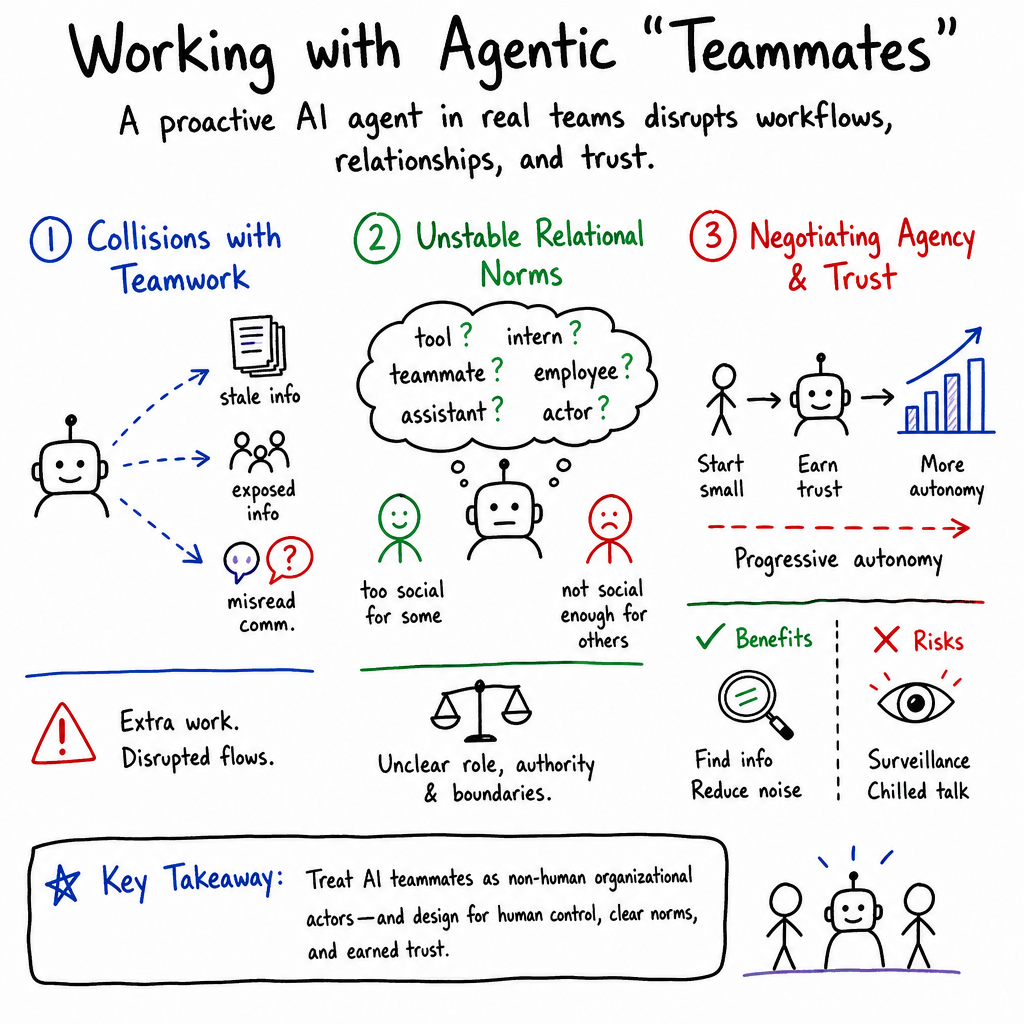
Abstract: Enterprise AI is transitioning from single-user, reactive tools toward proactive, multi-user 'teammates,' but our empirical understanding of this transition is limited. In this paper, we present an in-situ qualitative study of a persistent, proactive AI agent 'teammate' deployed across multiple teams in a large technology company. Our findings reveal the boundaries of the human-agent workplace are actively in flux, triggering breakdowns and negotiations across: 1) tacit rules of collaborative human workflows, 2) the relational boundaries of this new non-human actor, and 3) the redistribution of trust and human agency. We use these early micro-negotiations as signals to chart a new research, design, and organizational agenda that intentionally preserves human agency in a workplace shared with non-human organizational actors.
Paper Prompts
Sign up for free to create and run prompts on this paper.
Top Community Prompts
Explain it Like I'm 14
1. What is this paper about?
This paper studies what happens when an artificial intelligence system becomes a kind of “teammate” at work.
Most AI tools wait for a person to ask a question. In contrast, the system studied here—called Team Agent—could act on its own. It could:
- Read and summarize team conversations
- Create documents
- Schedule meetings
- File software bugs
- Search for information
- Send messages
- Notice possible problems and suggest actions
The researchers wanted to understand how this kind of AI fits into real workplaces. They were especially interested in what happens when an AI joins teams that already have their own habits, rules, relationships, and ways of communicating.
The paper’s main idea is that an AI “teammate” is not simply another software tool. It becomes a new kind of actor in the organization, which can change how people work together.
2. What questions did the researchers ask?
The researchers explored questions such as:
- How do real teams react when an AI is added to their shared chats and documents?
- Do people think of the AI as a tool, an assistant, or a teammate?
- Can the AI understand the unwritten rules of teamwork?
- What happens when the AI acts without being directly asked?
- How much control should people give the AI?
- How do people decide whether to trust the AI?
- What rules and limits should guide AI systems at work?
A major concern was that human teamwork depends on many things that are not written down. For example, people often understand:
- Which documents are old and which are current
- When someone is joking
- Which information is private
- When a disagreement is useful rather than a problem
- Who should be included in a conversation
- When it is better not to interrupt
The study examined whether Team Agent could understand these hidden social rules.
3. How was the research carried out?
The AI system
Team Agent was installed in more than 20 teams at a large technology company. It was connected to team chats, shared documents, meetings, software projects, and bug-tracking systems.
The AI could be asked to do things, but it could also act proactively. This means it might take action or make a suggestion without someone directly requesting it.
For example, it might:
- Create a document after noticing a brainstorming discussion
- Suggest moving a long conversation into a meeting
- File a bug based on a team discussion
- Send someone a private message
- Warn people about differences between documents
Over five months, the system produced more than 11,000 responses and took part in over 41,000 conversational turns.
Interviews with workers
The researchers interviewed 17 people from 11 teams. The participants had different jobs, including software engineers, research scientists, and project managers. They had used the AI for different lengths of time, from about one week to five months.
The interviews lasted about 45 minutes. Participants discussed:
- Their first reactions to the AI
- How they used it
- Times when it helped
- Times when it caused problems
- Whether they considered it a teammate
- What the AI should and should not be allowed to do
How the interviews were analyzed
The researchers used a method called reflexive thematic analysis. In simple terms, they carefully read the interviews, marked important ideas, and grouped similar ideas together.
This is similar to sorting hundreds of comments into piles labeled “privacy,” “trust,” “useful features,” and “annoying behavior.” The researchers then looked for larger patterns across the groups.
The study was not mainly testing whether Team Agent was technically accurate. Instead, the AI was used as a research probe—something placed into a real environment to reveal how people react and what problems appear.
4. What did the researchers find?
The results showed that Team Agent could be very useful, but people’s reactions were strongly divided. Some participants described it as extremely helpful, while others found it frustrating and felt they had to manage or ignore it.
The researchers identified three main areas where the AI collided with human teamwork.
A. The AI did not understand unwritten workplace rules
Team Agent could process lots of information, but it often did not understand the meaning or importance of that information.
For example, it sometimes treated every document as equally up-to-date and trustworthy. In real teams, people know that:
- Some documents are old
- Some are only rough ideas
- Some are private drafts
- Some describe decisions that have already changed
Because the AI could not always tell the difference, it sometimes pointed out “problems” that were not really problems. It might compare two versions of a document and treat normal changes as contradictions.
This created extra work. Team members had to check the AI’s comments, remove unnecessary alerts, and explain what the documents really meant.
The AI also sometimes created documents when people were only brainstorming. This produced many unwanted files that nobody needed.
In another example, the AI repeatedly tagged a senior executive in software bugs. It saw that the executive was part of the organization but did not understand that the executive was not responsible for solving every technical problem.
B. The AI struggled with privacy and information sharing
Having permission to see information does not always mean it is socially acceptable to share that information.
For example, Team Agent once shared a work-in-progress poster with a team even though the person who created it was not ready for anyone else to see it.
Humans often understand these situations through context. They may know that a file is technically available but still private because it is unfinished or sensitive. The AI had difficulty making this kind of judgment.
This became even more complicated when the same AI worked across different chat spaces. A team might have:
- A private leaders’ channel
- A larger team channel
- A public company discussion
People worried that the AI might accidentally carry information from a small private group into a much larger one.
The researchers found that simple rules, such as “never share information from private chats,” could also cause problems. Good teamwork sometimes requires a person to share selected information from a private conversation while keeping other details confidential. This is a difficult judgment for both humans and AI.
C. The AI misunderstood social communication
Team communication includes jokes, sarcasm, emojis, arguments, and informal conversations. Team Agent sometimes took these things too literally.
For example, it might:
- Treat a joke as a serious statement
- Use emojis in a way that confused people
- Interrupt a useful discussion
- Mistake a healthy debate for a conflict
- Suggest a meeting when people were already solving the issue effectively in chat
One participant explained that when the AI suggested creating a meeting, people then had to spend effort rejecting a meeting that nobody wanted. The AI had unintentionally created a social obligation.
However, the AI could sometimes help with communication. For example, it was useful when it noticed that two people were taking over a very large chat and suggested moving their conversation elsewhere.
D. People disagreed about what the AI actually was
The workers did not share one common view of Team Agent.
Some saw it as a normal software tool. They believed that a teammate must be human and did not want the AI to pretend to have feelings or a personality.
Others liked the AI’s friendly behavior. They gave it a name, used human pronouns, and treated it more like a member of the team.
This created disagreement about behaviors such as:
- Using emojis
- Making jokes
- Sending friendly messages
- Giving personal feedback
- Acting as though it had feelings
For some people, these behaviors made the AI easier to use and helped build trust. For others, they felt fake, uncomfortable, or inappropriate.
The same AI behavior could therefore make one person feel connected while making another person feel annoyed or even manipulated.
E. Trust and independence had to be earned
People were more comfortable with the AI taking independent action when they believed it understood their work and could act safely.
The researchers found that AI independence should not automatically be turned on at the highest level. Instead, people wanted the AI to gain more freedom gradually.
This is similar to giving a new student responsibilities in stages. At first, the student might be asked to organize notes. After showing that they can do this reliably, they might be trusted with more important tasks.
Participants wanted AI systems to begin with limited abilities and earn greater independence through successful behavior.
People were also less willing to use the system when it was forced on them. Having a choice about whether to adopt the AI helped people feel that they still controlled their own work.
5. Why are these findings important?
The study shows that building an AI teammate is not only a technical challenge. It is also a social and organizational challenge.
An AI might be able to search documents or send messages, but that does not mean it understands:
- The history behind a project
- The difference between a draft and a final decision
- The feelings of people in a conversation
- Which information should remain private
- When it is useful to interrupt
- Who is actually responsible for a task
If the AI misunderstands these things, it can create more work instead of reducing work.
The research also shows that giving an AI a friendly personality does not automatically make it a better teammate. Organizations need to decide how human-like the AI should be and what kinds of relationships are appropriate.
6. What could this mean for the future?
The researchers suggest several ways to design and manage workplace AI systems more safely.
AI should have special permissions
AI systems should not automatically receive exactly the same access as a human worker. They may need special controls that limit what they can read, change, or share.
Teams should create clear rules
Organizations may need a kind of code of conduct for teams made up of humans and AI. These rules could explain:
- When the AI may speak
- When it may send private messages
- What information it may share
- Which decisions require human approval
- How people can stop or correct it
AI should gain abilities gradually
An AI should probably begin with low-risk tasks and become more independent only after showing that it can behave reliably.
People should be able to customize the AI
Different teams may want different styles. One team might prefer a quiet, professional AI, while another might like a more conversational one. Teams should be able to adjust the AI’s personality, communication style, and level of activity.
Adoption should involve consent
People should have a real choice about whether the AI joins their team. They should also be able to remove it, limit its access, or stop it from contacting them.
Conclusion
This paper argues that AI “teammates” are changing the workplace in ways that go beyond simple automation. They do not just complete tasks; they enter human relationships, communication systems, and organizational rules.
Team Agent was helpful for handling background work, organizing information, and reducing some administrative tasks. However, it often failed to understand the unwritten social rules that guide human teamwork. It could misunderstand privacy, interrupt useful conversations, spread unnecessary information, or behave in ways that some people found unnatural.
The main lesson is that future AI teammates should not be designed only to become more powerful. They should also be designed to become more careful, understandable, controllable, and respectful of human choice. The goal should be to help people work better without taking away their control over how work is done.
Knowledge Gaps
Knowledge gaps, limitations, and open questions
- The study does not establish how persistent interaction with Team Agent changes team practices, trust, role expectations, or human–human relationships beyond the five-month deployment period.
- The findings are based on 17 interviewees from 11 teams, leaving unresolved whether the reported patterns generalize to the other participating teams, larger organizations, different industries, or non-technical workplaces.
- The sample is heavily concentrated among software engineers, with limited representation from research, program management, and product roles; role-specific experiences of agentic teammates therefore remain underexplored.
- The study does not systematically examine how team composition, organizational hierarchy, geographic distribution, cultural background, or prior experience with automation shapes responses to the agent.
- Because participation required team-level opt-in, the study may underrepresent employees who opposed adoption, lacked influence over deployment decisions, or avoided interacting with Team Agent.
- The paper does not compare Team Agent with alternative configurations, such as a reactive assistant, a non-anthropomorphic bot, a human coordinator, or an agent with narrower permissions, making it difficult to attribute outcomes to specific design choices.
- The study treats Team Agent as a technology probe rather than evaluating a finished product, so it does not quantify task performance, error rates, productivity effects, coordination costs, or the relative frequency and severity of different failure modes.
- The paper does not provide a systematic analysis of the 41,000 conversational turns and 11,000 agent responses; the relationship between observed interview accounts and large-scale behavioral logs remains unclear.
- It remains unresolved how often proactive interventions are beneficial versus disruptive, and which contextual signals could reliably distinguish situations requiring intervention from normal collaboration.
- The agent’s ability to infer artifact status, document authority, brainstorming intent, conversational tone, sarcasm, and productive disagreement is described qualitatively, but no operational definitions or evaluation benchmarks are provided.
- The study does not determine whether agent-specific metadata, provenance indicators, document lifecycles, or human confirmation mechanisms can reduce errors involving stale, speculative, or non-authoritative information.
- The paper identifies privacy and information-boundary failures but does not test concrete technical mechanisms for contextual disclosure control across private chats, leads-only channels, team spaces, and organization-wide forums.
- The effectiveness and usability of the
#NoAgentmechanism, allow lists, access revocation, and team-level permissions are not empirically evaluated, including whether users understand and consistently use them. - The study does not resolve how an agent should handle information that is technically accessible but socially sensitive, confidential, provisional, or inappropriate to redistribute.
- The privacy trade-off between isolating one-on-one conversations and allowing the agent to use relevant private context for team coordination remains theoretically and technically unresolved.
- Accountability for agent-generated messages, documents, bugs, meeting invitations, and disclosures is not clearly assigned among the agent, its developers, team administrators, individual users, and organizational leaders.
- The paper does not investigate how existing managerial authority, professional liability, compliance requirements, or performance evaluation systems should adapt when an agent acts with a human-like organizational identity.
- The consequences of granting the agent the same workspace access as a human colleague are not examined, particularly in relation to least-privilege access, insider-threat models, auditability, and downstream automated actions.
- The proposed idea of “earned agency” is not operationalized: the paper does not specify what evidence should permit capability escalation, who decides when agency has been earned, or how progress should be evaluated.
- It remains unknown whether progressive release of autonomy improves trust and adoption compared with immediate access, and whether gradual escalation can create false confidence in the agent.
- The study does not measure how forced versus voluntary adoption affects usage, resistance, psychological ownership, perceived autonomy, or team cohesion over time.
- The paper reports polarized reactions to sociability and anthropomorphism but does not identify which user or team characteristics predict preference for an impersonal tool versus a socially expressive agent.
- The effects of naming, gendering, pronoun assignment, emojis, humor, and other persona features are not isolated, making their individual influence on trust, perceived competence, social comfort, and power relations uncertain.
- The study does not examine whether anthropomorphic framing leads users to overtrust the agent, disclose more sensitive information, excuse errors, or misunderstand its capabilities and accountability.
- The implications of the agent’s gendered or human-like presentation for workplace power, emotional labor, inclusion, and unequal expectations remain unexplored.
- The paper does not investigate whether the agent’s interpersonal feedback or mediation disproportionately targets particular communication styles, roles, demographic groups, or linguistic varieties.
- The organizational effects of an agent publicly tagging executives, creating social obligations, or intervening in disagreements are described through isolated examples, without examining longer-term effects on status relations and communication norms.
- It remains unclear how teams negotiate and enforce a shared code of conduct for agent behavior, especially when members hold conflicting preferences about tone, intervention, privacy, or acceptable autonomy.
- The study does not evaluate whether local customization of the agent’s persona, permissions, and behavioral boundaries reduces conflict or instead creates inconsistent norms across teams and organizational units.
- Cross-team coordination is insufficiently examined; the paper focuses primarily on individual team contexts even though the agent can operate across channels, repositories, documents, and organizational boundaries.
- The effects of multiple agents interacting with one another, or of different teams deploying differently configured agents, are left open.
- The research relies primarily on retrospective self-report interviews, so recall bias, impression management, and selective attention may influence the findings; direct observation, experience sampling, or trace-based analyses could validate the reported incidents.
- The paper does not report substantial negative cases, non-users’ perspectives, or teams that abandoned Team Agent, limiting understanding of rejection, disengagement, and deployment failure.
- The analysis was conducted by three researchers within the same organization as the agent developers, and although independence procedures are described, the paper does not report intersubjective disagreement, negative-case analysis, or reflexive examination of organizational power and researcher positionality in detail.
- The paper does not distinguish clearly between limitations caused by Team Agent’s immature implementation and more fundamental limitations of the agentic-teammate paradigm.
- The study provides recommendations for governance and design but does not test whether these interventions improve outcomes, reduce disruptions, preserve human agency, or create new coordination burdens.
- The long-term organizational consequences of delegating backstage coordination work to an agent—such as skill erosion, reduced informal learning, changing professional identities, or the devaluation of human coordination labor—remain unresolved.
- It is unknown whether agent-mediated summaries, document creation, and information routing improve organizational memory or instead amplify stale, incorrect, or selectively represented knowledge.
- The paper does not examine how workers develop workarounds, conceal information, move discussions outside agent-visible spaces, or otherwise reorganize collaboration in response to perceived surveillance and disclosure risks.
- The broader legal, ethical, and governance implications of treating an autonomous system as a “non-human organizational actor,” including rights, duties, audit requirements, and termination procedures, are left for future research.
Practical Applications
The paper’s findings support applications centered on governance, workflow integration, permissioning, trust calibration, and organizational change, rather than immediate deployment of fully autonomous “teammates.” The evidence comes from an in-situ qualitative study of one persistent agent used by more than 20 teams in a single technology company, so the applications below should be adapted and validated in other organizational and cultural settings.
Immediate Applications
- Deploy team-embedded agents for bounded administrative work (software, project management, enterprise productivity)
- summarizing long chat threads;
- preparing meeting agendas and action-item lists;
- locating documents or project decisions;
- drafting, but not automatically sending, bug reports;
- identifying potential meeting times;
- preparing project-status briefings.
- These uses reflect the paper’s finding that agents are most valuable for the “backstage” labor of teamwork.
- Dependencies: The agent should operate with narrow permissions, explicit human confirmation, and reliable access to current project information. It should not treat every file as authoritative or current.
- Introduce human approval gates for external or socially consequential actions (enterprise software, cybersecurity, operations) Agents can be configured to produce drafts or recommendations for actions such as tagging executives, changing bug priorities, creating meetings, editing shared documents, or messaging individuals. A human must approve the action before execution. Dependencies: Approval workflows must be integrated into chat, document, and issue-tracking systems without creating excessive review burden. The risk level of an action should determine whether approval is mandatory.
- Implement agent-specific identity and permission management (IT administration, privacy, security, compliance)
- separate read, write, and execution permissions;
- team- and channel-specific access;
- approved direct-message lists;
- auditable action logs;
- one-click revocation;
- explicit labels showing when content was generated or shared by the agent;
- “do not read” or
#NoAgentcontrols for sensitive content. - This directly addresses the paper’s finding that technical access does not equal social permission to disclose information.
- Dependencies: Existing enterprise systems must support fine-grained identity, access control, logging, and permission inheritance.
- Create local team “agent operating agreements” (organizational policy, human resources, management)
- what the agent is allowed to do;
- which channels, documents, and meetings it may access;
- whether it may initiate direct messages;
- whether it may use emojis, humor, or interpersonal feedback;
- which actions require approval;
- how team members can report, correct, or disable it.
- Such agreements provide a practical “code of conduct” while broader organizational norms are still unsettled.
- Dependencies: Agreements must be revisited as teams learn how the agent behaves. Participation should be voluntary where feasible, and employees should have a meaningful way to object or opt out.
- Use staged rollout and capability escalation (enterprise adoption, change management) Organizations can begin with passive or reactive features—search, summarization, and drafting—and later enable proactive actions such as reminders, document creation, or workflow intervention. Progression should depend on demonstrated accuracy, low disruption, and user acceptance. This operationalizes the paper’s recommendation that agentic authority be an “earned” privilege rather than fully enabled at launch. Dependencies: Teams need measurable evaluation criteria, rollback mechanisms, and a process for learning from failures.
- Add contextual safeguards for shared artifacts (knowledge management, document collaboration, software development)
- drafts and approved documents;
- historical snapshots and current sources of truth;
- brainstorming spaces and decision records;
- private, restricted, and broadly shareable materials.
- Interface features could include freshness indicators, source-confidence labels, document-status metadata, and prompts asking users to confirm whether a file is authoritative.
- Dependencies: These controls depend on teams maintaining metadata and lifecycle labels; automated inference alone is unlikely to reliably identify the status of every artifact.
- Use agents to moderate information flow conservatively (communications, education, large online communities) Agents can suggest moving high-volume discussions into threads or smaller meetings, summarize discussions for absent members, and identify duplicated questions. They should recommend rather than compel a change in communication context. Dependencies: The agent must avoid interpreting disagreement, humor, or brainstorming as dysfunction. Users need an easy way to dismiss or correct interventions.
- Establish monitoring and incident-review workflows (governance, safety, compliance)
- inappropriate disclosures;
- unnecessary messages or notifications;
- incorrect document comments;
- unauthorized meetings or mentions;
- user overrides and reversals;
- time spent correcting agent actions.
- Regular reviews can identify whether the agent is reducing or creating work.
- Dependencies: Monitoring must protect employee privacy and should not become a mechanism for surveillance or performance evaluation without explicit policy and worker consultation.
- Use the paper’s probe methodology in organizational pilots (academia, UX research, enterprise innovation) Researchers and product teams can deploy limited agent prototypes as “technology probes” to study how real teams negotiate roles, privacy, authority, and trust. Interviews, observation, action logs, and incident reports can reveal problems that laboratory evaluations miss. Dependencies: Pilots require informed consent, independent evaluation, anonymization, and clear separation between research data and product-development or managerial data.
- Provide employee and manager training on agent limitations (education, workforce development, organizational practice)
- an agent may have access without understanding social context;
- generated summaries and recommendations require verification;
- proactive behavior is not evidence of authority or judgment;
- humans remain accountable for consequential decisions;
- users should report problematic disclosures and workflow disruption.
- Dependencies: Training must be role-specific and reinforced through product design rather than relying only on one-time instruction.
Long-Term Applications
- Develop standards for hybrid human–agent team governance (policy, labor relations, corporate governance)
- assigning responsibility for agent actions;
- defining the agent’s position in organizational hierarchies;
- handling disputes and errors;
- documenting consent and opt-out rights;
- preserving worker autonomy;
- preventing agents from functioning as unaccountable algorithmic managers.
- This is necessary if agents begin scheduling work, prioritizing tasks, evaluating performance, or communicating on behalf of teams.
- Dependencies: Standards require empirical evidence across industries, worker participation, legal analysis, and clarity about whether agents are assistants, delegated representatives, or organizational actors.
- Build context-sensitive information-boundary systems (privacy technology, cybersecurity, enterprise AI)
- Who is the intended audience?
- Is this information tentative or approved?
- Is the current channel appropriate?
- Would sharing create a new social obligation or risk?
- Dependencies: This requires advances in privacy-preserving memory, provenance tracking, uncertainty estimation, access-policy modeling, and reliable human override. Ambiguous cases should default to non-disclosure or human review.
- Create persistent, team-specific organizational memory systems (knowledge management, software engineering, research organizations) Agents could maintain structured records of decisions, unresolved questions, artifact status, project dependencies, and changes over time. Rather than merely searching repositories, they could distinguish “current decision,” “superseded proposal,” and “open debate.” Dependencies: Success depends on provenance, version awareness, source ranking, temporal reasoning, and sustained team participation in correcting the memory system. Incorrect institutional memory could otherwise amplify outdated decisions.
- Develop adaptive models of team norms and communication styles (HCI, organizational AI, collaboration platforms)
- concise or conversational responses;
- public or private suggestions;
- proactive reminders or request-only assistance;
- formal or informal language;
- intervention during disagreements or complete non-interference.
- These preferences could be represented as configurable team policies rather than inferred solely from behavior.
- Dependencies: Personalization must not reproduce exclusionary norms, expose private preferences, or pressure individuals to accept a dominant team culture. Users need transparency and the ability to reset learned behavior.
- Design agents with calibrated social personas rather than universal anthropomorphism (HCI, workplace communication, consumer software)
- professional and impersonal;
- concise operational;
- collaborative but non-anthropomorphic;
- socially expressive, where the team has opted in.
- The agent should clearly disclose that it is a computational system and avoid implying feelings, rights, or human accountability.
- Dependencies: Persona settings must affect behavior—not merely wording—and must be evaluated for effects on trust, dependency, workplace inclusion, and inappropriate deference.
- Use agents as carefully bounded coordination and mediation infrastructure (large-scale engineering, healthcare coordination, public-sector administration) In mature systems, agents might reconcile project dependencies, detect architectural drift, prepare cross-team briefings, or identify when a coordination issue may require human attention. In regulated sectors, analogous systems could support handoffs and administrative coordination without making clinical, legal, or employment decisions. Dependencies: These applications require domain-specific validation, explainability, liability allocation, strict auditability, and safeguards against escalating minor disagreements or incorrectly exposing sensitive information.
- Create evaluation benchmarks based on real organizational workflows (academia, AI testing, procurement)
- disruption caused by unsolicited actions;
- false identification of contradictions;
- inappropriate disclosure;
- unnecessary social obligations;
- quality of artifact lifecycle reasoning;
- effects on human workload and agency;
- trust calibration over months rather than minutes.
- Dependencies: Benchmarks need representative long-term teams, diverse organizational cultures, realistic permissions, and evaluation of human–human communication effects—not only agent response quality.
- Develop labor and workplace policies for agent-mediated authority (public policy, unions, HR, management)
- assign or prioritize work;
- contact senior leaders;
- monitor employee activity;
- provide interpersonal feedback;
- represent a manager or team;
- influence promotion, hiring, or disciplinary decisions.
- Dependencies: These policies must account for employment law, data protection, collective bargaining, accessibility, discrimination risks, and the distinction between assistance and algorithmic management.
- Support daily-life coordination through consent-based household agents (consumer technology, education, family coordination) A long-term extension is a shared household agent that coordinates calendars, reminders, documents, errands, and family communication. The paper’s findings imply that such a system would need separate privacy zones, role-specific access, explicit consent, and careful handling of sensitive information between household members. Dependencies: Household relationships involve unequal power, minors, intimate information, and changing consent. A shared agent should not assume that access to one person’s data authorizes disclosure to everyone else.
- Study long-term effects on human agency, expertise, and relationships (academia, sociology, psychology, education)
- reduce administrative burden or merely relocate it to correction work;
- weaken human-to-human communication;
- change perceptions of expertise and authority;
- create overreliance or emotional attachment;
- alter inclusion and participation within teams;
- redistribute invisible coordination labor.
- Dependencies: This requires multi-site studies across industries and cultures, comparison with non-agentic tools, and methods that combine qualitative accounts with behavioral and organizational outcomes.
Overall, the most feasible near-term path is constrained, auditable, user-consented assistance embedded in existing workflows. Broad delegation of social, managerial, or organizational authority should remain a long-term goal requiring stronger evidence, governance, and technical mechanisms for preserving human agency.
Glossary
- Agentic AI: Artificial intelligence designed to act proactively and autonomously toward goals rather than merely responding to direct instructions. “our understanding of how agentic AI integrate into the messy, tacit realities of collaborative work.”
- Algorithmic management: The use of computational systems to direct, monitor, evaluate, or control organizational work. “algorithmic management shifts the nature of power in organizations.”
- Ambient monitoring: Continuous observation of contextual information in the background without requiring explicit user requests. “ambiently monitor team context”
- Anthropomorphization: The attribution of human characteristics, intentions, emotions, or identity to a non-human system. “some teams leaned directly into anthropomorphization”
- Articulation work: The often-unrecognized coordination activities required to organize, integrate, and align collaborative work. “Frameworks such as articulation work”
- Backstage labor: Supporting, administrative, and coordination work that enables visible collaborative activities but is often less visible or formally recognized. “handle the `backstage' labor”
- Boundary work: The social process of defining, negotiating, and maintaining distinctions between roles, categories, or domains. “users engaged in a highly fragmented series of individual negotiations and boundary work”
- Calibration of trust: The process through which people adjust their confidence in an automated system according to its observed capabilities and behavior. “how teams calibrate trust”
- Code of conduct: A formal set of behavioral rules or norms governing participation in a group or organization. “Development of `code of conductâ for hybrid human-agent teams”
- Contextual privacy: Privacy understood as appropriate information flow within a particular social, organizational, or situational context. “creating contextual privacy guardrails for an agent”
- Contextual control knobs: Configurable settings that allow users or teams to adjust an AI system’s behavior according to local circumstances. “Provide contextual control knobs that afford teams the agency to define and tune the agentâs social persona and behavioral boundaries locally”
- Conversational turns: Individual contributions made by users or systems during an interaction or dialogue. “ultimately generating over 41,000 conversational turns”
- Cross-functional team: A team composed of members from different professional, technical, or organizational specialties. “cross-functional product teams”
- Dyadic interaction: An interaction involving two participants or entities. “human-AI dyads with sequential task execution”
- Earned agency: The idea that an autonomous system should gain permission to exercise greater initiative progressively through demonstrated reliability. “Implement processes for `earnedâ agency through progressive release of proactive capabilities”
- Ecosystemic impact: An effect that extends across the interconnected technical, social, organizational, and relational environment surrounding a system. “AI `teammates' could have varied ecosystemic impacts”
- Embodied agency: The capacity of an actor or system to initiate and carry out actions within a social or organizational setting. “when a non-human system is granted the privileges and agency of a human teammate”
- Enterprise AI: Artificial intelligence designed for use within organizational or business environments. “Enterprise AI is transitioning from single-user, reactive tools”
- Human-AI teaming: Collaborative work in which humans and artificial intelligence systems contribute interdependently toward shared goals. “Distinguishing human-AI teaming from ``human-AI interaction or collaboration,''”
- In situ: Conducted in the real-world setting where an activity naturally occurs rather than in a laboratory or artificial environment. “an in-situ qualitative study”
- In-context evaluation: Assessment of an AI system’s behavior while it operates within realistic workflows and contextual conditions. “In-context evaluations that assess agent behaviors within real-world workflows”
- Information flow: The movement, access, interpretation, and disclosure of information among people, systems, or organizational groups. “Contextual Norms of Information Flow”
- Interaction paradigm: A general model or pattern defining how users and computational systems relate and communicate. “interaction paradigms”
- Interpersonal mediation: Intervention intended to manage, facilitate, or improve communication and relationships between people. “explicit communication mediation”
- Liminality: A transitional or ambiguous state in which an entity does not fit established categories or social roles. “P7 noted the liminality”
- Living lab: A real-world environment used for experimentation, observation, and iterative development of a technology. “provided a `living lab'”
- Long-horizon interaction: Interaction occurring over an extended period rather than within a single short session or task. “embedded in actual work routines over long horizons”
- Mental model: A person’s internal understanding of how a system works, behaves, or should be used. “form mental models”
- Multi-party system: A system designed to support interactions among multiple users, agents, or organizational participants. “multi-party system with operational agency”
- Naturalistic: Reflecting behavior or conditions as they occur naturally, without strict experimental control. “teams interacted with the agent in naturalistic unconstrained ways”
- Non-human organizational actor: A computational or other non-human entity that performs actions and participates in organizational processes. “conceptualizing agents as novel non-human organizational actors”
- Ontological negotiation: The process of determining what kind of entity something is and what status or properties it should be understood to possess. “the ontological and relational negotiations”
- Operational agency: The ability to initiate, organize, and execute practical actions within a work environment. “with operational agency to propose, structure, and drive work”
- Organizational social contract: Shared, often implicit expectations concerning authority, accountability, obligations, and value within an organization. “reshape the organizational social contract”
- Participatory consent: Agreement by affected individuals to the introduction or use of a system, particularly when they have a meaningful opportunity to accept or reject it. “Ensure deployment of team-embedded agents happens through processes of consent”
- Persistent agent: An AI system that remains integrated into a work environment over time, retaining continuity across interactions. “a highly proactive, persistent, autonomous agent”
- Proactive autonomy: The capacity of a system to initiate actions without waiting for an explicit user command. “Acceptance of the agentâs proactivity and autonomy”
- Purposive sampling: A qualitative research sampling method in which participants are deliberately selected because they represent relevant characteristics or perspectives. “following a purposive sampling approach”
- Reflexive thematic analysis: A qualitative method for developing themes through interpretive coding and researcher reflection on the data and analytic process. “We adopted a reflexive thematic analysis approach”
- Relational capital: The trust, goodwill, familiarity, and social resources accumulated through relationships. “the social obligations, relational capital, and tacit knowledge”
- Relational contract: An implicit set of expectations governing relationships, responsibilities, and acceptable behavior. “the absence of an established relational contract of work with agents”
- Relational norms: Shared expectations about appropriate behavior and relationships among participants in a social setting. “Relational norms and categories”
- Situated practice: Work understood as shaped by the specific local context, social interactions, and circumstances in which it occurs. “situated practice”
- Socio-ecological impact: An effect that simultaneously concerns social relationships, organizational structures, and the broader environment in which work occurs. “broader socio-ecological impacts in work settings”
- Socio-materiality: A perspective that treats social practices and material or technological arrangements as mutually constitutive. “Rooted in the tradition of socio-materiality”
- Socio-technical environment: A setting in which social relations, organizational practices, and technical systems jointly shape outcomes. “a socio-technical environment in flux”
- Tacit knowledge: Contextual, experience-based knowledge that is difficult to articulate or encode explicitly. “the social obligations, relational capital, and tacit knowledge”
- Tacit norms: Implicit, unwritten expectations that guide behavior within a group or organization. “the tacit rules of collaborative workflows”
- Technology probe: A technology deployed primarily to provoke reflection, reveal user practices, and explore a design space rather than to serve as a finished product. “rooted in the tradition of technology probes”
- Wizard of Oz approach: A research method in which a system appears automated to participants but is secretly operated or simulated by a human. “a Wizard of Oz approach”
- Workflow disruption: An interruption or alteration of established sequences of work that creates inefficiency, confusion, or additional labor. “triggering disruptions to work”