The cosmological necklace problem
Abstract: We investigate 3d de Sitter axion wormhole which contribute to the no-boundary density matrix. We identify "cosmological necklace" solutions: an infinite series of Euclidean saddles corresponding with repeated bounces. This results in an unbound gravitational entropy, and a divergent path integral. To remedy this, we study the gravitational path integral using a (mostly) Lorentzian lapse contour. Within a minisuperspace steepest-descent analysis, we find that a single necklace dominates, leading to a finite entropy. A crucial element is to take into account an redundancy in the FLRW path integral, where is the scale factor. Surprisingly, the dominant solution is not purely Euclidean. Its entropy turns out to be independent of the axion flux, and equals the empty de Sitter entropy. We also study higher-dimensional necklaces, sourced by either an axion flux or by Yang-Mills instantons, and argue for qualitatively similar results: the single necklace solution dominates along a Lorentzian lapse contour.
Paper Prompts
Sign up for free to create and run prompts on this paper.
Top Community Prompts
Explain it Like I'm 14
1. ¿De qué trata el artículo?
El artículo estudia un problema de gravedad cuántica relacionado con el universo en expansión, especialmente con el espacio de de Sitter, un modelo del universo que tiene una constante cosmológica positiva.
Los autores analizan unas soluciones llamadas “collares cosmológicos” (cosmological necklaces). Se llaman así porque parecen varios “anillos” o “eslabones” de espacio-tiempo unidos entre sí.
El problema principal es que, si se incluyen todos estos collares en el cálculo, la entropía del universo se vuelve infinitamente grande. Eso no tiene sentido físico. Para solucionar este problema, los autores proponen usar una forma distinta de hacer el cálculo: integrar principalmente sobre espacios-tiempo lorentzianos, es decir, parecidos al espacio-tiempo normal que usamos para describir el tiempo real.
2. ¿Qué preguntas intenta responder la investigación?
El artículo intenta responder principalmente a estas preguntas:
- ¿Qué ocurre si incluimos todas las geometrías posibles del universo en el cálculo de gravedad cuántica?
- ¿Por qué aparecen infinitas soluciones parecidas a collares?
- ¿Por qué esas soluciones producen una entropía infinita y poco razonable?
- ¿Existe una regla para decidir qué soluciones deben incluirse y cuáles deben descartarse?
- ¿Puede el cálculo producir la entropía esperada para un universo de de Sitter?
- ¿Qué papel desempeña la simetría , donde representa el tamaño del universo?
En pocas palabras, los autores buscan una manera coherente de sumar distintas formas posibles del espacio-tiempo sin obtener resultados absurdos.
3. ¿Cómo realizaron el estudio?
Un modelo simplificado del universo
Los autores no estudian todos los detalles posibles del universo. En su lugar, utilizan una aproximación llamada minisuperespacio.
Esta aproximación es como hacer un dibujo sencillo de un problema muy complicado. En vez de permitir que cada punto del universo cambie de manera independiente, se supone que todo el universo tiene una forma muy regular y que su tamaño está descrito por una sola cantidad:
- : el tamaño o “radio” del universo.
- : una cantidad relacionada con cuánto tiempo transcurre entre dos momentos.
Esto convierte el problema de la gravedad en algo parecido a estudiar una partícula moviéndose en una colina o en un valle. En la analogía, el universo es como una pelota cuya posición es , y el potencial describe las zonas por las que puede moverse.
Agujeros de gusano con axiones
Primero estudian un universo de tres dimensiones con un campo llamado axión. En este modelo, el axión actúa como una forma especial de materia que puede impedir que el universo se reduzca completamente a tamaño cero.
La ecuación principal contiene un término como
donde mide la cantidad de flujo del axión. Este término ayuda a crear una especie de “puente” o agujero de gusano entre distintas partes del espacio-tiempo.
También estudian modelos de más dimensiones y otros ejemplos en los que el papel del axión lo desempeñan campos de Yang-Mills, relacionados con las fuerzas fundamentales.
El problema de los collares
Una solución básica puede repetirse varias veces. Si una solución forma un collar, también se pueden pegar dos, tres, cuatro o infinitas copias:
- un collar,
- dos collares unidos,
- tres collares unidos,
- y así sucesivamente.
Cada copia adicional hace que la acción gravitatoria sea más negativa. Como la contribución al cálculo depende aproximadamente de , las soluciones con más collares parecen cada vez más importantes.
Es parecido a una suma como
que nunca termina y se hace infinita. En este caso, el resultado sería una entropía infinita.
Cambiar el camino de integración
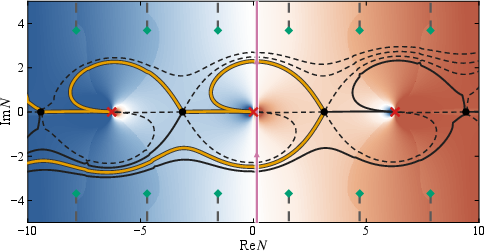
Para evitar este problema, los autores no suman simplemente todos los valores reales de . En cambio, eligen un camino complejo:
Esto significa que el cálculo se hace principalmente en la dirección imaginaria de , que corresponde a una evolución más cercana al espacio-tiempo lorentziano.
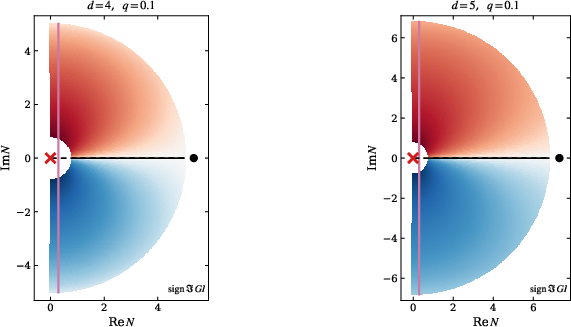
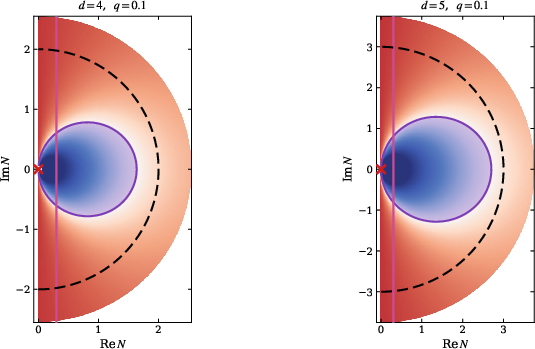
Para decidir qué soluciones cuentan realmente, utilizan una técnica matemática llamada teoría de Picard-Lefschetz. Se puede entender como una forma de seguir los caminos de descenso más seguros en un paisaje complejo. Algunas soluciones aparecen como posibles respuestas, pero el camino elegido determina cuáles contribuyen realmente al resultado final.
La simetría
El tamaño físico del universo depende de , no de por separado. Por eso, y describen el mismo tamaño espacial.
Los autores tratan esta transformación como una redundancia, parecida a una simetría de la descripción. Tenerla en cuenta es importante porque permite incluir correctamente soluciones que pasan de a .
En la imagen intuitiva, el universo disminuye de tamaño, atraviesa una región especial y después vuelve a crecer con negativo. Aunque cambie de signo, el tamaño físico sigue siendo positivo.
4. ¿Cuáles son los principales resultados?
El cálculo puramente euclidiano falla
Si se suman todas las soluciones euclidianas reales, aparecen collares con cualquier número de repeticiones. No existe una solución que domine claramente, porque siempre se puede añadir otro collar que contribuya aún más.
El resultado es:
- una suma divergente,
- una entropía ilimitada,
- y una violación de la idea de que la entropía no debería superar la entropía de de Sitter.
Por tanto, los autores concluyen que no es correcto definir la gravedad cuántica sumando todas las geometrías euclidianas posibles.
El camino lorentziano elimina las soluciones problemáticas
Cuando se utiliza el camino
la mayoría de las soluciones con muchos collares no contribuyen al resultado final. La solución más importante es la que tiene un solo collar, correspondiente a .
Así, el cálculo deja de ser infinito y produce una respuesta finita.
La entropía coincide con la de de Sitter vacío
En el modelo de tres dimensiones, la acción de la solución dominante produce
Según los autores, esta cantidad coincide con la entropía de Gibbons-Hawking del espacio de de Sitter vacío.
Esto es sorprendente porque el modelo contiene flujo de axión. Sin embargo, el resultado final de la entropía no depende de la cantidad de axión :
La explicación propuesta es que, en regiones suficientemente grandes y en tiempos muy tardíos, el efecto del axión se vuelve pequeño. El universo se parece cada vez más al espacio de de Sitter vacío, y por eso la entropía termina siendo la misma.
Resultados en más dimensiones
Los autores también estudian:
- agujeros de gusano con axiones en dimensiones superiores;
- agujeros de gusano magnéticos producidos por campos de Yang-Mills.
Aunque estos casos son más difíciles y algunos se analizan numéricamente, encuentran un comportamiento parecido: el camino lorentziano selecciona una solución simple, en lugar de permitir que contribuyan infinitos collares.
5. ¿Por qué son importantes estos resultados?
La gravedad cuántica intenta describir el universo teniendo en cuenta las reglas de la mecánica cuántica. Para hacer predicciones, normalmente se suman muchas historias posibles del espacio-tiempo.
Este artículo muestra que no basta con sumar todas las geometrías que parezcan soluciones válidas. Algunas soluciones pueden ser matemáticamente correctas, pero producir resultados físicamente imposibles, como una entropía infinita.
La investigación sugiere que también hay que especificar cuidadosamente:
- qué camino se utiliza en los cálculos;
- qué soluciones cuentan como contribuciones físicas;
- cómo se tratan las simetrías;
- y cómo se conectan las descripciones euclidianas y lorentzianas.
La propuesta de los autores funciona como un filtro: deja pasar la solución de un solo collar, pero bloquea la cadena infinita de soluciones que causa la divergencia.
Conclusión: posible impacto de la investigación
En lenguaje sencillo, el artículo propone una nueva regla para hacer cálculos de gravedad cuántica en universos parecidos al de de Sitter.
La idea principal es:
No todas las formas matemáticamente posibles del espacio-tiempo deben incluirse automáticamente. El camino de integración elegido puede decidir cuáles son físicamente relevantes.
Con el camino principalmente lorentziano, el cálculo produce una entropía finita y compatible con la entropía conocida de de Sitter. Esto podría ayudar a construir una teoría más consistente de la gravedad cuántica y a comprender mejor los agujeros de gusano, la entropía cosmológica y el origen del universo.
Sin embargo, los resultados todavía son teóricos. Los autores trabajan con modelos simplificados y reconocen que quedan preguntas abiertas, como comprobar mejor la independencia respecto al flujo de axión y entender completamente qué camino lorentziano es el correcto.
Knowledge Gaps
Knowledge gaps, limitations, and open questions
- Validity beyond minisuperspace: The necklace resolution is established only within a homogeneous and isotropic FLRW truncation; it remains unknown whether inhomogeneous metric and matter fluctuations generate additional saddles or alter the Picard–Lefschetz decomposition.
- Derivation of the lapse contour: The choice is motivated by obtaining a finite result and recovering the Gibbons–Hawking entropy, but no fundamental principle uniquely derives this contour from the full gravitational path integral.
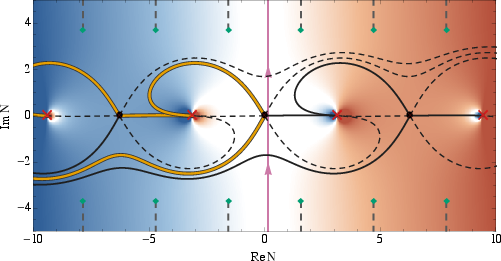
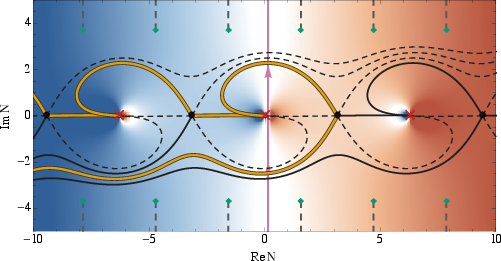
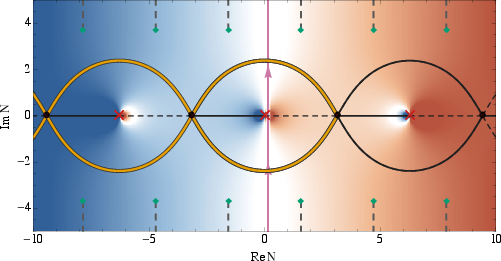
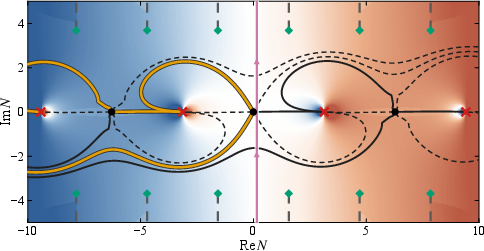
- Contour dependence: The alternative contours and lead to qualitatively different dominant contributions. The paper does not determine which contour is physically correct for different observables, boundary conditions, or notions of de Sitter state preparation.
- Treatment of the conformal factor: The positive regulator in leaves wrong-sign conformal fluctuations around the dominant saddle. A complete prescription for handling these fluctuations while preserving stable matter perturbations is not provided.
- One-loop and higher-loop corrections: The dominance of the single necklace and the resulting entropy are argued semiclassically. The impact of determinants, loop corrections, zero modes, and possible negative modes on saddle dominance and finiteness remains unresolved.
- Measure and normalization of the path integral: Overall factors, gauge-volume factors, and the correct treatment of the redundancy are not fully derived. In particular, the paper notes that factors of two are ignored because they are subleading semiclassically, leaving the exact normalization undetermined.
- Justification of the gauge identification: Although and produce the same spatial metric, the global meaning of this identification, its treatment at , and its implementation in the full gravitational configuration space are not established.
- Behavior near : The dominant tunneling geometry passes through a complexified region to avoid the classical singularity at . The admissible integration cycle, boundary conditions, and physical interpretation of this complex continuation require a more complete formulation.
- Entropy interpretation: The identification of with the entropy of an observer’s causal diamond is not independently derived for the axion wormholes. A perturbative Lorentzian algebra or state-counting calculation analogous to the cited de Sitter analyses is still needed.
- Origin of the flux-independent entropy: In three dimensions, the dominant action is found to be independent of the axion flux , but the argument based on deforming the action contour to late-time de Sitter behavior does not fully establish why all flux-dependent contributions cancel, especially beyond the semiclassical approximation.
- Higher-dimensional generalization: The claim that the same mechanism works in higher dimensions is based partly on numerical studies and qualitative arguments. A general analytic proof of saddle selection, flux independence, and entropy universality in arbitrary dimension is absent.
- Even-dimensional scale-factor symmetry: The persistence of the structure in even dimensions is asserted through the notion of “kinetic gauge,” but the precise gauge construction and its equivalence to the odd-dimensional treatment are not demonstrated in detail.
- Yang–Mills sector: The Yang–Mills necklace examples are constructed at the classical level, but the quantum propagators, fluctuation determinants, and complete steepest-descent analysis are not worked out as explicitly as in the three-dimensional axion model.
- Generality of the pole argument: The pole at is argued to be universal for the relevant minisuperspace propagator, but the conditions under which this remains true for other potentials, matter systems, factor-ordering choices, and boundary conditions are not fully specified.
- Factor-ordering dependence: The Wheeler–DeWitt Hamiltonian and its inverse-square potential require a choice of operator ordering. The paper does not analyze whether the propagator, its pole, or the selected saddles depend on this choice.
- Choice of propagator solution: The preference for the modified Bessel solution over the solution is based on the short-time delta-function limit. The paper does not establish whether additional physical conditions—such as self-adjointness, positivity, or boundary conditions at —select the same solution uniquely.
- Full topology sum: The analysis excludes higher necklaces through contour selection, but it does not provide a complete classification of other connected or disconnected topologies that may contribute to the no-boundary trace.
- Interactions between disconnected components: The discussion identifies a divergence from multiple disconnected de Sitter spheres, but the treatment of their combinatorial factors, interactions, and possible restrictions on disconnected manifolds is not developed.
- Boundary-condition dependence: Most explicit calculations use equal boundary sizes, often or equivalent sign choices. It remains unclear how the contour prescription and saddle selection change for unequal boundary geometries or more general no-boundary density-matrix elements.
- Observable dependence: The proposed contour is justified using the no-boundary trace and entropy. Its consistency for correlation functions, transition amplitudes, wave functions, and Lorentzian observables is not established.
- Relation to canonical quantum gravity: The lapse-integral prescription is formulated in a particular minisuperspace representation, but its relation to the Wheeler–DeWitt constraint, physical inner product, and gauge-invariant Hilbert space of the full theory remains unclear.
- Semiclassical meaning of negative- saddles: Negative-lapse or negative- contributions are retained in parts of the contour analysis and described as suppressed, but their geometric interpretation, orientation, and role in the physical path integral are not resolved.
- Stability of the dominant mixed-signature saddle: The paper identifies a dominant saddle containing Euclidean and Lorentzian segments, but does not fully determine its fluctuation spectrum or whether it satisfies a well-defined generalized KSW or admissibility condition.
- Robustness under matter deformations: It remains unknown whether small changes to the axion action, potential, cosmological constant, or matter equation of state preserve the single-necklace dominance and the de Sitter entropy limit.
- Connection to a UV-complete theory: No derivation is given from string theory, holography, or another ultraviolet completion that would validate the proposed contour, the quotient, or the exclusion of Euclidean necklace covers.
- Comparison with alternative contour prescriptions: The proposal is not systematically compared with other approaches to the gravitational path integral, including purely Euclidean, Vilenkin-type, Hartle–Hawking, or contour prescriptions derived from holography and matrix models.
- Thermodynamic consistency beyond the leading entropy: The argument uses the Gibbons–Hawking entropy as an external benchmark, but corrections to the entropy, generalized entropy contributions, and verification of thermodynamic laws for nonzero flux are left open.
Practical Applications
Immediate Applications
- Quantum-gravity path-integral modeling and numerical workflows — Theoretical physics, quantum cosmology.
- reducing the gravitational system to the scale factor
a(τ)and lapseN; - integrating out
a(τ)to obtain an effective actionI(N); - locating complex saddles;
- determining contributing saddles through Picard–Lefschetz theory.
- Dependency: This is an immediate research tool only within minisuperspace or similarly controlled truncations. Its validity for the full gravitational path integral, including inhomogeneous modes and fluctuations, remains unproven.
- reducing the gravitational system to the scale factor
- A diagnostic for rejecting pathological Euclidean saddles — Quantum gravity, mathematical physics.
- de Sitter gravity;
- axion and Yang–Mills wormholes;
- other FLRW models with periodic Euclidean solutions;
- candidate quantum-cosmology boundary conditions.
- Dependency: The test assumes that the Gibbons–Hawking entropy or a comparable Lorentzian entropy is the correct physical benchmark.
- Automated saddle-selection pipelines for quantum cosmology — Scientific software and computational physics.
The paper’s combination of exact propagators, complex lapse contours, and steepest-descent analysis suggests a reusable computational workflow for classifying gravitational saddles. A software package could accept a minisuperspace potential
V(a)and:- solve the Wheeler–DeWitt or propagator equation;
- identify poles and saddle points in the complex
Nplane; - calculate thimble intersection numbers;
- return the dominant semiclassical geometries and their actions. Dependency: The action must be sufficiently analytic, singularities must be controllable, and the relevant contour deformation must be mathematically well-defined.
A consistency benchmark for de Sitter entropy calculations — Quantum gravity and holography. In the three-dimensional axion model, the dominant
k = 1saddle gives an entropy equal to the empty de Sitter value and, according to the paper, independent of the axion flux:
This result can serve as a benchmark for independent Lorentzian calculations, including algebraic approaches to static-patch observables, generalized entropy, and no-boundary density matrices. Dependency: The flux independence is established within the paper’s semiclassical minisuperspace treatment and requires confirmation beyond that approximation.
- Improved interpretation of the no-boundary density matrix — Cosmology and quantum foundations.
The proposed contour can be used in calculations of no-boundary amplitudes and traces for FLRW universes containing axion or Yang–Mills matter. Rather than summing all real Euclidean solutions, practitioners can evaluate the density matrix using a Lorentzian-dominated contour and include the
a \to -asector as a gauge redundancy. Dependency: The physical interpretation ofaand-aas equivalent configurations must be appropriate for the model, and gauge-volume factors must be treated consistently. - A training example for complex saddle and contour methods — Graduate education and academic research.
- Wheeler–DeWitt quantization;
- complex analysis in path integrals;
- Picard–Lefschetz theory;
- the difference between Euclidean and Lorentzian contour prescriptions;
- gauge redundancies in minisuperspace.
- It could support lecture notes, symbolic-computation exercises, and numerical demonstrations of how different contours select different saddles.
- Dependency: The model is highly simplified and should not be presented as a direct phenomenological model of the observable universe.
- A policy-level methodological lesson for quantum-gravity model evaluation — Research governance and theory assessment. Institutions and research programs evaluating quantum-cosmology proposals can use the paper’s criterion—finite amplitudes, bounded entropy, and agreement with known de Sitter limits—as a minimal validation checklist. Models that reproduce an infinite entropy through repeated covers should be flagged before being interpreted physically. Dependency: This is a methodological recommendation rather than an experimentally validated policy instrument.
Long-Term Applications
- A nonperturbative definition of de Sitter quantum gravity — Quantum gravity and cosmology.
- de Sitter partition functions;
- observer-dependent density matrices;
- quantum corrections to horizon entropy;
- correlations between causal patches;
- transitions between cosmological saddles.
- Dependencies: Major unresolved issues include the conformal-mode instability for
\operatorname{Re}N > 0, contour dependence, gauge fixing, ultraviolet completion, and the inclusion of non-minisuperspace degrees of freedom.
- Quantum-cosmology prediction tools for early-universe initial conditions — Cosmology.
- initial scale factors;
- matter or axion fluxes;
- tunneling versus bouncing histories;
- different inflationary branches.
- Dependencies: The paper studies closed, highly symmetric FLRW systems. Applying the method to realistic inflation requires perturbations, anisotropies, reheating, and a clear probabilistic interpretation of complex amplitudes.
- Observer-dependent entropy calculations in general FLRW spacetimes — Cosmology and quantum information.
- causal-patch thermodynamics;
- horizon area laws;
- entanglement entropy;
- gravitational edge modes;
- observer-dependent state counting.
- Dependencies: The proposed entropy interpretation of the wormhole action requires independent Lorentzian or algebraic confirmation. It is not yet established that every FLRW observer admits a well-defined Hilbert-space trace.
- Higher-dimensional gravitational saddle libraries — High-energy theory and mathematical physics.
- axion flux wormholes;
- Yang–Mills instanton geometries;
- magnetic wormholes;
- other gauge-field-supported cosmologies;
- compactifications with fluxes.
- Dependencies: The current higher-dimensional evidence is partly numerical and model-specific. Existence, stability, and contour contributions must be checked separately for each dimension and matter content.
- Connections to holography and de Sitter quantum information — Holography and quantum information.
- de Sitter partition-function models;
- static-patch operator algebras;
- generalized-entropy calculators;
- numerical tests of horizon-state counting.
- Dependencies: A complete holographic dual for de Sitter space is not known. The relation between the no-boundary trace and a static-patch Hilbert-space trace remains conceptually unsettled.
- Controlled quantum simulations of minisuperspace dynamics — Quantum computing and analog simulation. The Wheeler–DeWitt system can, in principle, be mapped to a one-dimensional quantum-mechanical problem with potential
Future quantum-simulation experiments could study propagation between a and -a, tunneling through the complexified scale-factor region, and the effect of different lapse contours. This would not simulate full quantum gravity, but could test aspects of the reduced mathematical mechanism.
Dependencies: Complex-time evolution, singular inverse-square potentials, gauge projection, and extraction of gravitational observables are technically difficult. Any experimental result would apply only to the reduced model.
- General-purpose contour-selection principles for gravitational path integrals — Mathematical physics and quantum field theory.
- black-hole instantons;
- AdS wormholes;
- topology-changing amplitudes;
- cosmological tunneling;
- quantum field theories with unstable Euclidean actions.
- Dependencies: The correct contour may depend on boundary conditions, observables, and the choice of physical state. The alternative contour
N=-ε+iℝgives a different dominant contribution, demonstrating that contour selection is not merely technical but physically consequential.
- Precision tests of flux-independence and entropy universality — Fundamental theory.
- at one loop;
- for large flux;
- in higher dimensions;
- with additional matter;
- under perturbations away from exact FLRW symmetry.
- Dependencies: Quantum corrections may introduce flux dependence, and the semiclassical approximation may fail near the minimal scale factor or near singular regions of the complexified geometry.
Glossary
- ADM formalism: A Hamiltonian formulation of general relativity that decomposes spacetime into spatial slices and temporal evolution. “we will consider the gravitational path integral in the ADM formalism in minisuperspace variables”
- Axion flux: A conserved field-strength quantity associated with an axion field, contributing to the cosmological dynamics. “Its entropy turns out to be independent of the axion flux”
- Bra-ket wormhole: A complexified wormhole geometry interpreted as connecting bra and ket components of a quantum state. “We avoid the big-bang singularity at by going in the complex plane, resulting in a bra-ket wormhole”
- Causal diamond: The spacetime region that can both influence and be influenced by an observer between specified events. “the gravitational entropy associated with the observer's causal diamond”
- Conformal factor problem: The unboundedness of the Euclidean gravitational action due to fluctuations of the metric’s conformal component. “the so-called conformal factor problem”
- Conjugate momentum: A momentum variable canonically paired with a configuration variable in Hamiltonian mechanics. “The dynamical fields are and (and the conjugate momentum of )”
- Cosmological horizon: A causal boundary beyond which events cannot communicate with an observer in an accelerating universe. “with the area of the cosmological horizon”
- Cosmological necklace: A periodically repeated Euclidean cosmological saddle formed by gluing multiple copies of a wormhole solution. “We identify ‘cosmological necklace’ solutions: an infinite series of Euclidean saddles corresponding with repeated bounces.”
- De Sitter space: A spacetime solution of general relativity with positive cosmological constant and accelerated expansion. “These asymptote to exponentially expanding 3d dS space”
- Euclidean saddle: A stationary point of the Euclidean gravitational action that contributes semiclassically to a path integral. “These solutions are also closed Euclidean saddles with the same boundary conditions”
- Extrinsic curvature: A measure of how a hypersurface is embedded in a higher-dimensional spacetime. “The two slices where $\abs{a}=a_\text{max}$ are identified such as to produce a closed topology”
- FLRW cosmology: A homogeneous and isotropic cosmological model described by a time-dependent scale factor. “In this work, we focus on -dimensional FLRW cosmologies with closed spatial slices”
- Friedmann equation: The gravitational constraint equation governing the scale factor in an FLRW universe. “The Friedmann equation is obtained by variation with respect to the lapse function ”
- Gauge redundancy: A nonphysical freedom in the mathematical description in which different configurations represent the same physical state. “we are treating as a gauge redundancy”
- Gibbons–Hawking entropy: The entropy associated with a de Sitter or black-hole horizon, proportional to its area divided by $4G$. “the Gibbons-Hawking saddle dominates”
- Hamiltonian constraint: A constraint requiring the gravitational Hamiltonian to vanish as a consequence of time-reparameterization invariance. “The equation of motion (the Hamiltonian constraint) is saying that the universe has vanishing energy”
- Hankel contour: A contour in the complex plane that encircles a branch cut, commonly used for analytic continuation and special-function integrals. “along the Hankel contour”
- Instanton: A nonperturbative Euclidean solution, often describing tunneling between semiclassical configurations. “higher-dimensional necklaces, sourced by either an axion flux or by Yang-Mills instantons”
- Kinetic gauge: A choice of gauge or parametrization in which the kinetic term is used to fix the time-reparameterization freedom. “These numerics take place in what we call kinetic gauge.”
- Lapse function: A variable controlling the proper-time separation between spatial hypersurfaces in a spacetime decomposition. “with the Euclidean lapse”
- Lefschetz thimble: A steepest-descent integration cycle attached to a saddle point in complexified path-integral space. “the integration contour is deformed to a sum of steepest descent contours (Lefschetz thimbles)”
- Lorentzian contour: A complex integration contour for the lapse that corresponds primarily to Lorentzian spacetime evolution. “We consider quantum gravity defined by the following Lorentzian lapse contour”
- Minisuperspace: A finite-dimensional truncation of gravitational configuration space retaining only highly symmetric degrees of freedom. “Within a minisuperspace steepest-descent analysis”
- Modified Bessel function: A special function solving a modified Bessel differential equation and appearing in radial or inverse-square quantum-mechanical problems. “one obtains the following solution”
- No-boundary state: A cosmological quantum state defined by a path integral over compact geometries without an initial boundary. “we study the no-boundary state for an observer existing in the corresponding matter density sector”
- On-shell action: The action evaluated on a configuration satisfying the classical equations of motion. “where the two blue ends are glued together to produce a closed Euclidean spacetime and is the solution's on-shell action”
- Picard–Lefschetz theory: A method for evaluating complex integrals by decomposing an original contour into steepest-descent cycles associated with saddle points. “A Picard-Lefschetz analysis crucially shows that only the saddles contribute.”
- Propagator: An amplitude for evolution between two configurations or boundary states. “A path integral with action \eqref{2.8action}, initial value and final value decomposes into minisuperspace quantum mechanics propagators”
- Quantum cosmology: The application of quantum theory to the universe as a whole, including its geometry and dynamics. “Lorentzian lapse contours have a long history in quantum cosmology”
- Scale factor: A function describing the relative spatial size of an expanding or contracting universe. “where is the scale factor”
- Semiclassical approximation: An approximation in which quantum amplitudes are evaluated using classical solutions and fluctuations around them. “We will do this semiclassically.”
- Steepest-descent analysis: An asymptotic method that approximates an integral using neighborhoods of stationary points of its exponent. “We then perform a steepest descent analysis.”
- Timelike Liouville theory: An analytically continued version of Liouville field theory relevant to two-dimensional quantum gravity with timelike signature. “Timelike Liouville might provide a rigid framework to make progress on this”
- Tunneling solution: A solution describing transition through a classically forbidden or complexified region between configurations. “Configuration 1: Tunneling solutions”
- Von Neumann entropy: An entropy defined from the trace of a density operator, , measuring quantum uncertainty. “such an algebra has a well-defined notion of von Neumann entropy”
- Wick rotation: An analytic continuation between Lorentzian and Euclidean time, typically . “the sphere, the Wick rotation of dS”
- Yang–Mills instanton: A finite-action nonperturbative solution in a non-Abelian gauge theory. “higher-dimensional necklaces, sourced by either an axion flux or by Yang-Mills instantons”
- Wormhole throat: The narrowest spatial region connecting two asymptotic or larger-volume parts of a wormhole geometry. “which can be thought of as a limit where the wormhole throat becomes small”

