Infinite-Parameter LLMs: Generating and Adapting Weights from Live Data
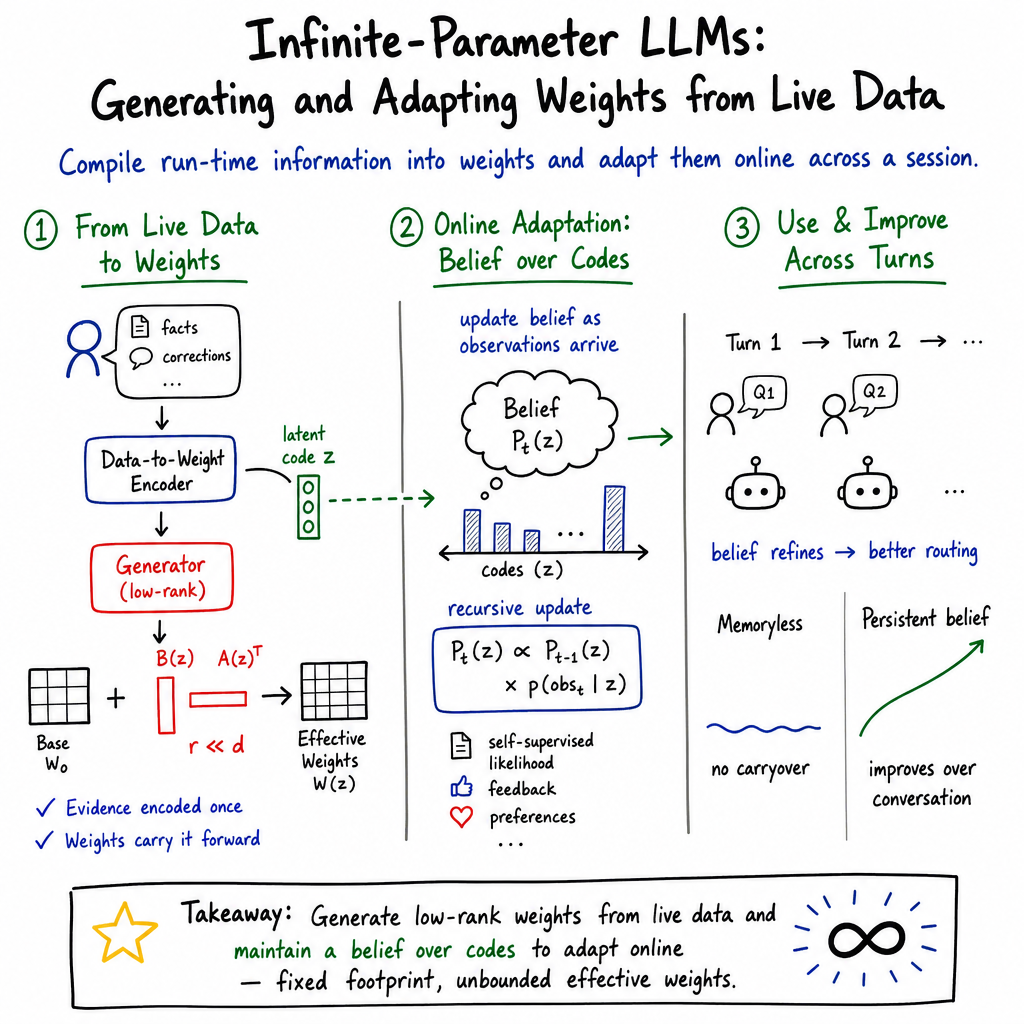
Abstract: The scaling laws hold that a LLM grows more capable with more parameters and more training data, and Mixture-of-Experts (MoE) architectures have ridden these laws to remarkable results, activating only a fraction of an enormous stored parameter bank for each token. That success is built on static pretraining data. A deployed model faces a different world, where much of the data that would make it more useful is not in its training set but in the live interaction it is currently handling, such as the facts a user supplies or the corrections they give. A conventional model cannot learn from this data, because its weights are frozen after training. Instead, the knowledge and behaviour supplied at run time are placed in the prompt, by retrieval or instruction, and re-read on every request only to be discarded once the request ends. We ask how an architecture could learn from live interaction by writing it into its weights. Taking inspiration from MoE, we propose the \textbf{Infinite-Parameter LLM}. A compact hypernetwork turns the data given at run time into a low-rank modulation of a shared base network, so the feed-forward weights are generated from live data rather than stored in a fixed bank. Where prior weight generators read the context once and freeze, we carry a Bayesian belief over the generator's latent code and update it online, so the effective weight is re-derived from that evolving belief as the session proceeds rather than fixed after one read. The stored footprint stays fixed, yet the weights the model can compile are effectively infinite. For the knowledge and behaviour supplied at run time, carrying them in the weights rather than the prompt is amortized in compute, frees the context window, persists across turns, and can generalise better than in-context use. We specify an evaluation protocol that tests exactly this against in-context learning and retrieval.
Paper Prompts
Sign up for free to create and run prompts on this paper.
Top Community Prompts
Explain it Like I'm 14
1. What is the paper about?
This paper proposes a new kind of LLM called an Infinite-Parameter LLM.
Today’s LLMs usually have fixed internal settings, called weights. These weights are learned during training and normally do not change when the model talks to a user. If a user gives the model a new fact or corrects it, the model can use that information only temporarily through the conversation’s prompt.
The paper asks:
Can a LLM turn information from a live conversation into temporary new weights, so it can learn and adapt while it is being used?
The authors propose a system that generates small changes to the model’s weights from the information provided during use. These changes can also be updated as the conversation continues.
The term “infinite-parameter” does not mean the model stores an unlimited amount of knowledge. Instead, it means the model can create a very large, potentially unlimited variety of temporary effective weights from a small, fixed set of stored components.
2. What questions are the researchers asking?
The paper focuses on several main questions:
- Can a model learn useful facts and instructions from a user during a conversation?
- Can it place this information in its weights instead of repeatedly putting it in the prompt?
- Can the model’s temporary weights change as new evidence arrives?
- Can this be done without storing a huge collection of expert networks?
- Is carrying information in temporary weights better than using:
- ordinary in-context learning,
- retrieval-augmented generation,
- or a model that generates its weights only once?
- Can the model adapt while avoiding harmful changes or forgetting too much?
In simple terms, the researchers want to build a model that can learn during a session without permanently retraining the entire model.
3. How does the proposed method work?
A basic LLM
A LLM has many numbers called weights. These numbers control how it processes words and predicts what comes next.
Normally, these weights are fixed after training. The model can read new information, but the information stays in the prompt rather than becoming part of the model’s internal behavior.
Mixture-of-Experts as inspiration
The paper is inspired by Mixture-of-Experts, or MoE, models.
An MoE model contains many smaller expert networks. For each word, a routing system chooses only a few experts to use. This is like having a large group of specialists and asking only the most relevant specialists to answer each question.
For example:
- one expert might be good at mathematics,
- another at grammar,
- and another at science.
However, ordinary MoE models must store all of these experts. They are also fixed after training.
Generating experts instead of storing them
The proposed model does not keep a large bank of stored experts. Instead, it has:
- A normal shared model, called the base network.
- A small generator, sometimes called a hypernetwork.
- A short internal code that describes the current information or task.
- A system for updating that code during the conversation.
The generator uses the code to create a small adjustment to the base model’s weights.
A useful analogy is a basic music player with an equalizer:
- The base model is the music player.
- The generated weight changes are like adjusting the equalizer.
- The user’s information determines how the equalizer is adjusted.
- The model can keep changing the settings as the conversation develops.
The base model remains the same, but its behavior can be changed for the current task.
Low-rank changes
The paper uses low-rank weight changes. This means the model does not rewrite all of its weights. It creates a much smaller adjustment that can still influence the model’s behavior.
This is similar to adding a small attachment to a large machine rather than rebuilding the entire machine.
If the original weight is represented by , the new weight is described as:
Here:
- is the shared base weight,
- is the short code representing the current information,
- is the small adjustment created from that code.
The adjustment is made using smaller pieces, which saves computing power and memory.
Updating a belief about the code
A major idea in the paper is that the model does not use only one fixed code. Instead, it keeps a belief about which code is most suitable.
This belief is like a set of guesses with confidence levels:
- “There is a 70% chance that this information is important.”
- “There is a 20% chance that the user wants this style.”
- “There is only a 10% chance that this detail should affect the answer.”
As the conversation continues, the model updates these confidence levels.
The authors describe this as a form of Bayesian filtering. In everyday language, this means:
- Start with an initial guess.
- Observe new information.
- Update the guess.
- Keep the useful information and reduce the importance of information that seems unreliable.
This allows the model’s temporary weights to change during a session instead of being created once and then frozen.
What part of the model changes?
The proposal changes mainly the model’s feed-forward networks, or FFNs. These are parts of a transformer that process information after the attention mechanism has gathered context.
The attention system itself is left unchanged. This keeps the method more focused and limits the amount of extra computation.
4. What are the main findings?
The paper is mainly a proposal and design description. It explains the architecture, compares it with earlier ideas, and presents an evaluation plan. The supplied text does not report a complete set of experimental results with final numerical scores.
Still, the paper makes several important claims about what the method is designed to achieve.
The model can create many temporary experts
Because the generator can produce weight adjustments from a continuous code, it can create many different effective experts without storing each one separately.
This is why the authors call the system “infinite-parameter.” The stored model remains a fixed size, but the number of possible temporary versions is very large.
This does not mean the model has unlimited memory. The model still has limited capacity, and the temporary adaptation is intended to be small and controlled.
Information can be carried in weights instead of the prompt
Normally, if a user tells a model a new fact, that fact must remain in the prompt for the model to use it repeatedly.
The proposed method attempts to compile the fact into a temporary weight adjustment. This could have several benefits:
- the fact does not need to be repeated in every prompt,
- less space is used in the context window,
- the model can use the information more efficiently,
- the information can remain available across multiple turns.
For example, if a user explains a fictional world to the model, the model could use that information through its temporary adapted weights instead of rereading the entire explanation each time.
The model can adapt during a session
Earlier weight-generating systems usually read a task description once and create one fixed adapter. The proposed system is different because it updates its internal belief as new messages arrive.
This could help when:
- the user corrects the model,
- new facts are introduced,
- the task changes slightly,
- the model becomes more certain about what the user wants.
The method may use memory more efficiently
The model does not need to keep a huge bank of expert networks in memory. It stores only the base model, the generator, and a small amount of information about the current code.
This could make dynamic adaptation less expensive than storing many full experts.
The paper proposes careful comparisons
The authors plan to compare their system with:
- ordinary prompting,
- in-context learning,
- retrieval-augmented generation,
- one-time weight generators,
- test-time training,
- and standard stored-expert MoE models.
These comparisons are important because the goal is not simply to create a complicated model. The real question is whether putting information into temporary weights is better than simply leaving the information in the prompt.
5. Why are these ideas important?
Current LLMs have an important limitation: they can respond to new information, but they usually cannot truly learn from it while they are being used.
For instance, a model might be told:
“In this story, the character Maya is afraid of water.”
It can use this fact while the sentence remains in its context. But if the context is removed, the model may no longer remember it. The proposed method aims to place the information into temporary model behavior so that it can last throughout a session.
This could be useful for:
- personalized assistants,
- tutoring systems,
- medical or technical support,
- software agents,
- long-running projects,
- interactive fiction,
- and systems that learn from user corrections.
The model might also become better at following a user’s preferred writing style or solving a particular kind of problem without needing the same instructions repeated again and again.
6. Limitations and challenges
The paper also makes clear that this approach does not solve every problem.
It does not create unlimited knowledge
“Infinite-parameter” refers to the number of possible temporary weight configurations, not unlimited storage. The model still has a limited ability to represent information.
The model might learn the wrong thing
If the user provides false, confusing, or harmful information, the model might adapt in an undesirable way. The belief system is meant to help by tracking uncertainty, but this problem still requires testing.
The model could forget or change too quickly
A system that adapts rapidly may become unstable. It might overreact to one message or lose useful information. This is known as the stability–plasticity problem:
- Plasticity means being able to learn new things.
- Stability means keeping important old behavior.
A good system needs both.
Extra computation is still required
Although the generated adjustments are small, the model must still process new information and update its internal belief. This may make it more complicated or slower than a standard LLM.
The proposed benefits need experimental proof
The paper presents a strong architectural idea, but the crucial evidence must come from experiments. The model needs to show that it performs better than prompts, retrieval, and other adaptation methods under similar memory and computing limits.
Conclusion
This paper proposes a LLM that can create and update temporary weight changes from information received during a live conversation.
Its main ideas are:
- generate temporary experts instead of storing a huge expert bank,
- use small low-rank changes to modify a shared base model,
- represent the current task with a short internal code,
- maintain uncertainty about that code,
- and update the code as the conversation continues.
If successful, this approach could make LLMs more personalized, efficient, and capable of learning during use. Instead of repeatedly showing a model the same facts or instructions, users could provide the information once, and the model could adapt its behavior for the rest of the session.
However, the approach still needs careful testing to determine whether it truly outperforms simpler methods and whether it can adapt without becoming unstable or learning incorrect information.
Knowledge Gaps
Knowledge gaps, limitations, and open questions
- No empirical results are reported. The paper proposes an evaluation protocol but does not provide experiments, numerical results, statistical tests, or evidence that the architecture improves over in-context learning, retrieval, one-shot weight generation, test-time training, or stored-bank MoE baselines.
- The proposed method is not specified completely enough for reproduction. The provided text ends during the method description and does not establish the final encoder architecture, generator parameterisation, belief-update equations, training objective, optimisation procedure, or all implementation details.
- The claimed advantage over prompting remains unverified at matched compute and memory budgets. It is unclear whether compiling information into weights is actually more accurate, cheaper, faster, or more context-efficient than keeping the same information in the prompt or an external retrieval system.
- The computational cost of the live-data encoder is not quantified. Processing the supplied data, generating adapter parameters, maintaining beliefs, and updating them may offset or exceed the proposed per-token savings from not rereading the prompt.
- The latency and throughput impact of per-token expert generation is unknown. The paper gives asymptotic costs for applying a low-rank delta but does not measure end-to-end serving latency, batching efficiency, GPU utilisation, memory bandwidth, or scaling with sequence length and batch size.
- The practical meaning of “infinite parameters” is not experimentally established. A continuous latent space can contain infinitely many codes, but the paper does not determine how many distinct, useful, and reliably separable behaviours can be realised under finite numerical precision, generator capacity, training data, and optimisation constraints.
- The effective capacity of the low-rank modulation is unclear. The paper does not establish which ranks, latent dimensions, number of adapted layers, or generator architectures are sufficient for factual knowledge, behavioural adaptation, multi-step reasoning, or domain transfer.
- The interaction between the shared base FFN and generated low-rank deltas is unexplored. It remains unknown whether the deltas provide genuinely new representational directions or mostly rescale and perturb capabilities already available in the base model.
- The proposed Bayesian belief may be poorly calibrated. No evidence is provided that the posterior over latent codes accurately represents uncertainty, that uncertainty estimates correlate with prediction error, or that posterior means or modes produce better weights than point estimates.
- The recursive Bayesian filter is not shown to be a valid approximation to the intended posterior. The paper does not specify the likelihood, transition model, variational family, approximation error, or conditions under which the amortized update is stable and accurate.
- The source and semantics of the online evidence are underspecified. It is unclear whether updates use user-provided facts, input tokens, model-generated tokens, rewards, corrections, task outcomes, or likelihood signals, and how these heterogeneous evidence types are combined.
- The method may learn from incorrect or adversarial live data. The paper does not address fact verification, source reliability, prompt injection, poisoning, malicious corrections, or mechanisms for preventing false information from being compiled into the weights.
- The distinction between user facts and model hallucinations is unresolved. If generated outputs or hidden states drive per-token updates, the model could reinforce its own errors through self-conditioning or self-training.
- Catastrophic forgetting within and across sessions is not evaluated. The paper claims bounded and reversible adaptation but does not show whether later updates overwrite earlier facts, whether unrelated behaviours are disrupted, or whether information persists appropriately across turns.
- Retention and forgetting schedules are not defined sufficiently. The proposed uncertainty-gated retention and process-noise mechanisms require concrete rules, hyperparameters, and tests across short, long, interrupted, and multi-session interactions.
- Conflicting information handling is unexplored. The method does not explain how it should represent contradictory user statements, changing facts, multiple sources with different reliability, or context-dependent truths.
- Session isolation and privacy guarantees are absent. The paper does not specify how adapted beliefs are stored, reset, encrypted, shared, or prevented from leaking between users, sessions, tenants, or tasks.
- The persistence claim is ambiguous. It is unclear whether adaptations persist only within a request, across turns in a session, across sessions, or across deployments, and what storage and consistency mechanisms are required for persistent beliefs.
- The method’s behaviour under long sessions is unknown. Recursive posterior updates may accumulate numerical error, become overconfident, drift away from the prior, or degrade as the number of turns or tokens grows.
- The effect of update cadence is not established. The paper proposes contextual, per-turn, and per-token updates but provides no comparison of their accuracy, stability, cost, or susceptibility to noise.
- The method may introduce train–test mismatch. The paper does not clarify whether training exposes the model to the same sequence of live corrections, partial observations, delayed feedback, and online distribution shifts encountered at inference.
- The training procedure for online adaptation is unspecified. It remains unclear how the generator, encoder, filter, and base model are jointly or separately trained, what supervision is used, and whether the model is trained on realistic sequential interaction trajectories.
- The required training data for the generator is unknown. The paper does not establish whether a generator trained on synthetic tasks, supervised demonstrations, instruction data, or static corpora can generalise to arbitrary user-provided facts and behaviours.
- The model’s ability to generalise beyond the adapted data is unverified. Claims that generated weights may generalise better out of distribution are inherited from related work rather than demonstrated for the proposed online, recursively updated architecture.
- The risk of memorisation by the hypernetwork is not quantified. The paper identifies memorisation as a known failure mode but does not test whether the encoder reproduces training examples, fails on compositional combinations, or leaks sensitive input data.
- The scope of adaptation is unclear. The paper does not establish whether the method can learn only stylistic or task-specific behaviour, or whether it can reliably encode factual knowledge, procedures, novel concepts, tool-use policies, and multi-step skills.
- Attention is left unchanged without showing that this is sufficient. Many forms of adaptation may require changes to retrieval, token interactions, or long-range state tracking; the paper does not compare FFN-only adaptation with adaptation of attention or other components.
- The choice of FFN-only low-rank updates is not justified empirically. There is no ablation against attention adapters, full-layer adapters, multiplicative modulation, larger-rank updates, or full test-time fine-tuning.
- The effect of generated weights on calibration and safety is unknown. Online modulation may alter confidence, refusal behaviour, factuality, toxicity, bias, or instruction hierarchy, but these effects are not measured.
- No mechanism is given for preserving pretrained capabilities. The paper claims that the base anchors adaptation, but does not quantify degradation on general-language, reasoning, coding, multilingual, safety, or domain benchmarks after live updates.
- The interaction with the residual stream and layer normalisation is unexplored. Generated FFN deltas may cause activation-scale shifts or instability, especially when applied across multiple layers or repeatedly updated beliefs.
- The stability of generated weights is not demonstrated. Small changes in the latent code could produce large changes in the low-rank factors, causing output discontinuities or unpredictable behaviour; the paper does not impose or evaluate smoothness, Lipschitzness, or trust-region constraints.
- The relationship between posterior uncertainty and safe adaptation is unresolved. High uncertainty might indicate that more evidence is needed, but it might also arise from distribution shift, ambiguity, or adversarial inputs; the proposed gating policy is not validated.
- The categorical and continuous belief variants are not compared. The paper presents both Gaussian continuous codes and categorical posteriors over materialised codes but does not determine which is preferable in capacity, scalability, calibration, or robustness.
- The claim that the expert set is unbounded does not imply unbounded useful diversity. The paper does not measure the number of functionally distinct experts, the coverage of the reachable weight manifold, or whether different latent codes collapse to similar behaviours.
- The effects of finite precision and quantisation are unexamined. The architecture’s continuous latent-space argument may weaken under quantised inference, low-precision adapter generation, and hardware-specific numerical constraints.
- No scaling law is established for the proposed architecture. It is unknown how performance changes with base-model size, generator size, latent dimension, rank, number of adapted layers, amount of live data, and number of online updates.
- The evaluation protocol does not yet establish realistic deployment conditions. The paper needs tests involving noisy user corrections, delayed outcomes, changing tasks, multi-turn dialogue, multiple users, long documents, retrieval errors, and limited latency or memory budgets.
- Baseline comparability is unresolved. Fair comparisons require equalised input information, context length, trainable parameters, inference FLOPs, latency, external-memory access, adaptation data, and persistence duration; the paper does not specify how these factors will be controlled.
- The method is not compared against strong contemporary alternatives for persistent memory. External memory systems, recurrent state-space models, test-time training, fast-weight methods, retrieval with reranking, parameter-efficient continual learning, and hybrid prompt-plus-adapter systems require systematic evaluation.
- The claimed amortized compute benefit is not demonstrated over repeated requests. Any advantage depends on the cost of compiling the data being amortized across enough subsequent tokens or turns; the break-even point is not analysed.
- The storage requirements for beliefs and generated states are unspecified. Although the resident parameter footprint is fixed, persistent per-user or per-session latent states may grow with the number of users and sessions.
- The method’s multi-user scalability is unknown. A shared generator may be fixed-size, but serving many users with distinct evolving beliefs could create substantial state-management, caching, scheduling, and memory costs.
- No theoretical guarantees are provided for continual adaptation. The paper does not establish convergence, bounded drift, forgetting bounds, posterior consistency, stability under recursive updates, or guarantees that updates remain close to the pretrained model.
- The proposed architecture may not outperform simpler adapter conditioning. It remains open whether a conventional recurrent memory, learned prefix, cached encoder representation, or dynamically selected LoRA can achieve the same benefits with lower complexity.
- The causal role of weight compilation is not isolated. Improvements could arise from additional computation, an auxiliary encoder, extra hidden state, or longer effective processing rather than from carrying information in generated weights; controlled ablations are needed.
- The claim that weight-carried knowledge frees the context window is incomplete. The model may still need the original evidence for verification, disambiguation, attribution, or future updates, and the paper does not test whether removing that evidence harms reliability.
- The effect on interpretability and attribution is unresolved. It is unclear how to identify which live data caused a particular generated-weight change or output, making debugging, auditing, correction, and regulatory explanation difficult.
- Reversibility is asserted but not operationalised. The paper does not show how to remove a specific fact or behaviour from a generated latent belief without affecting unrelated information.
- No evaluation of selective forgetting or data deletion is provided. This is important for privacy requirements, user corrections, changing permissions, and legal deletion requests.
- The paper does not establish whether online adaptation improves sample efficiency. The number and type of corrections or examples needed to induce reliable behaviour are unknown, as is the comparison with ordinary few-shot prompting.
- The effect of adaptation on output diversity and mode collapse is unknown. Generated deltas may over-specialise the model to a user or task, reducing useful generality and increasing repetitive or brittle responses.
- The proposal’s benefits for factual recall versus reasoning are not separated. Weight compilation may help repeated recall of supplied facts but not reasoning over relations among them; separate evaluations are needed.
- The paper does not test compositionality of multiple adaptations. It remains unclear whether facts, instructions, demonstrations, and corrections can be combined without destructive interference or whether independently generated adaptations can be merged.
- Cross-lingual and multimodal applicability is unaddressed. The architecture is presented for decoder-only LLMs, with no evidence about multilingual live data, code, images, audio, or heterogeneous evidence sources.
- The practical deployment boundary between adaptation and fine-tuning is unclear. The paper does not define when a persistent live-learning update should be promoted to offline training, discarded, reviewed, or isolated from the base model.
- Safety and governance procedures for autonomous adaptation are missing. A deployed system needs policies for update approval, rollback, monitoring, provenance, audit logs, and human oversight, none of which are specified.
- The novelty claim requires broader empirical and bibliographic validation. Because the proposal combines several existing components and cites concurrent work with overlapping goals, the distinct contribution of the particular low-rank generator-plus-Bayesian-filter coupling remains to be demonstrated experimentally rather than primarily through positioning.
Practical Applications
Immediate Applications
The paper is primarily a proposed architecture and evaluation protocol rather than a validated production system. Therefore, the following immediate applications should be understood as prototype-level deployments that can be implemented using existing hypernetworks, low-rank adapters, Bayesian filtering, and test-time adaptation techniques, subject to empirical verification.
- Session-level personalization for conversational assistants — Software, customer service, productivity
- Compile a user’s preferences, terminology, formatting conventions, and corrections into a low-rank adapter instead of repeating them in every prompt.
- A running belief over the latent code could update the assistant after each turn, allowing it to retain preferences throughout a session while remaining reversible.
- Potential product: a personal assistant with “temporary learned preferences,” such as preferred writing style, meeting format, coding conventions, or accessibility settings.
- Dependencies: reliable detection of explicit user consent, strong isolation between users, safeguards against malicious instructions, and mechanisms for forgetting or resetting sensitive information.
- Long-document and multi-turn document analysis — Legal, finance, research, enterprise software
- Convert information from a contract, technical manual, policy document, or research corpus into generated FFN-side adapter weights.
- Subsequent questions could be answered without repeatedly placing the full document into the context window.
- This may reduce context-window pressure and inference costs for repeated queries over the same source.
- Potential workflow: document ingestion → data-to-weight encoding → adapter validation → repeated question answering or summarization.
- Dependencies: factual retention must be tested against retrieval-augmented generation; the system must provide provenance because compiled weights may obscure which document passage produced an answer.
- Temporary task and workflow adaptation — Enterprise software, coding, education
- Encode task instructions, demonstrations, schemas, or output examples into a session-specific adapter.
- Applications include adapting a general model to a company’s ticket taxonomy, a laboratory’s reporting format, a school’s grading rubric, or a software project’s coding conventions.
- Unlike conventional fine-tuning, the adaptation could be created at inference time and discarded after the task.
- Dependencies: the low-rank latent space must be expressive enough for the target behavior; adaptation must not degrade general capabilities or cause instruction conflicts.
- Context-window reduction for repeated interactions — Cloud AI infrastructure
- Use generated weights to amortize the cost of repeatedly reading the same instructions, demonstrations, or facts.
- This is most useful when the same information supports many subsequent generations in a session.
- Potential tool: an inference server that maintains a temporary posterior over latent codes and applies a generated low-rank delta to selected FFN layers.
- Dependencies: the cost of the encoder and adapter generation must be lower than the cost of repeated prompt processing; memory management and batching support would be required.
- Personalized coding assistants — Software engineering
- Learn project-specific APIs, naming conventions, architecture patterns, test requirements, and developer corrections during a coding session.
- The system could modify its generated weights as the developer accepts, rejects, or corrects suggestions.
- Potential product: a project-local coding assistant whose temporary adapter is derived from repository documentation and live code-review feedback.
- Dependencies: generated knowledge must remain grounded in the current repository; unsafe code generation, stale project assumptions, and cross-project information leakage must be controlled.
- Adaptive educational tutoring — Education
- Encode a learner’s demonstrated misconceptions, preferred explanation style, current curriculum, and teacher-provided examples into a temporary adapter.
- Per-turn or per-token Bayesian updates could allow the tutor to adjust difficulty as evidence about the learner accumulates.
- Potential workflow: diagnostic questions → latent learner-state update → personalized explanation or exercise generation.
- Dependencies: educational outcomes must be measured rather than inferred from fluency alone; student data requires privacy protections, and the model should not permanently label or overfit to temporary mistakes.
- Interactive research assistants — Academia and scientific computing
- Compile a project’s terminology, hypotheses, experimental protocols, and evolving findings into session-specific weights.
- The assistant could become specialized to a research project without requiring full model retraining.
- Potential tool: a laboratory notebook assistant that updates its temporary model state as experiments and corrections are recorded.
- Dependencies: scientific claims need source tracking and independent verification; Bayesian adaptation over latent codes does not guarantee calibrated uncertainty about the underlying facts.
- Rapid domain adaptation for small and edge models — Mobile, embedded systems, private enterprise deployments
- A compact base model could generate task-specific low-rank modulations without storing a large expert bank.
- This may be useful where memory is limited but the device receives a stable stream of local instructions or user data.
- Potential products: offline field-service assistants, local industrial copilots, or personalized on-device language interfaces.
- Dependencies: the encoder and generator must fit device compute and memory budgets; on-device privacy, quantization compatibility, and latency require benchmarking.
- Prototype infrastructure for comparing prompt-based and weight-based memory — Academia and AI engineering
- Implement the paper’s proposed evaluation protocol to compare:
- in-context learning,
- retrieval-augmented generation,
- one-shot generated adapters,
- test-time training,
- stored-bank MoE,
- and online Bayesian latent-code adaptation.
- Evaluate matched context, parameter, latency, and compute budgets on knowledge retention, behavioral adaptation, out-of-distribution generalization, forgetting, calibration, and reversibility.
- Dependencies: fair budget matching is essential, especially because encoder computation and adapter-generation costs may otherwise be omitted.
- Policy and governance experiments for reversible model memory — Public policy, safety, enterprise governance
- Use the proposed reversible, bounded adaptation mechanism to study alternatives to permanent fine-tuning and unrestricted persistent memory.
- Policies could distinguish temporary session learning from durable model updates and require explicit approval before a generated adapter is retained.
- Potential governance tool: adapter-level audit, expiration, rollback, and user-controlled deletion.
- Dependencies: generated weights must be inspectable or at least attributable enough for auditing; reset operations must actually remove the relevant information.
Long-Term Applications
These applications depend on evidence that the proposed online Bayesian adaptation improves over prompting and retrieval under realistic compute, accuracy, safety, and robustness constraints.
- Continual-learning personal agents — Consumer software and enterprise automation
- An agent could accumulate preferences, successful workflows, corrections, and outcome information across sessions while keeping its base model fixed.
- The generated latent state could function as a reversible, low-dimensional personal memory rather than a permanent model update.
- Potential product: a long-lived executive, household, or business operations assistant that adapts to its user and environment.
- Dependencies: reliable long-term memory consolidation, protection against catastrophic interference, secure user separation, retention policies, and defenses against poisoned interaction data.
- Adaptive healthcare decision-support systems — Healthcare
- A system could adapt to a hospital’s protocols, a clinician’s workflow, patient-specific terminology, and local documentation practices.
- Online uncertainty estimates might help determine when new evidence should modify the generated adapter and when the current behavior should be retained.
- Potential workflow: local protocol ingestion → temporary adapter generation → clinician-supervised updates from corrections and outcomes.
- Dependencies: extensive clinical validation, regulatory approval, calibrated uncertainty, provenance, human oversight, privacy compliance, and strict limits on autonomous adaptation. The paper provides no evidence that the method is safe for diagnosis or treatment.
- Robotics and embodied agents that learn from interaction — Robotics and industrial automation
- A robot could compile task instructions, environmental descriptions, operator corrections, and observed outcomes into changing low-rank policies or language-planning behaviors.
- The model could specialize to a household, warehouse, laboratory, or production line without storing a separate full model for every environment.
- Potential product: an instruction-following robot that learns local procedures during deployment.
- Dependencies: real-time latency, sensor grounding, safe exploration, distribution shift, recovery from erroneous updates, and formal safety constraints. Language-level adaptation alone is insufficient for reliable physical control.
- Multi-tenant adaptive AI services with fixed infrastructure — Cloud computing
- A provider could serve many users or organizations using one shared base model and dynamically generated tenant-specific adapters rather than permanently storing a separate expert bank.
- The fixed resident footprint could simplify deployment while allowing per-tenant behavior and terminology.
- Potential architecture: shared base model + tenant-isolated latent posterior + ephemeral generated FFN modulation.
- Dependencies: strict isolation in GPU memory and caches, resistance to cross-tenant leakage, scheduling of encoder and generation costs, and verification that adapter states cannot be reconstructed by unauthorized users.
- Domain-specific AI without conventional fine-tuning — Finance, law, engineering, science
- Organizations could generate temporary domain behavior from current regulations, internal procedures, or project data, reducing the need for repeated parameter-efficient fine-tuning cycles.
- The approach could support rapidly changing domains in which permanent model updates become obsolete quickly.
- Dependencies: high-quality domain data, robust out-of-distribution generalization, version control for generated states, and validation against authoritative sources. The paper explicitly acknowledges that the method does not remove the base model’s capacity limits.
- Adaptive financial analysis and compliance assistants — Finance
- A system could incorporate current regulatory rules, institution-specific policies, and analyst corrections into a temporary adapter for a reporting or compliance session.
- Online adaptation might help maintain consistent terminology and procedural behavior as the analyst supplies feedback.
- Dependencies: auditability, deterministic reproducibility, resistance to adversarial financial data, strict separation between factual adaptation and unauthorized decision-making, and formal compliance validation.
- Agents that learn from outcomes rather than only instructions — Autonomous software agents
- The architecture could use task outcomes, tool results, user corrections, and verifier feedback to update a latent code during execution.
- This would extend adaptation beyond static retrieval or demonstrations toward outcome-conditioned behavior.
- Potential workflow: plan → act → observe result → update posterior → revise future actions.
- Dependencies: trustworthy outcome signals, prevention of self-reinforcing errors, careful credit assignment, and safeguards against learning undesirable shortcuts.
- Dynamic expert generation for multilingual and cross-cultural systems — Translation, localization, communication tools
- Live data could compile terminology, style guides, local conventions, and domain-specific translation preferences into temporary generated weights.
- A single base model could support many specialized language or localization settings without a permanently stored expert bank for each one.
- Dependencies: adequate multilingual capacity in the base model, protection against culturally inappropriate adaptation, evaluation across dialects, and avoidance of encoding transient user bias as general behavior.
- Long-lived scientific or industrial digital twins — Energy, manufacturing, infrastructure
- A model could continually adapt to a facility’s changing terminology, operating procedures, maintenance history, and observed outcomes.
- Generated weights could support low-latency interaction with a stable local operational context.
- Potential product: an adaptive maintenance or process-control assistant linked to equipment telemetry and operator feedback.
- Dependencies: trustworthy sensor data, temporal consistency, integration with control systems, cybersecurity, explainability, and strict separation between advisory language generation and safety-critical control.
- A general framework for bounded, uncertainty-aware model memory — AI research and policy
- The paper’s belief-over-code formulation could become a common interface for reversible memory, combining:
- a data-to-weight encoder,
- a generated low-rank adapter,
- an online posterior,
- uncertainty-gated retention,
- and explicit reset or forgetting operations.
- This could unify research on hypernetworks, fast weights, test-time training, continual learning, and Bayesian adaptation.
- Dependencies: empirical evidence for calibrated posterior estimates, stable recursive updates, resistance to catastrophic forgetting, and benchmarks that measure both beneficial adaptation and harmful memory formation.
- Foundation models with effectively unbounded behavioral reach, but bounded storage — General-purpose AI research
- If the proposed mechanism scales, one fixed model could generate a very large continuous family of task-specific effective weights on demand.
- This could replace some forms of stored expert specialization with a compact generator and live data pathway.
- Dependencies: the term “infinite-parameter” must not be interpreted as unlimited knowledge or capacity. The generated family remains constrained by the base model, generator size, latent dimension, rank, training distribution, and numerical precision. Demonstrating useful scaling, rather than merely an unbounded mathematical parameterization, remains an open research question.
Glossary
- Amortized Bayesian filter: A learned approximation that performs Bayesian state updates efficiently during inference. “by an amortized recursive Bayesian filter”
- Amortized compute: Computational cost distributed across repeated uses so that later operations become cheaper. “Carrying the data in the weights, rather than re-reading it from the context on every token, is amortized in compute”
- Autoregressive stream: A sequential generation process in which each output depends on previously generated tokens. “the running hidden state, equivalently the realised output, of the autoregressive stream”
- Bayesian belief: A probability distribution representing uncertainty about an unknown variable or model state. “we carry a Bayesian belief over the generator's latent code”
- Bayesian hierarchical mixture of experts: A probabilistic mixture-of-experts model whose expert-selection structure is represented hierarchically. “Bayesian hierarchical mixtures of experts”
- Catastrophic forgetting: The loss of previously learned information when a model is trained on new information. “its failure mode, catastrophic forgetting”
- Conditional computation: A neural-network strategy in which only input-dependent portions of a model are activated for each input. “the conditional-computation construction”
- Continuous latent code: A real-valued hidden representation used to control generated model parameters. “a continuous generated family”
- Convex hull: The set of all weighted averages of a collection of points or parameter vectors. “confining each token's effective weight to the convex hull of a fixed atom set”
- CP factorisation: A tensor-decomposition method that represents a high-dimensional tensor as a sum of rank-one tensors. “factorises a fixed weight tensor”
- Decoder-only transformer: A Transformer architecture that uses only decoder-style self-attention, typically for autoregressive generation. “We build on a standard decoder-only transformer”
- Dirichlet-process gate: A gating mechanism based on a Dirichlet process, allowing a theoretically unbounded number of mixture components. “nonparametric infinite MoE via a Dirichlet-process gate”
- Distillation: Training a smaller or simpler model to reproduce the behaviour of a larger teacher model. “Distillation, where we use it, is an enabling training choice”
- Dynamic-weight tensor: A tensor of neural-network weights whose values depend on the input. “the dynamic-weight-tensor view treats any layer whose weights are an input-dependent function”
- Entmax gate: A sparse probability-mapping function used to assign input-dependent weights to experts. “routed by a differentiable entmax gate”
- Extended Kalman filtering: A recursive Bayesian estimation method for nonlinear dynamical systems. “low-rank extended Kalman filtering”
- Fast weights: Neural-network parameters or temporary states that are updated rapidly during processing. “Adapting weights at inference descends from fast-weight programmers”
- Forward-only adaptation: Model adaptation performed during ordinary forward inference rather than through backpropagation-based optimization. “so adaptation is bounded and reversible rather than a permanent consolidation”
- Generative expert architecture: A model design that creates expert parameters dynamically instead of storing separate expert networks. “A generative expert architecture and its design space”
- Hypernetwork: A neural network that generates the weights or parameter updates of another neural network. “Hypernetworks generate a target network's weights”
- Intrinsic dimension: The minimum number of degrees of freedom needed to represent meaningful variation in a high-dimensional system. “task adaptation occupies subspaces of strikingly low intrinsic dimension”
- In-context learning: The ability of a pretrained model to perform a task using examples or instructions supplied in the input context without changing its weights. “In-context learning conditions a frozen model on instructions or a few demonstrations”
- Low-rank adaptation: Parameter-efficient adaptation that represents a weight update using matrices of substantially lower rank than the original weight matrix. “Low-rank or vector experts over a shared base”
- Low-rank modulation: A low-dimensional parameter update applied to an existing neural-network weight matrix. “a low-rank modulation of that base”
- Latent variable: An unobserved variable inferred from observed data and used to represent hidden structure. “we therefore treat the code as a latent variable”
- Laplace approximation: A method for approximating a probability distribution, commonly a posterior, with a Gaussian centered near its mode. “Bayesian posteriors over low-rank adapters are tractable (Laplace-LoRA”
- Mixture-of-Experts (MoE): A neural architecture containing multiple expert subnetworks with an input-dependent mechanism that selects or combines only some of them. “A Mixture-of-Experts model stores a large bank of expert sub-networks”
- Nonparametric model: A model whose effective complexity is not fixed in advance and can grow with the available data. “nonparametric infinite MoE”
- Online learning: Learning in which a model updates incrementally as new data arrives. “Continual and online learning study exactly the problem of updating a model over time”
- Posterior: A probability distribution representing updated beliefs after incorporating observed evidence. “carry a calibrated posterior over the generating latent code”
- Product-key memory: A memory mechanism that retrieves entries using combinations of keys, enabling efficient access to very large memory banks. “built on product-key memory”
- Quantisation: The reduction of numerical precision used to represent model parameters or activations. “resident memory is reduced by quantising and decoding experts on the fly”
- Recursive Bayesian inference: Sequential updating of a probability distribution as new evidence becomes available. “updated online by recursive Bayesian inference”
- Residual stream: The sequence of hidden representations passed through successive Transformer layers, usually by residual connections. “which already integrates context through the layer's attention and the residual stream”
- Retrieval-augmented generation: A method that retrieves external information and supplies it to a generative model as additional context. “retrieval-augmented generation fetches relevant text into the context”
- Sparsely-gated mixture of experts: A mixture-of-experts architecture in which a gating network activates only a small subset of experts for each input. “Sparsely-gated MoE realised this at scale”
- Stability--plasticity trade: The tension between preserving existing knowledge and remaining able to learn new information. “The framing: our uncertainty-gating is a stability--plasticity controller”
- Tensor-Ring factorisation: A tensor-decomposition technique that expresses a tensor through a cyclic sequence of lower-dimensional factors. “a single CP- or Tensor-Ring-factorised weight tensor”
- Test-time training: Updating a model during inference, often using self-supervised objectives derived from the current input. “Test-time training updates weights by self-supervised gradient steps”
- Variational continual learning: A continual-learning approach that maintains and updates an approximate posterior over model parameters or latent states. “our online update is recursive Bayesian filtering (variational continual learning”
- Weight generator: A network that produces the parameters or parameter updates of another network from input data. “The weight generators that turn a context into an adapter do so once”
- Weight modulation: The alteration of existing neural-network weights using an input-dependent signal or generated update. “the same family as an additive or multiplicative weight modulation from a code”

