Local Langlands functoriality for Yu's supercuspidals II: Fargues--Scholze's parametrization
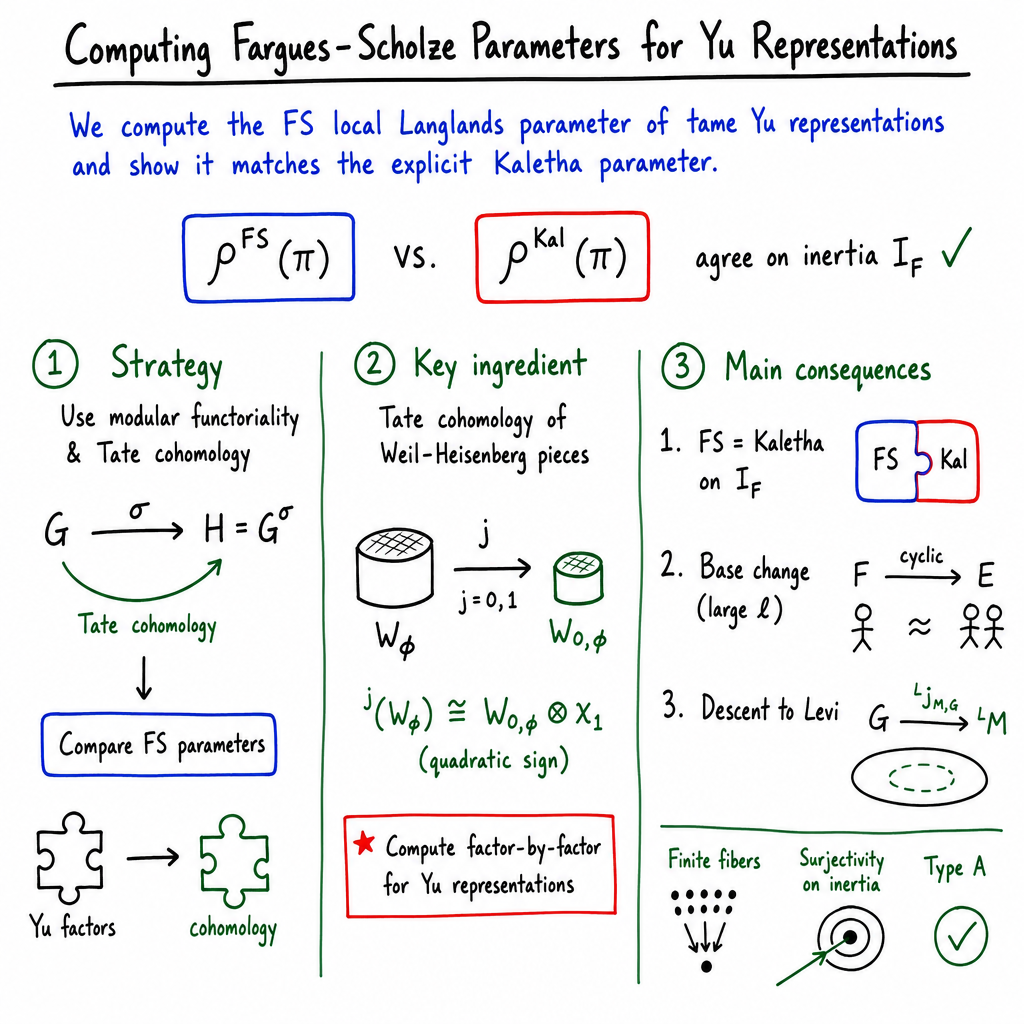
Abstract: This is the second of two papers dedicated to the explicit computation of the Fargues--Scholze correspondence. We compute the Tate cohomology of cuspidal representations arising from Yu's construction. Combining this with modular functoriality in the Local Langlands Correspondence, and the partial characterization of the Local Langlands Correspondence established in the first paper, we compare the Fargues--Scholze and Kaletha parametrizations. Among the consequences (and under an assumption expected to be supplied in forthcoming work), we deduce that the Fargues--Scholze correspondence has finite fibers and is surjective onto inertial L-parameters.
Paper Prompts
Sign up for free to create and run prompts on this paper.
Top Community Prompts
Explain it Like I'm 14
1. What is this paper about?
This paper studies a major idea in modern mathematics called the Local Langlands Correspondence. This correspondence tries to connect two different kinds of objects:
- Representations: ways of describing the symmetries of a mathematical group.
- L-parameters: ways of describing how information about a number system changes when we move around it.
A rough analogy is a translation dictionary. One side contains complicated symmetry objects, and the other side contains algebraic descriptions that are often easier to study.
The paper focuses on a particular version of this dictionary, called the Fargues–Scholze correspondence, and compares it with another explicit version developed by Kaletha. The authors investigate representations constructed using a method called Yu’s construction, which produces many important examples of complicated, or “cuspidal,” representations.
The main goal is to check whether the two correspondences give the same answers.
2. What questions are the authors asking?
The paper asks several closely related questions:
- Do the Fargues–Scholze and Kaletha methods assign the same L-parameter to the same representation?
- Can the authors calculate the part of an L-parameter that describes ramification? Ramification measures how strongly a number system behaves differently after passing to a more complicated extension.
- What happens when representations are changed by a process called base change? Base change is similar to studying the same object after moving to a larger number system.
- Can every suitable L-parameter be obtained from some representation?
- Do only finitely many representations correspond to one given Fargues–Scholze parameter?
- Can one recognize whether a representation is “non-singular” by looking at whether its L-parameter is irreducible?
In everyday language, the authors want to know whether this mathematical translation system is:
- accurate,
- complete,
- reasonably one-to-one,
- and compatible with natural ways of changing the objects.
3. How did they investigate these questions?
The paper is theoretical rather than experimental. The authors do not collect data from an experiment. Instead, they prove mathematical statements using several connected tools.
Representations and L-parameters
A representation is a way a group can act on a vector space. It is like describing all the ways a set of symmetries can move objects around.
An L-parameter is a homomorphism from a group related to a local number system into a special algebraic group called an L-group. It records how arithmetic information is transformed.
The authors compare two ways of producing these parameters:
- the Fargues–Scholze construction;
- the Kaletha construction.
They often compare only the parameter’s restriction to inertia, which records the part of the arithmetic behavior that remains after ignoring ordinary, unramified movement. One can think of this as studying the “local twisting” while temporarily ignoring the larger-scale motion.
Yu’s construction
Many of the representations studied in the paper are built using Yu’s construction. This method combines simpler pieces in stages, somewhat like building a complicated machine out of smaller components.
The authors calculate what happens to these representations under a process called Tate cohomology.
Tate cohomology
Tate cohomology is a mathematical tool for studying objects that have a symmetry. It compares the parts that remain fixed under the symmetry with the parts that can be written as a kind of “difference” caused by that symmetry.
A simple analogy is examining a spinning object:
- some features stay unchanged when the object spins;
- other features cancel out or repeat;
- Tate cohomology helps record what survives this process.
The paper carefully calculates Tate cohomology for:
- tensor products,
- Weil–Heisenberg representations,
- and representations made using Yu’s construction.
Modular functoriality
The authors also use modular functoriality. This describes how parameters change when one moves between related groups, especially after reducing calculations modulo a prime number.
This is similar to studying a complicated calculation using different number systems, such as clock arithmetic. Surprisingly, information that looks limited after this reduction can reveal important facts about the original problem.
The authors combine information from several primes. They use a mathematical “independence of ” principle to piece together results obtained modulo different primes and recover information in characteristic zero.
Base change and descent
The paper also studies:
- base change, where the number field is replaced by a larger field;
- descent, where information is transferred from a larger or more complicated group to a smaller related group;
- spectral endoscopy, a special situation involving centralizers and related groups.
These methods allow the authors to reduce difficult problems to smaller or more manageable ones.
4. What are the main findings?
The paper’s central result is that the two parameter constructions agree in the situations considered.
Agreement between the two correspondences
For the representations studied, the Fargues–Scholze parameter agrees with the parameter predicted by Kaletha, at least on inertia. Under stronger conditions, the agreement holds for the entire parameter.
In particular:
- If the torus associated with the representation is maximally unramified, the two parameters agree on inertia.
- If the representation is also non-singular, the full parameters agree.
- Under a stated modular-functoriality assumption, the inertial parameters agree more generally.
- After passing to a suitable finite unramified extension, the full parameters agree for non-singular representations.
This is important because the Fargues–Scholze construction is very general, while Kaletha’s construction is more explicit. Showing that they agree confirms that the abstract theory matches detailed calculations.
Non-singularity and irreducibility
The paper proves that, assuming the needed modular-functoriality result,
a representation is non-singular exactly when its Fargues–Scholze parameter is irreducible.
Here, irreducible means that the parameter cannot be broken into smaller independent pieces. This gives researchers a way to recognize a property of a representation by examining its parameter.
Finite fibers
The authors show that the Fargues–Scholze correspondence has finite fibers. This means that only finitely many representations can produce the same parameter.
This does not mean the correspondence is perfectly one-to-one, but it does mean that one parameter cannot come from infinitely many unrelated representations.
Preservation of depth
The correspondence also preserves depth. Depth measures how complicated or deeply ramified a representation is.
So, roughly speaking, representations that are more complicated in a certain arithmetic sense are sent to parameters that show the same level of complexity.
Surjectivity onto inertial parameters
The authors prove that every irreducible inertial L-parameter comes from some irreducible smooth representation, under their assumptions.
In simpler terms, the parameter side is not missing the important objects: suitable parameters can be reached from the representation side.
Functoriality and base change
The paper proves new compatibility results for base change, especially for cyclic extensions of large prime degree. It also studies how parameters behave when passing to certain smaller related groups.
These results help show that the Fargues–Scholze correspondence behaves naturally when the underlying mathematical setting changes.
Special case: groups related to
For groups that become similar to after an unramified extension, the authors obtain a particularly strong result: for non-singular cuspidal representations, the complete Fargues–Scholze and Kaletha parameters agree without needing to pass to a further extension.
5. Why are these results important?
The Local Langlands Correspondence is expected to connect representation theory and number theory in a deep and organized way. But proving that different versions of the correspondence really describe the same objects is difficult.
This paper provides evidence that:
- the Fargues–Scholze correspondence is giving the expected answers;
- explicit formulas developed by Kaletha match the more abstract Fargues–Scholze theory;
- the correspondence respects important operations such as base change;
- its parameters do not lose essential information;
- and the parameter side is sufficiently complete and controlled.
The work is also notable because it uses ideas from positive characteristic, even though some of the final results concern characteristic-zero objects. This is like solving a difficult problem about ordinary numbers by temporarily studying it using clock arithmetic, then combining the resulting clues.
6. What could this research lead to?
The results may help mathematicians build a complete Local Langlands Correspondence for more groups and more kinds of representations.
Possible future effects include:
- making the correspondence easier to calculate explicitly;
- extending the theory to cases with stronger or wilder ramification;
- improving the understanding of representations of groups such as , , symplectic groups, and unitary groups;
- supporting broader versions of the categorical Local Langlands program;
- and proving that the remaining conditional parts of the work hold without extra assumptions.
Some conclusions currently depend on a hypothesis about modular functoriality, especially for cyclic base change at all primes . The authors expect future work to establish this hypothesis more generally. Once that happens, many of the paper’s results should become unconditional.
Overall, the paper strengthens the idea that two different mathematical “translation systems”—the Fargues–Scholze and Kaletha parametrizations—are describing the same underlying structure. That makes the Local Langlands Correspondence more trustworthy, more understandable, and potentially useful for solving further problems in number theory and representation theory.
Knowledge Gaps
Knowledge gaps, limitations, and open questions
The paper establishes substantial comparisons between the Fargues–Scholze and Kaletha parametrizations, but the stated results remain conditional and concentrated on specific classes of groups and representations. The main unresolved issues are:
- Unconditional modular functoriality is not established for all primes . The principal comparison theorems and their consequences depend on Hypothesis~\ref{hyp:modular-functoriality}; a proof covering small and non-banal primes is deferred to forthcoming work.
- The results are restricted to groups that split after a tamely ramified extension and satisfy . It remains unclear how the comparison behaves for groups with more complicated wild splitting or when the residue characteristic divides the order of the absolute Weyl group.
- The full Fargues–Scholze parameter is not generally identified with the Kaletha parameter. For non-singular representations, the comparison is only proved after restriction to in general; determining whether $\rho^{\FS}(\pi)\sim\rho^{\Kal}(\pi)$ over all of remains open outside special cases such as type .
- The integer controlling the field restriction is not optimized or systematically characterized. Although depends on the image of in and is effective in principle, the paper does not provide general sharp bounds, an intrinsic interpretation, or an algorithm for computing it across reductive groups.
- The explicit comparison is limited primarily to cuspidal representations arising from Yu’s construction. It remains to extend the calculation to cuspidal representations produced by other constructions, especially in small residue characteristic and for representations with more wildly ramified behavior.
- Cyclic base change of degree is not handled in the generality needed for broader wild constructions. The paper identifies the extension of the small-degree base-change theorem to especially ramified degree- extensions as a major unresolved technical obstacle.
- The behavior of the correspondence for groups and representations outside the tame Yu setting is not determined. In particular, the paper does not establish whether the same Tate-cohomological and modular-functorial methods apply to all small- constructions such as those associated with Bushnell–Kutzko, Stevens, or related theories.
- The relation between Tate cohomology and modular functoriality is not yet formulated as a general theorem. The paper proves the required compatibility in several specific finite and -adic settings, but the precise categorical or representation-theoretic framework governing this phenomenon remains unexplored.
- The role of the sign characters is only partially conceptualized. The paper traces one component of the FKS sign character to Weil–Heisenberg Tate cohomology and another to discrepancies between -embeddings, but it does not provide a complete intrinsic derivation of the full sign character in all cases.
- The dependence on semisimplification is not fully resolved. Several modular-functoriality statements identify parameters only after semisimplification, leaving open whether the Fargues–Scholze correspondence preserves finer non-semisimple or monodromy data.
- The characteristic-zero information recovered from congruences is not completely understood. The argument uses modular reductions at multiple primes and independence-of- results, but the extent to which this method can recover integral structures, extension data, or finer parameter invariants remains unclear.
- The paper proves surjectivity only onto inertial restrictions of irreducible parameters. It does not establish surjectivity onto full irreducible -parameters over in the general setting.
- The structure of Fargues–Scholze fibers remains largely unknown. Finite fibers are proved conditionally, but their cardinalities, dependence on depth and central characters, and relation to expected -packets are not determined.
- Depth preservation is established under the paper’s hypotheses but not explained geometrically. A conceptual relation between depth on the representation-theoretic side and ramification breaks or slope data of the Fargues–Scholze parameter remains to be developed.
- The expected description of Fargues–Scholze -packets is not proved in full generality. The paper deduces that packets attached to irreducible parameters consist of non-singular cuspidal representations, but it does not determine packet multiplicities, internal parametrizations, or character identities.
- Compatibility with established classical local Langlands correspondences remains incomplete. The results imply compatibility in several classical cases, but a systematic comparison with the correspondences for all classical groups, their inner forms, and non-split variants is not provided.
- The extension from inertial compatibility to compatibility with Frobenius and monodromy is incomplete. Agreement on inertia, or after restriction to a finite unramified extension, does not determine the full Weil-group parameter without additional control of Frobenius actions.
- The impact of coefficient changes is not fully analyzed. The paper treats - and -coefficients, but it does not completely clarify how parameters vary over integral coefficient rings or how reduction modulo interacts with L-packets and singularity.
- The generality of the group-theoretic finiteness results is not connected to explicit classification data. The abstract bounds on finite subgroups and parameter images are not converted into concrete bounds or classifications for particular root systems, residue characteristics, or families of reductive groups.
- The incomplete manuscript text leaves some technical claims and proofs unverifiable. The supplied paper terminates during the proof of a finiteness lemma and contains malformed LaTeX and missing material, so the validity and scope of later arguments cannot be independently assessed from the provided text alone.
Practical Applications
Immediate Applications
The paper is primarily a foundational work in local representation theory and the Local Langlands Correspondence. Its results do not directly produce consumer products or operational tools, but they support concrete mathematical workflows in computational representation theory, number theory, and related academic research.
- Explicit computation of Fargues–Scholze parameters for Yu-type supercuspidal representations — Mathematical software / academia The comparison
provides a practical procedure for computing the inertial part of the Fargues–Scholze parameter of a broad class of cuspidal representations. A symbolic implementation could accept: - a reductive group , - a Yu datum or associated torus-character pair , - residue characteristic , - coefficient characteristic ,
and return the predicted inertial -parameter using Kaletha’s explicit construction and the relevant -embedding.
Dependencies: must satisfy the stated tameness assumptions, including splitting over a tamely ramified extension and , unless later sections of the paper remove those restrictions. The comparison also depends on modular functoriality hypotheses for cyclic base change in the relevant coefficient characteristics.
- Verification and cross-checking of Local Langlands parametrizations — Academia / computational number theory
The paper gives a way to compare three descriptions of the same representation:
- the Fargues–Scholze parameter;
- the Kaletha parameter;
- where available, a classical parameter for groups such as inner forms of or unitary groups.
This can be used as a consistency test for databases, formal calculations, and future implementations of the Local Langlands Correspondence.
Dependencies: Classical correspondences must already be known for the group under study, and comparisons may initially hold only after semisimplification, on inertia, or after restriction to a finite extension .
- Depth-preserving classification workflows — Representation theory / software The result that preserves depth can be incorporated into classification algorithms. Given a cuspidal representation constructed through Moy–Prasad and Yu data, one can use its depth as an invariant of the associated -parameter. This helps organize representations and parameters into finite-depth strata.
A potential workflow is: 1. compute the Moy–Prasad depth of ; 2. construct the associated inertial parameter; 3. attach the same depth to the parameter; 4. search only within the corresponding depth stratum.
Dependencies: The theorem is established under the paper’s hypotheses, including the modular-functoriality assumption. It also concerns the classes of representations covered by the stated correspondence results.
- Finite-fiber searches for representations with a prescribed parameter — Mathematical databases / academia
- enumerating candidate members of an -packet;
- testing uniqueness or multiplicity conjectures;
- organizing computational tables of supercuspidal representations.
Dependencies: “Finite fibers” does not by itself provide an efficient enumeration algorithm or an explicit uniform bound. Additional data concerning packets, component groups, and representation construction are required.
- Modular base-change calculations — Arithmetic geometry / representation theory The paper supplies explicit constructions of representations over cyclic extensions whose parameters behave compatibly with restriction:
in the situations covered by the theorems. This can be used to build test cases for cyclic base change and to reduce parameter computations to fields where the torus or group has a simpler structure.
Dependencies: The degree of the extension, the ellipticity of the base-changed torus, the coefficient characteristic, and the validity of modular-functoriality hypotheses are all significant. The results are not a general-purpose base-change theorem for arbitrary representations.
- Inductive calculations through unramified twisted Levi subgroups — Academic research workflow The descent result identifies a representation of a proper unramified twisted Levi subgroup whose parameter maps to that of the original representation under
This yields a recursive strategy: - replace a parameter for by one for a smaller group ; - compute the smaller parameter; - recover the original parameter through the -embedding.
Dependencies: The relevant torus must satisfy the paper’s non-total-ramification condition, and the existence of the required representation is theorem-specific rather than universal.
- Improved training and reference material for graduate education — Education / academia
- the Local Langlands Correspondence;
- -adic representation theory;
- reductive groups over local fields;
- modular representation theory;
- arithmetic geometry.
Dependencies: The material is highly specialized and presupposes substantial background in algebraic groups, -adic groups, and -groups. It is not immediately suitable for general mathematical or nontechnical training.
Long-Term Applications
The following applications require further theoretical development, explicit algorithms, larger computational datasets, or removal of the paper’s conditional hypotheses.
- A general-purpose Local Langlands computation engine — Mathematical software / symbolic computation
- Bruhat–Tits building and Moy–Prasad filtration data;
- Yu datum construction;
- Deligne–Lusztig representations;
- Tate cohomology;
- Weil–Heisenberg representations;
- spectral endoscopy;
- Kaletha and Fargues–Scholze parameter comparison.
Such a tool could support explicit calculations for groups including , , symplectic groups, orthogonal groups, and unitary groups.
Dependencies: The relevant constructions must be fully formalized algorithmically, including sign characters, -embeddings, coefficient changes, and ramification data. The conditional modular-functoriality hypothesis must become unconditional in the required range.
- Explicit determination of Fargues–Scholze -packets — Representation theory / arithmetic geometry
- classify non-singular cuspidal representations;
- compute packet members;
- relate packet size to component groups;
- compare Fargues–Scholze packets with classical packets.
Dependencies: Parameter irreducibility must be made computationally testable, and the relationship between the Fargues–Scholze parametrization and packet multiplicities must be established more completely.
- Surjectivity-based construction of representations from inertial data — Number theory / arithmetic geometry
- existence algorithms for representations with specified ramification;
- systematic construction of test cases for local reciprocity;
- controlled families of representations with prescribed wild inertia behavior.
Dependencies: The theorem guarantees existence under stated assumptions but does not necessarily provide an efficient constructive algorithm. Extending the result beyond Yu-type or tame settings, especially to highly ramified and small- cases, remains necessary.
- Extension to small residue characteristics and more wildly ramified representations — Arithmetic representation theory The authors indicate that their strategy may extend to constructions beyond Yu’s framework, including settings relevant when is small, such as , and to more wildly ramified representations. A successful extension could substantially enlarge the range of groups and representations for which Fargues–Scholze parameters are explicitly computable.
Dependencies: The most difficult identified issue is controlling small-degree, particularly degree-, cyclic base change for ramified extensions. Additional work is also needed on modular Tate cohomology, wild ramification, and the behavior of sign characters.
- Support for the categorical Local Langlands program — Geometric representation theory / academia
- categorical decompositions indexed by -parameters;
- compatibility between sheaf-theoretic and representation-theoretic categories;
- inductive constructions through Levi subgroups;
- control of supports and depth in categorical parameter spaces.
Dependencies: The paper does not itself prove the categorical correspondence. Further compatibility with Eisenstein series, parabolic induction, and geometric constructions is required.
- Automated verification of functoriality and endoscopy diagrams — Formal mathematics / software engineering
- compatibility of -embeddings;
- conjugacy of parameter constructions;
- restrictions under cyclic extensions;
- descent to twisted Levi subgroups;
- sign-character identities.
Dependencies: The underlying algebraic geometry and representation theory must first be represented in machine-checkable libraries. This is a long-term formalization project rather than an immediately deployable software application.
- Applications to global automorphic problems — Automorphic forms / number theory
- identifying local components of global automorphic representations;
- analyzing ramification in automorphic Galois representations;
- testing local factors in automorphic -functions;
- supporting global functoriality conjectures.
Dependencies: A local parameter computation alone does not establish global automorphy or global functoriality. Additional trace-formula, patching, and compatibility results are required.
- No direct consumer, healthcare, finance, energy, or daily-life application The paper’s objects—Weil groups, -groups, Tate cohomology, reductive -adic groups, and supercuspidal representations—are theoretical mathematical structures. There is no evidence in the paper for an immediate application to healthcare, finance, robotics, energy systems, consumer technology, or ordinary daily-life workflows. Any such application would be indirect, likely through advances in computational mathematics, formal verification, or cryptographic and arithmetic research rather than through a direct product derived from the stated theorems.
Glossary
- Abelianization: The quotient of a group by its derived subgroup, producing its largest abelian quotient. “$H_{\ab}=H/H_{\der}$ for its abelianization.”
- Adjoint quotient: The quotient of a reductive group by its center. “$H_{\ad}=H/Z(H)$ for its adjoint quotient.”
- Bruhat--Tits building: A geometric structure encoding the reduction-theoretic and subgroup structure of a reductive group over a local field. “We let denote the extended Bruhat--Tits building of over .”
- Centralizer: The subgroup or group scheme consisting of elements that commute with a specified subset. “If is a closed subscheme, then we denote by [...] the scheme-theoretic centralizer [...] of in .”
- Cohomology, Tate: A periodic cohomology theory for groups, especially finite cyclic groups, used here to study representations in modular settings. “We compute the Tate cohomology of cuspidal representations arising from Yu's construction.”
- Compact induction: A representation-theoretic induction procedure in which functions have compact support modulo the inducing subgroup. “We use $\ind$ for ordinary induction in finite or finite-index settings and $\cInd$ for compact induction.”
- Cuspidal representation: A representation that does not arise as a subquotient of parabolic induction from a proper Levi subgroup. “Let be an irreducible cuspidal -representation of .”
- Derived subgroup: The subgroup generated by commutators, measuring the nonabelian part of a group. “$H_{\der}$ for its derived subgroup.”
- Elliptic: In the context of L-parameters, a condition expressing that the parameter does not factor through a proper parabolic subgroup. “An L-parameter is irreducible if and only if it does not normalize any proper parabolic of $#1 G$. Such L-parameters are referred to as elliptic in \cite[Definition X.2.1]{FS}.”
- Endoscopy: A theory relating representations and L-parameters of reductive groups to those of associated auxiliary groups defined using centralizers in dual groups. “Thus, spectral endoscopy is endoscopy with the roles of the group and its dual group reversed.”
- Fargues--Scholze correspondence: A proposed form of the local Langlands correspondence arising from the geometry of the Fargues--Fontaine curve. “We compare the Fargues--Scholze and Kaletha parametrizations.”
- Frobenius twist: A modification of a representation or module obtained by applying a field’s Frobenius automorphism to its scalar structure. “$\Pi^{(\ell)}=\Pi\otimes_{k,\Fr_\ell}k$ is the coefficient Frobenius twist.”
- Functoriality: The transfer of representations or L-parameters between groups induced by a homomorphism of their L-groups. “The conclusion of Theorem~\ref{thm:II-intro-main-thm} is a consequence of \cite[Theorem~1.3.1]{CF26a}.”
- Glauberman correspondence: A correspondence relating invariant representations of a group with an automorphism to representations of an associated fixed-point subgroup. “We have to control the Tate cohomology of Deligne--Lusztig representations, which boils down to the link between Tate cohomology and the Glauberman correspondence.”
- Inertia subgroup: The subgroup of the Weil group acting trivially on the residue field of a local field. “We write for the Weil group of , for the inertia subgroup.”
- Inertial L-parameter: The restriction of an L-parameter to the inertia subgroup, recording its ramification behavior. “To any such representation we constructed an inertial L-parameter.”
- Langlands dual group: The complex or algebraic reductive group whose root datum is dual to that of the original group. “The Langlands dual group $#1{G}$ is regarded over .”
- L-group: A group combining a reductive group’s Langlands dual group with an action of the Weil or Galois group. “We write for the L-group of .”
- L-parameter: A homomorphism from a Weil-type group into an L-group that parametrizes representations. “For any such we also have a Fargues--Scholze parameter.”
- Moy--Prasad filtration: A filtration of the points and Lie algebra of a reductive group indexed by points in its Bruhat--Tits building and real depths. “For , the notations and refer to the Moy--Prasad filtration at .”
- Normalizer: The subgroup of elements that preserve a specified subgroup or subscheme under conjugation. “We denote by [...] the scheme-theoretic centralizer (resp.\ ) the scheme-theoretic [...] normalizer of in .”
- Parabolic induction: The construction of representations of a reductive group from representations of a Levi subgroup of a parabolic subgroup. “If is a parabolic -subgroup of [...] then we write [...] for normalized parabolic induction.”
- Reductive group: An algebraic group whose connected component has trivial connected unipotent radical. “We denote by a connected reductive group over .”
- Semisimplification: The process of replacing a representation or module by the direct sum of its composition factors. “$\rho^{\FS}(\Pi^{(\ell)}) \sim \bigl({}^L\psi\circ\rho^{\FS}(\pi)\bigr)^{ss}$.”
- Semisimple homomorphism: A homomorphism whose image is completely reducible in the relevant algebraic-group sense. “Recall the notion of semisimple homomorphism from \cite[\S 10.1]{CF26a}.”
- Smooth representation: A representation of a locally compact totally disconnected group in which every vector has an open stabilizer. “All representations and characters of are understood to be smooth unless otherwise stated.”
- Spectral endoscopy: A modular form of endoscopy involving centralizers of elements and reversed roles for a group and its dual group. “We refer to this situation as spectral endoscopy, and we call a spectral endoscopic group for .”
- Supercuspidal representation: An irreducible representation that does not occur as a subquotient of parabolic induction from a proper parabolic subgroup. “Such L-parameters are referred to as elliptic in \cite[Definition X.2.1]{FS} and supercuspidal in \cite[Definition 4.1.1]{Kal21b}.”
- Tame ramification: Ramification whose index is not divisible by the residue characteristic. “Throughout this introduction, we will assume that splits after a tamely ramified extension of .”
- Tannakian dual group: An algebraic group reconstructed from a tensor category of representations and its fiber functor. “In \S \ref{sec:spectral-endoscopy} we use the notation for the Tannakian dual group.”
- Torus: A group algebraically isomorphic over an algebraic closure to a product of multiplicative groups. “If is an -torus, then $T(F)_{\mathrm{b}$ denotes the maximal bounded subgroup of .”
- Twisted Levi subgroup: A Levi-type subgroup that becomes a Levi subgroup after a suitable field extension or twisting. “There exists a proper unramified twisted Levi -subgroup .”
- Unipotent radical: The largest connected normal unipotent subgroup of an algebraic group. “Let $#1 G_x$ [...] denote the quotient of the special fiber of [...] by the unipotent radical of its identity component.”
- Weil group: A group associated with a local field that encodes its arithmetic and Galois action. “We write for the Weil group of .”
- Wild inertia subgroup: The pro- subgroup of inertia governing wild ramification in a local field. “ for the wild inertia subgroup.”
- Yu’s construction: A method for constructing cuspidal representations of reductive -adic groups from filtered group data. “This paper is the second half of a two-paper series which aims to explicitly compute the Fargues--Scholze parameters, at least on inertia, for cuspidal representations arising from Yu's construction.”

