The -server conjecture is true
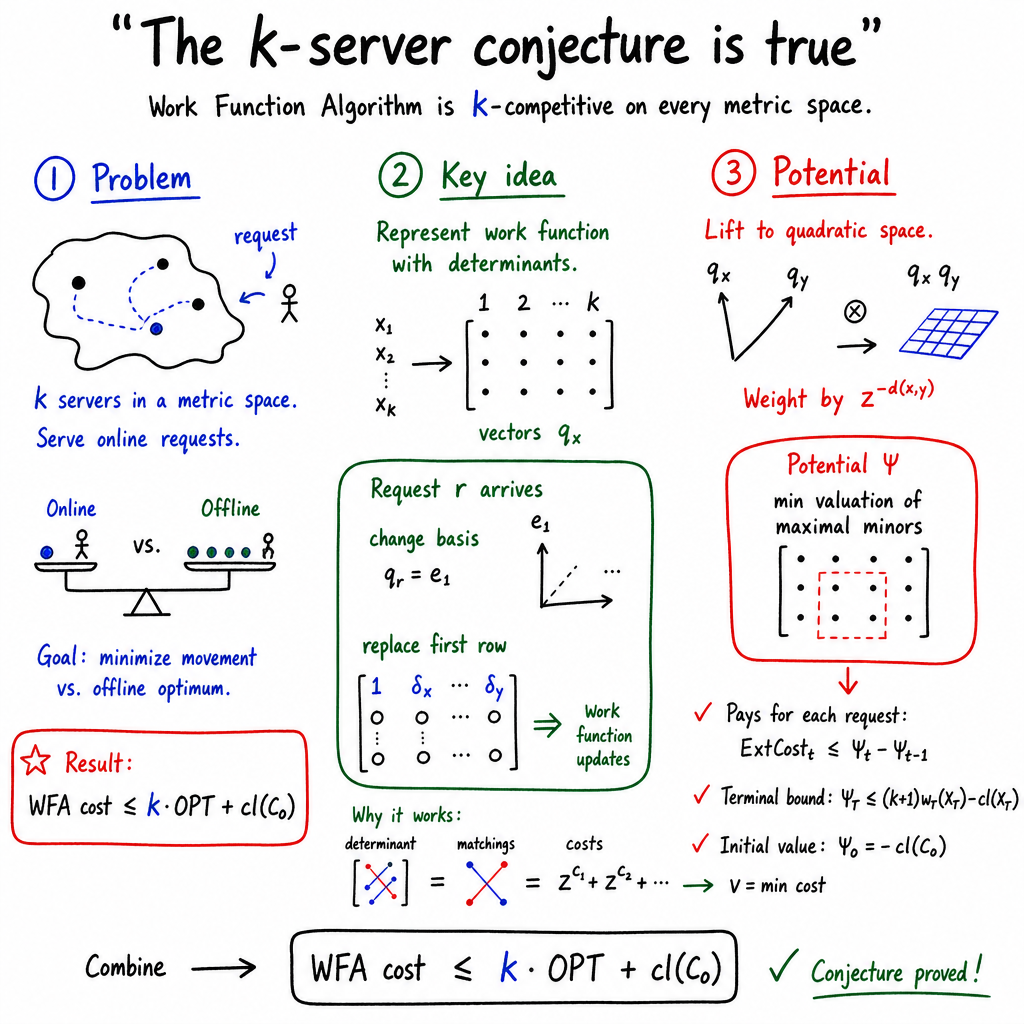
Abstract: The -server conjecture states that a deterministic online algorithm can achieve competitive ratio on every metric space. We prove the conjecture. Specifically, we show that the work function algorithm satisfies it. Our proof uses a natural algebraic representation of the work function as a matrix, which encodes all feasible paths to reach a configuration. In this representation, the minimum and addition operations arising in the definition of optimal costs correspond to addition and multiplication of formal expressions, and each work function value corresponds to the determinant of columns of the matrix. A request arrival updates the representation via a change of basis and row replacement. The amortized analysis is based on a potential function defined in terms of a larger matrix whose coordinates are pairs of coordinates of the original matrix representation.
Paper Prompts
Sign up for free to create and run prompts on this paper.
Top Community Prompts
Explain it Like I'm 14
1. What is the paper about?
The paper studies the -server problem, a famous problem in computer science.
Imagine that:
- There are delivery robots, or “servers,” placed in different locations.
- Customers make requests at different places.
- Whenever a request appears, one robot must move there.
- The robots do not know where future requests will be.
- The goal is to make the robots travel as little total distance as possible.
The paper claims to prove the long-standing -server conjecture. This conjecture says that an online strategy can perform at most times worse than a perfect strategy that knows the future.
The strategy studied is called the work function algorithm, or WFA.
2. What questions does the paper ask?
The main question is:
Can the work function algorithm always keep its total travel distance within times the cost of the best possible strategy that knows the future?
More specifically, the authors want to show that, for every possible map of locations and every sequence of requests,
The extra term depends only on the starting positions of the servers. It is
which means the sum of the distances between every pair of starting servers.
This extra amount is fixed at the beginning, so it becomes less important when the request sequence is long.
3. How does the research work?
The work function
The algorithm keeps track of a quantity called the work function.
For every possible arrangement of the servers, the work function asks:
What is the cheapest total distance needed to serve all requests so far and finish with the servers in this arrangement?
This is like keeping a scorecard for every possible ending position.
When a new request arrives, the algorithm updates all these scores. It then chooses the move that balances two things:
- The cost needed to reach a new arrangement.
- The work function value of ending in that arrangement.
In simple terms, WFA tries to avoid moving too far now while also keeping its future options good.
Comparing online and offline strategies
The authors compare WFA with an offline strategy. An offline strategy is allowed to see the entire request sequence in advance, so it represents the best possible performance.
This is a common way to study online algorithms. The comparison is called a competitive ratio:
A ratio of means that the online algorithm spends no more than times as much as the ideal strategy, apart from the small starting-position adjustment.
Replacing complicated minimums with algebra
The difficult part of the proof is showing that WFA really has this guarantee for every possible metric space.
The work function is updated using expressions involving:
- minimums,
- additions,
- and movement distances.
The authors transform these calculations into algebra involving vectors, matrices, and determinants.
A useful analogy is this:
- The ordinary work function keeps many possible travel plans and remembers the cheapest one.
- The authors encode all those plans inside a large mathematical table.
- Determinants of parts of the table reveal the cost of the cheapest plans.
They use a special formal symbol , whose exponent represents a travel cost. For example, a term such as represents a cost of 7. The smallest exponent in an expression represents the cheapest possible cost.
Extra symbolic letters are added so that two different travel plans cannot accidentally cancel each other out. This is similar to giving every possible route a unique label.
The potential function
The proof also uses a potential function. A potential function is like a stored amount of “credit” that changes over time.
The authors show that:
- Every time WFA pays to handle a request, the potential rises enough to pay for that cost.
- The potential cannot rise without limit.
- Its starting and ending values can be bounded using the costs of WFA and the best offline strategy.
This is similar to a bank-account argument: WFA may spend money during individual steps, but the proof shows that the algorithm has enough mathematical “credit” to cover those expenses overall.
The potential is built from products of pairs of vectors. These products form a larger space with
coordinates. The authors then study determinants of this larger matrix.
Although the algebra is highly technical, its purpose is simple: it provides a precise way to measure how much progress WFA has made and how much cost it has accumulated.
4. What are the main findings?
The paper’s main theorem states that for any finite request sequence,
Here:
- is the total movement cost of the work function algorithm.
- is the cost of the best strategy that knows the future.
- is the number of servers.
- is the extra starting-position term.
The important conclusion is that the WFA is -competitive on every metric space.
A metric space is simply a collection of locations with distances satisfying the usual rules:
- distances are never negative,
- a place is distance 0 from itself,
- distance works the same in either direction,
- and traveling through an intermediate place cannot be shorter than the direct distance.
Before this paper, the -server conjecture had been proved only for certain special settings, such as:
- two servers,
- line-shaped maps,
- tree-shaped maps,
- some small numbers of locations,
- and several other special cases.
The paper claims to handle all metric spaces at once.
5. Why is this important?
The result matters because the -server problem is a basic example of decision-making without knowledge of the future.
Many real-world situations have this structure:
- delivery vehicles responding to new orders,
- computer servers handling changing requests,
- robots moving around a building,
- caches deciding which information to keep nearby,
- and service workers traveling between locations.
The theorem says that the work function algorithm is not merely reasonable in certain simple maps. According to the paper, it has a strong worst-case guarantee even on very complicated maps.
The result is also theoretically important because the -server conjecture has been an open problem for many years. Proving it would complete a major goal in the study of online algorithms.
Simple overall summary
The paper argues that the work function algorithm is a reliable strategy for moving servers when requests arrive unexpectedly. It compares the algorithm with an imaginary perfect planner that knows all future requests.
Using a complicated but carefully designed system of matrices, determinants, and a potential function, the authors claim to prove that
If the proof is correct, it confirms the -server conjecture for all metric spaces and gives a general explanation of why the work function algorithm performs well even without knowing the future.
Knowledge Gaps
Knowledge gaps, limitations, and open questions
The paper establishes the deterministic -server conjecture for the work function algorithm, but leaves the following issues unresolved or insufficiently explored:
- Efficient implementability of the algebraic representation: The proof uses rational functions with exponentially many formal coefficient variables and repeated determinant-preserving basis changes, but does not provide a polynomial-time method for maintaining this representation or evaluating the resulting work function.
- Representation-size growth: It is unclear how the number, degree, and encoding size of the formal expressions evolve over a long request sequence, particularly after repeated inversions and row replacements.
- Practical computation of the potential: The potential is defined as a minimum over maximal minors of a large matrix, but no efficient procedure is given for computing it or even for approximating it.
- Numerical or symbolic stability: The proof relies on exact formal coefficients to prevent cancellation. It does not address whether the construction can be implemented with finite-precision arithmetic, randomized coefficients, or other computationally realistic substitutes.
- Explicit treatment of : The normalization lemma assumes , while the theorem is stated for arbitrary . The trivial case is not separately integrated into the formal proof.
- Dependence on finite request sequences: The construction introduces variables indexed by the full finite label set and request times. Its extension to infinite metric spaces or infinite request streams is not formalized beyond applying the result to finite prefixes.
- Infinite and continuous metric spaces: Although the theorem is stated for any metric space, the proof reduces to a finite set of initial and requested labels. The paper does not discuss whether additional issues arise for non-discrete spaces, nonattained minima, or configurations involving points outside the observed label set.
- Tie-breaking beyond the lazy implementation: The paper states that the result extends to any WFA tie-breaking rule, but the proof is written using a lazy trajectory and does not give a separate argument establishing this extension in detail.
- Tightness of the additive term: The bound
$\WFA_{C_0}(\sigma)\le k\,\OPT_{C_0}(\sigma)+\cl(C_0)$
leaves open whether the initial clique-weight term is necessary, whether it can be replaced by a smaller quantity, or whether it can be eliminated under alternative conventions.
- Tightness for specific metrics and sequences: The paper does not characterize request sequences or metric spaces attaining competitive ratio , nor does it determine whether the analysis is tight for all or only in worst-case families.
- Interpretation of the quadratic potential: The symmetric-square construction proves the required coefficient , but the paper does not establish whether this potential is unique, minimal-dimensional, or part of a broader hierarchy of useful algebraic potentials.
- Generalization to higher-order or other online problems: The relationship between determinant valuations, valuated matroids, and the quadratic potential is not developed into a systematic method for proving competitive bounds for weighted -server, generalized -server, -taxi, or other work-function algorithms.
- Weighted and generalized -server variants: The proof is specific to the unweighted configuration distance and ordinary metric triangle inequality. It does not determine whether an analogous determinant and symmetric-power construction works with server-dependent movement costs or generalized service constraints.
- Randomized algorithms: The result is deterministic and does not clarify whether the algebraic potential can contribute to improved randomized -server algorithms, especially in light of the unresolved gap between known randomized upper and lower bounds on general metrics.
- Competitive analysis against stronger adversaries: The consequences of the result under different adversarial models, including adaptive adversaries and distributional formulations, are not investigated.
- Beyond competitive ratio: The paper does not study resource augmentation, advice complexity, learning-augmented requests, smoothed analysis, or instance-dependent refinements of the -server bound.
- Empirical validation: No experiments compare the WFA, the algebraic representation, or the proposed potential with existing algorithms on finite metric instances, so the practical usefulness of the construction remains unknown.
- Verification of the formal proof: Given the intricate use of formal fields, determinant identities, freshness variables, and valuation inequalities, the paper does not provide a machine-checkable formalization or an independently reproducible verification of the central algebraic arguments.
Practical Applications
Immediate Applications
The paper’s main result is a deterministic, -competitive guarantee for the work function algorithm (WFA) on every metric space, up to an additive initialization term:
$\WFA(\sigma)\le k\,\OPT(\sigma)+\cl(C_0).$
This is primarily a theoretical result, but it supports several practical applications when the metric and number of servers are sufficiently small.
- Online caching and memory management — software systems
- Model cache contents as server locations in a uniform metric, where a request for an uncached object requires replacing another object.
- Implement WFA as a theoretically optimal deterministic baseline for small-cache or small-catalogue experiments.
- Use it to benchmark practical policies such as LRU, FIFO, or cost-aware eviction.
- Feasibility assumptions: the relevant state space must be finite and sufficiently small; direct computation of all work-function values is generally exponential in the number of locations and .
- Task dispatching and mobile-agent assignment — logistics and robotics
- Treat vehicles, robots, drones, or service agents as servers and customer/job locations as requests.
- Use the metric to represent travel time, energy consumption, or monetary movement cost.
- WFA can provide an online dispatching policy that reacts immediately to new requests without knowing future demand.
- Feasibility assumptions: movement costs should be well approximated by a metric, and the number of agents and candidate locations should be limited enough for work-function computation.
- Online network service placement — cloud and edge computing
- Represent service replicas, compute instances, or data-access points as server positions.
- Incoming user requests create a sequence of locations; moving or migrating a replica incurs a distance-dependent cost.
- A WFA-based controller can balance migration costs against future flexibility, using the work function as a summary of the best achievable cost for each placement configuration.
- Feasibility assumptions: migration costs must be stable enough to form a metric or pseudometric; latency, capacity, and heterogeneous server costs may require extensions beyond the exact theorem.
- Benchmarking online movement algorithms — industry and academia
- Use the result as a definitive deterministic benchmark for general-metric -server algorithms.
- Compare heuristic policies against:
- offline optimal cost,
- the -competitive upper bound,
- WFA’s actual cost,
- and specialized algorithms for lines, trees, paging, or weighted stars.
- The determinant-based representation provides an alternative implementation and verification framework for work-function updates in small instances.
- Feasibility assumptions: the bound is worst-case and does not imply that WFA is faster, simpler, or empirically superior to specialized heuristics.
- Educational tools for online algorithms and competitive analysis — academia
- Build interactive demonstrations showing:
- how work functions evolve after each request,
- how the WFA selects a configuration,
- how extended costs are charged to a potential,
- and how the competitive ratio depends on .
- The paper’s matrix and determinant representation can illustrate the connection between min-plus dynamic programming, valuated matroids, and tropical-style algebra.
- Feasibility assumptions: software should use small examples or symbolic computation, since the full state space grows rapidly.
- Deterministic baseline for online routing and fleet repositioning — transportation
- Model service vehicles or maintenance teams as servers and incidents as requests.
- Use WFA to produce a reproducible worst-case baseline for comparison with predictive or machine-learning dispatch systems.
- The guarantee is useful when future demand is adversarial, highly uncertain, or unavailable.
- Feasibility assumptions: real transportation systems often include time windows, vehicle capacities, asymmetric travel, and request priorities, none of which are directly covered by the basic -server model.
- Policy and infrastructure evaluation
- The theorem gives a formal guarantee for a broad class of online allocation problems: no deterministic policy based on this model can be forced to perform asymptotically worse than a factor relative to an offline optimum, and WFA achieves that factor.
- This can inform procurement and infrastructure studies involving a fixed number of movable resources.
- Feasibility assumptions: the policy interpretation requires the system to be faithfully reducible to server locations and movement costs; operational constraints may invalidate the reduction.
Long-Term Applications
The paper’s algebraic innovation—representing work-function values as valuations of determinants and using a quadratic-product potential—could support broader algorithmic developments, but these applications require substantial additional research and engineering.
- Scalable WFA implementations for larger and metric spaces — algorithms and software
- Develop compressed, sparse, approximate, or low-rank representations of the determinant-column state.
- Use these representations to avoid enumerating all configurations, whose number is approximately .
- A practical product could be an online resource-allocation engine with certified competitive guarantees for moderate-size systems.
- Dependencies: efficient evaluation of work functions, numerical or symbolic stability, tie-breaking rules, and methods for controlling state explosion.
- Approximate work-function algorithms with certificates
- The determinant representation may inspire approximation schemes that preserve enough of the valuation structure to retain provable performance bounds.
- Possible outputs include an approximate work-function oracle or a certificate that the current policy remains within a controlled factor of offline optimum.
- Dependencies: the paper relies on formal variables and exact valuation arguments; replacing them with floating-point arithmetic or approximate distances may break the cancellation and independence properties used in the proof.
- Extensions to heterogeneous and generalized server systems
- Adapt the method to:
- weighted servers,
- servers with different movement costs,
- asymmetric or directed networks,
- capacity-constrained resources,
- generalized -server problems,
- and -taxi or service systems.
- Such extensions could yield online algorithms for heterogeneous fleets, multi-tier cloud services, or workforce scheduling.
- Dependencies: the proof depends strongly on the metric structure, determinant identities, and the specific work-function recurrence. New models may require different algebraic representations or may not admit a -competitive bound.
- Online robotics with energy-aware motion planning — robotics and autonomous systems
- Replace ordinary distance with energy, battery usage, or risk-adjusted travel cost.
- Incorporate the method into multi-robot systems that must respond to unknown sequences of inspection, delivery, or rescue requests.
- The algebraic state could potentially support formal guarantees for adaptive repositioning.
- Dependencies: energy costs may be state-dependent, non-metric, time-dependent, or asymmetric; collision avoidance and continuous configuration spaces are outside the paper’s model.
- Cloud and edge orchestration with replica migration — distributed systems
- Generalize the server model to include replica placement, data locality, migration delay, and service-level objectives.
- A future WFA-derived controller could decide when to move replicas closer to demand and when to preserve current placement.
- Dependencies: replica placement is usually combinatorial and includes capacity, bandwidth, setup, and concurrency constraints. These must be incorporated without destroying the properties needed for the work-function analysis.
- New competitive algorithms for metrical task systems and related problems
- Since WFA already appears in metrical task systems, list update, matching, layered graph traversal, and convex body chasing, the determinant and symmetric-square techniques may transfer to other online optimization problems.
- Potential outcomes include improved competitive ratios, new potentials, or exact bounds for problem classes where current analyses are incomplete.
- Dependencies: transfer is not automatic. Each problem needs an appropriate configuration space, recurrence, algebraic lift, and potential-function inequality.
- Randomized online algorithms
- The deterministic result provides a strong reference point for studying whether randomization can improve performance on particular metric families or under different adversary models.
- The algebraic framework may help identify structure that can be randomized, for example by sampling configurations or perturbing work-function values.
- Dependencies: the paper does not prove a randomized result. Randomized guarantees depend on the adversary model, metric size, aspect ratio, and whether randomization is allowed in the state representation.
- Automated discovery and verification of competitive potentials — theorem proving and AI-assisted mathematics
- The paper’s potential is based on the symmetric square of the server-state representation. This suggests a broader workflow:
- 1. encode a work-function recurrence algebraically;
- 2. search for tensor, symmetric-power, or determinant-based potentials;
- 3. verify request-update inequalities symbolically or with computer-assisted proof.
- Such tools could support research on unresolved online-algorithm conjectures and generate formally checkable proof artifacts.
- Dependencies: automated searches may produce candidate inequalities without guaranteeing general validity. Human-guided invariant design, exact symbolic algebra, and independent proof verification remain necessary.
- Formal verification of online resource-allocation policies
- The explicit matrix updates and potential inequalities could be translated into proof assistants or certified optimization software.
- This could produce policies with machine-checkable guarantees for safety-critical applications such as emergency response, network resilience, or autonomous maintenance.
- Dependencies: formalization must handle rational-function fields, valuations, determinants, metric assumptions, and the potentially very large configuration space.
- Application to economic allocation and matching
- The paper connects work functions with valuated matroids, gross substitutes, and -concavity. Longer-term research could investigate online allocation mechanisms in which resources move between agents or markets.
- Potential tools include online matching or dynamic assignment systems with structural guarantees derived from valuated-matroid representations.
- Dependencies: economic allocation introduces incentives, strategic behavior, payments, and fairness constraints, none of which are addressed by the server model. Competitive movement cost alone is insufficient for mechanism-design guarantees.
- Daily-life resource management systems
- In the long term, similar ideas could support applications such as:
- repositioning shared bicycles or scooters,
- scheduling home-service workers,
- moving medical equipment between hospital units,
- coordinating charging stations or mobile batteries,
- and allocating a fixed number of delivery or repair resources.
- These systems could use WFA-inspired controllers as robust fallbacks when demand forecasts are unreliable.
- Dependencies: practical deployment requires real-time computation, noisy demand data, non-metric constraints, fairness considerations, and integration with predictive forecasting. The theorem supplies a worst-case movement-cost guarantee, not a complete operational policy.
Glossary
- Amortized analysis: An analysis method that distributes costs over a sequence of operations using a potential function. “The amortized analysis is based on a potential function defined in terms of a larger matrix”
- Basis change: Replacing one vector-space basis with another while preserving the represented mathematical objects. “Change the vector space basis so that is a base vector”
- Cramer’s rule: A method for expressing the solution of a linear system using ratios of determinants. “This is Cramer’s rule, and it gives”
- Clique weight: The sum of pairwise distances among all points in a configuration. “For a configuration , define its clique weight by”
- Competitive analysis: The study of online algorithms by comparing their performance with an optimal offline algorithm. “The -server problem, introduced by Manasse, McGeoch and Sleator~\cite{ManasseMS88}, is a central problem in competitive analysis.”
- Competitive ratio: The worst-case multiplicative factor by which an online algorithm’s cost exceeds the optimal offline cost. “The -server conjecture states that a deterministic online algorithm can achieve competitive ratio on every metric space.”
- Configuration: A set of locations occupied by the servers at a particular time. “A configuration is a -element subset of , representing the locations of servers.”
- Convex body chasing: An online problem in which an algorithm must select points from successively revealed convex sets while minimizing movement. “Moreover, work functions have been instrumental to advancements on convex body chasing”
- Determinant: A scalar associated with a square matrix that encodes properties such as linear dependence and volume scaling. “each work function value corresponds to the determinant of columns of the matrix.”
- Dynamic programming: A technique that solves problems by recursively combining solutions to overlapping subproblems. “It is well-known (see, e.g., \cite{Koutsoupias09}) that the work function can be computed online by dynamic programming”
- Extended cost: The maximum increase of any work-function value caused by a single request. “we bound the so-called extended cost .”
- Formal expression: A symbolic algebraic expression whose variables and operations are manipulated without assigning numerical values. “We introduce a novel approach which has been standard in the theory of valuated matroids”
- Formal sum: A finite sum of powers of a formal variable with coefficients from a specified field. “the set of formal sums of the form ”
- Fraction field: A field formed by taking ratios of elements of an integral domain. “We may form their fraction field”
- Fresh coefficient variable: An independent symbolic variable introduced to prevent cancellation between alternative algebraic terms. “The factors are distinct fresh variables”
- Gaussian elimination: An algorithm for solving linear systems and transforming matrices using elementary row operations. “Gaussian elimination gives an invertible matrix with .”
- Gross substitutes condition: An economic substitutability property related to the existence of Walrasian equilibria. “Kelso and Crawford~\cite{KelsoC82} introduced the closely related gross substitutes condition”
- Homogeneous polynomial: A polynomial whose monomials all have the same total degree. “It is a homogeneous polynomial of degree two.”
- Integral domain: A commutative ring with no zero divisors, allowing construction of a fraction field. “Therefore these finite sums have no zero divisors.”
- Lazy implementation: An implementation that delays or minimizes changes until they are necessary. “For simplicity, we assume here a lazy implementation”
- Matching: An assignment pairing elements of two sets, with an associated total cost. “The exponent of each term is the cost of a matching from to .”
- Maximal minor: The determinant of a square submatrix formed by selecting as many rows and columns as the matrix permits. “Define .”
- Metrical task system: An online problem in which states have movement costs and requests impose state-dependent service costs. “The -server problem further belongs to the class of metrical task systems”
- Min-plus recurrence: A recurrence using addition for combining costs and minimum for selecting the least-cost alternative. “Since the work function recurrence is defined by taking minimums of sums”
- Normalization: A transformation that puts a mathematical object into a standard form while preserving relevant properties. “Determinant-preserving normalization”
- Oblivious adversary: An adversary whose entire input sequence is fixed independently of an algorithm’s random choices. “randomized algorithms (against oblivious adversaries)”
- Online algorithm: An algorithm that must make decisions as input arrives without access to future input. “A deterministic online algorithm can achieve competitive ratio on every metric space.”
- Potential function: A quantity used to account for accumulated changes and bound the total cost of an algorithm. “there exists a potential function ”
- Pseudometric: A distance function that may assign distance zero to distinct elements. “Thus induces a pseudometric on ”
- Quasiconvexity: A structural property of a function related to valuated matroids and discrete convexity. “An important property of -server work functions is quasiconvexity”
- Rational function: A ratio of two polynomials whose denominator is nonzero. “Let be the field of rational functions over in all these variables.”
- Row replacement: Updating a matrix by replacing one row while leaving the remaining rows unchanged. “Equivalently, replace the first row of the entire column matrix”
- Symmetric square: The vector space generated by pairwise products of vectors, including products of a vector with itself. “The vector space of these quadratic polynomials is denoted .”
- Tropical geometry: A mathematical area studying algebraic structures in which addition is replaced by taking a minimum or maximum. “This relationship has since been further expanded by advances in tropical geometry”
- Valuation: A function assigning an algebraic object its lowest exponent or analogous measure of magnitude. “We can define the valuation of a formal sum to be the smallest exponent”
- Valuated matroid: A weighted generalization of a matroid satisfying valuated versions of matroid exchange properties. “We introduce a novel approach which has been standard in the theory of valuated matroids”
- Walrasian equilibrium: A market equilibrium in which prices and allocations simultaneously satisfy consumer optimization and market-clearing conditions. “the gross substitutes condition as a sufficient condition for the existence of Walrasian equilibria.”
- Work function: The minimum offline cost of serving all requests so far and ending in a specified configuration. “The work function is the function that maps a configuration to the minimum (offline) cost to serve the first requests and then move to configuration .”
- Work function algorithm: An online algorithm that chooses a configuration minimizing the current work-function value plus movement cost from the previous configuration. “The work function algorithm (WFA) serves the request at time in a configuration minimizing .”

