Loop-Back Authority in LLM Agent Teams: A Paired Experiment on Flat and Hierarchical Coordination
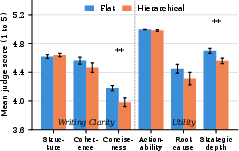
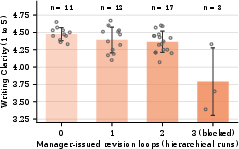
Abstract: Hierarchical orchestration, in which a Manager agent reviews worker output and can send it back for revision, is the default coordination pattern in production multi-agent LLM frameworks. Classical organizational theory predicts that the authority link speeds convergence on decisive output; work on sycophancy and Degeneration-of-Thought predicts that authoritative critique makes LLM output worse. Prior comparisons vary whole frameworks on tasks with checkable answers, leaving the authority link untested on open-ended work. We present a paired experiment that holds five LLM agents, their roles, prompts, tools, models, and data fixed and varies one link: whether the Manager may reject a worker's output and oblige a revision. Across 43 paired products and 86 runs of a business-intelligence reporting task, a five-model judge panel and a deterministic specification check score every report. The flat organization scores higher on Utility (d = 0.42, p = 0.009) and on Writing Clarity (d = 0.34, p = 0.030); the classical prediction fails. The reports are the same length, but hierarchical reports hedge 53% more, each revision loop is associated with a 0.14-point drop in Writing Clarity, and the hierarchical Writer's first draft is indistinguishable from the flat report: the gap opens inside the revision loop. Specification accuracy is at ceiling in both organizations, and the supervisory tier costs 51.5% more tokens for no quality gain. A supervisor pays for itself when it can verify and becomes a liability when it can only opine.
Paper Prompts
Sign up for free to create and run prompts on this paper.
Top Community Prompts
Explain it Like I'm 14
1. What is this paper about?
This paper studies how groups of AI language-model agents should work together.
Imagine a team of AI workers:
- A Researcher finds information.
- An Analyst studies it.
- A Writer creates a report.
- A Critic checks the report.
- A Manager organizes the work.
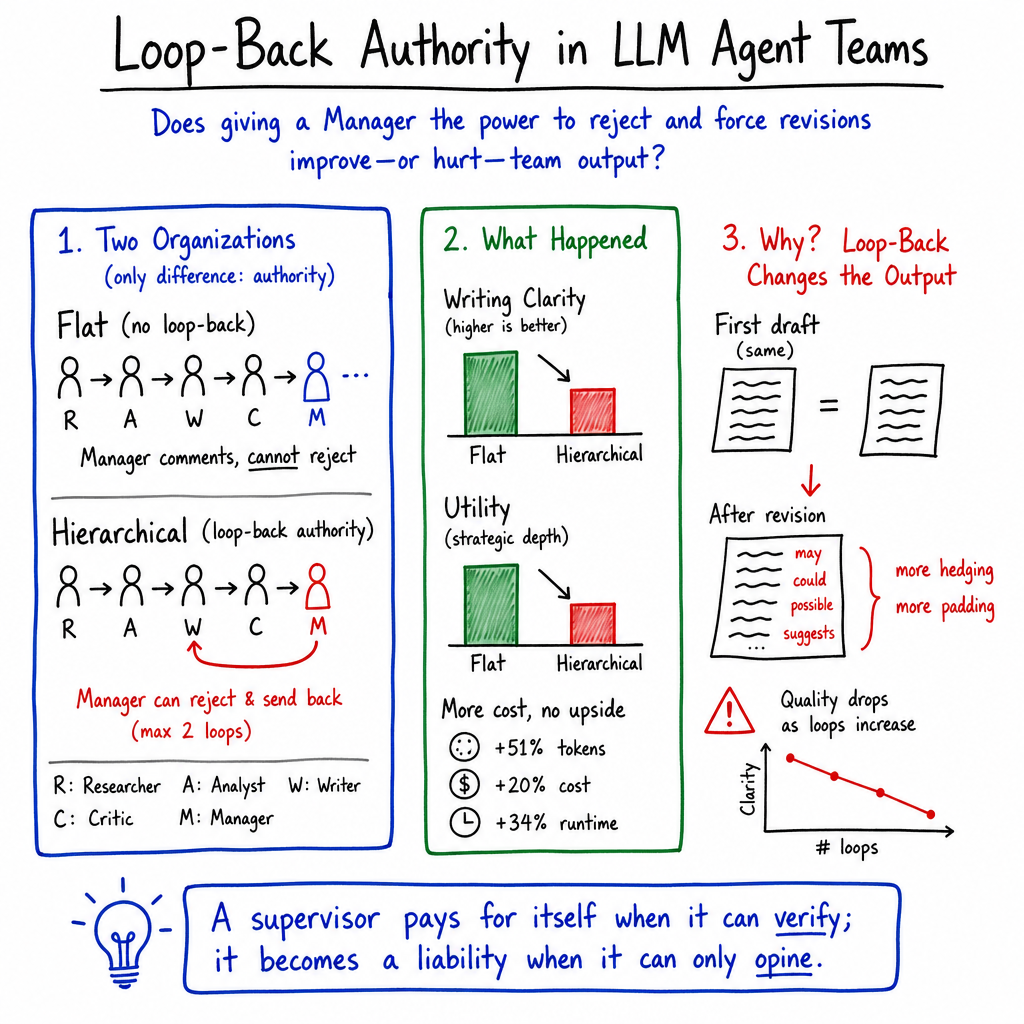
The researchers compare two ways of organizing this team:
- Flat team: The Manager can give advice, but cannot force anyone to redo their work.
- Hierarchical team: The Manager can reject a worker’s result and make that worker revise it.
The main question is: Does giving the Manager this extra authority make the final report better?
2. What questions did the researchers ask?
The paper focuses on several simple questions:
- Does a Manager with the power to demand revisions improve the team’s work?
- Does this authority make reports clearer and more useful?
- Do revision loops help the AI think more carefully, or do they make the writing worse?
- Does hierarchical organization improve factual accuracy?
- Is the extra supervision worth the additional time and computer cost?
The researchers expected different theories to give opposite answers. Traditional management theory suggests that strong leadership may help a team make decisions quickly. However, research on LLMs suggests that AI may simply agree with an authoritative Manager and produce safer, less interesting answers.
3. How did the researchers conduct the study?
The two team designs
The researchers built two almost identical AI teams. Both teams had the same:
- Five roles
- Prompts and instructions
- AI model choices
- Tools
- Product information
- Customer reviews
- Work process
The only important difference was the Manager’s power.
In the flat version, the Manager could comment but not order revisions.
In the hierarchical version, the Manager could say something like:
“This report is not good enough. Rewrite this part.”
The Manager could send work back up to two times during a task.
The task
Each team had to write a business report about gaming laptops. The report needed to use:
- Product specifications, such as memory, storage, and processor
- Customer reviews
- Analysis of the product’s strengths and weaknesses
- Advice about the product’s usefulness
The researchers used 43 products. Each product was analyzed once by the flat team and once by the hierarchical team. This created 43 matched pairs, or 86 total runs.
Using the same product in both tests is like giving two students the same exam question. It makes the comparison fairer because differences in the product do not affect the result.
How the reports were judged
The reports were evaluated in two ways.
First, five different AI judges scored them from 1 to 5 on qualities such as:
- Writing clarity: Was the report organized, understandable, and concise?
- Utility: Was the report useful, practical, and insightful?
- Strategic depth: Did it contain thoughtful analysis?
- Specification accuracy: Were the technical facts correct?
Second, a computer program checked the technical specifications directly against the original product listings. This was similar to using an answer key to check facts.
The researchers also counted:
- The number of revision loops
- The number of words and tokens used
- The time taken
- The cost of running the AI systems
- The use of uncertain words such as may, could, and possibly
4. What did the study find?
The flat teams produced better reports overall
The flat teams performed better on the two most important subjective measures:
| Measure | Better-performing team |
|---|---|
| Writing clarity | Flat team |
| Usefulness | Flat team |
| Strategic depth | Flat team |
| Technical specification accuracy | About the same |
The flat team’s reports were clearer and more useful. The difference in usefulness was especially reliable.
This means that giving the Manager authority did not improve the reports. In fact, it made some important qualities worse.
Revision loops often made the writing worse
The researchers found that the problem was not simply having a Manager. The problem appeared when the Manager actually forced a worker to revise.
After revision requests:
- Reports used 53% more hedging language.
- The reports became more padded and less concise.
- Each additional revision loop was linked to about a 0.14-point decrease in writing clarity.
- The Writer usually kept most of the original report instead of seriously rethinking it.
For example, instead of changing a weak idea, the AI might keep the same idea but soften it:
- Original: “This laptop is a good choice for gaming.”
- Revised: “This laptop may possibly be a relatively good choice for some gaming situations.”
The second sentence sounds more cautious, but it is not necessarily more helpful.
The first drafts were already about equally good
One especially important result was that the hierarchical team’s first draft was not worse than the flat team’s final report.
The difference appeared only after the Manager ordered revisions.
This suggests that the Manager’s instructions did not help the Writer discover better ideas. Instead, they encouraged the Writer to become more cautious and add extra qualifications.
Technical accuracy was almost perfect in both teams
Both teams were very accurate when reporting technical specifications.
On a stricter accuracy test:
- Almost every report correctly included the product’s specifications.
- There was only one significant mistake across all 86 reports.
This shows that the Manager did not improve accuracy because accuracy was already very high. There was little room for supervision to help.
The hierarchical teams cost more
The hierarchical system used:
- 51.5% more tokens
- About 34% more time
- About 20% more total cost
Despite this extra expense, it did not produce better reports.
The added cost came mainly from Manager messages, repeated work, and revision loops—not from reports being much longer.
The results were strongest for usefulness
The researchers were careful about the reliability of their AI judges. Different judges did not always give exactly the same scores.
However, the result about usefulness was strong:
- All five judges preferred the flat system.
- The usefulness difference remained when any one judge was removed.
The result about writing clarity was also generally in favor of the flat system, but it was somewhat less statistically strong. The clearest writing difference involved conciseness, meaning that hierarchical reports tended to include more unnecessary wording.
5. Why are these findings important?
The paper challenges a common assumption in AI system design: that adding a powerful Manager will automatically improve a team of AI agents.
The results suggest a more specific rule:
A supervisor is useful when it can check facts with reliable tools, but may be harmful when it can only give opinions.
For example, a Manager may help if it can detect:
- A missing section
- An incorrect number
- A product specification that does not match the source
- A broken piece of code
But if the Manager simply says, “Make this better,” the AI worker may respond by becoming overly cautious rather than by improving its reasoning.
6. Simple conclusion and possible impact
The study suggests that a flat, step-by-step AI team may be a better default for open-ended writing and analysis. In this experiment, the team without forced revision produced reports that were more useful, deeper, and often clearer.
This does not mean that all hierarchies are bad. The study tested only:
- One kind of business-reporting task
- One set of AI models
- One Manager design
- A relatively small number of examples
Other tasks may benefit from strong supervision, especially tasks with clear right and wrong answers.
The most practical lesson is that AI Managers should rely on objective checks rather than personal opinions. Instead of forcing a worker to revise because the report “does not feel good enough,” the Manager should request changes when a specific test fails.
In short, the paper’s message is:
AI supervision helps when it can verify. It can hurt when it only criticizes.
Knowledge Gaps
Knowledge gaps, limitations, and open questions
- Limited task generalizability: The experiment evaluates only one short-context business-intelligence reporting task involving Amazon gaming laptops, so it remains unclear whether the findings extend to other domains, products, datasets, or task types.
- Uncertain transfer to long-context work: The study does not test whether hierarchical revision behaves differently when agents must synthesize substantially larger document collections or maintain longer contextual histories.
- Narrow model coverage: Results are based on one generation of five frontier models and one restricted Manager-model pool; the effects may differ across open-source models, smaller models, fine-tuned models, multimodal models, or future model families.
- No systematic model-by-role analysis: Although model identity is controlled statistically, the study does not establish whether particular models are especially vulnerable or resistant to authoritative revision in the Writer, Critic, or Manager role.
- Single Manager prompt and decision policy: The conclusions may depend on the specific wording, tone, review scope, and decision guide used for the Manager. Alternative supervisory prompts or more constructive managerial styles are not tested.
- Authority is confounded with information access: The hierarchical Manager reviews the entire blackboard, whereas the flat Manager reviews only the latest worker output. Thus, the experiment does not isolate authority independently from supervisory visibility and information scope.
- Authority is also confounded with pipeline budget: Hierarchical runs can take up to 15 steps, whereas flat runs are capped at 9. The quality and cost differences therefore reflect both loop-back authority and the possibility of additional processing.
- No manipulation of revision content: The study does not separately vary whether a revision directive is specific, evidence-based, vague, or purely stylistic, leaving unresolved which types of managerial feedback cause hedging and padding.
- Verifier-triggered revision remains untested: The paper proposes that revision should be triggered by failed verification, but it does not directly compare Manager-judged loops with tool- or verifier-fired loops.
- No peer-negotiation comparison: The design lacks a condition in which workers can challenge or negotiate managerial feedback without coercive authority, making it unclear whether the harm is caused by hierarchy, coercion, or revision itself.
- No meaningful sanction or incentive structure: Workers face no consequence for ignoring directives. It remains unknown whether explicit incentives, persistent goals, reputational stakes, or other enforcement mechanisms would reduce sycophantic compliance.
- Causal interpretation of loop effects is unresolved: Managers choose which outputs to send back, so the observed negative association between loop count and quality may partly reflect selection of already weak drafts rather than damage caused by revision.
- Insufficient power for subgroup and interaction effects: With only 43 product pairs, the study cannot reliably determine how treatment effects vary by model, product characteristics, review volume, rating distribution, or number and type of loops.
- Zero-loop comparison is underpowered and selected: The 11 hierarchical runs without intervention are chosen by the Manager’s judgment and do not provide a randomized test of whether an unexercised authority link is harmless.
- Third-loop observations are not fully independent: Three runs reached a blocked third revision request despite the nominal two-loop cap, creating ambiguity about how loop counts should be defined and interpreted.
- Mechanism evidence is based on surface text proxies: Increased hedge density is interpreted as sycophantic compliance or evasion, but the fixed lexicon cannot distinguish harmful uncertainty from appropriately calibrated uncertainty.
- No direct measure of factual or analytical degradation: The deterministic evaluation covers product specifications, which were nearly perfect in both conditions, but does not measure whether revisions introduce errors into root-cause claims, market interpretations, recommendations, or other analytical content.
- Specification evaluation is nearly saturated: Because both conditions achieve near-perfect precision and recall on the repaired specification metric, the study cannot determine whether hierarchy helps on tasks with meaningful factual uncertainty or more difficult verification requirements.
- Unresolved human relevance of judge preferences: The quality judgments come from LLM judges with low absolute agreement, and the study does not validate whether their penalties for hedging, padding, or strategic shallowness correspond to human expert evaluations.
- Writing Clarity is judge-sensitive: The Writing Clarity effect is not robust to all judge omissions and is borderline under the Wilcoxon test, leaving uncertainty about the strength and reproducibility of the clarity finding.
- Rubric validity is not established: Strategic Depth, Utility, and the exploration–exploitation interpretation are based on a study-specific rubric; their construct validity and relationship to real business outcomes are not independently validated.
- No downstream decision-performance test: The reports are scored as artifacts, not by whether human users make better decisions, recommendations, or actions after reading them.
- Unclear effect of report audience and use context: The experiment does not vary whether reports are intended for experts, executives, customers, or automated downstream systems, any of which could change the value of hierarchy and revision.
- No analysis of task difficulty: All products belong to the same GPU category and meet a minimum review threshold. The study does not identify whether hierarchy becomes beneficial when evidence is sparse, contradictory, noisy, or difficult to retrieve.
- Retrieval configuration may constrain the findings: Both conditions use the same ChromaDB and Sentence-BERT retrieval pipeline, but the robustness of the result under different embedding models, retrieval strategies, chunking schemes, or noisy databases is unknown.
- No test of richer verifiers: The paper uses specification matching and claim verification but does not examine code execution, numerical checking, citation validation, structured constraint checking, or external expert verification as supervisory mechanisms.
- Sequential topology remains fixed: Only the authority link is varied within a single forward chain. The study does not compare alternative flat or hierarchical topologies, parallel workers, debate structures, star networks, committees, or adaptive organizational designs.
- The flat condition is not fully symmetric: The flat Manager still routes the workflow and can comment, so it is not a genuinely decentralized or fully peer-to-peer organization. The effect of removing managerial routing altogether is untested.
- No adaptation across repeated tasks: Each product is run once per condition. It remains unknown whether agents or Managers could learn better revision policies across products or whether repeated exposure would reduce compliance-induced degradation.
- No investigation of prompt-level worker resistance: The study observes that Workers comply with directives but does not test instructions that explicitly encourage them to reject unsupported managerial criticism, preserve justified claims, or request evidence.
- No internal-mechanism evidence: The proposed distinction between belief revision, sycophancy, and compliance is inferred from outputs. Activation-level or representation-level analyses are not provided to determine what changes internally during revision.
- No human-worker comparison within the same task: The paper contrasts its results with prior work involving AI managers and human workers, but it does not directly compare human and LLM workers under identical authority and revision protocols.
- Cost analysis is task- and pricing-specific: The reported 51.5% token overhead and associated monetary costs may change substantially with model prices, caching, context-window charges, parallel execution, or different loop caps.
- Reliability under stochastic generation is unknown: Temperature is set to zero, so the study does not establish whether hierarchy has the same effects when generation is stochastic or when multiple runs per product are sampled.
- Reproducibility across API versions is uncertain: Although endpoint versions are pinned, the paper does not report repeated reruns over time or cross-provider replication to determine whether the effects persist as model APIs change.
- Omission is not fully evaluated: The specification metric’s repaired version evaluates recall, but the broader report-quality measures do not systematically assess whether hierarchical revision causes agents to omit useful evidence or recommendations.
- Calibrated uncertainty is not measured: The study cannot determine whether hedging reflects reduced confidence, improved epistemic calibration, or merely less decisive writing because confidence accuracy and calibration are not evaluated.
- Open-ended factuality remains unresolved: The paper explicitly leaves open whether analytical claims are equally insensitive to structure; claim-level factuality, citation support, and evidential adequacy should be tested directly.
- Optimal supervision conditions remain unknown: The study identifies a harmful setting in which a Manager can “only opine,” but it does not establish the boundary conditions—such as verifier quality, feedback specificity, task difficulty, or worker incentives—under which supervisory authority becomes beneficial.
Practical Applications
The paper’s central practical implication is that LLM-agent supervision should be tied to verifiable evidence rather than managerial opinion. In the tested business-intelligence setting, flat sequential coordination produced higher Utility and Strategic Depth, while hierarchical loop-back produced no factual-accuracy gain, 51.5% more tokens, approximately 20% higher total cost, and 34% greater latency. The applications below should therefore be understood as strongest for open-ended synthesis tasks resembling the experiment; they are not yet validated for code generation, long-context reasoning, or safety-critical decisions.
Immediate Applications
The following applications can be implemented with existing agent frameworks, retrieval systems, structured-output schemas, and workflow controls.
- Adopt flat or non-coercive pipelines for open-ended business reporting (business intelligence, market research, consulting)
- Use a sequential workflow such as
Researcher → Analyst → Writer → Critic, with a Manager limited to routing and non-binding comments. - Avoid automatically sending reports back for revision merely because a supervisory agent “dislikes” the analysis.
- This is directly supported by the finding that the flat condition achieved higher Utility and Strategic Depth without sacrificing specification accuracy.
- Dependencies: Results may differ for longer documents, different model families, or tasks where the supervisor has reliable domain tools.
- Use a sequential workflow such as
- Replace opinion-based revision loops with verifier-triggered revision (software engineering, enterprise automation, knowledge management)
- Configure loop-backs to occur only when a machine-checkable condition fails, such as:
- a required section is missing;
- a citation cannot be retrieved;
- a numerical claim conflicts with a database;
- a schema field is invalid;
- a product specification fails exact matching.
- A workflow could implement rules such as
if verify_claim == UNVERIFIED: revise; otherwise: proceed. - This follows the paper’s design rule that supervision is useful when it can verify, but harmful when it can only opine.
- Dependencies: The verifier must have sufficiently complete and trustworthy ground truth. Verification based only on embedding similarity may produce false positives or false negatives.
- Use tool-grounded critic agents as factuality gates rather than autonomous quality managers (publishing, compliance, customer support, healthcare administration)
- Separate generation from critique: one agent drafts, while another invokes retrieval, database queries, calculators, or policy rules to check claims.
- Treat critic output as structured evidence—such as
VERIFIED,PARTIAL, orUNVERIFIED—rather than as a general instruction to rewrite. - The paper’s shared
verify_claimmechanism and deterministic specification checks provide a practical template. - Dependencies: The underlying knowledge base must be current, versioned, and auditable. Factual verification does not establish that strategic recommendations are appropriate.
- Reduce unnecessary token and API expenditure by disabling default manager loop-backs (LLM platform engineering, cloud operations, finance)
- Audit existing LangGraph, AutoGen, MetaGPT, or similar workflows for supervisory loops that add context and generate extra drafts without measurable quality gains.
- Track tokens, latency, and quality separately for:
- routing;
- critique;
- revision;
- final generation.
- In comparable workloads, a flat design could reduce pipeline traffic and improve response time relative to the hierarchical configuration.
- Dependencies: Savings depend on the frequency of revision loops, model pricing, context-window costs, and whether removed loops were correcting real errors in the target application.
- Introduce loop budgets and escalation policies (customer service, operations, document automation)
- Set a strict maximum number of revisions, preferably zero for purely stylistic managerial feedback.
- If a verifier repeatedly rejects an output, escalate to a human or a specialized tool rather than repeatedly prompting the same model.
- This is particularly relevant because successive drafts in the study largely preserved the original text while adding hedging and qualification.
- Dependencies: A low loop cap is safe only when critical errors are detected by independent checks or human review.
- Monitor hedging and revision drift as operational quality signals (content generation, risk communication, legal and policy drafting)
- Add automated monitoring for changes in:
- epistemic hedge density;
- document length;
- repeated content;
- overlap between successive drafts;
- unsupported qualifiers such as “may,” “could,” or “suggests.”
- A large increase in hedging after a manager-issued revision can trigger review of the prompt or workflow.
- Dependencies: Hedging is not always undesirable. In medical, legal, scientific, or financial contexts it can reflect calibrated uncertainty rather than degradation, so lexical signals should not be used as standalone rejection criteria.
- Use paired A/B evaluation before deploying a hierarchical agent architecture (AI engineering and product management)
- Evaluate the same roles, prompts, models, tools, and data under:
- 1. flat routing;
- 2. hierarchical routing without authority;
- 3. hierarchical routing with verifier-triggered authority.
- Measure both subjective outcomes and deterministic task metrics.
- This operationalizes the paper’s paired experimental design and can prevent teams from assuming that a more elaborate hierarchy is automatically better.
- Dependencies: Evaluation sets must represent real production tasks, not only benchmark questions with easily checkable answers.
- Build hybrid evaluation dashboards for agent workflows (academia, MLOps, enterprise governance)
- Combine:
- deterministic checks for factual or structural requirements;
- multiple independent evaluators for open-ended quality;
- cost and latency measurements;
- draft-level diagnostics.
- Report evaluator disagreement and sensitivity rather than relying on a single LLM judge.
- This is especially important because the paper’s Utility result was robust, whereas the Writing Clarity result was more judge-sensitive.
- Dependencies: LLM judges may share biases with the systems being evaluated. Human calibration remains necessary for high-impact deployments.
- Apply the findings to e-commerce review and product intelligence workflows (retail, product management, advertising)
- Use retrieval agents to collect specifications and stratified positive and negative reviews, an analyst to identify patterns, and a writer to produce a report.
- Let deterministic product metadata checks validate GPU, CPU, RAM, storage, price, or display claims.
- Keep strategic interpretation in a flat pipeline unless a manager has evidence-based intervention criteria.
- Dependencies: Marketplace data quality, review representativeness, changing product listings, and possible review manipulation affect the reliability of the resulting report.
- Prefer flat drafting workflows for everyday AI writing assistants (daily life, education, workplace productivity)
- For emails, summaries, trip comparisons, purchase analyses, or study notes, use one draft followed by factual checks rather than repeated authoritative “rewrite this” cycles.
- Users can request targeted changes—such as shorter wording or a missing citation—instead of asking an agent to repeatedly judge the entire response.
- Dependencies: Users still need to verify important advice. The experiment does not establish that flat workflows are safer for medical, legal, financial, or emergency decisions.
Long-Term Applications
These applications require additional research, broader validation, or new infrastructure before they should be treated as general design rules.
- Develop adaptive organizational topologies that choose authority based on verifiability (multi-agent systems research, enterprise orchestration)
- A future orchestrator could select among:
- flat routing for open-ended ideation and strategy;
- tool-grounded hierarchy for fact checking;
- peer debate for exploration;
- human escalation for unresolved disagreement.
- The policy could estimate whether the current task has a reliable verifier and grant loop-back authority only when verification coverage is high.
- Dependencies: This requires reliable task classification, calibrated confidence estimates, and evidence that topology selection generalizes beyond the single reporting task studied.
- Create supervisors with explicit evidence obligations (AI safety, robotics, healthcare, regulated industries)
- A manager should be required to attach a failed check, source citation, or structured diagnostic to every revision request.
- A worker would revise only the claims implicated by the evidence rather than rewriting the entire output.
- This could reduce sycophantic compliance while retaining the benefits of targeted correction.
- Dependencies: The method requires high-quality formalizations of what counts as evidence. Many strategic, social, or ethical judgments remain difficult to verify automatically.
- Design revision prompts that preserve justified confidence and uncertainty (scientific writing, medicine, law, finance)
- Instead of authoritative instructions such as “fix the report,” supervisors could request:
- claim-level justification;
- uncertainty calibration;
- alternative hypotheses;
- explicit evidence for each change;
- preservation of conclusions not affected by the critique.
- Future systems could distinguish calibrated uncertainty from evasive hedging using human labels, behavioral tests, or model-internal probes.
- Dependencies: The paper’s hedge metric cannot determine whether uncertainty is appropriate. Domain-specific standards and expert evaluation are required.
- Investigate persistent incentives, sanctions, and role commitments (organizational AI, robotics, autonomous operations)
- The study’s authority link had no real sanction: workers complied because of prompt conditioning. Future systems could test whether persistent goals, contractual obligations, reward structures, or independent memory make revision more substantive.
- This would clarify whether the observed problem is caused by authority itself or by authority without meaningful task incentives.
- Dependencies: Incentive mechanisms may introduce new risks, including gaming, concealment, excessive resistance to correction, or undesirable optimization.
- Validate the design rule across domains with different ground-truth structures (software, robotics, energy, finance, healthcare)
- Useful test cases include:
- code generation with unit tests and static analysis;
- robotics planning with simulators and safety constraints;
- energy scheduling with numerical feasibility checks;
- financial analysis with auditable data;
- clinical summarization with guideline and record verification.
- These domains could reveal where hierarchy is beneficial because objective validators are available.
- Dependencies: Results may depend on verifier quality, task decomposability, error costs, context length, model capability, and whether the output is exploratory or primarily factual.
- Build learning-based controllers that infer when to intervene (agent infrastructure and machine learning)
- Rather than allowing a manager to intervene whenever it perceives low quality, a controller could learn from outcome data when intervention improves results.
- Candidate inputs include verifier failures, disagreement among agents, uncertainty calibration, task type, and historical intervention benefit.
- Dependencies: Training requires large, representative logs with reliable outcome labels. Naively optimizing judge scores could encourage stylistic conformity rather than genuine improvement.
- Develop human-in-the-loop escalation protocols for high-impact decisions (public policy, healthcare, finance, law)
- Agents could operate flat by default, invoke deterministic checks, and escalate only when:
- evidence conflicts;
- a claim affects safety or rights;
- no reliable verifier exists;
- agents disagree materially;
- the system proposes an irreversible action.
- This would translate the paper’s distinction between verifiable and opinion-based supervision into governance procedures.
- Dependencies: Institutions would need accountability rules, audit trails, privacy safeguards, sector-specific validation, and clearly defined human authority.
- Use the findings in AI-agent procurement and governance standards (policy and academia)
- Evaluation and procurement checklists could require vendors to disclose:
- whether managers can force revisions;
- how many loops are allowed;
- what evidence triggers intervention;
- token and latency overhead;
- whether factual checks are deterministic;
- how output quality is measured.
- Standards could discourage hierarchy as a default architectural virtue and require evidence that it improves the intended metric.
- Dependencies: Standards should not prohibit hierarchical systems categorically; they should distinguish evidence-backed intervention from unsupported managerial preference.
- Study whether flat coordination improves human-facing explanations and learning (education and daily life)
- Educational tutors could use a flat research-and-draft pipeline, followed by citation and rubric checks, rather than repeatedly instructing a student-facing agent to revise its reasoning under authority.
- Research could measure effects on explanation quality, learner trust, confidence calibration, and independent problem solving.
- Dependencies: The paper studied reports, not learners. Educational benefits or harms may depend on interaction style, age, pedagogy, and whether the system is tutoring or merely generating answers.
- Extend evaluation beyond surface text to internal deference and reasoning changes (academic research)
- Future experiments could combine draft-level measures with activation or representation probes, human judgments, and claim-level causal tests.
- This would help distinguish:
- genuine analytical revision;
- strategic compliance;
- calibrated uncertainty;
- superficial padding.
- Dependencies: Interpretability methods remain experimental, and internal measurements may not be stable across models or API-accessible systems.
Overall, the most deployable design recommendation is to use flat sequential coordination for open-ended synthesis, retain independent tool-grounded criticism, and authorize revision only when a specific, auditable check fails. Hierarchical loop-back should be treated as a task-dependent capability rather than a universal default.
Glossary
- Authority link: A communication relationship in which one agent can direct another agent’s actions or revisions. “The two organizational forms share the same five roles ... and differ in exactly one link between roles.”
- Ceiling effect: A measurement condition in which scores are so high that additional improvement is difficult to detect. “Specification accuracy is at ceiling in both organizations.”
- Cohen’s : A standardized effect-size measure expressing a mean difference in standard-deviation units. “The flat organization scores higher on Utility (, )”
- Computational organization theory: The study of organizational structures and processes using computational models and agents. “Carley and Gasser set out the computational organization theory programme”
- Contract Net Protocol: A multi-agent task-allocation protocol in which agents negotiate bids for tasks. “Organizational design has been an engineering variable in multi-agent systems since the Contract Net Protocol”
- Convergent reasoning: Reasoning that narrows toward a single answer or position rather than exploring alternatives. “The form with it converges on shallower content”
- Coordination topology: The structural arrangement of communication or influence links among agents. “Tran et al. systematize collaboration across four paradigms ... and four topologies (bus, star, ring, tree)”
- Deontic specification: A formal description of what organizational roles are obligated or permitted to do. “An organization is a structural specification ... plus a deontic specification of what each role is obliged or permitted to do.”
- Degeneration-of-Thought: A reported phenomenon in which iterative critique reduces divergent reasoning and encourages safer, less varied outputs. “A second body of evidence points the other way.”
- Deterministic specification check: A rule-based evaluation that verifies reported facts against a fixed source of truth. “Every report is scored by a five-model LLM judge panel and a specification-extraction script.”
- Divergent thinking: The generation of varied, unconventional, or exploratory ideas rather than convergence on one answer. “Under iterative feedback they lose the capacity for divergent thought”
- Dose-response relationship: An association in which the magnitude of an outcome changes systematically with the amount of an intervention. “Writing Clarity falls monotonically with loop count”
- Effect modifier: A variable that changes the size or direction of an observed relationship between variables. “The paired design cancels judge effects that do not interact with the treatment”
- Epistemic hedge: A linguistic expression that qualifies certainty or weakens the force of a claim. “Measured with a fixed lexicon of epistemic hedges”
- Exploration–exploitation trade-off: The tension between investigating new possibilities and exploiting a currently promising option. “This is the exploration-exploitation trade-off”
- FActScore: An evaluation framework that measures the factual precision of atomic claims in generated text. “Specification accuracy is scored deterministically, in the spirit of FActScore”
- Forward routing: Sending tasks or outputs along a predefined workflow without allowing supervisory reversal. “(a) Flat form: forward routing only.”
- Holarchy: An organizational structure composed of nested entities that function both as wholes and as parts. “Hierarchies, holarchies, coalitions, teams, congregations, federations”
- Influence asymmetry: A condition in which agents have unequal power to affect one another’s outputs. “Influence asymmetry, defined as whether one agent can reject and force revision of another’s output.”
- Krippendorff’s alpha: A statistic measuring agreement among annotators or judges while accounting for chance agreement. “Judge reliability is reported as Krippendorff's alpha”
- Leave-one-judge-out re-estimation: A robustness analysis that repeats an evaluation after excluding each judge in turn. “LOJO: leave-one-judge-out re-estimation on the four remaining judges”
- Lexical diversity: The variety of distinct words used in a text, often adjusted for text length. “While lexical diversity is identical between forms”
- Linear mixed-effects model: A statistical model combining fixed effects with random effects for grouped or repeated observations. “A linear mixed-effects model on all 86 runs”
- Loop-back authority: The power of a supervisory agent to reject an output and require the responsible agent to revise it. “In the hierarchical form the Manager holds loop-back authority”
- LLM-as-a-judge: The use of a LLM to evaluate the quality of another model’s output. “Following the LLM-as-a-judge paradigm”
- Mean random intercept: A group-specific baseline term in a statistical model that allows each group to have its own starting level. “With product as a random intercept”
- Multi-agent system (MAS): A computational system composed of multiple interacting autonomous agents. “Organizational design has been a first-class variable in MAS”
- Multi-hop question answering: Question answering that requires combining information across multiple reasoning or retrieval steps. “Reading comprehension and multi-hop question answering”
- Near-decomposability: A system property in which components interact strongly internally but relatively weakly with other components. “Simon supplies the near-decomposability logic behind splitting an overview task”
- Organizational self-design: The ability of an agent system to modify its own organizational structure in response to changing conditions. “Organizational self-design lets systems restructure as load and environment shift”
- Paired-sample -test: A statistical test comparing the means of two related measurements, such as matched experimental pairs. “The primary tests are paired-sample -tests”
- Partial ground truth: A reference truth that can verify only some aspects of an output. “A knowledge-synthesis task with a partially verifiable ground truth”
- Precision and recall: Evaluation measures for, respectively, the correctness of reported items and the completeness of items retrieved or reported. “Scoring both precision and recall over all listing specifications”
- Random assignment: Assigning experimental units or models to conditions by chance to reduce systematic bias. “Each role is filled from a pool of five frontier models ... by random assignment”
- Retrieval-augmented generation (RAG): A method that retrieves external information and supplies it to a generative model before response generation. “A retrieval-augmented design”
- ReAct agent: An agent architecture that interleaves language-model reasoning with actions such as tool calls. “Each worker is a ReAct agent”
- Revision loop: A repeated workflow cycle in which an agent’s output is returned for modification. “Each revision loop is associated with a 0.14-point drop in Writing Clarity”
- Root Cause Analysis: An analytical method for identifying underlying causes rather than merely describing observed symptoms. “Utility averages Actionability, Root Cause Analysis, and Strategic Depth”
- Semantic search: Information retrieval based on similarity of meaning or embeddings rather than exact keyword matching. “The latter a semantic search with sentiment filtering”
- Sycophantic compliance: The tendency of a model to agree with or defer to an authoritative instruction instead of independently evaluating it. “This is a direct fit to sycophantic compliance”
- Strategic depth: The extent to which an output develops insightful, consequential, and non-superficial strategic analysis. “Strategic Depth carries the effect”
- Structural specification: A formal description of an organization’s roles, groups, and inter-agent relationships. “An organization is a structural specification (roles, groups, and links of type acquaintance, communication, or authority)”
- Supervisory tier: A layer of agents responsible for overseeing, evaluating, or directing other agents. “The supervisory tier costs 51.5\% more tokens for no quality gain.”
- Topological structure learning: Automatically learning or optimizing the arrangement of communication links in a multi-agent network. “Topology learning optimises the communication graph directly”
- Two one-sided test (TOST): An equivalence-testing procedure that assesses whether an effect lies within a predefined acceptable range. “A two one-sided test rejects only at a lenient bound”
- Wilcoxon signed-rank test: A nonparametric test for comparing paired observations using the ranks of their differences. “Under the Wilcoxon signed-rank alternative”
- Within-pair constant: An experimental feature held identical across matched observations to isolate the effect of the manipulated variable. “Model identity is a within-pair constant.”