Existence of the Core in Approval-Based Committee Elections
Abstract: We settle the main open question in the theory of approval-based multi-winner elections: we show that there always exists a committee in the core. The core is a stability and group fairness concept. The proof introduces a new voting rule that optimizes an entropy-like objective function over committees and payment systems. All local optima of this objective function lie in the core, which implies that a core committee can be found in polynomial time.
Paper Prompts
Sign up for free to create and run prompts on this paper.
Top Community Prompts
Explain it Like I'm 14
1. What is this paper about?
This paper studies how to choose a group of candidates—called a committee—in a fair way.
Imagine an election where:
- Many voters are choosing several representatives.
- Each voter marks every candidate they approve of.
- A fixed number, , of candidates must be selected.
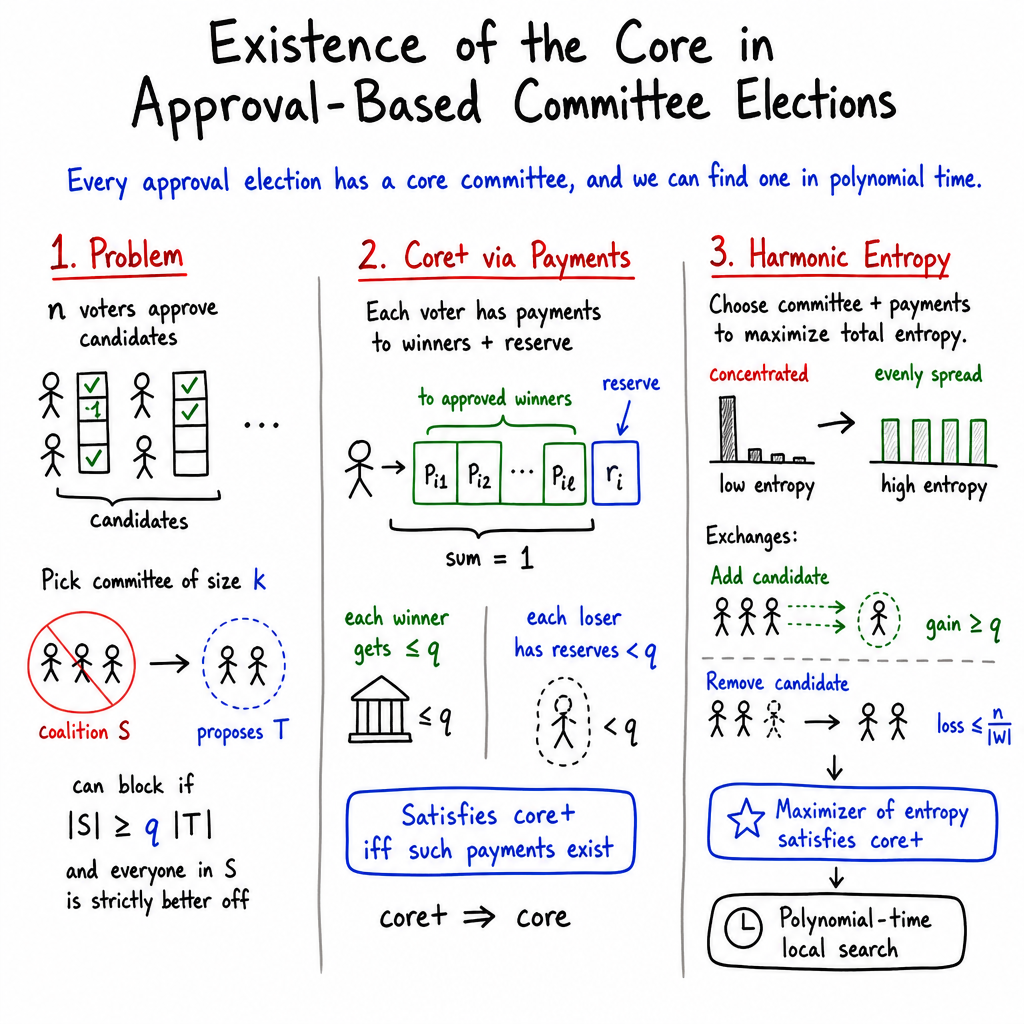
The paper focuses on a very strong idea of fairness called the core. The core says that no large enough group of voters should be able to leave the chosen committee, use the seats they deserve, and choose a different group of candidates that would make every person in that group better off.
The main result is:
For every approval-based election, at least one core committee always exists. Furthermore, one can find such a committee efficiently.
This solves a long-standing unanswered question in voting theory.
2. What questions does the paper ask?
The researchers mainly want to answer three questions:
- Does a fair committee in the core always exist?
- Can we actually find one using a computer in a reasonable amount of time?
- Can the idea of fairness be strengthened so that it remains fair even when voters are allowed to participate only partly in a group decision?
The answer to all three questions is positive.
The paper introduces an even stronger version of the core, called core+. If a committee satisfies core+, it also satisfies the ordinary core.
3. How does the research work?
Approval-based elections
Each voter submits a list of approved candidates. For example:
| Voter | Approved candidates |
|---|---|
| Alice | A, B, D |
| Ben | B, C |
| Cara | A, D |
If the committee is , Alice gets utility $2$ because she approves both selected candidates. Ben gets utility $1$, and Cara gets utility $1$.
A voter's utility is simply the number of selected candidates they approve.
The core: preventing unfair group departures
Suppose a committee has seats and there are voters. A group of voters needs enough people to “pay for” an alternative group of candidates.
The paper uses a number called a quota, usually
This means that roughly voters are needed to deserve one seat.
A group can block the committee if:
- The group is large enough to afford some number of seats.
- Every voter in the group would approve more candidates in the new proposal than in the current committee.
A committee is in the core if no such group exists.
An everyday analogy is a school choosing several class representatives. The core says that no sufficiently large group of students should be able to say:
“We deserve this many representatives, and we could choose a different group that would be better for every one of us.”
Fractional groups and core+
The researchers also study a more flexible version called core+. In core+, voters and candidates can participate partly, rather than only fully.
For example, instead of saying that a voter is either completely in or completely out of a group, core+ allows a voter to participate at 30% or 70%.
This makes core+ harder to satisfy than the ordinary core. If a committee survives even these partly participating groups, then it certainly survives ordinary groups.
Payment systems
To analyze core+, the paper imagines that every voter has one unit of money.
Voters can use their money to support candidates in the committee. Any money they do not spend is called their reserve.
A payment system must follow rules such as:
- A voter cannot spend more than their one unit.
- Each selected candidate can receive at most the amount allowed by the quota.
- Candidates not selected should not have too much support coming from voters’ leftover money.
This is similar to a school budget:
- Each student receives one token.
- Students use tokens to support representatives.
- No representative can receive more than the fair amount.
- If an unselected candidate has enough leftover support, that may show that the committee is unfair.
The authors prove that a committee satisfies core+ exactly when an appropriate payment system exists.
Harmonic entropy
The paper then creates a new mathematical score called harmonic entropy.
This score rewards payment systems in which each voter spreads their money fairly among several approved selected candidates, instead of putting all their money behind one candidate.
For example, suppose a voter has one unit of money:
- Spending all $1$ on one candidate is very concentrated.
- Spending $0.5$ on two candidates is more balanced.
- Spending $0.33$ on three candidates is even more balanced.
The paper’s score gives higher values to more evenly spread payments. It is somewhat similar to the better-known idea of Shannon entropy, which is used to measure how evenly something is distributed.
The researchers:
- Consider every possible committee.
- Consider all valid payment systems for that committee.
- Choose the payment system with the highest harmonic entropy.
- Give the committee a score based on that best payment system.
- Select a committee with the highest score.
Water-filling
The proof uses an idea called water-filling.
Imagine several containers holding different amounts of water. If one container is much fuller than the others, water is taken from the fullest containers and spread into a new container until the levels become more balanced.
In the paper, this represents moving a voter’s money away from heavily supported candidates and spreading it more evenly. The researchers show that this balancing operation improves the harmonic-entropy score in exactly the way needed for the proof.
Local improvement and computation
A local optimum is a solution that cannot be improved by making a small change, such as replacing one candidate with another.
The paper proves something powerful:
Every local optimum of their harmonic-entropy objective already satisfies core+.
This means a computer does not necessarily need to search through every possible committee. It can repeatedly make improving changes until it reaches a local optimum. That process produces a core+ committee.
The authors also show that the objective can be simplified using linear programming, a standard method for solving problems involving variables and constraints. As a result, a core committee can be found in polynomial time, meaning the computation is considered efficient as the election grows.
4. What are the main findings?
The paper’s main findings are:
A core committee always exists
For every approval-based election, no matter how voters approve candidates, there is at least one committee that belongs to the core.
This is important because researchers had not previously been able to prove that the core was always non-empty.
A stronger committee, satisfying core+, also exists
The paper proves the existence of a committee satisfying the stronger core+ condition. Since core+ is stronger than the ordinary core, this gives an especially robust form of fairness.
The committee can be found efficiently
The researchers do not merely prove that a fair committee exists. They also show how to find one in polynomial time.
In simple terms, the method is practical in the mathematical sense: it should not require checking every possible group of voters and every possible alternative committee one by one.
The proof has been checked by computer
The result about the ordinary core was formally verified using Lean, a computer system for checking mathematical proofs.
This is important because it reduces the chance that the complicated proof contains a hidden mistake.
The result works with different quotas
The main result uses the usual Hare quota,
but the paper also proves existence using the slightly different Droop quota,
This shows that the result is not tied to only one precise definition of how many voters deserve a seat.
5. Why is this important?
In a multi-winner election, it is not enough to choose candidates who receive the most votes individually. The goal is also to represent different groups of voters fairly.
For example, a committee should not give all its seats to candidates supported by one large group while completely ignoring several smaller but still important groups.
The core is especially demanding because it protects groups even when their members do not all agree on exactly the same candidates. They only need to be able to find an alternative committee that would make each member individually better off.
This research could have several effects:
- It gives voting theorists a general guarantee that a strongly fair outcome exists.
- It provides a practical method for computing such an outcome.
- It may help design better voting rules for councils, parliaments, committees, and organizations.
- Its payment-system interpretation connects voting with ideas from markets and budgeting.
- The formal computer verification provides extra confidence in the result.
Conclusion
The paper solves a major problem in approval-based committee elections. It proves that a strongly fair committee always exists, even under a demanding definition of group fairness called the core.
The researchers achieve this by imagining that voters distribute money among candidates and by measuring how evenly that money is spread using a new score called harmonic entropy. They show that committees with the best score cannot be unfairly challenged by any sufficiently large group—even when partial participation is allowed.
Most importantly, the paper shows that such a committee can be found efficiently. This means the result is not only theoretically interesting but could also become useful for creating fairer real-world decision-making systems.
Knowledge Gaps
Knowledge gaps, limitations, and open questions
- The paper does not provide empirical evaluations of the proposed harmonic-entropy rule on real or synthetically generated elections, leaving its practical behavior, fairness outcomes, and comparison with PAV, MES, and other rules unresolved.
- Although a polynomial-time algorithm is claimed, the paper does not fully specify the algorithmic implementation, including how the continuous optimization problem and the infinite-series objective are represented and solved exactly.
- The computational complexity is not characterized in detail: the paper does not provide explicit polynomial running-time bounds in terms of voters, candidates, committee size, and the encoding length of the quota.
- The relationship between the harmonic-entropy optimization problem and standard linear programming is asserted but not fully developed in the provided text; the exact linear-program formulation and its size remain unclear.
- The paper does not establish whether the proposed voting rule can be implemented efficiently in practice for large elections, despite the theoretical polynomial-time result.
- It remains unresolved whether the harmonic-entropy rule satisfies standard axioms beyond core+, such as committee monotonicity, candidate monotonicity, participation, consistency, neutrality under relevant tie-breaking procedures, or Pareto efficiency.
- The paper does not investigate how the rule behaves under ties and whether different optimal payment systems or maximizing committees can produce substantially different outcomes.
- The paper proves existence of a committee satisfying core+ but does not quantify how restrictive core+ is relative to the integral core; the frequency and structure of committees that satisfy core but fail core+ are not studied.
- The strength of core+ is not fully characterized: it is unclear whether core+ is strictly stronger than core for approval elections, and, if so, the paper does not provide explicit separating examples.
- The paper does not determine whether every core committee is associated with a payment certificate of the type used for core+, or whether the certificate captures only a strict subset of core-stable committees.
- The consequences of using quotas between the Droop quota and Hare quota are not systematically analyzed; the paper establishes existence for this range but does not study how the selected committees or guarantees vary continuously with .
- The paper does not examine whether analogous existence and computation results hold for quotas below the Droop quota or above the Hare quota.
- The proof relies essentially on approval utilities ; it remains open whether the harmonic-entropy method extends to general monotone, dichotomous, additive, or cardinal voter preferences.
- The paper does not analyze extensions to weighted voters, fractional voter populations, candidate costs, variable committee sizes, or candidates with unequal prices.
- The treatment of payment systems assumes a unit budget for every voter and identical quota capacity for every winning candidate; the robustness of the result under heterogeneous budgets or candidate capacities is unexplored.
- The paper does not study whether the method extends to settings with constraints on feasible committees, such as matroid, partition, budget, geographic, or diversity constraints.
- The relationship between harmonic entropy and other entropy or welfare objectives is only described informally; no characterization is given of why this objective is necessary, whether simpler objectives suffice, or which objective properties guarantee core+.
- The paper does not establish uniqueness, strict concavity, or structural properties of harmonic-entropy maximizers; consequently, the geometry of the set of optimal payment systems and committees remains unclear.
- The stability of the selected committee under small changes in approvals, voter populations, quota, or committee size is not analyzed.
- The paper does not provide approximation guarantees for restricted or heuristic implementations of the rule, which may be relevant if exact optimization is computationally expensive despite polynomial-time solvability.
- The proof that local optima satisfy core+ is not accompanied by a precise characterization of the neighborhood or local-search procedure, leaving unclear what constitutes a local optimum algorithmically and how local optima can be reached.
- The paper does not establish whether common local-search dynamics converge efficiently, nor whether they are robust to cycling, tie-breaking, or numerical approximation.
- The consequences of the rule for voter utility and utilitarian or egalitarian welfare are not quantified; maximizing harmonic entropy may trade off these objectives in ways that remain unknown.
- The paper does not compare the new rule’s proportionality guarantees with EJR, FJR, FJR+, Lindahl priceability, stable priceability, or other established axioms beyond the stated implication to core+.
- The paper does not investigate whether core+ implies additional representation properties, such as EJR or FJR, under unrestricted approval profiles.
- The proof of the payment characterization uses strict inequalities for losing candidates, but the behavior at the boundary—when a losing candidate has reserve load exactly —is not explored, including whether numerical or symbolic perturbations affect certification.
- The paper does not discuss numerical precision and certification issues for computing payments and verifying strict inequalities, which may matter for practical implementations.
- The formal Lean verification is reported, but the paper does not specify which results and computational claims are formally verified, nor whether the optimization, infinite-series arguments, and algorithmic complexity claims are included.
- The paper does not investigate strategic incentives: voters’ incentives to misreport approval sets, manipulation complexity, or resistance to strategic behavior remain open.
- The effect of cloning candidates or voters is not analyzed, leaving possible vulnerabilities to candidate replication, voter replication, or related control operations unresolved.
- The paper does not examine whether the rule is compatible with anonymity and neutrality after a concrete committee-selection tie-breaking mechanism is specified.
- The existence theorem is existential and does not identify structural properties of all core+ committees; further work is needed to characterize the set of feasible core+ committees and its combinatorial geometry.
- The paper does not provide lower bounds showing whether the polynomial-time computation of a core+ committee is close to optimal, or whether simpler algorithms are possible for special cases.
- The applicability of the method to probabilistic or randomized committee selection is left open, including whether fractional or lottery analogues of harmonic entropy yield stronger welfare or fairness guarantees.
- The paper does not study the behavior of the rule in asymptotic regimes, such as large numbers of voters, many candidates, sparse approval sets, or random approval models.
- The paper does not establish whether the core+ certificate is economically interpretable as an actual equilibrium or only as a mathematical separating certificate, particularly because winning candidates need not receive exactly their quota in the payment-system definition.
Practical Applications
Immediate Applications
- Proportional committee selection in public and organizational elections (democratic governance, academia, professional associations)
- university senates and faculty committees;
- nonprofit and professional-association boards;
- student representative bodies;
- public advisory committees;
- internal corporate or labor-representation councils.
- The resulting committees are protected against proportional coalitional deviations: no sufficiently large group should be able to use its proportional share of seats to propose an alternative that makes every member strictly better off.
Dependencies: Voters must be able to submit meaningful approval sets; the committee size and quota must be specified in advance; the implementation must faithfully solve the paper’s optimization problem and handle ties transparently.
- Participatory budgeting and multi-project selection (public policy, municipal government, civic technology)
Candidates can be interpreted as projects and committee seats as the number of projects funded. The rule can therefore be used to construct participatory-budgeting packages that are stable against groups of residents proposing affordable alternatives. The payment-system interpretation is particularly relevant: each voter has a unit budget, projects have quota-like capacity constraints, and unused voter budgets identify projects whose supporters may be underserved.
A practical workflow would be:
- collect approval ballots over proposed projects;
- set the number of projects or standardized project slots;
- compute a harmonic-entropy-maximizing committee;
- publish the selected projects together with a payment certificate for
core+; - use the certificate to audit whether losing projects have sufficiently low reserve support.
Dependencies: The model assumes projects have equal unit cost or can be represented by equal-sized slots. Heterogeneous costs, indivisible budget amounts, and project complementarities require adaptation.
- Auditable fairness certificates for elected committees (election administration, regulation, open government)
- each voter’s payments toward approved winners;
- each voter’s remaining reserve;
- the total reserve load of every losing candidate;
- the quota used in the election.
- Because
core+can be checked through a linear program, this creates an operational audit process that is more informative than simply publishing the winning committee. It can show why no fractional coalition can afford a strictly better deviation.
Dependencies: Payment certificates must be normalized and publicly inspectable without exposing sensitive voter information. The interpretation is strongest when approval ballots are sincere and voter identities are not needed for verification.
- Open-source voting and civic-tech software (software engineering, election technology)
- approval-ballot parsing and validation;
- quota selection using the Hare or Droop quota;
- harmonic-entropy optimization;
- linear-program verification of
core+; - generation of human-readable payment certificates;
- comparison against PAV, MES, EJR, and other approval-based rules.
- The formal Lean verification in the
ABCVotingLeanproject can also support development of a machine-checked reference implementation or verification layer.
Dependencies: The paper states polynomial-time computability, but production deployment still requires a complete algorithmic specification, numerical-stability analysis, efficient LP formulations, and testing on large real-world profiles.
- Ex-post fairness analysis of existing committees (research evaluation, governance auditing)
- an integral blocking coalition exists;
- a fractional blocking coalition exists;
- the committee admits a valid payment-system certificate.
- This is useful for comparing electoral systems, diagnosing underrepresented groups, and identifying candidates or issues that are systematically excluded.
Dependencies: Verification may be computationally manageable through linear programming for core+, but exact core verification involves combinatorial binary feasibility and may be more demanding. Approval utility must also be an acceptable fairness proxy.
- Design of more transparent multi-winner election rules (policy and institutional design) Election commissions can use the paper’s results to move beyond winner-only criteria such as plurality or majority support. The harmonic-entropy objective explicitly rewards spreading each voter’s unit budget across approved winners and across multiple approved candidates. This offers a principled design for elections where proportional representation and resistance to group dissatisfaction are central objectives.
Dependencies: Higher harmonic entropy should not automatically be equated with every conception of fairness. Policymakers must decide whether coalition stability should take priority over majority preference, candidate quality, geographic representation, or other constraints.
- Formal-methods education and verification research (academia, computer science, economics)
- cooperative-game-theoretic core stability;
- approval-based voting;
- linear programming and Farkas’ lemma;
- convexity and concavity;
- payment and market interpretations;
- Lean formalization.
- It can be used in courses and research projects on algorithmic social choice, optimization, formal verification, and mechanism design. Students can reproduce the
core+linear program, construct payment certificates, and verify small instances computationally.
Dependencies: The available formalization must cover the relevant theorem statements and implementation interfaces. Educational use should distinguish formally verified claims from experimental or engineering claims.
Long-Term Applications
- Large-scale public decision platforms with continuously updated representation (digital democracy, civic platforms, policy) A future platform could use harmonic-entropy committees for citywide or national issue selection, allowing residents to approve multiple policies and producing committees that remain stable against proportional deviations. Repeated elections could use previous payment systems and reserves to track persistent underrepresentation over time. Such a system might generate dashboards showing which communities are represented, which losing proposals have high reserve load, and how committee composition changes under alternative quotas.
Dependencies: Scaling to millions of voters and candidates, privacy-preserving aggregation, resistance to coordinated manipulation, and mechanisms for handling changing voter populations would require further research.
- Heterogeneous-cost participatory budgeting (public finance, resource allocation)
- infrastructure projects with different prices;
- school or hospital investment packages;
- climate-transition portfolios;
- nonprofit grant allocation.
- A successful extension would preserve core-like stability while accounting for project costs and complementarities.
Dependencies: The current existence and polynomial-time results may not transfer directly to weighted projects. New definitions of quotas, payments, and entropy objectives may be needed, and indivisibility can introduce additional computational difficulty.
- Multi-resource allocation and public-goods markets (energy, transportation, healthcare, education)
- allocating school program slots among student communities;
- distributing healthcare outreach capacity across patient groups;
- selecting transportation improvements;
- choosing energy or climate projects;
- allocating research infrastructure.
- The core+ certificate could serve as a fairness guarantee that no proportionally entitled group can finance a strictly better alternative.
Dependencies: These settings usually involve unequal needs, priorities, project complementarities, and non-approval utilities. Extending the rule beyond binary approval preferences is a substantive theoretical requirement.
- Hybrid human–AI decision support for committee design (AI governance, decision support, software)
- geographic or demographic balance;
- legal eligibility;
- conflict-of-interest restrictions;
- diversity requirements;
- minimum expertise coverage.
- The system could explain recommendations using payment and reserve information rather than opaque predictive scores. This would make the algorithm suitable for “why was this committee selected?” inquiries.
Dependencies: Additional constraints may destroy core existence or polynomial-time solvability. AI systems must not infer approval preferences from sensitive data without consent, and explanation interfaces must accurately represent the mathematical certificate.
- Robust and strategic approval-based elections (mechanism design, political economy)
- strategy-resistant ballot formats;
- uncertainty-aware core certificates;
- robustness guarantees under noisy approval data;
- repeated-election mechanisms that discourage tactical misreporting.
Dependencies: Core stability is an ex-post fairness property, not necessarily a truthful-reporting guarantee. Strategic behavior could change the selected committee and may require incentive-compatible modifications.
- Extension to rankings, cardinal utilities, and general monotone preferences (social choice theory, market design) The method could inspire analogous entropy-based rules for voters who submit rankings, scores, or richer utility functions. Such a generalization could support committee selection where voters value candidates differently rather than simply approving or disapproving them.
Dependencies: The proof relies heavily on approval utilities, unit voter budgets, and the structure of assignment constraints. General preferences may require new exchange arguments, and core existence may fail or become computationally difficult.
- Online and dynamic committee maintenance (platform governance, distributed systems, robotics and autonomous systems) In settings where committees must evolve over time—such as moderation panels, standards bodies, sensor-selection panels, or fleets of autonomous agents—the payment and reserve state could be maintained incrementally. New candidates or agents could be added when their reserve load is high, while low-impact members could be removed using exchange bounds inspired by the paper.
Dependencies: The paper addresses static elections. Dynamic use would require stability under arrivals and departures, temporal fairness, bounded update costs, and protection against repeated strategic entry or exit.
- Machine-checked standards for algorithmic fairness (formal verification, regulation, safety-critical software)
- medical-resource advisory panels;
- public procurement committees;
- research-funding panels;
- safety and ethics boards;
- standards-development organizations.
- A certified implementation could prove that the deployed output satisfies the intended quota and stability properties.
Dependencies: Formal verification of the theorem does not by itself verify data quality, software deployment, ballot secrecy, or the suitability of the model. End-to-end certification would require verified optimization solvers, input specifications, and governance procedures.
Glossary
- Approval-based committee election: An election in which voters approve candidates and a fixed-size committee is selected. “Approval-based multiwinner elections ask how to select a fixed-size committee of candidates”
- Approval profile: The collection of approval sets submitted by all voters. “An approval-based election instance is denoted by where is the approval profile.”
- Blocking coalition: A group of voters that can collectively propose an affordable alternative making every member strictly better off. “A non-empty coalition blocks if there exists a proposal ”
- Coalitional deviation: A proposed alternative outcome made by a coalition seeking improved utilities. “The core formalizes proportionality through coalitional deviations.”
- Concavity: A property of a function for which mixtures have value at least the mixture of the values. “ is continuous, concave, and symmetric”
- Convex combination: A weighted average of objects whose weights are nonnegative and sum to one. “take the convex combination of this collection and the original payment system”
- Cooperative game theory: The study of strategic interactions among groups of agents, including coalition formation and stability. “rooted in the classical core from cooperative game theory”
- Core: The set of committee outcomes that cannot be blocked by any sufficiently large coalition. “A committee is in the core if it is not blocked by any non-empty coalition .”
- Core+: A strengthened, fractional version of core stability that also rules out fractional blocking deviations. “Core+ is stronger than core because \eqref{eq:program-core+-fail} is easier to satisfy than \eqref{eq:program-core-assignment-fail}.”
- Droop quota: A quota equal to the number of voters divided by one more than the committee size. “our proof also shows core existence for the Droop quota .”
- EJR (Extended Justified Representation): A proportional-representation property requiring sufficiently cohesive voter groups to receive adequate representation. “such as Extended Justified Representation (EJR)”
- Entropy: A measure associated with the dispersion or uncertainty of a probability distribution. “The proof introduces a new voting rule that optimizes an entropy-like objective function”
- Farkas lemma: A theorem of alternatives that characterizes infeasibility of linear systems through the existence of suitable nonnegative multipliers. “a positive equivalent definition can be obtained by using Farkas lemma.”
- FJR (Full Justified Representation): A strong proportional-representation axiom for approval-based committee elections. “This includes Justified Representation (JR), Extended Justified Representation (EJR), and Full Justified Representation (FJR)”
- FJR+: A strengthening of Full Justified Representation that permits a related fractional relaxation. “Core+ (in its positive payment form) is equivalent to ‘frugal Lindahl priceability’, recently introduced by \citet{golz2026apportionment}.”
- Fractional committee: A committee represented by fractional candidate selections rather than an integral set of candidates. “which is a virtual market equilibrium for public goods that works for divisible settings (where fractional committees are allowed)”
- Hare quota: The quota obtained by dividing the number of voters by the committee size. “The default choice is the Hare quota given by .”
- Harmonic entropy: The paper’s entropy-like objective for measuring how evenly payment mass is distributed. “Our rule closes the remaining gap to integral committee selection by introducing a new analog of Shannon entropy, which we call harmonic entropy.”
- Harmonic number: The sum of the reciprocals of the first positive integers up to a specified index. “equals , the ()-th harmonic number.”
- Harmonic entropy objective: The optimization criterion that maximizes the aggregate harmonic entropy of voters’ payment vectors. “The harmonic entropy objective of a set is”
- Homogeneous system: A system of equations or inequalities whose relevant right-hand sides are zero, allowing scale-preserving transformations. “the system \eqref{eq:program-core+-fail} is homogeneous”
- Integrality constraint: A restriction requiring variables to take integer, often binary, values rather than arbitrary real values. “core+ is stronger than core and is obtained by relaxing the integrality constraints”
- Lindahl equilibrium: A market equilibrium for public goods in which agents face personalized prices matching their contributions to public-good costs. “which is a virtual market equilibrium for public goods that works for divisible settings”
- Lindahl priceability: A property asserting that an outcome can be supported by payments resembling personalized public-good prices. “This strengthening is related to an earlier notion called Lindahl priceability”
- Local optimum: A solution that cannot be improved by sufficiently small changes, even if better global solutions exist. “All local optima of this objective function lie in the core”
- Linear program: An optimization problem with a linear objective and linear constraints. “Note that it can be checked if a given committee is core+ by solving a linear program.”
- Monotone preference: A preference relation under which obtaining additional approved alternatives cannot reduce an agent’s utility. “constant-factor approximations for general monotone preferences”
- Payment system: A distribution of voter payments and reserves satisfying budget and candidate-capacity constraints. “A payment system for a committee is given by non-negative voter payments”
- Priceability: The ability of a committee to be supported by a feasible system of voter payments and candidate prices. “The resulting certificate is closely related to the well-studied priceability axiom.”
- Probability simplex: The set of nonnegative vectors whose coordinates sum to one. “denote the -dimensional probability simplex.”
- Proportional Approval Voting (PAV): A voting rule designed to provide proportional representation by aggregating voters’ marginal approval-based utilities. “\citet{PeSk20a} show that Proportional Approval Voting (PAV) gives a factor-2 approximation to the core”
- Proportional representation: The principle that groups of voters should receive committee representation proportional to their size or support. “A central objective in this setting is proportional representation”
- Quasi-equilibrium: No occurrence in the supplied paper text.
- Reserve: A voter’s unspent portion of their unit budget after making payments to approved committee members. “every voter pays at most 1 unit of money in total for approved winners and retains after those payments”
- Shannon entropy: The standard information-theoretic entropy measuring uncertainty in a probability distribution. “In contrast to the classic Shannon entropy ”
- Stable lottery: A randomized outcome intended to satisfy a stability condition against group deviations. “constant-factor approximations for general monotone preferences, stable lotteries”
- Telescoping sum: A sum in which successive terms cancel, leaving only boundary terms. “the corresponding terms in the definition of cancel in a telescoping manner.”
- Utility: A numerical representation of a voter’s satisfaction with a committee. “and derives utility from a committee .”
- Water-filling: A resource-allocation procedure that lowers large coordinates to a common level and redistributes the released mass. “The quantities admit an intuitive water-filling interpretation.”
- Water-level: The common coordinate value reached during a water-filling operation. “ is exactly the level at which these two quantities agree.”

