Storing Infinite Dynamical Attractors in Nonreciprocal Associative Neural Networks
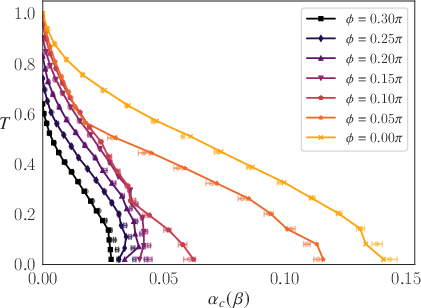
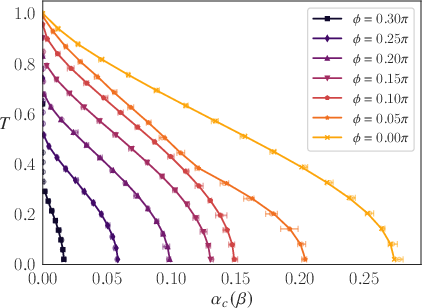
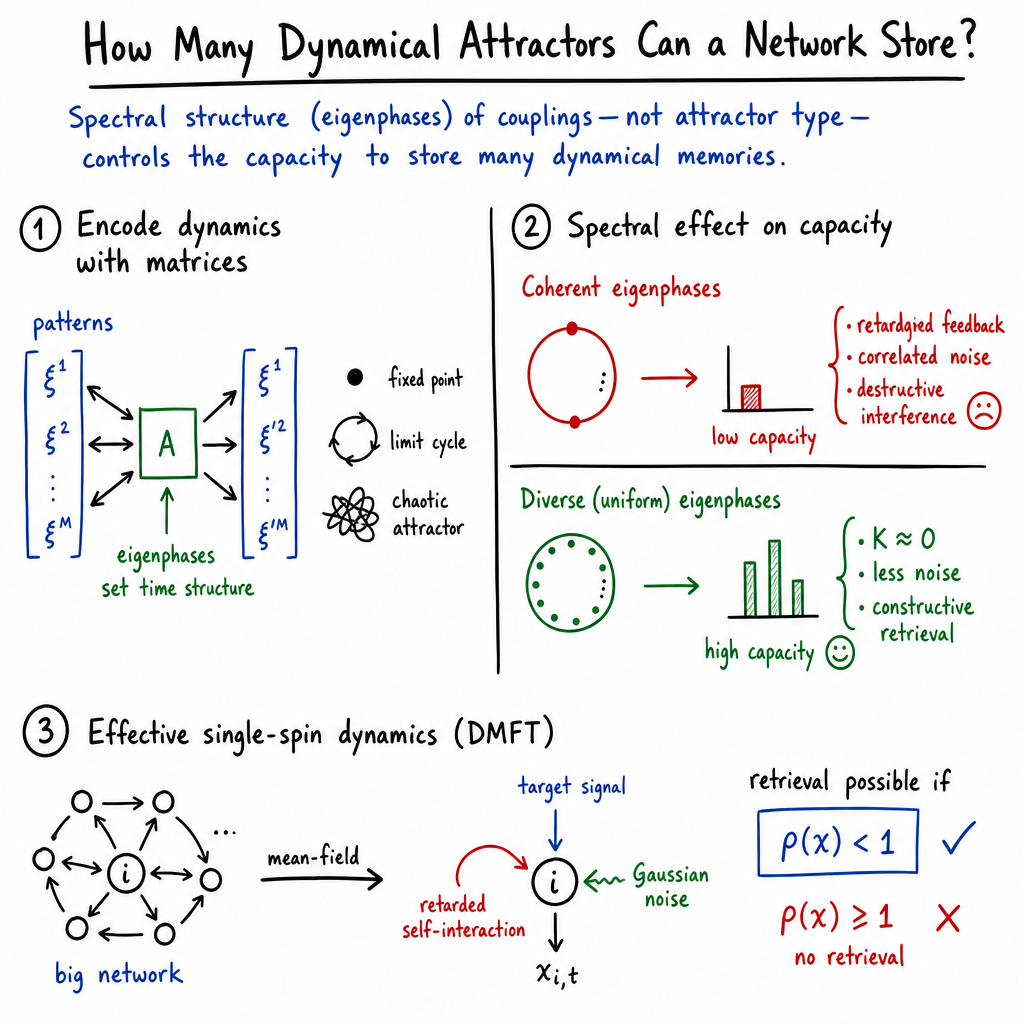
Abstract: We develop a dynamical mean-field theory for nonreciprocal associative networks that store an extensive number of dynamical attractors, from limit cycles to strange attractors. Using a path integral calculation under quenched disorder, we derive self-consistent dynamical mean-field equations for pattern overlaps, autocorrelations and response functions. Memory retrieval capacity is governed by the spectral structure of the coupling matrices encoding stored patterns. When their eigenvalues are coherently aligned, retarded self-interactions and quenched noise feed back destructively: at zero eigenphase (fixed point attractors) the classical equilibrium capacity bound is recovered, while for limit cycles retrieval collapses far below it. In contrast, for uniformly distributed eigenphases, retarded self-interactions and much of the quenched noise cancels, reducing the dynamics to an effective single-spin process and amplifying capacity substantially. We validate the theory against microscopic simulations for limit-cycle and chaotic attractors, identifying eigenvalue decoherence as the mechanism enabling enhanced storage of dynamical memories.
Paper Prompts
Sign up for free to create and run prompts on this paper.
Top Community Prompts
Explain it Like I'm 14
1. What is this paper about?
This paper studies how artificial neural networks can remember many changing patterns, not just still images.
For example, a network might remember:
- a pattern that stays the same, like a stored picture;
- a repeating pattern, like a dance or rhythm;
- a complicated changing pattern, like chaotic weather.
The researchers ask whether one network can store a large number of these moving memories at the same time. They especially study networks where connections between neurons are nonreciprocal. This means that neuron A can strongly affect neuron B even when neuron B does not affect neuron A in the same way.
2. Main questions
The paper focuses on several important questions:
- How many changing memories can the network store?
- What makes storing these memories easier or harder?
- Does the network work better when all memories have similar rhythms, or when their rhythms are different?
- Can the same theory explain the storage of both repeating patterns and chaotic patterns?
The central idea is that the network’s success depends strongly on the eigenvalues of its connection matrices. In simpler language, these eigenvalues describe the natural rhythms and directions built into the network.
3. How did the researchers study this?
Building the neural network
The researchers created a model containing many artificial neurons. Each neuron could be in one of two states, represented by or .
At each time step, a neuron either:
- changed its state based on signals from other neurons, or
- stayed as it was.
The connections between neurons were designed to store groups of random patterns. Each group represented one dynamical memory.
A useful analogy is a music player:
- each stored attractor is like a different song;
- the connection matrix is like the player’s internal recording;
- the neurons move through a sequence of states as the song plays.
Fixed points, cycles, and chaos
The researchers studied three types of memories:
- Fixed-point attractors: the network settles into one unchanging pattern.
- Limit-cycle attractors: the network repeatedly goes through the same sequence of patterns.
- Chaotic or “strange” attractors: the network follows a complicated path that never repeats exactly, but still stays within a particular region of possible states.
An attractor is a pattern or motion that the network naturally approaches after starting from many different conditions.
The mathematical method
The main theoretical tool was called dynamical mean-field theory.
This method replaces a very large network with a simpler description of one typical neuron. It is similar to predicting the behavior of a large crowd by studying an “average person,” while still including the effects of the crowd.
The researchers tracked three main quantities:
- Overlap: how closely the network matches a stored memory.
- Correlation: how similar the network is to its own earlier states.
- Response: how much the network changes when it receives a small extra signal.
They also used a path-integral calculation, which keeps track of all possible histories of the neurons over time. This allowed them to calculate the effects of randomness and interference between stored memories.
Finally, they compared the theory with direct computer simulations of large networks.
4. Main findings
Different rhythms can improve memory capacity
The most important result is that a network can store more dynamical memories when those memories have different rhythms or phases.
Here, a phase is like the timing position in a cycle. If two memories have the same phase, they are moving in step. If their phases are spread out, they are less synchronized.
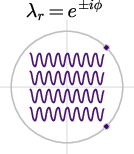
When all stored memories have similar rhythms, they interfere with one another. This interference can seriously reduce the number of memories the network can store.
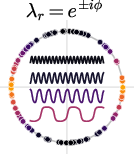
When their rhythms are more diverse, much of this interference cancels out. The memories become easier to separate, allowing the network to store more of them.
The authors call this effect eigenvalue decoherence. In simple terms, it means that differences in the memories’ natural rhythms prevent them from getting tangled together.
Coherent cycles are difficult to store
When all memories use the same rotation or rhythm, the network creates unwanted feedback from its past states. This feedback acts like an echo that interferes with the current memory.
For repeating cycles, the storage capacity can fall far below the usual capacity for fixed memories.
In contrast, when the rhythms are distributed around the circle instead of being identical, this harmful feedback largely disappears.
Capacity can exceed the classical Hopfield result
For fixed-point memories, the paper recovers the well-known result for a classical Hopfield network.
However, when the rhythms of the stored memories are spread out, the network can store considerably more. In one case, the zero-temperature capacity was about
compared with the classical Hopfield value of about
$0.138.$
The quantity measures the largest number of stored patterns per neuron that can still be retrieved reliably.
So, under the conditions studied, spreading out the rhythms can almost double the storage capacity.
The result also works for chaotic memories
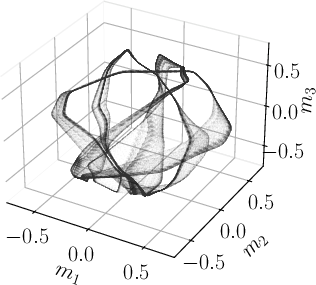
The researchers designed a four-pattern system that produced a chaotic attractor. They found that the theory accurately predicted the behavior seen in computer simulations.
Just as with repeating cycles, chaotic memories were stored more successfully when their eigenvalues were spread out instead of grouped into matching pairs.
This suggests that the result is not limited to simple cycles. It may apply to many kinds of changing memories.
There is a stability limit
The network does not always work. The researchers found that retrieval fails when the response of the system becomes too strong.
In mathematical terms, this happens when the spectral radius of the response matrix becomes larger than one. In everyday language, the network’s feedback becomes an amplifier: small disturbances grow larger and larger instead of dying away.
This gives a useful rule:
The network can store dynamical memories only while its feedback remains stable.
Partial diversity also helps
The researchers also tested cases between complete similarity and complete randomness.
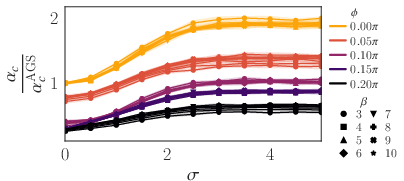
They gradually increased the spread of the rhythms among stored memories. In most cases, memory capacity increased steadily as the rhythms became more different. The improvement was often between 1.5 and 3 times the capacity of the fully synchronized case.
This shows that the benefit does not require perfectly random rhythms. Even moderate diversity can help.
5. Why are these findings important?
The paper suggests that diversity can make a complex neural system more stable and more useful.
This may help explain why real brains contain many different rhythms, such as theta, beta, and gamma oscillations. Different frequency bands may carry separate kinds of information partly because their differences reduce interference.
The results could also be useful for designing:
- artificial neural networks;
- systems that store sequences or time-dependent information;
- brain-inspired computing devices;
- models of memory and brain rhythms.
The work also challenges the idea that adding more types of behavior always makes a system less stable. In this case, adding diversity actually helps: different rhythms interfere less, so the network can store more memories.
Simple conclusion
The paper shows that a neural network can remember many moving, repeating, or even chaotic patterns. The key is not only the number of neurons or connections, but also how similar the stored memories are.
If all memories have the same rhythm, they interfere with one another. If they have different rhythms, the interference can cancel out. As a result, the network can store more memories and retrieve them more reliably.
In short:
Different rhythms help neural networks keep more dynamical memories without becoming confused.
Knowledge Gaps
Knowledge gaps, limitations, and open questions
- The theory is derived for i.i.d. binary patterns; it remains unclear whether the capacity enhancement persists for correlated, structured, sparse, or biologically learned patterns.
- The coupling construction uses block-diagonal pattern interactions, so interactions between different attractors are restricted to quenched crosstalk. Networks with explicitly coupled memories or hierarchical attractor relationships are not analyzed.
- The paper does not provide a general analytic expression for memory capacity as a function of the full eigenvalue distribution; most conclusions are demonstrated for identical rotations, uniformly distributed eigenphases, or selected numerical distributions.
- The relationship between eigenvalue decoherence and capacity is not established for non-orthogonal, non-normal, defective, or strongly non-unitary coupling matrices, where eigenvectors and transient amplification may be as important as eigenvalues.
- The claimed criterion is presented as necessary for finite quenched noise, but its precise relationship to retrieval stability, basin stability, and dynamical phase transitions is not fully derived.
- The theory does not characterize the nature of the retrieval failure at or beyond , including whether failure results from noise divergence, attractor destruction, a spin-glass transition, or finite-time numerical effects.
- The mean-field derivation assumes the thermodynamic limit and does not quantify finite-size corrections, especially near critical capacities, heteroclinic bifurcations, and the instability.
- Numerical validation is limited mainly to ; the dependence of capacity, phase boundaries, and eigenphase-decoherence effects on the update probability is unresolved.
- The limiting cases of fully parallel updates () and sequential updates () are not systematically studied within the presented framework.
- Only Glauber spin updates with binary states are considered; it remains unknown whether the mechanism applies to continuous-valued neurons, threshold units, rate models, or other stochastic update rules.
- The effects of external fields are not explored, including time-dependent inputs, signal-driven retrieval, perturbation robustness, and switching between stored attractors.
- Retrieval is evaluated primarily through overlap norms and capacity thresholds; the paper does not quantify basin sizes, cue-dependent retrieval probability, convergence times, phase accuracy, or the probability of landing on the intended attractor.
- The coexistence and competition of multiple attractors are not characterized dynamically. In particular, possible attractor selection biases, spontaneous switching, multistability, and cross-attractor transitions remain unexamined.
- The stored dynamical memories are generated from random patterns and prescribed matrices rather than learned from example trajectories; the capacity and spectral requirements under biologically or algorithmically plausible learning rules are unknown.
- The paper does not determine how accurately a desired frequency, quasiperiodic trajectory, or chaotic invariant measure can be encoded, nor how storage capacity depends on similarity between attractors.
- The chaotic example relies on a single matrix found by a genetic algorithm, so it does not establish generality across chaotic attractors, matrix dimensions, Lyapunov spectra, or attractor geometries.
- The claim that capacity depends more on spectral diversity than attractor topology is not fully separated from other confounding factors, such as matrix dimension, frequency distribution, stability margin, and the magnitude of the response kernel.
- The partial-coherence study is based on finite-size simulations and a limited range of phase distributions; a quantitative theory for arbitrary phase correlations, multimodal distributions, and phase disorder is missing.
- The uniform-eigenphase cancellation results appear exact only under idealized spectral distributions and orthogonality assumptions; the robustness of cancellation to finite numbers of attractors, spectral sampling fluctuations, and matrix perturbations is not quantified.
- The effect of heterogeneity in attractor dimensions is not studied, despite the model allowing different block sizes.
- The analysis does not investigate nonuniform memory loads, unequal attractor strengths, or normalization schemes that compensate for differences in block dimension and eigenvalue magnitude.
- The comparison with the classical Hopfield capacity does not establish an information-theoretic capacity bound for dynamical memories, and it remains unclear how capacity should be measured when each memory occupies multiple temporal states.
- The role of temperature is examined through selected phase diagrams, but the full nonequilibrium phase structure—including spin-glass, paramagnetic, oscillatory, quasiperiodic, and chaotic regimes—is not mapped.
- The impact of noise on the temporal fidelity of retrieved cycles and chaotic trajectories is not distinguished from complete retrieval failure; a graded measure of dynamical-memory degradation is needed.
- The paper does not analyze robustness to synaptic noise, pattern corruption, coupling perturbations, dilution, sparsity, or structural heterogeneity, although these factors could alter eigenvalue coherence and response kernels.
- The proposed biological interpretation is not tested against neural data or against networks with realistic delays, Dale’s law, excitatory–inhibitory structure, or conductance-based dynamics.
- The computational cost and scalability of solving the non-Markovian effective single-spin process for long trajectories, large pattern dimensions, and broad eigenvalue distributions remain unclear.
- The derivation and numerical implementation are presented for finite observation horizons, but the long-time limits of the correlation and response kernels—particularly for chaotic attractors—are not rigorously established.
- The paper does not provide rigorous bounds or proofs for the asserted capacity enhancement; the conclusions remain dependent on dynamical mean-field approximations and numerical experiments.
- The effects of quenched disorder in the target block itself are not examined; the target coupling matrices are prescribed, whereas variability or uncertainty in the intended attractor may substantially change retrieval.
- It remains unresolved whether eigenphase diversity can be optimized constructively, including whether there is an optimal nonuniform spectral distribution that maximizes capacity subject to stability and target-dynamics constraints.
Practical Applications
Immediate Applications
- Neural-network architecture design for temporal associative memory — AI/software
- Use the paper’s coupling construction,
to build recurrent models that retrieve not only static patterns but also sequences, oscillations, quasiperiodic trajectories, and chaotic attractors. - A practical workflow is to assign each desired temporal memory a pattern block and an encoding matrix , then simulate retrieval under noisy or incomplete initial conditions. - Dependence: current results assume binary units, random independent patterns, orthogonal or rotation-like encoding matrices, and a specific stochastic Glauber update rule. Performance in modern continuous-valued or gradient-trained networks remains to be validated.
Spectral pre-design tool for recurrent-memory capacity — AI hardware and software
- The derived mean-field equations can be implemented as a capacity-estimation tool that evaluates the response matrix , the noise kernel , and the retarded-interaction kernel before constructing a large network.
- Designers can use eigenphase dispersion as an explicit engineering parameter: avoid assigning identical or tightly aligned eigenphases to all stored attractors, and instead distribute them across the unit circle or introduce controlled phase variance.
- This could support automated hyperparameter searches over attractor frequencies, temperature/noise level, update probability , and memory load .
- Dependence: the key stability requirement is , where is the spectral radius. The reported capacities are model-specific and should not be treated as universal engineering limits.
- Simulation and benchmarking framework for dynamical memories — Academia and software
- The paper’s effective single-spin process and publicly referenced code can be used to benchmark recurrent-memory models without simulating every neuron at very large .
- Researchers can compare microscopic simulations with dynamical mean-field predictions for fixed-point, cyclic, quasiperiodic, and chaotic retrieval.
- Useful benchmark metrics include overlap norm, attractor-retrieval probability, critical load , Lyapunov exponents, autocorrelation functions, and response spectra.
- Dependence: the theory is asymptotic in network size and may require finite-size corrections for practical systems.
- Design of frequency-separated temporal representations — Neuroscience and neuromorphic computing
- The results provide an actionable hypothesis: memories encoded with distinct or weakly correlated dynamical frequencies should interfere less than memories with synchronized spectral structure.
- In a neuromorphic system, different tasks could be assigned different rotation angles or eigenphase distributions so that each task occupies a distinct temporal channel.
- In neuroscience, the theory can guide analyses testing whether memories associated with theta, beta, gamma, or other rhythms are more separable when their phases or frequencies are less coherent.
- Dependence: this is a mechanistic prediction from an abstract binary network, not evidence that biological circuits implement the exact matrix construction.
- Robust temporal-pattern classification and anomaly detection — Software, robotics, and industrial monitoring
- A network can be trained to store normal dynamical trajectories—such as machine vibrations, robotic motion cycles, or physiological rhythms—and classify an input by the attractor to which it converges.
- Failure to converge, convergence to the wrong attractor, or a large reduction in overlap can serve as an anomaly signal.
- Example workflows include monitoring rotating machinery, detecting abnormal robot gait cycles, or identifying deviations in periodic sensor streams.
- Dependence: practical deployment requires adapting the model to continuous-valued observations, nonstationary noise, missing data, and online learning. The paper demonstrates storage and retrieval, not end-to-end anomaly-detection accuracy.
- Control of distributed recurrent systems through spectral diversity — Robotics and control
- Robot behaviors such as walking, turning, manipulation, or rhythmic exploration could be represented as separate dynamical attractors in a nonreciprocal recurrent controller.
- A controller designer could reduce interference between behaviors by assigning them different eigenphase structures and switching attractors through external fields or initial-state cues.
- Dependence: the paper does not establish closed-loop stability under physical-body dynamics, actuator delays, or safety constraints. Hardware implementation would require controller-level proofs and experiments.
- Educational and research-use analytical model — Academia
- The model can serve as a teaching and research platform connecting associative memory, random matrices, non-equilibrium statistical mechanics, dynamical systems, and neural computation.
- Students can reproduce the transitions between fixed points, limit cycles, and chaotic attractors, and examine how coherent versus dispersed eigenvalues affect capacity.
- Dependence: reproducibility requires resolving typographical issues in the supplied manuscript and carefully matching the paper’s update convention, temperature, , network size, and initialization procedure.
Long-Term Applications
- High-capacity sequence and episodic-memory modules for AI — AI and machine learning
- The framework could evolve into a recurrent memory module for storing many temporally structured items, such as speech fragments, motion primitives, event sequences, or multivariate sensor trajectories.
- A future product could automatically learn a spectral codebook: each memory receives an encoding matrix whose eigenphases are optimized to maximize capacity while maintaining stable retrieval.
- Such a module could complement transformers or linear-attention systems by providing persistent, energy-efficient dynamical memory.
- Dependencies: learning rules for and the patterns are not developed; scaling beyond random binary patterns, handling interference during continual learning, and comparing against transformer memory mechanisms require further work.
- Neuromorphic hardware for multiplexed dynamical memories — Hardware and edge computing
- Nonreciprocal synaptic devices, asymmetric crossbar arrays, or analog recurrent circuits could implement the coupling matrices and store multiple oscillatory or chaotic attractors with low-power local dynamics.
- Spectral-decoherence principles could guide hardware allocation of temporal channels, potentially enabling simultaneous storage of multiple rhythms or motor programs.
- Dependencies: physical devices must realize stable asymmetric couplings, suppress unwanted self-couplings, tolerate fabrication variability, and maintain . The paper does not address quantization, device noise, energy consumption, or programming complexity.
- Biologically grounded models of hippocampal and cortical memory replay — Neuroscience and healthcare research
- The theory could be extended to test whether frequency diversity helps neural circuits store and replay multiple episodes, oscillatory motifs, or internally generated trajectories.
- Candidate applications include modeling memory replay during sharp-wave ripples, cross-frequency communication, and simultaneous representation of events at different temporal scales.
- Experimental studies could compare phase dispersion, retrieval fidelity, and interference across neural populations with different oscillatory organization.
- Dependencies: biological networks are heterogeneous, structured, sparse, plastic, and often continuous-valued. Establishing a correspondence between model eigenphases and measurable neural rhythms requires empirical validation.
- Chaotic-attractor memory for rich trajectory generation — Robotics, simulation, and generative AI
- The demonstrated storage of a strange attractor suggests future controllers or generative systems that recall complex, nonrepeating yet structured behaviors.
- Potential uses include naturalistic robot exploration, synthetic biological-signal generation, adaptive locomotion, and generation of complex temporal stimuli.
- A system could retrieve a chaotic attractor from a partial cue and generate a trajectory with the appropriate statistical and geometric properties.
- Dependencies: chaotic retrieval is especially sensitive to finite-size effects, noise, parameter mismatch, and synchronization. Applications require defining acceptable trajectory similarity rather than exact state-by-state reproduction.
- Adaptive spectral memory allocation in policy and communication systems — Policy, communications, and distributed computing
- The paper’s central design principle could inspire scheduling systems that assign distinct temporal or spectral signatures to concurrent information streams in order to reduce cross-talk.
- Possible examples include frequency-separated distributed controllers, asynchronous multi-agent coordination, and temporal multiplexing in sensor networks.
- Dependencies: these analogies require translating neural eigenphase diversity into operational communication channels. Capacity, latency, interference, and regulatory constraints would need independent analysis.
- Diversity-aware stability design for other complex systems — Ecology, epidemiology, and energy
- The result that spectral diversity can reduce destructive feedback may motivate analogous models of ecological communities, coupled oscillators, power-grid control, or interacting-agent systems.
- A practical long-term research direction is to identify whether heterogeneity in interaction phases or response times can increase coexistence, resilience, or disturbance tolerance.
- Dependencies: the paper only establishes the effect for a particular associative neural architecture. Transfer to ecological, energy, or policy systems requires models that include conservation laws, nonlinear constraints, topology, and domain-specific data.
- Policy guidance for artificial neural systems with interpretable stability constraints — AI governance and standards
- The condition and the measurable relationship between spectral structure and retrieval capacity could become part of testing standards for recurrent AI systems.
- Developers could report spectral-radius margins, attractor interference, retrieval failure rates, and robustness under perturbations before deploying dynamical-memory systems in healthcare, robotics, or safety-critical applications.
- Dependencies: these metrics are not sufficient for safety or fairness, and the paper does not study adversarial inputs, distribution shift, privacy, or human oversight. They would need to complement—not replace—domain-specific certification.
Glossary
- Associative memory: A neural-network mechanism that stores information as patterns and retrieves them from partial or noisy inputs. “Statistical mechanics has proven fundamental to understanding how neural network models function as associative memories”
- Attractor: A stable dynamical state or trajectory toward which a system evolves. “each containing patterns”
- Autocorrelation: A measure of similarity between a time-dependent signal and a time-shifted version of itself. “derive self-consistent dynamical mean-field equations for pattern overlaps, autocorrelations and response functions”
- Bernoulli variable: A binary random variable representing an event that occurs with a specified probability. “independent variables ”
- Bifurcation: A qualitative change in the behavior or structure of a dynamical system as a parameter varies. “there is a heteroclinic bifurcation at ”
- Causal: Relating only to influences from earlier times or events. “can be computed at time using only causal influences from time ”
- Coloured Gaussian noise: Gaussian random noise with temporal correlations rather than independent values at each time. “equivalent to a nonequilibrium spin glass driven by coloured Gaussian noise”
- Conjugate eigenvalues: Complex eigenvalues that occur in pairs consisting of a number and its complex conjugate, typically for real matrices. “their eigenvalues come in conjugate pairs $e^{\pmi\phi_r}$”
- Critical capacity: The maximum memory load at which a network can reliably retrieve stored patterns. “Critical capacity as a function of temperature ”
- Critical load: The largest ratio of stored patterns to network units compatible with successful retrieval. “the resulting phase boundary ”
- Dynamical mean-field theory: A statistical framework that reduces the collective dynamics of a large interacting system to self-consistent effective single-unit dynamics. “Here we develop a a dynamical mean-field theory for nonrecirocal associative memories”
- Eigenphase: The phase angle of a complex eigenvalue, especially when the eigenvalue lies on the unit circle. “with the eigenphase of the target block”
- Eigenvalue decoherence: The reduction of coherent interaction effects caused by spreading eigenvalue phases across different values. “identifying eigenvalue decoherence as the mechanism enabling enhanced storage of dynamical memories”
- Effective field: The aggregate input acting on a unit after combining external inputs and network interactions. “with update probability , driven by effective fields ”
- Effective single-spin process: A reduced stochastic description of one representative unit that incorporates the influence of the rest of the network through self-consistent fields and noise. “reducing the dynamics to an effective single-spin process”
- Extensive: Scaling proportionally with the system size. “store an extensive number of dynamical attractors”
- Generating functional: A functional whose derivatives produce statistical moments and response functions of a stochastic dynamical system. “We introduce a moment-generating functional for trajectories”
- Glauber dynamics: A stochastic update rule for spin systems in which transition probabilities depend on the local field and temperature. “via Glauber dynamics at inverse temperature ”
- Heteroclinic bifurcation: A bifurcation involving trajectories that connect distinct saddle points, often causing a periodic orbit to slow or disappear. “the cycle slows near four saddle-type fixed points until its period diverges and the orbit collapses onto fixed points”
- Hubbard–Stratonovich transformation: An integral transformation that replaces a quadratic interaction term with an auxiliary Gaussian variable. “linearised by a Hubbard--Stratonovich transformation introducing ”
- Inverse temperature: The reciprocal of thermodynamic temperature, controlling the strength of thermal fluctuations in statistical-mechanical models. “at inverse temperature ”
- Lyapunov exponent: A quantity measuring the average exponential growth or decay rate of infinitesimal perturbations in a dynamical system. “with Lyapunov exponents , ”
- Lyapunov equation: A matrix equation commonly used to characterize stability and covariance in linear dynamical systems. “resulting in the Lyapunov equation ”
- Mean-field theory: An approximation that replaces many-body interactions with an average or self-consistent interaction. “The quenched generating functional~\eqref{eq:quenched_generating_functional} factorises over spins once the kernels and are fixed.”
- Moment-generating functional: A functional encoding trajectory statistics whose derivatives generate moments of dynamical variables. “We introduce a moment-generating functional for trajectories”
- Non-Markovian: Depending on the history of a process rather than only its current state. “the non-Markovian history encoded in ”
- Nonreciprocal coupling: An interaction in which the influence from one unit to another differs from the reverse influence. “Nonreciprocal (asymmetric) couplings extend this to sequential association”
- Onsager correction: A compensating self-interaction term that removes or adjusts the effect of a unit’s feedback on its own effective field. “the diagonal exclusion generates an Onsager correction that cancels exactly”
- Order parameter: A macroscopic quantity summarizing an important collective property of a system. “We define dynamical order parameters for the pattern overlaps, correlations, and response functions”
- Quenched disorder: Randomness in system parameters that remains fixed during the dynamics. “the remaining sets as a source of quenched disorder”
- Quasiperiodic orbit: A bounded trajectory combining incommensurate frequencies without repeating exactly. “when is irrational the overlap dynamics generically traces a quasiperiodic orbit on a two-torus.”
- Retarded self-interaction: A delayed influence of a unit’s previous states on its present dynamics. “retarded self-interactions and quenched noise feed back destructively”
- Response function: A measure of how a system’s output changes in response to a small external perturbation. “derive self-consistent dynamical mean-field equations for pattern overlaps, autocorrelations and response functions”
- Resolvent expansion: An expansion of the inverse of a matrix into a series of powers, often used to analyze spectral and dynamical properties. “the term in the resolvent expansion”
- Saddle-point evaluation: An asymptotic approximation that evaluates an integral near points where its exponent is stationary. “Finally saddle-point evaluation results in the quenched generating functional”
- Saddle point: A stationary point of a function that is neither necessarily a maximum nor a minimum. “until its period diverges and the orbit collapses onto fixed points”
- Spectral radius: The largest absolute value of a matrix’s eigenvalues. “the spectral radius of is larger than 1”
- Spin glass: A disordered system of interacting spins characterized by competing interactions and complex collective behavior. “equivalent to a nonequilibrium spin glass driven by coloured Gaussian noise”
- Strange attractor: A chaotic attractor with intricate, typically fractal geometric structure. “Figure~\ref{fig:Fig2}(a) shows a strange attractor obtained by this procedure”
- Susceptibility: A response coefficient quantifying how a system changes under an applied perturbation. “with susceptibility, for , \begin{equation}”
- Synchronous dynamics: An update scheme in which all units are updated simultaneously. “The parameter interpolates between parallel dynamics () and single–spin updates ()”
- ** quenched generating functional**: A generating functional averaged over fixed random disorder, used to derive effective dynamical equations. “Finally saddle-point evaluation results in the quenched generating functional”
- Hetero-associative network: A network that maps one set of patterns or representations to a different set. “Exponential hetero-associative networks have become an active object of study”
- Heteroclinic orbit: A trajectory connecting two different invariant saddle points. “the cycle slows near four saddle-type fixed points”
- Unit circle: The set of complex numbers with modulus one, often describing eigenvalues of orthogonal or rotation matrices. “when the eigenvalues of $\bm{\hat{A}$ are uniformly distributed on the unit circle”
- Variance reduction: The decrease in variability achieved by averaging or aggregating stochastic quantities. “Shaded bands and error bars denote standard deviation over trials.”
- Whitening: A transformation that decorrelates variables and normalizes their variances. “with eigenvalues uniformly distributed on the unit circle”

