Sound-based Multi-Person 3D Pose Estimation
Abstract: Can we recover the 3D poses of multiple people using only sound? This paper presents the first attempt to estimate multi-person 3D poses solely from acoustic signals. Estimating the poses of multiple individuals using acoustic signals is inherently challenging due to the superposition of motion-dependent signal variations. Unlike single-person scenarios, the presence of multiple subjects leads to overlapping acoustic signatures, making it difficult to attribute specific signal changes to an individual's pose. Furthermore, the complexity is compounded by inter-person reflections, which introduce intricate propagation delays that obscure the temporal motion-acoustic relationship. To address these issues, we propose SoundMHPE (Sound-based Multi-person Human Pose Estimator), a novel encoder-decoder framework consisting of two key components. First, the Acoustic Multi-scale Encoder captures diverse temporal and fine-grained frequency features to isolate subtle acoustic signatures from complex, overlapping signals. Second, the Temporal Pose Decoder employs an attention mechanism to disentangle multi-person information across successive frames. By jointly accounting for temporal dynamics and inter-person dependencies, this component precisely reconstructs frame-wise individual poses. To validate our approach, we constructed the 6-hour Acoustic Multi-person Pose (AMP) dataset consisting of 432K synchronized frames of multi-person pose and acoustic data, and demonstrated that our SoundMHPE outperforms baseline models. Project page: https://oumi03.github.io/sound-mhpe/

Paper Prompts
Sign up for free to create and run prompts on this paper.
Top Community Prompts
Explain it Like I'm 14
1. What is this paper about?
This paper asks an unusual question:
Can we figure out the 3D positions and movements of several people using only sound?
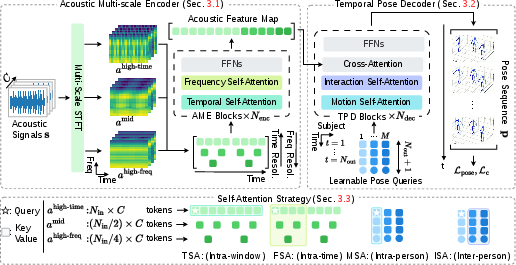
The researchers created a system called SoundMHPE, which stands for Sound-based Multi-person Human Pose Estimator. The system sends out sounds using speakers and listens to the echoes with a microphone. From these echoes, an artificial intelligence model tries to work out where each person’s body parts are in three-dimensional space.
Most pose-estimation systems use cameras. However, cameras can have problems in darkness, when people are hidden behind one another, or when privacy is important. Sound could be useful in some of these situations.
2. What were the researchers trying to find out?
The main goals were to:
- Estimate the 3D poses of several people at the same time using sound.
- Separate the sound changes caused by one person from those caused by other people.
- Track how each person moves from one moment to the next.
- Test whether the new system works better than simpler existing models.
- Build a new dataset so that other researchers can study this problem.
This is difficult because sound signals from different people overlap. It is similar to trying to understand several people talking at once, except that the system is listening to echoes created by body movements.
3. How did the researchers do it?
Collecting sound and movement data
The researchers used:
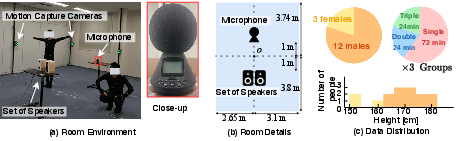
- Two speakers to send out a special sound signal.
- A four-channel microphone to record the returning sound.
- A motion-capture camera system to record the true positions of the people’s bodies.
The special sound signal was a time-stretched pulse, which is a sound whose frequency changes over time. People may not notice it clearly, but it helps the system measure how sound bounces around the room.
The researchers recorded 15 people performing movements such as:
- Walking
- Twisting
- Raising both arms
- Moving at different speeds
They recorded one, two, and three people together. The dataset, called AMP, contains about six hours of recordings and approximately 432,000 frames. Each person was represented using a skeleton with 21 body joints, including the head, shoulders, hands, hips, knees, and feet.
Turning sound into useful information
The system first changes the recorded sound into a picture called a spectrogram. A spectrogram shows:
- Which sound frequencies are present
- When those frequencies appear
- How strong they are
It is like making a map of sound over time.
The system uses several different time windows when creating these spectrograms:
- Short windows show exactly when a sound changes.
- Long windows give more detail about which frequencies are present.
Using both is helpful because body movements can create very small changes in both the timing and frequency of echoes.
The two main parts of SoundMHPE
SoundMHPE has two important components.
Acoustic Multi-scale Encoder
The Acoustic Multi-scale Encoder examines the spectrograms at different levels of detail. It searches for useful clues in the sound, such as small echoes or frequency changes caused by moving arms, legs, or the body.
This is like examining a photograph both from far away to understand the whole scene and up close to notice small details.
Temporal Pose Decoder
The Temporal Pose Decoder uses the sound information to predict the pose of each person over several frames.
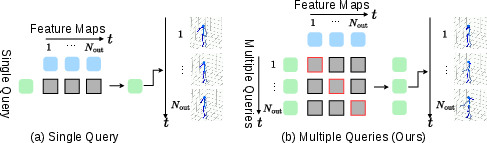
It gives the model separate “questions,” called queries, for:
- Each person
- Each moment in time
This helps the system keep track of which movement belongs to which person. It can also compare a person’s movement with the movements and sound reflections created by others.
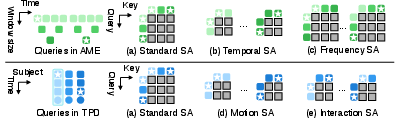
The model uses a technique called attention. Attention helps the model decide which pieces of information are most important. For example, it can focus on:
- Earlier and later movements of the same person
- The possible effect of one person’s sound reflections on another person
- Different sound frequencies that may reveal small body movements
4. What did the researchers discover?
SoundMHPE performed better than the comparison models
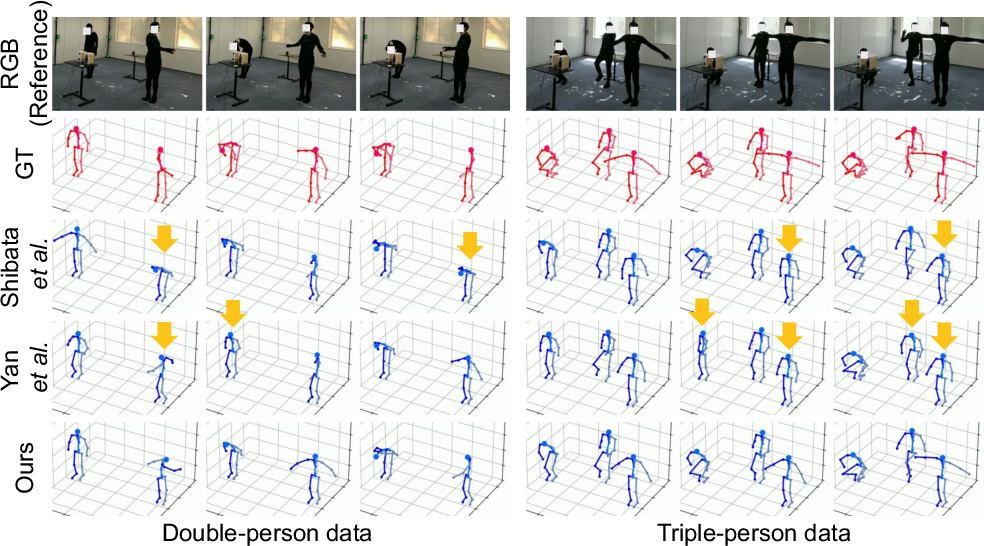
The researchers compared SoundMHPE with two adapted systems. SoundMHPE produced more accurate poses on all three main measurements.
| Method | Average joint error | Correct joint score |
|---|---|---|
| Adapted Shibata model | 121.7 mm | 0.36 |
| Adapted WiFi-based model | 119.9 mm | 0.36 |
| SoundMHPE | 106.5 mm | 0.43 |
A smaller joint error is better, while a higher correct-joint score is better. SoundMHPE’s average error was about 10–15 millimeters lower than the comparison systems.
It worked with multiple people
For three people, SoundMHPE achieved:
- An average joint error of 111.2 millimeters
- A correct-joint score of 0.44
The system was able to recognize challenging movements such as:
- Twisting
- Raising both arms
- Walking while another person moved nearby
However, estimating three people was still somewhat harder than estimating one person. This is expected because the sound reflections become more mixed and confusing.
Both major components were useful
The researchers removed parts of SoundMHPE to see what happened.
| System version | Average joint error |
|---|---|
| Without the Acoustic Multi-scale Encoder | 115.2 mm |
| Without the Temporal Pose Decoder | 116.5 mm |
| Complete SoundMHPE | 106.5 mm |
Removing either component made the results worse. The Temporal Pose Decoder was especially important because it helped the model match each sound pattern to the correct person and moment.
The special attention techniques helped
The researchers also tested simpler attention methods. Their customized attention methods worked better because they separated different kinds of information:
- Temporal attention studied how sound changed over time.
- Frequency attention studied relationships between different frequencies.
- Motion attention followed one person across time.
- Interaction attention studied how the sound patterns of different people affected one another.
It showed some ability to work in new rooms
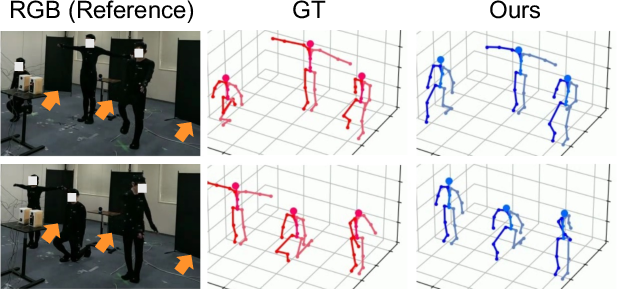
The researchers placed partitions in the room to change how sound bounced around. SoundMHPE could still estimate rough body poses, although unusual echoes remained a challenge.
They also tested parts of the method on WiFi signals. The method improved WiFi-based pose estimation too, suggesting that some of its ideas may be useful for other types of signals.
5. Why is this research important?
This paper is important because it is the first reported attempt to estimate the 3D poses of multiple people using only acoustic signals.
A sound-based system could have several advantages:
- It can work in darkness, where cameras struggle.
- It may help detect people who are partly hidden.
- It does not record recognizable images of people, which could help protect privacy.
- It may be useful for monitoring movement, sports training, emergency response, or detecting falls.
However, the system is not yet ready for every real-world situation. The experiments were done indoors, and different rooms can create different patterns of echoes. Background noise, furniture, walls, and people standing very close together may also reduce accuracy.
Conclusion
The paper shows that sound can provide enough information to estimate the 3D movements of several people. SoundMHPE succeeds by examining sound at different levels of detail and by separately tracking each person across time.
The results suggest that acoustic pose estimation could become a useful alternative to camera-based systems, especially in dark, private, or partly blocked environments. More research and larger datasets will be needed before the technology can work reliably in busy real-world places.
Knowledge Gaps
Knowledge gaps, limitations, and open questions
- Limited participant diversity: The AMP dataset contains only 15 participants, with just three women and a relatively narrow height range (150–181 cm), leaving robustness to broader variation in body shape, age, clothing, mobility, and physical ability unresolved.
- Restricted motion repertoire: The dataset focuses on walking, twisting, and raising both arms; performance on sitting, lying down, crouching, running, falls, carrying objects, physical interaction, and fine-grained hand or finger motions is not evaluated.
- Limited number of simultaneous people: Experiments include at most three subjects, although the model allocates 15 subject slots. Its accuracy, computational cost, and failure behavior in denser crowds remain unknown.
- Predetermined capacity for subjects: The decoder uses a fixed maximum of subject identities, but the paper does not establish how the method behaves when the number of people exceeds this capacity or varies substantially at inference time.
- Unclear identity consistency over time: The method uses subject-specific queries, but the paper does not evaluate whether identities remain correctly assigned across long sequences, crossings, temporary occlusions, or people entering and leaving the sensing region.
- No explicit treatment of subject appearance or identity ambiguity: Acoustic observations may be insufficient to distinguish people with similar motions or positions. The paper does not quantify identity swaps or determine whether subject-specific query embeddings genuinely correspond to persistent individuals.
- Single-room training and evaluation: Most data were collected in one indoor room using one fixed speaker–microphone arrangement. Generalization across room geometries, floor and wall materials, ceiling heights, furniture layouts, and reverberation times is therefore not established.
- Weak evaluation of environmental generalization: The unseen-environment experiment uses partitions placed in the same room rather than independent buildings or substantially different acoustic conditions. The reported qualitative result does not quantify degradation or define the tested acoustic changes.
- Insufficient testing under realistic noise: The study does not systematically evaluate speech, music, machinery, ventilation, traffic, alarms, competing active-sonar systems, or nonstationary background noise.
- Dependence on a controlled active signal: The method relies on a known TSP emitted by a pair of loudspeakers. Its performance under loudspeaker distortion, signal interruptions, synchronization errors, frequency-dependent attenuation, or other simultaneous sound sources remains untested.
- Potential privacy and safety implications are not examined: Although acoustic sensing may reduce visual privacy concerns, the paper does not analyze privacy leakage, audibility of the emitted signal, hearing-safety constraints, or acceptability in homes, hospitals, aircraft, or workplaces.
- Hardware generalization is unresolved: Results rely on a particular pair of speakers and a four-channel ambisonics microphone. Robustness to different microphone arrays, channel counts, speaker placements, sampling rates, inexpensive hardware, and sensor failures is not reported.
- Sensitivity to sensor placement is unknown: The paper does not evaluate changes in speaker–microphone distance, height, orientation, room placement, or the relative position of people to the sensing apparatus.
- No occlusion or obstacle protocol is provided: The motivation emphasizes sensing behind obstacles, but the experiments do not systematically test walls, furniture, curtains, metal, water, or partial acoustic blockage.
- Ground-truth limitations are not discussed: Motion-capture measurements may themselves contain tracking errors, marker occlusions, or synchronization inaccuracies, but no annotation uncertainty or ground-truth quality analysis is provided.
- Coordinate-frame and global-position performance are unclear: The inclusion of PA-MPJPE removes translation, rotation, and scale differences, potentially masking errors in absolute localization. The paper does not separately report joint-relative pose, global body position, orientation, or scale accuracy.
- Evaluation metrics do not capture temporal quality: MPJPE, PA-MPJPE, and PCK do not measure jitter, lag, identity switches, temporal smoothness, motion continuity, or physically implausible poses. These are particularly important for a sequence-based decoder.
- No uncertainty estimates are reported: Confidence scores are used to select outputs, but their calibration, reliability under unseen conditions, and relationship to pose error are not evaluated.
- Failure cases are not systematically characterized: Qualitative figures show failures, but the paper does not provide per-joint, per-motion, per-subject, or per-number-of-people error breakdowns, nor does it identify the acoustic conditions that cause failures.
- Baseline comparisons are limited: The baselines are adaptations of single-person acoustic and WiFi models rather than established multi-person acoustic methods or broader signal-separation approaches. The paper does not compare against oracle or non-neural source-separation pipelines.
- Baseline fairness and reproducibility require clarification: The adapted models, training procedures, parameter counts, preprocessing, hyperparameter tuning, and computational budgets are not described in sufficient detail to determine whether comparisons are fully controlled.
- Ablation studies conflate multiple design changes: Removing AME or TPD also changes the input representation, attention structure, or query formulation. More granular ablations are needed to isolate the contribution of multi-scale STFT, each window size, TSA, FSA, MSA, ISA, temporal embeddings, and subject embeddings.
- The chosen STFT configuration is not broadly optimized: Only a few hand-selected window combinations are tested. The effects of hop size, overlap, Mel-bank design, frequency range, phase information, waveform features, and learned time–frequency representations remain unexplored.
- The physical basis of the learned representation is not validated: The paper hypothesizes that AME captures inter-person reflections and fine-grained frequency variations, but does not analyze attention maps, propagation delays, frequency bands, or correspondence between learned features and measurable acoustic phenomena.
- The role of microphone directionality is unresolved: The four ambisonic channels are used, but there is no comparison with omnidirectional, fewer-channel, or larger-array microphones to establish how much 3D information each channel contributes.
- Temporal-context trade-offs are not studied: The model uses 16 previous frames and predicts eight frames, but latency, prediction horizon, causal inference, alternative context lengths, and performance under real-time streaming constraints are not evaluated.
- Real-time feasibility is unknown: The paper does not report inference speed, memory use, model size, STFT overhead, energy consumption, or latency on deployable hardware.
- Long-term tracking is untested: Experiments use short prediction windows; robustness over minutes or hours, including accumulated identity errors and changes in room conditions, remains unknown.
- The fixed skeleton limits applicability: The 21-joint representation may not transfer to other skeleton conventions, body models, children, people with assistive devices, or applications requiring detailed articulation.
- Interaction scenarios are underexplored: The model is described as modeling inter-person dependencies, but participants’ physical interactions, close contact, occlusion by other bodies, and coordinated group actions are not systematically evaluated.
- Cross-modal transfer does not establish acoustic generality: The PiW experiment changes both the signal modality and the preprocessing pipeline, so it does not demonstrate that the acoustic representation itself transfers. It also evaluates a separate benchmark with different sensing conditions and target distributions.
- Cross-modal results are not directly comparable in scope: The paper claims modality-agnostic applicability, but does not test transfer between acoustic and WiFi data, joint multimodal training, or whether the proposed architecture outperforms modality-specific state-of-the-art methods.
- No robustness analysis for missing or corrupted channels is included: Performance under microphone-channel dropout, clipping, saturation, packet loss, synchronization drift, or corrupted TSP cycles is unknown.
- Training-data scale may be insufficient for real-world variability: Although the dataset contains approximately 432K frames, the recordings represent only six hours and a small number of environments and participants. It remains unclear whether the model learns general acoustic–pose relationships or dataset-specific spatial and behavioral regularities.
- Data-splitting risks are not fully documented: Cross-subject evaluation is described, but the paper does not clarify whether temporally adjacent frames, motion repetitions, recording sessions, room configurations, or subject positions are separated sufficiently to prevent leakage.
- No public-data or independent-reproduction validation is reported: The paper introduces AMP but does not establish whether performance can be reproduced by independent researchers using other rooms, hardware, or collection protocols.
- The upper bound of acoustic-only pose estimation remains unclear: The reported MPJPE of 106.5 mm leaves substantial error, but the paper does not compare against sensor-fusion systems, acoustic oracle settings, or theoretical/empirical limits imposed by ambiguous propagation paths.
- Causal attribution among multiple people remains unresolved: The method predicts poses from the superimposed signal but does not explicitly separate sources or demonstrate that each predicted pose is causally attributable to the corresponding individual rather than inferred from dataset-level motion correlations.
- Robustness to adversarial or unintended movements is unknown: Unmodeled moving objects, pets, fans, doors, or people outside the annotated subject set could produce acoustic reflections and false detections, but open-world behavior is not evaluated.
- Deployment in non-soundproof or occupied environments remains speculative: The paper identifies real-world deployment as a challenge but does not quantify performance in homes, public spaces, medical facilities, or other settings with uncontrolled acoustic interference and changing occupancy.
Practical Applications
Immediate Applications
- Privacy-preserving indoor activity monitoring — healthcare, assisted living, and smart homes.
- detecting falls or prolonged immobility;
- monitoring whether a person has left a bed or chair;
- identifying broad activities such as walking, twisting, or raising the arms;
- tracking simultaneous movement in shared rooms.
- Dependencies and assumptions: The current evidence is limited to an indoor room, three-person scenarios, and controlled motion classes. Fall detection would require task-specific training and clinical validation. Privacy is improved relative to cameras but not eliminated: microphones still capture acoustic information, and consent, secure processing, and disclosure controls remain necessary.
- Camera-free occupancy and movement analytics — buildings, retail, and workplaces. The system can provide approximate multi-person skeletons for room-level movement analysis while remaining usable in darkness or low-light environments. Potential products include occupancy dashboards, movement heat maps, and alerts for unusual inactivity or congestion. Dependencies and assumptions: Performance depends on speaker–microphone placement, room acoustics, the number of people, and the distance between subjects. The AMP dataset contains only 15 participants and up to three people, so deployment would require calibration and testing in the target building.
- Indoor sports and exercise feedback — fitness, rehabilitation, and sports technology. The estimated 3D joints can support camera-free repetition counting, exercise-form feedback, group exercise monitoring, and coarse movement assessment. The model’s ability to represent motions such as walking, twisting, and arm raising is directly relevant to these workflows. Dependencies and assumptions: The reported average error is approximately 106.5 mm MPJPE overall and 111.2 mm in the triple-person setting. This is potentially adequate for coarse activity recognition but not necessarily for precise biomechanical assessment, injury diagnosis, or professional sports analytics. Additional sport-specific data and latency testing are required.
- Low-light and visually obstructed monitoring — industrial safety and facilities management. Acoustic pose estimation can supplement or replace cameras in dark rooms, areas with visual occlusion, or environments where cameras are undesirable. Examples include monitoring worker posture in warehouses, detecting whether operators are inside restricted zones, and observing movement in storage or maintenance areas. Dependencies and assumptions: The paper demonstrates coarse generalization to an unseen reflective environment, but not to factories, large halls, machinery noise, or outdoor settings. Robustness to background noise, reverberation, moving equipment, and hearing-safety regulations must be established.
- Research and education infrastructure for acoustic perception.
- reproducing acoustic pose-estimation experiments;
- benchmarking multi-person signal disentanglement;
- teaching multimodal sensing, Transformers, and spatial audio;
- developing new models using the released project materials.
- Dependencies and assumptions: The dataset’s limited demographic, indoor, and controlled-motion coverage restricts generalization. Licensing, reproducibility of the hardware setup, and access to synchronized ground truth may affect adoption.
- Reusable temporal modeling for other sensing modalities — software and wireless sensing. The paper reports that the Temporal Pose Decoder and the specialized attention structure improve performance when applied to WiFi CSI features, with MPJPE improving from 127.4 mm for the original single-frame system to 122.6 mm. Developers can therefore reuse the motion self-attention, interaction self-attention, and frame-specific query design in WiFi, radar, or other time-series pose systems. Dependencies and assumptions: The cross-modal result is demonstrated on the PiW benchmark rather than in a new real-world deployment. The waveform-specific multi-scale STFT encoder cannot be transferred unchanged to CSI or radar; modality-specific feature extraction is still required.
- Camera-free interactive systems and robotics prototypes. A robot, smart speaker, or room controller could use estimated body position and motion to infer gestures, approach direction, or the presence of multiple users. This could enable hands-free interfaces in kitchens, workshops, classrooms, or accessible computing environments. Dependencies and assumptions: The paper estimates pose but does not establish reliable gesture classification, identity persistence, real-time latency, or robustness to speech and music. A practical product would need confidence-based rejection, temporal tracking, and fail-safe behavior.
Long-Term Applications
- Multi-person fall detection and emergency response — healthcare and public safety. A mature version could continuously monitor hospitals, nursing facilities, shelters, or homes and detect falls, collisions, crowd distress, or abnormal postures without relying on visible cameras. Acoustic sensing could be valuable in darkness, smoke, or visually obstructed areas. Dependencies and assumptions: This requires large datasets containing real falls, assistive devices, diverse body types, beds and furniture, multiple simultaneous events, and realistic noise. False alarms, missed detections, medical-device integration, latency, and regulatory validation are central barriers. The current model should not be treated as a clinical or safety-certified detector.
- Disaster relief and through-obstacle human localization. Acoustic pose estimation could eventually support search-and-rescue systems by identifying coarse human posture or movement behind visual obstructions, in dark interiors, or in partially collapsed structures. Arrays of speakers and microphones could be distributed across a search area to improve spatial coverage. Dependencies and assumptions: The paper only evaluates an indoor room with known sensing geometry. Rubble, wind, large reverberant spaces, irregular surfaces, weak signals, and unknown speaker–person geometry may substantially alter propagation. Robust localization, sensor placement, battery operation, and validation under emergency conditions are needed.
- Crowd and group behavior analysis — transportation, security, and urban planning. Scaled acoustic arrays could estimate movement patterns and coarse poses of several people in stations, corridors, venues, or public facilities. Potential uses include detecting crowd surges, unsafe falls, bottlenecks, and unusual collective motion. Dependencies and assumptions: The demonstrated limit is three people in a controlled setting. Scaling to dense crowds creates severe signal superposition and tracking ambiguity. Large-array synchronization, privacy governance, background-noise suppression, and extensive population-level evaluation would be required.
- Robotic collaboration and human–robot safety. Robots could use acoustic pose estimates to track multiple nearby workers, anticipate gestures, and adapt trajectories when cameras are blocked or lighting is poor. In manufacturing, this could support shared workspaces; in service robotics, it could support interaction with several users. Dependencies and assumptions: Safe control requires centimeter-level or otherwise task-appropriate accuracy, stable person identity, calibrated global coordinates, low latency, and uncertainty estimates. The reported centimeter-to-decimeter-scale errors and occasional failure cases are not yet sufficient for safety-critical collision avoidance without redundant sensors.
- Multimodal sensor fusion for robust pose estimation. SoundMHPE could become one branch of a sensor-fusion system combining acoustic, RGB, depth, LiDAR, WiFi, mmWave, or UWB signals. Acoustic sensing would provide useful information in darkness or when visual observations are occluded, while other modalities could resolve acoustic ambiguities. Dependencies and assumptions: This requires synchronized sensors, cross-modal calibration, missing-modality handling, and models trained across diverse environments. The current results show architectural transfer to WiFi but do not demonstrate fusion or robustness under simultaneous modality failures.
- Acoustic digital twins and human–environment simulation. Long-term systems could reconstruct approximate multi-person motion from acoustic reflections and use it to drive virtual environments, training simulators, or facility simulations. Applications include evacuation modeling, rehabilitation simulation, and interaction design for spaces where camera data cannot be collected. Dependencies and assumptions: Reliable global position, identity tracking, scale estimation, and long-duration temporal consistency are still unresolved. The current evaluation focuses on pose accuracy over short sequences rather than stable trajectories or full environmental reconstruction.
- Large-scale academic benchmarks for privacy-aware human sensing. The AMP dataset and SoundMHPE architecture can motivate broader research into acoustic sensing under demographic variation, room changes, occlusion, noise, and higher person counts. A future benchmark could include standardized splits by environment, subject, microphone geometry, noise condition, and number of people. Dependencies and assumptions: Progress depends on collecting substantially larger and more diverse datasets, reporting uncertainty and failure rates in addition to MPJPE/PCK, and establishing ethical protocols for recording human motion and acoustic signals.
- Everyday assistive interfaces and accessibility technologies. A future compact device could infer multi-person gestures or posture changes to control appliances, request assistance, or provide feedback to users with limited mobility. Unlike vision-based systems, it could operate in darkness and avoid transmitting images. Dependencies and assumptions: Consumer deployment would require small, low-power models, inaudible or acceptable emitted signals, robust performance with speech, pets, furniture, and music, and clear user controls. The current speaker–microphone setup and controlled acoustic environment do not yet establish these requirements.
Glossary
- Ablation study: An experiment that removes or changes components of a model to measure their individual contributions. “detailed ablation studies further confirm the effectiveness of our proposed components.”
- Active acoustic sensing: A sensing method that emits sound and analyzes its reflections or received signals to infer properties of an environment or target. “Active acoustic sensing estimates target states by emitting sound signals and analyzing the received acoustic signals.”
- AdamW: An optimization algorithm for training neural networks that decouples weight decay from gradient-based parameter updates. “All experiments used AdamW~\cite{AdamW_loshchilov_2017} as the optimizer”
- Ambisonics microphone: A microphone system that records sound in multiple channels to preserve spatial and directional information. “we use an ambisonics microphone that records across four channels”
- Attention mechanism: A neural-network operation that assigns different importance weights to elements of an input representation. “the Temporal Pose Decoder employs an attention mechanism to disentangle multi-person information across successive frames.”
- Binary cross entropy: A loss function used to measure the difference between binary labels and predicted probabilities. “ is the binary cross entropy loss”
- Chirp signal: A signal whose frequency varies over time, commonly used in sensing and radar-like measurements. “prior works have explored pose estimation with chirp signals”
- Confidence score: A model output representing the estimated reliability or probability of a prediction. “the decoder predicts a single-frame pose and a confidence score ${\hat{c_i}$ for each query.”
- Cross-attention: An attention operation in which queries attend to a separate set of feature representations. “by computing cross-attention between these queries and the feature maps”
- Cross-modal applicability: The ability of a method or architecture to operate across different types of input data or sensing modalities. “a cross-modal evaluation demonstrating that SoundMHPE can be successfully applied to WiFi signals”
- Cross-subject evaluation: An evaluation protocol in which people or identities in the test set are not present in the training set. “conducted cross-subject (group) evaluation with the remaining unseen group”
- Disaster relief: The use of computational systems and sensing technologies to assist emergency response and recovery operations. “disaster relief efforts”
- Disentangle: To separate information from different underlying sources or factors that are mixed together in an observed signal. “To disentangle dynamic motion-dependent information from acoustically overlapped features”
- Encoder-decoder framework: A neural architecture containing an encoder that transforms input data into features and a decoder that uses those features to produce predictions. “a novel encoder-decoder framework that explicitly accounts for the complexity of acoustic signals”
- Euclidean distance: The straight-line distance between two points in a geometric space. “MPJPE is computed as the mean Euclidean distance between the predicted and ground-truth joint positions.”
- Feature map: A tensor of learned representations produced by a neural network for subsequent processing. “producing an acoustic feature map.”
- Feed-forward network (FFN): A neural-network component that transforms representations through one or more fully connected layers without recurrent connections. “each composed of a Temporal Self-Attention, a Frequency Self-Attention and feed-forward networks (FFNs)”
- Fourier transform: A mathematical operation that decomposes a signal into its constituent frequency components. “ represents the Fourier transform operation”
- Generalization: The ability of a model to perform effectively on data or conditions not encountered during training. “Generalization to environments with unseen reflection characteristics remains a challenge”
- Ground truth: The reference data treated as correct for training or evaluating a predictive model. “A Motive motion capture system (OptiTrack) equipped with 16 cameras was utilized for obtaining ground-truth pose data.”
- Hungarian algorithm: An optimization algorithm for finding a minimum-cost matching between two sets, such as predicted and reference objects. “We utilize the Hungarian algorithm for matching-based loss calculation”
- Inaudible continuous tones: Sustained sound signals whose frequencies are outside the range normally perceived by humans. “inaudible continuous tones”
- Intra-person temporal dynamics: Changes over time in the pose or motion of a single individual. “intra-person temporal dynamics”
- Inter-person dependencies: Relationships between the signals, motions, or poses of different individuals. “By jointly accounting for temporal dynamics and inter-person dependencies”
- Inter-person reflections: Acoustic reflections involving sound interactions with multiple people. “the complexity is compounded by inter-person reflections”
- Log-Mel spectrogram: A time-frequency representation whose spectral magnitudes are mapped to the perceptual Mel scale and logarithmically transformed. “We convert the acoustic signal into a log-Mel spectrogram.”
- Long Short-Term Memory (LSTM): A recurrent neural-network architecture designed to model dependencies over sequences using gated memory cells. “including temporal-CNN~\cite{temp-conv_pavllo_2019}, LSTM~\cite{lstm-pose_luo_2018}, and Transformer”
- Mean per joint position error (MPJPE): The average Euclidean distance between predicted and reference positions over all body joints. “We employ three evaluation metrics: mean per joint position error (MPJPE)”
- Mel filter bank: A collection of frequency filters spaced according to the perceptual Mel frequency scale. “where denotes the Mel filter banks”
- Multi-head or multi-person pose estimation: The simultaneous estimation of body poses for several individuals in the same scene. “This paper presents the first attempt to estimate multi-person 3D poses solely from acoustic signals.”
- Multi-resolution: The use of representations computed at multiple temporal or spatial scales. “This approach employs a multi-resolution STFT with varying window sizes”
- Occlusion: A condition in which an object or person is partially or completely blocked from a sensor’s view. “these approaches are highly susceptible to occlusion and low-light conditions”
- Percentage of correct keypoints (PCK): An evaluation metric measuring the proportion of predicted joints within a specified distance of their reference positions. “PCK measures the percentage of joints whose euclidean distance to the ground truth is within a predefined threshold.”
- Procrustes analysis: A geometric alignment procedure that removes differences such as translation, rotation, and scale before comparing shapes or poses. “PA-MPJPE first aligns the predicted pose to the ground-truth pose using Procrustes analysis”
- Query: A learned representation used by attention-based models to retrieve or aggregate relevant information from feature maps. “the decoder prepares queries, each corresponding to a potential object.”
- Reverberation: The persistence and repeated reflection of sound in an environment after the original sound is produced. “background noise and reverberation were present.”
- Self-attention: An attention mechanism in which elements of the same sequence compute relationships with one another. “The self-attention mechanisms in SoundMHPE are specifically designed to disentangle the complex spatio-temporal features”
- Short-Time Fourier Transform (STFT): A Fourier analysis method that represents how a signal’s frequency content changes over time by analyzing successive windows. “We first apply multi-scale Short Time Fourier Transform (STFT) to obtain a multi-scale log-Mel spectrogram.”
- Spectrogram: A visual or numerical representation of a signal’s energy or amplitude across time and frequency. “This spectrogram is tokenized and fed into an Acoustic Multi-scale Encoder (AME)”
- Spatio-temporal: Relating to both spatial structure and temporal change. “Spatio-temporal modeling is important for multi-person pose estimation”
- Superposition: The combination of multiple signals or signal components into a single observed signal. “the observed signals represent a superposition of concurrent motion features”
- Temporal convolution: A convolutional operation applied along the time dimension to capture patterns in sequential data. “a CNN-based architecture with temporal convolutions”
- Temporal positional embedding: A learned or fixed representation that indicates the position of an element within a sequence over time. “each query is conditioned on both a temporal positional embedding and a subject-specific embedding.”
- Tensor: A multidimensional numerical array used to represent data and intermediate neural-network features. “The tensor is subsequently flattened along the time--channel dimensions”
- Time stretched pulse (TSP): A periodic acoustic signal whose frequency changes during each cycle, used as an emitted sensing signal. “we use a time stretched pulse (TSP) signal, which is a periodic signal whose frequency changes within each cycle”
- Tokenization: The conversion of structured input data into discrete units that can be processed as neural-network tokens. “This spectrogram is tokenized and fed into an Acoustic Multi-scale Encoder (AME)”
- Transformer: A neural-network architecture that models relationships among sequence elements primarily through attention mechanisms. “DETR is a Transformer-based model designed for end-to-end object detection”
- UWB radar: Ultra-wideband radar, which uses very short electromagnetic pulses over a broad frequency range for sensing. “UWB radar signals”
- Weight decay: A regularization technique that penalizes large model parameters during optimization to reduce overfitting. “with a weight decay of ”
- WiFi channel state information (CSI): Measurements describing how a wireless signal is altered by propagation through an environment. “Because WiFi channel state information (CSI) is not a waveform”
- Waveform: The time-domain shape of a physical signal, such as an acoustic or electromagnetic signal. “Because WiFi channel state information (CSI) is not a waveform”