Catalan's constant is irrational
Abstract: Whether the constant introduced by Catalan in the nineteen century is irrational, is a long-standing open problem. In this paper we prove the irrationality of via using suitable weights.
Paper Prompts
Sign up for free to create and run prompts on this paper.
Top Community Prompts
Explain it Like I'm 14
1. What is the paper about?
The paper claims to solve a famous problem in mathematics: proving that Catalan’s constant is irrational.
Catalan’s constant is the number
Its decimal value begins
A number is rational if it can be written as a fraction of two whole numbers, such as . A number is irrational if no such fraction exists. For example, and are irrational.
For many years, mathematicians did not know whether Catalan’s constant was rational or irrational. The main purpose of this paper is to claim that it is irrational.
2. What questions does the research ask?
The central question is:
Can Catalan’s constant be written as a fraction of two integers?
The paper tries to prove that the answer is no.
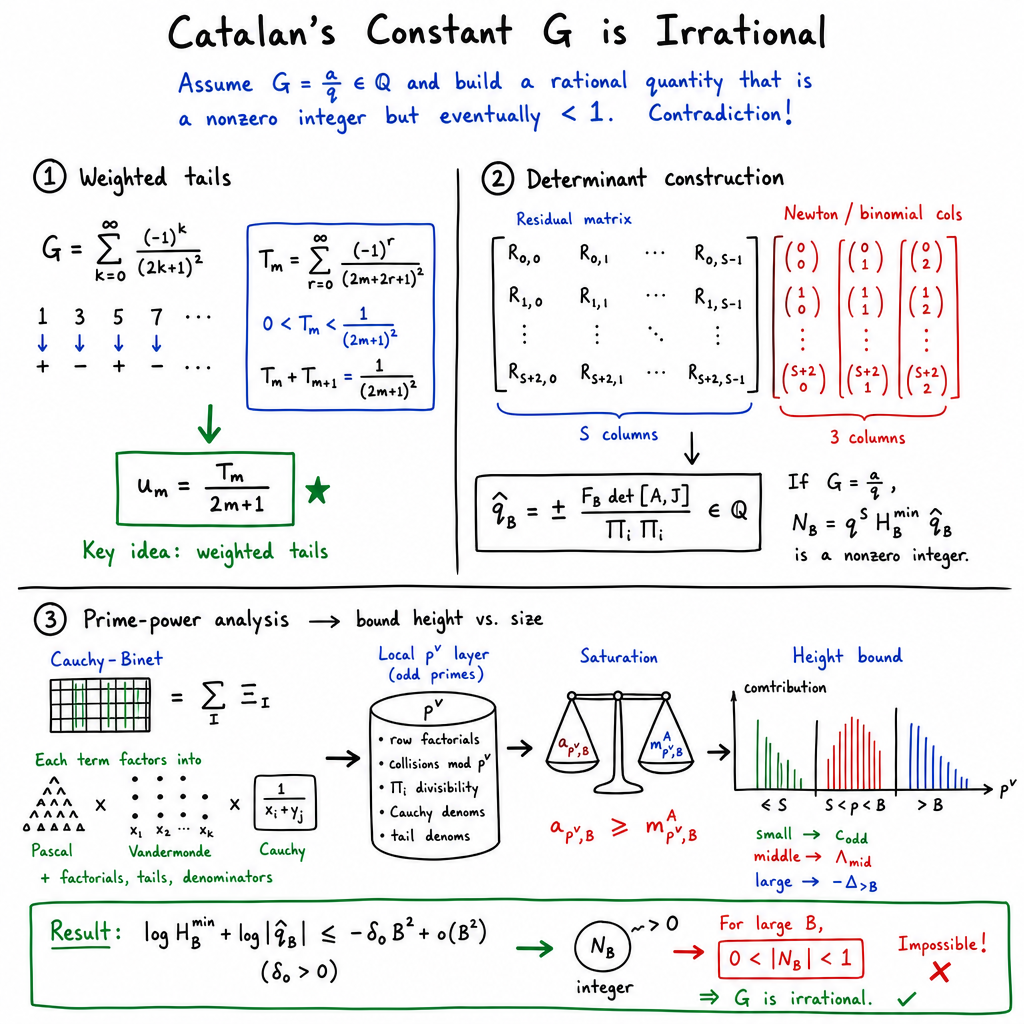
More specifically, it aims to construct certain carefully designed mathematical expressions that would become impossible if were rational. The strategy is similar to this:
- Pretend that is a fraction.
- Build a special number from this assumption.
- Prove that this number is both:
- a nonzero whole number, and
- smaller than $1$.
- This is impossible, because a nonzero whole number cannot have absolute value less than $1$.
This type of argument is called a proof by contradiction.
3. How did the authors approach the problem?
The proof uses several advanced ideas from number theory and linear algebra. Here is the basic idea in simpler language.
Studying the “tails” of the series
Instead of looking only at the whole infinite sum, the paper studies what remains after stopping at a certain point. For example, after the first few terms, one might look at
These remaining pieces are called tails.
The paper then gives each tail a weight:
The weighting is important. It is like giving different clues in a puzzle different levels of importance so that they fit together more effectively.
Building a matrix
The researchers place many of these weighted tails into a rectangular table called a matrix. They combine the entries using alternating sums involving binomial coefficients.
A matrix can be thought of as a spreadsheet of numbers. The authors prove that the columns of their matrix are independent: no column can be recreated by combining the others. In technical language, the matrix has full column rank.
This matters because it guarantees that at least one carefully selected square part of the matrix has a nonzero determinant.
A determinant is a number calculated from a square table of numbers. If the determinant is not zero, the table contains useful independent information—similar to having enough independent clues to solve a puzzle.
Creating a special rational number
The nonzero determinant is combined with factorials, binomial coefficients, and the weighted tails. The paper calls the resulting rational quantity .
The authors then study its denominators prime by prime. This means they examine how many times each prime number—such as $3$, $5$, or $7$—appears in the denominator.
This is done using -adic valuations. In everyday terms, a -adic valuation is simply a counter that records how strongly a particular prime divides a number. For example,
because .
Using divisibility patterns
The determinant is expanded using the Cauchy–Binet formula, a rule for expanding determinants of products of matrices.
Two important determinant patterns appear:
- a Vandermonde determinant, which measures how different selected numbers are from one another;
- a Cauchy determinant, which has a special formula involving fractions.
These formulas allow the authors to estimate how divisible the determinant is by different primes.
The proof separates the primes into ranges:
- small primes,
- medium-sized primes,
- large primes.
For each range, the paper estimates how much “divisibility improvement” is gained. These estimates are eventually combined with estimates involving factorials and the tails of the series.
Using asymptotic estimates
The authors let a large parameter, called , grow bigger and bigger. They estimate the size of their expressions as becomes large.
This is called asymptotic analysis. It is similar to asking how fast different parts of a calculation grow when the input becomes enormous.
The paper shows that the negative contributions from divisibility are larger than the positive contributions from the other parts. The result is an estimate of the form
where .
The important meaning is that the expression on the left becomes strongly negative as grows.
4. What are the main findings?
The paper’s main theorem is:
Catalan’s constant is irrational.
The authors reach this conclusion by assuming that
for positive integers and .
Under this assumption, they construct a number
They prove two apparently contradictory facts about :
- is a nonzero integer;
- for sufficiently large , its absolute value satisfies .
But no nonzero integer can be between and $1$. Therefore, the assumption that is rational must be false.
The numerical estimates in the paper produce a positive margin of approximately
This margin is what makes the final contradiction work: the expression becomes small quickly enough to fall below $1$.
Why the result matters
Catalan’s constant has been studied for almost two centuries. Although mathematicians already knew that related numbers, such as , are irrational, Catalan’s constant was much harder to understand.
If the proof is correct, it settles a long-standing question in number theory and gives researchers a new method involving:
- weighted series tails,
- determinants,
- prime divisibility,
- and carefully balanced estimates.
The idea of using weighted tails is presented as the paper’s main new ingredient.
5. What could this research lead to?
This work could have several effects.
First, it would complete our knowledge about an important special number. Second, the techniques might be adapted to study other constants defined by infinite series, especially values of mathematical functions called Dirichlet -functions.
The method could also help mathematicians design very accurate formulas for special constants or prove that other complicated numbers are irrational.
However, an important caution is needed: the text provided is a preprint-style manuscript with several apparent typographical and LaTeX errors in its formulas. Also, the statement that the proof was checked by an AI system is not the same as independent verification by expert mathematicians. A result of this importance would normally need careful checking by specialists and publication through the usual mathematical review process.
In simple terms, the paper presents an ambitious argument claiming that Catalan’s constant cannot be written as a fraction. Its overall strategy is to turn the assumption of rationality into an impossible situation: a nonzero whole number that is forced to be smaller than $1$.
Knowledge Gaps
Knowledge gaps, limitations, and open questions
- The paper contains substantial notation and transcription errors that prevent the argument from being checked as written, including missing symbols in definitions of , , matrix entries, binomial coefficients, determinants, valuations, and integer sets.
- The displayed definition of Catalan’s constant is mathematically inconsistent in several places: terms are written as rather than , and the associated Dirichlet beta series is likewise given with the wrong exponent.
- The proof depends on the full definitions of the weighted residual matrix, the completed matrix, and the scalar , but several matrix symbols and dimensions are corrupted or omitted, making it unclear whether the determinant identities are even well-defined.
- The construction of the selected row set is nonconstructive. The paper proves that some nonzero minor exists but does not provide an explicit choice of or show that the subsequent local estimates are uniform over all admissible choices.
- The claim that is a rational number under the assumption relies on the rationality of every weighted tail, but the relevant formulas are not stated consistently enough to verify this implication.
- The “no rational function satisfies” argument in the full-column-rank proof is too compressed: it does not fully justify the pole-selection argument, including possible pole cancellation and the behavior at infinity.
- The proof of the saturation theorem reduces the desired inequality to a counting inequality involving , but the derivation of the bound in equation \eqref{eq:PhiLower} is not shown in sufficient detail to verify all coefficients and error terms.
- The assertion that the test set gives the required lower bound for every odd prime power depends on several occupancy identities whose endpoint conventions and residue transformations are not fully checked.
- The stability lemma is stated uniformly for every odd prime power but is supported only by an informal “row contribution is ” argument. A rigorous proof would need explicit bounds for the minimization over subsets , the Vandermonde collision term, and the denominator layers.
- The passage from the local stability estimate to an total error uses prime-power summation estimates without carefully accounting for the number of layers, the dependence on , and the range in which the layers are nonzero.
- The Cauchy–Binet expansion is used to replace the sum of determinants by its largest normalized summand. The paper does not rigorously control signs, cancellations, or the possibility that the largest absolute summand does not determine the size of the sum.
- The claim that the number of Cauchy–Binet summands has logarithm is not justified quantitatively for the relevant value of and subset size .
- The asymptotic “ledger” in Proposition \ref{prop:ledger} is largely presented as a bookkeeping assertion. The paper does not provide a complete derivation showing how each factorial, Vandermonde, Cauchy, tail, and real-place contribution combines and how all terms cancel.
- The raw quadratic coefficient $39/200$ is asserted to follow from Stirling’s formula, but the individual contributions producing this coefficient are not displayed, preventing independent verification.
- Uniformity of the Stirling and tail estimates over all subsets appearing in the Cauchy–Binet expansion is claimed but not proved.
- The treatment of prime $2$ is separated from the odd-prime analysis, but the interaction between the $2$-adic contribution and the real normalization is described only informally; the exact cancellation required for the final constant is not independently established.
- The small-prime constant depends on a complicated piecewise function and an asserted list of breakpoints. The paper does not provide the complete cell decomposition or enough data for readers to reproduce the claimed 178-cell calculation.
- The statement that the marginal ordering is constant on each breakpoint cell is not proved. Additional crossings or threshold changes could alter the piecewise formula for .
- The numerical interval for is based on computer-assisted evaluation, but the implementation, exact rational data, code, and independently checkable certificate are not supplied.
- The claimed Euler–Maclaurin remainder bounds and logarithm enclosures are described procedurally rather than demonstrated; their validity for every endpoint and every special-function term is not independently documented.
- The middle-prime integral is obtained from an asserted 235-cell decomposition, but the cell boundaries, marginal orderings, and exact affine formulas are omitted, leaving the central rational value difficult to verify.
- The large-prime piecewise formula is stated without a derivation from the underlying residue-class optimization, so it remains unclear whether all boundary cases and transitions have been included.
- The claim that prime powers with contribute only uses a coarse counting argument but does not establish uniform bounds for each local layer.
- The weighted prime-power asymptotic \eqref{eq:PNTscale} is invoked for piecewise-defined functions with discontinuities and parameter-dependent breakpoints without specifying the required endpoint treatment or proving that boundary contributions are negligible.
- The final contradiction assumes for fixed denominator , which is valid under the rationality hypothesis, but the dependence of all preceding constants and estimates on the hypothetical numerator and denominator is not systematically addressed.
- The paper does not compare its method with existing irrationality criteria for Catalan’s constant, such as hypergeometric, Padé, or linear-forms approaches, so the precise advance over prior bounds and methods remains unclear.
- No quantitative irrationality measure, lower bound for rational approximations, or effective irrationality criterion for is obtained beyond the qualitative irrationality conclusion.
- It remains unexplored whether the weighted-tail and local-saturation method applies to other Dirichlet -values, especially , , or constants with analogous alternating tail recurrences.
- The method’s dependence on the specific weight is not analyzed; there is no optimization principle explaining why this weight works or whether other weights yield larger asymptotic margins.
- The argument fixes the scale ratio . It is not shown whether another ratio produces a stronger margin, whether $1/20$ is close to optimal, or whether the proof works over an interval of ratios.
- The claimed result depends heavily on computer-generated numerical data and AI-assisted verification, but no human-readable independent verification or formally checkable proof artifact is provided.
Practical Applications
The paper is a theoretical number-theory contribution whose principal finding is the claimed irrationality of Catalan’s constant, . Its practical impact is therefore primarily methodological and academic rather than technological or consumer-facing. The applications below are derived from the proof architecture—weighted tails, determinant constructions, -adic valuation bounds, Cauchy–Binet expansions, and asymptotic prime-power analysis—rather than from an immediately deployable physical product.
Immediate Applications
- Benchmark for computational number theory software (software, academia)
- Possible workflow: compute , , residual matrices, selected minors, Cauchy–Binet summands, and -adic valuations using rational arithmetic.
- Dependency: the formulas in the paper must first be independently checked, since the supplied manuscript contains visibly corrupted notation and several malformed expressions.
- Computer-assisted verification of irrationality proofs (formal methods, software, academia)
- Potential tool: a reproducible verification package containing exact rational certificates for the finite-cell integrations and interval enclosures.
- Dependency: a complete machine-readable version of the argument and independently validated numerical data are required. The paper’s statement that it was verified by an AI system is not, by itself, a substitute for formal proof or peer review.
- High-precision computation of Catalan’s constant (scientific computing)
- Possible product: a certified arbitrary-precision library for constants related to Dirichlet -functions.
- Dependency: numerical stability, cancellation in determinant evaluations, and efficient handling of large integers.
- Reusable determinant templates for special constants (symbolic computation, research mathematics)
- Actionable use: researchers can replace the Catalan tail recurrence with an analogous recurrence and test whether the resulting residual matrix has full rank.
- Dependency: the target sequence must have sufficiently strong recurrence and denominator structure to support the polynomial-defect argument.
- Teaching material for advanced mathematics (education, academia)
- irrationality proofs and Diophantine approximation;
- Dirichlet -functions;
- -adic valuations;
- determinant methods;
- Cauchy–Binet and Vandermonde identities;
- asymptotic analysis involving prime powers.
- The proof illustrates how local arithmetic information and global analytic estimates can be combined to obtain a contradiction.
- Improved reproducibility practices for AI-assisted mathematics (research policy, academia)
- Actionable workflow: publish prompts, generated intermediate calculations, source code, exact certificates, and independent human verification alongside the paper.
- Dependency: transparent separation between conjectural AI output, computational evidence, and formally established mathematics.
Long-Term Applications
- A general irrationality framework for Dirichlet -values (number theory, academia)
- Potential outcome: a systematic library of auxiliary-function constructions indexed by characters or recurrence types.
- Dependencies: suitable weights, nonvanishing determinant minors, local saturation inequalities, and asymptotic margins strong enough to overcome all error terms.
- Automated discovery of irrationality proofs (AI for mathematics, symbolic computation)
- Potential tool: an AI-assisted theorem-discovery system for Apéry-style and determinant-based irrationality proofs.
- Dependencies: reliable symbolic algebra, rigorous interval arithmetic, proof assistants, and algorithms capable of distinguishing genuine identities from numerical coincidences.
- Formalization in proof assistants (formal verification, academia)
- Potential benefit: a mechanically checked certificate for the claimed irrationality result and reusable libraries for arithmetic-special-function proofs.
- Dependencies: formal definitions of the relevant analytic limits, prime-power summations, asymptotic estimates, and certified numerical inequalities.
- Optimization of irrationality measures and rational approximants (theoretical and computational number theory)
- Dependency: stronger control of determinant cancellation, more precise prime-distribution estimates, and improved asymptotic constants.
- Methods for other recurrence-defined constants (mathematical research) The weighted-tail construction may apply to constants represented by alternating sums, integrals, or special functions whose tails obey relations such as
where is rational. Candidate areas include Euler sums, generalized beta values, polylogarithmic constants, and selected hypergeometric values. - Potential workflow: classify recurrences, search for weights that turn residual terms into low-degree polynomials, and evaluate the resulting determinant heights. - Dependency: the recurrence must permit sufficiently strong denominator cancellation and a positive asymptotic margin.
- Applications to cryptography or finance are indirect and speculative (security, finance)
- Examples: auditable numerical computation, exact symbolic preprocessing, and certified bounds in scientific or financial software.
- Dependency: a separate application-specific problem must benefit from these methods; the theorem about alone does not provide such a deployment.
- Everyday-life impact remains negligible (daily life)
- Dependency: successful translation of the research methods into robust, general-purpose computational tools.
Overall, the paper’s strongest practical contribution is the proposed combination of weighted tails, determinant rank arguments, local -adic saturation, and computer-certified asymptotics. These methods may become reusable research tools, but the manuscript’s specific theorem and numerical certificates require independent mathematical verification before they can be treated as established results.
Glossary
- Adelic viewpoint: A perspective using structures from all completions of a number field simultaneously, typically in arithmetic geometry and number theory. “They also provided an adelic viewpoint of in the arithmetic-holonomy work”
- Alternating polynomial: A polynomial that changes sign when two variables are interchanged. “The determinant is an alternating polynomial in ”
- Cauchy determinant: A determinant whose entries have the form and whose value has a product formula. “the Cauchy determinant gives a second”
- Cauchy--Binet formula: A formula expressing the determinant of a matrix product as a sum of products of minors. “In light of the Cauchy--Binet formula, we can write”
- Catalan’s constant: The real number . “The Catalan constant is irrational.”
- Cauchy matrix: A matrix whose entries are reciprocals of sums of row and column parameters. “a product of an Pascal matrix, a diagonal matrix, and an Cauchy matrix”
- Collision number: The number of pairs of objects occupying the same residue class or category. “the collision number is minimized by the balanced occupancy”
- Consecutive row set: A matrix row index set consisting of consecutive integers. “with the consecutive row set ”
- Dirichlet character: A completely multiplicative periodic arithmetic function used in the theory of Dirichlet -functions. “For a nontrivial Dirichlet character ”
- Dirichlet -function: A series associated with a Dirichlet character. “the Dirichlet -function is given by”
- Euler constant: The constant arising in harmonic-sum asymptotics, approximately $0.57721$. “( is the Euler constant .)”
- Euler--Maclaurin expansion: An asymptotic formula relating sums to integrals and boundary-derivative corrections. “use the Euler--Maclaurin expansions through ”
- Finite-difference transform: A linear operation formed from alternating binomial sums that computes finite differences. “Apply the lower-triangular finite-difference transform”
- Full column rank: The property that all columns of a matrix are linearly independent. “we have .”
- Hurwitz zeta function: The generalized zeta function . “where is the Hurwitz zeta function.”
- Irrationality: The property of a number not being expressible as a ratio of two integers. “A long-standing unsolved problem is whether Catalan's constant is irrational.”
- Kronecker symbol: A generalization of the Legendre and Jacobi symbols used to define quadratic characters. “be the Kronecker symbol”
- Lebesgue measure: A mathematical notion of size for sets, extending length, area, and volume. “where Lebesgue measure is used in .”
- Local layer: The contribution to a valuation or arithmetic estimate arising from a fixed prime-power modulus. “The complete local layer of a summand is”
- Marginal cost: The incremental contribution incurred by selecting one additional element in an optimization or occupancy problem. “the marginal minimum in \eqref{eq:Eexact}”
- Mertens’ formula: An asymptotic relation involving weighted sums over primes or prime powers. “The standard weighted prime-power summation used below is”
- Nonarchimedean triangle inequality: The valuation inequality for a nonarchimedean valuation. “The nonarchimedean triangle inequality gives”
- Newton interpolation: Polynomial interpolation using binomial-coefficient or falling-factorial basis functions. “The Newton interpolation polynomial through the values”
- Odd-prime small-scale constant: A limiting constant obtained from the contribution of small odd prime powers in the asymptotic estimate. “The odd small-prime constant”
- Padé-type approximation: A rational approximation constructed to match a function’s series coefficients to high order. “Diophantine properties of numbers related to Catalan's constant”
- Pascal alternant: A determinant involving binomial coefficients whose factorization contains a Vandermonde product. “The Pascal alternant gives one Vandermonde”
- Pascal matrix: A matrix whose entries are binomial coefficients. “a product of an Pascal matrix”
- Positive-part height: A logarithmic measure formed from positive parts of prime-adic denominator exponents. “the positive-part height of the same scalar.”
- Prime-power valuation layer: The component of a valuation decomposition associated with a modulus . “For every odd prime power, a local saturation theorem”
- Prime Number Theorem: The theorem describing the asymptotic distribution of prime numbers. “This refinement of Mertens' formula ... is equivalent to the Prime Number Theorem”
- Rational function: A function expressible as the quotient of two polynomials. “the rational function satisfies”
- Right kernel: The set of vectors mapped to zero by a matrix when vectors are multiplied on the right. “lies in the right kernel.”
- Riemann zeta function: The special function , initially defined for . “where is the Riemann zeta function.”
- Saturation theorem: A result showing that a bound from one arithmetic layer is at least as large as a corresponding minimum or test-layer bound. “For every odd prime power and every ”
- Tail: The remainder of an infinite series after finitely many terms have been removed. “and call ... a tail of the Catalan constant ”
- Transcendental number: A number that is not a root of any nonzero polynomial with rational coefficients. “are irrational since is transcendental”
- Vandermonde determinant: A determinant whose value is a product of pairwise differences of its parameters. “This produces one Vandermonde and the Cauchy determinant gives a second.”
- Weighted tail: A series remainder multiplied or normalized by an additional factor. “view ... as a weighted tail of ”
- von Mangoldt function: The arithmetic function equal to when is a positive power of a prime , and zero otherwise. “where is the the von Mangoldt function.”

