The Emergent Symbolic Structure of Artificial Neural Networks
Abstract: Modern systems in AI somehow excel in domains for which they seem poorly suited. Intelligence has traditionally been modeled as operating over structured combinations of symbols, such as logical formulas. However, the strongest modern AI systems are based on neural networks, which instead represent information in continuous vectors. Vectors seem inadequate for capturing the structure of language, logic, and other cognitive domains, yet neural networks achieve impressive performance in these areas. How do they do it? In this work, we propose a potential answer: Despite appearances, perhaps the internal representations of neural networks implicitly realize symbolic structure. In support of this hypothesis, we show that the vector representations of a variety of neural networks can be closely approximated with symbolic structures: we can replace the network's entire representation-generating process with a closed-form equation instantiating a symbolic structure, and the network's behavior remains largely unchanged. This finding holds for both small-scale neural networks trained to manipulate lists as well as LLMs operating in four domains that are central in symbolic traditions: arithmetic, logic, computer code, and language. Further, our symbolic approximation allows us to modify an LLM's behavior in targeted ways via precise interventions on its internal representations, showing that the LLM's behavior is reliant on the symbolic structures we have identified. This work provides a potential way to reconcile longstanding symbolic conceptions of intelligence with the vector-based nature of modern AI.


Paper Prompts
Sign up for free to create and run prompts on this paper.
Top Community Prompts
Explain it Like I'm 14
1. ¿De qué trata el artículo?
El artículo estudia cómo los modelos de inteligencia artificial representan la información dentro de sus “cerebros” artificiales.
Los sistemas modernos de IA, como los modelos de lenguaje, suelen usar vectores: largas listas de números. A primera vista, estos números parecen muy diferentes de los símbolos que usamos los humanos, como palabras, posiciones, reglas matemáticas o instrucciones de programación.
Por ejemplo, una oración puede representarse simbólicamente como:
“El gato persigue al perro”
En una representación simbólica, podríamos indicar que:
- “gato” es el sujeto,
- “persigue” es el verbo,
- “perro” es el objeto.
Pero una red neuronal no guarda necesariamente esta información como palabras y etiquetas claras. En cambio, la transforma en una lista de números.
La pregunta principal del artículo es:
¿Podrían esas listas de números esconder una estructura simbólica, aunque no podamos verla directamente?
Los autores creen que sí.
2. Objetivos y preguntas de investigación
El artículo intenta responder varias preguntas:
- ¿Las redes neuronales aprenden por sí solas estructuras parecidas a las usadas por los sistemas simbólicos?
- ¿Pueden sus vectores representar no solo qué elementos aparecen, sino también en qué posición o función aparecen?
- ¿Ocurre esto solamente en redes pequeñas y tareas sencillas, o también en modelos grandes de lenguaje?
- ¿Estas estructuras ocultas realmente influyen en el comportamiento del modelo?
- ¿Una red puede entender nuevas combinaciones de elementos y posiciones, aunque nunca las haya visto exactamente durante el entrenamiento?
Esto es importante porque saber que una IA da respuestas correctas no nos explica cómo las produce. El campo que intenta entender el interior de estos sistemas se llama interpretabilidad, o a veces interpretabilidad mecanicista.
3. ¿Cómo hicieron la investigación?
Redes neuronales y vectores
Una red neuronal puede imaginarse como una enorme colección de pequeñas operaciones matemáticas. Recibe información, la transforma varias veces y finalmente produce una respuesta.
Durante esas transformaciones, la información se guarda en vectores, es decir, listas de números como:
1 |
[0.8, -1.2, 3.5, 0.1, ...] |
Estos números no suelen tener un significado evidente para una persona. Sin embargo, pueden estar organizados de una forma útil para la red.
La idea de “rellenos” y “roles”
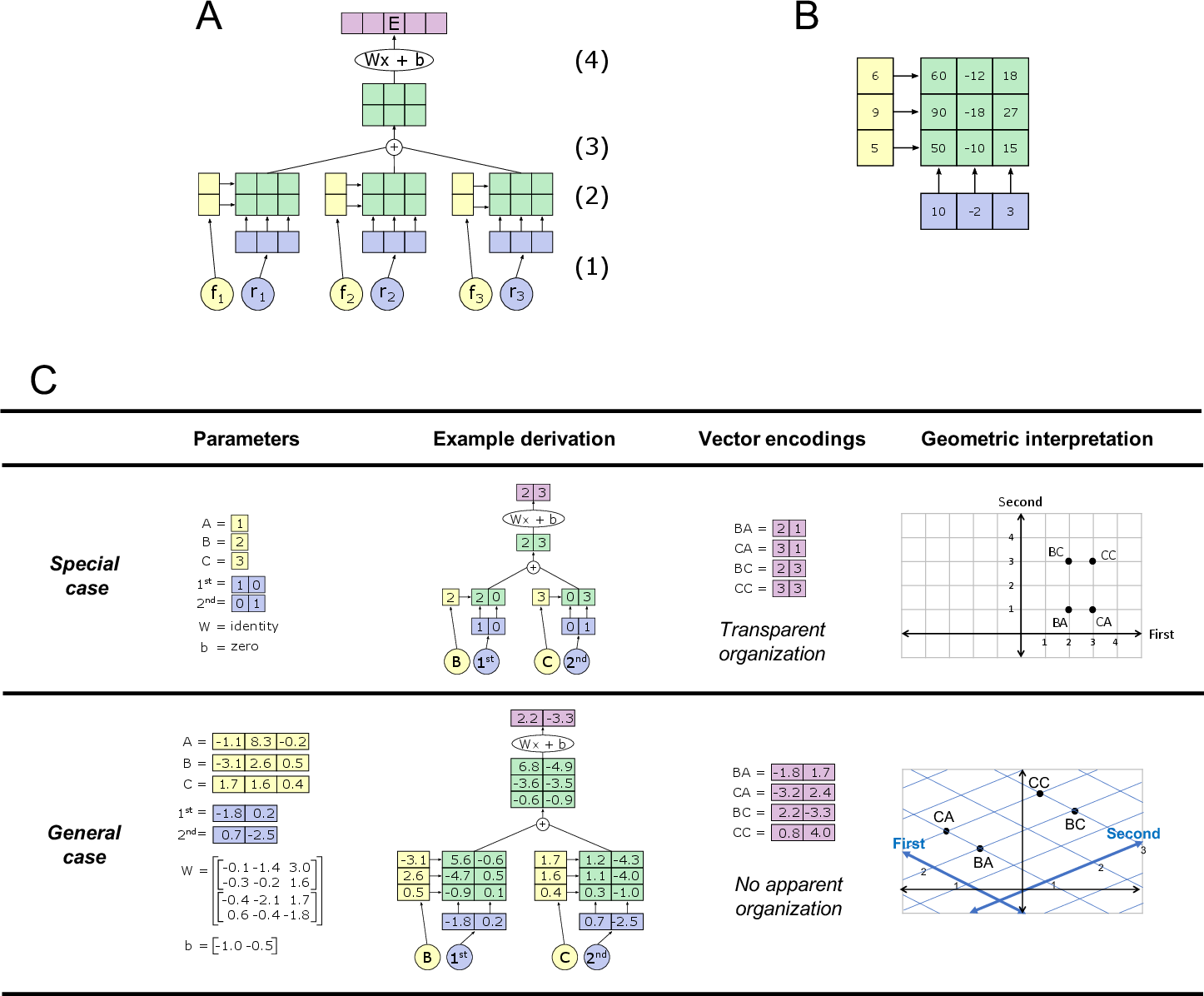
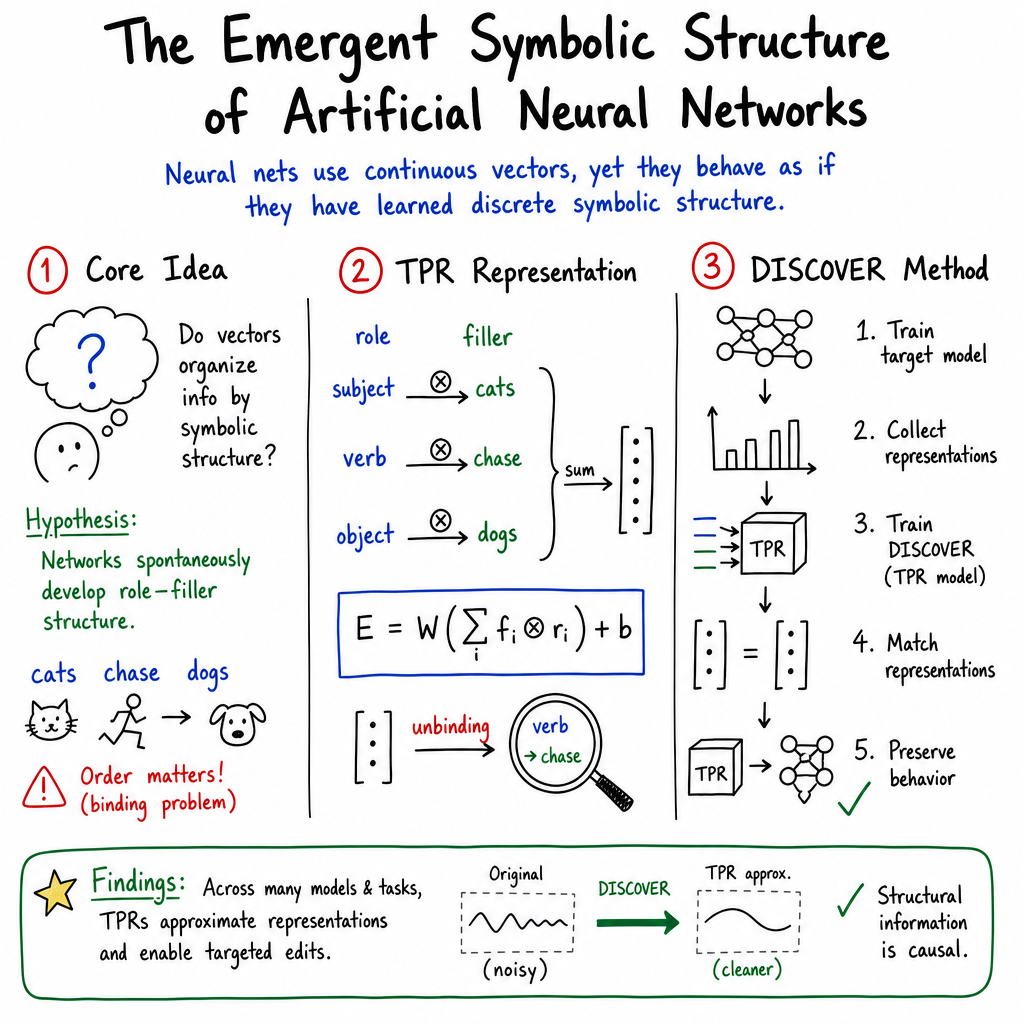
Los autores usan una teoría matemática llamada Representaciones de Producto Tensorial, o TPR por sus siglas en inglés.
La idea puede entenderse con etiquetas:
- Un relleno es el elemento, como “gato”, “perro” o el número 3.
- Un rol es el lugar o función que ocupa, como “sujeto”, “objeto”, “numerador” o “segunda posición”.
Por ejemplo, en la oración:
“Los gatos persiguen a los perros”
podríamos tener:
| Relleno | Rol |
|---|---|
| gatos | sujeto |
| persiguen | verbo |
| perros | objeto |
Una TPR intenta combinar cada relleno con su rol y convertir toda esa información en un vector. Es parecido a guardar objetos en cajas etiquetadas: no solo importa qué objeto tenemos, sino también en qué caja está.
Esto evita un problema importante. Si simplemente sumáramos los vectores de “gatos”, “persiguen” y “perros”, no sabríamos quién hace qué. Las frases:
- “Los gatos persiguen a los perros”
- “Los perros persiguen a los gatos”
tendrían los mismos elementos, pero significados distintos. Los roles permiten distinguirlas.
El método DISCOVER
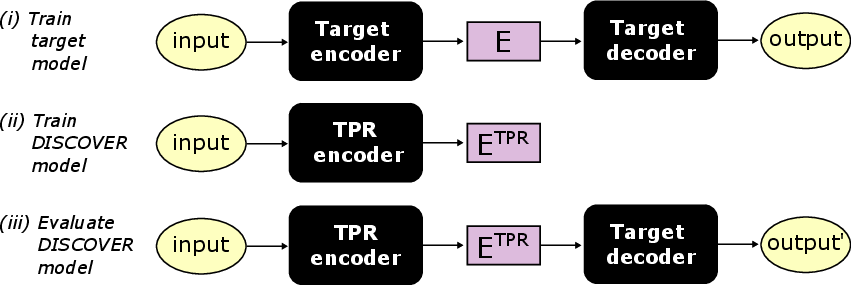
Los investigadores crearon o utilizaron un método llamado DISCOVER. Su nombre viene de DISsecting COmpositionality in VEctor Representations, que significa aproximadamente “examinar cómo se combinan las partes dentro de las representaciones vectoriales”.
El procedimiento fue parecido a esto:
- Entrenaron una red neuronal normal para realizar una tarea.
- Observaron los vectores internos que producía esa red.
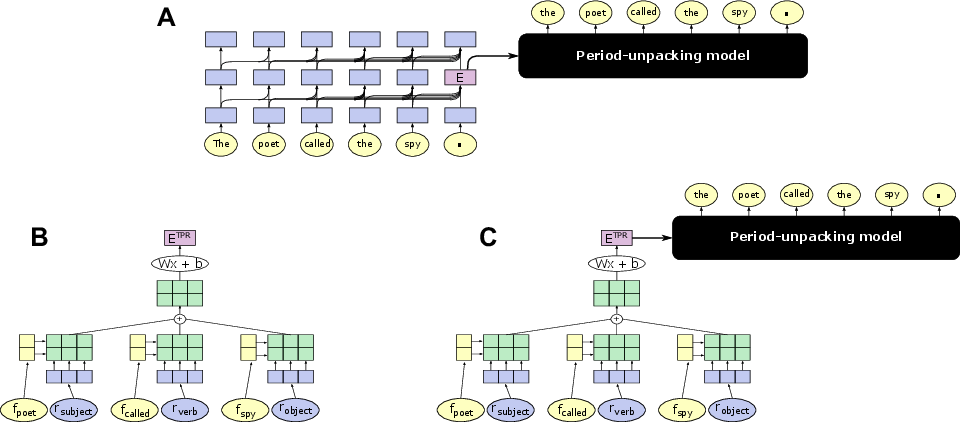
- Entrenaron otra representación, construida explícitamente con una estructura TPR, para imitar esos vectores.
- Sustituyeron los vectores originales de la red por los vectores creados por DISCOVER.
- Comprobaron si la red seguía dando las respuestas correctas.
La comparación se parece a fabricar una llave nueva que imita a la llave original. Si la nueva llave sigue abriendo la puerta, significa que se parece mucho a la original en los aspectos importantes.
Si los vectores TPR podían reemplazar a los vectores de la red sin cambiar mucho su comportamiento, eso indicaba que la red probablemente tenía una organización interna parecida a una estructura simbólica.
Tareas con listas de letras
Primero estudiaron redes pequeñas que debían trabajar con listas de letras. Por ejemplo:
- Copiar:
Q M Z → Q M Z - Invertir:
Q M Z → Z M Q - Intercalar:
Q M Z V R → Q R M V Z
Estas tareas parecen sencillas, pero obligan a la red a recordar dos cosas:
- Qué letras aparecen.
- Dónde está cada letra.
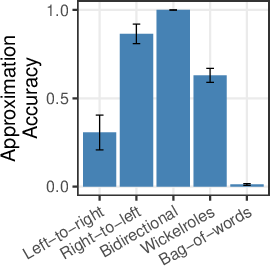
Los investigadores probaron distintos tipos de “roles” para describir las posiciones:
- posición de izquierda a derecha,
- posición de derecha a izquierda,
- combinación de ambas,
- letras vecinas,
- o simplemente “la letra está presente”, sin tener en cuenta su posición.
Esta última opción, llamada bolsa de palabras, servía como prueba de control. Si la red solo recordara qué letras aparecen, pero no su orden, debería funcionar con esta representación. Como las tareas dependen del orden, se esperaba que funcionara mal.
Modelos grandes de lenguaje
Después aplicaron el método a varios modelos grandes de lenguaje, incluidos GPT-2-XL, Pythia, Llama, Gemma, Qwen y otros.
Los estudiaron en tareas relacionadas con:
- aritmética,
- lógica,
- programación,
- lenguaje,
- listas y oraciones.
En los modelos de lenguaje, cada palabra o fragmento de palabra suele tener su propio vector. Los autores se concentraron inicialmente en el vector correspondiente al punto final de una oración. Su hipótesis era que ese punto podía contener información sobre toda la oración anterior, como si fuera un resumen interno.
4. Principales resultados
Las redes pequeñas mostraron estructuras simbólicas
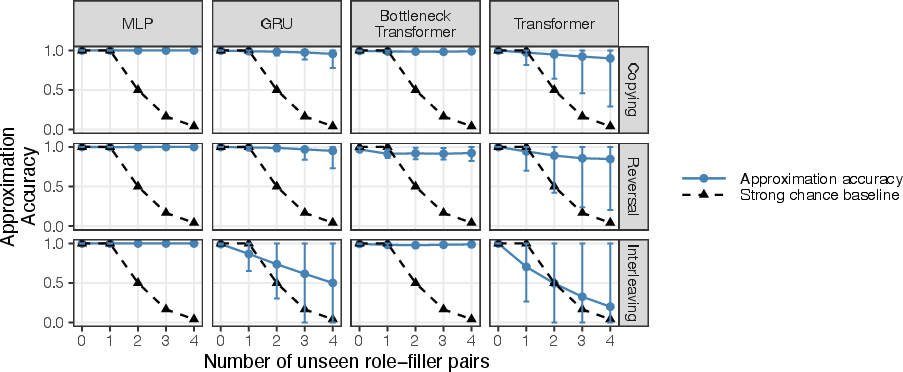
Las redes entrenadas para copiar, invertir o intercalar listas pudieron ser aproximadas muy bien usando TPR.
La mejor representación fue generalmente la bidireccional, que tiene en cuenta la posición de cada letra desde ambos extremos de la lista.
Por ejemplo, una letra podía describirse como:
- segunda desde la izquierda,
- tercera desde la derecha.
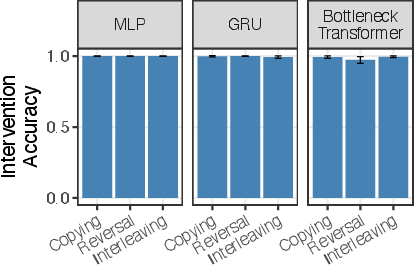
En el caso de las redes recurrentes que invertían listas, la aproximación bidireccional alcanzó una precisión de casi el 100 %. Esto significa que los vectores TPR podían sustituir prácticamente a los vectores originales sin impedir que la red resolviera la tarea.
La estructura dependía de la tarea
Los resultados también tenían sentido según lo que debía hacer cada red:
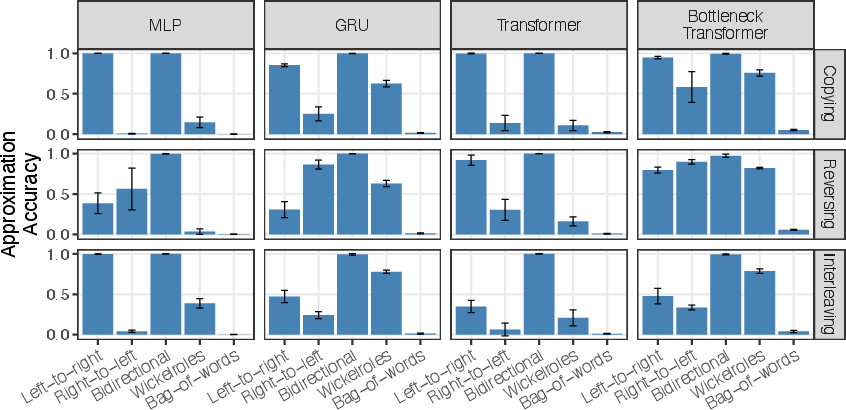
- En las tareas de copiar, era más útil conocer la posición de izquierda a derecha.
- En las tareas de invertir, era especialmente útil la posición de derecha a izquierda.
- En las tareas de intercalar, se necesitaban ambas direcciones.
Esto sugiere que las redes no solo almacenaban una lista desordenada de letras. Aprendían una forma organizada de representar sus posiciones.
La representación de “bolsa de palabras” funcionó mal en estas tareas. Esto era esperable, porque una bolsa de palabras sabe qué elementos están presentes, pero no sabe cómo están ordenados.
El resultado apareció en distintos tipos de redes
Los autores analizaron varios tipos de redes:
- perceptrones multicapa,
- redes recurrentes,
- Transformers,
- Transformers con un “cuello de botella”.
Aunque estas redes procesan la información de maneras diferentes, todas mostraron aproximaciones TPR fuertes. Esto indica que la estructura simbólica encontrada no parece ser un accidente de un solo tipo de arquitectura.
Los modelos grandes de lenguaje también mostraron esta estructura
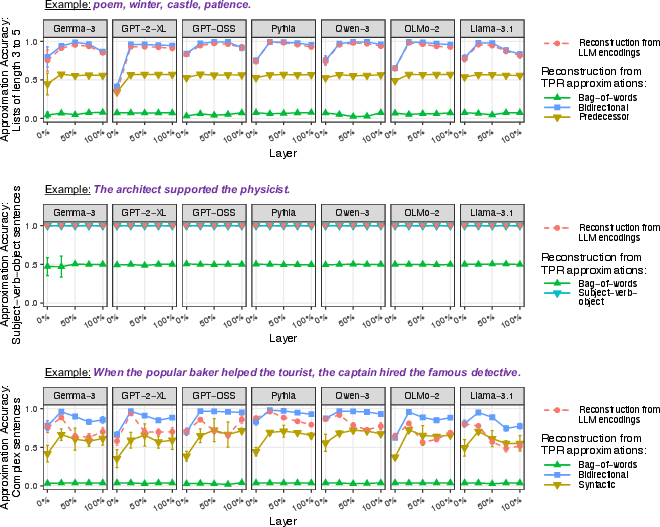
Los siete modelos grandes de lenguaje examinados mostraron evidencias de una estructura simbólica implícita.
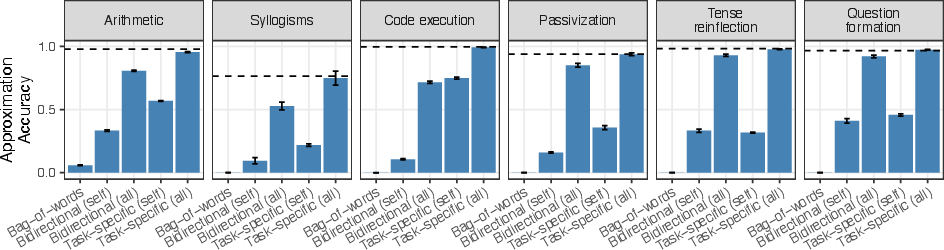
El análisis más detallado de uno de ellos, GPT-OSS, cubrió cuatro áreas que suelen considerarse simbólicas:
- matemáticas,
- lógica,
- código,
- lenguaje.
Sus representaciones internas podían aproximarse mediante TPR en todas esas áreas.
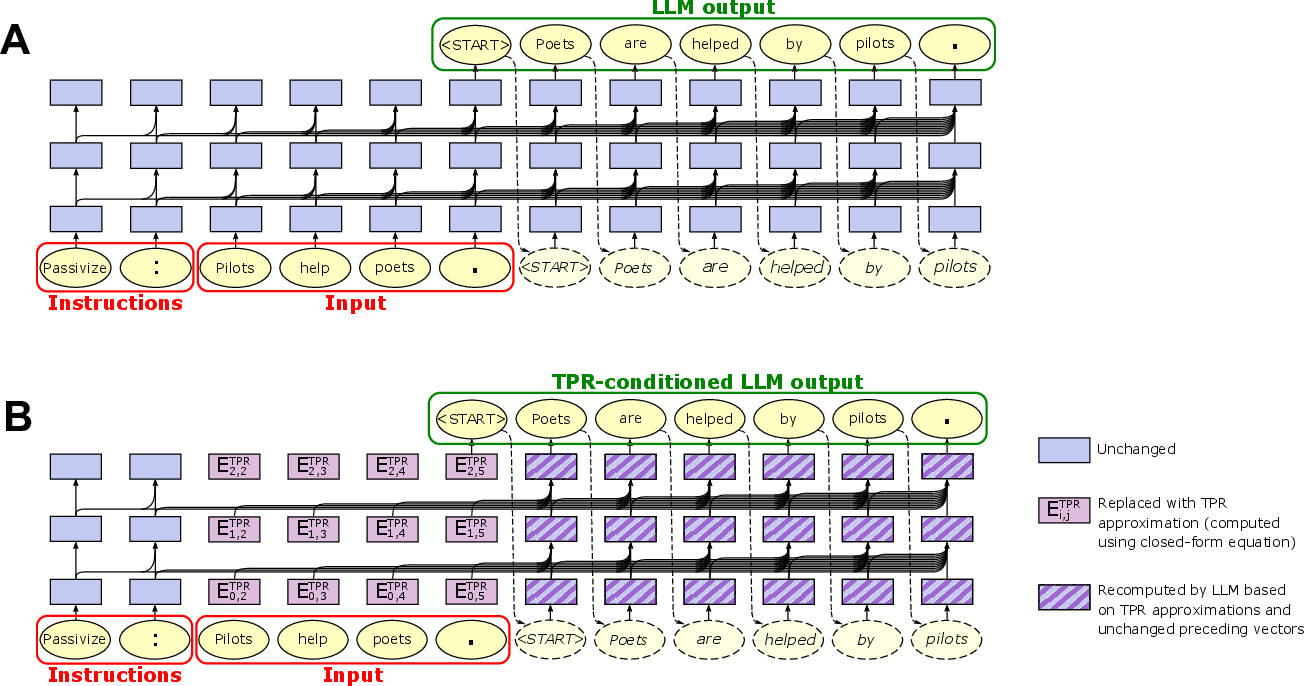
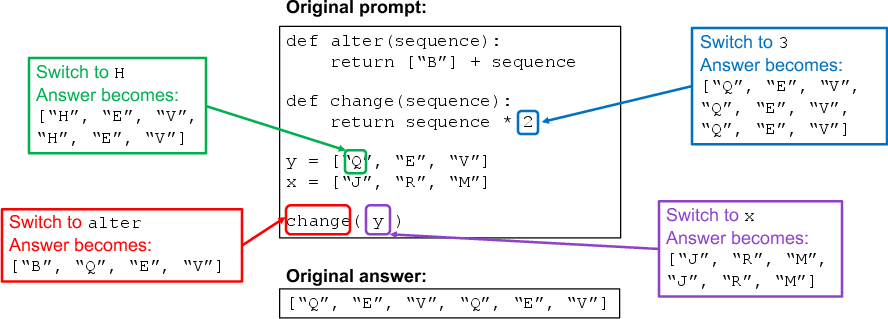
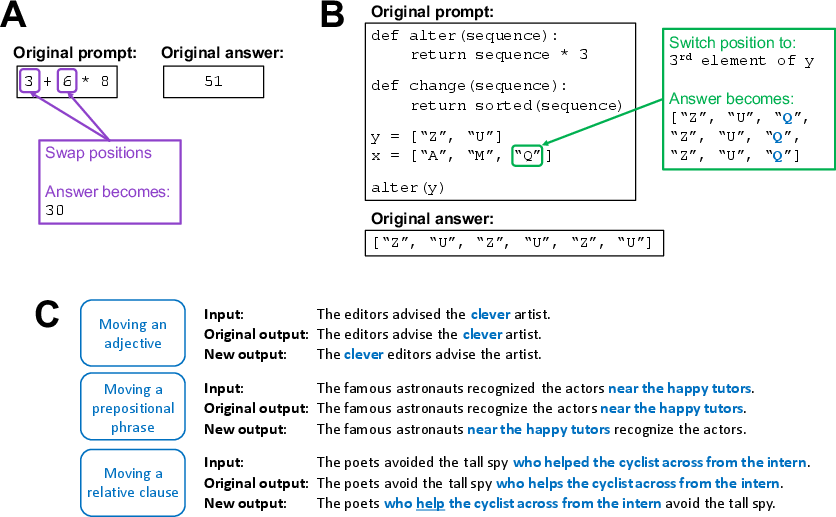
Las intervenciones cambiaron el comportamiento de manera predecible
Uno de los resultados más importantes fue que los investigadores no solo describieron los vectores: también pudieron modificarlos.
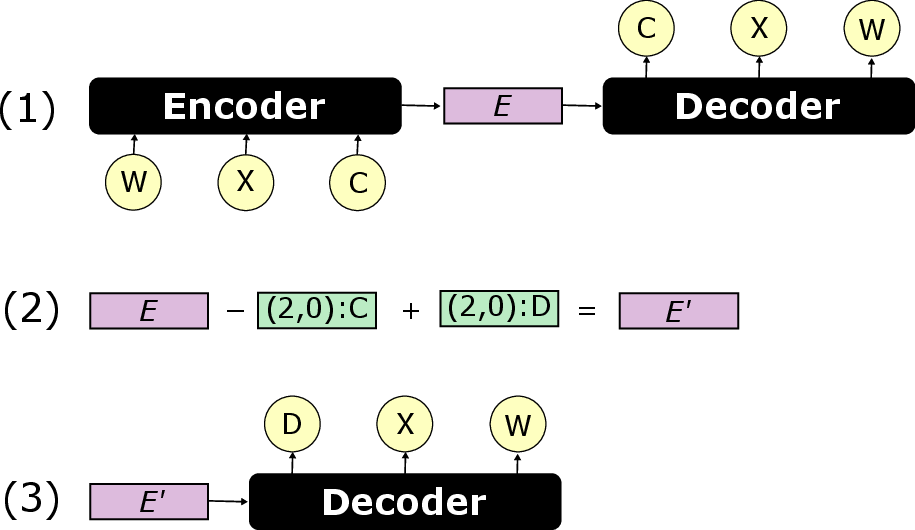
Por ejemplo, tomaron una representación relacionada con:
“El médico inteligente ayudó al abogado.”
Después cambiaron el rol de “inteligente” para que pasara de describir al sujeto a describir al objeto. La red comenzó a comportarse como si la frase fuera:
“El médico ayudó al abogado inteligente.”
Esto sugiere que los roles encontrados no son solo una explicación bonita creada después del experimento. Parecen estar conectados con la manera en que la red produce sus respuestas.
Las redes pudieron generalizar nuevas combinaciones
DISCOVER también pudo trabajar con combinaciones que no habían aparecido durante su entrenamiento.
Por ejemplo, si había visto la palabra “científico” en muchos contextos, pero nunca como sujeto de una oración, podía predecir correctamente cómo representarla cuando aparecía en esa posición.
Esto indica que la información no estaba guardada únicamente como combinaciones completas, como “científico-como-sujeto”. En cambio, la red parecía combinar de forma sistemática:
- la identidad del elemento,
- y el rol que ocupa.
5. ¿Por qué son importantes estos resultados?
El artículo propone una posible solución a una antigua discusión sobre la inteligencia artificial.
Durante mucho tiempo, algunos investigadores pensaban que la inteligencia necesitaba símbolos y reglas explícitas. Otros construyeron redes neuronales que trabajaban con números y vectores, sin símbolos visibles.
Este trabajo sugiere que ambas ideas podrían estar relacionadas:
Una red neuronal puede usar vectores por fuera, pero organizar esos vectores como si contuvieran símbolos, posiciones y relaciones por dentro.
La red no tiene necesariamente una lista visible de reglas como:
1 |
sujeto + verbo + objeto |
Pero sus vectores podrían estar organizados de una manera que permite representar esa estructura.
Implicaciones y posible impacto
Si estos resultados se confirman con más investigaciones, podrían tener varios efectos.
Primero, podrían ayudar a los científicos a entender mejor cómo funcionan los modelos de lenguaje. En lugar de considerar sus vectores como números misteriosos, podríamos analizarlos como estructuras con partes y posiciones.
Segundo, esta comprensión podría mejorar la seguridad y el control de la IA. Si sabemos qué parte de una representación corresponde a una función concreta, quizá podamos modificarla de manera precisa, en vez de cambiar el comportamiento del modelo de forma accidental.
Tercero, los investigadores podrían diseñar modelos que combinen lo mejor de dos enfoques:
- la capacidad de aprendizaje flexible de las redes neuronales,
- y la claridad y organización de los sistemas simbólicos.
Sin embargo, el artículo no demuestra que las redes neuronales estén realizando exactamente las mismas operaciones que un programa simbólico tradicional. DISCOVER muestra que sus representaciones se parecen mucho a estructuras simbólicas y que esas estructuras parecen influir en el comportamiento. Aún queda por descubrir cómo las redes crean esas estructuras durante el aprendizaje.
En resumen, el artículo sostiene que las redes neuronales quizá no sean tan “no simbólicas” como parecen. Aunque piensen usando grandes listas de números, dentro de esas listas podrían estar construyendo una especie de sistema oculto de objetos, posiciones y relaciones.
Knowledge Gaps
Knowledge gaps, limitations, and open questions
The paper provides evidence that several neural networks can be approximated by linearly transformed Tensor Product Representations (TPRs), but it leaves the following issues unresolved:
- Causal mechanism: The experiments show that TPR approximations preserve behavior, but they do not explain how the original networks learn or computationally implement TPR-like structure internally.
- Uniqueness of the discovered structure: A successful DISCOVER approximation does not establish that TPRs are the only, or even the simplest, structure represented by the target model. Competing representations may achieve comparable functional accuracy.
- Comparison with alternative formalisms: The paper does not systematically compare TPRs against other structured vector representations, such as holographic reduced representations, vector symbolic architectures, slot-based representations, or learned relational bases.
- Role-scheme selection bias: DISCOVER is supervised and requires researchers to specify candidate role schemes in advance. This may favor the hypothesized TPR structure and leaves open whether the same conclusions would emerge from a fully unsupervised or broadly exploratory analysis.
- Incomplete feature discovery: The method presupposes which elements serve as fillers and focuses primarily on positional roles. It does not determine whether models represent additional features, such as semantic, syntactic, discourse, temporal, or hierarchical relations.
- Overexpressive approximations: Bidirectional roles can subsume simpler role schemes, so high approximation accuracy may reflect excess representational capacity rather than the exact structure used by the target network. A principled procedure for minimizing or pruning the discovered structure remains undeveloped.
- Approximation metric limitations: Approximation accuracy is based largely on whether the original decoder produces the exact output sequence. This may conceal substantial vector-level errors, partial behavioral degradation, changes in probability distributions, or effects on less likely outputs.
- Dependence on the original decoder: The evaluation tests whether the target decoder can use the DISCOVER representation, not whether the representation is independently interpretable or sufficient for other decoders and tasks.
- Limited intervention scope: The causal interventions modify selected role assignments in controlled examples, but it remains unclear whether interventions can reliably manipulate more complex structures, nested relations, hierarchical syntax, variable binding, or multiple interacting roles.
- Intervention specificity: The paper does not establish whether targeted interventions alter only the intended feature or whether they also introduce unintended changes to semantic content, plausibility, confidence, or unrelated downstream computations.
- Synthetic-task generality: The small-model experiments use short sequences of at most six letters and only copying, reversing, interleaving, and sorting tasks. It is unknown whether the findings extend to longer sequences, larger alphabets, noisy inputs, hierarchical operations, or tasks requiring recursion and variable reuse.
- Natural-language coverage: The LLM analysis appears to rely on highly controlled lists and templated sentences. This leaves unresolved whether TPR-like structure is used for naturally occurring, ambiguous, idiomatic, multilingual, conversational, and discourse-level language.
- LLM representation location: The initial LLM analysis assumes that the period token represents the entire preceding sentence or list. This assumption is not established across models, layers, tokenization schemes, sentence types, or contexts.
- Token-level heterogeneity: It remains unclear whether TPR-like structure is localized to punctuation representations or distributed across ordinary token positions and layers, and how these representations interact during generation.
- Model and training diversity: The analyzed models do not necessarily span the full range of architectures, training objectives, parameter scales, modalities, or post-training procedures. The robustness of the result across newer, smaller, multimodal, instruction-tuned, and recurrent or state-space models remains unknown.
- Training-data effects: The paper does not determine whether emergent symbolic structure results from pretraining data, architectural inductive biases, optimization dynamics, task supervision, or post-training alignment.
- Random-seed and training-trajectory effects in LLMs: Although multiple small models are trained with different initializations, it is unclear whether the LLM findings are robust across independent training runs, checkpoints, and alternative optimization histories.
- Scaling behavior: The relationship between model size, training duration, capability, and the quality or type of discovered TPR structure is not established.
- Out-of-distribution compositionality: The reported generalization to new filler–role combinations is limited in scope. It remains open whether models systematically generalize to novel combinations involving multiple unseen fillers, unseen role combinations, longer structures, or compositions requiring recursive binding.
- Repeated fillers and ambiguity: Some list experiments require unique words to support particular role schemes. The behavior of the proposed representations when fillers repeat, are ambiguous, or occur in multiple structurally distinct roles is therefore insufficiently characterized.
- Hierarchical structure: The examined role schemes are primarily positional or local. The paper does not show whether TPR approximations capture nested trees, long-distance dependencies, quantifier scope, coreference, or other forms of hierarchical symbolic structure.
- Information capacity and scaling: The work does not quantify how many fillers and roles can be reliably represented and unbound as dimensionality, sequence length, vocabulary size, or structural complexity increase.
- Robustness to perturbations: It remains unknown whether the discovered structure persists under paraphrase, word-order variation, typos, irrelevant context, adversarial inputs, distribution shifts, or changes in formatting and punctuation.
- Functional importance across tasks: The interventions demonstrate that identified structures can influence behavior, but the paper does not measure how necessary these structures are relative to other mechanisms or whether models can perform the same tasks through redundant non-TPR pathways.
- Layerwise development: The analyses do not fully resolve when TPR-like structure emerges during processing or training, how it changes across layers, and whether different layers encode different role systems.
- Relationship to neural circuits: The study characterizes representational geometry but does not identify the attention heads, neurons, features, or circuit-level pathways that create, maintain, transform, and read out the proposed role–filler bindings.
- Reproducibility and completeness of implementation: At the time described, only a partial codebase was available and the complete code was pending release. Independent replication therefore depends on resources and implementation details that are not yet fully accessible.
- Scope of the paper’s conclusion: The results support the possibility that some neural representations have implicit TPR-like structure, but they do not establish that symbolic structure is generally necessary for intelligent behavior or that TPRs provide a complete account of neural computation in symbolic domains.
Practical Applications
Immediate Applications
The paper’s findings primarily enable interpretability, auditing, and controlled intervention workflows rather than fully autonomous products. The most practical applications are those that use DISCOVER and Tensor Product Representations (TPRs) to analyze already-trained neural networks.
- Mechanistic interpretability tools for LLMs — AI/software
- Apply
DISCOVERto approximate selected internal representations of LLMs with explicit role–filler structures. - A practical tool could report whether a model represents information such as “subject,” “object,” “numerator,” “denominator,” “preceding item,” or “code argument” in a systematically compositional way.
- This could complement probes, activation patching, sparse autoencoders, and causal tracing in model-debugging pipelines.
- Dependencies: The analyst must specify plausible role schemes; the method is currently supervised and may fail when the assumed symbolic structure is incorrect. High approximation accuracy must also be validated behaviorally, not only through vector similarity.
- Apply
- Behavioral debugging and error diagnosis in LLMs — AI/software
- Use the recovered symbolic approximation to determine whether an error arises from:
- a missing filler, such as a forgotten entity;
- an incorrect role assignment, such as confusing subject and object;
- a failure to preserve order;
- or a decoding error after the relevant information has been represented.
- For example, a model’s response to a sentence could be analyzed to test whether it encoded “doctor” as the subject and “lawyer” as the object.
- Dependencies: The identified TPR must be causally related to model behavior; a correlational approximation alone is insufficient.
- Targeted internal activation editing — AI safety and model control
- The paper demonstrates interventions that change a filler’s role, such as moving an adjective from a subject position to an object position, after which the model behaves as though the underlying sentence structure had changed.
- This suggests workflows for controlled activation editing in which researchers alter specific relations without retraining the entire model.
- Potential uses include correcting entity-role swaps, testing causal hypotheses, and constructing controlled counterfactuals for evaluation.
- Dependencies: Interventions may have unintended effects elsewhere in the network. They require reliable role and filler vectors, access to internal activations, and extensive off-target behavioral testing.
- Evaluation suites for compositional generalization — Academia and AI development
- Use the paper’s synthetic tasks—copying, reversing, interleaving, and list manipulation—to test whether a model systematically composes content with position.
- Extend these tests to practical settings such as:
- argument order in code;
- subject–verb–object relations;
- arithmetic operand positions;
- logical antecedent–consequent relations;
- and ordered instructions.
- These evaluations can distinguish genuine structural generalization from memorization of frequent role–filler combinations.
- Dependencies: Synthetic benchmarks may not predict performance on all naturalistic tasks. Results should be replicated across datasets, languages, architectures, and sequence lengths.
- LLM auditing for order sensitivity and relational failures — Policy, governance, and enterprise AI
- Regulators, auditors, and model developers could test whether a model preserves legally or operationally important relations, such as:
- who authorized an action;
- which patient received a treatment;
- which account belongs to a transaction;
- or which variable is passed to a software function.
- A TPR-based audit could identify whether the model encodes entities independently of their roles or preserves their relationships.
- Dependencies: The paper does not establish reliability in high-stakes domains. Domain-specific validation, privacy safeguards, and human review would be required.
- Improved educational demonstrations of neural and symbolic computation — Education and cognitive science
- The method provides a concrete way to show students how continuous vectors can encode discrete structure.
- Interactive demonstrations could compare:
- a bag-of-words representation;
- a position-sensitive TPR;
- and a neural model whose internal state is approximated by that TPR.
- This could support teaching in machine learning, computational linguistics, cognitive science, and AI interpretability.
- Dependencies: The mathematical concepts—tensor products, role embeddings, and unbinding—would need accessible visualizations and simplified implementations.
- Representational diagnostics for model architecture selection — AI engineering
- Developers can compare MLPs, recurrent networks, standard Transformers, and bottleneck Transformers according to how clearly and robustly they encode structure.
- This may inform architecture choices for tasks requiring reliable ordering, binding, or compositionality, even when several architectures achieve similar task-level accuracy.
- Dependencies: The study uses selected tasks and models; representational clarity may not correlate directly with accuracy, efficiency, robustness, or deployment cost.
- Controlled generation of counterfactual test cases — Software testing and red teaming
- TPR-style interventions can generate structured counterfactuals, such as swapping:
- two entities’ roles;
- operands in an arithmetic expression;
- function arguments in code;
- or premises and conclusions in logical statements.
- These cases could be incorporated into regression tests and red-team suites for LLM applications.
- Dependencies: The intervention must produce semantically valid counterfactuals, and the method must be adapted to the model’s tokenizer and layer-specific representations.
Long-Term Applications
The following applications are plausible extensions of the findings but require substantial research, validation, scaling, or engineering development.
- Interpretable symbolic interfaces for LLMs — AI/software
- Future systems could expose an intermediate, structured interface between neural computation and downstream symbolic tools.
- An LLM might convert its internal representation into explicit role–filler structures for:
- theorem proving;
- database querying;
- program execution;
- planning;
- or rule-based verification.
- This could enable hybrid systems in which neural models provide flexible perception and language understanding while symbolic modules perform exact reasoning.
- Dependencies: Current results show that representations can be approximated by TPRs, not that models natively export stable symbolic data structures. Reliable decoding, persistence across layers and contexts, and formal correctness remain unresolved.
- Neuro-symbolic reasoning systems with learned role binding — Logic, mathematics, and software
- The findings could guide architectures that explicitly combine neural vector representations with role–filler binding.
- Potential systems include models that represent:
- variables and their scopes;
- arithmetic operands and operators;
- logical propositions and their relations;
- or function names and argument positions.
- Such systems might improve systematic generalization and reduce errors caused by argument-order confusion.
- Dependencies: It remains unclear when emergent TPR structure is necessary, when it is merely one adequate description, and how it behaves under long contexts, recursion, ambiguity, and distribution shift.
- More reliable code-generation and program-repair assistants — Software engineering
- A code model with explicit access to role-sensitive representations could better preserve function-argument order, variable binding, data-flow relations, and control-flow structure.
- Possible products include:
- activation-level code repair tools;
- structure-aware code completion;
- automated argument-order checkers;
- and hybrid LLM–compiler workflows.
- Dependencies: Programming languages contain nested, recursive, and scope-sensitive structures that exceed the simple role schemes studied in the paper. Integration with parsers, type checkers, and formal test suites would be necessary.
- Verified mathematical and logical reasoning systems — Mathematics and formal methods
- If TPR-like structures can be identified and manipulated reliably in models performing arithmetic and logic, future systems could use internal role editing to test or correct operand, quantifier, premise, and conclusion assignments.
- A possible workflow would compare the model’s inferred symbolic structure with a formal solver before accepting an answer.
- Dependencies: Approximate representation does not guarantee valid reasoning. Exactness, numerical stability, unbinding accuracy, and resistance to adversarial prompts must be established before use in formal verification or high-stakes mathematics.
- Safety monitoring and real-time intervention in deployed models — AI governance
- A future monitoring system could detect internal representations associated with unsafe relational configurations, such as an unauthorized person being assigned the role of approver or a harmful action being bound to a legitimate instruction.
- It might intervene before generation by modifying or suppressing selected role–filler bindings.
- Dependencies: This requires robust causal understanding, low-latency access to model activations, protection against distribution shift, and evidence that interventions do not simply redirect harmful behavior into less detectable representations.
- Auditable healthcare and financial decision-support systems — Healthcare and finance
- In clinical systems, structural analysis could test whether a model correctly binds a treatment to the right patient, symptom, dosage, or contraindication.
- In finance, it could examine whether an institution, account, amount, and transaction type are assigned to the correct roles.
- Future products might provide an internal relational audit trail alongside a model’s output.
- Dependencies: These domains require much stronger guarantees than those demonstrated in synthetic lists or selected LLM tasks. Regulatory approval, confidential-data handling, calibrated uncertainty, domain experts, and independent clinical or financial validation are essential.
- Structure-aware robotics and embodied agents — Robotics
- Robots and agents could use role–filler representations to bind objects to spatial, temporal, and action roles—for example, “place the red cup on the left shelf” versus “place the left cup on the red shelf.”
- TPR-inspired interventions could support safer testing of instruction interpretation before an action is executed.
- Dependencies: The paper studies textual and vector representations, not perception or physical interaction. Extending the approach to multimodal, dynamic, and continuously changing environments will require new role schemes and grounding mechanisms.
- Automatic discovery of role schemes — AI research
- The supervised version of
DISCOVERcould be extended so that models infer candidate roles without requiring researchers to specify them in advance. - This would make the method more useful for unfamiliar domains, multilingual models, multimodal data, and tasks with nested or non-obvious structure.
- Dependencies: Unsupervised feature and role discovery is substantially harder and may produce multiple equally good explanations. Model selection, identifiability, and human interpretability would need systematic treatment.
- The supervised version of
- Compact symbolic distillation and model compression — AI infrastructure
- If a model’s behavior over a restricted task domain can be accurately represented by a closed-form TPR equation, that representation could replace part of the original encoder.
- This may reduce inference cost or produce small task-specific models for edge devices, educational software, or embedded systems.
- Dependencies: The paper shows functional equivalence on analyzed tasks, not broad equivalence across all inputs. Compression would require guarantees over out-of-distribution examples, robustness, numerical precision, and coverage of the model’s full behavior.
- Cognitive modeling of human symbolic behavior — Cognitive science
- The results provide a framework for comparing neural-network representations with hypotheses about how humans encode order, grammatical roles, and relational structure.
- Future experiments could test whether human errors and neural-network errors show similar sensitivity to left-to-right, right-to-left, bidirectional, or contextual role schemes.
- Dependencies: Similar representational geometry would not by itself establish that humans use TPRs or that neural networks implement cognition in the same way. Behavioral and neuroscientific evidence would be required.
Glossary
- Affine transformation: A transformation combining a linear mapping with a translation or bias term. “the summed matrix is passed through an affine transformation ”
- Approximation accuracy: The proportion of test examples for which an approximation preserves the target model’s complete correct output. “the metric of approximation accuracy, which is the proportion of test-set examples on which the target model's decoder produces the entire correct output sequence”
- Attention-based processing: Sequence processing in which elements selectively use information from other elements through attention mechanisms. “attention-based processing in the two types of Transformers”
- Bilinear structure: A mathematical structure that is linear in each of two inputs separately. “TPRs have a simple, bilinear structure”
- Binding problem: The challenge of associating distinct features with their corresponding roles or positions. “how can a neural network bind together different pieces of information such as features and positions?”
- Bottleneck Transformer: A Transformer whose decoder can access only one encoder representation, forcing that vector to summarize the input. “the bottleneck Transformer is a new architecture that we introduce for the purpose of analyzing Transformer representations”
- Closed-form equation: An explicit mathematical expression that computes a result without requiring an iterative procedure. “we can replace each neural network's entire representation-generating process with a single, interpretable, TPR-based equation”
- Compositionality: The systematic construction of complex representations from simpler components. “DISsecting COmpositionality in VEctor Representations”
- Continuous vector: A numerical representation whose values vary over continuous dimensions rather than consisting of discrete symbols. “using continuous vectors”
- Causal intervention: A deliberate modification to an internal representation to test whether it changes model behavior in a predicted way. “Our analyses enable us to intervene on neural network representations in ways that lead the network’s behavior to change in the expected ways”
- Degenerate: Having extra representational capacity that can reproduce a simpler structure without using all available distinctions. “a bidirectional role scheme can be realized in a degenerate way”
- DISCOVER: An analysis method that approximates neural-network representations with explicitly structured tensor-product representations. “we apply an analysis method that we call DISCOVER”
- Emergent symbolic structure: Symbolic organization that develops in a neural network without being explicitly programmed. “we find emergent symbolic structure across all three classes of neural networks”
- Encoder-decoder architecture: A model design in which an encoder converts an input into representations and a decoder generates an output from them. “the network was made of two subnetworks: the encoder (which converts the input sequence to a vector representation) and the decoder”
- Embedding: A learned vector representation of a discrete object, such as a word, filler, or role. “these vectors can also be referred to as filler embeddings and role embeddings”
- Feature discovery: The process of identifying interpretable properties represented within a model’s internal states. “the substantial complications that arise with unsupervised feature discovery”
- Filler: An element placed into a structural position in a tensor-product representation. “a symbolic structure is framed as a collection of fillers---the elements of the structure”
- Functionally equivalent: Producing the same relevant outputs or behavior despite using a different internal representation. “the TPR approximations are functionally equivalent to these target encodings”
- Gated recurrent unit (GRU): A recurrent neural-network architecture that uses gates to regulate information flow through time. “each of which is a gated recurrent unit (GRU) network”
- Holistic information: Information representing an entire object or sequence as a unified whole. “some scenarios faced by LLMs might require holistic information about a sentence”
- Implicit symbolic structure: Symbolic organization encoded indirectly within continuous neural representations. “the vector representations of standard neural networks have implicit symbolic structure”
- Interleaving: A sequence operation that alternates elements from opposite ends of a list. “alternating letters from the start and end of the list until all letters are used up”
- Linearly independent: A property of vectors where no vector can be expressed as a linear combination of the others. “a procedure which is exact when the role vectors are linearly independent”
- Linear Representation Hypothesis: The proposal that neural representations are sums of vectors corresponding to individual concepts. “Most prior representational analyses can be unified under a proposal called the Linear Representation Hypothesis”
- Linearly-transformed Tensor Product Representation: A tensor-product representation followed by an affine transformation that reshapes it into a vector. “We use a variant of TPRs that we call linearly-transformed TPRs”
- LLM: A large neural model trained primarily on text to process and generate language. “We also analyze seven LLMs”
- Mechanistic interpretability: The study of the internal mechanisms responsible for an AI system’s behavior. “an important goal for mechanistic interpretability”
- Mean squared error: The average of the squared differences between predicted and target numerical values. “we train it so that the encodings it produces are as close as possible (i.e., minimizing mean squared error)”
- Multi-layer perceptron (MLP): A feedforward neural network composed of multiple fully connected layers. “multi-layer perceptrons”
- Null hypothesis: A baseline assumption that a model lacks the structure or effect being investigated. “The bag-of-words role scheme is essentially a null hypothesis corresponding to a lack of structure”
- Role embedding: A vector representation of a structural position or function. “the role of numerator would be encoded with a vector ”
- Role scheme: A rule specifying how structural positions are assigned to elements. “there are many reasonable hypotheses about what sorts of positions could be used as roles”
- Sequence-to-sequence: A modeling framework that maps an input sequence to an output sequence, often through an encoder and decoder. “The type of neural network that we use is a sequence-to-sequence recurrent neural network”
- Sparse autoencoder: A neural network trained to reconstruct inputs using a sparse set of internal features. “sparse autoencoders”
- Systematic compositional structure: Consistent rules for combining components across novel combinations. “vectors can have systematic compositional structure even if no such structure is apparent to human observers”
- Tensor product: An operation that combines two vectors into a higher-dimensional matrix encoding their association. “Each filler vector is combined with the corresponding role vector using the tensor product”
- Tensor Product Representation (TPR): A representation that binds fillers to roles using tensor products and sums the resulting structures. “Tensor Product Representations are a proposal about how symbolic structure could be realized in vector space”
- Unbinding: A procedure for recovering the filler associated with a particular role in a tensor-product representation. “it is possible to determine which filler occupies each role through a simple linear procedure called unbinding”
- Unidirectional: Processing information in only one temporal or positional direction, typically from earlier to later tokens. “these LLMs are unidirectional, in contrast to the bidirectional Transformer encoders studied above”
- Vector space: A mathematical space whose elements can be represented as vectors and combined through vector operations. “Tensor Product Representations are a proposal about how symbolic structure could be realized in vector space”
- Wickelroles: Role labels for letters based on the neighboring letters that precede and follow them. “Each letter's role indicates what letter appears before it and what letter appears after it”

