WikiSkill: Compiling Agent Experience into Persistent Knowledge for Skill Evolution
Abstract: Agent skills package specialized knowledge and workflows into reusable resources that extend AI agent capabilities. Recent work automatically discovers such skills from agent experience, which enables agents to progressively adapt through interaction. However, the insights that guide skill development typically remain scattered across optimization histories, limiting their systematic reuse across iterations. We introduce WikiSkill, a framework that co-evolves agent skills with a persistent knowledge base (wiki). At a high level, WikiSkill separates raw execution experience, accumulated knowledge, and executable skills, while continuously consolidating experience into the wiki, which subsequent skill updates can build on. Across diverse benchmarks and models, WikiSkill consistently outperforms state-of-the-art skill-evolution methods and improves over no-skill baselines in most model-benchmark settings. We find that skill evolution complements model scaling: larger models generally benefit more from evolved skills, while smaller models with skills can outperform substantially larger models without them. We also find that evolved skills transfer effectively across models and model families, and skills evolved by other models can outperform self-evolved skills. Finally, our ablation studies confirm that persistent knowledge accumulation in the wiki is critical for effective skill evolution. These results demonstrate the benefits of systematically accumulating and refining agent experience for developing reusable and transferable skills.
Paper Prompts
Sign up for free to create and run prompts on this paper.
Top Community Prompts
Explain it Like I'm 14
1. What is the paper about?
The paper introduces WikiSkill, a system designed to help AI agents become better at tasks over time.
An AI agent can already solve many kinds of problems, but it may need special instructions for tasks such as:
- Solving difficult mathematics problems
- Searching the web
- Editing spreadsheets
- Answering questions from long documents
- Completing tasks in a virtual world
These special instructions are called skills. WikiSkill helps an AI create and improve these skills by remembering useful lessons from its past attempts in a permanent knowledge base called a wiki.
A simple way to think about it is:
The AI tries a task, studies what went well or badly, writes down the lesson in a notebook, and then uses that notebook to improve its instructions for the next attempt.
2. What questions did the researchers investigate?
The researchers wanted to find out:
- Can a permanent knowledge base help AI agents develop better skills?
- Does WikiSkill work better than other methods for creating skills?
- Do stronger AI models benefit more from improved skills?
- Can a skill created by one AI model be used successfully by another model?
- Is it better for the AI to keep its past lessons, rather than starting over each time?
The main idea was that an AI should not only save its final skills. It should also save the reasoning and evidence behind those skills, including failed attempts and rejected ideas.
3. How did the researchers test WikiSkill?
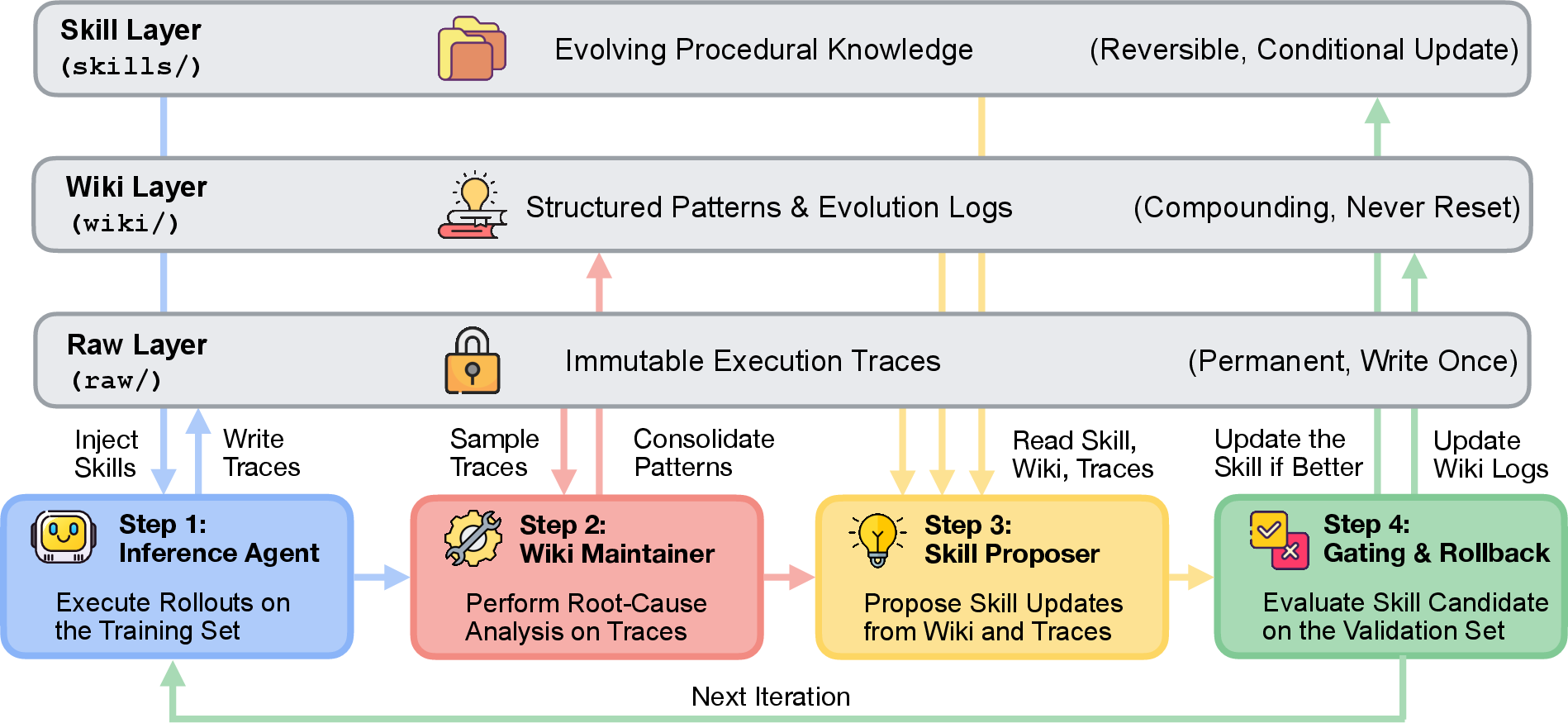
The three layers of WikiSkill
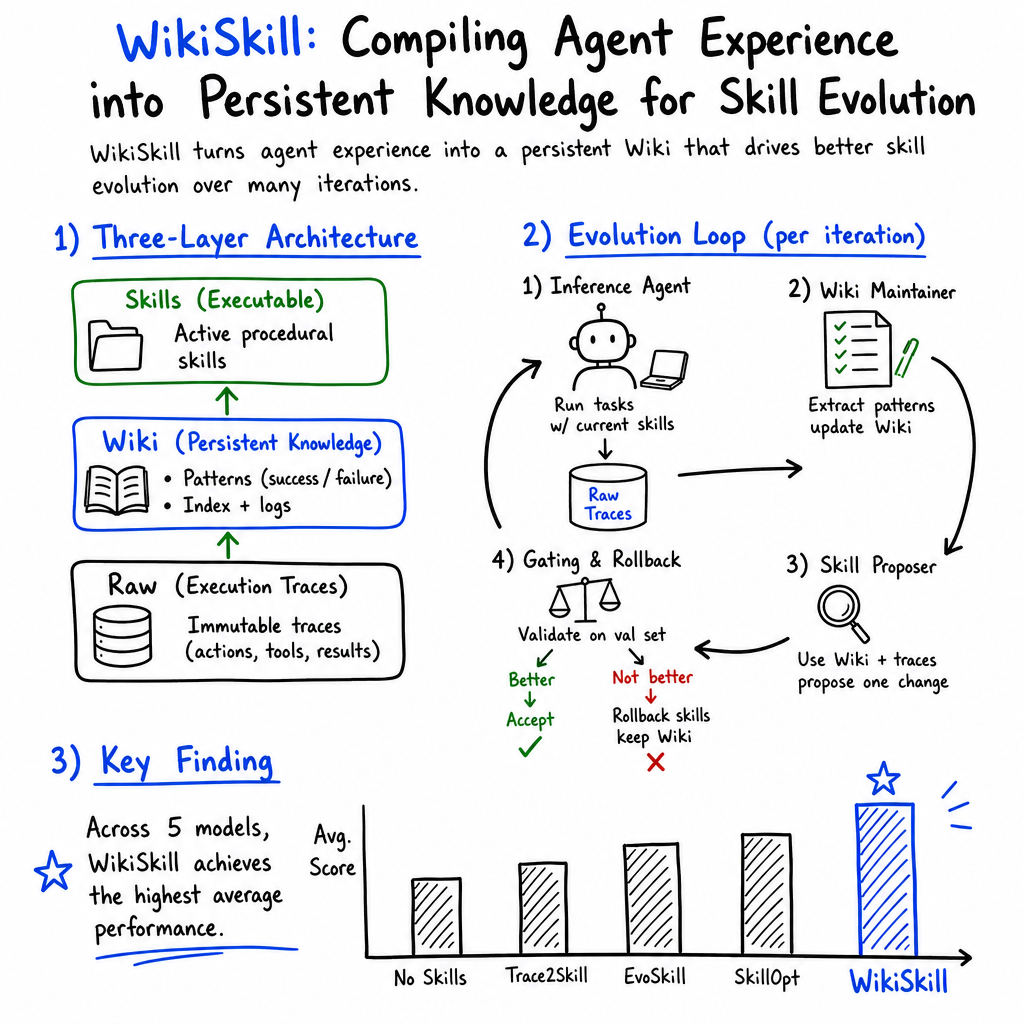
WikiSkill organizes information into three layers:
| Layer | What it stores | Everyday comparison |
|---|---|---|
| Raw Layer | Complete records of the AI’s actions and results | A video recording of everything the AI did |
| Wiki Layer | General lessons, mistakes, successful strategies, and past changes | A notebook summarizing what the AI learned |
| Skills Layer | The instructions the AI actively uses | A recipe or instruction manual |
The Raw Layer cannot be changed. This is useful because the researchers can always look back at exactly what happened.
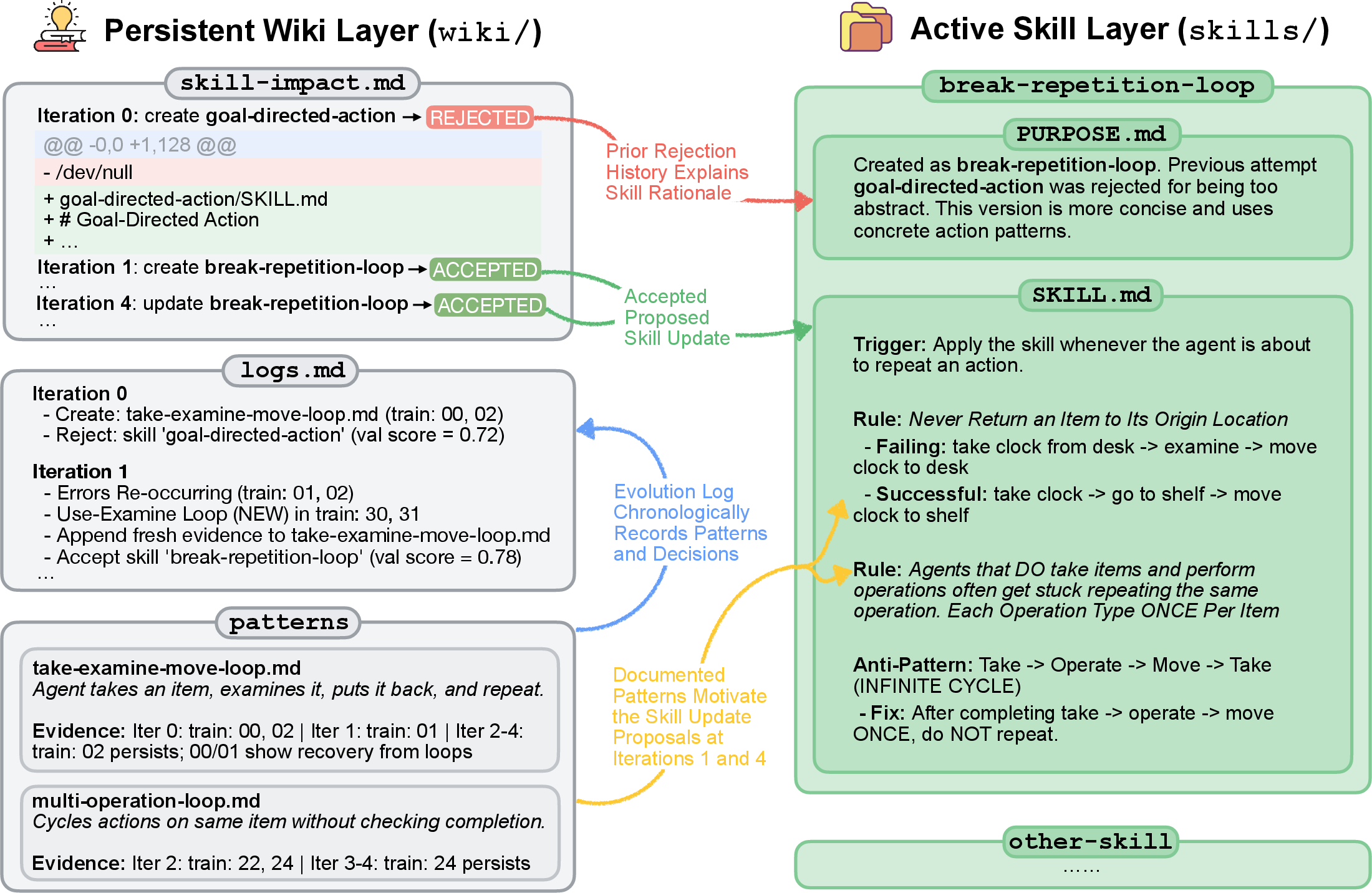
The Wiki Layer is updated over time. It may contain lessons such as:
- “The agent often repeats the same action.”
- “Use a particular search strategy when looking through long documents.”
- “Do not return an object to the place where it was just taken from.”
The Skills Layer contains the practical instructions that the AI uses while solving new tasks.
The improvement cycle
WikiSkill repeats the following process:
- The Inference Agent tries tasks using its current skills.
- The system saves detailed records of what the agent did.
- The Wiki Maintainer studies successful and failed attempts and adds useful lessons to the wiki.
- The Skill Proposer reads the wiki and suggests a new or improved skill.
- The new skill is tested on separate validation tasks.
- If the new skill improves the score, it is kept. If it makes things worse, it is removed.
- Even when a skill is rejected, the lesson about that rejection remains in the wiki.
This is similar to a student preparing for a test. The student solves practice problems, records mistakes, updates their study notes, tries a new strategy, and keeps the strategy only if it improves their practice score.
Tasks, models, and comparisons
The researchers tested WikiSkill on five different benchmarks:
- LiveMath: mathematical reasoning
- SealQA: web searching and answering questions
- SpreadSheetBench: working with spreadsheets
- OfficeQA: answering questions from long documents
- ALFWorld: interacting with objects and completing tasks in a virtual environment
They used five AI models from the Qwen, Gemma, and Gemini families. They compared WikiSkill with:
- Using no skills
- Trace2Skill
- EvoSkill
- SkillOpt
These other systems also try to improve AI skills, but they do not maintain the same kind of long-term, organized wiki.
4. What did the researchers discover?
WikiSkill usually produced the best results
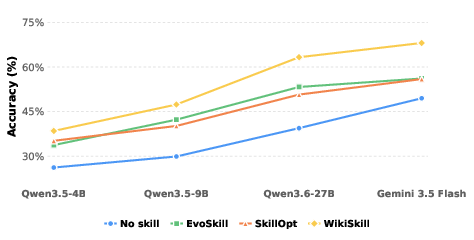
WikiSkill achieved the highest average score for all five tested models.
For example:
- Qwen-3.5-4B improved from an average score of 26.2% without skills to 38.5% with WikiSkill.
- Qwen-3.5-9B improved from 29.9% to 47.4%.
- Qwen-3.6-27B improved from 39.4% to 63.3%.
- Gemini-3.5-Flash improved from 49.5% to 68.1%.
This shows that giving an AI carefully developed instructions can make a large difference.
The improvements were especially large in some areas. For example, Qwen-3.6-27B’s score on spreadsheet tasks rose from 40.8% without skills to 81.7% with WikiSkill.
Skills helped smaller models compete with larger ones
The researchers found that skills can partly make up for a model being smaller.
For example:
- Qwen-3.5-9B with WikiSkill scored 47.4% on average.
- The much larger Qwen-3.6-27B without skills scored 39.4%.
This does not mean that skills always make a smaller model better than a larger one. However, it shows that useful instructions can give a smaller model a major advantage.
Larger models often benefited more from skills
Although smaller models also improved, larger models usually gained more from WikiSkill.
For the Qwen models, the average improvement was:
- +12.3 percentage points for the 4-billion-parameter model
- +17.5 percentage points for the 9-billion-parameter model
- +23.9 percentage points for the 27-billion-parameter model
A larger model may be better at understanding and following complicated instructions. Therefore, it can make better use of a well-written skill.
Skills could be transferred between different models
A skill created by one model could often help another model.
For example, a skill created by Qwen-3.6-27B helped Qwen-3.5-9B on spreadsheet tasks:
- Without skills: 24.3%
- With its own skill: 33.6%
- With the skill created by Qwen-3.6-27B: 50.5%
In another example, Qwen-3.5-9B performed better on ALFWorld using a skill created by Qwen-3.6-27B than using its own skill:
- Its own skill: 63.4%
- Transferred skill: 70.2%
This suggests that the best skill creator and the best skill user do not always have to be the same model.
Some skills did not transfer well
Not every skill worked well when moved to another model.
For example, a skill created by the smaller Qwen-3.5-4B model caused Gemini-3.5-Flash’s spreadsheet score to fall from 50.5% to 18.1%.
The researchers think this happened because the smaller model’s skill included special tricks that helped it avoid its own limitations. Those tricks restricted the stronger Gemini model and stopped it from using better strategies.
This is similar to giving a professional athlete instructions designed for a beginner. The instructions might help the beginner but get in the professional’s way.
The permanent wiki was very important
The researchers performed an ablation study, which means they removed one part of the system at a time to see whether it mattered.
When the Skill Proposer could use the persistent wiki, the average score was 63.7%. Without the persistent wiki, the average score fell to 48.7%.
This was strong evidence that the wiki was not just an extra storage area. It was a key reason why WikiSkill worked.
The wiki helped the system remember:
- Repeated mistakes
- Successful methods
- Previous skill changes
- Rejected proposals
- Which changes improved or harmed performance
The researchers also found that allowing the task-solving agent to read the wiki directly during practice sometimes made the final skills worse. Their explanation is that the agent might use the wiki as a shortcut instead of showing which knowledge truly needs to be placed inside the skill.
5. Why is this research important?
The paper suggests that AI improvement does not always require changing the model itself. Instead, an AI can become more capable by building a collection of useful, reusable skills.
This could lead to AI systems that:
- Learn from repeated experience
- Remember lessons for long periods
- Avoid repeating old mistakes
- Reuse skills across many tasks
- Share useful skills between different models
- Improve without retraining the entire model
The idea could be useful in real-world AI assistants. For example, an assistant might gradually learn better ways to organize files, analyze business documents, search for information, or use computer programs.
However, the research also shows that skills must be written carefully. A skill that helps one model may confuse another. Future systems may need to decide whether a lesson is a general rule that works everywhere or a model-specific trick that only works for one AI.
Simple conclusion
WikiSkill teaches AI agents to improve in a way that resembles human learning. The agent practices tasks, studies its mistakes, records important lessons in a permanent wiki, and uses those lessons to improve its instructions.
The main finding is that organized, long-term memory can make skill development more powerful and reliable. Skills can greatly improve AI performance, sometimes allowing smaller models to compete with larger ones. The research points toward AI systems that do not merely answer questions, but continuously learn, organize their experience, and build a growing library of useful knowledge.
Knowledge Gaps
The paper leaves the following knowledge gaps, limitations, and open questions unresolved:
- Generalization beyond the five benchmarks is unknown. The evaluation covers mathematics, web search, spreadsheets, document QA, and ALFWorld, but does not establish whether WikiSkill works for broader real-world domains, especially open-ended, safety-critical, collaborative, or rapidly changing tasks.
- The extent of out-of-distribution generalization is unclear. Training, validation, and test splits are described, but the paper does not report performance under substantial shifts in task distribution, tool availability, document sources, environments, or task difficulty.
- The contribution of each Wiki component is not isolated sufficiently. The ablation jointly removes the Wiki Maintainer when the Proposer lacks wiki access, making it difficult to distinguish the effects of persistent storage, pattern consolidation, evolution logs, skill-impact tracking, and proposer access to historical information.
- The quality of the wiki is not evaluated independently. The paper reports pattern counts and lengths but does not measure factual accuracy, redundancy, completeness, consistency, usefulness, or whether wiki entries correctly identify root causes.
- The mechanism behind the wiki’s benefit remains uncertain. Improvements are attributed to persistent knowledge accumulation, but the experiments do not determine whether gains arise from retaining rejected proposals, preserving raw traces, summarizing recurring failures, providing additional context, or simply increasing the amount of optimization history.
- The effect of wiki growth and context burden is unexplored. Because the wiki is never reset and has no hard limit on pattern creation or editing, it is unclear whether performance eventually saturates, degrades due to clutter, or becomes constrained by context-window and retrieval costs.
- Long-term evolution stability is untested. The experiments appear to use relatively short evolution runs, and do not establish whether WikiSkill avoids knowledge drift, oscillating edits, irreversible accumulation of incorrect patterns, or degradation over substantially more iterations.
- The fixed validation-gating rule may be overly restrictive. Candidate updates are accepted only when validation performance strictly improves, so the paper does not examine strategies for handling noisy scores, tied improvements, temporary regressions, complementary changes, or updates that improve only a subset of tasks.
- Validation overfitting is not fully addressed. Repeatedly evaluating proposals on the same validation split can lead to indirect optimization against validation examples, but the paper does not quantify this effect or test alternative validation sets, cross-validation, or fresh holdout evaluation after evolution.
- Statistical reliability is limited by the number of runs. Results are averaged over three independent evolution runs, which may be insufficient to characterize the substantial stochasticity of LLM rollouts, proposer decisions, and accepted skill trajectories.
- The reported significance analysis is underspecified. The paper mentions paired bootstrap testing but does not clarify how scores across tasks, runs, models, and methods are paired or whether multiple comparisons across many benchmark-model combinations are corrected.
- Compute and cost efficiency are not comprehensively reported. The paper does not provide total inference calls, token usage, wall-clock time, storage growth, API costs, or energy consumption for WikiSkill versus the baselines.
- The fairness of baseline comparisons is not fully established. Although the methods share a general evolution loop, differences in optimizer prompts, number of proposals, trace budgets, model access, tool usage, and implementation details may affect results and are not fully documented in the provided text.
- The role of the underlying proposer, maintainer, and inference models is unclear. The paper does not systematically vary these components or determine whether improvements are attributable to WikiSkill’s architecture rather than stronger auxiliary LLMs or particular prompt designs.
- The method’s sensitivity to prompting and orchestration choices is unknown. No robustness study examines alternative maintainer prompts, proposer prompts, ReAct policies, patch formats, pattern schemas, or instructions for selecting traces.
- Sampling bias in wiki maintenance is unresolved. The Wiki Maintainer processes only a sampled subset of successful and failing traces, but the paper does not quantify how sample size, success/failure ratio, task stratification, or sampling randomness affects the resulting knowledge and final performance.
- Successful strategies may be underrepresented or incorrectly generalized. The framework relies on LLM-based extraction from sampled traces, yet it does not assess whether patterns learned from successes are causal, reproducible, or merely correlated with particular task instances.
- The raw-trace privacy and security implications are not considered. Persisting complete trajectories—including reasoning, tool calls, outputs, and potentially sensitive task information—raises questions about privacy, data retention, access control, and secure use in real deployments.
- The framework’s resistance to poisoned or misleading experience is untested. Incorrect answers, adversarial tasks, faulty tool outputs, or malicious instructions could be consolidated into persistent wiki patterns, but no defenses or robustness experiments are presented.
- Skill conflicts and compositionality are not studied. The paper focuses on evolving a set of skills but does not explain how contradictory instructions, overlapping skills, cross-domain interactions, or multiple simultaneously relevant skills are resolved.
- The full-injection skill setting limits conclusions about practical deployment. Injecting the complete content of all active skills into the system prompt avoids retrieval failures, but it leaves open whether WikiSkill remains effective with realistic skill retrieval, progressive disclosure, token budgets, and imperfect triggering.
- Skill length and complexity are not linked quantitatively to performance. The paper reports average line counts but does not determine whether longer skills improve outcomes, cause instruction-following failures, or impose model-dependent context costs.
- Negative transfer is characterized only qualitatively. The paper identifies spreadsheet and OfficeQA examples of model-specific workarounds, but does not provide a predictive framework for identifying transferable versus model-specific skill content before deployment.
- Cross-model transfer is evaluated incompletely. Transfer experiments use selected source models and do not systematically cover different architectures, training procedures, modalities, context lengths, tool interfaces, or models outside the Qwen, Gemma, and Gemini families.
- The durability of transferred skills under model updates is unknown. The paper does not test whether skills remain effective after model version changes, quantization, instruction-tuning changes, tool API changes, or modifications to the inference system prompt.
- The distinction between skill discovery and skill execution is not formally measured. The paper infers this distinction from transfer results, but does not define separate metrics or experimental protocols that independently quantify discovery capability and execution capability.
- The claimed interaction with model scaling is not causally established. The observed increase in skill gains with model size is based on a small, nonuniform set of models and may reflect differences in model family, training data, context handling, or tool competence rather than scale alone.
- The source of large benchmark gains is not sufficiently diagnosed. Increases may result from improved reasoning, better tool-use procedures, answer-format compliance, reduced execution failures, or exploitation of benchmark regularities; the paper does not decompose these effects.
- Potential benchmark contamination and memorization are not examined. The study does not assess whether models or evolved skills have encountered benchmark tasks, related data, or publicly available solution procedures during pretraining or evolution.
- Performance robustness across random task orderings is not reported. Since persistent knowledge accumulates sequentially, the order in which training tasks and traces are processed could influence which patterns are discovered and retained.
- No comparison is made with simpler persistent-memory baselines. The paper does not test whether a basic append-only memory, retrieval-augmented trace archive, structured error database, or manually summarized history can achieve similar gains without the full wiki architecture.
- The benefits of retaining rejected proposals are not isolated. Although the case study emphasizes rejected edits, there is no ablation comparing retention of rejection information with retention of accepted proposals only, or with an unstructured proposal history.
- The impact of immutable raw traces is not tested. It remains unknown whether preserving all raw trajectories is necessary, or whether compressed, filtered, or selectively retained traces would provide comparable performance at lower storage and context costs.
- The paper does not establish whether improvements persist without test-time access to auxiliary artifacts. Skills are injected at inference, but the practical lifecycle of exporting, versioning, validating, and deploying evolved skills across agents and environments is not evaluated.
- Failure recovery and catastrophic skill degradation are underexplored. Rollback protects the active skills after validation regressions, but the persistent wiki can still accumulate harmful information; the paper does not evaluate recovery from corrupted wiki states or erroneous maintenance updates.
- Human interpretability and editability are not assessed. Although the filesystem format is described as auditable, the study does not measure whether humans can understand, verify, correct, or safely maintain the generated skills and wiki patterns.
- The paper does not report reproducibility artifacts in the provided text. Key implementation details—such as exact prompts, sampling budgets, iteration counts, task-split sizes, random seeds, model settings, and complete baseline configurations—are deferred to appendices that are not included here, limiting independent replication.
- The evaluation does not address continual learning with changing task distributions. The wiki accumulates knowledge, but the paper does not test how it handles obsolete procedures, concept drift, changing tools, or the need to delete or deprecate outdated patterns.
Practical Applications
Immediate Applications
The paper’s strongest near-term contribution is a practical architecture for converting agent execution traces into reusable, auditable procedural knowledge without modifying model parameters. The following uses could be deployed now, provided that organizations can supply task-specific evaluation data, tool access, and appropriate governance.
- Enterprise workflow agents with persistent operational playbooks (software, business operations, customer support)
- store immutable task traces;
- extract recurring failure modes and successful strategies;
- maintain a structured knowledge wiki;
- propose incremental updates to executable skills; and
- accept or reject changes using a validation set.
This could produce products such as an automated “agent playbook manager” that continuously improves workflows while preserving the history of why each change was made. Feasibility depends on having representative validation tasks, stable tools and APIs, and enough repeated traffic for useful patterns to emerge.
- Auditable agent improvement pipelines (regulated software, compliance, governance)
- what the agent attempted;
- which patterns were extracted;
- which skill edits were proposed;
- whether each edit improved validation performance; and
- which changes were accepted or rolled back.
This is immediately relevant to internal AI governance, model-risk management, and software change control. A deployment workflow could require every skill update to produce a unified diff, validation score, acceptance decision, and rollback point. This assumes that execution traces can be stored securely and that validation scores are meaningful proxies for production quality.
- Spreadsheet and document-automation assistants (finance, accounting, legal, administration)
- formula generation and repair;
- structured spreadsheet transformations;
- financial-report preparation;
- long-document question answering;
- contract or policy retrieval; and
- enterprise report analysis.
A practical workflow would allow the agent to evolve skills such as “validate formulas before editing,” “search long documents hierarchically,” or “confirm cell ranges before applying batch operations.” Human approval should remain required for financial, legal, or externally distributed outputs. The results also indicate that larger models may be better at executing detailed multi-step procedures, especially in long-context settings.
- Web research and search-procedure optimization (research, intelligence, journalism, market analysis)
- query decomposition;
- source triangulation;
- date and provenance verification;
- handling contradictory sources; and
- reducing redundant browsing actions.
The method could be integrated into research assistants or retrieval-augmented generation systems. Dependencies include access to reliable search tools, continuously updated source indexes, citation verification, and safeguards against consolidating incorrect or low-quality search behavior.
- Robotic and interactive-environment procedure learning (robotics, logistics, games, simulation)
- warehouse task planning;
- inventory manipulation;
- household-robot simulations;
- game-playing agents; and
- robotic process automation.
The wiki can record recurring loops, unsafe action sequences, and effective recovery procedures. A gating system can reject procedures that reduce success on held-out scenarios. Real-world robotics would additionally require safety constraints, simulator-to-reality validation, physical-world monitoring, and recovery behavior for unforeseen states.
- Local skill libraries for smaller models (on-device AI, edge computing, cost reduction)
- internal help desks;
- structured data entry;
- routine office automation;
- device-level assistants; and
- low-latency industrial systems.
Organizations could evolve skills using a stronger development model and execute them with a cheaper model. This assumes that the skill is expressed in a model-agnostic form and that the target model can reliably follow the procedure. The paper’s negative-transfer examples show that this cannot be assumed automatically.
- Failure-analysis and incident-response tooling for AI agents (MLOps, software engineering, site reliability)
- repeated tool-call failures;
- loops;
- hallucinated assumptions;
- invalid output formats;
- timeouts; and
- regressions after skill changes.
Engineering teams could use these records to prioritize fixes and reproduce failures. Immediate feasibility depends on instrumenting tool calls, masking sensitive data, and defining domain-specific success metrics beyond simple task accuracy.
- Curriculum and instructional assistants (education and academia)
- checking intermediate calculations;
- selecting an appropriate solution method;
- explaining common misconceptions; and
- adapting explanations to student errors.
The approach is suitable for instructor-assistance and formative feedback rather than unsupervised grading. Dependencies include pedagogically validated rubrics, protection against reinforcing incorrect strategies, and review by educators.
- Research infrastructure for reproducible agent experimentation (academia)
raw/for immutable trajectories;wiki/for consolidated hypotheses and failure patterns; andskills/for executable interventions.
This would make agent-improvement studies easier to reproduce, compare, and audit. It also separates persistent knowledge accumulation from the active intervention being tested. Adoption requires standardized trace schemas, benchmark splits, version control, and consistent reporting of rejected as well as accepted updates.
- Policy and organizational controls for adaptive AI systems (public policy, corporate governance)
- prohibiting unvalidated skill changes in production;
- requiring held-out validation before deployment;
- retaining immutable logs;
- separating knowledge extraction from action execution;
- permitting rollback of executable skills; and
- auditing negative transfer across models.
These controls are deployable as organizational policies even before formal regulation is established. Their effectiveness depends on preventing the persistent wiki from becoming an unreviewed source of sensitive, incorrect, or unauthorized knowledge.
Long-Term Applications
The longer-term opportunities require broader validation, robust model-agnostic representations, improved safety mechanisms, and evidence from production environments rather than benchmark tasks alone.
- Continuously self-improving enterprise agents (software, healthcare administration, logistics, finance) A mature WikiSkill system could operate as a controlled continual-learning layer that improves agents from production experience while leaving base-model parameters unchanged. For example, a healthcare administration agent might learn better procedures for appointment scheduling, insurance verification, and record retrieval; a logistics agent might refine exception-handling procedures.
This requires: - reliable online monitoring; - privacy-preserving trace storage; - distribution-shift detection; - human review for high-impact changes; - protection against feedback loops; and - evaluation on rare but consequential failures.
Benchmark gains do not by themselves establish safe autonomous improvement in these domains.
- Cross-model skill marketplaces and shared procedural repositories (AI platforms, open-source software)
- domain-specific skill packages;
- compatibility metadata;
- evaluation results by model;
- tool and environment requirements;
- known negative-transfer cases; and
- versioned provenance records.
The main dependency is a standardized skill interface. The paper shows that transfer can be beneficial but also harmful, particularly when a skill encodes model-specific workarounds or inefficient tool usage.
- Model-and-skill routing systems (cloud AI, cost optimization)
The distinction between skill discovery and skill execution suggests a future architecture that separately selects:
- which model should develop or revise a skill;
- which model should execute it; and
- which skill variant is best for a particular model and task.
A routing system could use a strong model for skill discovery, a smaller model for routine execution, and a specialized model for long-context or tool-heavy tasks. This requires compatibility testing, performance-cost models, and online detection of when a transferred skill is producing negative transfer.
- Long-term memory systems for autonomous agents (general-purpose agents, robotics)
- factual knowledge;
- procedural patterns;
- error taxonomies;
- rejected strategies;
- evidence supporting each rule; and
- temporal versions of changing procedures.
This could support longer-lived personal, enterprise, or robotic agents. Further research is needed on knowledge contradiction, forgetting, provenance, memory compression, privacy, and resistance to malicious or erroneous experience.
- Safety-oriented skill evolution (robotics, cybersecurity, critical infrastructure)
- identifying unsafe robot action sequences;
- learning cybersecurity incident-response procedures;
- recording tool-use policies that prevent data exfiltration; and
- refining escalation rules for uncertain decisions.
A future gating mechanism would need multi-objective criteria combining task success, safety, latency, resource use, and policy compliance. Simple validation accuracy is insufficient for safety-critical deployment.
- Self-maintaining software engineering agents (software development and DevOps)
- repository-specific testing conventions;
- safe migration workflows;
- debugging sequences;
- dependency-update procedures; and
- deployment rollback decisions.
The persistent audit trail would help distinguish a genuinely useful repair strategy from a one-off workaround. Long-term deployment depends on repository-scale evaluation, secure code execution, access control, and avoiding the reinforcement of brittle patches.
- Personalized knowledge assistants with user-controlled memory (daily life, accessibility, productivity) A consumer assistant could maintain a private wiki of user-approved procedures, such as preferred travel planning, household routines, accessibility adaptations, or recurring document workflows. The user could inspect, edit, approve, or delete patterns and skills.
This requires strong privacy controls, transparent provenance, consent management, and mechanisms to prevent the assistant from turning accidental behavior into permanent instructions. The paper’s architecture is compatible with user-controlled persistence, but the experiments do not evaluate personal-data or adversarial settings.
- Institutional knowledge preservation and workforce transition support (public sector, academia, industry)
- troubleshooting procedures;
- laboratory protocols;
- manufacturing exceptions;
- administrative workflows; and
- field-service knowledge.
The long-term challenge is validating that extracted procedures reflect expert intent rather than superficial correlations. Human experts would need to review and certify the resulting skills, especially where tacit knowledge or safety requirements are involved.
- Adaptive public-service and policy-delivery systems (government and social services) In the longer term, agencies could use persistent, auditable procedural knowledge to improve workflows for benefits navigation, case management, multilingual information access, and regulatory assistance. Skills could evolve from anonymized service interactions and validated staff feedback.
Feasibility depends on fairness auditing, legal accountability, accessibility, secure data handling, and safeguards against learning policies that disadvantage particular groups. Any deployment affecting eligibility, enforcement, or rights would require human oversight and formal impact assessment.
- New benchmarks and standards for experience-compiling agents (academia and industry standards)
- knowledge retention across iterations;
- usefulness of rejected proposals;
- transfer across models and environments;
- robustness to distribution shift;
- safety regressions;
- auditability; and
- cost per accepted improvement.
Such standards would be necessary before organizations can compare persistent-memory and skill-evolution systems reliably. The current evidence is promising but limited to five benchmarks, five models, controlled task splits, and prompt-injected skills rather than full production retrieval and deployment conditions.
Glossary
- Ablation study: An experiment that removes or changes one component to measure its contribution to a system’s performance. “To understand where persistent knowledge contributes to skill evolution, we ablate wiki access for the two components that can use it during evolution”
- Action space: The set of actions available to an agent in an environment. “The trajectory consists of observations and actions ”
- Agent trajectory: The ordered sequence of observations and actions produced during an agent’s task execution. “generate an execution trajectory ”
- Atomic proposal: A proposed modification designed to make one independent change rather than several coupled changes. “In each iteration, the Skill Proposer produces an atomic proposal that targets a single skill”
- Audit trail: A persistent record of actions, changes, and outcomes that supports later inspection. “providing an objective, ground-truth audit trail of past interventions”
- Benchmark: A standardized dataset or task suite used to compare system performance. “We evaluate across five benchmarks spanning diverse domains”
- Bootstrap testing: A statistical method that estimates uncertainty or significance by repeatedly resampling observed data. “Statistical significance of performance differences is evaluated using paired bootstrap testing at ”
- Candidate skill set: A provisional collection of skills evaluated before being accepted as the active version. “The system evaluates on the validation split”
- Closed model: A model whose parameters or implementation are not publicly available for modification or inspection. “For closed models, we use Gemini-3.5-Flash”
- Compounding knowledge: Knowledge that accumulates over time, with later updates building on earlier information. “a persistent knowledge base that compounds across iterations”
- Context window: The maximum amount of text or tokenized information a LLM can process in one input context. “To avoid context window exhaustion when analyzing long execution histories”
- Continual loop: An iterative process that repeatedly uses new experience to update a system. “these components form a continual loop in which experience is consolidated into persistent knowledge”
- Cross-model transfer: The use of skills or knowledge developed by one model with a different model. “We further find that evolved skills transfer effectively across model families”
- Domain-specific scoring function: A task-dependent function that assigns a correctness or quality score to an agent’s answer. “The correctness of the prediction is evaluated by a domain-specific scoring function ”
- Embodied task: A task in which an agent interacts with an environment through actions, often involving simulated or physical entities. “interactive embodied tasks (ALFWorld”
- Evolution log: A chronological record of updates and findings generated during iterative system development. “appends a summary of the iteration's findings to the evolution log logs.md”
- Execution trace: A detailed record of an agent’s interactions, including reasoning, actions, observations, and tool outputs. “This layer stores the raw execution traces ”
- Exploration–exploitation trade-off: The tension between trying new strategies and using strategies already known to work. “the agent runs rollouts, analyzing execution traces, proposing skill modifications, and gating changes”
- Filesystem-based module: A software component organized as files and directories on a filesystem. “a reusable filesystem-based module (i.e., an organized directory)”
- Frontmatter metadata: Structured metadata placed at the beginning of a document, commonly using a delimited format. “each skill contains a SKILL.md file with frontmatter metadata”
- Full injection: The practice of placing the complete content of a resource directly into a model’s prompt. “Following prior work, this full-injection setting ensures that procedural instructions are immediately available”
- Gating mechanism: A decision procedure that accepts or rejects a proposed system change according to a performance criterion. “a gating mechanism filters changes”
- Ground-truth answer: The correct reference answer used to evaluate a prediction. “predictions and ground-truth answers”
- Immutable execution trace: A recorded execution history that cannot be altered after creation. “To preserve the raw history, this layer is immutable”
- Incremental editing: Modifying an existing artifact through small, localized changes rather than replacing it entirely. “Updates to pattern pages are applied using incremental, patch-based editing”
- Inference-time execution: The process of using a trained model to produce outputs for new inputs. “evolved skills are injected into the Inference Agent's prompt at inference time”
- Interactive embodied task: A task requiring sequential interaction with an environment through actions and observations. “interactive embodied tasks (ALFWorld”
- Knowledge consolidation: The process of combining observations or experiences into a structured, reusable representation. “the Wiki Maintainer consolidates traces into the wiki”
- Long-context setting: A task or model configuration involving unusually large input contexts. “in long-context settings, smaller models can become distracted by lengthy document contexts”
- Meta guidance: Higher-level instructions or feedback about how an optimization or update process should proceed. “SkillOpt uses rejected-edit feedback and epoch-wise meta guidance”
- Model scaling: Increasing model size or computational capacity to study its effect on performance. “skill evolution complements model scaling”
- Negative transfer: A situation in which knowledge transferred from one model or task reduces performance on another. “model-specific strategies that can cause negative transfer”
- No-skill baseline: The performance of a system operating without the additional skill resources being evaluated. “We also evaluate each model without skills as a no-skill baseline”
- Open-weight model: A model whose trained parameters are publicly available, typically allowing local deployment or further research. “For open-weight models, we evaluate Qwen-3.5-4B/9B-Instruct”
- Paired bootstrap test: A bootstrap significance test that resamples paired observations while preserving correspondence between conditions. “multiple bold results indicate methods that are not significantly different from the best under a paired bootstrap test with 1,000 iterations”
- Patch-based editing: Updating a file by applying localized additions, replacements, or insertions. “applying an incremental, patch-based edit to the targeted existing skill”
- Persistent knowledge base: A knowledge repository retained across iterations rather than reset after each update. “WikiSkill, which adds a structured knowledge layer between raw experience and executable procedures”
- Procedural knowledge: Knowledge about how to perform a task, including actions, sequences, and conditions. “a skill packages domain-specific procedural knowledge into instructions, scripts, and other resources”
- Progressive disclosure: Presenting or loading information only when it becomes relevant to reduce unnecessary context. “It also supports progressive disclosure”
- Root cause analysis: A systematic investigation intended to identify the underlying source of a failure. “It performs root cause analysis on the failing tasks”
- Rollout: One execution of an agent through a task or environment, producing a sequence of interactions. “During the training rollouts, the Inference Agent is restricted from accessing the Wiki Layer”
- Rollback: Reverting a system to a previous accepted state after a proposed change performs poorly. “If rejected, the system discards the candidate skill modifications and reverts the skill set”
- Self-evolved skill: A skill developed using the same model that later executes it. “Highlighted rows indicate self-evolved skills, where the inference model and skill source are the same”
- Skill evolution: The iterative discovery, evaluation, and refinement of reusable agent procedures. “We formalize the task of iterative skill evolution for LLM agents”
- Skill impact tracker: A record linking proposed skill changes to their validation results and acceptance decisions. “a skill impact tracker (skill-impact.md, updated programmatically by the outer-loop harness after validation gating)”
- Skill provisioning: The process of supplying an agent with the skills it can use during execution. “Skill Provisioning for the Inference Agent”
- Statistical significance: The likelihood that an observed performance difference is not attributable to random variation under a specified statistical test. “Statistical significance of performance differences is evaluated using paired bootstrap testing at ”
- Structured knowledge layer: An organized intermediate representation placed between raw data and executable procedures. “We introduce WikiSkill, which adds a structured knowledge layer between raw experience and executable procedures”
- Tool call: A model-generated request to invoke an external software tool or service. “These traces capture the agent's complete step-by-step interactions, including reasoning, tool calls, tool-call outputs, and final answers”
- Transferability: The extent to which knowledge or a skill remains useful when applied to another model or setting. “The transferability of evolved skills depends on whether they capture general procedures or model-specific workarounds”
- Validation gating: Accepting a proposed update only when it improves performance on a validation set. “The acceptance decision is governed by”
- Validation split: A portion of a dataset used to assess candidate changes during development rather than for final reporting. “The system evaluates on the validation split”
- Wiki Maintainer: The component that converts execution traces into persistent, structured knowledge. “The Wiki Maintainer agent receives the full wiki context alongside sampled traces”
- Wiki-informed skill proposer: An agent that uses the persistent wiki and execution evidence to generate or revise skills. “The Proposer $\mathcal{M}_{\text{P}$ is an LLM-based agent responsible for skill discovery and refinement”

