Failure of Higher-Order Truth within Intuitionistic Propositional Logic
Abstract: We answer the question whether all Heyting algebras can appear as the lattice of subterminal objects of an elementary topos in the negative. Concretely, we have shown that the free Heyting algebra on two generators cannot be such a Heyting algebra. The mathematical results in this document were obtained with the help of ChatGPT 5.6 Sol, although the document itself was written entirely by us and we take full responsibility for its contents.
Paper Prompts
Sign up for free to create and run prompts on this paper.
Top Community Prompts
Explain it Like I'm 14
1. What is this paper about?
This paper studies the relationship between logic and a mathematical structure called a topos. A topos can be thought of as a general mathematical universe where we can talk about objects, sets, functions, and logic.
The paper focuses on the possible “truth values” inside such a universe. It asks:
Can every Heyting algebra be used as the collection of truth values in some elementary topos?
The authors answer no. In particular, they prove that one important example—the free Heyting algebra on two generators—cannot be the collection of truth values of any elementary topos.
This means that higher-order intuitionistic logic has more structure than a Heyting algebra alone can capture.
2. What are the main questions?
The main research question is:
Is every Heyting algebra the lattice of subterminal objects of some elementary topos?
To understand this, we need a few simple translations:
- A Heyting algebra is a system for handling truth values in intuitionistic logic. Unlike ordinary logic, intuitionistic logic does not automatically accept that every statement is either true or false.
- A lattice is a collection of objects arranged by an order, such as “less true than” or “contains less information than.”
- A subterminal object is, roughly, an object that behaves like a proposition: it is either inhabited in at most one way. So subterminal objects act like the topos’s internal truth values.
- An elementary topos is a kind of mathematical universe with enough structure to support both set-like mathematics and higher-order logic.
The paper’s more specific goal is to test the question using the free Heyting algebra on two basic statements, usually called and .
The authors try to show that if this algebra really were the truth-value system of a topos, then the topos’s richer logic would be able to describe something that the Heyting algebra itself cannot describe. That creates a contradiction.
3. How did the authors approach the problem?
The proof has two main parts.
Building a model of possible situations
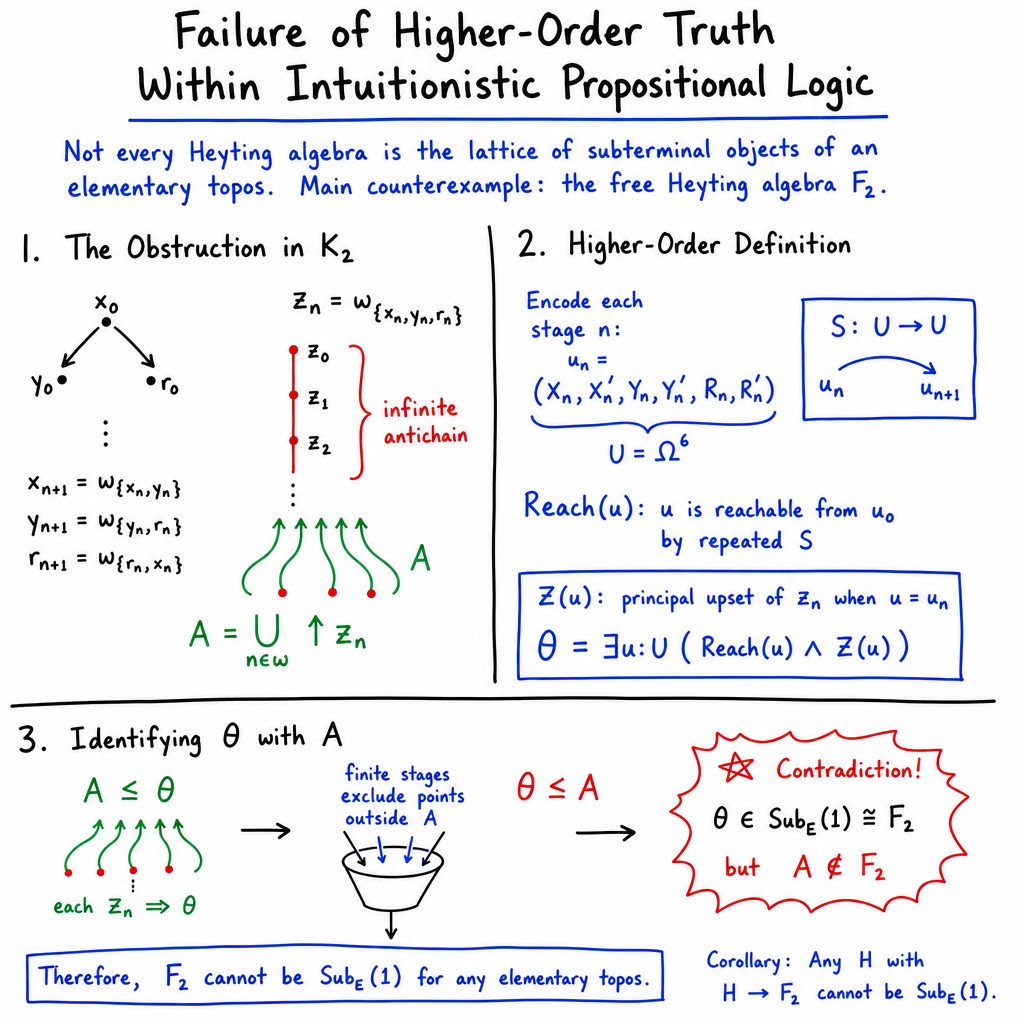
First, the authors use a structure called Bellissima’s Kripke model.
A Kripke model is a way of representing intuitionistic logic using a collection of possible situations. These situations are arranged in a hierarchy:
- A point represents what is currently known.
- A higher point represents a situation with more information.
- If a statement is true at one point, it must remain true at all later points.
This is similar to solving a mystery: as you learn more clues, a conclusion that was already certain cannot suddenly become uncertain.
The points in the model form an ordered set called . The “2” means that the model deals with two basic statements, and .
The free Heyting algebra can be represented inside the collection of all upward-closed subsets of . An upward-closed subset is a group of situations with the property that, once a situation is included, every later and more informative situation is included too.
However, not every upward-closed subset belongs to .
Constructing a special set that the algebra cannot describe
The authors construct points
for each natural number . The points form an antichain. This means that none of them is later than another one: they are separate branches in the model.
They then define
where means “ and all situations above it.”
So contains everything above at least one of the points .
The paper proves that:
is an upward-closed subset of , but is not an element of the free Heyting algebra .
In everyday language, is a pattern that can be seen in the full model, but cannot be described using any ordinary finite intuitionistic formula built from and .
Showing that higher-order logic can describe the special set
The authors then assume, for contradiction, that really is the collection of truth values in some elementary topos .
They use formulas to describe the points and package these descriptions into six-part objects. A rule is defined that changes the object associated with stage into the object associated with stage .
They then define a higher-order predicate called Reach. Informally, Reach(u) means:
The object can be reached from the starting object by repeatedly applying the rule .
This definition is constructively careful. Instead of saying “keep applying forever,” it says that belongs to every collection that:
- contains the starting point, and
- remains closed under applying .
This is similar to defining all reachable places in a maze as the places included in every set that contains the entrance and includes every next step.
Finally, the authors define a proposition that says:
There is a reachable object that also satisfies the condition corresponding to one of the points .
Because this is a higher-order construction inside the topos, must be one of the topos’s truth values. Under the assumed identification, it must therefore correspond to an element of .
4. What are the main findings?
The central findings are:
- The set is a valid upward-closed subset of the Kripke model .
- Nevertheless, is not represented by any element of the free Heyting algebra .
- If were the lattice of subterminal objects of an elementary topos, the higher-order logic of that topos could construct a proposition .
- The authors prove that and describe exactly the same subset of :
- This is impossible because belongs to , while does not.
Therefore, the assumption must be false:
The free Heyting algebra on two generators cannot be the lattice of subterminal objects in any elementary topos.
The paper also gives a broader consequence. If another Heyting algebra can map onto in a way that reaches every element of , then that larger algebra cannot be the lattice of subterminal objects of an elementary topos either.
5. Why is this important?
The result shows that the truth values in an elementary topos are not governed only by the rules of a Heyting algebra.
A Heyting algebra captures ordinary intuitionistic propositional logic: statements made from basic propositions using operations such as “and,” “or,” and “if...then.”
But an elementary topos also supports higher-order logic, where we can quantify over collections, functions, and other mathematical objects. The paper shows that this extra ability can create a proposition that is not available from propositional logic alone.
A useful analogy is:
- A Heyting algebra is like a toolbox containing certain basic tools.
- Higher-order logic is like a workshop where you can use those tools to build new devices.
- The paper proves that, in this case, the workshop can build something that cannot be found in the original toolbox.
6. Overall impact
The paper settles a longstanding question negatively, at least by providing a specific counterexample:
Not every Heyting algebra can arise as the system of truth values of an elementary topos.
This helps mathematicians understand the limits of topos theory and the difference between:
- propositional intuitionistic logic, represented by a Heyting algebra, and
- higher-order intuitionistic logic, available inside a topos.
The result may also help researchers identify which Heyting algebras can come from topoi and what additional properties those algebras must have. Although the proof uses advanced ideas such as Kripke models, free Heyting algebras, and internal higher-order logic, its basic message is simple:
A mathematical universe with higher-order reasoning has richer truth-value behavior than every Heyting algebra can provide.
Knowledge Gaps
The paper establishes a negative result for the free Heyting algebra on two generators, but leaves the following issues unresolved:
- Proof of the obstruction proposition depends on an unstated key step. The argument that some join-irreducible component contains infinitely many points requires an explicit justification that a finite union of sets containing only finitely many cannot equal .
- The use of downward filteredness is not fully verified. The proof invokes results from Darnière–Junker to assert that every relevant join-irreducible is downward filtered, but does not precisely check that their hypotheses and conventions agree with the upward-closed representation used here.
- The claim that each is finite and upward-closed needs proof. The construction of the filtration appears to involve all upward-closed subsets of , but the finiteness and closure properties required later are only asserted.
- The recursive construction of is not checked against Bellissima’s admissibility conditions. In particular, the paper does not explicitly verify condition (iii) for principal upsets or establish that the required valuation constraints hold at every stage.
- The pairwise incomparability of is asserted without a complete induction. Since this incomparability is used in proving that the form an antichain, the relevant order-theoretic argument should be supplied in detail.
- The proof that the form an antichain contains notation and direction ambiguities. Statements such as “ iff ” require careful verification under the recursively defined order, especially when .
- The explicit formulas and are not independently validated. The paper cites Bellissima’s theorem but omits the concrete verification that the displayed formulas define exactly the principal upset and its complement for the conventions adopted here.
- The definability of the successor map is underexplained. The recursive equations are given only on the sequence ; it is not shown in detail that they determine a well-defined internal morphism on all of .
- The construction of
Reachrequires clarification about internal impredicative quantification. The formula quantifies over ; the paper should explicitly explain why the required power object and quantification are available in every elementary topos and how this formula behaves constructively. - The claim that
Reachcaptures exactly finite iteration is not established. The argument proves, at most, that every externally indexed is reachable and that reachability is contained in every internally inductive predicate. It does not fully discuss whether this notion coincides with the intended external reachability relation. - The equivalence relations may not be adequately characterized. The paper defines by , but does not prove that this is an equivalence relation internally or explain precisely why the sequence has only finitely many such classes.
- The selection of representatives is external rather than internal. The transition from finitely many external equivalence classes to the internal predicate needs a formal justification that the chosen finite list is sufficient in the internal logic of the assumed topos.
- The proof of inductiveness of omits a potential dependence on representatives. It assumes that the -class of has a chosen representative, but does not explicitly prove that equality modulo is preserved by the definable map .
- The implication is not justified in the stated order-theoretic conventions. Since denotes the upset generated by , the relationship between , , and should be explicitly derived.
- The argument in Lemma $\ref{lem:thetaexclude}$ uses implication algebra without sufficient detail. The step from to should be stated as the relevant intuitionistic tautological principle and checked in the internal Heyting algebra.
- The identification of with depends on an unproved representation identity. The equality
is standard for upsets, but the paper should prove it under its notation and show that all complements involved correspond to the displayed coprincipal formulas.
- The contradiction relies on an implicit injective identification. The paper assumes an isomorphism and then treats the resulting elements as subsets of . It should explain how the topos-theoretic global sections are transported through the Bellissima embedding and why equality with is meaningful.
- The result is restricted to and does not determine the status of other free Heyting algebras. It remains open whether the same method excludes for every , or whether some higher-rank free Heyting algebras might occur as subterminal lattices.
- No classification of realizable Heyting algebras is provided. The paper does not identify structural conditions separating Heyting algebras that can arise as from those that cannot.
- The corollary for algebras surjecting onto leaves the categorical mechanism implicit. It does not explain whether the relevant surjective homomorphism must preserve additional structure or how it interacts with subterminal lattices and inverse-image functors.
- The relationship with known positive constructions is not analyzed. The paper does not determine whether the obstruction applies to locales, Boolean algebras, étale-finite Heyting algebras, or other classes known or conjectured to be realizable.
- The precise higher-order principle responsible for the obstruction remains unidentified. Although the proof uses quantification over predicates on , it does not isolate a minimal fragment of higher-order intuitionistic logic that distinguishes from an arbitrary Heyting algebra.
- The argument is not generalized beyond elementary topoi. It remains unresolved whether analogous non-realizability results hold for weaker categorical settings, such as elementary doctrines, Heyting categories, realizability toposes, or categories lacking a natural numbers object.
- The dependence on external choice and metatheoretic reasoning is not discussed. The construction selects finite representatives and a point externally; the extent to which the proof can be formalized constructively or internally in a suitable foundation is left open.
- The paper does not provide an independent formal verification of the proof. Given the intricate recursive Kripke construction and internal higher-order argument, machine-checking or a fully detailed syntactic derivation would be needed to rule out errors in the displayed formulas and order relations.
Practical Applications
Immediate Applications
The paper is primarily a foundational result in categorical logic rather than an applied engineering study. Its immediate practical value is therefore concentrated in formal methods, theorem proving, and the design of semantic models for constructive logic.
- Formal verification of higher-order intuitionistic systems — software/formal methods.
- propositional intuitionistic reasoning;
- higher-order intuitionistic reasoning; and
- the additional structure imposed by topos semantics.
- Potential workflow: encode the recursive points , the predicates , and the higher-order reachability predicate in a proof assistant such as Lean, Coq, Agda, or Isabelle.
- Dependencies: the formalization must correctly support Heyting algebras, Kripke semantics, elementary topoi, and constructive quantification over predicates. The paper’s argument should also be independently checked before being used as a benchmark.
- Counterexample benchmark for categorical-logic software — software/research infrastructure.
- finite Kripke models;
- upward-closed subsets;
- Heyting operations;
- principal and coprincipal definability; and
- finite approximations to profinite Heyting algebras.
- Potential product: a “Kripke–Heyting model checker” that determines whether a finite or finitely represented upset is generated by a formula in a specified free Heyting algebra.
- Dependencies: is infinite, so practical implementations require truncation, symbolic representations, or profinite approximations. Finite computations can validate local claims but cannot by themselves establish the infinite non-membership result.
- Curriculum and training material for constructive logic — academia/education.
- categorical logic;
- topos theory;
- intuitionistic logic;
- Kripke semantics; and
- algebraic logic.
- Potential workflow: students can reconstruct the antichain , prove that , and then analyze how the internal higher-order term reproduces .
- Dependencies: the exposition contains notation and typesetting corruption in the supplied text, so educational use requires editorial cleanup and verification of the displayed formulas.
- Guidance for semantic-model selection in constructive programming languages — programming languages.
- dependent type theory;
- constructive set theory;
- higher-order functional programming;
- realizability; or
- internal languages of topoi.
- Practical implication: a compiler, type checker, or semantics tool that models only propositional truth values may miss higher-order definability phenomena represented by predicates such as
Reach. - Dependencies: translating the result into a particular programming language requires a precise correspondence between the language’s type theory and an elementary-topos or related categorical model.
- Research-policy and funding prioritization for foundational verification — policy/academia. The paper identifies a concrete boundary between propositional algebraic structure and higher-order categorical structure. This can justify support for projects developing machine-checked foundations, categorical proof assistants, and constructive semantics rather than treating these areas as purely abstract. Dependencies: this is an indirect application. The result does not itself produce a deployable policy instrument or technology; its value depends on integration with formalization and verification programs.
Long-Term Applications
The following applications require further mathematical development, computational scaling, or empirical validation. They should be understood as research directions rather than established consequences of the theorem.
- Automated discovery of higher-order obstructions — AI/theorem proving.
The construction of combines:
- a recursively generated antichain in a universal Kripke model;
- finite-rank approximations ;
- a higher-order reachability predicate; and
- a definability contradiction. This pattern could inspire automated systems that search for Heyting-algebra elements which are not propositionally definable but become definable using higher-order quantification. Potential tool: a countermodel generator that proposes recursive Kripke configurations and synthesizes predicates analogous to . Dependencies: such a system would need algorithms for join-irreducibility, filteredness, symbolic infinite antichains, and constructive higher-order reasoning. It would also require safeguards against relying on unverified conjectural proof steps.
Classification of realizable truth-value lattices — mathematical logic/topos theory. The theorem excludes and, via the corollary, every Heyting algebra admitting a surjective homomorphism onto . A long-term research program could classify which Heyting algebras can occur as for an elementary topos . Potential outputs: a decision procedure for restricted algebraic classes, structural criteria for realizability, or a database of positive and negative examples. Dependencies: the result addresses only a specific obstruction and does not characterize all realizable Heyting algebras. Progress would require extending the argument beyond two generators and relating it to known positive constructions, such as sheaf and presheaf topoi.
- Profinite and finite-model approximation engines — software/formal mathematics. Since is described as an image-finite universal Kripke model and is related to the profinite completion of , finite stages could become the basis of scalable approximation methods for intuitionistic theories. Potential applications: bounded model checking, counterexample generation, equivalence testing for intuitionistic formulas, and approximation of semantic entailment. Dependencies: finite-stage agreement does not imply global agreement. Algorithms would need convergence guarantees, complexity bounds, and methods for detecting when an apparently finite pattern encodes an essentially infinite obstruction.
- Higher-order effects in verification of distributed or stateful systems — software/formal methods.
The internal predicate
Reachillustrates a constructive way to express inductive reachability by quantifying over predicates closed under a transition operator. This could eventually inform verification logics for transition systems where ordinary propositional invariants are insufficient. Potential workflow: represent system states as objects of a categorical model, define a transition map , and use higher-order invariant predicates to characterize reachable configurations. Dependencies: the paper concerns logical definability, not system verification or computational complexity. Applying the method would require decidable fragments, finite representations, and sound abstraction techniques. - Design of categorical semantics for dependently typed and proof-relevant systems — programming languages/type theory. The negative result suggests that the semantics of higher-order constructive languages may require structure beyond a chosen lattice of truth values. This could influence future models of dependent types, effects, or proof-relevant computation in which propositions are treated as objects rather than merely algebraic truth values. Potential products: semantic libraries for proof assistants, categorical intermediate representations, or type-checking frameworks that track higher-order predicate structure explicitly. Dependencies: a direct connection to a language implementation has not been established. Additional work is needed to identify which aspects of the obstruction survive under proof relevance, universes, normalization, or computational interpretation.
- New foundations for policy reasoning under constructive uncertainty — policy/knowledge representation. In the longer term, richer intuitionistic and higher-order semantics could support systems that represent incomplete information without imposing classical excluded-middle assumptions. Possible domains include formal regulation, scientific knowledge bases, and multi-agent reasoning. Dependencies: this is speculative. The paper does not address uncertainty quantification, natural-language policy, explainability, or empirical decision quality. A usable system would require mappings from domain concepts to categorical or intuitionistic structures and evidence that the additional higher-order expressiveness improves practical reasoning.
- No direct daily-life or consumer application is established. The paper does not provide an algorithm, physical technology, medical method, financial model, or consumer workflow that can be deployed directly. Any daily-life use would be indirect—for example, through future proof-assistant tools or verified software whose semantics benefits from the distinctions identified here.
Glossary
- Antichain: A set of pairwise incomparable elements in a partially ordered set. “The family of points forms an antichain in .”
- Constructive logic: A form of logic that avoids principles such as unrestricted excluded middle and requires explicit constructions for existence claims. “We reason constructively in the internal logic of $#1 E$.”
- Coreflection: A categorical construction assigning an object a universal approximation from a specified subcategory, in the direction dual to reflection. “On the compact-regular coreflection of a stably compact locale”
- Copprincipal set: In this context, the complement of a principal upset generated by a point of a Kripke frame. “For any , there exist and in defining the principal and coprincipal sets generated by ”
- Downward filtered: A property of a subset of a poset in which every pair of elements has a common lower bound within the relevant structure. “each is downward filtered”
- Elementary topos: A category with finite limits, exponentials, and a subobject classifier, providing a categorical universe for interpreting higher-order logic. “whether all Heyting algebras can arise as the lattice of subterminal objects of an elementary topos”
- Embedding: An injective structure-preserving map from one mathematical structure into another. “the free Heyting algebra on generators embeds into the lattice of upward-closed subsets of ”
- Equivalence relation: A relation that is reflexive, symmetric, and transitive, thereby partitioning a set into equivalence classes. “we can construct an indexed family of equivalence relations on $#1 U$ in $#1 E$”
- Finite homomorphic image: The image of an algebra under a homomorphism whose codomain or image is finite. “the kernel of every finite homomorphic image of is a principal filter of ”
- Free Heyting algebra: The Heyting algebra generated by specified elements subject only to the axioms of Heyting algebras. “The mathematical results in this document were obtained with the help of ChatGPT 5.6 Sol”
- Global proposition: A proposition represented by a global section of the subobject classifier in a topos. “as a global proposition if it were the case that $Sub_{#1 E}(1) \cong F_2$”
- Global section: A morphism from the terminal object to another object, representing a globally defined element or proposition. “are global sections of in $#1 E$”
- Heyting algebra: A bounded distributive lattice equipped with an implication operation satisfying the adjunction between conjunction and implication. “We answer the question whether all Heyting algebras can appear as the lattice of subterminal objects of an elementary topos”
- Higher-order logic: Logic allowing quantification over predicates, sets, or functions, rather than only over individual elements. “the higher-order language of an elementary topos”
- Image-finite poset: A partially ordered set in which the upset generated by every element is finite. “the poset is an image-finite poset”
- Internal formula: A logical expression interpreted within the language and categorical structure of a mathematical universe such as a topos. “by the following internal higher-order formula”
- Internal logic: The logic interpreted inside a category, particularly a topos, using its objects and morphisms as types and terms. “reason constructively in the internal logic of $#1 E$”
- Intuitionistic propositional logic: A propositional logic in which proofs of existence and truth are constructive and the law of excluded middle is not generally assumed. “Failure of higher-order truth within intuitionistic propositional logic”
- Join-irreducible: An element of a lattice that cannot be expressed as the join of two strictly smaller elements. “ can be written as a finite join of join-irreducible formulas”
- Kripke model: A partially ordered collection of worlds with monotone valuations used to provide semantics for intuitionistic logic. “There is a very concrete description of using Kripke models.”
- Locale: A point-free representation of a topological space, formulated as a complete lattice satisfying the infinite distributive law. “A positive answer is known for complete Heyting algebras (i.e., locales) via sheaves”
- Monotone evaluation function: A valuation that preserves the ordering of worlds or states in a Kripke model. “a poset with a monotone evaluation function”
- Open map: A morphism between posets or related structures satisfying an order-theoretic analogue of openness, used here in a duality with profinite Heyting algebras. “the category of image-finite posets and open maps”
- Principal filter: A filter generated by a single element, consisting of all elements above that generator. “the kernel of every finite homomorphic image of is a principal filter of ”
- Principal upset: The set of all elements greater than or equal to a particular element in a poset. “For a principal upset ”
- Profinite completion: A completion obtained by approximating an algebraic structure through its finite quotients or finite images. “${K_N} \cong #1{F_N}$ is therefore exactly the profinite completion of ”
- Profinite Heyting algebra: A Heyting algebra characterized by finite approximability and represented by upsets of an image-finite poset. “the category of profinite Heyting algebras”
- Quantification over predicates: The higher-order operation of ranging over predicates or subsets of an object. “ expresses the fact that is reachable from ”
- Reduced Kripke model: A finite Kripke model in which distinct points do not have the same theory. “Equivalently, one can show that a finite Kripke model of is reduced iff there are no distinct points having the same theory.”
- Subobject classifier: An object in a topos classifying subobjects through characteristic morphisms. “the lattice of global sections of the subobject classifier in $#1 E$”
- Subterminal object: An object admitting at most one morphism from every object, equivalently an object that embeds into the terminal object. “the lattice of subterminal objects in $#1 E$”
- Surjective homomorphism: A structure-preserving map that reaches every element of its codomain. “if it admits a surjective homomorphism ”
- Theory of a point: The collection of formulas satisfied at a particular world in a Kripke model. “We call the set the theory of .”
- Upset: A subset of a poset containing every element above each of its members. “the upset of is finite”
- Universal Kripke model: A Kripke model into which all finite reduced Kripke models of a given theory embed. “The image-finite poset is then the universal Kripke model of ”
- Valuation: An assignment of truth values or propositional variables to elements of a semantic model. “The valuation ”
- Yoneda-style representation: A representation of mathematical objects through their relationships with all other objects, associated with the Yoneda perspective in category theory. “we get an embedding”

