Near-Optimal Bounds for Sketching the Schatten--1 Norm
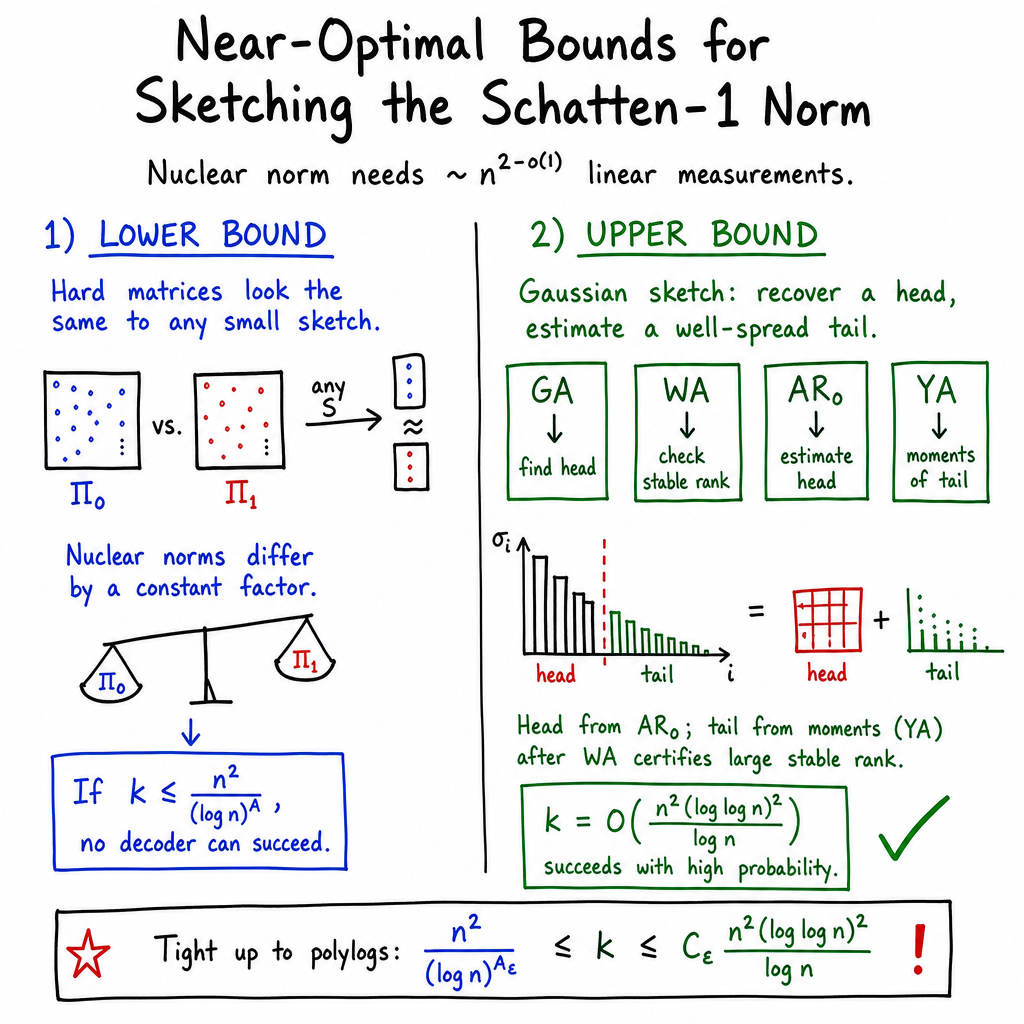
Abstract: Let be the smallest number of real linear measurements needed by a randomized, oblivious sketch that estimates the nuclear norm of every fixed real matrix within a factor , with probability at least $2/3$. For every fixed $0<ε<1$, the proved result is for all sufficiently large , where depend only on . Previously, the best bounds for general linear sketches were and the trivial upper bound (Li, Nguyen, Woodruff, 2019). The theorem therefore nearly resolves the open measurement-complexity question left by that work: the displayed lower and upper bounds are tight up to polylogarithmic factors. In particular, the complexity is , and for every fixed $c>0$, measurements are impossible. The upper bound is obtained by a fixed Gaussian sketch whose decoder combines implicit low-rank recovery with moment estimation on a high-stable-rank residual. The lower bound constructs moment-matched spectra, randomizes their singular vectors, and compares every low-dimensional observation through an odd-order tensor estimate and a Fisher-information path argument.
Paper Prompts
Sign up for free to create and run prompts on this paper.
Top Community Prompts
Explain it Like I'm 14
1. What is this paper about?
This paper studies how much information is needed to estimate the nuclear norm of a matrix.
A matrix is a rectangular grid of numbers. Its singular values are special numbers that describe how strongly the matrix stretches space in different directions. The nuclear norm, also called the Schatten–1 norm, is the sum of all singular values:
The main question is:
If we are not allowed to store the whole matrix, how many carefully chosen measurements are needed to estimate its nuclear norm accurately?
The paper studies a method called a linear sketch. A linear sketch stores a short list of numbers made by taking linear combinations of the matrix entries. Later, a decoder uses those numbers to estimate the nuclear norm.
2. What are the main research questions?
The paper asks two related questions:
- Lower-bound question: Can we prove that every successful sketch must store a very large number of measurements?
- Upper-bound question: Can we design a sketch that uses fewer measurements than simply storing all entries?
The paper focuses on estimating the norm within a fixed relative error. For example, if the true nuclear norm is $100$, an estimate with 10% error should lie between $90$ and $110$.
The authors want the estimate to work for every fixed matrix, with probability at least $2/3$ over the sketch’s random choices.
3. How does the research work?
The paper uses two different strategies: one for proving the lower bound and one for designing the upper bound.
3.1 The lower-bound strategy
To show that small sketches cannot work, the authors create two kinds of random matrices that are difficult to tell apart using only a small number of measurements.
The two types of matrices have:
- noticeably different nuclear norms;
- very similar measurements when viewed through a low-dimensional sketch.
This creates a contradiction. If the sketch could estimate the nuclear norm accurately, it could also tell which type of matrix it had received. But the authors show that the measurements do not contain enough information to make that decision reliably.
The construction has several important parts.
Matching many moments
The authors create two collections of singular values whose first several moments are exactly the same.
A moment is a summary such as
It is similar to comparing two groups of numbers by their average, average square, average cube, and so on.
The two collections are designed so that many of these summaries agree, while their sums of square roots are different. Since singular values are square roots of squared singular values, this means their nuclear norms are different even though many other measurements look the same.
Randomly rotating the matrices
The authors then randomly change the row and column directions of the matrices without changing their singular values.
An everyday analogy is this: imagine writing the same shape on a transparent sheet and rotating the sheet randomly. The important size information remains the same, but a viewer looking through only a few windows has difficulty recognizing the shape.
Adding Gaussian noise
The paper adds a small amount of random Gaussian noise. This is similar to adding a little static to a signal.
The noise serves two purposes:
- it makes the probability distributions mathematically smooth;
- it allows the authors to use tools from statistics, such as Fisher information, to measure how distinguishable the two types of matrices are.
The authors then show that a low-dimensional measurement sees only a tiny amount of the difference between the two matrix families.
3.2 The upper-bound strategy
For the upper bound, the authors design a sketch using random Gaussian measurements.
Instead of treating all singular values equally, they divide them into two parts:
- a head, containing the largest singular values;
- a tail, containing the rest.
This is similar to describing a song by separately recording its loudest sounds and the quieter background.
Estimating the head
The large singular values contain important information but are relatively few. The sketch uses random projections to identify the important directions associated with them.
The decoder does not necessarily reconstruct the entire matrix. It only estimates the contribution of this small, important part.
Estimating the tail
The smaller singular values are more numerous, so reconstructing them individually would be expensive. However, if their energy is spread out fairly evenly, the tail has high stable rank.
Stable rank is a way of measuring how spread out a matrix’s strength is. If almost all the strength comes from one direction, the stable rank is small. If the strength is shared among many directions, the stable rank is large.
For a high-stable-rank tail, the authors estimate several power sums of the singular values. They then use a polynomial that approximates the square-root function. This lets them estimate the sum of the singular values without finding every singular value separately.
The sketch uses four independent Gaussian matrix products for these tasks. All the random measurements are chosen before seeing the input matrix.
4. What are the main results?
The paper proves that the required number of measurements, called , satisfies
where and are constants that depend on the desired accuracy but not on .
The exact logarithmic factors are not fully settled, but the main message is clear:
Estimating the nuclear norm of an arbitrary matrix requires almost real measurements.
The results have two sides.
Lower bound
The lower bound says that no sketch can use only a genuinely smaller power of .
For every fixed , a sketch using only
measurements is impossible.
In simpler terms, saving a large polynomial amount of information is impossible. A sketch may save some logarithmic factor, but it cannot reduce the problem from roughly measurements to, for example, , , or measurements.
Upper bound
The upper bound gives an actual method using approximately
measurements.
This is smaller than , so it improves on the basic method of storing every matrix entry.
The upper and lower bounds are close except for powers of logarithms. This is why the paper calls the result near-optimal.
5. Why is this important?
Earlier research only showed that the number of measurements was somewhere between roughly and . That left a very large gap.
This paper reduces the uncertainty dramatically. It shows that the true answer is almost , up to logarithmic factors.
The result also explains why the nuclear norm is difficult to estimate for general matrices. If a matrix is positive semidefinite, its nuclear norm equals its trace, and the trace can be found with just one measurement. But for an arbitrary matrix, the singular values depend on complicated interactions between rows and columns. Those directions contain a lot of information, and a small sketch cannot capture enough of them.
6. Possible impact and limitations
The research suggests that algorithms for processing large matrices cannot usually estimate the nuclear norm accurately while storing only a tiny amount of information—at least not when:
- the matrix is completely unrestricted;
- the sketch is linear;
- the sketch must work in one general measurement model;
- the accuracy is a fixed constant factor.
This may matter in areas such as:
- streaming data analysis;
- machine learning;
- optimization involving low-rank matrices;
- matrix completion and compressed sensing;
- scientific computing with very large matrices.
However, the result does not say that every matrix problem requires nearly storage. Special cases can be much easier. For example, matrices with special structure, sparse matrices, positive semidefinite matrices, or algorithms allowed multiple passes may need far less memory.
The paper also counts exact real-valued measurements rather than ordinary computer bits. An exact real number could contain an unlimited amount of binary information. Therefore, the result directly measures the number of linear counters, not the complete amount of computer memory needed in bits.
Simple takeaway
The paper answers an important question about compressing matrices:
For a completely general matrix, accurately estimating the sum of its singular values is almost as hard as remembering nearly the whole matrix.
The authors prove both that small sketches are impossible and that a carefully designed random sketch can save a logarithmic amount of space. Thus, they come very close to determining the true difficulty of the problem.
Knowledge Gaps
The paper establishes a strong near-quadratic measurement bound, but several aspects remain unresolved or only partially addressed:
- Optimal logarithmic factors remain unknown. The lower bound is , while the upper bound is ; the correct dependence on , , and is not determined.
- The exact measurement complexity is unknown. It remains open whether is closer to the lower bound, the stated upper bound, or potentially with a different polylogarithmic exponent.
- The dependence on the approximation error is not optimized. The constants in both bounds depend on fixed , but the paper does not provide sharp dependence as or characterize the regime of nonconstant accuracy.
- The result is restricted to fixed constant relative error. The proof does not establish bounds when varies with dimension, including very small-error or coarse-approximation regimes.
- The square-matrix case is the main focus. A corresponding near-optimal characterization for rectangular matrices, especially with strongly unbalanced dimensions, is not derived.
- Computational efficiency of the decoder is unresolved. The upper-bound decoder uses implicit low-rank recovery, adaptive cutoff selection, Gaussian regression, and polynomial moment estimators, but the paper explicitly does not analyze running time, numerical conditioning, or implementability.
- The upper bound assumes exact real arithmetic. No finite-precision implementation is given, and the required bit precision, numerical range, rounding stability, and accumulation of approximation errors are not quantified.
- The relationship to finite-memory streaming space remains open. The exact-real lower bound on the number of linear measurements is not converted into a comparable bit-space lower bound for general bounded-integer or rational turnstile streams.
- The Gaussian sketch is not shown to be precision-robust. It is unclear whether finite-precision approximations to the sampled Gaussian matrices preserve the stated guarantee uniformly over all real inputs.
- The decoder’s measurability and stability under finite observations are not accompanied by practical certification procedures. In particular, the paper does not specify how the stable-rank certification and cutoff decisions behave under noisy or rounded sketch values.
- The lower bound does not apply to nonlinear sketches. The construction rules out low-dimensional randomized oblivious linear measurements, but it does not characterize arbitrary nonlinear sketches or general finite-state algorithms in the exact-real model.
- The lower bound is specific to oblivious sketches. It does not address adaptive measurement schemes whose measurements may depend on earlier observations or on partial information about the input.
- Other access models are not analyzed. The results do not establish analogous bounds for multiple passes, row-order streams, adaptive entry access, or alternative matrix-update models.
- The bilinear-sketch complexity remains unresolved at the near-quadratic scale. Although the paper distinguishes general linear and bilinear sketches, it does not determine whether bilinear sketches require measurements, admit comparable polylogarithmic savings, or exhibit a different asymptotic rate.
- The lower-bound hard distribution may not yield a finite-bit hard instance family directly. The Gaussian smoothing and Haar rotations are useful for the exact-real testing argument, but the paper does not quantify how to discretize these distributions while preserving the indistinguishability and nuclear-norm separation needed for bit lower bounds.
- The effect of restricting inputs to bounded or discrete matrices is not established. It remains unclear whether the nearly quadratic lower bound persists for matrices, bounded-entry matrices, integer matrices, or matrices with polynomially bounded dynamic range.
- The robustness of the lower bound under structural promises is unexplored. The argument does not determine the complexity for matrices with bounded rank, bounded stable rank, sparsity, incoherence, nonnegative entries, symmetry, or other common restrictions.
- The lower bound does not directly cover positive-semidefinite or nearly positive-semidefinite inputs. Since one measurement suffices exactly for positive-semidefinite matrices, the transition between unrestricted matrices and matrices with limited negative-spectrum or nonsymmetric structure is left open.
- The role of random singular vectors is not separated from the intrinsic difficulty of the problem. The hard instances rely on independent Haar left and right singular vectors; whether comparable hardness holds for deterministic, structured, or less-random singular directions is not shown.
- The tensor-rotation estimate may not be sharp. The odd-order contraction bound contains substantial factors such as , and the paper does not determine whether these losses are artifacts of the proof or inherent.
- The moment-matching order is not known to be optimal. The construction uses , but it is not established whether alternative hard distributions or information-theoretic arguments could use larger effective matching order and strengthen the lower bound.
- The Gaussian smoothing parameters are not optimized. The proof uses a fixed noise scale depending on to regularize the orbit distributions, but the tradeoff between smoothing magnitude, norm separation, Fisher information, and lower-bound strength is not fully characterized.
- The lower-bound method is not generalized to other Schatten norms. The paper explains why techniques for do not settle , but it leaves open whether the moment-matching and random-rotation framework can yield sharp bounds for $0
- The approximation tradeoff beyond constant-factor estimation is incomplete. Existing nonconstant-factor upper bounds are cited, but the paper does not provide a matching lower-bound curve for sketch dimension as a function of approximation factor .
- Success-probability dependence is not characterized. The theorem uses success probability $2/3$ and does not analyze how the measurement complexity changes for failure probability or whether standard amplification is optimal in this model.
- The results concern estimating one norm value, not recovering spectral information. It remains open whether similar measurement complexity is necessary for estimating related quantities such as effective rank, Schatten moments, Ky–Fan norms, or the singular-value distribution.
- The proof’s reliance on quoted external results leaves some quantitative dependencies potentially nontransparent. The exact interaction among the Weingarten estimates, rotation-group spectral gap, polynomial approximation, concentration bounds, and inverse-Wishart calculations is not independently optimized for constants or asymptotic losses.
- No empirical or implementation-level validation is provided. The paper does not test whether the proposed upper-bound sketch performs effectively at moderate dimensions or whether the theoretical cutoff and polynomial-degree choices are practical.
Practical Applications
Immediate Applications
- Avoiding impractical constant-accuracy sketches for unrestricted matrices — software, data infrastructure, and streaming analytics.
- Action: Use the theorem as a feasibility screen when evaluating proposed matrix-sketching products or algorithms.
- Assumptions/dependencies: The lower bound applies to one-shot, oblivious, linear measurements with a “for every fixed matrix” guarantee. It does not automatically cover nonlinear sketches, adaptive measurements, multiple passes, sparsity promises, row-order input, or weaker approximation requirements.
- Selecting structured input models where nuclear-norm estimation is inexpensive — machine learning, optimization, and scientific computing.
- Action: Before using a general nuclear-norm sketch, test whether the matrix is guaranteed to be positive semidefinite or can be represented through a positive semidefinite factorization.
- Potential tool: A matrix-statistics API that dispatches PSD inputs to a trace counter and unrestricted inputs to a more expensive approximation routine.
- Assumptions/dependencies: The shortcut is valid only when . For an indefinite symmetric matrix, is the sum of absolute eigenvalues, not the trace.
- Using Frobenius-norm sketches when coarse nuclear-norm estimates are sufficient — software monitoring, optimization, and numerical linear algebra. The standard inequalities
provide an immediately available, although potentially loose, approximation. Existing Frobenius-norm sketches can therefore serve as low-memory diagnostics for matrix magnitude, with a known worst-case approximation factor. - Action: Use a Frobenius sketch for rapid screening, anomaly detection, or resource estimation, and invoke a more expensive procedure only when a constant-factor nuclear-norm estimate is necessary. - Sectors: Streaming data systems, randomized numerical linear algebra, large-scale optimization, and machine learning. - Assumptions/dependencies: The quality may be as poor as a factor of for full-rank matrices. The method is useful only when such an approximation is operationally acceptable or when additional spectral structure is known.
- Exploiting sparsity, limited rank, or restricted presentation models — finance, graph analytics, recommendation systems, and scientific data pipelines.
- Action: Preserve and expose structural metadata such as row/column sparsity, approximate rank, update order, or the ability to make multiple passes.
- Potential workflow: Route sparse transaction matrices, graph-incidence matrices, or user–item matrices to specialized Schatten-norm algorithms rather than general-purpose sketches.
- Assumptions/dependencies: Guarantees depend quantitatively on sparsity, number of passes, matrix dimensions, and the desired approximation factor. Violating the structural promise can invalidate the memory guarantee.
- Improving algorithm-selection policies for matrix optimization — academia and industrial optimization.
- Action: Use rank estimates, singular-value decay, and PSD checks to decide whether to apply trace computation, low-rank recovery, Frobenius estimation, or a more costly nuclear-norm routine.
- Assumptions/dependencies: The paper establishes measurement complexity, not end-to-end runtime, numerical stability, or convergence improvements for optimization algorithms.
- Separating real-word sketch complexity from bit complexity — policy, systems research, and algorithm evaluation.
- Action: Require implementations and benchmarks to specify precision, dynamic range, update magnitudes, and the number of bits per stored counter.
- Potential policy use: Establish reporting standards for claims about “memory-efficient” matrix-streaming algorithms.
- Assumptions/dependencies: Translating the theorem into a bit-space lower bound requires additional finite-precision and input-model assumptions.
Long-Term Applications
- A deployable near-quadratic nuclear-norm sketch for dense matrix streams — software infrastructure and large-scale analytics. The upper bound suggests a fixed Gaussian linear sketch using roughly
measurements for fixed relative accuracy. A future implementation could maintain several independent Gaussian matrix products while receiving turnstile updates, then estimate the norm in the decoder. - Potential product: A distributed matrix-streaming service that stores Gaussian projections rather than all entries. - Required development: Explicit finite-precision analysis, numerically stable estimators, computationally efficient decoding, and experimentally validated constants. - Assumptions/dependencies: The theorem is asymptotic, uses exact real arithmetic, and does not establish practical runtime. The decoder’s implicit head recovery, cutoff selection, and moment estimators may be expensive or unstable at realistic dimensions.
- Adaptive spectral-head and stable-rank-tail monitoring — machine learning, robotics, imaging, and scientific computing.
- Potential workflow:
- 1. Estimate candidate dominant singular subspaces with a Gaussian projection.
- 2. Select a spectral cutoff in the decoder.
- 3. Recover or estimate the low-rank head.
- 4. Use polynomial moment estimators for the residual tail.
- Applications: Detecting rank collapse in training, monitoring observability in robotics, estimating image or tomography complexity, and tracking covariance concentration in scientific experiments.
- Assumptions/dependencies: The residual must have sufficiently high stable rank for the polynomial approximation argument to be accurate. Real data may have heavy tails, finite precision, noise, or rapidly changing spectra that violate the analytical assumptions.
- Streaming estimators for other spectral functionals — statistics, network science, and quantum information.
- Actionable research direction: Replace the square-root approximation used for the nuclear norm with polynomial approximations to other functions of squared singular values.
- Potential tools: A reusable spectral-sketch compiler that takes a target function and produces moment-based estimators with an accuracy–memory tradeoff.
- Assumptions/dependencies: The required polynomial degree depends on the approximation interval and spectral conditioning. Functions with singularities or strong sensitivity near zero may require substantially more measurements.
- Finite-precision and bounded-stream lower bounds — policy, hardware design, and theoretical computer science.
- Action: Analyze the same hard distributions under bounded integer or rational updates, finite dynamic range, rounded measurements, and explicitly limited word sizes.
- Sectors: Edge devices, FPGA/ASIC streaming accelerators, privacy-preserving telemetry, and distributed databases.
- Assumptions/dependencies: The conversion is nontrivial because a small number of high-precision real measurements may carry many bits. New arguments must control attainable states, numerical precision, and update ranges simultaneously.
- Distributed and federated matrix monitoring — cloud computing, finance, healthcare, and privacy-sensitive analytics.
- Potential workflow: Each site maintains the same public Gaussian measurement map, periodically sends sketch updates, and a central decoder estimates the global norm.
- Assumptions/dependencies: Linear sketches are not inherently private; differential privacy, secure aggregation, leakage analysis, and protection against adversarial updates would be required. The global matrix must also be representable as an additive stream.
- Lower-bound-guided hardware and algorithm co-design — accelerators and high-performance computing.
- Action: Compare the cost of storing dense matrices, maintaining Gaussian projections, exploiting low-rank factors, and using multiple passes over external memory.
- Potential products: FPGA kernels for projection updates, GPU-based spectral-head extraction, and hybrid systems combining exact trace counters with approximate tail estimators.
- Assumptions/dependencies: Practical benefit depends on sparsity of updates, projection generation cost, communication overhead, numerical precision, and whether the application requires constant relative error or only a coarse estimate.
- Educational and research benchmarks for matrix sketching — academia and graduate education.
- Action: Use the construction as a benchmark suite with PSD, low-rank, sparse, and adversarial moment-matched matrices to evaluate proposed sketching algorithms.
- Potential output: Reproducible datasets and software comparing memory, accuracy, runtime, number of passes, and precision.
- Assumptions/dependencies: The theoretical hard instances may be difficult to generate or may not reflect natural workloads; empirical conclusions should therefore be reported separately from worst-case guarantees.
Glossary
- Binary testing: Statistical decision problem of distinguishing between two possible input distributions or hypotheses. “Le Cam's binary testing identity”
- Bilinear sketch: A sketch that represents a matrix through multiplication by fixed left and right projection matrices. “a bilinear sketch stores a matrix for chosen left and right projection matrices ”
- Coisometry: A linear map whose rows are orthonormal, so its product with its transpose is the identity. “Therefore, for lower bounds it suffices to consider a row coisometry with .”
- Empirical law: A probability distribution formed by assigning equal mass to each element of a finite sample. “the empirical law of its squared diagonal entries is”
- Fisher information: A measure of how much information a probability distribution contains about a parameter, commonly expressed through the squared score function. “the total variation between the endpoints can be bounded by integrating the square root of Fisher information along the path.”
- Fisher--Rao bound: An inequality relating the total variation between endpoint distributions to the integrated square root of Fisher information along a path. “The Fisher--Rao bound converts path speed into total variation”
- Frobenius inner product: The matrix analogue of the Euclidean inner product, defined by the trace of one matrix transpose multiplied by another. “Identify with using the Frobenius inner product”
- Frobenius norm: The square root of the sum of the squares of all matrix entries, equivalently the Euclidean norm of the singular-value vector. “The upper bound is obtained by a fixed Gaussian sketch whose decoder combines implicit low-rank recovery with moment estimation on a high-stable-rank residual.”
- Gaussian channel: A transformation that adds Gaussian noise to a signal or random variable. “\subsection{Step 3: add a small Gaussian channel}”
- Gaussian cycle statistics: Statistics based on cyclic products of Gaussian sketch entries that estimate power sums of singular values. “Each power-sum coefficient of this polynomial is estimated without bias from a fourth independent block using Gaussian cycle statistics.”
- Gaussian regression: Regression using Gaussian random measurements, here to estimate a matrix component from a randomized sketch. “The head is estimated from a fresh right sketch by Gaussian regression.”
- Haar orthogonal matrix: An orthogonal matrix sampled uniformly according to Haar measure on the orthogonal group. “where are independent Haar orthogonal matrices.”
- Implicit low-rank recovery: Estimation of a low-rank component through sketch measurements without explicitly reconstructing the full matrix. “The upper bound is obtained by a fixed Gaussian sketch whose decoder combines implicit low-rank recovery with moment estimation on a high-stable-rank residual.”
- Inverse-Wishart expectation: An expectation involving the inverse of a Wishart-distributed random covariance matrix. “inverse-Wishart expectation”
- Ky--Fan norm: The sum of the largest specified number of singular values of a matrix. “the truncated singular value decomposition minimizes both every Ky--Fan norm”
- Le Cam's testing identity: A result characterizing the optimal success probability for distinguishing two equally likely distributions in terms of their total variation distance. “Le Cam's testing identity then implies that no decoder can reliably decide which distribution generated the input”
- Moment matching: Construction of distributions or spectra whose moments agree through a prescribed degree. “The lower bound constructs moment-matched spectra”
- Moment-preserving path: A continuous path of distributions or spectra along which selected moments remain constant. “\begin{lemma}[Equal-weight packet and moment-preserving path]”
- Nuclear norm: The sum of a matrix’s singular values; also called the Schatten--1 norm. “The first is the nuclear norm, also called the Schatten--1 norm.”
- Oblivious sketch: A randomized sketching map chosen independently of the input matrix. “the smallest number of real linear measurements needed by a randomized, oblivious sketch”
- Odd-order tensor: A tensor with an odd number of factors or indices, used here because it is the first order not canceled by even-moment matching. “An odd-order random-rotation lemma shows that a rank- projection sees at most”
- Orthogonal projection: A linear operator projecting vectors onto a subspace while leaving that subspace fixed and annihilating its orthogonal complement. “The matrix is an orthogonal projection of rank on the -dimensional matrix space.”
- Orthogonal Weingarten formula: A group-integration formula for calculating expectations of products of entries of random orthogonal matrices. “The standard orthogonal Weingarten formula is the only external group-integration formula used”
- Polynomial approximation: Approximation of a function by a polynomial over a specified interval or domain. “We approximate the square-root function on that interval by a degree- polynomial.”
- Pushforward: The probability distribution obtained by applying a measurable map to a random variable or probability law. “This is called the pushforward of by .”
- Random rotation: Multiplication by randomly sampled orthogonal transformations, used to conceal fixed singular directions. “The lower bound constructs moment-matched spectra, randomizes their singular vectors”
- Real-RAM: An idealized computational model in which operations on real numbers are treated as unit-cost operations. “In an idealized real-RAM interpretation, the theorem bounds the number of data-dependent real words.”
- Rotation-group spectral gap: A separation between the largest and second-largest eigenvalues of an operator associated with a rotation group, indicating a rate of mixing or decay. “the rotation-group spectral gap”
- Score function: The gradient of the logarithm of a probability density with respect to a parameter. “the later score and Fisher-information calculation differentiates densities”
- Stable rank: A continuous rank surrogate defined as the squared Frobenius norm divided by the squared operator norm. “The stable rank of a nonzero matrix is”
- Schatten norm: A matrix norm obtained by applying an norm to the matrix’s singular values. “For , Li and Woodruff obtained sharp dimension bounds for the operator norm and even Schatten norms”
- Singular-value truncation: Approximation of a matrix obtained by retaining only its largest singular values. “We record the part of the singular-value truncation theorem used later.”
- Steinitz lemma: A rearrangement result guaranteeing an ordering of bounded vectors with zero sum whose partial sums remain bounded. “The Steinitz lemma orders these moves so that the accumulated moment error stays small”
- Tensor contraction: The operation of summing over paired tensor indices, reducing tensor order or connecting tensor factors. “The complete calculation in \eqref{eq:B.13a}--\eqref{eq:B.14} proves the following three component bounds”
- Tensor order: The number of tensor factors in a tensor product. “Now let be a positive integer, called the tensor order”
- Total variation: A measure of the maximum statistical distinguishability between two probability distributions. “but the two projected distributions are close in total variation.”
- Turnstile streaming model: A streaming model in which updates may increment or decrement arbitrary coordinates or matrix entries. “It arose in the turnstile streaming model.”
- Yao's principle: A minimax principle that converts lower bounds for deterministic algorithms under a hard input distribution into lower bounds for randomized algorithms. “Yao's principle converts this deterministic testing statement into a lower bound for randomized sketches.”

