Decoding silent reading from non-invasive EEG
Abstract: Non-invasive decoding of inner speech faces a fundamental data problem: a corpus pairing brain activity with a person's spontaneous inner monologue cannot be collected, and the available proxy paradigms (cued repetitive and retrospectively reported generative inner speech) are slow to acquire, poorly time-locked, and subject compliance is unverifiable. We therefore treat silent reading as a scalable proxy task and ask how much lexical and semantic information a contrastive decoder can extract from it. We report an open-vocabulary analysis of approximately 240,000 word presentations recorded from a single densely-sampled participant across 393 runs (ca. 49 h) of 19-channel dry-electrode EEG. Words from continuous narrative text were presented in rapid serial visual presentation, with typography randomised on every trial to partially decorrelate word identity from low-level visual form. A convolutional EEG encoder, optionally followed by a causal transformer, was trained with a CLIP-style contrastive objective to align short EEG windows with hidden-state embeddings of the presented word taken from a LLM. Decoding, evaluated as word-grouped top-10 retrieval against permutation baselines, was reliably above chance, extended to mid-frequency and rare words, and scaled log-linearly with training-data volume with no sign of saturation. Removing occipital and posterior-temporal electrodes reduced the word-level gain by roughly one third but left context tracking unchanged. Control analyses separate word-level decoding from narrative context tracking and from a non-neural positional prior introduced by the transformer's positional embedding. These results establish that open-vocabulary word-level information is recoverable from EEG during silent reading, and that decoding is data-limited rather than saturated.
Paper Prompts
Sign up for free to create and run prompts on this paper.
Top Community Prompts
Explain it Like I'm 14
1. What is this paper about?
This paper asks whether a computer can get clues about which words a person is silently reading by measuring brain activity with EEG.
EEG uses small sensors placed on the scalp to record the brain’s electrical signals. Unlike some brain-computer interfaces, EEG does not require surgery, so it could eventually be safer and easier to use.
The researchers are interested in this because people who cannot speak due to illness or injury might one day use brain signals to communicate. However, this study does not yet decode a person’s private, spontaneous thoughts. Instead, it studies silent reading as a simpler stand-in for inner speech.
2. What questions did the researchers ask?
The paper focuses on several main questions:
- Can EEG contain enough information to identify individual words that someone is silently reading?
- Is the computer identifying the actual word, or is it only guessing the general topic of the story?
- Can the system recognize uncommon words, or only very common words such as the, and, or is?
- Does giving the computer more training data improve its performance?
- Which parts of the EEG signal and which computer-model designs work best?
The researchers also wanted to check whether their results came from accidental shortcuts. For example, perhaps the system could guess a word because it knew where the reader was in the story, rather than because it detected the brain’s response to that particular word.
3. How was the research carried out?
Collecting the brain data
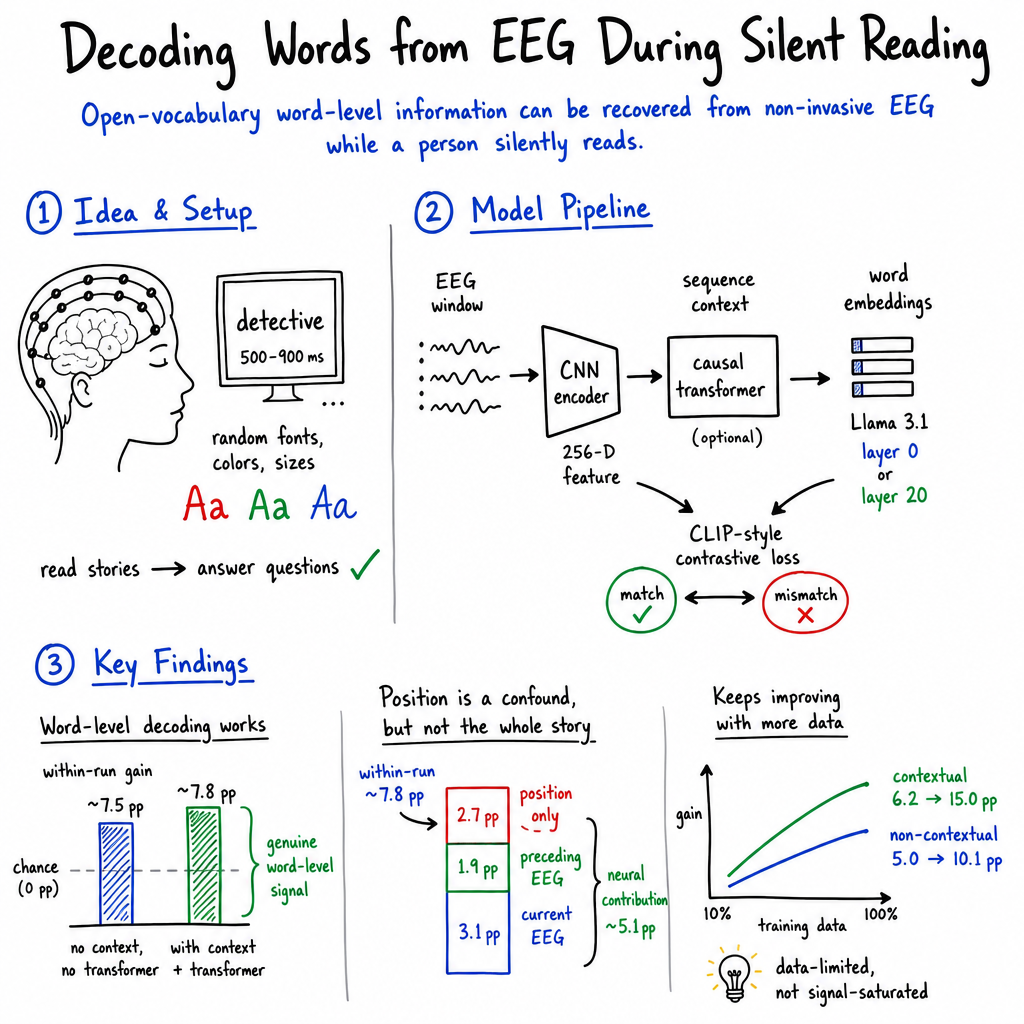
One participant silently read parts of fictional stories, including Sherlock Holmes. The words appeared one at a time on a screen, much like subtitles appearing quickly.
The study collected a very large amount of data from this one person:
- About 240,000 word presentations
- 393 recording sessions
- Nearly 49 hours of reading
- 19 dry EEG electrodes placed on the scalp
The words were shown in different fonts, colours, sizes, and letter spacing. This was important because otherwise the computer might simply learn what a word looks like instead of learning how the brain responds to its meaning.
Preparing the EEG signals
The researchers cleaned the EEG recordings by removing some electrical noise and signals that were too large, which might have been caused by movement or other interference.
They then cut the brain recording into short pieces around the time each word appeared. Keeping these pieces the same length prevented the computer from using word length or display time as an easy clue.
Turning words into computer representations
The researchers used a LLM called Llama, similar in some ways to the models behind modern chatbots.
The LLM converted each word into a long list of numbers called an embedding. An embedding is like a numerical description of a word’s identity and meaning. For example, words such as king and queen would have somewhat related representations.
The researchers used two types of representations:
- Non-contextual representations: These described the word itself, without considering the earlier words.
- Contextual representations: These also included information from the words that came earlier in the story. For example, the meaning of a word can be affected by the sentence and situation around it.
Training the decoder
The computer model had two main jobs:
- It looked at a short piece of EEG and turned it into a numerical representation.
- It compared that EEG representation with the numerical representations of many possible words.
The model was trained to place the correct EEG and word representations close together, while placing incorrect pairs farther apart. This is similar to a matching game: the model learns which brain pattern belongs with which word.
The researchers used a neural network called a convolutional network to study patterns in the EEG over time. Some versions also used a transformer, a type of model that can consider information from earlier items in a sequence. This allowed the model to use information from earlier words in the story.
Testing whether the system really recognized words
For each test example, the system had to choose the correct word from a group of 512 possible word presentations. The researchers mainly reported whether the correct word appeared among the model’s top 10 guesses.
They also compared the results with shuffled EEG signals. This created a “chance” baseline, showing how well the system could perform without matching the correct brain signal to the correct word.
Several special tests were used:
- Within-story testing: All possible words came from the same passage, so knowing the general story topic would not help much.
- Context swapping: The EEG for one word was replaced with EEG from another moment in the same story. If performance remained high, the system was probably using story context rather than the current word.
- Position testing: The researchers checked whether the model was simply learning the reader’s position in the story.
- Electrode removal: They removed electrodes near the back of the head to see how important visual-processing brain areas were.
4. What did the researchers find?
EEG contained information about individual words
The main result was that the model performed better than chance when trying to identify silently read words.
Across many model settings, the average improvement on the main within-story test was about 6.7 percentage points above the shuffled baseline. Other model settings produced an average improvement of about 7.8 percentage points.
Every model tested showed some positive improvement, although the exact size differed.
This suggests that short EEG signals contain information related to the word currently being read.
The system was not only following the story topic
A major concern was that the system might only recognize the general passage. For example, it might learn that the participant was reading a detective story and then make guesses based on that topic.
The tests showed that this was not the whole explanation. In the most carefully controlled, non-contextual setup, the model still achieved about 7.5 percentage points of within-story improvement. Since all candidate words came from the same story passage, topic information could not explain this result very well.
The researchers therefore conclude that the EEG signal includes information about the specific word, not only the surrounding narrative.
Context helped, but it also introduced extra information
Models that used contextual language representations and a transformer achieved much larger overall scores. One configuration reached an overall gain of about 19.8 percentage points.
However, about 5.9 percentage points of this result could be obtained from story-level context. In other words, part of the model’s success came from knowing which passage was being read and what had happened earlier.
This is not necessarily useless. A practical brain-computer interface could benefit from understanding context. But it means the larger score should not be interpreted as pure word-by-word decoding.
Uncommon words could also be decoded
The results were not limited to very frequent words. The model also showed above-chance performance for medium-frequency and rare words.
This is important because a useful communication system would need to handle many different words, not just a small list of common ones.
More data continued to improve performance
The researchers found that performance increased as they added more training data. The improvement followed an approximately log-linear pattern, meaning that more data kept helping, although each additional amount of data probably produced a smaller improvement than the previous amount.
Importantly, the results did not show that the system had reached a fixed limit. This suggests that EEG language decoding may currently be limited mainly by the amount of high-quality training data available.
Visual-processing electrodes were important
Removing electrodes near the back and sides of the head reduced the word-level improvement by roughly one third.
These areas are involved in processing visual information, including the shapes of letters and words. This finding suggests that some of the decoded signal comes from the brain’s response to seeing the written word.
The researchers tried to reduce this problem by changing the appearance of each word. However, the study cannot yet prove that the model is decoding deep word meaning rather than partly decoding visual word shapes.
Story position was not enough to explain the results
The researchers also tested whether the model could succeed just by knowing where the reader was in the story.
For the strongest contextual model, position alone explained about 2.7 percentage points of the within-story gain. The total gain was about 7.8 percentage points, leaving about 5.1 percentage points after correcting for position.
This means that position contributed something, but it could not explain all of the decoding performance.
5. Why are these findings important?
This study provides evidence that non-invasive EEG can recover open-vocabulary word information during silent reading. “Open vocabulary” means the system is not restricted to just a few preselected words; it works with many different words from natural stories.
The study is also important because it used a very large dataset from one participant. Earlier studies often had only a few hours of EEG data, which may not have been enough for the computer to learn the weak relationship between brain signals and language.
The findings suggest three main lessons:
- EEG does contain useful language-related signals, even though they are much weaker and noisier than signals recorded directly from the brain.
- Large amounts of training data matter greatly. The system had not clearly reached its maximum performance.
- Careful controls are necessary. A high score can partly come from story context, word position, or visual features rather than the exact meaning of the current word.
6. What could this research lead to?
In the long term, this kind of research could help create communication tools for people who have lost the ability to speak. A person might silently read or imagine words, while a computer uses brain signals to help produce messages.
However, this paper is still an early step. It studied only one participant, and the results were based on a validation set rather than a completely untouched final test set. The best scores were selected from many model experiments, so they may be somewhat optimistic.
Also, silently reading a word is not the same as freely thinking a private sentence. Reading produces strong visual signals, and the computer may be using some of those signals. The researchers plan to study listening and other participants in future work to see whether the results generalise.
Overall, the paper shows that EEG-based language decoding is possible, but it is not yet a mind-reading system. It demonstrates a promising foundation: with enough data and careful testing, brain activity recorded from outside the head can reveal information about the words a person is processing.
Knowledge Gaps
Knowledge gaps, limitations, and open questions
- Generalisability across participants is unresolved: the headline results come from a single densely sampled participant, so it is unknown whether comparable word-level decoding is achievable in typical individuals.
- Cross-subject decoding has not been demonstrated: the paper does not establish whether models can generalise across people, whether subject-specific calibration is necessary, or how much data each new participant would require.
- The relationship to genuine inner speech remains untested: silent reading is only a proxy, and no transfer analysis evaluates whether representations learned from reading can decode repetitive, generative, or spontaneous inner speech.
- The planned listening condition is unavailable: because passive listening was not included in the present analysis, the study cannot determine whether the decoded information is modality-general semantic content or primarily visual word-form processing.
- Visual confounds are reduced but not eliminated: typography randomisation does not remove information from word length, character count, visual complexity, retinal position, onset/offset transients, or other stimulus-dependent visual features that may remain correlated with word identity.
- The neural source of decoding is poorly localised: 19-channel scalp EEG and the broad channel ablation cannot determine whether the signal arises from visual cortex, language-related temporal regions, distributed semantic networks, or volume-conducted activity.
- Semantic processing is not directly isolated from orthographic processing: above-chance word retrieval does not show how much of the signal reflects meaning, lexical identity, spelling, phonology, or low-level visual analysis.
- The causal language-model targets may impose representational assumptions: decoding Llama hidden states tests recoverability of one model's embedding geometry, not language information independently of Llama's vocabulary, tokenisation, layer choice, or training distribution.
- Only two target layers were evaluated: the study does not map how decoding changes across all model layers or compare Llama representations with alternative LLMs, static lexical embeddings, human-rated semantic spaces, or task-specific representations.
- The use of the last subword-token state may distort target representations: multi-subword words are represented only by the final token, leaving unclear whether performance varies with tokenisation length or whether the target adequately represents the whole word.
- Context tracking remains difficult to interpret mechanistically: the context-tracking swap measures passage-related information but does not distinguish narrative topic, sentence position, lexical predictability, discourse state, repetition structure, or slow changes in attention and arousal.
- The preceding-EEG contribution is not independently validated: position probes attribute information from preceding EEG to neural contextual decoding, but this term could also reflect autocorrelated EEG, temporal drift, fatigue, or haemodynamic/electrophysiological carryover.
- Position correction is specific to the tested architecture and probe: the study does not establish whether the positional-prior decomposition remains valid for other sequence models, positional encodings, run lengths, or evaluation pools.
- Temporal overlap and carryover are not fully resolved: rapid serial presentation, especially with a zero-millisecond ISI, may cause EEG responses to adjacent words to overlap, making it unclear how much “current-word” decoding reflects prior or upcoming stimuli.
- The optimal neural latency is uncertain: varying window lock and length identifies performance differences but does not establish when lexical or semantic information becomes available in EEG or whether the selected windows contain stimulus-onset, offset, or motor-related activity.
- The comprehension task does not provide trial-level compliance verification: end-of-run questions can indicate general engagement but cannot establish that the participant semantically processed every word or remained attentive throughout each run.
- The effects of the protocol changes are not fully disentangled: the change in inter-stimulus interval and the replacement of the one-back task with comprehension questions are confounded with recording time, training, fatigue, and narrative progression.
- Long-session stability is unknown: although approximately 49 hours were collected, the paper does not determine whether decoding quality remains stable across days, sessions, electrode repositioning, fatigue, or changes in cognitive state.
- Dry-electrode reliability is not characterised sufficiently for deployment: the impact of electrode impedance, motion, sweat, contact variation, and setup reproducibility on decoding performance remains unclear.
- The evaluation does not use a held-out test set: model selection and reported performance both use the validation set, so absolute gains may be optimistic and performance on genuinely unseen data is unknown.
- Checkpoint and hyperparameter selection create additional optimism: selecting epochs by the primary retrieval metric and reporting large sweeps over configurations can inflate apparent performance through multiple comparisons and winner’s-curse effects.
- The scaling result lacks repeated estimates at each data volume: the scaling sweep uses one fit per data ratio, preventing reliable estimation of variance, confidence intervals, and whether the apparent log-linear trend is robust to random subsampling.
- Saturation at larger sample sizes remains unknown: the observed absence of saturation up to roughly 49 hours does not establish how much data would ultimately be required or whether performance eventually reaches a practical ceiling.
- The reported metric is not equivalent to usable communication accuracy: word-grouped top-10 retrieval within 512-trial pools does not measure continuous decoding, sentence reconstruction, typing rate, latency, error correction, or clinical communication utility.
- Candidate-pool dependence has not been fully explored: performance may change substantially with pool size, lexical similarity, semantic similarity, repeated words, balanced frequencies, or candidates that were never presented during training.
- Generalisation to unseen words is not tested: the split guarantees unseen text chunks but explicitly does not guarantee unseen word types, leaving open whether the decoder learns compositional or semantic representations rather than word-specific associations.
- Rare-word performance may be statistically unstable: frequency-bin results do not by themselves establish reliable decoding for individual rare words, morphologically novel words, or words with limited training repetitions.
- Naturalistic prose limits stimulus control: correlations among word frequency, length, predictability, syntax, punctuation, sentence position, and narrative context make it difficult to identify which linguistic properties drive performance.
- The fixed 19-channel montage may underestimate achievable performance: it remains unknown whether high-density EEG, improved referencing, source reconstruction, or alternative sensor placements would substantially improve lexical and semantic decoding.
- The decoder architecture has not been compared with strong alternatives: the paper does not establish whether the observed gains depend on the convolutional design, attention pooling, transformer depth, masking strategy, or contrastive objective.
- The impact of preprocessing choices is incompletely quantified: minimal filtering and amplitude rejection may retain artefacts or remove relevant low-frequency information, while the paper does not systematically compare robust artefact correction, rereferencing, ocular regression, and independent-component methods.
- Non-neural behavioural and experimental signals may remain: stimulus timing, screen refresh artefacts, button responses, breaks, run boundaries, and recording-session metadata could provide predictive information unless explicitly controlled in the EEG data.
- The semantic level of the decoded representation is uncertain: successful alignment with LLM embeddings does not demonstrate access to proposition-level meaning, syntactic structure, discourse relations, or the participant’s individually interpreted meaning.
- Individual differences in reading strategy are unexplored: subvocalisation, phonological recoding, fixation strategy, comprehension depth, reading speed, and prior familiarity with the text may influence the decoded signal.
- Clinical feasibility has not been established: the study does not test patients with aphasia, paralysis, neurodegeneration, impaired vision, or atypical EEG, nor does it determine whether the paradigm can support communication under realistic clinical constraints.
- Real-time operation is untested: training and evaluation are offline, and it remains unknown whether the model can decode with sufficiently low latency, tolerate streaming data, and operate without access to future run structure or batch-level normalisation.
- The privacy and misuse implications remain open: the paper does not assess whether models trained for word decoding can inadvertently recover unintended thoughts, personal information, or linguistic content outside the instructed task.
Practical Applications
Immediate Applications
The findings support practical uses of EEG-based language decoding as an offline research, assessment, and human-computer interaction technology. They do not yet support reliable real-time decoding of spontaneous inner speech or clinical communication, because the study used one participant, extensive subject-specific training, and a silent-reading proxy rather than endogenous thought.
- EEG language-decoding benchmark for academia and BCI research
- Researchers can use the paper’s paradigm as a reproducible benchmark for testing whether EEG models recover word-level information from naturalistic language.
- A practical workflow would combine:
- rapid serial visual presentation of continuous text;
- randomized typography to reduce visual-form confounds;
- minimally processed dry-electrode EEG;
- contrastive alignment between EEG features and language-model embeddings;
- within-run retrieval against permutation baselines.
- This could help compare EEG architectures, electrode montages, preprocessing pipelines, window lengths, and data volumes under a common evaluation protocol.
- Dependencies: access to the stimulus corpus, EEG hardware, language-model embeddings, substantial participant-specific recordings, and strict separation of training and validation text.
- Evaluation and quality-control tool for language-decoding experiments
- The paper’s decomposition methods can be implemented as an analysis package that separates:
- current-word decoding;
- narrative or passage-level context tracking;
- positional priors;
- contributions from preceding EEG trials.
- This would be useful for laboratories developing speech or inner-speech BCIs, since a high aggregate retrieval score may otherwise reflect knowledge of the passage rather than identification of the current word.
- The position-only masking probe is especially suitable as a model-audit procedure for sequence models.
- Dependencies: researchers must retain trial order, preserve masked placeholders for rejected EEG segments, and use held-out test data rather than selecting and reporting only the best validation epoch.
- Personalized EEG model-training workflow
- The log-linear improvement with training-data volume suggests that a practical near-term product could be a personalized calibration platform: users read engaging narrative material for repeated sessions while the system learns an individual EEG-to-language representation.
- Such a platform could automatically:
- schedule reading sessions;
- monitor comprehension through questions;
- reject artefact-contaminated trials;
- retrain the decoder incrementally;
- report performance separately for frequent, medium-frequency, and rare words.
- This is relevant to BCI companies and neurotechnology researchers investigating whether individual calibration is more effective than immediately seeking a universal model.
- Dependencies: long recording times, sustained attention, stable electrode placement, user-specific neural variability, and evidence that performance transfers to new tasks rather than only new passages.
- Offline assessment of reading-related neural processing
- The method could be used in cognitive neuroscience and education research to study how EEG representations differ across reading conditions, such as:
- silent reading versus listening;
- familiar versus unfamiliar vocabulary;
- normal versus dyslexic reading;
- native versus second-language reading;
- shallow versus deep comprehension.
- Word-frequency analyses could provide a neural measure of how lexical processing changes with vocabulary knowledge or reading expertise.
- Dependencies: the current results establish detectability, not a validated diagnostic biomarker. Group-level reliability, normative datasets, and controls for eye movements, typography, word length, and comprehension are required.
- Experimental tool for comparing language representations
- The contrastive architecture provides a way to test whether EEG signals correspond more closely to:
- word identity;
- semantic representations;
- contextual representations;
- modality-general language features.
- Comparing layer-0 and contextual language-model targets can be used to investigate which levels of computational language representations are reflected in scalp EEG.
- This could support model comparison in computational neuroscience, including tests of different LLMs or multilingual representations.
- Dependencies: language-model embeddings are not direct measurements of human semantics, and results may depend on tokenization, selected layers, corpus statistics, and the causal context available to the model.
- Low-bandwidth silent-reading interfaces for controlled environments
- In laboratory or accessibility settings, the decoder could potentially rank candidate words while a person silently reads, supporting exploratory interfaces such as:
- selecting among displayed options;
- verifying whether a user recognized a displayed term;
- detecting broad passage or topic engagement;
- controlling simple software through a constrained vocabulary.
- The most realistic immediate implementation would be candidate-ranking or verification, not unrestricted text generation.
- Dependencies: the reported top-10 retrieval gains are offline, selection-optimistic, and measured in 512-trial candidate pools. Latency, robustness to new users, real-time calibration, and performance under natural reading have not been demonstrated.
- Attention and engagement monitoring during digital reading
- Because the task combines neural responses with comprehension checks, the paradigm could inform software that detects lapses in reading engagement or adapts presentation speed.
- Potential applications include adaptive educational interfaces, usability studies, and fatigue monitoring during extended text comprehension.
- The contextual component may be useful for estimating whether a reader is following a passage, even when exact word decoding is weak.
- Dependencies: context tracking must be shown to correlate with independently measured comprehension, and EEG changes must be distinguished from fatigue, eye movements, task difficulty, and general arousal.
- Policy and standards for responsible neural-language-decoding claims
- The paper provides an immediate methodological basis for policy guidance requiring developers to report:
- subject count and amount of subject-specific training;
- whether the task is perceived language or inner speech;
- candidate-pool size and chance definition;
- context and positional controls;
- held-out test performance;
- failure rates and artefact sensitivity.
- Such standards would help prevent silent-reading results from being presented as unrestricted mind reading or clinically usable inner-speech decoding.
- Dependencies: adoption requires consensus among BCI researchers, clinicians, regulators, and privacy authorities.
Long-Term Applications
The longer-term applications depend on demonstrating cross-subject generalization, transfer from reading to listening and inner speech, real-time operation, robustness outside controlled presentation, and clinical usefulness. The current study is an important feasibility result but does not yet establish these capabilities.
- Non-invasive communication BCI for people with severe speech impairment
- A mature version of the system could allow people with stroke, ALS, traumatic brain injury, or neurodegenerative disease to communicate without vocalization or surgery.
- A possible product workflow would combine:
- silent reading or internally generated language during calibration;
- a personalized EEG encoder;
- a language-model decoder;
- uncertainty-aware candidate ranking;
- a spelling, phrase-selection, or text-to-speech interface.
- The initial system would likely use constrained phrase sets or adaptive vocabulary expansion before attempting open-ended conversation.
- Dependencies: transfer from externally presented reading to genuine inner speech is the central unresolved dependency. Clinical users may also have atypical visual, attentional, motor, or cortical function, and dry-electrode systems must remain reliable over long periods.
- Cross-modal decoding of reading, listening, and imagined language
- The planned passive-listening condition could establish whether EEG representations learned during silent reading transfer to heard language. A later stage could test transfer to covert speech or inner monologue.
- If successful, this could produce a modality-general semantic BCI that works across:
- reading;
- listening;
- attempted speech;
- imagined speech.
- Such a system might reduce calibration requirements by using large, easy-to-label reading and listening datasets to bootstrap harder-to-label inner-speech data.
- Dependencies: shared semantic representations must be separable from visual word-form and auditory phonetic activity. Cross-modal transfer must be assessed on held-out speakers, words, passages, and tasks.
- Open-vocabulary assistive communication
- The reported extension to mid-frequency and rare words suggests a possible route toward systems that are not restricted to a small fixed vocabulary.
- Future products could include:
- neural spelling aids;
- vocabulary-aware text composition;
- rare-name and medical-term selection;
- personalized phrase prediction;
- communication tools that combine neural evidence with language-model priors.
- A hybrid decoder could use EEG to provide weak lexical evidence while a LLM constrains outputs to grammatically and contextually plausible alternatives.
- Dependencies: rare-word performance must be validated independently, and the system must quantify uncertainty to avoid confidently outputting incorrect words. Open-vocabulary operation also requires evaluation on words and concepts absent from training data.
- Real-time adaptive reading and education systems
- A robust decoder could enable educational software to estimate, in real time, whether a learner is processing particular words or concepts.
- Potential tools include:
- adaptive presentation timing;
- vocabulary remediation;
- automatic identification of words requiring rereading;
- personalized difficulty adjustment;
- neural measures of second-language lexical acquisition.
- The system might combine EEG-derived lexical evidence with comprehension questions and behavioral measures rather than relying on EEG alone.
- Dependencies: real-time accuracy, low setup burden, tolerance to movement and eye artifacts, and validated links between decoded neural signals and learning outcomes are necessary.
- Neuroadaptive human-computer interaction
- Future interfaces could use decoded lexical or semantic states to control software, robots, wheelchairs, or smart-home systems without overt speech or hand movement.
- A practical architecture would likely decode a small set of intentional commands embedded in natural language and combine them with conventional sensors and confirmation mechanisms.
- In robotics, this could support silent selection of navigation goals, object categories, or action alternatives.
- Dependencies: safety-critical systems require very low false-command rates, explicit user confirmation, fail-safe behavior, and reliable performance under motion, fatigue, and environmental noise.
- Large-scale EEG language foundation models
- The paper’s unsaturated scaling curve motivates the development of large, longitudinal EEG-language datasets and pretrained EEG encoders.
- Such models could provide reusable representations for:
- reading and speech BCIs;
- cognitive-state estimation;
- clinical neurorehabilitation;
- multimodal neuroscience;
- personalized neural interfaces.
- Industry could develop pretrained models that are fine-tuned with a smaller amount of user-specific data, analogous to transfer learning in speech and vision.
- Dependencies: the current scaling result comes from one densely sampled participant. Population-scale benefit requires testing across ages, languages, neurotypes, electrode systems, and recording environments, while addressing data privacy and institutional consent.
- Clinical monitoring and rehabilitation
- EEG-based lexical decoding could eventually help monitor recovery of language function after stroke or brain injury, or evaluate rehabilitation progress when overt speech is unavailable.
- Repeated measurements might track changes in word-level and contextual processing over time and guide individualized therapy.
- Dependencies: clinical deployment requires longitudinal reliability, clinically meaningful outcome correlations, diagnostic specificity, and validation against established neuropsychological assessments. The paper does not yet show that decoding accuracy reflects health status or recovery.
- Neural privacy and governance frameworks
- If future systems decode internally generated language rather than merely presented words, they could create new risks involving inferred thoughts, consent, employment screening, advertising, legal evidence, and data ownership.
- Long-term policy applications should therefore include:
- explicit consent standards for neural-language data;
- limits on secondary use;
- user control over recording and decoding;
- protections against compelled disclosure;
- requirements to distinguish intended communication from involuntary neural signals.
- Dependencies: meaningful privacy regulation depends on actual decoding capabilities, which remain uncertain. Technical safeguards should be developed before systems become capable of reliable spontaneous-thought decoding.
- Daily-life silent communication and personal assistants
- In a mature, portable form, users might silently issue messages or commands to phones, hearing devices, augmented-reality systems, or home assistants.
- Potential workflows include silently composing a short message, selecting a destination, requesting assistance, or controlling accessibility features.
- The likely path is incremental: fixed commands first, phrase selection next, and open-ended communication only after substantial validation.
- Dependencies: comfortable long-term electrodes, calibration that works across days, robustness to movement and distraction, strong user authentication, and safeguards against unintended decoding are all unresolved.
Glossary
- 10–20 layout: Standardised system for positioning scalp electrodes using proportional measurements of the head. “19 dry scalp electrodes in the 10-20 layout”
- Ablation: Experimental removal of a model component or input feature to measure its contribution. “a channel ablation”
- AdamW: Optimisation algorithm that combines Adam adaptive updates with decoupled weight decay. “Models were trained for 100 epochs with AdamW”
- Amyotrophic lateral sclerosis (ALS): Neurodegenerative disease that progressively damages motor neurons. “amyotrophic lateral sclerosis or other neurodegenerative disease”
- Attention masking: Reduction or elimination of a signal by competing stimuli or attentional demands. “possibly resulting from attentional masking”
- Attention pooling: Learnable operation that weights and aggregates features across time or other positions. “collapses time with a learnable attention pooling”
- Batch normalisation: Neural-network technique that normalises intermediate activations to improve training stability. “All blocks use ELU activations, batch normalisation and 20\% dropout.”
- BCI (brain-computer interface): System that translates neural activity into commands or communication outputs. “Brain-computer interfaces (BCIs) that decode intended or imagined speech”
- Causal attention: Attention mechanism in which each position can use only current and preceding positions. “The causal mask mirrors the causal attention of the LLM”
- Causal LLM: LLM that predicts text using only preceding tokens. “Because the model is causal, a hidden state at any layer above the input embedding incorporates all preceding words.”
- Causal transformer: Transformer sequence model restricted to attending to earlier or current sequence elements. “A four-layer causal transformer”
- Channel ablation: Analysis that removes selected recording channels to estimate their importance. “a montage with O1, O2, T5 and T6 removed”
- CLIP contrastive objective: Training objective that aligns representations from different modalities by increasing similarity for matching pairs and decreasing it for mismatched pairs. “trained with the symmetric CLIP contrastive objective”
- Context-independent gain: Retrieval performance remaining after subtracting performance attributable to narrative context. “Context-independent gain overall gain context-tracking gain.”
- Context-tracking gain: Decoding performance attributable to identifying the surrounding passage or narrative rather than the current word. “This quantity therefore is the context-tracking component of the overall gain”
- Contrastive decoder: Decoder trained to distinguish matching neural and target representations from non-matching alternatives. “how much lexical and semantic information a contrastive decoder can extract”
- Convolutional encoder: Neural network that converts structured input, such as EEG time series, into learned feature representations using convolutions. “A convolutional EEG encoder”
- Cosine similarity: Similarity measure based on the angle between two vectors. “the model's EEG prediction is compared (cosine similarity, scaled by the learned temperature)”
- Data augmentation: Training procedure that creates varied inputs through controlled transformations. “as a data-augmentation strategy”
- Densely sampled participant: Participant contributing an unusually large quantity of recordings or trials. “a single densely-sampled participant”
- ECoG (electrocorticography): Invasive recording of electrical activity from electrodes placed on the cortical surface. “Intracortical and electrocorticographic systems”
- EEG (electroencephalography): Non-invasive measurement of electrical brain activity using scalp electrodes. “Non-invasive decoding of inner speech”
- ELU (exponential linear unit): Nonlinear activation function used in neural networks. “All blocks use ELU activations”
- Empirical permutation baseline: Chance-performance estimate obtained by randomly rearranging predictions or labels and recomputing the metric. “every reported quantity is a gain relative to an empirical permutation baseline”
- End-to-end architecture: Model trained directly from raw or minimally processed inputs to final outputs. “end-to-end architectures gain little from elaborate M/EEG artefact pipelines”
- Epoch: Fixed temporal segment of a recording, or a complete pass through training data depending on context. “Models were trained for 100 epochs”
- Feature vector: Numerical vector encoding properties learned or extracted from an input. “a 256-dimensional per-trial feature vector”
- Foundation model: Large pretrained model intended to support many downstream tasks. “recent EEG foundation models”
- Generative inner speech: Internally generated speech content freely imagined by a participant rather than externally cued. “Generative inner speech, in which participants freely imagine an item”
- Hidden state: Internal vector representation produced by a neural-network layer for a particular input position. “Each word was represented by a hidden state extracted from a pretrained Llama-3.1-8B model”
- In-batch negative: Non-matching example within the same training batch used as a contrastive competitor. “all contribute in-batch negatives”
- Intracortical recording: Neural recording obtained using electrodes inserted into or placed within the cerebral cortex. “Intracortical and electrocorticographic systems”
- Jitter: Deliberate random variation in the timing of an event. “plus up to 100\,ms of jitter”
- L2 normalisation: Scaling a vector to unit Euclidean length. “mapped into a shared 256-dimensional space, L2-normalised”
- Lexical decoding: Recovery of word-identity information from neural signals. “it is not word-level lexical decoding”
- Log-linear scaling: Relationship in which performance changes approximately linearly with the logarithm of data volume. “demonstrated an unsaturated log-linear scaling relationship”
- MEG (magnetoencephalography): Non-invasive measurement of magnetic fields generated by neural activity. “their EEG results were far weaker”
- Montage: Arrangement and selection of electrodes used for physiological recording. “Recording montage: 19 dry scalp electrodes”
- Non-contextual embedding: Representation determined by a word’s identity independently of surrounding text. “Layer 0 --- non-contextual.”
- Optically-pumped magnetometer (OPM): Magnetometer using optically manipulated atomic states to measure weak magnetic fields from brain activity. “across EEG, MEG and optically-pumped magnetometers”
- Positional embedding: Learned representation encoding an item’s location in a sequence. “the transformer's positional embedding acting as a non-neural positional prior”
- Positional prior: Bias or predictive information about an item derived from its sequence position rather than its content. “a non-neural positional prior on the within-run gain”
- Rapid serial visual presentation (RSVP): Experimental method presenting visual items sequentially and rapidly, usually at a central location. “Words from continuous narrative prose are presented one at a time at the centre of a black screen (rapid serial visual presentation).”
- Representation collapse: Failure in which a model maps different inputs to identical or nearly identical representations. “a control for representation collapse”
- Retrieval gain: Improvement in retrieval accuracy relative to a chance or permutation baseline. “All gains reported here are top-10 word-grouped retrieval gains”
- Semantic representation: Internal encoding of meaning or conceptual content. “higher-level areas are engaged in encoding its meaning”
- Sequence model: Model that processes ordered inputs while representing dependencies across positions. “The presence of the transformer and the choice of embedding layer”
- Shared latent space: Common vector space into which representations from different sources are projected for comparison. “the two pathways meet only in a shared 256-dimensional L2-normalised space”
- Softmax: Function that converts a set of scores into a probability distribution. “The resulting distribution is softmaxed”
- Sub-word token: Token representing part of a word in a LLM’s tokenisation scheme. “the chosen target embedding is that of the last sub-token”
- Temporal-shift augmentation: Data augmentation that randomly shifts an analysis window along the time axis. “a random temporal shift of up to or \,ms was applied”
- Top-10 retrieval: Evaluation criterion counting a prediction as successful when the correct item appears among the ten highest-ranked candidates. “word-grouped top-10 retrieval within fixed candidate pools of 512 validation trials”
- Transformer: Neural architecture based primarily on attention mechanisms for modelling sequences. “An optional four-layer causal transformer”
- Vocabulary: Set of distinct word types that a model can represent or decode. “the model must operate over tens of thousands of word types”
- Winner’s curse: Selection bias caused by reporting the best result from many tested configurations. “reported scalars are read at the epoch that maximised the within-run gain, so that metric carries winner's-curse optimism”
- Word-grouped retrieval: Evaluation method that combines scores for repeated occurrences of the same word before ranking candidates. “All metrics are word-grouped top-10 retrieval”