Resolution of Singularities in Positive Characteristic: Frobenius-Hasse Towers and Exceptional-History Descent
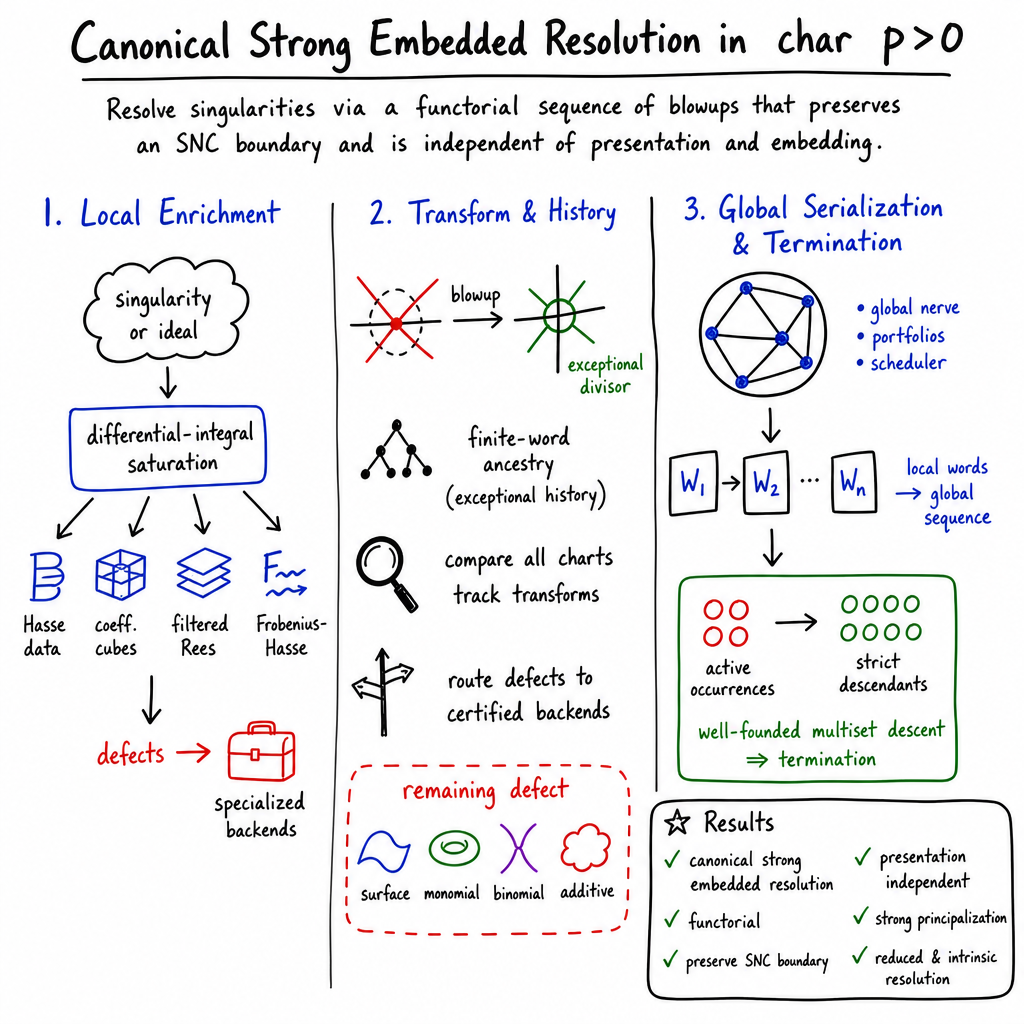
Abstract: Let k be a perfect field of characteristic p>0. We introduce an object-level construction for canonical strong embedded resolution and principalization over k. The construction program replaces monotonicity of pointwise numerical invariants by a well-founded history of addressed comparison factors. Starting from the differential-integral saturation of a marked Rees algebra, we construct total-Hasse activity packets, filtered coefficient cubes, semilinear Frobenius-Hasse sources, and literal transform data for ordinary permissible blowups. A six-row defect calculus routes local problems to certified surface, toroidal-monomial, binomial, and additive-type procedures, after which clean centre portfolios are serialized and descended on a global nerve. The central structure is a global replacement certificate transporting successor addresses, paid quotients, typed traces, displayed parents, reopening data, and terminal truth across macroblocks. We prove that a complete state equipped with this certificate admits a strict multiset replacement in a single dependent well-founded order; hence the iteration terminates and the exhausted state reconstructs a regular strict transform having normal crossings with the ordered boundary. We further formulate an object-level realization of the certificate through rigid generation, cross-generation no-reset, complete wild-capacity control, a centre-or-typed-exit alternative, structured cofibres, displayed-parent allocation, and literal terminal truth. The program page is also available at website https://sites.google.com/view/positive-char-resolution
Paper Prompts
Sign up for free to create and run prompts on this paper.
Top Community Prompts
Explain it Like I'm 14
1. What is this paper about?
This paper is about resolution of singularities in algebraic geometry.
A singularity is a place where a geometric object is not smooth—for example, the sharp point of a cone or the crossing point of two curves. Resolution of singularities means changing the object in a careful way so that these rough or broken-looking places become smooth.
The paper studies this problem over fields with positive characteristic. In simple terms, this means doing arithmetic where a prime number such as or behaves like zero. This setting is especially difficult because some standard calculus-based tools do not work as well.
The author claims to build a general, organized method that resolves singularities using a sequence of operations called blowups.
2. What questions does the paper try to answer?
The main goals are:
- Can every suitable singular geometric object over a perfect field of positive characteristic be changed into a smooth one?
- Can this be done using only a finite number of well-controlled blowups?
- Can the method keep track of old exceptional pieces created during earlier blowups?
- Does the method work consistently if the object is described in different ways?
- Does it behave properly when the object is smoothly or étale-mapped to another object?
- Can the method also simplify algebraic equations, not just geometric shapes?
A major difficulty is that, in positive characteristic, simply measuring how “bad” a singularity is may not always give a number that decreases after each blowup. The paper therefore tries to keep track not only of the singularity itself, but also of its history—the steps that created it.
This idea is summarized by the paper’s slogan:
The singularity may return; its history cannot.
3. How does the research work?
The paper presents a large framework divided into nine parts. It combines local calculations, tracking of exceptional pieces, and a global system for deciding which blowup to perform next.
Local analysis
The researchers first study the singularity near one point at a time. They use several technical tools:
- Differential operators: These are algebraic versions of taking derivatives. They help detect how complicated an equation is.
- Hasse operators: These are special derivative-like tools that continue to work in positive characteristic, where ordinary derivatives can lose important information.
- Rees algebras: These are bookkeeping devices. They store equations together with information about how strongly those equations vanish.
- Saturation: This means adding all the information that should logically follow from the original data, so that the description does not miss hidden features.
An analogy is to examining a damaged machine. Instead of looking only at the visible crack, the researchers record the crack, the forces acting on it, and the earlier repairs that may have affected it.
Blowups and exceptional history
A blowup is a geometric operation that replaces a troublesome region with a new space where the problem can be studied more clearly. It is somewhat like zooming in on a blurry intersection and replacing it with a clearer collection of directions.
Blowups create new boundary pieces called exceptional divisors. The paper keeps an ordered record of these pieces. This record is called the exceptional history or exceptional ancestry.
Keeping this history is important because a singularity can sometimes look simpler numerically while still hiding problems caused by earlier steps.
Handling positive-characteristic effects
The paper uses Frobenius and Hasse constructions. The Frobenius map raises quantities to the th power, where is the characteristic. These operations can behave differently from ordinary powers and derivatives.
The authors organize this information into structures called:
- Frobenius–Hasse towers,
- semilinear sources,
- height filtrations,
- coefficient cubes, and
- defect complexes.
These names describe layers of information used to detect different kinds of hidden complexity.
Global scheduling and termination
The method must eventually stop. To prove this, the paper does not rely only on one numerical score. Instead, it labels each active problem by its owner, parent, history, and other data.
The algorithm then shows that every completed group of blowups replaces existing problems with strictly “smaller” descendant problems in a well-founded ordering. A well-founded order is an ordering in which one cannot keep moving downward forever—like counting down through nonnegative whole numbers, although the paper’s ordering is much more complicated.
The paper calls the proof of this controlled progress a global replacement certificate.
4. What are the main results?
According to the paper’s abstract, the main result is a claimed construction of a canonical strong embedded resolution over a perfect field of positive characteristic.
In simpler language, the paper claims that it can:
- Start with a possibly singular object.
- Perform a finite sequence of ordinary blowups.
- Choose smooth, allowable centres for those blowups.
- Keep the boundary pieces arranged in a simple and controlled way.
- End with a smooth geometric object.
- Make the whole procedure independent of arbitrary choices.
The paper also claims several related results:
- Principalization of ideals: A complicated collection of equations can be transformed into something locally generated by one main equation, up to the controlled boundary.
- Reduced embedded resolution: Singular subobjects can be placed inside a smooth ambient space in a resolved form.
- Functoriality: If the original object is changed by a suitable smooth or étale map, the resolution process changes in a compatible way.
- Stability under field extension: The method continues to work after enlarging the perfect field.
- Re-embedding independence: Describing the same object inside a different surrounding space should not change the essential resolution.
The paper divides its construction into four broad stages:
| Stage | Main purpose |
|---|---|
| Local theory | Collect enough information about each singularity |
| Transformation theory | Understand how that information changes after blowups |
| Global organization | Combine local solutions into one consistent sequence |
| Termination and reconstruction | Prove the process stops and produces the desired smooth result |
These results are important because resolution of singularities is a central problem in algebraic geometry, and the positive-characteristic case is known to be particularly challenging.
5. Why might this research matter?
If the claims are correct, the method could provide a general way to simplify complicated algebraic shapes even when ordinary characteristic-zero techniques fail.
Possible benefits include:
- making singular spaces easier to study;
- improving the classification of algebraic varieties;
- helping researchers understand equations with complicated behavior in positive characteristic;
- providing a resolution procedure that is compatible with maps between spaces;
- supporting further work in arithmetic geometry, algebraic geometry, and related areas of mathematics.
The most important conceptual idea is that numbers alone may not describe a singularity well enough in positive characteristic. The paper instead combines numerical information with a carefully preserved record of what happened earlier.
Simple conclusion
This paper proposes a very large and technical system for smoothing out singular geometric objects in positive characteristic. It uses blowups as controlled repairs, Hasse and Frobenius tools to detect hidden problems, and historical records to remember how exceptional pieces were created.
The paper’s central claim is that this process is both finite and canonical: it eventually stops, produces a smooth result, and does not depend on arbitrary choices. If fully established, such a method would be a significant contribution to the long-standing problem of resolving singularities in positive characteristic.
Knowledge Gaps
The provided text contains the abstract, architecture, contents, and LaTeX assembly instructions, but not the mathematical contents of Parts I–IX themselves. Consequently, the following gaps concern both unresolved mathematical issues apparent from the available description and limitations caused by the missing proofs and constructions:
- The central resolution theorem is asserted but cannot be independently verified because the statements and proofs of the cited theorems are not included.
- The paper does not provide explicit definitions of the “differential–integral saturation,” “marked Rees algebra,” “coefficient cube,” or “filtered Rees complex,” making it unclear precisely what objects are constructed and how they differ from existing differential or Rees-algebra methods.
- The claimed preservation of information by total Hasse operators is not substantiated by examples showing information that ordinary differential operators lose and that the proposed Hasse-theoretic construction recovers.
- The relationship between the proposed Frobenius–Hasse towers and established approaches to resolution in positive characteristic—such as differential Rees algebras, coefficient ideals, or kangaroo phenomena—is not explained or compared.
- The existence and uniqueness of the “primitive semilinear sources” and their associated height filtrations are not demonstrated in the supplied text.
- The role of “gauge descent” and “semilinear source” constructions remains unclear, including whether they are canonical, effective, or dependent on auxiliary choices.
- The claimed exceptional-history data are not formally specified sufficiently to determine what information is stored, how it transforms under blowup, or why finite ancestry is enough to control all future exceptional contributions.
- No explicit proof is given that the proposed all-chart transformation is compatible across overlapping blowup charts.
- The “finite-word heredity” claim is not supported by a precise finiteness theorem or by bounds on the length and complexity of the associated words.
- The paper invokes surface, toroidal–monomial, binomial, and additive-type backends without defining their exact input conditions or proving that every local defect can be assigned to one of these categories.
- The completeness of the backend list is not established; it remains unresolved whether positive-characteristic defects outside the stated classes can occur.
- The treatment of additive torsors is not sufficiently detailed to show how their potentially nontrivial cohomological or inseparable behavior is resolved by the proposed procedure.
- The “paid handoffs” between local backends are not formalized enough to verify that transitions preserve the required invariants and do not introduce new defects.
- The claimed functoriality under open, smooth, and étale pullback is not accompanied by a precise categorical formulation or proofs for each type of morphism.
- Compatibility with arbitrary base-field extensions beyond perfect extensions is not addressed, leaving the behavior over imperfect fields unresolved.
- The construction is stated for perfect fields of positive characteristic, but no explanation is given of which steps fundamentally require perfection and whether any portion extends to more general fields.
- The claimed stability under re-embedding is not demonstrated through an explicit comparison between resolutions arising from two different embeddings.
- The procedure’s dependence on an ordered simple-normal-crossings boundary is not clarified, particularly when the boundary is reordered, enlarged, or replaced by an equivalent divisor.
- The “canonical global nerve,” “clean portfolios,” and “global scheduler” are not defined in enough detail to establish that the global serialization is independent of local choices or orderings.
- The paper does not provide an explicit algorithm for computing the proposed centres from equations or generators of the input variety and ideal.
- No complexity bounds are given for the number of blowups, the size of the Hasse data, the ancestry filtration, or the global certificate.
- The termination argument relies on a “dependent occurrence order” and “well-founded dependent order,” but the underlying order, its well-foundedness, and its compatibility with every permitted transformation are not explicitly presented in the supplied text.
- It remains unclear whether the replacement certificate is a genuinely finite combinatorial object that can be constructed effectively, or mainly an abstract existence certificate.
- The six realization components—such as “complete wild-capacity control” and “universal progress”—are named but not defined or independently justified here.
- The relationship between strict endpoint replacement and geometric decrease of singularities is not made explicit; in particular, strict descent of addressed occurrences may not transparently imply descent of familiar invariants.
- The “terminal truth comparison” is not specified sufficiently to establish that the terminal combinatorial state is exactly equivalent to regularity, principalization, or normal crossings.
- The paper does not supply examples demonstrating that the method terminates on classical difficult examples in positive characteristic, such as kangaroo singularities or purely inseparable hypersurfaces.
- No examples compare the proposed resolution sequence with known algorithms in characteristic zero or with existing partial results in positive characteristic.
- The claims of strong principalization of coherent ideals are not accompanied by precise hypotheses on the ambient scheme, ideal, boundary, or regularity assumptions.
- The passage from principalization to reduced embedded resolution and then to intrinsic resolution is described only as “standard,” leaving the required descent and embedding arguments unproved in the supplied material.
- It is not established whether the resulting resolution is canonical in the strict sense of being uniquely determined, or only functorial up to canonical isomorphism.
- The treatment of singular schemes that are nonreduced, reducible, or not equidimensional is not described.
- The behavior of the construction under products, compositions of morphisms, and base change by non-smooth maps remains open.
- No independent verification, formalization, computational implementation, or machine-checkable version of the extensive certificate framework is provided.
- Because the actual Parts I–IX are referenced through external PDF files rather than included in the supplied text, the internal consistency of theorem numbering, definitions, hypotheses, and cross-part dependencies cannot be assessed.
Practical Applications
Immediate Applications
The paper is a foundational mathematics work rather than an experimentally validated application study. Its immediate practical value is therefore primarily in mathematical software, symbolic computation, formal verification, and research workflows, rather than in direct commercial or clinical deployment.
- Computer algebra for singular algebraic varieties — Software and computational mathematics
- a polynomial ideal or marked Rees algebra,
- an ordered simple-normal-crossings boundary,
- a perfect ground field,
- and return a sequence of permissible blowups together with transformed ideals and exceptional-divisor data.
- Dependencies: the paper’s theoretical constructions must be converted into explicit finite algorithms; computational representations for Hasse operators, coefficient data, and ancestry records are required; efficiency may be poor for large examples.
- Symbolic principalization of ideals in positive characteristic — Computer algebra and algebraic geometry
- simplifying polynomial constraints,
- studying ideal membership and local multiplicity,
- preparing equations for elimination or normalization,
- constructing explicit birational models.
- Dependencies: practical use requires implementations of the “decorated backends” mentioned in Part IV, including surface, toroidal–monomial, binomial, and additive-type cases.
- Benchmarking and validation of positive-characteristic resolution algorithms — Academia and research infrastructure The paper provides a proposed architecture for testing resolution procedures: local semantic packets, exceptional histories, global serialization, replacement certificates, and terminal truth conditions. Researchers could use these concepts to design benchmark suites and verification checklists for algorithms operating in characteristic . Dependencies: the claimed theorems and certificate components must be independently checked, and concrete examples must be supplied. The supplied text contains an abstract and structural overview but not the full mathematical proofs.
- Formalization in proof assistants — Formal methods and computational mathematics The explicit decomposition into local transformations, descent rules, ancestry tracking, termination certificates, and reconstruction steps is potentially suitable for formal verification in systems such as Lean, Coq, or Isabelle. In particular, the “global replacement certificate” and dependent multiset termination strategy could become formal proof objects. Dependencies: formalization would require precise definitions, machine-checkable statements, and proofs for all nine parts. The terminology alone is not sufficient to establish formalizability.
- Reproducible documentation of geometric transformations — Academic publishing and research workflows The proposed serialization on a canonical global nerve and its owner, parent, quotient, trace, and reopening records could inspire data schemas for recording long sequences of geometric transformations. Such a schema could make computational experiments and published resolution constructions easier to audit and reproduce. Dependencies: a standardized representation of schemes, ideals, blowup charts, exceptional divisors, and morphisms would be needed.
- Teaching advanced algebraic geometry — Higher education The paper’s division into local theory, semilinear height, exceptional transformation, defect backends, global serialization, termination, and certificate realization can serve as a conceptual curriculum for explaining why resolution in positive characteristic is difficult. Dependencies: the material is highly specialized and would need substantial expository adaptation, examples, and prerequisite instruction.
Long-Term Applications
These applications depend on independent verification of the results, effective implementations, scalability studies, and—in some cases—extensions beyond the stated hypotheses.
- Automated resolution pipelines for algebraic geometry — Software, symbolic computation, and research mathematics
A mature implementation could automatically resolve singularities of varieties or principalize ideals over perfect fields of positive characteristic. A possible workflow would be:
- construct a differential–integral saturation;
- compute Hasse and coefficient data;
- identify the relevant defect type;
- select a certified local backend;
- perform permissible blowups;
- transport exceptional history globally;
- verify the terminal normal-form condition. Such a tool could support explicit birational geometry, moduli computations, arithmetic geometry, and algorithmic algebraic geometry. Dependencies: termination guarantees must translate into practical complexity bounds; field arithmetic and blowup computations may become prohibitively expensive; the method is stated for perfect fields of characteristic .
Resolution-assisted numerical and symbolic modeling of algebraic systems — Engineering, applied mathematics, and scientific computing
- local parametrization,
- multiplicity analysis,
- continuation near singular configurations,
- decomposition of solution spaces,
- robust treatment of exceptional branches.
- Dependencies: translating abstract scheme-theoretic outputs into numerically stable coordinates is nontrivial. Most engineering models use characteristic zero, so the direct relevance is strongest for finite-field or modular computations.
- Finite-field cryptanalysis and arithmetic geometry — Cryptography and number theory Since the work addresses positive characteristic, its methods could eventually help analyze singular algebraic varieties over finite fields that occur in cryptographic constructions, coding theory, and arithmetic algorithms. Resolution may clarify local structure, exceptional components, and intersection behavior in algebraic attacks or point-counting problems. Dependencies: the paper does not present cryptographic applications or complexity analyses. Any security relevance would require application-specific reductions and careful treatment of finite-field extensions.
- Improved algorithms for arithmetic geometry over finite fields — Number theory and computational mathematics
- local zeta functions,
- intersection multiplicities,
- singular fibers of families,
- cohomological invariants,
- degeneration and reduction behavior.
- The functoriality under smooth and étale pullback, together with extension of the perfect ground field, could be particularly useful for constructions that must remain compatible across field extensions.
- Dependencies: the relationship between the proposed resolution objects and concrete cohomological or point-counting algorithms must be developed; computational costs may outweigh the theoretical benefits.
- Canonical preprocessing for moduli and deformation problems — Algebraic geometry and mathematical physics Functorial strong embedded resolution could provide canonical local models for singular families and degenerations. This may help organize moduli problems by replacing singular configurations with controlled normal-crossings or monomial structures, making boundary components and their histories explicit. Dependencies: compatibility with the relevant moduli functors, stacks, group actions, and families must be proved. “Canonical” behavior in the paper’s setting may not automatically extend to all moduli constructions.
- Verified geometric transformation engines — Formal verification and trustworthy AI/software The paper’s certificate-oriented architecture could lead to independently checkable outputs: rather than trusting a large resolution program, a user could verify a compact certificate recording each centre, transformation, ancestry relation, and terminal condition. This is analogous to proof-carrying computation. Dependencies: certificate size, checker efficiency, and the exact decidability of all local conditions must be established. The proposed certificate terminology requires concrete machine-checkable specifications.
- Extensions to imperfect fields or broader positive-characteristic settings — Long-term mathematical research The techniques may motivate extensions to imperfect fields, non-perfect residue fields, mixed-characteristic situations, or more general singularity categories. The Frobenius–Hasse and semilinear-source framework could provide a starting point for handling phenomena that are invisible to characteristic-zero invariants. Dependencies: perfectness is an explicit hypothesis of the paper. Frobenius behavior, descent, and coefficient extraction can change substantially over imperfect fields, so such extensions are not immediate consequences.
- Complexity-aware resolution algorithms — Theoretical computer science and computational algebra
- number of blowups,
- degree growth,
- coefficient growth,
- number of active exceptional-history records,
- certificate size.
- This would make it possible to compare the proposed method with existing resolution and principalization algorithms.
- Dependencies: the paper establishes or claims qualitative termination, but practical deployment requires explicit complexity bounds and strategies for avoiding combinatorial explosion.
- Applications to singular geometric models in robotics, vision, and optimization — Robotics, computer vision, and computational geometry Algebraic singularities in robot configuration spaces, camera models, and polynomial optimization problems can cause unstable numerical behavior. Long-term, resolution-based preprocessing could partition such spaces into simpler charts and identify exceptional configurations explicitly. Dependencies: most target applications are over the real numbers or complex numbers, whereas the paper focuses on perfect positive-characteristic fields. A useful transfer would require characteristic-zero analogues, reduction-mod- techniques, or a theory connecting finite-characteristic computations to real or complex geometry.
- Policy and standards for auditable symbolic mathematics — Research governance and academic policy If the certificate architecture proves effective, it could inform standards for publishing computational mathematics: authors might distribute transformation traces, formal certificates, and independently runnable checkers alongside papers and datasets. This would improve reproducibility for long, intricate symbolic proofs. Dependencies: adoption requires community standards, interoperable formats, open-source verification tools, and independent confirmation that the certificates faithfully encode the claimed geometric properties.
- Daily-life applications — Indirect and highly speculative No direct consumer, healthcare, energy, finance, or household application follows from the paper alone. Any eventual effect on daily life would be mediated through improved mathematical software, finite-field computation, formal verification, or scientific models—not through a standalone product derived immediately from the resolution theorem. Dependencies: substantial translation from abstract algebraic geometry to domain-specific algorithms would be required.
Glossary
- Additive torsor: A geometric object describing a space with a free and transitive action by an additive group. “additive torsors”
- Ancestral-carrier descent: A descent process that tracks geometric carriers through successive exceptional transformations. “simultaneous ancestral-carrier descent”
- Canonical nerve: A uniquely determined combinatorial structure used to organize and serialize local data globally. “canonical global nerve”
- Centre-or-typed-exit alternative: A certified choice between selecting a permissible centre and terminating through a classified exit. “a centre-or-typed-exit alternative”
- Coefficient cube: A structured collection of coefficient data obtained from differential or Hasse operations on an algebraic object. “coefficient cubes”
- Coherent ideal: A sheaf of ideals locally generated by finitely many elements and satisfying a finiteness condition central to algebraic geometry. “strong principalization of coherent ideals”
- Complete wild-capacity control: A condition ensuring that all complications arising from inseparability or characteristic- phenomena are bounded and managed. “complete wild-capacity control”
- Dependent descent: A termination or ordering method in which the order of an object depends on associated structural data. “Dependent occurrence order”
- Differential–integral saturation: A closure operation combining differential stability with integral closure in order to preserve singularity data. “differential--integral saturation”
- Displayed-parent allocation: The explicit assignment of each descendant occurrence to a recorded parent in a replacement process. “displayed-parent allocation”
- Defect calculus: A formal system for measuring and resolving failures of a desired geometric or algebraic normal form. “defect calculus”
- Defect strictification: The process of replacing approximate or non-strict defect data with data satisfying strict structural conditions. “Defect strictification”
- Decorated backend: A specialized resolution procedure equipped with additional structural labels or data. “Defect Closure and Decorated Backends”
- Embedded resolution: Resolution of singularities performed while preserving the embedding of a variety or scheme in an ambient smooth space. “strong embedded resolution”
- Exceptional ancestry: The recorded genealogical history of exceptional divisors created by successive blowups. “exceptional ancestry”
- Exceptional transformation: The change in algebraic or geometric data induced by a blowup along an exceptional centre. “Exceptional Transform”
- Filtered Rees complex: A graded algebraic complex equipped with a filtration that records transformation and differential information. “filtered Rees complexes”
- Finite-word heredity: The preservation of structural properties through finite sequences represented as words. “finite-word heredity”
- Frobenius–Hasse filtration: A filtration combining the characteristic- Frobenius map with Hasse differential operators. “Frobenius--Hasse filtration”
- Functorial resolution: A resolution procedure compatible with specified morphisms, such as smooth or étale pullbacks. “functorial resolution”
- Gauge descent: A method of simplifying or comparing structures by descending through choices of gauge or presentation. “gauge descent”
- Global replacement certificate: A formal certificate proving that a global collection of active objects can be replaced by strictly smaller descendants. “A global replacement certificate”
- Global scheduler: A rule that orders and coordinates local resolution operations across a global construction. “global scheduler”
- Hasse operator: A higher differential operator suited to positive characteristic, often defined through divided-power or coefficient-extraction formulas. “Total Hasse operators”
- Height filtration: A filtration that organizes objects according to a numerical or structural notion of height. “height filtrations”
- Intrinsic resolution: A resolution defined independently of a chosen embedding or presentation. “intrinsic resolution”
- Literal derived source: A source object obtained directly from the transformation process rather than inferred only from numerical invariants. “literal derived source”
- Literal terminal truth: An explicitly verified terminal condition asserting that the final state has the required geometric property. “literal terminal truth”
- Marked Rees algebra: A Rees algebra together with marking data, such as assigned orders, used to encode resolution problems. “a marked Rees algebra”
- Multiset termination: A termination argument based on strict decrease of a multiset in a well-founded ordering. “multiset termination”
- Numerical descent: Termination or simplification based primarily on decreasing numerical invariants. “Where numerical descent fails”
- Ordered simple-normal-crossings boundary: A boundary formed by divisors meeting transversely, together with a prescribed ordering of its components. “an ordered simple-normal-crossings boundary”
- Permissible blowup: A blowup whose centre satisfies the regularity, boundary, and ideal-theoretic conditions required by the resolution procedure. “permissible blowup”
- Permissible centre: A regular subvariety or subscheme along which a permitted blowup may be performed. “regular permissible centres”
- Principalization: The transformation of a coherent ideal into a locally principal, typically invertible, ideal. “strong principalization of coherent ideals”
- Primitive semilinear source: A source object carrying a semilinear action, typically related to Frobenius, and satisfying a primitiveness condition. “Primitive semilinear sources”
- Re-embedding: The replacement of one embedding of a geometric object by another while preserving compatibility of the construction. “stable under re-embedding”
- Renewal forest: A forest-shaped combinatorial structure recording the replacement and descent of occurrences. “renewal forest”
- Resolution of singularities: A process replacing a singular space by a regular one through controlled geometric transformations. “Resolution of Singularities in Positive Characteristic”
- Saturated generation: The construction of algebraic data after imposing the relevant differential and integral closure conditions. “Saturated generation”
- Semilinear source: An object on which scalar multiplication is twisted by a field endomorphism such as Frobenius. “semilinear source”
- Simple normal crossings: A local configuration in which components of a divisor are smooth and intersect transversely like coordinate hyperplanes. “simple-normal-crossings boundary”
- Strict endpoint replacement: A replacement operation that produces descendants strictly lower in the designated well-founded order. “strict endpoint replacement”
- Structured cofiber: A quotient-like construction retaining additional organization needed to track a morphism or obstruction. “structured cofibres”
- Surface backend: A specialized resolution procedure used when the remaining defect reduces to a surface-type problem. “surface and monomial backends”
- Terminal reconstruction: The recovery of the required geometric normal form from the verified exhausted state. “terminal reconstruction”
- Total Hasse activity: The complete collection of nontrivial contributions detected by Hasse differential operators. “total-Hasse activity”
- Toroidal–monomial backend: A resolution procedure based on toroidal geometry and monomial ideals. “toroidal--monomial”
- Universal progress: A globally valid guarantee that every nonterminal state admits a certified improvement. “universal progress”
- Well-founded dependent order: An order involving dependent structural data that admits no infinite strictly descending sequence. “a well-founded dependent order”
- Wild capacity: The bounded amount of characteristic- or inseparable complexity that a construction can accommodate. “wild capacity”