Disproof of the Yau--Tian--Donaldson conjecture
Abstract: We construct a polarized smooth projective fivefold and prove that it is K-polystable but does not admit a constant scalar curvature Kähler metric. This disproves the Yau--Tian--Donaldson conjecture for constant scalar curvature metrics. The main result of this paper was obtained using generative AI, particularly GPT-5.6-sol, Fable 5, and the Danus system. A detailed report on the use of generative AI in this paper is enclosed in the appendix, joint with Bin Dong and Guoxiong Gao.
Paper Prompts
Sign up for free to create and run prompts on this paper.
Top Community Prompts
Explain it Like I'm 14
1. What is this paper about?
The paper studies a famous idea in mathematics called the Yau–Tian–Donaldson conjecture.
Very roughly, the conjecture says:
A geometric object should have a particularly nice shape if and only if it passes certain algebraic stability tests.
The “nice shape” in this case is a constant scalar curvature Kähler metric, or cscK metric. This is a special way of measuring distances and angles on a complex geometric space so that its curvature is the same everywhere.
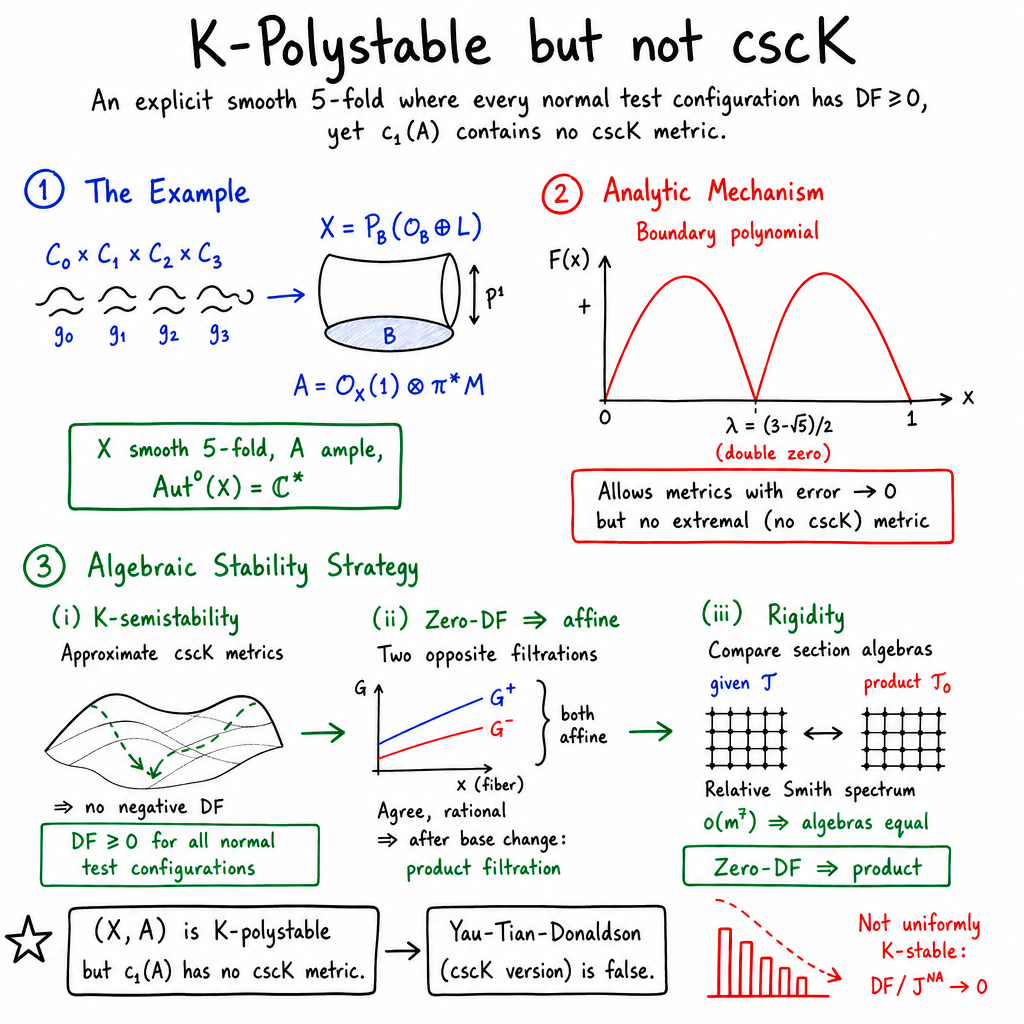
The paper claims to find an example that breaks the conjecture. It constructs a smooth, five-dimensional algebraic space that:
- passes every required K-stability test, but
- does not have a constant scalar curvature Kähler metric.
If the proof is correct, this would show that the original version of the Yau–Tian–Donaldson conjecture is false for general polarized varieties.
2. What questions are the researchers asking?
The main questions are:
- Can a space be K-polystable but still fail to have a cscK metric?
- Can the Yau–Tian–Donaldson conjecture fail outside the special Fano setting?
- What happens when a space is stable, but not “uniformly” stable?
- Can all possible algebraic degenerations with zero instability be completely understood?
The important distinction is between two kinds of stability:
- K-polystability: every allowed degeneration has a nonnegative score, and only obvious “product-like” degenerations have score zero.
- Uniform K-stability: there is also a definite positive gap. Every genuinely bad degeneration must have a noticeably positive score.
The example in the paper has the first property but not the second.
3. How did the researchers approach the problem?
The paper combines algebraic geometry, differential geometry, and calculations with polynomials.
Building the geometric example
The researchers begin with four complicated algebraic curves:
Their genera—their levels of topological complexity—are extremely large and different:
They form the product
This space has four dimensions. Over every point of , they attach a copy of a projective line, which can be thought of as a mathematically ideal version of a line with one extra point. The resulting space is
Since the base has four dimensions and each attached line adds one more, has five dimensions. The researchers also choose a special line bundle , which acts like a way of measuring the size of objects on . The pair is called a polarized fivefold.
The choices are carefully designed so that the only continuous symmetries of come from scaling the attached projective-line fibers. This symmetry is represented by the group .
Testing stability with degenerations
To test K-stability, the authors consider test configurations.
A test configuration is a controlled way of slowly deforming a geometric space into a possibly different space. An everyday analogy would be imagining a balloon changing shape over time and examining its shape at the final moment. In algebraic geometry, these changes are much more structured and can be measured precisely.
Each test configuration receives a number called the Donaldson–Futaki invariant, or $\DF$:
- $\DF>0$ means the degeneration does not reveal instability.
- $\DF<0$ means it detects instability.
- $\DF=0$ is the delicate borderline case.
The paper tries to prove that every relevant degeneration of has
$\DF\geq 0.$
It also studies the difficult equality case $\DF=0$, aiming to show that such a degeneration must really be a simple product coming from the known fiber-scaling symmetry.
Using a special polynomial
The geometry is summarized by a polynomial
where is a constant.
This polynomial is nonnegative between $0$ and $1$. It touches zero at the irrational number
The zero is repeated, meaning the graph touches the horizontal axis without crossing it. This special irrational point is central to the construction.
The authors use this polynomial in two ways:
- to show that there is no suitable extremal or constant-curvature metric;
- to understand why the stability score can get arbitrarily close to zero.
4. What are the main findings?
According to the paper, the constructed pair has the following properties.
It is smooth and polarized
The space is a smooth projective fivefold. This means it has no singular points, can be described using algebraic equations, and has five complex dimensions.
The line bundle is ample, which means it provides a sufficiently positive way to measure the geometry of .
It is K-polystable
The authors claim that for every normal ample test configuration, at every positive exponent,
$\DF\geq 0.$
They further claim that if
$\DF=0,$
then the degeneration is only a product configuration produced by fiber scaling and a simple scalar change. In other words, there are no hidden, genuinely new zero-score degenerations.
This is the hardest part of the claimed proof because K-polystability requires checking all normal test configurations, not just a convenient selection of them.
It has no extremal or cscK metric
The paper also claims that the polarization class contains:
- no extremal Kähler metric, and therefore
- no constant scalar curvature Kähler metric.
An extremal metric is a slightly more flexible type of special metric. A constant scalar curvature metric is a particularly important special case. Therefore, proving that no extremal metric exists is stronger than merely proving that no cscK metric exists.
It is not uniformly K-stable
The authors construct a sequence of test configurations based on ratios of Fibonacci numbers. These rational numbers approach the irrational number
For each configuration, the Donaldson–Futaki invariant is positive, but it becomes smaller and smaller:
$\DF_n>0,\qquad \DF_n\to 0.$
Thus, the space passes the ordinary K-polystability test, but there is no fixed positive safety margin. This shows that it is not uniformly K-polystable.
Why these findings matter
The paper claims to separate three ideas that had often been expected to be closely connected:
- algebraic K-polystability;
- uniform K-stability;
- existence of a cscK metric.
The example is said to be K-polystable but not uniformly K-stable and not cscK.
5. What could this research change?
If the argument is mathematically correct, it would have an important consequence:
The original Yau–Tian–Donaldson conjecture is not true for all smooth polarized projective varieties.
This would mean that passing all ordinary K-polystability tests is not enough to guarantee the existence of a constant-curvature metric.
The result would encourage mathematicians to use stronger conditions, such as:
- uniform K-stability, which requires a positive stability margin;
- completed or refined versions of K-stability;
- analytic conditions involving the energy of possible metrics.
However, the paper carefully says that this counterexample does not disprove all related results. In particular, it does not affect:
- the established Yau–Tian–Donaldson theorem for Fano varieties;
- stronger uniform-stability versions;
- newer “completed” stability theories.
In simple terms, the paper’s message is:
A geometric space can look stable under every ordinary yes-or-no test, yet still be too close to instability to support the special metric we want.
The supplied text also states that generative AI was used in producing the paper. That fact does not by itself establish whether the mathematics is correct; the claimed counterexample would still need careful checking by independent experts.
Knowledge Gaps
Knowledge gaps, limitations, and open questions
The paper establishes a highly specialized counterexample, but several mathematical, conceptual, and methodological issues remain unresolved:
- Independent verification of the central claims is still needed. The claimed K-polystability of the fivefold depends on a long classification of all normal ample test configurations, and the excerpt does not provide enough detail to independently assess whether the filtration, Smith-normal-form, descent, and rigidity arguments exclude every possible degeneration.
- The construction’s dependence on extremely large numerical parameters is unexplained. The paper does not determine whether the enormous genera and line-bundle degrees are close to minimal, whether substantially smaller examples exist, or which numerical constraints force their size.
- The existence of the four curves is nonconstructive over . The argument produces curves by choosing generic polynomials over finitely generated fields and embedding them into , but it does not give explicit complex equations for the curves or an effective procedure for verifying the required Jacobian orthogonality for concrete choices.
- The role of the pairwise Jacobian orthogonality condition is not quantified. It is used to obtain rigidity of automorphisms and section algebras, but the paper does not establish whether weaker hypotheses—such as weaker conditions on or groups—would suffice.
- It remains unclear whether the counterexample is isolated or belongs to a broader family. The paper does not characterize which choices of genera, degrees, or base varieties yield a positive boundary polynomial with an irrational interior double zero and the required equality classification.
- The nonexistence proof concerns extremal metrics through a limiting argument whose analytic hypotheses require further scrutiny. In particular, the excerpt does not fully explain the compactness, regularity, and convergence results needed to pass from approximate cscK metrics and nearby extremal metrics to the contradiction at the irrational zero.
- The relationship between the irrational boundary zero and non-finitely generated filtrations is not fully developed. The paper identifies rational Fibonacci approximations to the irrational crease, but it does not construct or analyze the corresponding limiting non-finitely generated filtration in a complete non-Archimedean framework.
- The precise analytic nature of the destabilizing irrational degeneration remains open. It is not established whether the limiting object can be represented by a geodesic ray, a finite-energy non-Archimedean metric, or another completed degeneration with a rigorously defined zero or negative invariant.
- The example is not uniformly relatively K-polystable, but the exact strongest stability property it satisfies is not determined. The paper shows positivity for each individual nonproduct test configuration and vanishing of a uniform quotient along a sequence, but does not locate the example within finer hierarchies such as reduced, filtrational, valuative, or completed stability conditions.
- The behavior under changes of polarization is unexplored. It is unknown whether has the same failure of cscK existence and K-polystability for all tensor powers in an analytically meaningful sense, or whether other polarizations on the same fivefold exhibit different stability behavior.
- The obstruction to cscK metrics is not shown to be deformation-stable. The paper does not investigate whether nearby polarized varieties or deformations of the curves and line bundles retain K-polystability without cscK metrics.
- The role of the nontrivial automorphism group remains a major limitation. Since , the example does not determine whether the original cscK Yau–Tian–Donaldson conjecture might hold for polarized varieties with finite or trivial automorphism group.
- The corresponding relative and extremal Yau–Tian–Donaldson statements are not fully separated. The paper proves absence of extremal metrics and failure of ordinary K-polystability equivalence, but it does not determine whether an appropriate relative or modified stability notion could correctly characterize extremal metrics for this example.
- It is not established whether a lower-dimensional smooth counterexample exists. The construction requires a fivefold with a four-dimensional product base; the paper leaves open whether the same phenomenon can occur for smooth polarized surfaces, threefolds, or fourfolds.
- The result does not address singular or log-polarized analogues beyond noting that Fano and uniform variants are unaffected. It remains unclear how the mechanism behaves for mildly singular varieties, log pairs, or other classes where the existing Yau–Tian–Donaldson theory is incomplete.
- The scope of the equality classification is convention-dependent. The classification is proved for normal ample test configurations and then extended to arbitrary ample configurations with a codimension-two normalization condition, but the relation to other notions of triviality—especially almost triviality and vanishing non-Archimedean norms—is not fully analyzed for this example.
- The scheme-theoretic extension does not resolve all possible nonnormal phenomena. Although the normalization is controlled in the zero-invariant case, the paper does not give a broader structural description of nonnormal central fibers or determine whether other nonnormal constructions could affect related stability notions.
- The K-polystability proof is not obviously robust under base change and normalization operations. The argument uses ramified base changes and descent, but the extent to which the Donaldson–Futaki invariant and equality characterization remain compatible with all relevant finite base changes is not systematically clarified.
- The claimed failure of the original conjecture depends on a specific definition of K-polystability. The paper does not compare in detail how the conclusion changes under alternative definitions involving special, ample, semiample, equivariant, filtrational, or completed test configurations.
- The implications for analytic existence theory are not fully articulated. The example demonstrates that ordinary algebraic K-polystability is insufficient for cscK existence, but it does not identify the precise analytic property—such as coercivity, properness, or uniform positivity—that fails and would be necessary in this setting.
- The generative-AI provenance introduces an unresolved reproducibility issue. Because the main result was reportedly obtained with generative AI systems, the paper would need unusually detailed human-verifiable derivations, computational records, and independently checkable proofs to establish that no hidden algebraic or analytic error entered the argument.
Practical Applications
Immediate Applications
- Revise mathematical criteria for cscK existence in algebraic geometry — academia. The central result provides a concrete warning that ordinary K-polystability, even when verified against all normal ample test configurations, is not sufficient for the existence of a constant-scalar-curvature Kähler metric in general polarized varieties. Researchers can therefore treat the implication
as unreliable outside settings covered by stronger hypotheses, such as Fano varieties or uniform/completed stability frameworks. Dependency: The result must withstand independent verification, especially because the supplied paper attributes substantial mathematical work to generative AI and contains apparent transcription and notation defects.
- Use stronger stability tests in computational classification workflows — algebraic geometry/software.
- the reduced or relative Donaldson–Futaki quotient;
- non-Archimedean -functionals;
- uniform K-stability thresholds;
- rational degenerations approximating irrational filtrations.
- The paper’s Fibonacci family illustrates why a positive invariant for every tested degeneration may coexist with an infimum of zero.
- Dependency: Effective algorithms for arbitrary test configurations and non-Archimedean functionals remain limited; the workflow is currently most realistic for highly structured varieties, such as toric or projective-bundle examples.
- Benchmark example for stability-analysis software — computational mathematics.
- ampleness of the polarization;
- Hilbert and weight polynomial calculations;
- Donaldson–Futaki invariant evaluation;
- detection of the irrational double zero
- comparison between K-polystability and uniform K-stability. Dependency: The numerical data and all geometric claims require reproducible machine-readable specifications and independent proof checking.
Improve peer-review and reproducibility procedures for AI-assisted mathematics — academia and research policy. The paper’s explicit disclosure of GPT-based and agent-based assistance can be used to motivate practical standards for AI-assisted research: archived prompts and outputs, formal proof verification, independently generated computations, provenance records, and clear allocation of human responsibility. Such procedures are immediately applicable to mathematical journals and research institutions. Dependency: AI-generated arguments must be checked by qualified mathematicians; language-model agreement or plausible symbolic output is not evidence of correctness.
Refine teaching materials on the Yau–Tian–Donaldson correspondence — education.
- K-semistability from K-polystability;
- K-polystability from uniform K-stability;
- ordinary, relative, and completed stability;
- algebraic test configurations from analytic metric existence.
- It can be incorporated into graduate courses and seminars to demonstrate why a conjectural equivalence may require quantitative hypotheses rather than merely nonnegative invariants.
- Dependency: The example should be presented as a claimed counterexample until the proof and publication status are independently established.
- Guide policy and funding priorities in pure mathematics — research policy. The findings support investment in the development of stronger algebraic and analytic stability theories—particularly uniform, reduced, and non-Archimedean criteria—rather than relying exclusively on ordinary K-polystability. This is an indirect policy application relevant to mathematical research programs, theorem-proving infrastructure, and formalization projects. Dependency: The policy implication concerns research direction rather than an operational public-sector intervention and depends on acceptance of the main theorem.
Long-Term Applications
- Develop a corrected existence criterion for canonical Kähler metrics — mathematics and geometric analysis. A major long-term use is to formulate and prove a replacement for the disproved equivalence. Candidate criteria may combine K-polystability with a positive uniform margin, coercivity/properness of the Mabuchi K-energy, or completed non-Archimedean stability. Such a theorem could provide a reliable decision framework for determining when a polarized variety admits a cscK metric. Dependencies: Further theory is needed to handle non-discrete automorphism groups, irrational filtrations, finite-energy completions, and the distinction between algebraic and transcendental degenerations.
- Create automated cscK feasibility pipelines for structured varieties — software and computational geometry.
A future tool could accept a polarized variety or projective bundle and perform the following workflow:
- calculate its Hilbert data and automorphism group;
- construct the relevant stability polynomial;
- search for rational destabilizing or near-destabilizing filtrations;
- estimate the reduced Donaldson–Futaki/ ratio;
- report whether ordinary stability is insufficient and whether a uniform gap is plausible. This could support research on moduli spaces and canonical metrics. Dependencies: The method will require scalable test-configuration search, exact arithmetic for large degree and genus data, and rigorous certification of numerical results.
Improve construction and classification of moduli spaces — algebraic geometry.
- algebraically K-polystable points;
- uniformly stable points;
- analytically metrizable points;
- boundary objects arising from irrational or non-finitely generated filtrations.
- Dependency: The precise effect on moduli functors depends on the chosen notion of stability and on whether a suitable replacement for the cscK locus can be shown to be algebraic or constructible.
- Study irrational degenerations and non-finitely generated filtrations — algebraic and non-Archimedean geometry. The Fibonacci approximations demonstrate a practical research direction: approximate an irrational crease by rational test configurations and analyze the asymptotic behavior of invariants. This may lead to tools for detecting instability that is invisible at any individual rational stage but appears in the limiting filtration. Dependencies: One needs a robust theory connecting rational test configurations, filtrations, non-Archimedean metrics, and analytic geodesic rays, together with control over limits and normalization.
- Extend counterexample searches to lower dimensions or finite automorphism groups — research program.
- threefolds or fourfolds;
- varieties with finite or trivial connected automorphism group;
- other projective bundles and admissible geometries;
- singular or logarithmic settings.
- Such extensions would determine whether the failure is caused by the presence of continuous automorphisms, high dimension, or the specific projective-bundle construction.
- Dependency: The equality classification for arbitrary test configurations is technically difficult and may not survive in lower-dimensional or less rigid examples.
- Inform numerical algorithms for canonical metrics — geometric analysis. Numerical schemes that search for cscK metrics using balanced embeddings, moment-map iterations, or energy minimization could incorporate a preliminary uniform-stability diagnostic. A variety that is K-polystable but has no cscK metric may cause apparent nonconvergence or extremely slow convergence; identifying a collapsing stability quotient could distinguish numerical failure from genuine nonexistence. Dependency: This requires a proven relationship between the discrete algorithm, the relevant coercivity functional, and the continuous metric problem. The paper itself does not provide a numerical algorithm or empirical validation.
- Support formal verification of advanced mathematical proofs — AI and theorem proving. Because the paper explicitly reports generative-AI involvement, it provides a possible benchmark for formalizing sophisticated arguments involving projective bundles, filtrations, Donaldson–Futaki invariants, and Kähler geometry. Long term, proof assistants could verify the algebraic computations and isolate precisely which steps require new human mathematical insight. Dependencies: Existing proof assistants do not yet provide routine libraries for all required areas of complex algebraic and differential geometry. Formalization would be substantial and cannot replace independent mathematical assessment of the claimed theorem.
Glossary
- Admissible metric: A Kähler metric constructed within a special geometric ansatz that permits explicit curvature calculations. “Smooth admissible metrics whose error in scalar curvature tends to zero”
- Algebraic one-parameter subgroup: An algebraic group homomorphism from the multiplicative group into an automorphism group. “an algebraic one-parameter subgroup of $\Aut(Y)$”
- Almost trivial test configuration: A test configuration whose normalization is a product, even if the original configuration is not itself a product. “Boucksom--Hisamoto--Jonsson later used almost trivial to mean that the normalization is trivial”
- Automorphism group: The group of algebraic or geometric self-isomorphisms of a variety or polarized variety. “the automorphism group of is infinite”
- Balanced embedding: An embedding associated with a projective embedding whose sections satisfy a moment-map balancing condition in geometric invariant theory. “His balanced-embedding theorem”
- Boundary polynomial: A polynomial encoding endpoint and curvature data that governs stability and metric behavior in an admissible construction. “compute its admissible boundary polynomial”
- Calabi program: The program seeking canonical Kähler metrics, particularly extremal and constant-scalar-curvature metrics, in prescribed Kähler classes. “Calabi's program asks for an extremal K\"ahler metric in a prescribed K\"ahler class”
- Central fiber: The fiber over the distinguished point $0$ in a test configuration, representing a degeneration of the original variety. “The algebraic weights on sections of the central fiber”
- cscK metric: A constant scalar curvature Kähler metric. “does not admit a constant scalar curvature K\"ahler metric”
- Degeneration: A family in which a geometric object specializes to a potentially different limiting object. “special degenerations of Fano manifolds”
- Donaldson--Futaki invariant: A numerical invariant of a test configuration used to assess the K-stability of a polarized variety. “every normal ample algebraic test configuration with generic polarized fiber has nonnegative Donaldson--Futaki invariant”
- Duistermaat--Heckman law: A measure describing the distribution of moment-map values, here associated with weights on the central fiber. “the standard central-weight Duistermaat--Heckman law”
- Endomorphism ring: The ring of self-morphisms of an algebraic or geometric object, with addition and composition as operations. “$\End_{\overline K}(J_f)=\mathbb Z$”
- Entry law: The probability measure obtained by normalizing the increasing filtration entries of a test configuration. “The probability measure obtained from the normalized increasing entries is called the entry law.”
- Equivariant openness: An openness principle asserting that geometric or metric properties persist under sufficiently small deformations compatible with a group action. “Circle invariance, equivariant openness, uniqueness, and naturality”
- Extremal Kähler metric: A Kähler metric whose scalar curvature satisfies a critical-point condition for the Calabi functional; cscK metrics are a special case. “does not admit any extremal K\"ahler metric”
- Fano manifold: A smooth projective variety whose anticanonical line bundle is ample. “For smooth Fano manifolds with the anticanonical polarization”
- Futaki character: A character on the Lie algebra of holomorphic vector fields that obstructs the existence of constant scalar curvature Kähler metrics. “the Futaki character of the fourfold constructed in”
- Geometric invariant theory (GIT): An algebraic framework for constructing quotients and analyzing stability under group actions. “a finite-dimensional consequence in geometric invariant theory (GIT)”
- Hilbert--Mumford viewpoint: A method for testing GIT stability using one-parameter subgroups and associated numerical weights. “developed the slope and Hilbert--Mumford viewpoints”
- Hilbert coefficients: Coefficients in the asymptotic polynomial expansions of dimensions of spaces of sections and associated weight sums. “Finally, set ... ”
- Hyperelliptic Jacobian: The principally polarized abelian variety associated with a hyperelliptic curve. “Hyperelliptic Jacobians”
- Initial filtration: A filtration induced by taking leading or initial terms with respect to a specified degeneration or direction. “the two opposite initial filtrations”
- Kähler class: A cohomology class represented by a Kähler form, equivalently specifying the symplectic and metric polarization data. “an extremal K\"ahler metric in a prescribed K\"ahler class”
- K-polystability: A stability condition requiring nonnegative Donaldson--Futaki invariants, with equality only for product test configurations. “It is K-polystable if, in addition, equality occurs only for polarized product test configurations.”
- K-semistability: The condition that every relevant test configuration has nonnegative Donaldson--Futaki invariant. “A polarized projective variety is K-semistable”
- K-stability: A strengthened stability condition in which the Donaldson--Futaki invariant is positive for every nontrivial test configuration. “Stoppa proved K-stability when the automorphism group is discrete”
- K-energy: An energy functional on the space of Kähler metrics whose critical points are constant scalar curvature Kähler metrics. “The K-energy of Mabuchi”
- KLT (Kawamata log terminal): A class of mild singularities in algebraic geometry defined using positivity conditions on discrepancies. “the smooth/klt category”
- Log canonical: A singularity condition weaker than Kawamata log terminal, characterized by nonnegative discrepancies. “but log canonical”
- Log discrepancy: A numerical measure of the singularity of a variety or pair along a valuation. “the model criterion in ... defined by log discrepancies”
- Moment map: A map encoding the infinitesimal action of a symmetry group on a symplectic or Kähler manifold. “the moment-map interpretation of scalar curvature”
- Non-Archimedean: Relating to algebraic or valuation-theoretic analogues of analytic geometry over fields with non-Archimedean absolute values. “The non-Archimedean slope formalism”
- Polarized variety: A projective variety equipped with an ample line bundle. “Let be a smooth polarized projective complex variety.”
- Projective bundle: The variety parametrizing one-dimensional quotients of the fibers of a vector bundle. “the projectivization of a rank-two vector bundle”
- Ramified base change: A finite change of the parameter in a family that may have nontrivial ramification, often used to clear rational weights. “After a ramified base change clears the denominators”
- Reductive group: An algebraic group whose representations have strong decomposability properties and whose unipotent radical is trivial. “for every reductive subgroup $G\subset\Aut(Y,H)$”
- Relative K-stability: A stability notion modified to account for continuous automorphisms, usually by subtracting contributions from a symmetry group. “Sz\"ekelyhidi introduced relative K-stability”
- Ruled surface: A surface fibered over a curve with fibers isomorphic to . “the ruled-surface work of T\o nnesen-Friedman”
- Scalar character: A one-dimensional representation of a group, contributing a uniform weight to sections. “together with a scalar character on the polarization”
- Sem i-abelian variety: An algebraic group formed as an extension of an abelian variety by an algebraic torus. “ and be semi-abelian varieties over ”
- Slope degeneration: A degeneration constructed by blowing up or modifying a subvariety and used to test stability numerically. “their Ross--Thomas slope degenerations”
- Test configuration: An equivariant one-parameter degeneration of a polarized variety used to define K-stability. “A test configuration of exponent for ”
- Uniform K-stability: A quantitative strengthening of K-stability requiring the Donaldson--Futaki invariant to dominate a norm of the test configuration. “uniform K-stability is necessary”
- Valuative criterion: A stability test expressed in terms of valuations, discrepancies, and numerical invariants rather than all families explicitly. “valuative criteria”
- Very ample: A line bundle whose complete linear system gives a closed embedding into projective space. “Thus separates points and tangent vectors on , so it is very ample.”
- Zero-invariant configuration: A test configuration whose Donaldson--Futaki invariant is zero. “Zero-invariant test configurations are products”

