On the Fragility of Self-Improving Agents: Variance, Task Order, and Underspecification
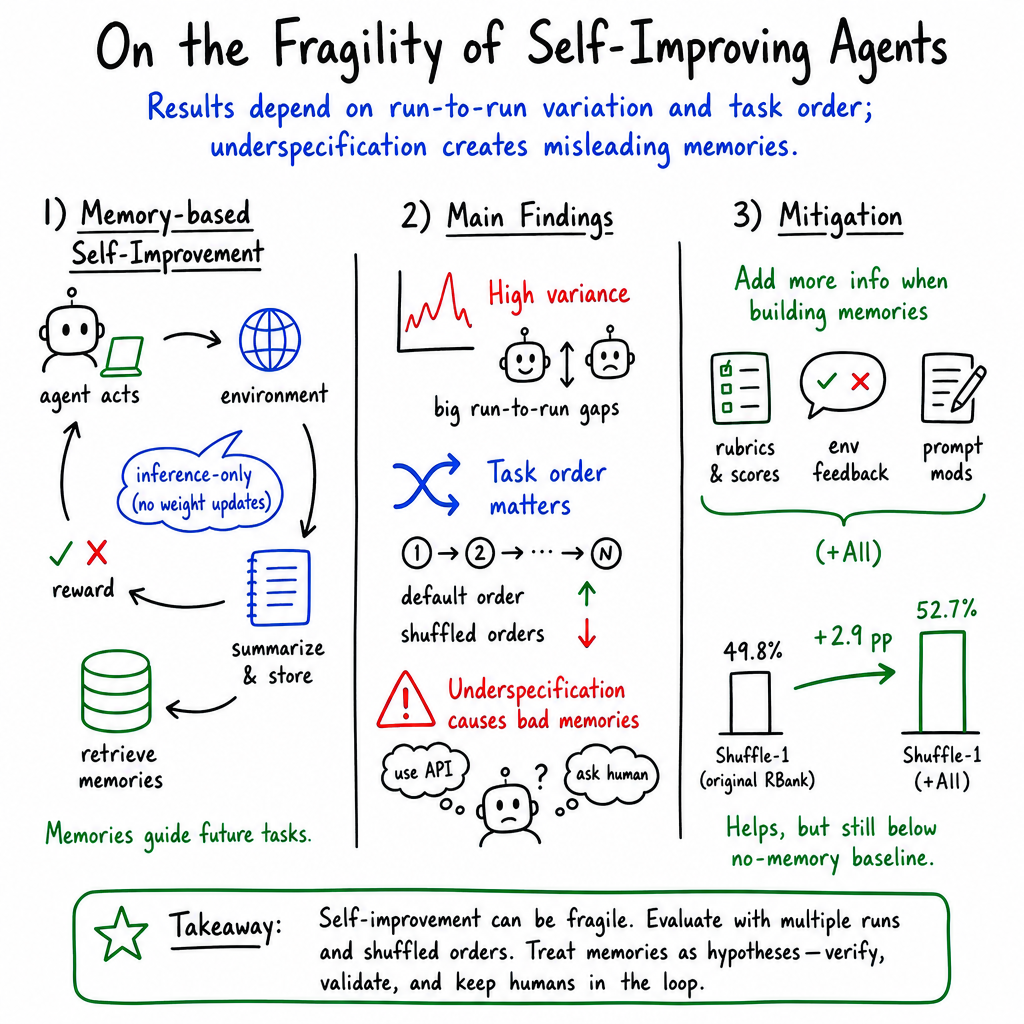
Abstract: Memory-based self-improving agents--those that learn from an online stream of tasks and improve over time by maintaining a textual memory bank--have shown great promise in recent literature. However, the reliability aspects of these methods have been critically overlooked. In this work, we conduct a comprehensive re-evaluation of two memory-based methods, broadening the scope of evaluation along two axes: (1) including multiple runs to quantify variance, and (2) randomly shuffling the tasks to investigate the effect of task order. Through these experiments, we make two observations that expose the fragility of current methods: First, agent evaluation is inherently noisy in complex environments and on multi-step tasks, and stacking a self-improving loop on top can further amplify this noise. Second, the agent's improvement is highly dependent on task order. Prior works often adopt default orderings that impose an implicit curriculum, acting as a hidden prerequisite for success. To better understand this fragility, we manually examine the agents' memory and hypothesize that task and environment underspecification contribute to this fragility. We validate this hypothesis by incorporating information that enables better specification, such as detailed rubrics and environment feedback, into the memory construction process. While this added information partially closes the performance degradation in previous experiments, significant gaps still remain, suggesting that other uncharacterized factors contribute to this fragility. Looking ahead, our work advocates for more rigorous evaluation protocols for self-improving agents by reporting results across multiple runs and stress-testing them under challenging conditions. Moreover, our findings on underspecification call for systems and interfaces that enable effective human oversight, preventing agents from failing in unforeseeable ways.
Paper Prompts
Sign up for free to create and run prompts on this paper.
Top Community Prompts
Explain it Like I'm 14
论文主题概述
这篇论文研究的是一种能够“边工作边学习”的人工智能代理,尤其是能够操作网页的 AI。
这些 AI 会把过去任务中的经验写成文字,保存到一个“记忆库”里。以后遇到类似任务时,它们会查看这些记忆,希望做得更好。
论文的核心问题是:这种自我改进真的可靠吗?还是它有时会因为记错、运气或任务顺序而变差?
研究者发现,这些系统比想象中更脆弱。它们有时会变好,但也可能学到错误经验,导致之后的表现下降。
研究者想回答什么问题?
研究主要关注以下几个问题:
- 同样的实验重复进行时,结果会不会差很多? 例如,同一个 AI 做同一组任务三次,成功率是否每次都一样?
- 任务的顺序会不会影响 AI 的学习效果? 如果 AI 先做简单任务、再做困难任务,是否更容易进步?如果把任务顺序完全打乱,会发生什么?
- AI 保存的记忆是否真的有用? AI 会不会保存一些看起来合理、但在当前环境中根本无法使用的建议?
- 给 AI 更多清楚的信息,能不能减少这些问题? 例如告诉它评分规则、网页环境的限制,以及哪些操作是不允许的。
研究方法:他们是怎么研究的?
测试对象
研究者测试了两种记忆型自我改进方法:
- AWM:把成功完成任务的步骤总结成可重复使用的“工作流程”。
- ReasoningBank:保存更一般的思考过程和经验,包括成功和失败时得到的教训。
可以把它们想象成两种学习笔记:
- AWM 像是“做这道题的具体步骤”。
- ReasoningBank 像是“做这类题时应该注意什么”。
测试环境
研究者让 AI 完成三个网页操作测试集中的任务:
- WebArena:在购物网站、GitLab、Reddit 和地图等网站上完成任务。
- VisualWebArena:除了文字,还需要理解网页上的图片和视觉元素。
- SCUBA:模拟企业工作,例如销售、客服和管理员操作。
这些任务可能包括搜索商品、填写表格、管理网页账户或寻找地图信息。
重复实验
过去很多研究只运行一次实验,然后报告一个成功率。论文作者认为,这就像只让一个学生参加一次考试,然后用这一次成绩判断他的真实水平。
因此,他们对每种设置运行了 三次,并比较:
- 平均成功率;
- 三次结果的差异;
- 最好的一次和最差的一次之间相差多少。
打乱任务顺序
研究者还比较了两种情况:
- 按照原来的顺序完成任务;
- 把任务随机打乱后再完成。
这就像学习数学时,先学简单加法再学复杂方程,和把所有题目随机混在一起。顺序可能会影响学习效果。
检查 AI 的记忆
研究者还人工阅读 AI 保存的记忆,寻找它为什么会犯错。
他们发现,有些记忆虽然听起来合理,但不适合当前环境。例如,AI 建议使用网页环境不支持的 API,就像老师要求你只能用纸笔答题,而你的笔记却建议“打开计算器程序”。
之后,研究者给 AI 增加了更多信息,包括:
- 更详细的评分标准;
- 网页环境返回的错误信息;
- 明确说明不能使用 API、外部网站或等待人工确认。
主要发现
1. AI 的表现有明显波动
即使使用完全相同的设置,AI 每次运行的结果也可能不同。
在 WebArena 的 GitLab 任务中:
- 没有记忆的普通 AI,最好和最差运行结果相差约 4.4 个百分点;
- 使用 ReasoningBank 后,最好和最差运行结果相差约 7.8 个百分点。
在某些任务类别中,差距甚至超过 10 个百分点。
这说明一次实验的结果可能只是运气好或运气不好。只看一次运行,容易得出错误结论。
2. 自我改进有时会放大不稳定性
在 24 个比较案例中,有 17 个案例在加入记忆型自我改进后,结果波动变大,约占 71%。
原因可能是:AI 很早犯下的一个小错误,会被写进记忆库。之后它在许多任务中反复使用这个错误经验,就像一个学生把错误公式写进笔记,并在后面的每道题中继续使用。
因此,不同运行中最开始出现的随机差异,可能会随着时间不断扩大。
3. 任务顺序非常重要
按照原来的任务顺序时,ReasoningBank 的平均表现提高了约 1.5%。
但是,当任务顺序被随机打乱后,表现反而下降了约 4.5%。
这说明原来的任务顺序可能已经偷偷形成了一个“从简单到困难”的学习课程。AI 先完成简单任务,再把经验用于困难任务,所以看起来像是在进步。
但现实世界中,用户不会总是按照简单到困难的顺序提问。一个真正可靠的 AI 必须能够应对任意顺序的任务。
4. 当基础 AI 已经很强时,记忆的帮助很小
这项研究使用了更强的新模型作为起点。结果发现:
| 方法 | WebArena | VisualWebArena | SCUBA |
|---|---|---|---|
| 没有记忆的基础 AI | 54.8% | 54.9% | 49.6% |
| AWM | 54.1% | 54.5% | 50.1% |
| ReasoningBank | 56.3% | 55.6% | 51.1% |
AWM 在两个测试中甚至略微降低了表现。ReasoningBank 虽然有所提高,但提高幅度通常只有约 1 个百分点左右,并不稳定。
这说明一种方法在较弱的 AI 上有效,并不代表它在更强的 AI 上仍然有效。
5. AI 会学到“看似正确、实际无用”的记忆
研究者发现了几种问题。
错误的环境假设
AI 有时会建议使用 API,但测试环境只能通过网页点击和输入文字,不能运行 API。
不被环境支持的行为
AI 经常记住“请求用户确认”。现实中这可能是好习惯,但测试环境没有真正的用户可以回答。因此 AI 可能不断等待,最后任务超时。
模糊任务导致错误理解
有些任务的说明不够清楚。例如,让 AI 找到可以缓解“磨牙问题”的商品。正确目标是寻找牙套,但 AI 可能误以为自己要提供医疗建议,于是回答“请咨询医生”。
然后,AI 还可能把这种误解写入记忆,影响后面的任务。
偶然成功的错误策略
在地图任务中,网页有时加载失败。AI 于是使用一个叫“哈弗辛公式”的数学方法估算两地距离。这个方法偶尔能得到正确答案,所以 AI 把它保存下来。
问题是,之后它可能在不适合的时候也使用这个公式。这就像一次猜答案碰巧答对了,学生却把“乱猜”记成了可靠解题方法。
6. 提供更多信息能改善表现,但不能完全解决问题
研究者尝试给 AI 更详细的说明:
- 告诉它真正的评分规则;
- 告诉它网页操作是否成功以及哪里报错;
- 明确限制只能使用浏览器操作;
- 指导它记住有用的网页操作步骤。
把这些信息全部加入后,在一种随机任务顺序下,ReasoningBank 的成绩从 49.8% 提高到 52.7%,提高了 2.9 个百分点。
这些措施减少了之前约 31% 的性能下降。不过,AI 的表现仍然比没有记忆的基础 AI 差,说明还有其他没有发现的问题。
为什么这些结果重要?
这篇论文提醒我们,AI 的“自我学习”并不等于真正可靠的学习。
如果研究者只进行一次实验,可能会误以为某个方法非常有效。实际上,结果可能受到随机性影响。
同时,如果测试任务按照特别有利的顺序排列,AI 可能看起来进步很快。但一旦任务顺序改变,它就可能表现变差。
更危险的是,AI 保存的记忆不一定是真正正确的知识。它们可能只是对某次失败、网页故障或模糊指令的错误解释。错误记忆还可能影响许多未来任务。
研究的影响和未来意义
这项研究并不是说自我改进的 AI 没有用,而是说明在真正部署之前必须更加小心。
研究者建议:
- 同一个实验要运行多次,而不是只运行一次;
- 使用随机任务顺序测试 AI;
- 同时测试清楚的任务和模糊、困难的任务;
- 检查 AI 保存的记忆是否真的正确;
- 让人类能够查看、修改或删除错误记忆。
未来的自我改进 AI 应该像一个会主动整理笔记、但还需要老师检查的学生。它可以自己总结经验,但不能自动相信每一条经验都正确。
总的来说,这篇论文的主要信息是:AI 不仅要变得更聪明,还要变得更稳定、更容易检查。只有这样,我们才能放心让它处理现实生活中的重要工作。
Knowledge Gaps
The paper leaves the following knowledge gaps, limitations, and open questions unresolved:
- Limited number of self-improvement methods: The evaluation covers only AWM and ReasoningBank, so it remains unclear whether the observed fragility generalizes to other textual-memory, skill-learning, parametric-memory, or hybrid self-improvement methods.
- Restricted domain coverage: Experiments focus exclusively on web-browsing and CRM-style environments; the effects of run variance, task order, and memory contamination in coding, computer-use, mathematical reasoning, customer service, or physical-agent settings remain unknown.
- Dependence on a single model generation: The main experiments use GPT-5-mini for both task execution and memory construction, leaving unresolved whether the findings depend on this model’s capabilities, calibration, sampling behavior, or instruction-following tendencies.
- Insufficient replication across models: The paper does not systematically test different backbone models or memory-construction models, making it difficult to separate method-specific fragility from model-specific behavior.
- Very small number of repeated runs: Most variance estimates are based on only three runs per condition. More repetitions are needed to obtain reliable confidence intervals, characterize tail risks, and determine whether reported best–worst gaps are stable.
- Limited exploration of task-order distributions: Only the default order and two shuffled orders are tested. The effects of fully randomized orders, adversarial orders, difficulty-balanced orders, domain-interleaved orders, and naturally occurring user-request distributions remain unmeasured.
- No formal causal analysis of task order: The study demonstrates performance changes under different orderings but does not isolate the mechanisms involved, such as early-task difficulty, domain clustering, memory age, retrieval frequency, or error accumulation.
- Unclear distinction between order effects and task-composition effects: The shuffled experiments may alter the temporal distribution of task types and difficulties. The paper does not fully disentangle pure ordering effects from changes in the sequence of domains, subtasks, or dependencies.
- No evaluation of longer task streams: The benchmarks contain finite task sets, and the study does not establish how memory quality, variance, or performance evolve over substantially longer horizons.
- Unresolved memory scalability problem: The work does not determine how memory size, retrieval frequency, context-window pressure, duplication, and obsolete memories affect performance as the task stream grows.
- No systematic measurement of memory quality: Memories are inspected manually and through keyword examples, but there is no validated metric for correctness, applicability, usefulness, redundancy, harmfulness, or long-term impact.
- Manual failure analysis is not quantified: The claims about API suggestions, user-confirmation requests, Haversine strategies, and irrelevant reflections are illustrative, but their prevalence, statistical reliability, and causal contribution to failures are not systematically measured.
- Underspecification is not operationally defined: The paper identifies task and environment underspecification but does not provide a formal taxonomy or measurable criterion for determining when a task, rubric, interface, or environment is sufficiently specified.
- Causal role of underspecification remains uncertain: Additional specifications improve performance, but the experiments do not establish how much of the observed fragility is caused by underspecification versus retrieval errors, model hallucination, evaluator noise, action failures, or prompt interactions.
- Incomplete ablation of proposed mitigations: The interventions combine multiple changes to memory construction, and the paper provides limited analysis of interactions among rubrics, environment feedback, and prompt modification. A fully controlled factorial ablation is needed.
- Potential leakage from evaluation information: Providing ground-truth rubrics and scores during memory construction may give the memory module information unavailable to the acting agent in deployment, raising questions about ecological validity and fairness of the comparison.
- Ground-truth rewards may overstate practical performance: The experiments deliberately provide exact rewards rather than noisy LLM-judge rewards, so the robustness of the methods under realistic, imperfect, delayed, or ambiguous feedback remains unresolved.
- Evaluator errors are observed but not systematically corrected: The paper reports false negatives and evaluator bugs but does not quantify their frequency, assess their effect on memory formation, or evaluate robust alternatives to benchmark evaluation.
- No protection against harmful memory propagation: The paper identifies “contagious” erroneous memories but does not test concrete validation mechanisms such as confidence estimation, evidence requirements, cross-task verification, expiration, contradiction detection, or human approval.
- No analysis of recovery after contamination: It remains unknown whether agents can detect and remove a harmful memory once it has influenced later tasks, or how many subsequent tasks are affected by a single erroneous memory.
- Temporal credit assignment is unexplored: The study does not determine how far downstream an early failure or incorrect memory affects performance, nor how memory systems should assign credit or blame across a sequence of tasks.
- No investigation of selective memory updating: The methods appear to update memory after tasks according to fixed procedures, but the benefits of updating only under high-confidence success, repeated evidence, novelty, or verified transfer are not evaluated.
- Human oversight is proposed but not tested: The paper recommends intervention interfaces without measuring whether humans can identify problematic memories, how quickly they can correct them, or whether oversight introduces unacceptable cost and latency.
- Deployment realism is limited: The benchmark setting assumes a controlled task stream and known environment feedback. Real deployments may involve changing websites, partial observability, authentication constraints, user interruptions, irreversible actions, and nonstationary objectives.
- Robustness to environment changes is unknown: The study does not test whether memories become harmful when websites, APIs, layouts, interaction affordances, or task policies change over time.
- Safety and risk are not evaluated beyond pass rate: Binary task success does not capture partial completion, unsafe actions, privacy violations, unnecessary external effects, user-trust loss, or the severity and reversibility of failures.
- Statistical conclusions are underpowered: The reported significance test uses only three runs and an unpaired t-test, which may be inappropriate for paired task sequences and unreliable for estimating small performance differences.
- Generalization beyond benchmark tasks is unverified: It remains unclear whether the observed degradation reflects properties of real user workflows or artifacts of WebArena, VisualWebArena, and SCUBA task construction and evaluation.
- Interactions with task ambiguity are underexplored: The study presents ambiguous examples but does not quantify how ambiguity level, alternative interpretations, or the availability of clarification affect memory usefulness and downstream performance.
- No comparison with non-memory adaptation baselines: The paper does not compare these methods with simpler alternatives such as task-order randomization without memory, retrieval-free reflection, explicit workflow libraries, fine-tuning, or external tool documentation.
- Trade-offs between improvement and stability are not characterized: The study reports increased variance and occasional gains but does not identify operating points that optimize both average performance and reliability, or quantify the cost of suppressing exploratory memory formation.
- The source of the remaining 69% performance gap is unidentified: After adding rubrics, environment feedback, and prompt constraints, most of the shuffled-order degradation persists; the responsible factors—retrieval failures, memory conflicts, exploration strategy, model planning, or benchmark structure—remain to be isolated.
Practical Applications
Immediate Applications
The paper’s findings support immediate use primarily as evaluation, monitoring, and governance practices, rather than as evidence that memory-based self-improving agents are ready for unsupervised deployment.
- Multi-run evaluation for AI-agent benchmarking — Academia and industry
- Replace single-run pass rates with results from multiple independent runs, reporting the mean, standard deviation, confidence intervals, and best–worst gap.
- Apply this workflow to web agents, coding agents, customer-service systems, CRM automation, and tool-using assistants.
- This is directly justified by the finding that self-improvement increased variance in 71% of evaluated cases, with best–worst gaps reaching approximately 10 percentage points.
- Dependencies: Sufficient compute and evaluation budget; fixed model versions, prompts, environments, and seeds; enough repeated runs for statistically meaningful estimates.
- Randomized task-order stress testing — Software engineering and AI safety
- Evaluate continual-learning agents under default, random, adversarial, and difficulty-balanced task sequences before deployment.
- A practical benchmark harness could automatically generate several task permutations and compare performance degradation relative to the baseline agent.
- This would reveal whether an apparent improvement depends on an accidental easy-to-hard curriculum. In the paper, performance changed from a reported improvement under the default order to degradation under shuffled orders.
- Dependencies: Representative task distributions and stable task identifiers; randomized orders must preserve task validity and avoid introducing confounding changes.
- Regression testing for agent memory — Enterprise software and research laboratories
- Treat each newly created memory or workflow as a potential software change. After memory updates, rerun a fixed regression suite to detect whether previously solved tasks fail.
- This can be implemented as a CI/CD-style workflow: execute tasks, update memory in a sandbox, rerun historical tasks, and approve or reject the memory update.
- It is particularly relevant to browser agents performing CRM administration, sales operations, service workflows, or internal web applications.
- Dependencies: Deterministic or sufficiently stable test environments; reliable task evaluators; mechanisms for versioning, rollback, and isolating memories.
- Explicit environment specifications in memory-generation prompts — Software and enterprise automation
- Include constraints such as “browser-only,” “no API access,” “no external websites,” “no code execution,” and “human confirmation is unavailable” when constructing memories.
- Memory-generation templates should distinguish supported actions from plausible but impossible actions. This directly addresses the paper’s examples of memories recommending APIs or waiting for user confirmation in environments that do not support them.
- Potential tool: A structured memory-construction form containing environment capabilities, prohibited actions, available tools, and navigation rules.
- Dependencies: Accurate and continuously updated environment metadata; prompt-level restrictions must be reinforced by runtime tool permissions.
- Use evaluator feedback and action errors to construct memories — Agent development
- Feed post-task rubrics, scores, failed assertions, action errors, and final-state information into the memory-construction process.
- For example, a failed
input_textaction should be recorded as a UI-state dependency rather than summarized merely as a generic workflow failure. - The paper reports that combining rubrics, environment feedback, and prompt modifications improved performance by 2.9 percentage points in one shuffled setting and partially reduced task-order degradation.
- Dependencies: Trustworthy evaluators and environment logs; feedback should be correctly attributed to the agent’s behavior rather than to benchmark or website defects.
- Human review queues for newly generated memories — Industry and operational governance
- Route memories with high-risk characteristics—such as unsupported tools, medical advice, external actions, or repeated failure patterns—to a human reviewer before they become globally retrievable.
- Reviewers could approve, edit, annotate, quarantine, or delete memories through a memory-management dashboard.
- This is an immediate mitigation for the paper’s observation that memories can behave as “contagious” errors, becoming increasingly influential after early stochastic introduction.
- Dependencies: Human review capacity, clear approval policies, access controls, and an audit trail showing which tasks used each memory.
- Memory versioning, rollback, and provenance tracking — Enterprise AI platforms
- Store the origin task, reward, evaluator result, environment state, creation prompt, model version, and subsequent usage history for every memory.
- If performance declines after a memory update, operators should be able to identify the responsible item and restore an earlier memory-bank version.
- Potential product: A Git-like memory registry with branching, validation, ownership, expiration dates, and rollback.
- Dependencies: Persistent logging, privacy-compliant storage, and a memory architecture that supports selective deletion or revision.
- Conservative deployment of self-improvement in low-stakes workflows — Daily life and productivity software
- Use memory-based agents for reversible tasks such as organizing personal notes, drafting browser-navigation instructions, or recommending workflow shortcuts, while requiring confirmation for purchases, account changes, or communications.
- Users should be shown which memories influenced an action and be able to correct them.
- Dependencies: Reversibility, user consent, protection of personal data, and avoidance of high-stakes decisions such as medical, legal, or financial actions.
- Benchmark curation and task-specification audits — Academia and policy
- Audit benchmark instructions for ambiguity, evaluator bugs, unsupported assumptions, and mismatches between intended and measured behavior.
- Begin with well-specified tasks, then separately report results on underspecified or ambiguous tasks rather than mixing the two.
- This follows the paper’s examples in which ambiguous prompts and evaluator errors produced irrelevant reflections and misleading memories.
- Dependencies: Expert annotation, transparent evaluator definitions, and ongoing maintenance as websites and interfaces change.
Long-Term Applications
The paper suggests several longer-term opportunities, but these require further validation because the current methods remained fragile even after specification improvements.
- Reliable self-improving enterprise agents — CRM, customer service, and business operations
- A mature system could learn reusable workflows for sales representatives, service agents, administrators, and other enterprise users while remaining robust to arbitrary request order.
- Such an agent might maintain separate memories by role, application, permissions, and environment, validating each workflow before reuse.
- Required development: Memory validation, task-order-invariant learning, distribution-shift testing, and safeguards against cascading errors.
- Dependencies: Stable APIs or interfaces, high-quality enterprise logs, privacy controls, and performance guarantees substantially stronger than the roughly 50–56% benchmark success rates reported here.
- Validated skill libraries and reusable workflow marketplaces — Software and automation
- Generated memories could evolve into portable “skills” for browser automation, coding, data entry, or business-process automation.
- Before publication or deployment, each skill would need executable tests, environment compatibility checks, provenance metadata, and safety review.
- Required development: Formal or semi-formal workflow representations, compatibility checking, sandbox execution, and automated counterexample generation.
- Dependencies: Standardized tool schemas and sufficiently consistent interfaces across websites and applications.
- Adaptive curriculum managers that are robust to arbitrary task streams — Academia and education
- Future agents could learn from mixed-difficulty tasks without relying on an accidental easy-to-hard ordering.
- In education, a tutoring or practice agent could use validated learning strategies while monitoring whether early examples bias later recommendations.
- Required development: Curriculum-aware memory retrieval, difficulty estimation, balanced sampling, and experiments beyond web browsing.
- Dependencies: Reliable measures of task difficulty and learning outcomes; educational deployment would also require pedagogical validation and protection against reinforcing incorrect explanations.
- Human–agent oversight interfaces for real-time intervention — Industry, public services, and daily life
- Operators could inspect the agent’s current memories, see why a memory was retrieved, preview the next action, and intervene before an irreversible operation.
- A useful interface might expose confidence, environmental assumptions, conflicting memories, and the expected effect of deleting or editing a memory.
- Required development: Interpretable memory retrieval, risk-aware action previews, interruption protocols, and usable human-computer interaction designs.
- Dependencies: Low enough interaction cost for practical use; accurate risk estimates; clear assignment of responsibility between users, operators, and vendors.
- Memory validators based on execution and counterfactual testing — AI safety and software verification
- A memory should be accepted only after it succeeds across multiple related tasks, environments, and task orders, rather than being inferred from one successful trajectory.
- Validators could test whether a proposed workflow depends on unsupported APIs, a specific page layout, an accidental website behavior, or an evaluator artifact.
- Required development: Automated test generation, counterfactual environments, causal attribution of success, and robust success criteria.
- Dependencies: Access to realistic simulators or sandboxes and evaluators that distinguish genuine task completion from accidental correctness.
- Reliability standards and procurement requirements for agentic AI — Policy and regulation
- Organizations and regulators could require vendors to disclose multi-run variance, task-order sensitivity, memory-update policies, rollback procedures, human-override mechanisms, and worst-case performance.
- Procurement specifications could prohibit deployment when self-improvement causes statistically significant regression or when memory provenance cannot be audited.
- Required development: Sector-specific reliability thresholds, standardized reporting formats, and independent evaluation laboratories.
- Dependencies: Agreement on definitions of reliability, reproducible benchmarks, and adaptation to domain-specific risks; thresholds should be stricter for healthcare, finance, public benefits, and infrastructure.
- High-stakes applications in healthcare, finance, and public administration — Long-term only
- A validated self-improving agent could eventually assist with clinical portal navigation, financial operations, benefits administration, or regulatory workflows.
- However, the paper does not establish readiness for these uses. Ambiguous instructions, incorrect memories, unsupported actions, and silent performance degradation could produce serious harm.
- Required development: Domain-expert oversight, certified environments, traceable decisions, formal access controls, extensive red-team testing, and fail-safe human approval.
- Dependencies: Legal compliance, privacy and security protections, domain-specific validation, and demonstrated robustness under task-order changes and underspecified requests.
- General-purpose continual-learning agents beyond web browsing — Robotics, coding, and tool use
- The evaluation methodology could be extended to robots, autonomous coding systems, laboratory agents, and multimodal computer-use systems.
- A long-term agent might accumulate skills across changing environments while recognizing when an old strategy is invalid in a new one.
- Required development: Grounded memory representations, environment-change detection, uncertainty estimation, safe exploration, and cross-domain transfer studies.
- Dependencies: The paper evaluates only textual memory in web-browsing settings; transfer to physical or high-impact environments cannot be assumed without dedicated experiments.

