FreeToken: Efficient Edge-Native MoE Serving with Bandwidth-Adaptive Execution
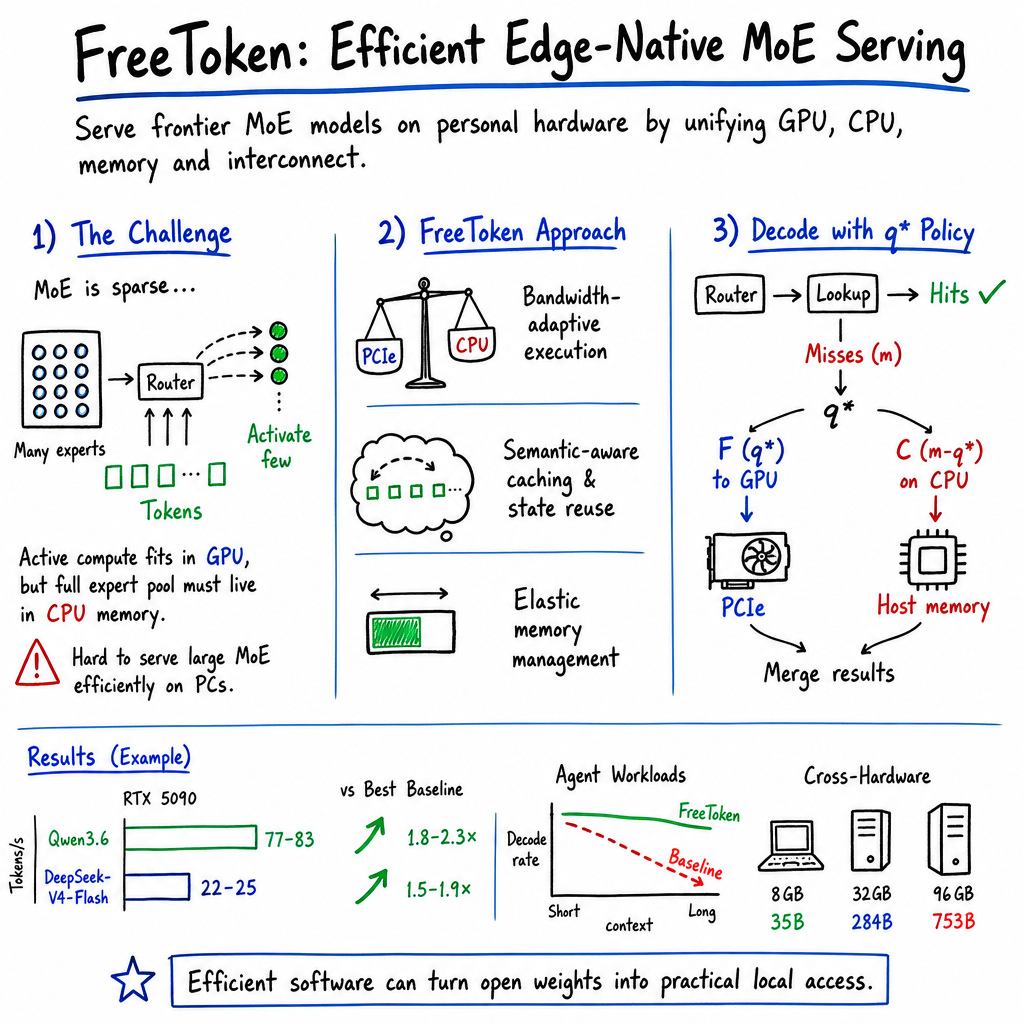
Abstract: Frontier open-weight models are increasingly available, but serving them still largely assumes datacenter infrastructure. We present FreeToken, an edge-native MoE serving system that treats a personal machine not as a small GPU, but as a unified, elastic inference platform. FreeToken co-designs the full serving stack, including model layout and loading, expert residency, CPU--GPU execution, agentic state reuse, and runtime memory management, around two realities of local AI: agent workloads continuously change their execution pattern, and edge hardware exposes heterogeneous resources whose balance differs from machine to machine. Rather than committing to a fixed offloading strategy, FreeToken continuously maps computation and model state onto the resources actually available. FreeToken supports more than 20 MoE models and real coding and tool-using agents across hardware ranging from an 8GB laptop GPU to a single workstation GPU. More importantly, it changes what these machines can practically serve, from a 35B model on a laptop to a 284B model on a gaming desktop and the 753B GLM-5.2 on a single workstation GPU. FreeToken turns open weights into deployable local software, making the machines users already own a practical platform for frontier-scale intelligence. We release the system at flashml.ai.
Paper Prompts
Sign up for free to create and run prompts on this paper.
Top Community Prompts
Explain it Like I'm 14
1. What is the paper about?
The paper introduces FreeToken, a system for running very large AI LLMs on personal computers instead of expensive data-center servers.
Many modern models use a design called a Mixture of Experts (MoE). These models contain many smaller parts, called experts, but use only a few experts for each word or token they produce. This saves computing power, but the complete model may still be too large to fit in a computer’s graphics memory.
FreeToken tries to solve this problem by using all the resources in a personal computer together:
- the GPU for fast calculations,
- the CPU for additional calculations,
- the computer’s main memory for storing model parts, and
- the connection between the CPU and GPU for moving data.
The main idea is to make large models usable on ordinary laptops, gaming computers, and single-GPU workstations.
2. What questions does the research ask?
The researchers are mainly asking:
- Can very large MoE models run at useful speeds on personal computers?
- How can the system quickly move the needed experts between computer memory and GPU memory?
- How can it avoid repeating work when an AI agent changes or reuses part of a conversation?
- How should the system decide whether the CPU or GPU should handle a model expert?
- Can one system adjust itself to different computers and changing available memory?
These questions matter because having access to a model’s files does not necessarily mean people can afford or technically manage to run it.
3. How does FreeToken work?
Storing the model in two places
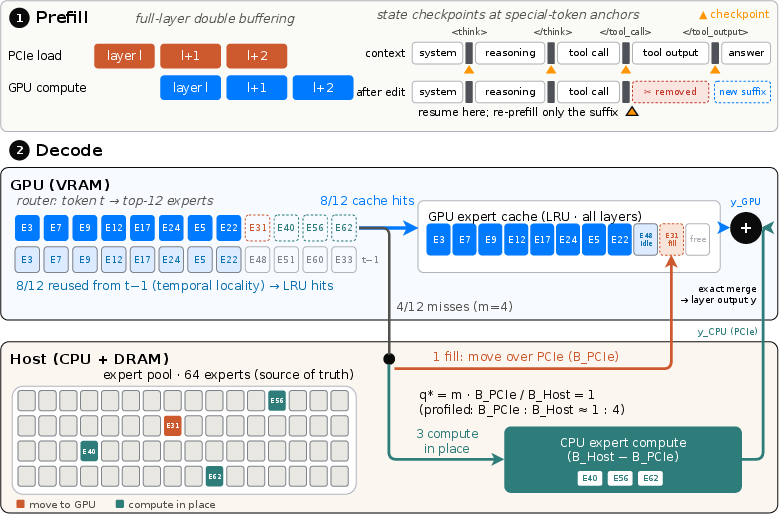
FreeToken keeps the complete collection of experts in the computer’s main memory. The GPU stores only a smaller, changeable selection of experts in its faster memory.
This is similar to a student’s desk:
- A bookshelf holds all the books.
- The desk holds only the books needed right now.
- When a new book is needed, it is brought from the shelf.
- If the desk becomes full, the least recently used book is returned to the shelf.
FreeToken uses a similar system for model experts. Its GPU cache is shared by all layers of the model and constantly changes according to which experts the model is using.
Faster processing of long prompts
Before a model answers, it must read and process the user’s prompt. This stage is called prefill.
For a long prompt, many different experts may be needed. FreeToken uses double buffering, which is like having two loading areas:
- While the GPU is calculating with one group of experts,
- the next group is being moved into another area.
Then the two areas switch roles. This allows moving data and calculating to happen at the same time instead of one after the other.
Reusing previous work in AI agents
AI agents often work in several steps. For example, a coding agent may:
- read a programming problem,
- write some code,
- use a tool to test it, and
- revise the code.
The conversation may change after each tool call. Without special handling, the model might need to reread and recalculate a large part of the conversation every time.
FreeToken saves important intermediate information at meaningful points, such as:
- the end of a thinking section,
- a tool call,
- a tool result, or
- a conversation turn.
These saved points are called semantic checkpoints. If an agent edits or removes part of its history, FreeToken can restart from the nearest useful checkpoint rather than starting from the beginning.
Choosing between the CPU and GPU
When an expert is not already in the GPU cache, FreeToken has two choices:
- move the expert to the GPU, or
- calculate with the expert directly on the CPU.
The best choice depends on the computer. For example, a laptop may have a slower connection between the CPU and GPU, while a desktop may have faster memory or a more powerful GPU.
FreeToken measures the actual bandwidth of the machine and calculates a suitable split. This is called bandwidth-adaptive execution. It is like deciding whether to send packages by truck or process them at the warehouse, depending on which route is currently faster.
Adjusting to changing memory
Personal computers are not dedicated only to AI. A user may also be running a browser, a game, or other programs. These programs can take away GPU memory.
FreeToken can resize its GPU expert cache while it is running. It can also give more memory to conversation history when the context becomes longer. This means the system does not always need to restart when memory conditions change.
Testing the system
The researchers tested FreeToken with:
- more than 20 MoE models,
- three especially large models in detail,
- six different computers,
- four realistic AI-agent tasks, including mathematics, coding, email, and calendar tasks.
They compared it with systems such as llama.cpp, Ollama, KTransformers, and MoE-Infinity.
They measured:
- decode throughput: how many tokens the model produces per second;
- time to first token (TTFT): how long a user waits before seeing the first part of an answer.
4. What were the main results?
FreeToken generally performed better than the other tested systems.
Faster text generation
On an RTX 5090, FreeToken produced:
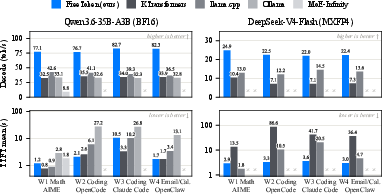
- 77–83 tokens per second with the Qwen3.6-35B-A3B model;
- 22–25 tokens per second with the much larger DeepSeek-V4-Flash model.
This was about 1.5 to 2.3 times faster than the strongest competing system, depending on the task.
Its speed also stayed fairly stable during multi-step agent tasks. The decoding speed remained within about 12% of the speed on a simple, single-turn task. Other systems slowed down much more when conversations became longer and more complicated.
Shorter and more reliable waiting times
FreeToken kept the worst measured time to the first token below 44 seconds across the tested workloads.
Other systems sometimes took more than 150 seconds, and one system reached about 946 seconds in a difficult situation. Such long delays can cause real applications to stop waiting and report an error.
Running very large models on modest hardware
The paper reports that FreeToken could:
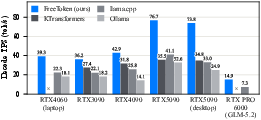
- run a 35-billion-parameter model on an 8 GB laptop GPU at 39.3 tokens per second;
- run a 284-billion-parameter model on a computer with a 32 GB gaming GPU;
- run the 753-billion-parameter GLM-5.2 model on a single workstation GPU.
The last result is especially notable because a model that large would normally be associated with a cluster of expensive data-center GPUs.
Better use of the expert cache
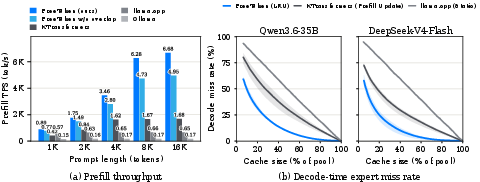
In one comparison, FreeToken’s changing cache missed far fewer needed experts than fixed placement strategies:
- FreeToken missed about 16% of expert requests for Qwen3.6;
- one competing strategy missed about 41%;
- a static strategy missed about 62%.
For DeepSeek-V4-Flash, FreeToken missed about 39%, compared with 59% and 89% for the other approaches.
Fewer misses mean less waiting for experts to be moved from main memory.
Why these findings are important
The results suggest that the main limitation of personal computers is not always the total amount of computing power. It is often how intelligently the system moves and reuses data.
FreeToken improves performance by:
- overlapping data movement with computation,
- remembering useful model states,
- keeping recently used experts in GPU memory,
- sharing work between the CPU and GPU, and
- adapting to each computer’s actual hardware.
5. What could this research mean?
If the results continue to hold on more models and computers, FreeToken could make powerful AI models much easier for individuals and small organizations to use locally.
Possible benefits include:
- lower costs than using an online AI service;
- better privacy because data can remain on the user’s computer;
- less dependence on large technology companies and data centers;
- useful coding, mathematics, and productivity agents on personal machines; and
- longer use of existing hardware instead of requiring special servers.
The research does not mean that every laptop can run every huge model. The computer still needs enough main memory, storage, and processing ability, and large models may take time to load. However, the paper shows that smart software can make much better use of hardware that people already own.
In simple terms, FreeToken turns a personal computer from “too small for a giant AI model” into a flexible team of storage and computing parts. This could help narrow the gap between people who can download advanced AI models and people who can actually use them.
Knowledge Gaps
Knowledge gaps, limitations, and open questions
- Limited hardware coverage: The evaluation uses only six single-GPU systems, with three consumer GPUs tested in rented servers under artificial CPU-thread and NUMA constraints; broader testing across AMD GPUs, Apple Silicon, integrated GPUs, consumer CPUs, Windows, Linux distributions, and different PCIe/DRAM configurations remains unresolved.
- No multi-GPU evaluation: The paper does not establish whether FreeToken’s cache, scheduling, and bandwidth-adaptive execution extend efficiently to multi-GPU workstations, heterogeneous GPUs, or consumer machines with multiple graphics cards.
- Restricted model coverage in the main experiments: Although the system reportedly supports more than 20 MoE models, detailed results focus primarily on Qwen3.6-35B-A3B, DeepSeek-V4-Flash, and GLM-5.2. Performance across different routing functions, expert sizes, attention mechanisms, quantization formats, and expert-count configurations is not characterized.
- Unclear support for dense models: The paper motivates serving frontier models broadly but does not evaluate whether FreeToken provides meaningful benefits for dense models or explain how its runtime behaves when MoE sparsity is absent.
- Unquantified accuracy impact of deployment formats: The experiments use BF16, MXFP4, and NVFP4 weights, but do not measure whether quantization, CPU dequantization, or heterogeneous GPU/CPU execution changes model accuracy, coding success, mathematical performance, or tool-use reliability.
- Limited workload diversity: The four workloads are fixed scenarios involving AIME, SWE-bench/OpenCode or Claude Code, and email/calendar tasks. The system’s behavior on interactive chat, retrieval-augmented generation, long-document analysis, multimodal agents, batch inference, streaming users, and unconstrained real-world sessions remains unknown.
- No rigorous concurrent-user evaluation: The experiments largely report per-request throughput and TTFT, but do not establish scalability under multiple simultaneous users, varied request arrival rates, batching, admission control, or fairness between sessions.
- Agent trajectories are not compared by total completion time: Because trajectories diverge across engines, the paper avoids comparing wall-clock task completion. This leaves unresolved whether higher token throughput and lower TTFT translate into faster end-to-end task completion, lower cost, or better agent success rates.
- Agent quality is only indirectly assessed: The requirement that coding runs produce a reference patch and that W4 runs complete all turns is not developed into a systematic quality evaluation. Error rates, patch correctness, tool-call validity, answer quality, and recovery from serving delays are not reported.
- The policy relies on a simplified bandwidth model: The analytical policy assumes that PCIe transfers and CPU expert execution share a measurable host-memory bandwidth pool and can be balanced using aggregate bandwidths. The model does not appear to account for NUMA effects, cache behavior, CPU contention, transfer setup costs, expert-size variation, synchronization overhead, or nonlinear bandwidth saturation.
- Bandwidth measurements may become stale: The two bandwidth parameters are profiled at deployment, but the paper does not evaluate how often they must be recalibrated or how performance degrades when background applications change CPU, DRAM, PCIe, or GPU contention.
- No robustness study under dynamic resource interference: Elastic cache resizing is motivated by browsers, games, and other applications, yet the experiments do not systematically inject competing workloads or quantify performance, latency, cache thrashing, and correctness during abrupt VRAM pressure.
- Cache resizing behavior is insufficiently evaluated: The paper states that the GPU expert cache can be rebuilt at safe points, but does not report resizing latency, temporary memory requirements, impact on active requests, or the policy used to decide how much memory should be allocated to experts versus KV cache.
- LRU may be inadequate for abrupt routing shifts: The evaluation supports LRU on the provided traces, but does not compare it against adaptive, frequency-aware, model-aware, or predictive policies under distribution shifts, adversarial routing patterns, or workloads with weak temporal locality.
- Semantic checkpointing assumes predictable context edits: Semantic anchors work when agents modify complete blocks marked by special tokens. The paper does not evaluate arbitrary text edits, token-level deletions, reordered histories, branch-heavy conversations, malformed prompts, or agent frameworks whose editing semantics do not align with these boundaries.
- Checkpoint memory trade-offs are not quantified: The paper does not provide a sensitivity analysis over the number, size, placement, and eviction policy of recurrent-state checkpoints, nor does it identify when checkpoint storage costs outweigh recomputation savings.
- Prefill overlap has important fallback cases: Full-layer double buffering requires enough GPU memory for two full layers. The paper does not quantify performance across cache capacities where the system falls back to on-demand prefill loading, nor does it compare alternative granularities such as expert-level or sublayer-level buffering.
- Prefill is treated as nearly dense without broad validation: The claim that long prompts activate almost the entire expert set is demonstrated only for selected traces and models. The relationship between prompt length, routing diversity, batch size, and expert coverage across model families remains insufficiently established.
- Batching and variable-length requests are underexplored: The mechanisms are described mainly for single-token decode and fixed supported batch sizes. It is unclear how cache contention, miss partitioning, CUDA-graph specialization, and partial CPU/GPU execution behave with dynamic batching and heterogeneous sequence lengths.
- CUDA Graph limitations are not fully addressed: The implementation prepares graphs for supported decode batch sizes, but the paper does not explain how graph capture handles changing batch sizes, request admission, cancellations, speculative decoding, or multiple simultaneous sessions.
- CPU execution scalability is unclear: Results cap some server experiments at six or eight CPU threads, while the workstation has substantially greater host bandwidth. The paper does not analyze optimal thread counts, CPU-core contention, hyperthreading, thermal throttling, or the point at which CPU execution becomes compute-bound rather than bandwidth-bound.
- Storage and startup claims lack end-to-end measurements: Direct loading into the FTW layout is described as reducing startup time, but the paper does not report complete cold-start latency across NVMe types, filesystems, operating systems, model sizes, or repeated model switching.
- The memory footprint of host-resident models is a practical constraint: Several demonstrations require hundreds of gigabytes of host memory. The paper does not evaluate paging, memory pressure, NUMA placement, multiple-model residency, or operation on systems where the full expert pool cannot be pinned.
- Power, heat, and energy consumption are not reported: Sustaining interactive throughput through simultaneous CPU execution, PCIe transfers, and GPU computation may impose substantial power and thermal costs on laptops and desktops, but energy per token and thermal stability are not evaluated.
- Long-term stability is not established: The experiments do not report multi-hour or multi-day serving, repeated cache rebuilds, memory fragmentation, pinned-memory exhaustion, driver instability, or degradation under prolonged agent sessions.
- Fault tolerance and recovery are unspecified: The paper does not address GPU resets, failed DMA transfers, corrupted host-resident weights, out-of-memory events caused by other applications, or recovery without restarting and reloading the full model.
- Security and privacy implications are unexamined: Keeping complete model weights, prompts, recurrent states, and agent histories in host memory on shared personal machines raises questions about isolation, data exposure, secure deletion, and protection from concurrent applications.
- Baseline comparisons may not fully isolate system improvements: Baselines differ in supported models, formats, server functionality, and configuration options. More extensive tuning, matched CPU budgets, matched quantization, and component-level comparisons are needed to determine how much of the advantage comes from caching, prefill overlap, CPU execution, memory management, or implementation differences.
- No comparison with predictive prefetching is provided: The paper discusses prior prediction-based systems but does not directly evaluate whether combining prediction with the shared LRU cache and miss execution would outperform either approach alone.
- The exact policy for selecting cache-fill experts is underspecified: After determining the number of fills, the system delegates selection to cache replacement logic, but the consequences of choosing particular misses for residency—especially under uneven expert sizes, heterogeneous future reuse, or concurrent requests—are not analyzed.
- Correctness under concurrent CPU/GPU partial execution needs stronger validation: Although the paper states that outputs are merged exactly, it does not provide numerical error bounds, reproducibility results, or tests across quantization formats and floating-point accumulation orders.
- Economic and usability claims remain unvalidated: The paper argues that local serving improves accessibility, but does not compare total ownership cost, electricity, noise, maintenance, setup complexity, or user experience against hosted APIs over realistic usage patterns.
- The boundary of “interactive” serving is not defined: Throughput comparisons use a 33-token/s production reference and selected TTFT thresholds, but acceptable latency varies by task and user. A broader human-centered study is needed to determine whether the reported performance supports practical use across different agent workflows.
- Future model evolution may challenge the design assumptions: The system depends on expert sparsity, stable routing locality, host-resident expert pools, and recurrent-state checkpoints. Its performance and applicability to models with dynamic expert counts, hierarchical routing, expert sharing, mixture-of-depths, speculative decoding, or substantially larger active parameter counts remain open questions.
Practical Applications
Immediate Applications
The paper’s results support applications that can be deployed with existing consumer GPUs, host memory, and the released FreeToken software, provided that the target model is supported and the hardware satisfies its memory, bandwidth, driver, and precision requirements.
- Local coding agents for individual developers and small engineering teams (Software development; Immediate Application) FreeToken can run agentic coding workflows locally, including repository inspection, tool calls, code generation, testing, and iterative debugging. The reported performance of approximately 39 tokens/s on an 8 GB RTX 4060 laptop and 77–83 tokens/s for Qwen3.6-35B-A3B on an RTX 5090 makes local alternatives to hosted coding agents practical. Potential workflow: integrate FreeToken behind an OpenAI- or Anthropic-compatible endpoint used by IDE extensions, terminal agents, or autonomous software-engineering tools. Dependencies: compatible model checkpoints, adequate system RAM for the complete expert pool, supported NVIDIA/CUDA hardware, and acceptable local power and thermal limits. The paper evaluates selected coding-agent traces rather than all development workloads.
- Privacy-preserving local assistants for email, calendars, and productivity tools (Enterprise software and personal productivity; Immediate Application) The system can support assistants that search mailboxes, summarize conversations, draft responses, schedule appointments, and invoke calendar or web tools without sending user data to a cloud API. Its semantic checkpoints are particularly relevant to multi-turn assistants whose context is repeatedly edited after tool calls. Potential product: a desktop assistant that keeps model weights and conversation state on the user’s workstation while dynamically adjusting GPU memory as other applications run. Dependencies: secure local tool execution, permission isolation, sufficient storage and RAM, and careful handling of sensitive data. Model accuracy, tool-use reliability, and prompt-injection defenses are outside the paper’s main evaluation.
- Offline and disconnected AI deployment (Field operations, defense, emergency response, and critical infrastructure; Immediate Application) Organizations can deploy frontier-scale open-weight MoE models on a workstation or laptop without continuous network access. This is useful for document analysis, technical troubleshooting, translation, summarization, and decision support in locations with unreliable connectivity. Potential workflow: preload the FTW-formatted model and run an on-device inference server connected to local documents and tools. Dependencies: the complete expert pool must fit in host storage and memory; quantized models may be required; local inference must meet the application’s latency and reliability requirements. Safety-critical decisions should remain subject to human review.
- Private enterprise inference for small organizations (Business software; Immediate Application) Small companies can use existing workstations instead of renting datacenter GPUs for internal chatbots, document assistants, code agents, and knowledge-base search. Elastic cache resizing allows the inference process to coexist with ordinary desktop workloads and adapt as VRAM becomes unavailable. Potential product: a single-node private AI appliance or departmental inference server supporting multiple open-weight MoE models. Dependencies: FreeToken’s current concurrency and multi-user scaling limits are not established by the paper. Organizations may need request admission control, authentication, auditing, and stronger isolation before production deployment.
- Local document and research assistants (Academia, legal services, finance, and professional services; Immediate Application) Researchers and analysts can use locally hosted models to summarize papers, compare documents, extract structured information, generate literature-search queries, and perform retrieval-augmented question answering over confidential corpora. Long-context agent sessions benefit from prefix and recurrent-state reuse after document or tool-context edits. Potential workflow: combine FreeToken with a local vector database, PDF parser, citation manager, and retrieval-augmented generation pipeline. Dependencies: retrieval quality, context-window limits, citation verification, and enough host memory for the selected model. The paper demonstrates serving performance, not factuality or research-assistant accuracy.
- Educational and laboratory access to large open models (Education and academia; Immediate Application) Universities, schools, and independent researchers can provide students with access to capable models using existing GPU workstations or lab computers rather than centralized cloud accounts. This enables courses and experiments in agents, model serving, tool use, systems optimization, and privacy-preserving AI. Potential workflow: install FreeToken as a local inference backend for classroom notebooks, coding environments, or model-systems testbeds. Dependencies: hardware availability, model licensing, operating-system support, usage scheduling, and the need to prevent one student’s workload from exhausting shared resources.
- Local benchmarking and systems research on MoE serving (Academic systems research; Immediate Application) Researchers can use FreeToken’s shared LRU cache, bandwidth-adaptive miss partitioning, semantic state caching, and FTW storage format as a baseline or experimental platform. The system exposes practical research questions concerning routing locality, PCIe/CPU/GPU scheduling, cache policies, and edge resource contention. Potential outputs: new cache replacement policies, routing predictors, heterogeneous schedulers, hardware profilers, and benchmarks for agentic inference. Dependencies: reproducible hardware measurements are essential because the proposed policy depends on empirically measured PCIe and CPU-side bandwidth. Results may not generalize to AMD, Apple, integrated-GPU, or non-CUDA systems.
- Cost-reduction for hosted or colocated inference services (Cloud and edge computing; Immediate Application) Small providers can use one workstation GPU plus host memory to serve models that would otherwise require multiple datacenter GPUs. This may reduce capital and operational costs for low- to moderate-volume workloads, private deployments, or development environments. Potential product: a locally hosted API compatible with existing agent clients, with runtime model switching and dynamic memory budgets. Dependencies: the reported results are primarily single-request or limited-workload demonstrations. High concurrency, queueing behavior, service-level objectives, fault tolerance, and economics under sustained workloads require additional validation.
- A practical runtime adaptation layer for desktop AI applications (Operating systems and developer tooling; Immediate Application) FreeToken’s elastic memory lifecycle can serve as a model for desktop AI runtimes that monitor VRAM availability, resize expert and KV caches, and continue serving without restarting when a browser, game, or graphics application changes memory pressure. Potential tool: a background inference daemon that profiles host bandwidth at startup, selects CPU/GPU execution splits, and exposes memory and latency controls to applications. Dependencies: reliable GPU memory monitoring, safe scheduler points, driver support, and graceful behavior under sudden memory reclamation.
Long-Term Applications
The following applications are plausible extensions of the paper’s innovations but require further research, engineering, validation, or ecosystem development before broad deployment.
- Frontier-scale personal AI appliances (Consumer electronics; Long-Term Application) FreeToken could enable compact desktops or laptops that locally serve models with hundreds of billions of parameters by combining moderate VRAM with large host memory and high-bandwidth interconnects. Such systems could provide persistent personal assistants, local coding agents, and multimodal productivity tools without subscription-based inference. Dependencies: larger and faster system memory, lower-power interconnects, improved quantization, cooling, storage capacity, and model architectures designed for edge bandwidth constraints. The paper demonstrates large models on selected NVIDIA workstations, not a complete consumer product.
- Distributed inference across multiple household or organizational machines (Edge and distributed computing; Long-Term Application) The host-resident expert-pool architecture could be extended to partition experts across several networked computers, allowing a collection of personal GPUs to serve a model larger than any individual machine. A scheduler could place frequently used experts near the active request and move less common experts over the network. Dependencies: network bandwidth and latency must approach local PCIe performance; synchronization, fault tolerance, privacy, and uneven machine availability are major challenges. Network transfers may erase the gains of local CPU/GPU cooperation.
- Federated or community-owned inference pools (Public infrastructure and cooperative computing; Long-Term Application) A future service could aggregate idle consumer GPUs to provide lower-cost inference for schools, nonprofits, or research groups while keeping model execution distributed across users’ machines. FreeToken’s hardware-adaptive scheduling is conceptually suited to heterogeneous nodes. Dependencies: trusted execution, authentication, compensation mechanisms, data confidentiality, malicious-node resistance, scheduling across unreliable hosts, and legal compliance. The paper does not evaluate distributed or adversarial environments.
- Adaptive inference for robots and autonomous systems (Robotics and edge autonomy; Long-Term Application) Robots could use MoE models locally for planning, manipulation, navigation, and tool interaction, dynamically allocating experts between GPU and CPU as sensor workloads and memory demands change. Semantic checkpoints could reduce recomputation when plans or tool outputs are revised. Dependencies: real-time deadlines are stricter than the reported interactive workloads; determinism, thermal limits, safety certification, embedded hardware support, sensor-stream processing, and bounded worst-case latency require dedicated study.
- On-device healthcare and clinical-support assistants (Healthcare; Long-Term Application) Private local inference could support clinical note drafting, medical literature retrieval, patient-facing education, and offline analysis of sensitive records. Keeping data on local hardware may reduce exposure to external APIs. Dependencies: clinical validation, medical accuracy, auditability, regulatory approval, secure storage, model-update procedures, and human oversight. FreeToken’s throughput and TTFT results do not establish medical reliability or suitability for diagnosis.
- Energy-aware and carbon-aware inference scheduling (Energy and sustainability; Long-Term Application) The runtime’s ability to measure bandwidth and adapt execution could be expanded to include power, temperature, battery state, and electricity prices. A scheduler might choose CPU-heavy execution on one device, GPU-heavy cache filling on another, or defer large requests when the battery or thermal budget is low. Dependencies: accurate power models, energy telemetry, thermal control, and a demonstrated relationship between the policy and total energy per token. The paper optimizes performance rather than energy consumption.
- Policy mechanisms for broader access to advanced AI (Public policy and digital equity; Long-Term Application) By lowering the infrastructure barrier to open-weight models, systems like FreeToken could support public-interest AI programs in schools, libraries, small businesses, and regions with limited cloud access. Policymakers could fund shared workstation labs or standards for auditable local inference. Dependencies: model licensing, hardware import and availability, electricity and maintenance costs, responsible-use policies, cybersecurity, and support for users without capable machines. Broader access also increases the need for misuse prevention and provenance controls.
- Bandwidth-adaptive serving as a general heterogeneous-computing abstraction (Systems software; Long-Term Application) The paper’s central idea—treating measured bandwidth as a scheduling signal and splitting work between memory tiers—could generalize beyond MoE inference to recommendation systems, sparse linear algebra, graph analytics, embedding retrieval, and GPU-accelerated simulation. Potential tool: a runtime API that profiles competing data paths and dynamically assigns work among GPU memory, host memory, CPU execution, storage, and possibly network resources. Dependencies: workloads must expose divisible tasks with independently mergeable outputs. Applications with strict ordering, large synchronization costs, or non-additive computations may not benefit.
- Semantic state caching for broader agent frameworks (Agent platforms and interactive AI; Long-Term Application) Semantic anchors could become a standard interface between agent frameworks and inference runtimes. Instead of treating prompts as undifferentiated token sequences, frameworks could explicitly mark durable boundaries—such as tool calls, planning phases, retrieved-document blocks, and conversation turns—to improve state reuse. Dependencies: agent frameworks must preserve stable semantic metadata, model state must remain valid after edits, and cache eviction must balance memory cost against expected reuse. Benefits may be smaller for models without recurrent or hybrid-attention components.
- Training and fine-tuning models specifically for edge-native serving (AI model design; Long-Term Application) Model developers could co-design MoE architectures with expert sizes, routing patterns, quantization formats, and recurrent-state boundaries that maximize cache locality and minimize host-memory traffic. This could produce models optimized for consumer hardware rather than merely compressed versions of datacenter models. Dependencies: training costs, accuracy–latency trade-offs, stable routing locality, hardware-specific optimization, and standardized edge benchmarks. The paper assumes existing models exhibit sufficient temporal expert locality; future models may not.
Glossary
- Agentic workload: A workload in which an AI system autonomously performs multi-step actions, often involving tools or changing context. “real agentic workloads”
- Bandwidth-adaptive execution: Runtime scheduling that adjusts computation and data movement according to measured hardware bandwidth. “Bandwidth-adaptive execution dynamically divides the missing experts between PCIe transfer and CPU execution”
- BF16: Brain floating-point 16-bit numerical format used for efficient neural-network computation. “Qwen3.6-35B-A3B in BF16”
- Cache fill: The process of transferring a missing data item into a cache for current or future reuse. “Experts in are transferred into cache slots”
- Cache miss: An access to data that is not currently present in the relevant cache. “cache misses require experts to be repeatedly loaded”
- Cache residency: The condition of an item being stored in a cache and available for fast access. “it maintains a shared LRU residency space”
- Chain-of-thought decoding: Generation that produces intermediate reasoning steps before reaching an answer. “long chain-of-thought decoding and no tool use”
- CUDA Graph: A CUDA execution structure that captures a sequence of GPU operations for efficient repeated execution. “Keeping all of this inside a statically captured CUDA Graph”
- Dequantization: Conversion of quantized numerical values back into a higher-precision representation during computation. “in-kernel dequantization”
- Decode: The autoregressive generation phase in which a model produces output tokens one at a time. “Decode requires a more fine-grained allocation”
- Device synchronization: Coordination that ensures GPU operations or GPU and host operations have reached a required execution point. “a costly device synchronization at every MoE layer”
- Direct I/O: An input/output method that transfers data directly between storage and application buffers while bypassing some operating-system caching. “parallel direct I/O straight into exact-size host banks”
- DMA: Direct Memory Access, allowing a hardware device to read or write memory without continuous CPU involvement. “both expert DMA transfers and CPU execution read from the same host-memory subsystem”
- Double buffering: Use of two buffers so one can be processed while the other is being filled or transferred. “full-layer double buffering hides transfer behind computation”
- Elastic resource management: Dynamic adjustment of resource allocation as hardware availability or workload requirements change. “Elastic edge resource management adapts FreeToken to the changing memory conditions”
- Expert offloading: Placement of model experts outside GPU memory, commonly in host memory or storage, with transfer or CPU execution when needed. “Expert offloading and caching.”
- Expert pool: The complete collection of expert networks contained in a mixture-of-experts model. “the complete expert pool remains the source of truth”
- Expert residency: The set of experts currently stored in a particular memory level, especially GPU memory. “Semantic-aware expert caching follows the model's evolving computation.”
- FP4: A four-bit floating-point representation used to reduce model-storage and data-transfer requirements. “Taking an FP4 deployment of DeepSeek-V4-Flash as an example”
- Frontier-scale model: A model near the leading edge of capability and typically requiring substantial computational resources. “frontier-scale open-weight models”
- GPU-centric serving: A serving architecture in which scheduling, routing, and execution control are primarily managed by the GPU. “FreeToken follows the GPU-centric serving architecture”
- Hybrid attention: An attention architecture combining different attention mechanisms, such as full attention and sliding-window attention. “Many frontier models adopt hybrid-attention architectures”
- Interconnect: A communication link connecting computing components, such as a CPU and GPU. “the CPU--GPU interconnect”
- LRU cache: A cache that evicts the least recently used item when space is needed. “a shared LRU expert cache”
- Memory-bound: A computational condition in which performance is limited primarily by memory bandwidth rather than arithmetic throughput. “At small decode batches, expert execution is memory-bound”
- Mixture of Experts (MoE): A neural-network architecture containing multiple expert subnetworks, with a router selecting only some experts for each token. “MoE architectures open a new path toward serving frontier-scale open-weight models on edge devices.”
- Model layout: The organization of model parameters and tensors in memory or storage for efficient access. “FreeToken co-designs the full serving stack, including model layout and loading”
- MXFP4: A microscaling floating-point four-bit format used for compact neural-network weights. “whose routed experts are natively MXFP4-quantized”
- NVFP4: An NVIDIA-oriented four-bit floating-point quantization format for neural-network computation. “the 8\,GB laptop serves its official NVFP4 release”
- NUMA: Non-uniform memory access, an architecture in which memory-access speed depends on the processor or device accessing the memory. “pinned to the GPU's NUMA node”
- On-demand loading: Loading data only when it is needed rather than loading the entire data set in advance. “FreeToken falls back to on-demand prefill loading”
- Paged KV cache: A memory-management scheme that stores key-value attention-cache data in fixed-size pages. “combining paged KV cache management”
- Pageable memory: Host memory that is not locked in physical RAM and may be paged by the operating system. “expert weights stay in pageable host storage”
- PCIe: Peripheral Component Interconnect Express, a high-speed bus used to connect GPUs and other devices to a host system. “the next layer's experts stream over PCIe”
- Pinned memory: Host memory locked in physical RAM so that devices can access it efficiently, commonly for DMA transfers. “FreeToken provides stable pinned I/O buffers”
- Prefetching: Loading data before it is explicitly requested, based on an anticipated future access. “Mixtral-offloading combined an LRU expert cache with speculative prefetching”
- Prefill: The phase that processes the input context before autoregressive token generation begins. “During prefill, FreeToken double-buffers expert movement with computation”
- Prefix reuse: Reusing computations or cached states associated with an unchanged prefix of a sequence. “prefix reuse for these layers depends on checkpoints of the state”
- Quantization: Reduction of numerical precision used to represent model weights or activations to reduce memory and computation costs. “A complementary line lowers the transfer volume by relaxing fidelity”
- Radix prefix tree: A tree data structure that stores shared sequence prefixes to support efficient lookup and reuse. “FreeToken manages full-attention KV with a radix prefix tree”
- Recurrent layer: A neural-network layer that summarizes prior inputs in a persistent evolving state. “a recurrent layer, however, compresses its entire prefix into one evolving state”
- Residual bandwidth: Memory or communication bandwidth remaining after another concurrent operation consumes part of the available capacity. “This residual bandwidth is precisely what is available for concurrent CPU expert execution.”
- SIMD: Single Instruction, Multiple Data, an execution technique that applies one instruction to multiple data elements in parallel. “The workers themselves form a persistent C++ pool pinned to physical cores.”
- Sliding-window attention: Attention restricted to a recent fixed-size portion of the sequence. “hybrid-attention architectures that interleave full attention with sliding-window attention”
- Sparse activation: A computation pattern in which only a small subset of available model components is activated for each input. “sparse activation makes the computation feasible”
- Speculative prefetching: Prefetching based on predictions about future data accesses that may not yet be certain. “combined an LRU expert cache with speculative prefetching”
- State checkpoint: A saved intermediate recurrent state that can be restored to avoid recomputing earlier context. “FreeToken anchors recurrent-state checkpoints at these boundaries”
- Static placement: A fixed assignment of model components to hardware resources that does not change during execution. “Static placement cannot follow token-level routing changes”
- Tensor shard: A partition of a tensor distributed across memory devices or processing units. “rather than tensor shards”
- Temporal locality: The tendency for recently accessed data to be accessed again soon. “following temporal locality”
- Time to first token (TTFT): The elapsed time from request submission until the first generated token is produced. “Prefill determines TTFT of every agent turn.”
- Token-level routing: Selection of experts separately for each input token in an MoE model. “Static placement cannot follow token-level routing changes”
- Tool call: An action in which an agent invokes an external function, service, or program. “Agentic tool calls trigger frequent re-prefill.”
- Working set: The subset of data or model components actively needed during a particular computation interval. “the expert working set stays roughly fixed”
- Weight layout: The physical arrangement of model weights in memory or storage. “Loading reads expert weights from disk directly into their final host layout”

