A Control-Theoretic Formulation of Global Workspace Theory
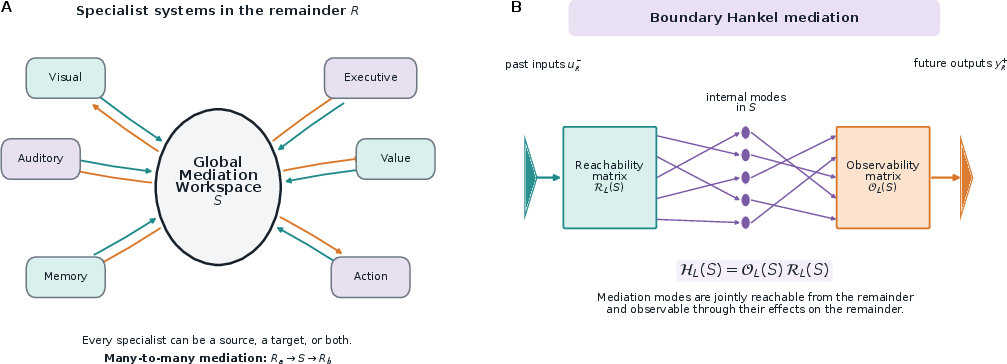
Abstract: Global workspace theory explains conscious access as the broadcasting of selected information to the rest of the network, but it lacks a formal criterion for identifying the mechanism that enables this access. We propose that a global workspace is a mediator, namely, a subnetwork that receives activity from distributed systems, transforms it through internal modes, and returns differentiated effects to the broader network. We formalize this claim as the Global Mediation Workspace (GMW), a control-theoretic formulation in which a candidate subnetwork is treated as an open system embedded in the remainder of the network. In this framework, reachability characterizes how the remainder can drive the candidate, observability characterizes how candidate states affect the remainder, and a boundary Hankel operator identifies the internal modes linking the two directions. The resulting signature quantifies mediation capacity, input-output alignment, effective dimensionality, and routed source-target breadth, each of which characterizes different components of global workspace. In synthetic benchmarks, we tested whether the signature can distinguish a planted differentiated mediator from dense hubs, one-sided receivers or broadcasters, and a split read/write aggregate with no common internal route. A nonlinear extension characterizes mediation through trajectory-conditioned differential operators, finite-amplitude response profiles, and state-dependent coalitions. As a preliminary application, we estimated the signature from ECoG recordings in four macaques under ketamine anesthesia. We found that input-output alignment was reduced during unconsciousness whereas potential capacity was increased. The GMW thus provides a formal and testable criterion for locating candidate global workspaces in neural recordings and for asking which aspects of mediation is crucial for conscious access.
Paper Prompts
Sign up for free to create and run prompts on this paper.
Top Community Prompts
Explain it Like I'm 14
1. Main topic
This paper proposes a new way to study how brain networks might make information available for conscious thought.
The authors call their proposed system the Global Mediation Workspace (GMW). It is based on Global Workspace Theory, which suggests that information becomes conscious when it can be shared with many different brain systems involved in memory, perception, decision-making, and action.
The paper does not claim that the GMW is “the part of the brain where consciousness happens.” Instead, it provides mathematical tools for finding brain-network groups that may perform an important job:
- Receive information from many parts of the brain.
- Transform that information internally.
- Send useful and varied information back to other parts of the brain.
The authors describe this as a read–transform–write process.
2. Main research questions
The paper focuses on several connected questions:
- How can researchers identify the brain network that performs the “workspace” function?
- How can they distinguish a true mediator from a simple brain hub?
- Does a candidate region both receive and send information through the same internal system?
- Does it support many different information routes, or only one repeated signal?
- Can this framework distinguish awake brain activity from activity during deep anesthesia?
- Can the method work in both simple mathematical networks and real brain recordings?
A major goal is to avoid confusing several different kinds of brain organization. For example, a group of brain regions might:
- Receive information but not send anything back.
- Send information widely but receive very little.
- Have many connections but transmit only one simple, repeated pattern.
- Contain good receivers and good broadcasters that are not internally connected.
According to the paper, none of these examples alone is enough to be called a Global Mediation Workspace.
3. How the research was carried out
A mathematical model of a brain network
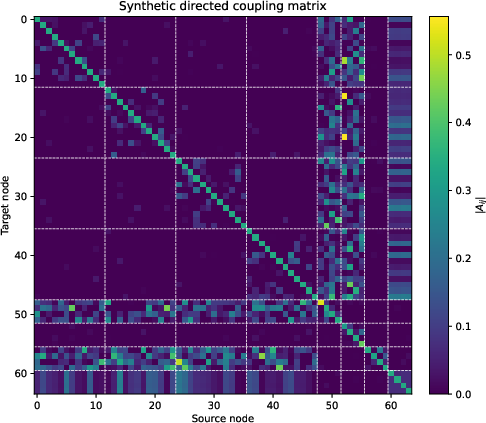
The researchers represented a brain network as a set of connected points, or nodes. Nodes could represent recording sites or groups of brain activity. Arrows between nodes represented how activity at one node predicted activity at another.
They divided the network into two parts:
- Candidate system (
S): the group being tested as a possible workspace. - Remainder (
R): everything outside that candidate group.
The candidate system was treated like a small machine placed inside a larger machine.
Measuring input and output
The authors used ideas from control theory, a branch of mathematics often used to understand machines, robots, and electrical systems.
They asked two main questions:
- Reachability: Can activity from the rest of the network drive different internal states of the candidate?
- Observability: Can researchers detect those internal states by looking at how the candidate affects the rest of the network?
An everyday analogy is a control panel:
- Reachability asks whether the buttons can make the machine enter many different settings.
- Observability asks whether you can figure out the machine’s internal setting by watching what it does.
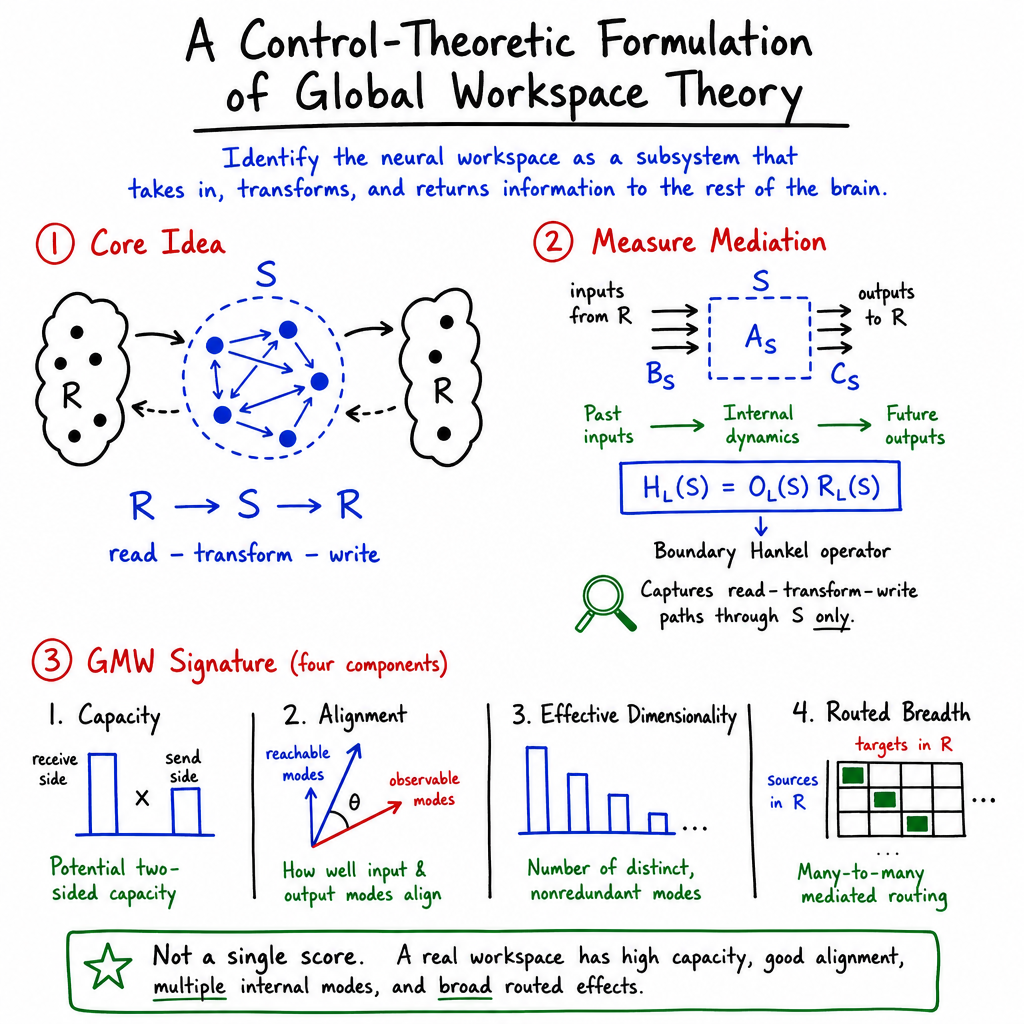
The researchers then combined these two measurements using a mathematical object called a boundary Hankel operator. This operator tracks paths that:
- Enter the candidate from the rest of the network.
- Move through the candidate’s internal connections.
- Return from the candidate to the rest of the network.
This is important because the candidate must not merely receive and send signals separately. It should connect what it receives to what it sends.
Measuring different qualities of mediation
The researchers created a GMW signature with several parts:
- Capacity: How much information or activity the candidate could potentially receive and send.
- Alignment: How well the directions used for receiving match the directions used for sending.
- Effective dimensionality: How many independent internal routes the candidate supports.
- Routed breadth: How widely the candidate connects different groups of brain systems through mediated pathways.
They also created a combined score called the Workspace Mediation Index, or WMI. However, the authors stress that WMI is only a convenient summary for comparing candidates of the same size. They do not present it as a universal “consciousness score.”
Testing artificial networks
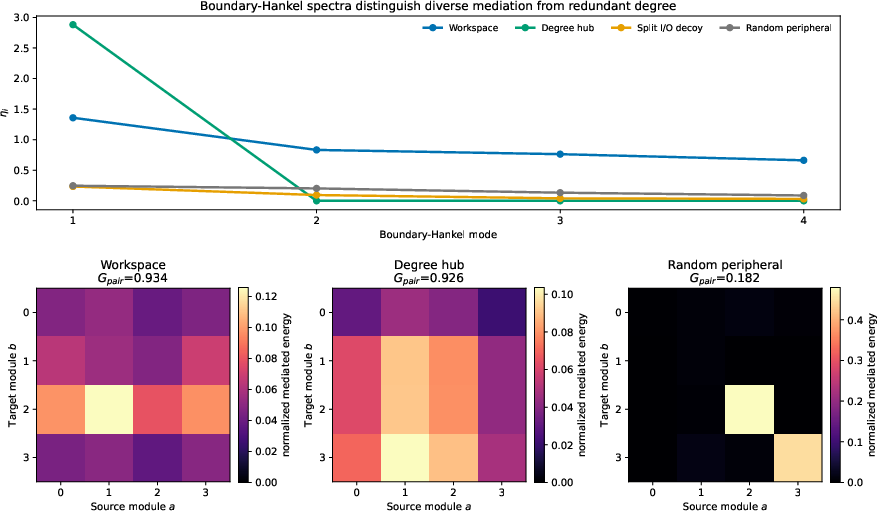
First, the authors tested the method using computer-generated networks. These networks included:
- A deliberately constructed, well-functioning mediator.
- Nodes that mainly sent signals.
- Nodes that mainly received signals.
- A highly connected hub that mostly transmitted one repeated pattern.
- A group containing separate receivers and senders with no shared internal route.
Because the researchers knew how the artificial networks had been designed, they could check whether the method correctly found the planted mediator.
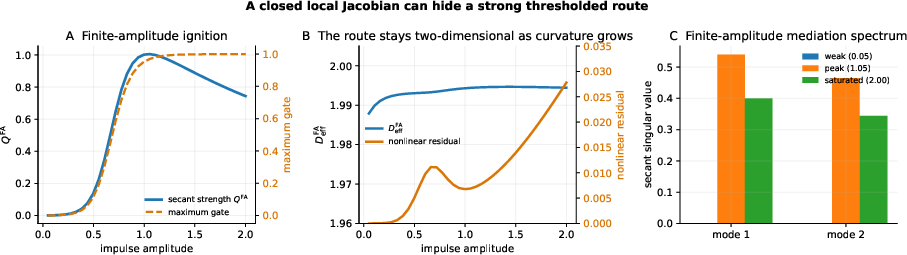
Extending the method to nonlinear systems
Real brains do not behave like simple machines with fixed rules. Their behavior can change depending on the current brain state and the strength of a signal.
The authors therefore developed a nonlinear extension. This tested how mediation changes:
- Along different activity patterns.
- At different signal strengths.
- In different situations or contexts.
This is similar to testing a door: a light push may not open it, but a stronger push might. A method that only studies tiny pushes could miss this behavior.
Studying macaque brain recordings
Finally, the researchers applied the framework to brain recordings from four macaque monkeys. The recordings came from electrodes placed on the surface of the brain, using a technique called ECoG.
They compared brain activity during:
- Wakefulness.
- Deep ketamine–medetomidine anesthesia.
- Recovery in some experiments.
The researchers used prediction models to estimate how activity flowed between recording sites. They also used careful testing procedures to reduce the chance that the same data were used both to choose candidate regions and to evaluate them.
This part of the study was mainly a method test. It asked whether the GMW measurements could be estimated from real recordings. It was not designed to prove or disprove Global Workspace Theory.
4. Main findings
The method separated true mediators from misleading network structures
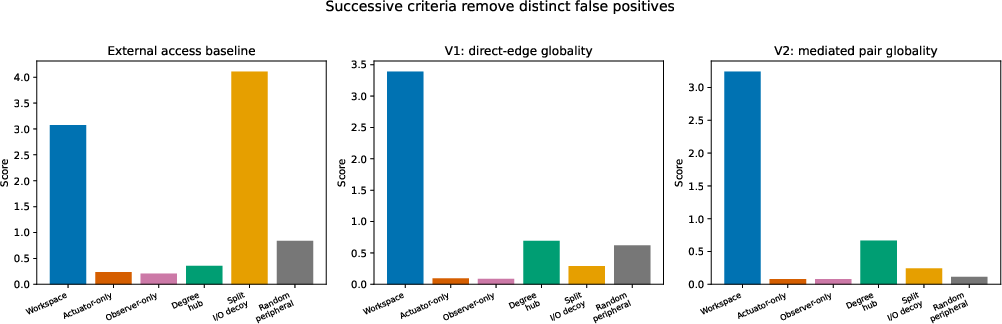
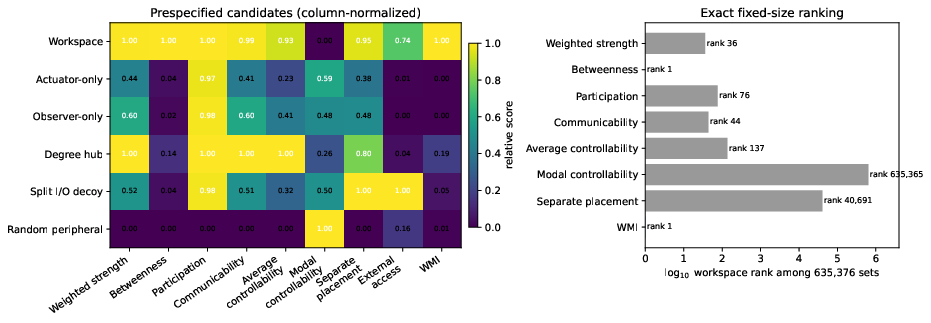
In the artificial networks, the GMW method correctly identified the planted mediator and rejected several misleading alternatives.
The results showed why different network features matter:
- A receiver-only group had too little ability to send information back.
- A broadcaster-only group had too little ability to receive information.
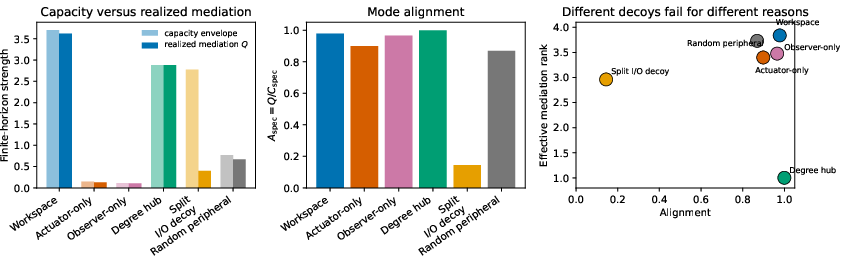
- A dense hub had many connections but mostly one internal mode, meaning it behaved like a narrow bottleneck.
- The split receiver–broadcaster group had strong input and output separately, but its receiving and sending directions did not connect properly inside the candidate.
- The planted GMW had several strong, aligned, and broadly distributed routes.
This suggests that simply counting connections is not enough. A useful mediator must have the right internal organization, not just high connectivity.
Different components reveal different weaknesses
The mathematical analysis showed that a candidate can fail in different ways:
- It may have strong potential capacity but poor alignment.
- It may have excellent alignment but very little total strength.
- It may have strong activity concentrated in only one route.
- It may connect many brain areas directly but fail to create many different source-to-target transformations.
This is why the authors prefer a multi-part signature instead of relying on one number.
Nonlinear behavior depends on brain state
In computer simulations, the best candidate could change when the system entered a different operating state.
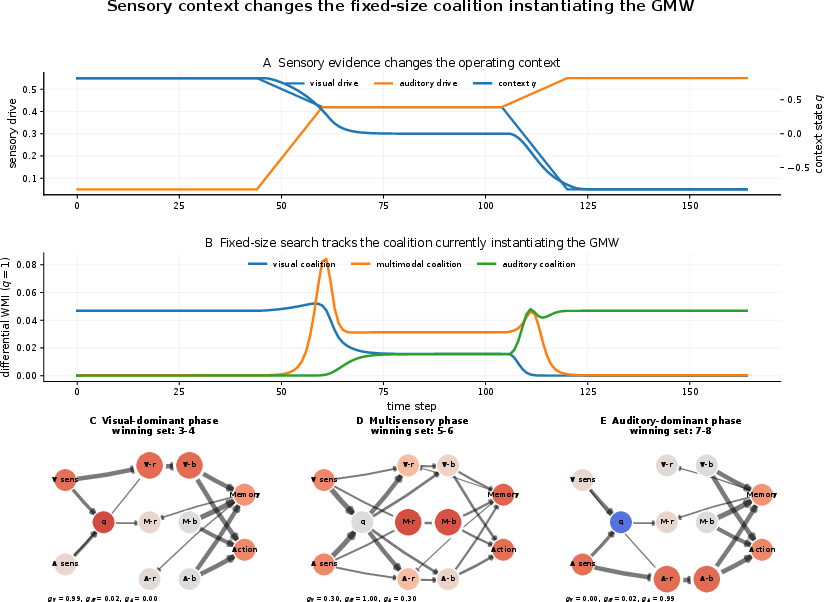
For example, a route might exist structurally but remain functionally “closed” until the system is in a state that aligns its receiving and sending modes. Similarly, different sensory contexts could cause different candidate groups to become the most active mediators.
This means that the workspace may not always be the same fixed set of brain regions. It could be a changing coalition whose activity depends on the current task or situation.
Anesthesia increased predictability and signal strength
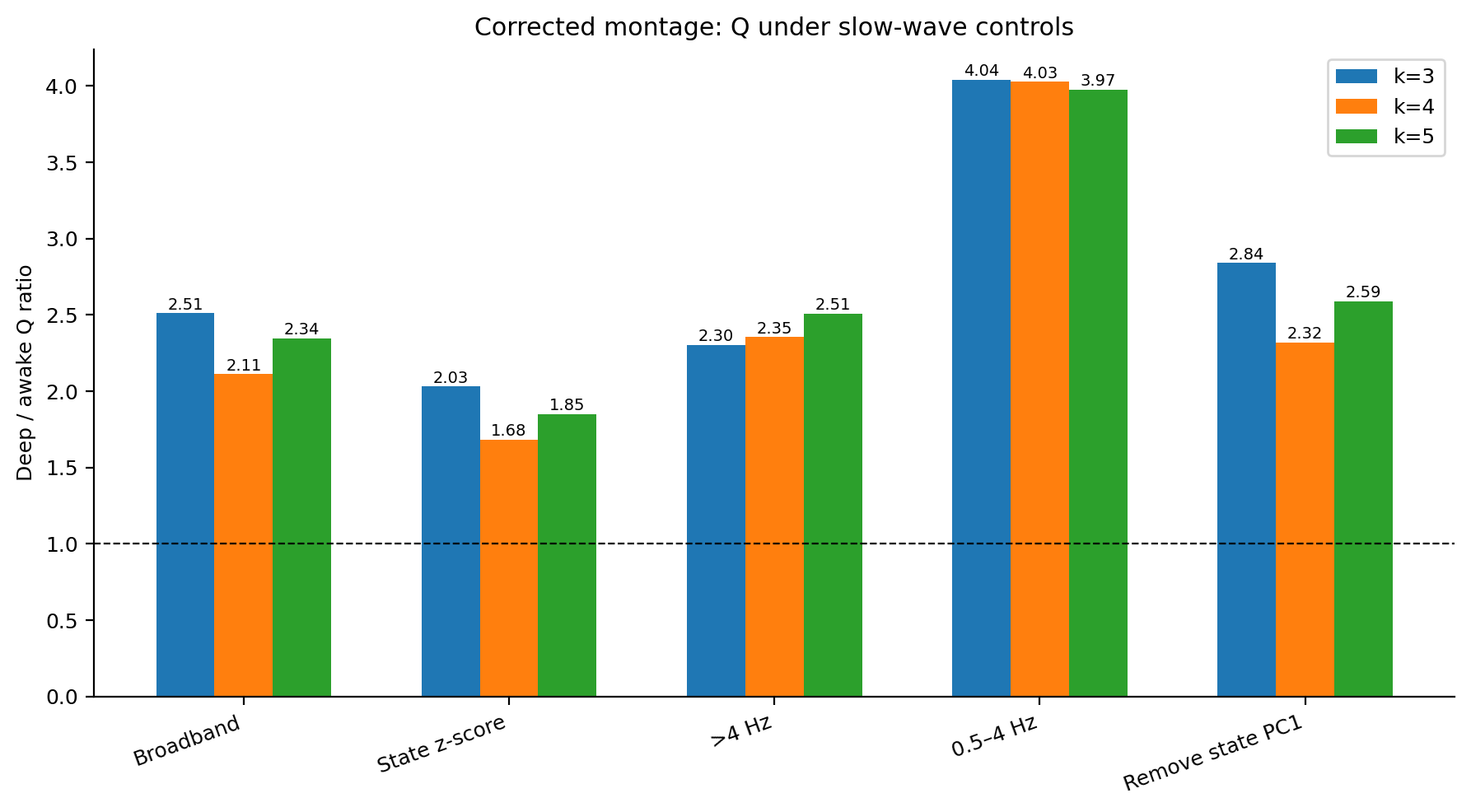
In the macaque recordings, deep anesthesia made brain activity more predictable over short time periods. The researchers also found increases in:
- Realized mediation strength.
- Potential mediation capacity.
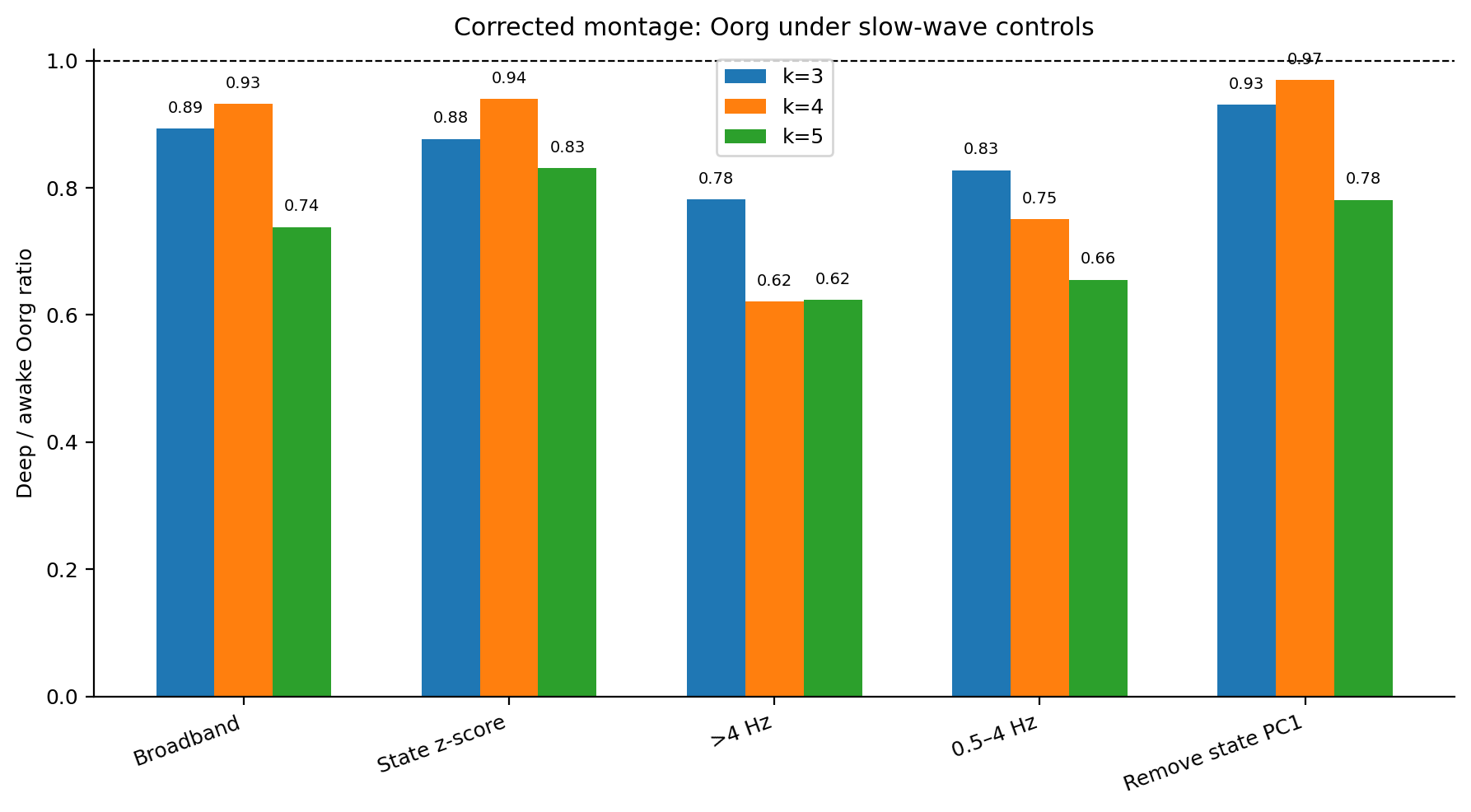
However, input–output alignment decreased during anesthesia.
In simple terms, the anesthetized brain produced stronger and more predictable activity, but the activity was less well organized into distinct, coordinated routes between different systems.
At larger candidate sizes, the researchers also saw reductions in:
- Effective dimensionality.
- Routed source–target breadth.
- Gain-free organization.
This means that anesthesia could increase the strength of brain signals while reducing the variety and organization of the routes carrying those signals.
The raw WMI still increased during anesthesia because the increase in signal strength was larger than the decrease in organization. This is an important warning: a high combined score does not necessarily mean that the brain has better conscious organization.
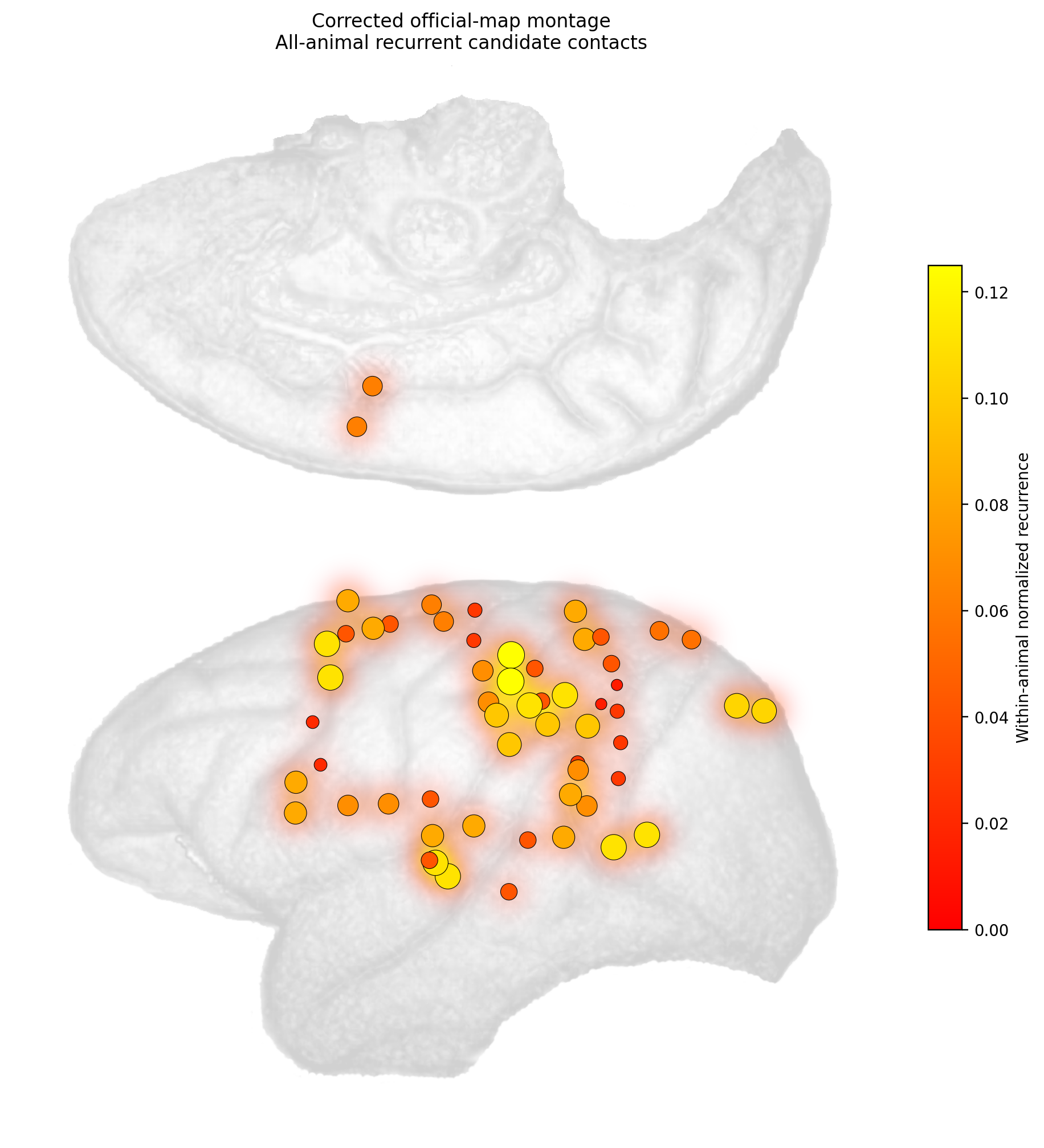
Candidate sites were widely distributed
The repeatedly selected awake candidate sites were found across several cortical areas, including frontal, parietal, temporal, and other association-related regions.
No single small brain location consistently dominated. This supports the idea that a workspace may be a distributed network, rather than one special anatomical center.
5. Why the findings matter
The paper provides a more precise way to ask whether a brain network acts as a mediator of information.
Earlier measures might identify:
- Highly connected hubs.
- Regions with many incoming or outgoing links.
- Shortest-path bridges.
- Strong statistical relationships between brain areas.
The GMW framework adds a different question:
Does this candidate receive activity, transform it through several internal routes, and send differentiated effects back to many parts of the network?
That distinction could help researchers study consciousness, attention, memory, anesthesia, and changing brain states more carefully.
For example, anesthesia may not simply “turn down” the brain. It may make activity stronger and more predictable while making communication less flexible and less differentiated. The GMW measurements could help separate these effects.
6. Implications and limitations
The research suggests that conscious access may depend on more than widespread communication or high signal strength. It may require a combination of:
- Strong two-way interaction.
- Proper alignment between incoming and outgoing activity.
- Several independent internal modes.
- Broad communication between different specialist systems.
However, the paper does not establish that all these features are required for consciousness. The authors leave that as a question for future experiments.
There are also important limitations:
- The analysis depends on how researchers define the candidate group and the rest of the network.
- The results depend on the time window, recording method, and mathematical model.
- The macaque study involved only four animals.
- ECoG recordings measure activity at selected electrode sites, not every neuron in the brain.
- The study shows that the method can be applied to recordings, but it does not prove that the measured network is the biological basis of consciousness.
Overall, the paper introduces a useful “network detective” tool. It looks not only for brain regions with many connections, but for groups that can receive information, process it in multiple ways, and return meaningful signals to the wider brain. This could lead to better ways of studying how flexible, conscious-like brain organization changes during waking, sleep, anesthesia, disease, or different mental tasks.
Knowledge Gaps
Knowledge gaps, limitations, and open questions
The paper establishes the GMW as a formal and computational framework, but leaves the following issues unresolved:
- No empirical criterion identifies which GMW signature components are necessary for consciousness. It remains unknown whether capacity, alignment, effective dimensionality, routed breadth, or a specific combination best predicts conscious access.
- The framework does not establish that GMW mediation is sufficient for consciousness. A nonconscious system could potentially exhibit high aligned mediation, and the paper does not test this possibility directly.
- The relationship between GMW measures and subjective experience is not tested. The macaque analysis compares wakefulness, anesthesia, and recovery but does not include behavioral reports, perceptual awareness measures, or other direct indicators of conscious content.
- The macaque application does not distinguish consciousness from anesthesia-related changes in signal dynamics. Increased mediation strength and predictability under anesthesia may reflect slow-wave gain, common input, or altered measurement statistics rather than enhanced functional access.
- The study uses only four macaques, limiting generalizability and inferential power. Days, blocks, folds, and candidate sizes are repeated measurements rather than independent biological samples.
- The analysis covers a narrow set of brain states and one anesthetic protocol. It remains unclear whether the observed signature changes generalize across natural sleep, other anesthetics, sedation levels, disorders of consciousness, active task states, or different arousal transitions.
- The framework has not been validated against experimentally manipulated neural mediation. Future work should perturb candidate subnetworks or their incoming and outgoing pathways to test whether high GMW scores predict causal read–transform–write function.
- Observational boundary reachability is not equivalent to experimental controllability. Because ECoG boundary activity is modeled rather than independently manipulated, the reachability measures do not demonstrate that the remainder can causally drive the candidate in the control-theoretic sense.
- The causal interpretation of the fitted transition matrix remains uncertain. Ridge VAR dynamics may reflect common inputs, volume conduction, unmeasured regions, preprocessing artifacts, or statistical predictability rather than directed biological influence.
- The paper does not systematically compare GMW estimates with ground-truth causal interventions in neural data. Validation against stimulation, lesion, optogenetic, or pharmacological perturbation data is needed.
- The dependence of the signature on the state-space representation is not fully resolved. Results may change with electrode variables versus latent states, source-reconstructed activity, regional aggregation, normalization, or nonlinear embeddings.
- The choice of state metric and coordinate scaling remains a substantive modeling decision. Although similarity-related invariance is discussed, practical results may still depend strongly on the metric used to measure candidate-state energy and mode alignment.
- Candidate boundaries and candidate sizes are not canonicalized. The framework evaluates declared subnetworks but does not determine the biologically intrinsic boundary, minimal workspace size, or whether overlapping candidates should be permitted.
- The WMI scalarization is not theoretically unique. Multiplying realized gain, normalized effective rank, and routed breadth imposes one particular trade-off; alternative weighting or multi-objective approaches could produce different candidate rankings.
- The routed-breadth measure depends on the module partition. The paper does not establish how modules should be defined, whether they should be anatomical, functional, data-driven, or hierarchical, or how robust is to different partitions.
- The effects of candidate size, horizon, sampling interval, and internal shift are incompletely characterized. Although sensitivity analyses are reported, there is no general principle for selecting parameters that correspond to biologically meaningful temporal and spatial scales.
- Finite-horizon mediation may omit slower or longer-range workspace processes. The macaque analysis focuses on 50–200 ms input–output separations, leaving open whether GMW organization differs at longer delays relevant to recurrent ignition, working memory, or sustained access.
- The framework does not yet model delayed, oscillatory, or frequency-specific communication in a principled way. A time-domain finite-horizon operator may obscure mediation that is expressed through phase, cross-frequency coupling, or band-limited dynamics.
- Signed-path cancellation complicates interpretation of mediation strength. Opposing pathways can cancel in the operator even when they are biologically meaningful, while absolute-value or gain-based alternatives could yield different conclusions.
- The distinction between mediation and common-drive effects remains unresolved. A candidate may appear to mediate activity because both boundary inputs and outputs are influenced by an unobserved source.
- The effects of measurement noise, limited coverage, and missing brain regions are not fully quantified. ECoG captures only a subset of neural activity, and unrecorded areas may alter estimated reachability, observability, and routed breadth.
- Bipolar montage construction may influence the identified candidates. Although geometry and contact reuse were audited, differencing can change effective connectivity and may distribute or suppress apparent mediation across electrodes.
- Cross-animal anatomical interpretation remains limited. The common two-dimensional electrode display is not stereotactically registered, so the reported distributed cortical scaffold cannot support precise cross-species or cross-animal localization.
- The stability of candidate identity across time and contexts is unresolved. The paper reports recurrently selected sites and state-dependent coalitions, but does not determine whether a stable workspace exists alongside transient task-specific workspaces.
- The framework does not establish whether workspace function is localized, distributed, overlapping, or dynamically reconfigured. Candidate selection results alone cannot discriminate among these organizational possibilities.
- Nonlinear validation remains simulation-based. The nonlinear extension is not applied to the macaque recordings, so it is unknown whether trajectory-conditioned Jacobians, secant operators, or state-dependent coalitions can be estimated reliably from real neural data.
- Finite-amplitude nonlinear mediation lacks a generally justified perturbation distribution. Secant-based estimates depend on perturbation amplitude and input ensemble, but the paper does not specify which perturbations best represent biologically relevant neural fluctuations.
- Nonsmooth and switching dynamics remain methodologically underdetermined. The paper presents alternative conventions for ReLU-like or threshold systems but does not identify a unique mediation operator for biological systems with discrete state transitions.
- Passive data may be insufficient to estimate nonlinear mediation in realistic sample sizes. The synthetic sample-size results show substantial estimation demands, but the amount of data required for reliable trajectory-conditioned operators in real recordings remains unknown.
- The framework’s robustness to model misspecification is not established. It is unclear how errors in linearity, stationarity, lag selection, regularization, or omitted nonlinear interactions affect the signature and candidate ranking.
- Statistical testing procedures for the full signature are not fully developed. The paper reports ratios and confidence intervals, but does not provide a general inferential framework for testing multicomponent signatures while accounting for candidate selection and multiple comparisons.
- Selection bias may remain in state comparisons. Awake-derived candidate discovery and cross-fitting reduce leakage, but the effects of candidate instability, hyperparameter selection, and reuse of data across sizes and metrics require further validation.
- The null models are not yet biologically definitive. Size-matched and synthetic nulls may control selected confounds, but stronger nulls preserving spatial embedding, autocorrelation, spectral structure, and anatomical constraints are needed.
- The paper does not determine whether GMW measures add predictive value beyond existing measures. Comparative analyses show different rankings, but formal out-of-sample comparisons with causal density, transfer entropy, information-theoretic integration, centrality, and other consciousness-related metrics are missing.
- The link between mediation rank and representational content is unexplored. The effective dimensionality of dynamical modes does not show whether those modes carry distinct perceptual, mnemonic, semantic, or action-relevant information.
- The framework does not assess content-specific global availability. It measures dynamical access between subnetworks but does not test whether a particular stimulus representation becomes available to multiple cognitive systems.
- The relationship between GMW mediation and recurrent ignition is unspecified. The paper does not determine whether high boundary mediation corresponds to ignition-like nonlinear amplification, sustained reverberation, or merely short-lag predictive coupling.
- The interaction between GMW mediation and intrinsic integration or information closure remains theoretical. The paper discusses these concepts as complementary but does not test whether GMW candidates are also integrated, informationally closed, or causally irreducible.
- The minimal causal mechanism underlying a high GMW score is unknown. It remains to be determined whether the score is driven primarily by recurrence, heterogeneous delays, nonlinear transformations, representational convergence, divergence, or specific network motifs.
- Biological interpretability of singular modes is incomplete. The modes are mathematically invariant under suitable coordinate transformations, but their correspondence to neural populations, cell types, anatomical pathways, or computational variables has not been demonstrated.
- The framework has not been tested in larger, heterogeneous, or structurally realistic networks. The synthetic benchmark uses 64 nodes and a planted four-node mediator, leaving uncertainty about scalability, overlapping modules, hierarchical networks, and distributed mediators without a discrete planted core.
- The possibility of multiple simultaneous GMWs is not fully addressed. The search procedure typically identifies a maximizing candidate, but competing, overlapping, or functionally complementary workspaces may coexist.
- The framework does not resolve whether a workspace must mediate all specialist systems or only a task-relevant subset. The meaning of “global” and the appropriate breadth threshold remain open empirical and theoretical questions.
- No normative or mechanistic account determines the appropriate threshold for substantial mediation. The paper proposes relative comparisons among candidates but does not provide universal criteria for deciding when a candidate qualifies as a GMW.
Practical Applications
Immediate Applications
The paper’s strongest near-term contribution is a measurement and analysis framework for identifying subnetworks that mediate distributed input–output interactions. These uses are feasible now with existing dynamical modeling, neural recordings, and control-theoretic software, provided that boundaries, candidate sizes, time horizons, and state metrics are specified in advance.
- Neuroscience data analysis and candidate-workspace mapping — Academia / healthcare research
- Apply the finite-horizon boundary Hankel operator to ECoG, EEG, MEG, fMRI-derived dynamical models, or intracranial recordings to rank candidate subnetworks according to:
- receive and send capacity,
- input–output alignment,
- effective mediation dimensionality, and
- breadth of routed source–target interactions.
- A practical workflow could fit a state-transition or effective-connectivity matrix, enumerate fixed-size candidate subnetworks, calculate the GMW signature and WMI, and validate rankings on held-out recordings.
- Potential tool: an open-source Python or MATLAB package for boundary selection, Gramian estimation, Hankel singular-value analysis, candidate search, null-model generation, and visualization of routed module-pair matrices.
- Dependencies: adequate signal quality, a defensible dynamical model, sufficient sample size, nonoverlapping or geometry-audited channels, and careful control of candidate-selection bias. The paper explicitly warns that observational reachability is not equivalent to experimentally controllable input.
- State monitoring during anesthesia and sedation — Healthcare / operating-room monitoring
- Use the signature as a multidimensional supplement to existing anesthesia monitoring. In particular, distinguish:
- increased dynamical gain and predictability, which may occur under deep anesthesia, from
- preservation of differentiated, aligned, many-to-many mediation.
- A monitoring dashboard could report separate trends for realized mediation strength, capacity, alignment, effective rank, and routed breadth instead of relying on a single scalar.
- Potential product: an experimental neurophysiological monitoring module for detecting changes in network organization during induction, maintenance, emergence, or recovery.
- Dependencies: prospective clinical validation, reliable calibration across patients and montages, real-time estimation, and demonstration that the measures predict behavioral responsiveness or clinically relevant transitions. The paper does not establish WMI as a consciousness measure or clinical diagnostic.
- Benchmarking network-analysis methods — Academia / software
- Use the synthetic benchmark logic to test whether a proposed network metric distinguishes:
- a genuinely differentiated mediator,
- a dense but low-rank hub,
- receiver-only or broadcaster-only nodes, and
- a split input/output aggregate with no common internal route.
- This provides a practical evaluation suite for comparing GMW metrics with centrality, communicability, controllability, Granger causality, transfer entropy, and information-theoretic measures.
- Potential output: standardized benchmark datasets and unit tests for network-analysis libraries.
- Dependencies: results may depend on coupling strengths, noise, model order, horizon, candidate size, module definitions, and the chosen state-space metric.
- Detection of redundant hubs and bottlenecks in engineered networks — Industry / software / robotics
- Apply the method to directed computational or communication networks to identify components that appear highly connected but mediate only one dominant mode.
- In robotics or distributed software, the analysis could reveal whether a controller, middleware layer, or communication hub supports multiple independent read–transform–write pathways or merely broadcasts a redundant signal.
- Potential workflow: construct an effective transition model from logs, designate a candidate subsystem and its external boundary, calculate the mediation spectrum, and redesign low-rank bottlenecks.
- Dependencies: the system must be reasonably modeled as a dynamical network; predictive influence must not be confused with physical connectivity; privacy and access to operational telemetry may limit deployment.
- Control and sensor-placement analysis — Engineering / industrial automation
- Use separate reachability and observability spectra to determine whether a subsystem can both receive informative signals and return distinguishable effects to the rest of a system.
- This can guide placement of sensors, actuators, communication links, or internal state variables in industrial control systems.
- The GMW formulation is particularly useful when standard one-sided controllability or observability metrics incorrectly favor separate receiver and broadcaster components.
- Dependencies: intervention-based interpretation requires independently manipulable inputs. Passive observational estimates support boundary-relative reachability, not proof of causal controllability.
- Model-based comparison of cognitive or behavioral states — Academia / education and human factors
- Compare network organization across attention, sleep deprivation, learning, workload, or task conditions using component-specific signatures rather than a single “integration” score.
- For example, a system could distinguish stronger overall interactions from broader or more differentiated routing.
- Potential workflow: pre-register candidate sizes and horizons, discover candidates in training data, and evaluate state differences on held-out sessions.
- Dependencies: the candidate boundary and module partition must be comparable across conditions; changes may reflect recording geometry, preprocessing, gain, or model fit rather than cognitive organization.
- Educational visualization of dynamical systems and network control — Academia / education
- Use the synthetic examples to teach why degree, centrality, or one-sided controllability do not establish mediation.
- Interactive demonstrations could show how:
- a dense hub has high strength but rank-one mediation,
- a split receiver/broadcaster has capacity but poor alignment, and
- a planted mediator supports several routed modes.
- Dependencies: primarily pedagogical; examples should be presented as construct demonstrations rather than evidence about biological consciousness.
- Daily-life interpretation of neural-state technologies — Consumer neurotechnology
- Incorporate the framework into exploratory EEG or neurofeedback research to identify whether an intervention changes network gain, alignment, or differentiated routing.
- It could help prevent misleading claims based solely on increased signal amplitude or predictability.
- Dependencies: consumer EEG has limited spatial resolution and may not support reliable subnetwork identification. No direct claims about awareness, mental health, or performance should be made without validation.
Long-Term Applications
These applications require larger datasets, improved nonlinear estimation, causal perturbation, clinical validation, or deployment at scale. The paper’s nonlinear extension is especially promising, but it remains a methodological framework rather than a validated operational product.
- Clinical consciousness and recovery-of-consciousness assessment — Healthcare
- A future multimodal system could track whether a patient’s brain supports differentiated, aligned, and broadly routed mediation during coma, disorders of consciousness, anesthesia, or recovery.
- Rather than producing a universal consciousness score, it could provide a profile such as:
- high potential capacity but low realized alignment,
- strong gain with reduced effective dimensionality, or
- preserved broad routing across multiple cortical systems.
- Such profiles might complement behavioral scales, evoked responses, and imaging.
- Dependencies: requires prospective studies across patients and diagnoses, test–retest reliability, robustness to lesions and medication, real-time estimation, external behavioral criteria, and strict separation between correlation with consciousness and definition of consciousness. The macaque results are preliminary and do not establish clinical validity.
- Adaptive anesthesia and closed-loop neuromodulation — Healthcare / neuroengineering
- If validated, component-specific GMW measurements could drive closed-loop adjustment of anesthetic dosage or stimulation.
- A controller might seek a target dynamical regime—for example, reducing excessive low-dimensional gain while preserving safe anesthesia—or detect emergence-related changes in alignment and routed breadth.
- Similar principles could inform adaptive deep-brain, cortical, or vagus-nerve stimulation.
- Dependencies: causal effects must be demonstrated through perturbations; estimation latency and uncertainty must be compatible with safety requirements; patient-specific models, regulatory approval, and fail-safe control are essential.
- Neuroprosthetic “workspace” interfaces — Robotics / assistive technology
- A prosthesis or brain–computer interface could use GMW-like modes to identify neural states that integrate information from multiple sensory or cognitive systems and return differentiated control signals.
- Potential applications include adaptive prosthetic limbs, shared-control wheelchairs, sensory substitution, and multimodal brain–computer interfaces.
- The system might select neural features with high routed breadth and effective dimensionality rather than simply choosing the strongest or most correlated channels.
- Dependencies: requires stable longitudinal recordings, subject-specific state estimation, causal or task-based validation, and protection against changes in candidate ranking across contexts.
- Context-adaptive artificial neural networks and cognitive architectures — AI / software
- The nonlinear formulation could be used to design or diagnose internal subnetworks that dynamically mediate between specialist modules such as vision, language, memory, planning, and action.
- A future architecture might:
- estimate differential mediation along current trajectories,
- recruit a context-dependent coalition,
- favor multiple aligned internal modes rather than a single attention bottleneck, and
- use routed source–target breadth as a design objective.
- This could produce tools for auditing whether a multimodal model has a genuine shared transformation route or merely combines separate receivers and broadcasters.
- Dependencies: differentiable access to model Jacobians or controlled perturbations, computational scalability, resistance to representation reparameterization, and clear criteria for distinguishing useful mediation from interpretability artifacts. The framework does not imply that such an architecture would be conscious.
- Fault-tolerant and modular robotics — Robotics / industrial engineering
- GMW analysis could identify dynamically important coalitions in robots whose perception, planning, memory, and motor systems must coordinate under changing conditions.
- A robot could switch its mediating coalition as task context changes—for example, emphasizing visual–motor mediation during navigation and language–planning mediation during instruction following.
- The method could also identify low-rank hubs whose failure would collapse many functions and guide redundant redesign.
- Dependencies: nonlinear, hybrid, and nonsmooth robot dynamics require trajectory-conditioned or finite-amplitude operators; online computation and safety certification remain substantial challenges.
- Large-scale communication and power-grid resilience — Infrastructure / energy
- In communication networks, power grids, and industrial plants, the framework could identify subnetworks that mediate many independent transformations between distributed modules.
- Applications include locating:
- single-mode bottlenecks,
- poorly aligned but highly capable subsystems,
- vulnerable cross-region routes, and
- candidate locations for redundant controllers or communication links.
- Dependencies: accurate directed dynamical models, changing operating regimes, reliable module definitions, and integration with existing reliability and contingency-analysis standards. Static topology alone is insufficient.
- Adaptive allocation and systemic-risk analysis in finance — Finance / policy
- A future extension could analyze financial institutions, markets, or payment networks as dynamical systems and identify subnetworks that mediate diverse source–target shocks.
- Regulators could distinguish a highly connected institution that transmits one common mode from a smaller coalition that transforms and redistributes multiple classes of risk.
- This could support stress testing, contingency planning, and targeted resilience interventions.
- Dependencies: causal identification, nonstationarity, strategic behavior, confidentiality, regime changes, and the danger of interpreting statistical predictive influence as causal economic transmission.
- Policy tools for evaluating distributed decision systems — Public policy / governance
- The framework could help audit whether information in distributed organizations, public-service networks, or emergency-response systems is genuinely transformed and routed across departments, or merely collected by one unit and broadcast redundantly.
- A policy dashboard could report capacity, alignment, dimensionality, and source–target breadth for crisis-management workflows.
- Dependencies: organizational data access, transparent boundary definitions, ethical governance, interpretability for nontechnical decision-makers, and safeguards against turning a descriptive network score into an opaque basis for high-stakes decisions.
- Scientific study of state-dependent and embodied cognition — Academia
- The nonlinear extension enables experiments testing whether the active mediating coalition changes with sensory context, task demands, learning, or neuromodulatory state.
- Researchers could combine neural recordings with controlled perturbations, stimulation, behavioral reports, and model-based trajectory analysis to test whether particular signature components predict conscious access or flexible report.
- This would directly address the paper’s central unresolved question: which components, if any, are necessary for conscious access.
- Dependencies: perturbational experiments, sufficiently rich sampling, nonlinear system identification, preregistered candidate and horizon choices, cross-subject replication, and comparison with competing theories such as global neuronal workspace, predictive processing, information closure, and integrated information approaches.
- Scalable real-time nonlinear mediation platforms — Cross-sector
- A mature implementation could estimate trajectory-conditioned Jacobians, finite-amplitude secant operators, active coalitions, and uncertainty in real time.
- Such a platform could support adaptive neurotechnology, AI diagnostics, robotics, and infrastructure control using the same conceptual pipeline.
- Dependencies: efficient algorithms for large candidate spaces, reliable uncertainty quantification, adequate excitation or perturbation diversity, handling of saturation and nonsmooth transitions, and validation that the selected operator reflects the system’s functional regime rather than finite-sample estimation noise.
Glossary
- Active-set kink: A nonsmooth transition point where the set of active units or constraints changes. “Near the active-set kink at ”
- Balanced-system identity: A control-theoretic relationship connecting reachability, observability, and Hankel singular values. “Standard balanced-system identities imply that the nonzero singular values of are”
- Boundary Hankel operator: An operator mapping boundary inputs through a candidate subsystem to future boundary outputs. “Their product is the boundary Hankel operator.”
- Boundary reachability: The finite-time ability of activity entering through a subsystem boundary to drive internal candidate states. “Finite-horizon boundary reachability characterizes how activity in the remainder can drive the candidate”
- Causal density: The mean pairwise conditional Granger causality across a network, used as a measure of distributed dynamical dependence. “most notably causal density, the mean pairwise conditional Granger causality across a network”
- Central secant: A finite-amplitude approximation of a nonlinear input–output response based on perturbations around a reference point. “the central secant ranked the planted candidate first”
- Communicability: A network measure that aggregates the influence of walks of different lengths between nodes. “Communicability sums weighted walks”
- Controllability Gramian: A matrix quantifying how strongly different internal state directions can be reached by inputs over a specified horizon. “The associated finite-horizon Gramians are”
- Cross-basis factorization: A decomposition expressing mediation in terms of separate controllability and observability spectra and their relative mode alignment. “The cross-basis factorization separates these two contributions.”
- Differential balancing: A nonlinear systems method that extends balancing concepts to trajectory-dependent differential operators. “The tangent-space formulation connects the GMW to nonlinear balancing, empirical Gramians, differential balancing”
- Differential mediation spectrum: The singular-value spectrum of a trajectory-conditioned linearization of a nonlinear mediation operator. “form a trajectory-conditioned differential mediation spectrum”
- Effective connectivity: A model-based estimate of directed causal or predictive influence among system variables. “ may be a local Jacobian, an effective-connectivity estimate”
- Effective dimensionality: A measure of how many independent dynamical mediation modes contribute substantially to a system’s response. “The resulting signature separates potential mediation capacity, input--output alignment, effective dimensionality”
- Empirical Gramian: A data- or perturbation-based approximation of a controllability or observability Gramian for a nonlinear system. “The tangent-space formulation connects the GMW to nonlinear balancing, empirical Gramians”
- Finite-horizon mediation: Mediation evaluated over a fixed number of discrete time steps rather than over an infinite-time response. “Finite-horizon boundary mediation”
- Finite-amplitude response profile: A characterization of nonlinear system behavior at perturbation magnitudes beyond the infinitesimal regime. “finite-amplitude response profiles”
- Global Latent Workspace: A theory emphasizing bidirectional translation between heterogeneous representational systems through a shared latent format. “The Global Latent Workspace emphasizes bidirectional translation between heterogeneous representational spaces”
- Global Mediation Workspace (GMW): A candidate subnetwork that receives, transforms, and returns activity to distributed systems through internally connected dynamical modes. “We call a candidate that performs this operation a Global Mediation Workspace (GMW).”
- Global neuronal workspace: A consciousness theory in which recurrent amplification makes selected information broadly available to specialized systems. “The global neuronal workspace account connects this functional transition to recurrent amplification”
- Granger causality: A statistical measure of whether one time series improves prediction of another. “Granger causality and transfer entropy estimate directed predictive or information-theoretic dependence”
- Hankel singular value: A singular value measuring the joint reachability and observability of a dynamical-system mode. “These are the finite-horizon mediation singular values.”
- Integrated Information Theory (IIT) 4.0: A theory focused on intrinsic cause–effect power and irreducibility within a system. “Integrated Information Theory 4.0 instead targets intrinsic cause--effect irreducibility”
- Internal similarity invariance: The property that a system-level operator remains unchanged under a change of internal state coordinates. “The equivalence, internal similarity invariance”
- Jacobian: A matrix of first-order partial derivatives describing the local linear response of a multivariable function. “Their finite-horizon variational reachability and observability matrices”
- Koopman representation: A linear-operator representation used to describe nonlinear dynamics through the evolution of observables. “lifted linear representations”
- LODO transfer: Same-animal leave-one-day-out transfer, in which a model or candidate is evaluated on a day excluded from fitting or selection. “same-animal leave-one-day-out (LODO) transfer”
- Markov parameter: An input–output response coefficient describing the effect of an input after a specified number of dynamical steps. “Each block aggregates signed, gain-weighted paths”
- Mode alignment: The degree to which state directions that can be reached by inputs correspond to directions that affect outputs. “A candidate can have substantial capacity envelope but small alignment”
- Modal controllability: A controllability measure describing how effectively inputs can influence particular dynamical modes. “Average and modal controllability quantify one-sided actuation”
- Nonsmooth dynamical system: A system whose governing function is not differentiable everywhere, often because of thresholds or piecewise-linear operations. “nonsmooth systems require an active-set or finite-amplitude convention”
- Observability Gramian: A matrix quantifying how distinguishable internal state directions are from their effects on measured outputs. “Observability asks which internal-state differences can be recovered from their effects on outputs.”
- Partial Information Decomposition (PID): A framework that separates redundant, unique, and synergistic information contributions. “Partial information decomposition and Integrated Information Decomposition distinguish redundant from synergistic information”
- Path-constrained cross-node variant: A mediation formulation restricting contributions to paths satisfying specified cross-node or routing constraints. “a path-constrained cross-node variant”
- Principal angle: An angle quantifying the geometric alignment between two subspaces. “Principal-angle diagnostics and derivations are given”
- Reachability matrix: A finite-horizon matrix collecting the effects of inputs on internal states across successive time steps. “define the finite-horizon reachability and observability matrices”
- Recurrent amplification: Dynamical feedback that increases and sustains activity through repeated interactions. “recurrent amplification and widespread reciprocal interactions”
- Ridge dynamics: Dynamical-system estimates obtained using ridge-regularized regression to control overfitting. “State-specific ridge dynamics were fitted at a 25-ms lag”
- Secant operator: An operator approximating a nonlinear mapping over a finite perturbation interval rather than at a single point. “the best linear secant operator at amplitude ”
- Spectral radius: The largest absolute value of a matrix’s eigenvalues. “The full matrix was rescaled to spectral radius $0.92$”
- State metric: A chosen geometric or statistical measure used to quantify distances, energies, or directions in state space. “Candidate size , horizon , temporal sampling interval, boundary modules, state metric”
- State-space channel: A dynamical route represented as a direction or mode in the system’s internal state space. “the candidate supported several aligned, gain-weighted state-space channels”
- Trajectory-conditioned operator: A dynamical operator whose properties are evaluated relative to a particular system trajectory or operating state. “trajectory-conditioned differential operators”
- Transfer entropy: An information-theoretic measure of directed temporal influence from one process to another. “Granger causality and transfer entropy estimate directed predictive or information-theoretic dependence”
- Variational reachability: Reachability computed for infinitesimal perturbations along a nonlinear reference trajectory. “Their finite-horizon variational reachability and observability matrices”
- Workspace Mediation Index (WMI): A scalar combining realized mediation strength, effective dimensionality, and routed breadth for fixed-size candidate search. “The Workspace Mediation Index (WMI) is retained as a pragmatic scalar for fixed-size candidate search”
- Zero-based block indices: Matrix-block indices beginning at zero rather than one. “With zero-based block indices ”