The Okinawa Lectures on Entropy
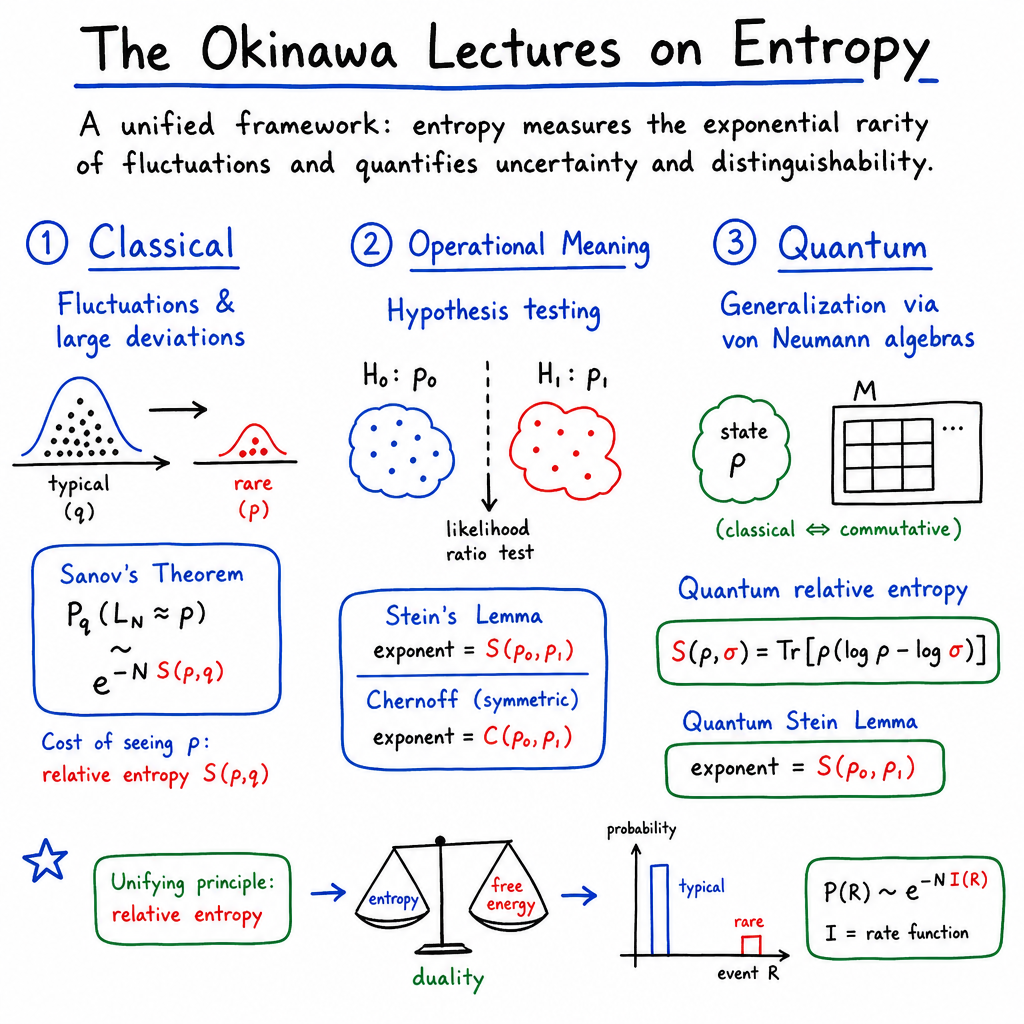
Abstract: After a historical introduction, the most important classical and quantum entropies are introduced as constructions in classical and quantum probability theory. Classical entropies are studied from large deviation theory, including theorems of Sanov, Cramér, Gärtner-Ellis, and Varadhan, and are illustrated in some applications to both Boltzmannian and Gibbsian statistical physics. Quantum entropies superficially connect to classical entropies at the formula level, but more deeply do so via the crucial role of entropy in statistical hypothesis testing. The classical (relative) Kullback-Leibler entropy, its quantum counterpart introduced by Umegaki, as well as their deformations proposed by Renyi all fit naturally in this context. Quantum entropy faces the new problem of defining and computing the relative entropy of a pair of states on a subsystem, here formalized as a von Neumann algebra. This requires modular (aka Tomita-Takesaki) theory, which provides the framework for the relative quantum entropies introduced by Araki and Uhlmann (these encompass both the Kullback-Leibler and Umegaki entropies as special cases). To (re)define and compute these entropies in terms of density operators and traces, further constructions are needed, namely Haagerup's noncommutative Lp spaces. Von Neumann algebras also provide the setting for the Connes-Stormer-Narnhofer-Thirring entropy, which is a quantum version of the Kolmogorov-Sinai entropy in dynamical systems and ergodic theory, to which we also provide an introduction. This course was originally inspired by, and should be relevant to, black hole thermodynamics, although we discuss neither this application nor the second law. The course tries to be both mathematically rigorous and interesting to theoretical physicists. Prerequisites are undergraduate probability theory, functional analysis, and quantum theory.
Paper Prompts
Sign up for free to create and run prompts on this paper.
Top Community Prompts
Explain it Like I'm 14
1. What is the paper about?
“The Okinawa Lectures on Entropy” is a set of mathematical lecture notes by Klaas Landsman. It explains the idea of entropy, a concept used in physics, mathematics, information theory, and quantum mechanics.
Entropy can be understood in several related ways:
- how spread out or disorganized something is;
- how uncertain we are about an event;
- how unlikely a large change from the usual behavior is;
- how much two possible explanations or probability patterns differ.
The paper compares entropy in the classical world, where objects have ordinary properties, with entropy in the quantum world, where particles are described using probabilities and mathematical objects called states.
Although the paper mentions black holes, it does not study black holes in detail. Instead, it develops the mathematical ideas that could later be used to understand topics such as black-hole thermodynamics.
2. Main questions and objectives
The paper is mainly asking:
- What is entropy, and why are there so many different definitions of it?
- How did the idea develop historically?
- How can entropy describe random events and unusual fluctuations?
- How does entropy help explain equilibrium in statistical physics?
- How should entropy be defined for quantum systems?
- What mathematical tools are needed to study entropy in very large or infinite quantum systems?
- How is entropy connected to information, probability, and testing scientific theories?
The author’s goal is not to present one new discovery. Instead, he organizes and explains many important existing ideas in one course. The notes are intended for advanced students and researchers, but the main ideas can be explained more simply.
3. How the paper approaches the subject
The paper uses a mixture of history, probability, physics, and higher mathematics.
Historical explanation
It begins with the work of scientists such as:
- Rudolf Clausius, who introduced entropy in thermodynamics;
- Ludwig Boltzmann, who connected entropy with the behavior of huge numbers of particles;
- Josiah Willard Gibbs, who developed statistical mechanics;
- Albert Einstein, who studied random fluctuations;
- John von Neumann, who defined entropy for quantum systems;
- Claude Shannon, who connected entropy with information;
- Alfréd Rényi and others, who developed new versions of entropy.
This history shows that entropy changed meaning as scientists applied it to new problems.
Classical probability and large deviations
A major part of the paper studies large deviation theory. This is the mathematics of very unusual events.
For example, imagine flipping a fair coin 1,000 times. We normally expect about 500 heads. Getting 510 heads would not be surprising, but getting 900 heads would be extremely unlikely. Large deviation theory measures how quickly the chance of such an unusual result becomes smaller as the number of coin flips increases.
The paper explains important results called:
- Sanov’s theorem;
- Cramér’s theorem;
- the Gärtner–Ellis theorem;
- Varadhan’s theorem.
These theorems are like detailed rules for calculating how unlikely unusual patterns are.
The paper also uses an empirical measure. This simply means recording what actually happened in a large collection of trials. For example, after many coin flips, the empirical measure records the fraction of flips that were heads and tails. It is similar to making a survey of a large group and counting the results.
Statistical physics
The paper applies these ideas to gases and other physical systems. A gas contains an enormous number of particles, each moving in a different way. It is impossible to track every particle individually, so scientists use probabilities and average behavior.
The paper explains how equilibrium—the usual, stable state of a system—can be understood as the most likely large-scale pattern. It discusses the work of Boltzmann and Gibbs, including the familiar relationship
where:
- is free energy;
- is energy;
- is temperature;
- is entropy.
In simple terms, a system tends to balance its energy and its disorder in a way that makes the free energy as small as possible.
Quantum entropy
The paper then moves to quantum mechanics. In quantum theory, a system may not have one definite state before it is measured. Instead, it may be described by probabilities.
For an ordinary probability list , Shannon entropy is
This is high when the possibilities are evenly balanced and low when one possibility is almost certain.
For example:
- A fair coin has high uncertainty.
- A coin that always lands heads has very low uncertainty.
Quantum mechanics uses a similar formula, called von Neumann entropy:
where is a mathematical description of the quantum state. The symbol , called the trace, is a way of adding together information from the quantum state.
For simple quantum systems, this is similar to Shannon entropy. However, quantum systems can have special features, such as superposition and entanglement, so more advanced mathematics is needed.
Von Neumann algebras and modular theory
To study complicated quantum systems, especially systems with infinitely many possible states, the paper uses von Neumann algebras.
A von Neumann algebra can be thought of as a carefully organized collection of mathematical operations representing the measurements that can be made on a quantum system.
For ordinary finite quantum systems, entropy can often be calculated using matrices and traces. For more general systems, this is not enough. The paper therefore introduces:
- relative entropy, which compares two probability or quantum states;
- modular theory, a framework for comparing quantum states in very general settings;
- noncommutative spaces, which extend familiar ideas about functions and averages to quantum operators.
These topics are technically difficult, but their purpose is straightforward: they provide better tools for measuring uncertainty and differences between quantum states.
4. Main findings and important results
Because this is a lecture course rather than an experiment, its “findings” are mainly mathematical conclusions and connections.
Entropy has several connected meanings
The paper shows that entropy is not just one formula. It can describe:
- disorder or the number of possible arrangements;
- uncertainty about an outcome;
- the probability of unusual fluctuations;
- the difference between two probability models;
- information gained from observing a system;
- the complexity of a changing dynamical system.
These meanings look different, but mathematics shows that they are closely related.
Unusual events become exponentially unlikely
One of the central ideas is that large deviations usually have probabilities of approximately the form
where:
- is the number of observations or particles;
- is a quantity that measures how unusual the event is.
The bigger is, the less likely the event becomes. This explains why large systems usually stay close to their average behavior.
This is important in statistical physics because it helps explain why gases and other systems appear predictable even though their individual particles move randomly.
Equilibrium is connected to maximum entropy
The paper explains why equilibrium states are often the most likely states. There are usually many more microscopic arrangements that look like equilibrium than arrangements that look unusual.
For example, if many particles are placed in a box, there are vastly more ways for them to be spread throughout the box than for them all to gather in one corner. Therefore, the spread-out state is overwhelmingly more likely.
This gives a statistical explanation for why systems tend to move toward equilibrium.
Relative entropy is especially fundamental
The paper argues that relative entropy is more basic than some of the better-known forms of entropy.
Relative entropy compares a probability distribution with a chosen reference distribution. It is similar to asking:
“How different is what we observed from what we expected?”
The classical version is called Kullback–Leibler relative entropy. Its quantum version is called Umegaki relative entropy.
The paper explains that Shannon entropy and von Neumann entropy can be seen as special cases of relative entropy when the reference state is a uniform distribution—one in which all possibilities are treated equally.
Quantum and classical entropy are related, but not identical
The formulas for classical and quantum entropy look similar, but quantum systems require new ideas because quantum measurements do not always behave like ordinary probabilities.
For simple systems, quantum entropy can be calculated from a matrix of probabilities. For more complicated systems, von Neumann algebras and modular theory are needed.
This shows that quantum information is not merely ordinary information with smaller particles. Quantum theory has its own special mathematical structure.
Entropy is useful for testing hypotheses
The paper emphasizes that relative entropy has a practical meaning in statistical hypothesis testing.
Suppose someone proposes a model for how a coin works. We can collect many flips and compare the results with the model. Relative entropy tells us how strongly the evidence separates one explanation from another.
In quantum physics, the same basic idea can be used to compare two possible quantum states. This connects entropy with deciding which scientific explanation is more believable.
5. Why the research matters
The paper’s main impact is that it brings together many areas that are often taught separately:
- thermodynamics;
- statistical mechanics;
- probability theory;
- information theory;
- quantum mechanics;
- dynamical systems;
- operator algebras.
This unified view can help scientists see that many different entropy formulas are answering related questions about uncertainty, likelihood, information, and change.
The ideas may be useful in several areas:
- understanding gases and materials;
- designing communication systems;
- developing quantum computers;
- studying quantum information;
- analyzing complex dynamical systems;
- investigating thermodynamics in extreme settings, including black holes.
The paper also makes clear that entropy is still not completely understood. In particular, the author does not try to settle every question about the second law of thermodynamics, which is often summarized by saying that entropy tends to increase. The exact meaning of this statement can depend on what kind of system and definition of entropy are being used.
Simple conclusion
In everyday language, entropy measures how many possibilities a system has and how uncertain or unusual its state is. A system usually moves toward states that can happen in the greatest number of ways. That is why gases spread out, why average behavior becomes predictable in large systems, and why information can be measured using entropy.
The paper explains how this simple idea grows into a powerful mathematical theory. It shows that the same basic concept can help describe coins, gases, computers, quantum particles, and perhaps even black holes.
Knowledge Gaps
Knowledge gaps, limitations, and open questions
- The paper explicitly omits the second law of thermodynamics, leaving unresolved how the classical, statistical, and quantum entropy frameworks developed in the lectures relate to a precise formulation of entropy increase.
- It does not establish whether, or under which axioms, the various formulations of the second law—Clausius, Thomson/Kelvin, Carathéodory, Lieb–Yngvason, and statistical-mechanical formulations—are genuinely equivalent.
- The relationship between equilibrium entropy in phenomenological thermodynamics and the paper’s emphasis on entropy as a measure of fluctuations away from equilibrium is identified but not developed into a unified formal framework.
- The paper does not provide a complete derivation of macroscopic irreversibility from reversible microscopic dynamics, including a precise account of coarse-graining, typicality, initial conditions, and the role of the thermodynamic limit.
- The connection between return to equilibrium, entropy production, and fluctuation–dissipation relations is mentioned but not technically analyzed or proved in the general settings relevant to classical and quantum systems.
- The paper excludes the area law for black-hole entropy, despite presenting black-hole thermodynamics as a major motivation; it therefore leaves unresolved how von Neumann-algebraic and modular-entropy constructions reproduce the geometric area term.
- It does not explain how ultraviolet divergences, renormalization, gravitational degrees of freedom, and horizon localization affect the definition of entropy for quantum fields near black-hole horizons.
- The role of holography in relating bulk gravitational entropy to boundary quantum-information measures is mentioned only as context and is not integrated with the entropy frameworks presented.
- The paper does not address the second law for black holes, including generalized entropy, quantum corrections, Hawking radiation, horizon dynamics, and the conditions under which generalized entropy is expected to increase.
- The entropy-related role of partial differential equations is explicitly omitted, including entropy solutions, entropy inequalities, and the mathematical mechanisms by which irreversible macroscopic equations emerge from microscopic models.
- No systematic connection is developed between large deviations, gradient flows, entropy production, and dissipative PDEs, despite noting that these theories are closely related.
- The paper does not examine the precise hypotheses required for entropy monotonicity in the Boltzmann equation, nor how such results extend to arbitrary initial data, singular solutions, boundaries, external forces, or quantum kinetic equations.
- The treatment of Boltzmann’s -theorem does not resolve the conceptual tension between microscopic time reversibility and macroscopic entropy increase, including Loschmidt’s reversibility objection and Zermelo’s recurrence objection.
- The relationship between Boltzmann’s combinatorial entropy, Gibbs entropy, and the entropy of empirical measures is described historically but not fully characterized under interacting-particle dynamics or non-equilibrium ensembles.
- The large-deviation discussion, as represented in the text, does not establish the range of validity of Sanov, Cramér, Gärtner–Ellis, and Varadhan theorems for non-independent, non-identically distributed, long-range, or dynamically correlated systems.
- It remains unclear how the large-deviation rate functions discussed in the paper should be modified for systems with phase transitions, non-convex free energies, metastability, or non-unique equilibrium states.
- The treatment does not fully address cases in which the Gärtner–Ellis differentiability or steepness assumptions fail, leaving the relation between rate functions and Legendre–Fenchel transforms unresolved in singular models.
- The paper does not systematically compare microcanonical, canonical, and grand-canonical entropies outside finite-state or otherwise well-behaved settings, particularly when ensemble equivalence fails.
- The status of entropy for systems with infinite phase space, unbounded Hamiltonians, or non-normalizable Gibbs measures is not fully resolved.
- The paper introduces classical and quantum relative entropies but does not provide a comprehensive comparison of their operational meanings beyond hypothesis testing, such as resource-theoretic interpretations, thermodynamic work extraction, or reversibility under quantum operations.
- The conditions under which classical Kullback–Leibler entropy, Umegaki entropy, Araki entropy, Uhlmann entropy, and Rényi-type quantities coincide or differ substantially are not organized into a complete comparison theorem.
- The operational interpretation of Rényi divergences in infinite-dimensional and von Neumann-algebraic settings remains underdeveloped, especially regarding domain conditions, continuity, and their exact hypothesis-testing meanings.
- The paper does not fully resolve how to define or compute entropy when two states have non-overlapping supports, when relative entropy is infinite, or when the relevant Radon–Nikodym derivatives are unbounded.
- Although modular theory is presented as the general framework for entropy on subsystems, the paper does not work out concrete computational methods for physically important type II and type III von Neumann algebras.
- The relation between modular operators, modular flow, relative entropy, and experimentally accessible observables is not developed beyond the formal mathematical construction.
- The discussion of Haagerup’s noncommutative spaces does not establish practical algorithms or explicit examples showing how these spaces enable entropy calculations in quantum field theory or other type III systems.
- The paper does not investigate the continuity, stability, and approximation properties of Araki or Uhlmann relative entropy under finite-dimensional truncations, increasing algebras, or thermodynamic limits.
- The relationship between subsystem entropy and the choice of algebra—rather than merely the choice of Hilbert-space tensor factor—is not explored in sufficient detail, particularly for gauge theories and quantum field theories.
- The treatment does not address gauge constraints, edge modes, superselection sectors, or the failure of naive tensor-factorization when defining quantum entropy for spatial subsystems.
- The paper introduces the Connes–Størmer–Narnhofer–Thirring entropy but does not provide a systematic comparison with other notions of dynamical entropy, including Voiculescu–Brown entropy, CNT entropy in non-factorial settings, and classical Kolmogorov–Sinai entropy.
- The precise hypotheses under which quantum dynamical entropy reduces to classical Kolmogorov–Sinai entropy are not fully established or illustrated through sufficiently broad examples.
- The paper does not clarify how different quantum dynamical entropies behave for non-amenable groups, continuous-time dynamics, dissipative channels, or open quantum systems.
- The links between entropy, ergodicity, mixing, and spectral properties of quantum dynamical systems are introduced but not developed into general structural results.
- The paper’s treatment is primarily expository and does not contribute new theorems, generalizations, or systematic comparative results; consequently, several claims are presented as motivation or overview rather than resolved conclusions.
- The historical narrative identifies unresolved disputes concerning Boltzmann’s and Gibbs’s approaches but does not settle how their theories should be mathematically unified or distinguished in modern statistical mechanics.
- The paper does not assess the empirical or experimentally testable content of the competing entropy interpretations, particularly the distinction between epistemic uncertainty, ensemble entropy, and physical thermodynamic entropy.
- The relation between entropy and information is introduced through Shannon’s formulation, but the paper does not fully address the philosophical and operational distinction between uncertainty, information, ignorance, and physical entropy.
- The role of measurement, observation, and observer-dependent coarse-graining in producing effective entropy increase remains largely unexplored.
- The paper does not analyze finite-size corrections, convergence rates, or error bounds for the asymptotic entropy and large-deviation results used to connect microscopic models with thermodynamic behavior.
- The effects of finite observation time, experimental noise, imperfect state preparation, and limited access to degrees of freedom on entropy estimation are not considered.
- The prerequisites and exposition are aimed at a broad audience, but the paper does not clearly delimit which statements require separability, faithfulness, normality, sigma-finiteness, finite dimensionality, or other technical assumptions.
- Because the supplied text is incomplete and ends mid-discussion, the paper’s later treatment of Shannon, Rényi, quantum hypothesis testing, modular theory, noncommutative spaces, and dynamical entropy cannot be assessed for additional omissions or unresolved issues.
Practical Applications
Immediate Applications
- Risk and anomaly detection through large deviations (finance, cybersecurity, manufacturing, energy)
- detecting abnormal transaction patterns or market losses;
- identifying cyberattacks through deviations in network traffic distributions;
- flagging manufacturing defects from atypical sensor profiles;
- forecasting rare failures in power grids or energy-storage systems.
- Feasibility assumptions: the observations should be sufficiently independent, stationary, or modeled by an appropriate dependent-process extension; the underlying distribution and rate function must be estimated reliably; rare-event estimates can be inaccurate with limited data.
- Entropy-based monitoring of industrial and physical systems (robotics, process engineering, IoT) Shannon or relative entropy can provide compact measures of uncertainty, disorder, or deviation from a reference operating state. A monitoring system could compare the observed distribution with a baseline using relative entropy, such as the Kullback–Leibler divergence, and trigger maintenance when the discrepancy becomes large. Feasibility assumptions: the baseline must represent healthy operation, measurements must be calibrated, and thresholds must distinguish genuine faults from normal environmental variation.
- Maximum-entropy modeling for incomplete information (science, engineering, public policy)
- estimating demand distributions when only averages or conserved quantities are known;
- modeling population, traffic, or energy-use patterns;
- reconstructing missing scientific measurements;
- generating probabilistic priors for inverse problems.
- Feasibility assumptions: the selected constraints must be meaningful and sufficient; maximum entropy does not guarantee that the resulting model captures causal structure or hidden dependencies.
- Free-energy optimization for physical and computational systems (energy, materials, chemical engineering)
- compare material phases;
- optimize heat-engine or refrigeration-cycle designs;
- estimate equilibrium compositions;
- evaluate energy-storage and thermal-management strategies.
- Feasibility assumptions: the system must be close enough to equilibrium for the chosen Gibbs or free-energy model to apply, and accurate Hamiltonians, energy functions, or thermodynamic parameters are required.
- Information-theoretic feature selection and compression (software, machine learning, data science)
- rank variables by information content;
- detect redundant features;
- construct data-compression schemes;
- quantify uncertainty in probabilistic predictions;
- compare model outputs with observed data.
- Feasibility assumptions: entropy depends on the probability model, discretization, and estimator. High entropy is not automatically useful information, and low relative entropy does not establish predictive adequacy.
- Classical statistical hypothesis testing (healthcare, quality control, public administration)
- comparing treatment-response distributions;
- validating whether a production line has changed regime;
- testing whether policy outcomes differ from historical patterns;
- identifying distribution shift in deployed machine-learning systems.
- Feasibility assumptions: the hypotheses must be explicitly specified, sampling bias must be controlled, and statistical significance should not be confused with practical importance.
- Quantum-state discrimination and quantum communication analysis (quantum computing and telecommunications)
- distinguish quantum states;
- assess distinguishability under measurements;
- evaluate quantum-channel performance;
- study privacy and information leakage;
- benchmark noisy quantum devices.
- Feasibility assumptions: reliable state tomography or alternative characterization methods are needed; Hilbert-space dimension and noise models may make direct computation expensive; laboratory implementations remain limited in scale.
- Entropy-aware education and research training (academia, education)
- entropy as uncertainty and as a fluctuation rate;
- the relationship between Shannon, Gibbs, Kullback–Leibler, von Neumann, and Rényi entropies;
- the role of variational principles;
- classical–quantum analogies and their limits.
- Feasibility assumptions: students need prerequisites in probability, functional analysis, and quantum theory; substantial scaffolding is required for the von Neumann algebra material.
- Policy communication about uncertainty and rare events (government, public health, climate and disaster planning) Large-deviation methods can support clearer communication of low-probability, high-impact scenarios, such as epidemic surges, floods, supply-chain disruptions, or energy shortages. Agencies could report both expected behavior and the estimated exponential cost of deviations. Feasibility assumptions: policy models must account for nonstationarity, feedback, strategic behavior, and model uncertainty; numerical probabilities should not be presented as exact forecasts.
- Daily-life decision support based on uncertainty measures (consumer software, personal analytics) Entropy concepts can be incorporated into recommendation, scheduling, and personal-finance tools to indicate confidence or ambiguity rather than presenting a single deterministic answer. For example, an application could signal when several choices have nearly equal predicted utility or when a user’s spending distribution differs sharply from their normal pattern. Feasibility assumptions: users must receive interpretable explanations; privacy, consent, and the risk of over-monitoring personal behavior must be addressed.
Long-Term Applications
- Scalable quantum hypothesis-testing and quantum-secure communication (quantum computing, cybersecurity)
- optimal discrimination of noisy quantum states;
- quantum key-distribution security analysis;
- certification of quantum channels;
- adaptive quantum sensing;
- privacy guarantees for quantum networks.
- This requires extending finite-dimensional formulas and algorithms to realistic, noisy, open, and possibly infinite-dimensional systems.
- Dependencies: fault-tolerant quantum hardware, efficient tomography or shadow-estimation techniques, experimentally validated noise models, and rigorous finite-sample security bounds.
- Noncommutative entropy tools for quantum many-body systems (condensed matter, quantum simulation, materials science)
- entanglement and relative entropy in lattice models;
- phase-transition indicators;
- thermalization and information transport;
- quantum error-correction properties.
- Dependencies: computationally tractable representations of von Neumann algebras, scalable numerical approximations, and experimentally accessible observables.
- Modular-theory methods for quantum field theory and black-hole physics (fundamental physics, quantum gravity)
- defining subsystem information in quantum field theory;
- analyzing horizons and entanglement across causal boundaries;
- studying holography and black-hole thermodynamics;
- clarifying the relationship between area laws, relative entropy, and energy conditions.
- Dependencies: unresolved conceptual and mathematical issues concerning renormalization, gravitational observables, horizon degrees of freedom, and the physical interpretation of algebraic entropy. The paper explicitly presents this as motivation and an open research direction rather than an established application.
- Rare-event simulation and reliability platforms for complex systems (infrastructure, energy, aerospace, climate engineering)
- cascading grid failures;
- aircraft or autonomous-vehicle faults;
- extreme climate events;
- epidemics;
- large-scale supply-chain disruptions.
- Dependencies: high-dimensional interacting systems violate simple independent-sample assumptions; accurate path-space rate functions and efficient algorithms are needed; validation against genuinely rare observations is difficult.
- Entropy-based control for autonomous robots and adaptive agents (robotics, autonomous vehicles) A future controller could use entropy reduction as an explicit objective: a robot would select actions that most efficiently reduce uncertainty about its environment while balancing energy and task performance. Relative entropy could quantify belief updates, and large-deviation estimates could identify unlikely but dangerous states. Dependencies: real-time computation, robust uncertainty models, safe exploration, partially observed dynamics, and guarantees against model misspecification. Entropy reduction alone does not define the robot’s goals or safety constraints.
- Thermodynamically informed machine learning and variational inference (AI, software, scientific computing)
- probabilistic inference;
- energy-based modeling;
- generative modeling;
- uncertainty calibration;
- information bottlenecks;
- distribution-shift detection.
- Future tools may use generalized Rényi or quantum divergences when standard Kullback–Leibler objectives are poorly suited to robustness or tail-risk control.
- Dependencies: optimization stability, principled choice of divergence, computational scalability, and empirical evidence that the thermodynamic analogy improves performance rather than merely re-labeling existing methods.
- Entropy-informed PDE solvers and irreversible-process models (fluid dynamics, kinetic theory, chemical engineering)
- Boltzmann and kinetic equations;
- diffusion and reaction systems;
- rarefied-gas simulation;
- transport and hydrodynamic limits;
- multiscale materials modeling.
- Dependencies: rigorous treatment of arbitrary-time dynamics, stable discretizations, boundary-condition handling, and proofs or numerical evidence that the discretized model preserves the relevant entropy law.
- Entropy-based phase-transition and materials-discovery systems (materials science, chemistry, energy storage)
Combining Gibbs variational principles, large deviations, and computational statistical mechanics could yield automated workflows for discovering stable or metastable materials and predicting phase changes. A platform might:
- define candidate microscopic models;
- compute free-energy differences;
- estimate fluctuation probabilities;
- rank materials by stability, transport, or storage performance. Dependencies: accurate microscopic Hamiltonians, sufficient sampling of metastable states, treatment of finite-size effects, and experimental validation.
Public-sector early-warning systems for systemic risk (finance, public health, governance) A long-term policy platform could combine entropy, divergence, and dynamical-entropy measures to detect structural changes in complex systems before conventional indicators become conclusive. Possible targets include financial contagion, demographic shifts, hospital overload, misinformation propagation, and infrastructure stress. Dependencies: access to timely and representative data, safeguards against surveillance misuse, transparent statistical assumptions, and governance mechanisms preventing automated entropy scores from becoming unreviewed policy decisions.
- A unified classical–quantum information software stack (academia, quantum industry, software engineering)
- Shannon and Rényi entropies;
- Kullback–Leibler and Umegaki divergences;
- finite- and infinite-dimensional approximations;
- large-deviation estimators;
- dynamical entropy calculations.
- Dependencies: standardized data structures, numerical methods for unbounded operators and noncommutative spaces, reproducibility standards, and clear separation between mathematically exact results and finite-data approximations.
Glossary
- Adiabatic inaccessibility: A thermodynamic condition describing when one state cannot be reached from another without heat exchange. “Carathodorian axiomatic approaches to thermodynamics ... are based on adiabatic inaccessibility axioms”
- Canonical ensemble: A statistical-mechanical ensemble describing systems at fixed temperature, typically with variable energy. “Boltzmann (1871) contains a discussion of the canonical ensemble”
- Carnot cycle: An ideal reversible heat-engine cycle operating between two temperatures. “Eq. holds for a reversible cycle”
- Coarse-graining: The replacement of detailed microscopic information by a lower-resolution macroscopic description. “both are based on a coarse-graining technique using what we now call an empirical measure”
- Connes–Størmer–Narnhofer–Thirring entropy: A quantum dynamical entropy defined for von Neumann algebras. “Von Neumann algebras also provide the setting for the Connes--St\o rmer--Narnhofer--Thirring entropy”
- Density operator: A positive, trace-one operator representing a quantum state. “ is his notation for a density operator”
- Dirac delta-function: A generalized function concentrated at one point and integrating to one. “the Dirac delta-function”
- Dynamical systems: Systems whose states evolve according to specified mathematical rules over time. “which is a quantum version of the Kolmogorov--Sinai entropy in dynamical systems”
- Empirical measure: A probability measure formed by assigning equal weight to observed samples or particles. “what we now call an empirical measure”
- Ergodic theory: The study of long-term statistical behavior in measure-preserving dynamical systems. “to which we also provide an introduction”
- Fenchel transform: A convex-analytic transformation relating a function to its conjugate through an optimization operation. “free energy and entropy are Fenchel transforms of each other”
- Fluctuation-dissipation theorem: A result relating equilibrium fluctuations to the dissipative response of a system. “the two are related by fluctuation-dissipation theorems”
- Free energy: A thermodynamic potential combining internal energy and entropy, often optimized in equilibrium models. “the variational principles - state that free energy and entropy are Fenchel transforms of each other”
- Gärtner–Ellis theorem: A large-deviation theorem deriving rate functions from limiting logarithmic moment-generating functions. “including central theorems of Sanov, Cramer, Gärtner--Ellis, and Varadhan”
- Grand canonical ensemble: A statistical-mechanical ensemble allowing both energy and particle number to fluctuate. “Gibbs introduces the microcanonical, canonical, and grand canonical ensembles”
- Haagerup’s noncommutative spaces: Generalizations of function spaces for operators associated with von Neumann algebras. “Haagerup's noncommutative spaces”
- H-theorem: Boltzmann’s result that a kinetic-theory entropy-like functional is nonincreasing in time. “what is now known as his -theorem”
- Hilbert space: A complete inner-product vector space used as the state space of quantum systems. “von Neumann defined the abstract concept of a Hilbert space”
- Holography: A proposed correspondence in which a theory in one dimension or setting encodes physics in another, often involving a boundary. “This context, typically enriched by ‘holography’”
- Information function: A function assigning the information content or surprise of an outcome. “the -dependent ‘information’ function”
- Kinetic theory: A statistical description of macroscopic matter based on microscopic particle motion. “the upcoming kinetic theory of gas”
- Kolmogorov–Sinai entropy: An entropy measuring the dynamical complexity or information production of a measure-preserving system. “a quantum version of the Kolmogorov--Sinai entropy”
- Large deviation theory: The mathematical study of exponentially unlikely deviations from typical probabilistic behavior. “This is studied in what is called large deviation theory”
- Maxwell distribution: The equilibrium probability distribution of molecular velocities in a classical gas. “his well-known formula for the velocity distribution in equilibrium”
- Microcanonical ensemble: An ensemble describing isolated systems with fixed energy, volume, and particle number. “Gibbs introduces the microcanonical, canonical, and grand canonical ensembles”
- Modular theory: The Tomita–Takesaki framework for analyzing states and automorphisms of von Neumann algebras. “the general case requires modular (aka Tomita--Takesaki) theory”
- Noncommutative spaces: Operator-algebraic analogues of classical spaces for noncommuting observables. “Haagerup's noncommutative spaces”
- Operator algebra: An algebra of operators on a Hilbert space, typically closed under relevant topological operations. “their interaction with operator algebras”
- Projection operator: An operator representing projection onto a subspace or quantum state. “ is the projection onto ”
- Quantum relative entropy: A quantum generalization of relative entropy that measures distinguishability between quantum states. “the quantum relative entropy introduced by Umegaki”
- Rate function: A function determining the exponential decay rate of probabilities of rare events. “Classical entropies give the rate of exponential decay of large deviations”
- Reversible cycle: A thermodynamic cycle that can be reversed without producing net changes in the system or environment. “reversible cycles have maximal efficiency”
- Sanov’s theorem: A large-deviation principle for empirical measures of independent random samples. “including central theorems of Sanov”
- Spectral theory: The study of eigenvalues, eigenvectors, and spectral decompositions of operators. “developed the spectral theory of bounded as well as unbounded normal operators”
- Statistical mechanics: The branch of physics connecting microscopic states and probabilities to macroscopic thermodynamic behavior. “Gibbsian statistical mechanics culminates in the following variational principles”
- Tomita–Takesaki theory: A theory describing modular operators, modular conjugations, and modular automorphism groups of von Neumann algebras. “modular (aka Tomita--Takesaki) theory”
- Umegaki entropy: A quantum relative entropy defined using traces of density operators. “its quantum counterpart introduced by Umegaki”
- Varadhan’s theorem: A large-deviation result relating exponential integrals to variational optimization over rate functions. “including central theorems of Sanov, Cramer, Gärtner--Ellis, and Varadhan”
- Von Neumann algebra: A weak-operator-closed *-algebra of bounded operators containing the identity. “the general case requires modular (aka Tomita--Takesaki) theory”
- factor: A type of infinite-dimensional von Neumann algebra with trivial center and a finite normalized trace. “his favourite factors”

