A counterexample to the Foregger-Sinkhorn tie-point conjecture
Abstract: The Foregger-Sinkhorn tie-point conjecture asserts that if a nearly decomposable doubly stochastic matrix minimizes the permanent on a face and the permanental cofactor at a prescribed zero is larger than its permanent, then that zero is a tie point. We give a counterexample in dimension eight.
- Degree-$M$ Bethe and Sinkhorn Permanent Based Bounds on the Permanent of a Non-negative Matrix (2023)
- Unleashing the power of Schrijver's permanental inequality with the help of the Bethe Approximation (2011)
- Characterization of polystochastic matrices of order $4$ with zero permanent (2024)
- Lih Wang and Dittert Conjectures on Permanents (2023)
- A counterexample to the parity conjecture (2023)
- A simple counterexample for the permanent-on-top conjecture (2021)
- Multidimensional permanents of polystochastic matrices (2020)
- Bounds on the permanent and some applications (2014)
- A Counterexample to a basis conjecture of Brualdi, Friedland, and Pothen (2026)
- Dittert's conjecture in dimension 16 via a joint-deficit scaling lemma (2026)
Summary
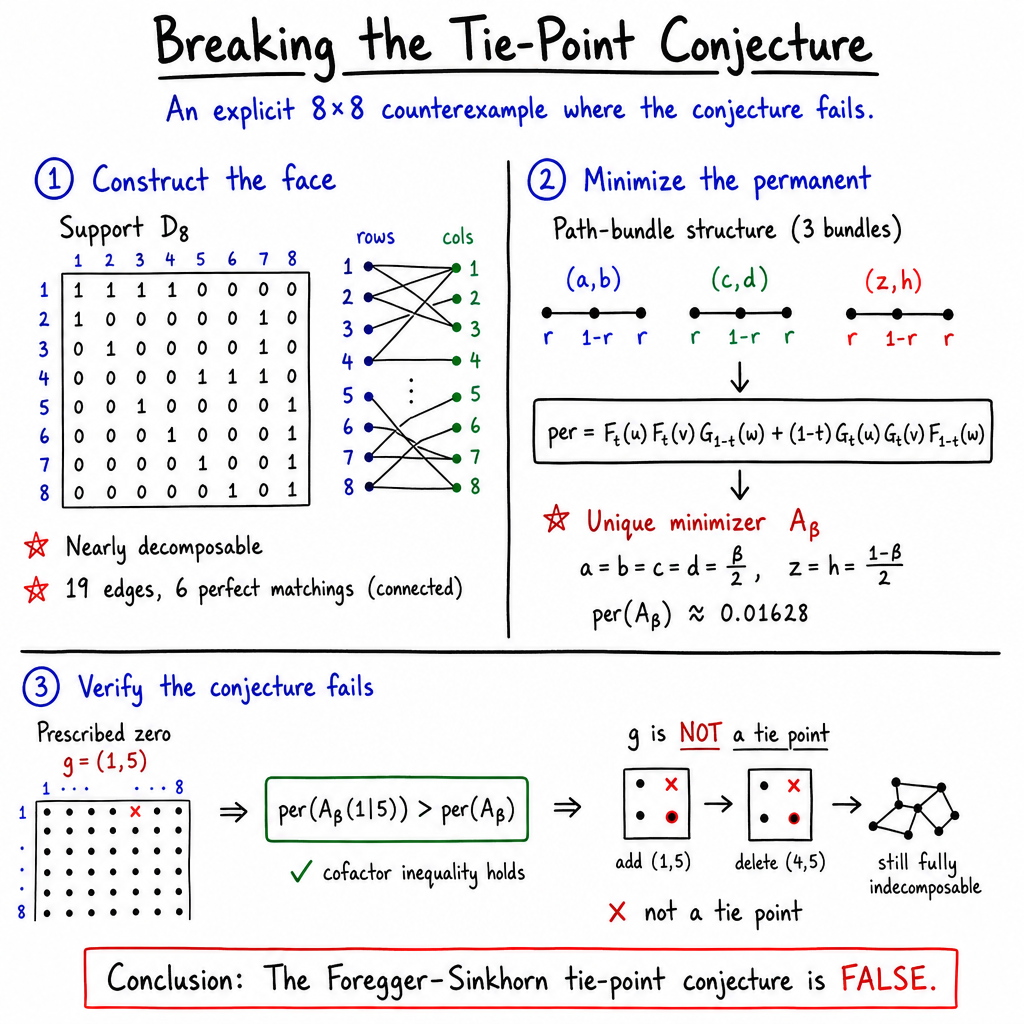
- The paper constructs an explicit order-eight counterexample in which a nearly decomposable support has a unique global permanent minimizer, yet the Foregger–Sinkhorn implication fails.
- The authors parametrize the complete face of the Birkhoff polytope and use a multiaffine reduction to prove global uniqueness, obtaining a minimizer with permanent approximately 0.01628248.
- For the zero position (1,5), the permanental cofactor exceeds the permanent by more than 0.024, but deleting an original edge leaves the augmented support fully indecomposable, proving that the position is not a tie point.
A counterexample to the Foregger–Sinkhorn tie-point conjecture
Problem setting
The paper “A counterexample to the Foregger–Sinkhorn tie-point conjecture” (2608.13025) refutes a longstanding implication concerning permanent minimization over faces of the Birkhoff polytope. Let Ωn denote the polytope of n×n doubly stochastic matrices. For a prescribed set of zero positions Z, the face Ωn(Z) consists of all doubly stochastic matrices vanishing on Z.
The conjecture concerns a nearly decomposable support. A support is fully indecomposable when its associated bipartite graph is connected, every support edge belongs to a perfect matching, and no permissible single-edge deletion produces a partly decomposable support. Given a zero position g outside a nearly decomposable support S, the position is called a tie point if adding g and then deleting any original support edge always yields a partly decomposable support.
The Foregger–Sinkhorn conjecture asserted that if a nearly decomposable matrix A minimizes the permanent over the corresponding face and a prescribed zero (i,j) satisfies
n×n0
then n×n1 must be a tie point. The paper constructs an explicit counterexample in dimension eight. The result is a direct separation between a strict permanental-cofactor inequality and the combinatorial condition imposed by tie-point structure.
The order-eight support
The counterexample is based on the zero-one support matrix
n×n2
The support has 19 edges and exactly six perfect matchings, represented by the row-to-column strings
n×n3
These matchings establish total support because their union contains every support edge. The paper also exhibits a spanning tree of the associated 16-vertex bipartite graph, proving connectedness. Consequently, n×n4 is fully indecomposable.
To prove near decomposability, the authors verify that every support edge is essential. For each edge n×n5, they identify another edge n×n6 such that every perfect matching containing n×n7 also contains n×n8. Deleting n×n9 therefore leaves Z0 outside every perfect matching, destroying total support. Hartfiel’s single-edge deletion criterion then implies that every such deletion produces a partly decomposable support. Thus Z1 is nearly decomposable.
The construction also lies outside the “complex” or “multiplex” family for which the tie-point implication had previously been verified. In the present support, four vertices have degree greater than two, rather than the two distinguished vertices characteristic of that special family. This distinction is important: the counterexample does not merely expose a gap in a proof for the known family, but demonstrates that the conjecture fails once its restrictive incidence pattern is removed.
Parametrization of the entire face
A central technical component is the explicit parametrization of every matrix in the closed face Z2. Each matrix has the form
Z3
where
Z4
The row and column constraints determine all remaining entries. The six free path parameters correspond to six length-three paths grouped into three bundles:
- Z5, joining Z6 to Z7;
- Z8, joining Z9 to Ωn(Z)0;
- Ωn(Z)1, joining Ωn(Z)2 to Ωn(Z)3.
Each path has edge weights Ωn(Z)4. The equality of the two endpoint weights is forced by the doubly stochastic constraints, and it permits the permanent to be expressed through bundle-level quantities.
For a bundle with path parameters Ωn(Z)5, define
Ωn(Z)6
The contribution when neither bundle hub is used is
Ωn(Z)7
whereas the contribution when both hubs are used is
Ωn(Z)8
The global graph contains one additional edge, Ωn(Z)9, and its cycle structure restricts perfect matchings to two global states. The permanent therefore becomes
Z0
where
Z1
This reduction is more than a convenient calculation. It makes the optimization over the complete face tractable, including all boundary strata. The authors explicitly avoid restricting attention to matrices with exactly the prescribed support.
Multiaffine reduction and global minimization
For fixed bundle sums, the products satisfy
Z2
After normalizing these intervals, the permanent is affine in each normalized product coordinate separately. Hence it is multiaffine in three variables and can be written as a convex combination of its eight corner values.
This observation is crucial. It does not assert that the permanent is globally convex; rather, it exploits coordinatewise affinity to reduce the optimization to eight explicitly analyzable configurations for every fixed Z3.
Seven corner values are shown to exceed Z4. The remaining corner, corresponding to equality of the two path parameters in every bundle, is
Z5
Its derivative factors as
Z6
On Z7, the first two factors are negative, so the sign of the derivative is determined by
Z8
The derivative of Z9 is strictly positive on the real line because its discriminant is negative and its leading coefficient is positive. Moreover,
g0
Therefore g1 has a unique root g2 in g3, and g4 decreases strictly up to g5 and increases strictly afterward. The unique global minimizer on the entire closed face is consequently obtained at
g6
where g7 is the unique root in the stated interval of
g8
The resulting matrix g9 has permanent
S0
The uniqueness claim is stronger than merely exhibiting a local stationary point or a minimizer in the relative interior. The multiaffine convex-combination argument proves global optimality over every boundary and interior stratum of S1, while the strict separation of the seven noncentral corners and the uniqueness of the root S2 establish uniqueness of the minimizer.
Failure of the tie-point implication
The prescribed zero is
S3
The paper computes the corresponding permanental cofactor and obtains
S4
The numerator is strictly decreasing on the isolating interval for S5, and its value at S6 is positive. Consequently,
S7
Thus the conjecture’s numerical hypothesis holds with a substantial strict margin.
The combinatorial conclusion nevertheless fails. After adjoining S8 and deleting the original support edge S9, the resulting support has five perfect matchings:
g0
Their union is the entire augmented-and-deleted support, and the paper gives a spanning tree of the associated bipartite graph. The support therefore remains connected and has total support, hence remains fully indecomposable. Since one original edge can be deleted without producing a partly decomposable support, g1 is not a tie point.
This establishes all components of the counterexample simultaneously: g2 is the unique global permanent minimizer on the relevant face, g3 is nearly decomposable, the cofactor exceeds the permanent, and the prescribed zero is not a tie point.
Theoretical implications
The result invalidates the Foregger–Sinkhorn conjecture in its general form and shows that the cofactor inequality does not encode sufficient information about the edge-critical structure of the support. The inequality compares two weighted matching aggregates: the permanent of the full matrix and the permanent of a deleted-row/deleted-column minor. Tie-point status, by contrast, is a universal structural condition over all original support edges. The counterexample demonstrates that these analytic and combinatorial properties can decouple even at a unique global minimizer.
The proof also illustrates the importance of analyzing the closed face rather than only the relative interior. Boundary points correspond to degenerations in which one path parameter vanishes or two parameters become unequal at fixed sum. Because the permanent is not generally convex on the Birkhoff polytope, a direct convexity argument would be unavailable. The multiaffine decomposition provides a more precise substitute for this particular support geometry.
The order eight should not be interpreted as a proven minimal dimension. The paper explicitly leaves open whether counterexamples exist in smaller dimensions. Determining the minimum order would require an exhaustive or structurally constrained classification of nearly decomposable supports, their face parametrizations, and the corresponding permanent minima.
Practical and future directions
For extremal permanent problems, the result cautions against inferring support-criticality from first-order or cofactor comparisons alone. Algorithms that search for permanent minimizers and then classify zeros through cofactor inequalities will require an independent combinatorial verification of tie-point properties. The support graph, its perfect-matching lattice, and the effect of single-edge deletions must be treated as separate data.
Several directions follow naturally. One is the systematic enumeration of nearly decomposable supports by order, with particular attention to graph families containing multiple high-degree hubs. Another is the development of symbolic or certified computational methods for minimizing permanents on low-dimensional faces. The present proof is especially amenable to such methods because it reduces the permanent to a multiaffine polynomial and isolates the decisive one-variable factor.
More broadly, the counterexample suggests that any valid replacement for the conjecture will need additional hypotheses. Possible restrictions could involve the structure of the support’s ear decomposition, the number and arrangement of high-degree vertices, uniqueness properties of perfect matchings, or stronger relations between the minimizing weights and the support’s edge-criticality. The verified complex/multiplex family indicates that graph-theoretic restrictions may recover a valid theorem even though the unrestricted implication is false.
Conclusion
The paper gives an explicit order-eight counterexample to the Foregger–Sinkhorn tie-point conjecture. It constructs a nearly decomposable support, proves that a specified matrix is the unique global permanent minimizer on the complete associated face, establishes a strict inequality between a permanental cofactor and the permanent, and independently proves that the corresponding zero is not a tie point. The result separates permanent-minimization data from tie-point structure and provides a concrete basis for revising the conjecture through additional combinatorial hypotheses.
Paper to Video (Beta)
No one has generated a video about this paper yet.
Whiteboard
Paper Prompts
Sign up for free to create and run prompts on this paper.
Top Community Prompts
Open Problems
We haven't generated a list of open problems mentioned in this paper yet.
Continue Learning
- How does the multiaffine reduction guarantee global minimization over both the interior and boundary of the associated face?
- Why does the cofactor inequality fail to capture the edge-critical structure required for a tie point?
- Could a Foregger–Sinkhorn-type implication hold under additional restrictions on support graphs, such as the complex or multiplex family?
- What is the smallest matrix dimension in which a counterexample to the tie-point conjecture can occur?
- Find recent papers about counterexamples in permanent minimization and the Birkhoff polytope.
Collections
Sign up for free to add this paper to one or more collections.
Tweets
Sign up for free to view the 2 tweets with 256 likes about this paper.