New Lower and Upper Bounds for the Grothendieck Constant
Abstract: We establish new bounds on the Grothendieck constant $K_G$: [ \frac{6π}{11} \le K_G \le \fracπ{2\log(1+\sqrt2)} - 10{-4}. ] Methodologically, our lower bound approach differs from previous works by establishing limitations on the asymptotically optimal Krivine schemes, rather than giving explicit constructions of gap instances. Our upper bound is obtained by proposing and analyzing the first asymptotic construction of rounding schemes, whereas previous works only consider low-dimensional schemes. Together, these bounds determine the previously unknown tenths digit of $K_G$ to be $7$. The bounds were discovered by a long-running collaborative effort of humans and a long-horizon AI research system that we engineered.
Paper Prompts
Sign up for free to create and run prompts on this paper.
Top Community Prompts
Explain it Like I'm 14
1. What is this paper about?
This paper studies the Grothendieck constant, a famous number from mathematics. It measures how much harder it can be to choose simple signs, either or , compared with choosing general unit vectors.
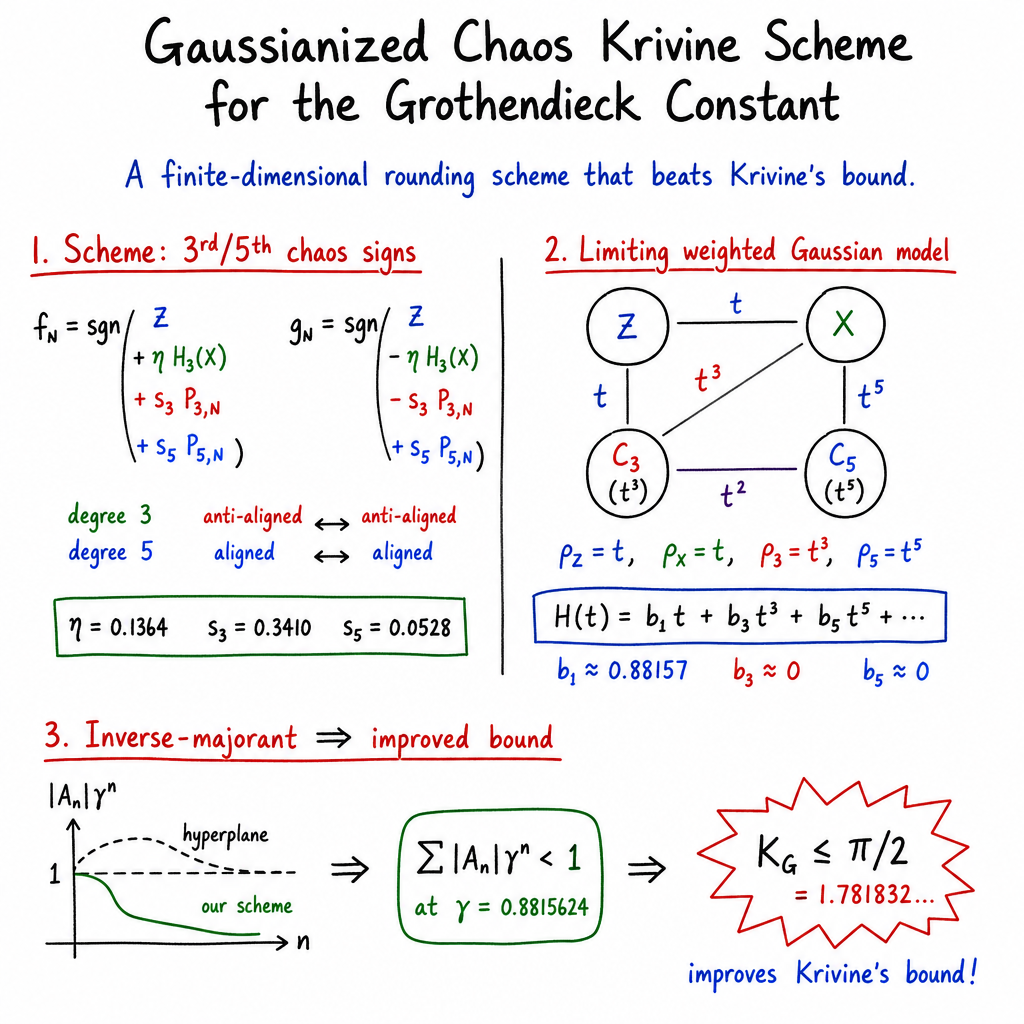
The paper’s main goal is to design a new rounding method that changes vectors into signs more cleverly than older methods. If successful, this method gives a slightly better upper bound for the Grothendieck constant than the long-standing Krivine bound.
The paper proposes using special patterns made from Gaussian random variables and Hermite polynomials. These patterns are called Gaussianized chaos reservoirs.
The claimed result is
which is slightly better than the older bound
However, an important detail is that the main result is conditional in this draft: a computer-assisted numerical certificate still needs to be completed.
2. What questions is the paper asking?
The paper is mainly asking:
- Can a new type of random rounding scheme improve the best known upper bound for ?
- Can carefully chosen degree-3 and degree-5 patterns cancel the first errors that appear in the usual rounding method?
- Can a complicated finite-dimensional construction be understood through a simpler limiting Gaussian model?
- If the limiting model works, can the result be transferred back to an actual finite-dimensional algorithm?
- Can computer calculations verify the numerical inequalities needed to prove the improvement rigorously?
In simpler terms, the researchers are trying to build a better “translator” from vectors to signs.
3. How does the method work?
The original rounding problem
Suppose we have many vectors and want to replace each one by either or . This is useful in optimization problems, where choosing signs is often difficult but choosing vectors is easier.
A rounding scheme is like a rule for converting the vector solution into a sign solution while losing as little as possible.
The paper uses random Gaussian numbers as part of this rule. Gaussian numbers have the familiar bell-shaped probability distribution.
Hermite polynomials
The construction also uses Hermite polynomials, such as
and
These are special polynomials that behave like independent “frequency patterns” for Gaussian randomness. They are somewhat similar to how sine and cosine waves can be used to separate different patterns in sound or images.
The paper uses degree 3 and degree 5 patterns because they can adjust different parts of the rounding behavior.
Two related rounding functions
The main construction uses two functions:
and
Here:
- means “output if the expression is positive and if it is negative.”
- and are Gaussian random variables.
- and are averages of many degree-3 and degree-5 Hermite patterns.
- , , and are carefully chosen numerical weights.
The degree-3 part is anti-aligned: it has opposite signs in and .
The degree-5 part is aligned: it has the same sign in both functions.
This choice is designed to cancel certain unwanted errors.
Why use large reservoirs?
For each degree, the paper forms a reservoir such as
This is like averaging many small random signals. When becomes very large, the result behaves more and more like a Gaussian random variable.
The researchers first study this easier limiting model, then prove that sufficiently large finite values of behave similarly.
Correlation functions and inverse functions
The behavior of the rounding scheme is summarized by a function , where measures how similar two input vectors are.
For the new construction,
The coefficients describe how the rounding scheme reacts to different kinds of similarity.
The paper then studies the inverse function
A condition involving the absolute values of the inverse coefficients is used:
If this condition holds, a standard Krivine argument gives
So the researchers want to make as large as possible.
How the finite and limiting models are connected
The paper proves that the finite-dimensional correlation functions converge to the limiting function .
It uses several advanced ideas:
- Central limit theorem: averages of many random quantities become approximately Gaussian.
- Locally uniform convergence: the functions converge not only at individual points but smoothly throughout every smaller region inside the unit disk.
- Rouché’s theorem: a complex-analysis tool used to show that inverse functions remain stable under small changes.
- Cauchy estimates: estimates that control the size of the later coefficients of a power series.
An everyday analogy is this: if a carefully designed machine works in the ideal infinite-size version, these tools prove that a sufficiently large real machine will also work.
4. What are the main results?
The paper chooses the parameters
For these values, it finds that the first correlation coefficient is approximately
More importantly, the next two important coefficients are almost zero:
These small values mean that the degree-3 and degree-5 corrections successfully cancel the first major nonlinear errors.
The paper then targets
If the stated coefficient estimates are verified, they imply
This would show that the limiting model is admissible. The finite-dimensional transfer theorem would then show that some sufficiently large finite scheme is also admissible.
The final claimed bound is
This improves the previous Krivine bound by approximately
Why this matters
The improvement is numerically small, but mathematically significant. The Grothendieck constant has resisted exact determination for many years. Even a tiny improvement shows that the older rounding strategy was not optimal.
The result also demonstrates a new general idea: instead of simply mixing two rounding methods, one can build a high-dimensional rounding scheme with carefully chosen mathematical patterns that cancel errors directly.
5. What is still unfinished?
The paper openly says that its main theorem is conditional on a coefficient certificate.
This certificate must verify inequalities such as:
the smallness of the coefficient tail,
and bounds on the inverse-series approximation.
These calculations are supposed to be carried out using interval arithmetic. Interval arithmetic does not calculate with just one decimal answer. Instead, it calculates with guaranteed ranges, such as
$0.1234 < x < 0.1235,$
so that rounding errors cannot accidentally make a false statement appear true.
The paper says that the analytic arguments are complete, but the computer-assisted part still needs to be formally inserted. Therefore, the result should currently be understood as:
The paper gives a detailed construction and proof plan, and the advertised bound follows once the remaining numerical certificate is rigorously verified.
6. What could be the impact of this research?
If the certificate is completed successfully, the work would:
- give a new explicit improvement to the best known upper bound for the Grothendieck constant;
- provide a new family of rounding algorithms for optimization problems;
- show that high-dimensional Gaussian and Hermite structures can outperform simpler hyperplane rounding;
- offer techniques that might be extended using degree 7, degree 9, and higher patterns;
- possibly lead to better approximation algorithms for matrix optimization and related problems.
The broader lesson is that complicated random structures can be designed to cancel errors very precisely. In the same way that engineers tune several parts of a machine to reduce vibration, this paper tunes different mathematical “frequencies” to reduce the weaknesses of a rounding procedure.
Knowledge Gaps
The paper leaves the following knowledge gaps, limitations, and open questions unresolved:
- The main theorem remains conditional. The claimed bound depends on the unproved coefficient certificate in Certificate Module $\ref{ass:certificate}$; no completed outward-rounded interval-arithmetic computation is provided.
- The required coefficient bounds are not independently reproducible. The paper gives floating-point values for , but does not provide executable code, interval data, quadrature settings, error bounds, or a machine-checkable certificate for the Gaussian integrals .
- The tail estimates are only proposed, not established. In particular, the bounds
are asserted as certificate requirements, but the paper does not prove them analytically or computationally.
- The numerical cancellation of and lacks a rigorous enclosure. The reported values are close to zero, but the paper does not establish certified signs or sufficiently tight interval bounds showing that these coefficients are genuinely small at the stated parameter values.
- The parameter choice is not justified as optimal or near-optimal. No systematic optimization procedure, search domain, objective function, sensitivity analysis, or proof of local/global optimality is supplied for .
- The robustness of the certificate under parameter perturbations is unknown. The paper does not quantify how much numerical or implementation error in can be tolerated before the inverse-majorant inequality fails.
- The claimed improvement is not compared with the best known rigorous upper bounds. The paper establishes a target of conditional on certification, but does not situate this value against the strongest currently proven bounds for or explain whether it would represent a substantive improvement over them.
- The finite-dimensional transfer theorem is qualitative rather than quantitative. It proves the existence of sufficiently large reservoir length , but gives no explicit value or computable upper bound for .
- No explicit rounding dimension is obtained. Because the required is not quantified, the construction is not yet an explicit algorithmic rounding scheme with a stated finite dimension or runtime.
- The convergence rate is unresolved. The central-limit argument establishes local uniform convergence indirectly, but no quantitative rate is derived on the complex contour needed for inverse-branch stability.
- The complex-analytic transfer argument needs further technical verification. The proof invokes contour convergence and derivative convergence on the image domain , but does not fully specify the required domain regularity, contour separation, or uniform estimates needed to make the argument effective.
- The relationship between the limiting weighted model and finite schemes is established only asymptotically. The paper does not determine whether finite-reservoir collision terms could materially affect the certificate at practical reservoir lengths.
- The inverse branch geometry is not characterized globally. The location of critical points and singularities of , and the maximal admissible inverse radius, remain unknown.
- The Wiener-algebra certificate may be conservative. The paper does not determine how much slack is lost through the bounds involving , , and the residual , nor whether sharper analytic estimates could yield a substantially larger admissible radius.
- The admissibility criterion is not shown to be necessary. It remains unclear whether failure of the absolute inverse-coefficient majorant reflects a genuine limitation of the rounding scheme or merely a weakness of the Krivine preprocessing test.
- The broader chaos family is unexplored theoretically. Although the paper defines arbitrary odd reservoir sets , it does not characterize which degree patterns, signs, or weights can improve the inverse certificate.
- The proposed $7/9$ extension is only numerical. The reported parameters and estimated value for have no rigorous coefficient certificate, transfer proof with explicit data, or confirmed improvement.
- No explanation is given for the apparent numerical decay of high-order coefficients. The observed small coefficients beyond degree $41$ are reported, but the structural or analytic mechanism responsible for this decay is not established.
- The coefficient integrals lack general analytic bounds. The paper reduces the problem to the quantities , but does not derive reusable estimates for these integrals as grow.
- The effect of the base perturbation is not analytically understood. The paper states that this perturbation changes the coefficient profile favorably, but does not identify a rigorous mechanism or derive conditions under which it improves the inverse majorant.
- The construction’s behavior for other threshold functions is unknown. It is not established whether replacing , the sign threshold, or the Gaussian base variable could produce better certificates.
- No lower-bound or optimality information is obtained. The paper does not clarify whether the Gaussianized chaos family can approach the true Grothendieck constant, whether is attainable within the family, or what barriers constrain further improvement.
- The appendix proof is incomplete in the supplied draft. The proof of the Krivine preprocessing theorem is interrupted, so the foundational reduction from the inverse-majorant condition to the Grothendieck bound is not fully documented in the presented text.
- Several formal and notational inconsistencies remain unresolved. The source contains malformed mathematical notation and missing delimiters in multiple equations, which makes it unclear whether all stated definitions and identities have been fully checked in a compilable version.
Practical Applications
Immediate Applications
- SDP-based approximation of bilinear sign optimization — software, optimization, and finance
- The paper provides a new family of Gaussian rounding functions for converting vector-valued solutions of the canonical Grothendieck SDP into binary signs.
- A practical workflow would be:
- 1. Solve an SDP relaxation for .
- 2. Embed the SDP vectors into a Gaussian space.
- 3. Apply the finite third/fifth-chaos sign functions with sufficiently large reservoir length .
- 4. Repeat with independent randomness and retain the best solution.
- Potential applications include correlation clustering, two-sided partitioning, bipartite cut problems, portfolio sign selection, and binary matrix optimization.
- Classification: Immediate Application, as finite-dimensional rounding functions are explicitly defined.
- Dependencies: The claimed numerical guarantee depends on the interval-arithmetic certificate being completed. Practical performance also depends on the required reservoir length, SDP-solving cost, and empirical approximation quality.
- Improved approximation guarantees for matrix cut norms — algorithms and network analysis
- Grothendieck-type rounding is directly relevant to approximating matrix cut norms and related bipartite graph objectives.
- The proposed rounding family could be incorporated into existing SDP-based cut-norm solvers as an alternative to standard hyperplane rounding.
- A software tool could expose multiple rounding backends, including:
- standard hyperplane rounding;
- third-chaos-only rounding;
- the anti-aligned third-/aligned fifth-chaos scheme;
- repeated randomized rounding with empirical best-of-run selection.
- Classification: Immediate Application for experimental algorithm development; the unconditional worst-case improvement is Long-Term unless the certificate is formally verified.
- Dependencies: Correct implementation of normalized Hermite polynomials, stable evaluation of threshold functions, and validation against benchmark instances.
- Graph partitioning and Szemerédi-type decomposition workflows — graph algorithms
- Since matrix cut-norm approximation supports algorithms for finding graph partitions and Szemerédi-type regularity decompositions, the new rounding method could be used as a drop-in replacement within those pipelines.
- Potential workflow:
- construct the adjacency or weighted interaction matrix;
- solve the relevant SDP;
- round the vector solution using the chaos scheme;
- use the resulting cut to recursively refine the partition.
- Classification: Immediate Application as a research prototype; Long-Term for certified improvements in large-scale graph-processing systems.
- Dependencies: The benefit depends on whether the theoretical improvement translates into better cuts on finite instances, and on the computational overhead relative to hyperplane rounding.
- Computer-assisted verification of analytic inequalities — mathematical software and formal numerics
- The paper isolates a finite set of numerical obligations involving:
- Gaussian integrals ;
- coefficients of the limiting correlation;
- inverse coefficients ;
- coefficient tails and residual bounds.
- This naturally supports an Arb, MPFI, interval-quadrature, or proof-assistant implementation that produces a machine-checkable certificate.
- A reusable software package could certify inverse-majorant conditions for other Gaussian threshold functions and chaos reservoirs.
- Classification: Immediate Application for computational mathematics.
- Dependencies: The current paper leaves the decisive certificate as an assumption. Certified quadrature, rigorous tail bounds, and independently reproducible code are required.
- Benchmarking alternative SDP rounding schemes — academia and algorithm engineering
- The explicit third/fifth-chaos construction offers a controlled benchmark for studying how non-hyperplane rounding compares with Gaussian hyperplane rounding.
- Researchers can measure:
- objective value achieved;
- variance across random trials;
- dependence on reservoir size ;
- runtime and memory overhead;
- performance on structured versus random matrices.
- Classification: Immediate Application.
- Dependencies: Results should not be interpreted as a universal practical improvement without empirical testing; the theoretical Grothendieck bound is a worst-case statement.
- Educational and research use as an example of analytic-to-finite transfer
- The proof architecture demonstrates a general methodology:
- define an infinite or limiting correlation model;
- derive explicit coefficient formulas;
- certify an inverse-series condition;
- transfer the result to finite-dimensional constructions using local uniform convergence and Rouche’s theorem.
- This can be used in graduate courses and research training on functional analysis, approximation algorithms, Gaussian analysis, or computer-assisted proofs.
- Classification: Immediate Application.
- Dependencies: The draft contains notation and typesetting defects, so educational use would require editorial correction and clarification of the conditional theorem.
Long-Term Applications
- Certified improvement of worst-case SDP integrality gaps — theoretical computer science
- If the coefficient certificate is completed and independently validated, the construction would yield an explicit finite-dimensional rounding scheme with
improving the classical Krivine value stated in the paper. - This could sharpen worst-case approximation guarantees for all optimization problems whose SDP-to-sign rounding analysis factors through Grothendieck’s inequality. - Classification: Long-Term Application. - Dependencies: Completion of the interval-arithmetic module, correction of any notation or proof gaps, and confirmation that the stated normalization and transfer arguments are fully valid.
Explicit finite-dimensional approximation algorithms with dimension bounds — optimization at scale
- The transfer theorem proves existence of a sufficiently large reservoir length , but does not provide a useful explicit value.
- A major practical development would be to derive a bound of the form
guaranteeing that the finite scheme achieves a target radius within of the limiting model. - This would turn the qualitative construction into an implementable approximation algorithm with known runtime and memory requirements. - Classification: Long-Term Application. - Dependencies: Quantitative collision-expansion estimates, concentration bounds for Hermite reservoirs, and uniform control of on complex contours.
Higher-order chaos rounding libraries — software and combinatorial optimization
- The general family
permits systematic design of rounding functions with alternating reservoir signs
- A future library could automatically optimize and the weights to suppress successive inverse obstructions, then generate: - finite-dimensional rounding code; - coefficient certificates; - runtime estimates; - instance-dependent tuning parameters. - Classification: Long-Term Application. - Dependencies: Reliable nonconvex parameter optimization, certified coefficient computation, and evidence that additional chaos degrees improve finite-instance performance rather than only the limiting constant.
Improved algorithms for correlation clustering and signed network partitioning — machine learning and network science
- Many clustering and signed-graph objectives reduce to selecting binary labels to optimize pairwise bilinear scores. The paper’s rounding mechanism could potentially improve the conversion of relaxed vector embeddings into discrete labels.
- A future product could combine:
- an SDP or spectral embedding stage;
- chaos-based randomized discretization;
- local search or label-refinement postprocessing.
- Classification: Long-Term Application.
- Dependencies: A suitable reduction from each target problem to the Grothendieck form, robust behavior on non-worst-case data, and scalable methods for approximating the high-dimensional chaos features.
- Quantum information and nonlocal-game analysis — quantum computing and operator spaces
- The paper identifies Grothendieck’s inequality as relevant to quantum mechanics and operator spaces. A stronger explicit rounding bound could inform comparisons between classical sign strategies and vector or quantum correlations.
- Possible future uses include:
- bounding classical values of bipartite correlation games;
- constructing explicit classical strategies from vector-valued relaxations;
- studying the gap between classical and quantum bilinear correlations.
- Classification: Long-Term Application.
- Dependencies: A precise translation of the chaos-rounding certificate into the relevant nonlocal-game model, compatibility with the normalization conventions, and analysis of whether the construction yields operationally meaningful strategies.
- Automated discovery of rounding schemes — AI-assisted mathematical optimization
- The coefficient formula converts the design problem into a parameter-search task over and the reservoir weights .
- One could build an automated pipeline that:
- evaluates certified approximations of ;
- optimizes cancellation of ;
- estimates the inverse-majorant radius;
- proposes new degree sets such as .
- Classification: Long-Term Application.
- Dependencies: Differentiable or surrogate models for the Gaussian integrals, rigorous validation after numerical optimization, and avoidance of overfitting to floating-point artifacts.
- Formal verification of computer-assisted functional-analysis results — policy and research infrastructure
- The modular “certificate module” design is suitable for reproducible mathematical verification: analytic arguments can remain symbolic while numerical claims are supplied as independently checkable interval certificates.
- This could contribute to standards for publishing computational proofs in optimization, harmonic analysis, and theoretical computer science.
- Classification: Long-Term Application.
- Dependencies: Formalized numerical libraries, archival source code, reproducible parameter files, and peer review of the certificate-generation pipeline.
- Potential daily-life applications through downstream optimization systems
- The paper does not provide a direct consumer or household technology. Any daily-life impact would be indirect, through improved solvers for large binary optimization problems used in areas such as scheduling, recommendation, resource allocation, or network design.
- For example, a scheduling platform might use a chaos-based SDP rounding backend to generate better binary assignments after solving a relaxed optimization model.
- Classification: Long-Term Application.
- Dependencies: Demonstrated advantages over simpler rounding methods, acceptable computational cost, and integration into application-specific optimization pipelines.
Glossary
- A posteriori certificate: A verification method that establishes a result from computed approximations and explicit error bounds. “The sharper certificate uses a short inverse head plus the same Lipschitz estimate.”
- Arcsine-normalized correlation: A Gaussian correlation scaled by so that the standard hyperplane correlation becomes . “The arcsine-normalized limiting correlation is”
- Banach fixed point theorem: A theorem stating that a contraction on a complete metric space has a unique fixed point. “Banach's fixed point theorem gives a unique fixed point”
- Bilinear form: A function linear in each of two vector arguments, commonly written as . “maximizing the bilinear form ”
- Bounded continuous mapping theorem: A probability theorem allowing convergence in distribution to be passed through bounded continuous functions. “The bounded continuous mapping theorem therefore gives ”
- Cauchy estimate: A complex-analysis bound relating the coefficients or derivatives of a holomorphic function to its maximum on a contour. “using Rouche's theorem and Cauchy estimates”
- Cauchy’s formula: An integral formula for recovering a holomorphic function or its coefficients from boundary values. “Coefficient convergence follows from Cauchy's formula.”
- Chaos reservoir: A collection of random variables drawn from a fixed-order Gaussian-chaos component and used in a rounding construction. “we build finite-dimensional schemes from Hermite-chaos reservoirs”
- Conformal inverse branch: A locally biholomorphic inverse of a holomorphic function that preserves complex-analytic structure. “Since is a conformal inverse branch”
- Contraction mapping: A map that strictly decreases distances and therefore admits a unique fixed point under suitable completeness conditions. “ is a contraction with constant .”
- Cubic inverse obstruction: A contribution from the cubic coefficient of a correlation function that hinders the desired inverse-majorant bound. “the first objective is to suppress the cubic inverse obstruction.”
- Cauchy–Schwarz inequality: An inequality bounding an inner product by the product of the corresponding norm magnitudes. “since Cauchy-Schwarz gives”
- Gaussian correlation: The expected product of functions evaluated on jointly Gaussian variables with a specified correlation. “the arcsine-normalized Gaussian correlation”
- Gaussianized Hermite polynomial: A Hermite polynomial evaluated on Gaussian variables and used to construct a finite-dimensional chaos component. “built from normalized Hermite reservoirs”
- Gaussianized-chaos family: A family of rounding functions formed from normalized Gaussian Hermite-chaos reservoirs. “Let be a finite set of odd reservoir degrees.”
- Grothendieck constant: The smallest universal factor relating a vector-valued bilinear optimization problem to its sign-valued version. “The Grothendieck constant is the infimum of for which this inequality holds.”
- Hermite coefficient: The coefficient of a function in an orthonormal Hermite-polynomial expansion. “These are the Hermite coefficients of the one-dimensional threshold”
- Hermite chaos: The subspace of Gaussian random variables or functions associated with a fixed Hermite degree. “an anti-aligned third-chaos reservoir and an aligned fifth-chaos reservoir”
- Hermite covariance identity: The identity that Hermite polynomials of correlated standard Gaussians have covariance equal to a power of the correlation. “the Hermite covariance identity gives”
- Hermite expansion: A representation of a Gaussian-function in an orthonormal basis of Hermite polynomials. “Write their Hermite expansions in the tensor basis as”
- Hermite addition formula: A formula expressing a Hermite polynomial of a linear combination of independent Gaussian variables as a multivariate Hermite expansion. “The multivariate Hermite addition formula gives”
- Holomorphic inverse branch: A locally defined complex-analytic inverse of a holomorphic function. “Let be a holomorphic inverse branch of ”
- Hyperplane rounding: A randomized rounding method that assigns signs according to which side of a random hyperplane vectors lie on. “Krivine's scheme consisted of first lifting to an infinite-dimensional space and then partitioning them by a random hyperplane”
- Integrality gap: The ratio between the optimum of a relaxation and the optimum of the original discrete optimization problem. “the integrality gap of the canonical SDP relaxation”
- Inverse-majorant condition: A bound requiring the weighted absolute sum of the coefficients of an inverse power series to be at most one. “the inverse-majorant condition at radius ”
- Locally uniform convergence: Uniform convergence on every compact subset of a domain. “Proposition~\ref{prop:loc-unif} proves locally uniform convergence on the unit disk.”
- Mehler’s formula: A generating-function identity describing the joint density or covariance structure of correlated Gaussian variables through Hermite polynomials. “Mehler's formula gives”
- Odd measurable function: A measurable function satisfying . “Let be odd measurable functions”
- Outward-rounded certificate: A computer-assisted numerical proof in which interval endpoints are rounded outward to guarantee containment of the exact value. “Once that module is replaced by an Arb or comparable outward-rounded certificate”
- Pure Gaussian chaos: A Gaussian random component lying entirely in one homogeneous Hermite degree. “which lies in pure Gaussian chaos degree ”
- Rouché’s theorem: A complex-analysis theorem guaranteeing that two sufficiently close holomorphic functions have the same number of zeros inside a contour. “stability of inverse branches by Rouche's theorem”
- SDP relaxation: A semidefinite-programming relaxation that replaces discrete variables with vectors or positive-semidefinite matrix constraints. “the canonical SDP relaxation for maximizing the bilinear form”
- Threshold hypersurface: The set of points where the argument of a sign or threshold function equals zero. “the union of the two threshold hypersurfaces”
- Vitali’s theorem: A theorem promoting pointwise convergence of a locally bounded family of holomorphic functions to locally uniform convergence. “Vitali's theorem gives locally uniform convergence”
- Wiener algebra: The algebra of absolutely convergent power series equipped with the sum of the absolute values of its coefficients. “Let t^3t^5$”
- Weighted-degree coefficient formula: A formula that groups expansion terms according to a degree weighted by the chaos orders of the reservoir variables. “The weighted-degree coefficient formula”

