A counterexample to the Kato conjecture for positive commutators
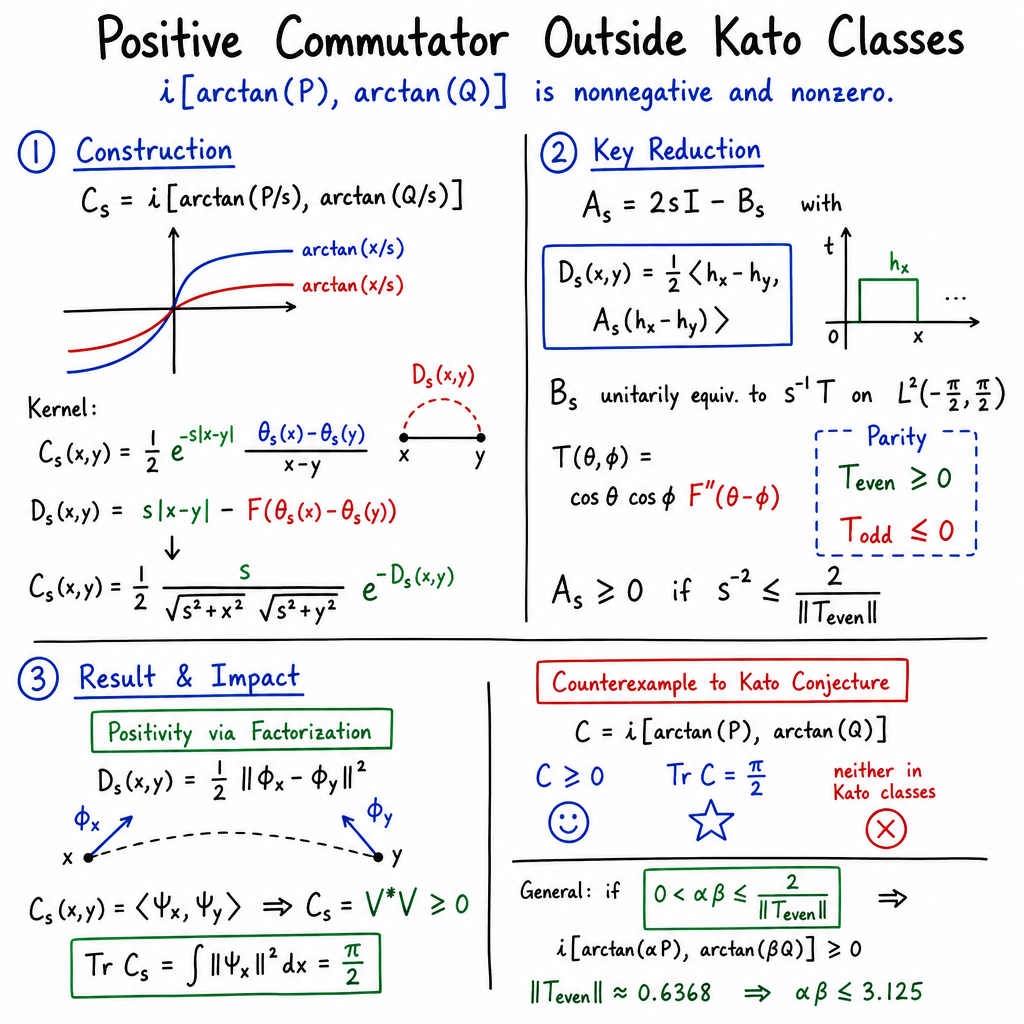
Abstract: We disprove the conjectural converse to Kato's positivity criterion for commutators of functions of the canonical position and momentum operators $Q$ and $P$ by showing that the operator [ i\,[\,\arctan(P),\,\arctan(Q)\,] ] is nonnegative and nonzero.
Paper Prompts
Sign up for free to create and run prompts on this paper.
Top Community Prompts
Explain it Like I'm 14
1. What is the paper about?
This paper studies a question in advanced mathematics about quantum-mechanical position and momentum.
The authors investigate two operators:
- , which represents the position of a particle. It acts like “multiply by the position .”
- , which represents momentum. It acts roughly like taking a derivative.
The paper focuses on the functions and and studies their commutator:
A commutator measures how much two operations fail to give the same answer when performed in different orders. For example, if doing operation A followed by B gives a different result from doing B followed by A, the operations do not commute.
The main result is that
is nonnegative, is not the zero operator, and has a precisely calculated trace of .
This gives a counterexample to a famous prediction called the Kato conjecture.
2. What questions were the researchers asking?
The main question was:
If a commutator involving functions of position and momentum is positive, must those functions have a special kind of analytic behavior predicted by Kato?
Kato had proved one direction of this idea. In simple terms, he showed:
- If two functions are sufficiently well behaved in a certain complex-number “strip,”
- and the widths of those strips are large enough,
- then their commutator is positive.
The conjecture claimed that the reverse should also be true:
If the commutator is positive and nonzero, then the two functions must come from Kato’s special classes.
The authors test this conjecture using the function .
Their key objectives were therefore:
- Show that the commutator of and is positive.
- Show that this commutator is not zero.
- Calculate its trace.
- Check whether satisfies Kato’s required conditions.
- Use the result to determine whether the Kato conjecture is correct.
3. How did they approach the problem?
The proof uses several advanced ideas, but the overall strategy can be described in a few steps.
Turning the commutator into a kernel
The authors first represent the commutator as an integral operator. Instead of thinking of the operator as an abstract rule, they describe it using a function of two variables, called a kernel.
You can think of a kernel as a large table of numbers. When the operator acts on a function, it combines the function’s values using this table.
For a parameter , they study
They find an explicit formula for its kernel. This formula contains exponential terms that make the kernel behave in a controlled way.
Proving positivity
Showing that an operator is nonnegative means that for every suitable function ,
This is similar to showing that a matrix is positive semidefinite: when a vector is multiplied on both sides of the matrix, the resulting number is never negative.
To prove this, the authors introduce an auxiliary operator connected to the function
They study this operator separately on:
- even functions, which satisfy ;
- odd functions, which satisfy .
They show that the even part is positive and the odd part is negative. Careful estimates then show that the combined operator needed in the proof is positive.
Using a geometric interpretation
A particularly interesting part of the proof rewrites a quantity in the kernel as a squared distance:
This means the complicated expression behaves like the squared distance between two points and in some abstract space.
This is useful because kernels of the form
are known to produce positive operators when behaves like a squared distance. The authors make this idea explicit using a construction called symmetric Fock space. For a 14-year-old reader, this can be viewed as a very large mathematical space that allows the kernel to be written as inner products:
Any matrix or operator formed from inner products is automatically nonnegative, much like a matrix of dot products between vectors.
Calculating the trace
The authors also show that the operator is trace class. Roughly speaking, this means that its total size can be measured by adding up suitable diagonal contributions, just as one adds the diagonal entries of a matrix.
They calculate this total exactly:
Finally, they estimate the size of the auxiliary operator carefully enough to prove the result for the particular choice .
Checking the Kato condition
The authors then study where can be extended as a well-behaved analytic function of a complex variable .
They show that:
- belongs to Kato’s class ;
- it does not belong to for any ;
- does not belong to any of the required Kato classes.
This is connected to the fact that has singularities at and . These singularities prevent it from being extended farther than a certain distance in the complex plane.
4. What did they find?
The central theorem says that
has all of the following properties:
- It is nonnegative. For every test function ,
- It is nonzero. So the positivity is not happening only because the commutator happens to vanish.
- It is trace class. Its total size is mathematically manageable.
- Its trace is exactly
These facts are important because does not satisfy the full analytic conditions required by the Kato conjecture. It has only a limited strip of good analytic behavior, and the negative version has the wrong sign behavior.
Therefore, the example has a positive, nonzero commutator but does not fit the pattern predicted by Kato’s conjecture.
The authors conclude:
The Kato conjecture is false.
5. Why is this important?
In mathematics, a conjecture is a carefully reasoned prediction that has not yet been proved or disproved. Showing that a conjecture is false is valuable because it tells researchers that the proposed rule was too broad.
This paper does not mean that Kato’s original result was wrong. Kato proved a correct sufficient condition: certain well-behaved functions always produce positive commutators.
What the new paper shows is that this condition is not necessary. Positive commutators can arise in other ways too.
The result may influence future research in:
- operator theory, the study of very general kinds of mathematical transformations;
- quantum mechanics, where position and momentum do not normally commute;
- spectral theory, which studies the possible values associated with operators;
- the study of positive kernels and matrices, which appear in probability, analysis, and mathematical physics.
Simple conclusion
The paper discovers a surprising exception to a long-standing mathematical prediction. The functions and create a commutator that behaves positively, even though does not have all the special properties that Kato’s conjecture said should be necessary.
In short, the research teaches mathematicians that positive behavior can occur in more ways than previously expected. It opens the door to finding a more accurate description of all functions that produce positive commutators.
Knowledge Gaps
Knowledge gaps, limitations, and open questions
The paper establishes a specific counterexample and a sufficient positivity regime, but leaves the following issues unresolved:
- No characterization of all positive commutators: The paper does not determine which bounded real-valued pairs satisfy after the Kato conjecture fails.
- Unknown optimal positivity region for arctangent pairs: Proposition 3 gives positivity when , but it is not shown whether this condition is necessary or whether positivity persists for larger values of .
- Exact value of remains unknown: The paper proves and reports numerical evidence of approximately $0.6368$, but does not establish the exact norm or a rigorously sharp value.
- Behavior beyond the proven parameter threshold is unexplored: The sign and spectral properties of outside the sufficient range are not analyzed. In particular, it is unknown whether the operator becomes indefinite immediately after the threshold.
- Lack of a broader family of counterexamples: The construction is based on and a specific kernel involving . The paper does not identify general conditions on other functions that produce positive commutators while violating the Kato strip criterion.
- The role of asymmetric parameters is not fully investigated: A scaling argument reduces the analysis to equal parameters, but the paper does not separately examine whether asymmetric choices of and exhibit additional phenomena beyond dependence on the product .
- No classification of extremal or boundary cases: It remains unknown what happens at the exact boundary , including whether the commutator develops a kernel, changes rank, or acquires other special spectral features.
- Spectral structure is largely unresolved: Apart from positivity, trace class, and trace , the paper does not determine the eigenvalues, eigenvalue asymptotics, rank, kernel, or multiplicity structure of the commutator.
- No explicit description of the range or factorization space: The Fock-space factorization proves positivity, but the resulting operator and the closed range of are not characterized in more concrete analytic or spectral terms.
- The trace formula is not generalized beyond the arctangent family: Although the paper proves , it does not establish a general trace formula for other positive commutators or identify which assumptions guarantee trace class.
- The counterexample lies outside exponential-moment hypotheses, but the intermediate regime is open: The paper contrasts the arctangent derivative, which has no nontrivial exponential moments, with prior results requiring such moments. It does not describe the precise boundary between classes where the Kato strip conclusion holds and classes where counterexamples occur.
- The relationship between positive commutators and operator monotonicity remains incomplete: The failure of positive semidefiniteness for the divided-difference kernel of is noted, but the paper does not provide a general criterion connecting positivity of the full commutator kernel with operator monotonicity or related function classes.
- Stability under perturbations is unknown: It is not determined whether positivity survives small perturbations of , of the scaling parameters, or of the position and momentum functions in suitable function norms.
- No multidimensional or alternative canonical-system extension is provided: The results concern the one-dimensional canonical pair on . Extensions to higher-dimensional canonical operators, other representations of the canonical commutation relations, or related pseudodifferential settings are left open.
- The conjecture’s strongest possible replacement is not formulated: Since the Kato converse is false, the paper does not propose or test a corrected necessary condition that would encompass both Kato-class examples and the arctangent counterexample.
Practical Applications
Immediate Applications
The paper is primarily a foundational result in functional analysis and mathematical physics. It does not present a validated engineering, clinical, or commercial technology. Its immediate applications are therefore mainly methodological, theoretical, and computational.
- Operator-theory verification tools — mathematics and formal methods.
The explicit example
i[arctan(P), arctan(Q)] ≥ 0, with nonzero trace-class operator and trace , can serve as a benchmark for testing conjectures, symbolic derivation systems, and computer-assisted proofs involving commutators of position and momentum operators. Dependencies: The operators must be interpreted on with the usual self-adjoint realizations of and ; numerical verification alone cannot establish operator positivity. - Numerical algorithms for positive-kernel operators — scientific computing. The paper supplies an explicit integral kernel for the commutator and a compact auxiliary operator
These formulas can be implemented using Galerkin, Nyström, quadrature, or spectral discretizations to study eigenvalues, operator norms, and trace-class behavior. Potential workflow: discretize on , compute its even and odd parity blocks, estimate , and use the resulting bound to certify positivity for parameterized arctangent commutators. Dependencies: Discretization error, endpoint behavior, and rigorous error bounds are needed if numerical results are used as proofs or safety certificates.
- Counterexample library for mathematical education and research — academia.
- canonical commutation relations;
- self-adjoint and trace-class operators;
- operator monotonicity;
- positive-definite and conditionally negative-definite kernels;
- limitations of converse theorems.
- Dependencies: The example requires substantial background in spectral theory and operator algebras; it is not directly a classroom-level computational model.
- Reusable positivity-certification method — functional analysis and mathematical physics. The Fock-space factorization
gives a constructive certificate of positivity rather than merely an abstract inequality. More generally, when an exponent can be represented as one half of a squared Hilbert-space distance, Schoenberg’s theorem can be used to establish positive semidefiniteness of the associated exponential kernel. Potential tool: a symbolic or semi-automated “kernel positivity pipeline” that searches for: 1. a squared-distance representation; 2. conditional negative definiteness; 3. a Gram or Fock-space factorization; 4. trace or Schatten-class estimates. Dependencies: The underlying operator must be positive, and the required integral representations may be difficult to discover for functions other than .
- Improved formulation of research assumptions — academia. The counterexample shows that positivity of a commutator does not, by itself, imply membership of the defining functions in the expected Kato analytic strips. This can immediately prevent researchers from using the Kato-strip converse as an unstated assumption in proofs concerning spectral perturbations, monotonicity, or commutator estimates. Dependencies: The conclusion applies to this class of commutators and does not invalidate Kato’s sufficient condition or the converse under additional hypotheses, such as exponential-moment assumptions.
- Trace-class benchmark for quantum-operator calculations — mathematical physics. The exact identity
provides a test case for analytical and numerical implementations of trace-class commutators and phase-space operator calculations. It may be useful for validating discretizations of canonical operators, Fourier-transform conventions, and commutator kernels. Dependencies: Finite-dimensional truncations of and generally do not preserve the canonical commutation relation exactly, so convergence and boundary effects must be analyzed.
Long-Term Applications
The longer-term opportunities depend on extending the paper’s construction beyond the specific arctangent pair and connecting the abstract operators to concrete models.
- A broader design theory for positive commutators — mathematical physics and quantum control. The parameterized result
suggests a systematic method for designing bounded functions of conjugate observables whose commutator has a prescribed sign. Such operators could eventually be used as Lyapunov-like quantities, monotonicity observables, or positivity certificates in quantum dynamics. Dependencies: One must determine whether analogous constructions exist for other bounded functions, other canonical pairs, and physically realizable Hamiltonians. Positivity of an operator does not automatically imply experimental measurability or dynamical usefulness.
- Quantum-information kernels and feature maps — quantum computing and machine learning. The Fock-space representation maps each real variable to a vector such that
This resembles an explicit feature map for a positive kernel. With further development, related constructions could generate mathematically controlled kernels for quantum feature maps, kernel methods, or operator-valued learning models. Dependencies: The feature space here is infinite-dimensional, and practical use would require finite-dimensional approximations, efficient state preparation, and stability guarantees. The paper does not demonstrate predictive performance or a quantum implementation.
- New criteria for kernel-based integral operators — software and data analysis. The combination of conditional negative definiteness, exponential kernels, parity decomposition, and operator-norm bounds could inform software libraries that automatically test whether parameterized kernels are positive semidefinite. This may be relevant to Gaussian-process covariance design, reproducing-kernel Hilbert spaces, and inverse problems. Dependencies: The kernels in the paper arise from highly structured analytic functions. Generalization to arbitrary data-dependent or multidimensional kernels requires separate mathematical results.
- Extensions to multidimensional phase space — physics and PDEs. A natural research direction is to replace the one-dimensional and by multidimensional position and momentum operators, or by pseudodifferential operators on manifolds. If positivity and trace-class properties can be preserved, the results could contribute to commutator estimates in quantum mechanics, dispersive PDEs, and semiclassical analysis. Dependencies: Higher dimensions introduce nontrivial issues involving tensor products, angular variables, noncommuting coordinates, domain questions, and possible failure of the one-dimensional parity argument.
- Robust spectral and stability estimates — PDE analysis and operator perturbation theory. Positive trace-class commutators can provide quantitative information through their trace, norm, and factorization. Generalizations might yield bounds for spectral flow, resonances, propagation observables, or stability under perturbations of , , , and . Dependencies: The paper establishes positivity for a specific family and does not derive spectral-flow or perturbation bounds. Additional estimates would be required for unbounded perturbations, boundary conditions, and noncanonical operators.
- Reassessment of analytic-strip assumptions in applied operator models — quantum dynamics and spectral theory. Many arguments use analyticity or exponential decay to obtain positivity or monotonicity. The arctangent example shows that positivity may persist even when the derivatives
have no nontrivial exponential moments. Future models may therefore admit positive commutator estimates under weaker, algebraic-decay assumptions. Dependencies: New replacement hypotheses must be identified; the counterexample alone does not provide a general criterion for positivity beyond the constructed family.
- Computer-assisted discovery of further counterexamples — academia and automated mathematics. The auxiliary operator , its approximate eigenvector, and the explicit norm bounds suggest a computational search strategy: parameterize candidate functions, construct the corresponding kernel operator, decompose it by symmetry, and numerically search for positive regions before attempting rigorous certification. Potential product: a research software package combining symbolic kernel derivation, spectral discretization, interval arithmetic, and proof certificates. Dependencies: Candidate discoveries would still require rigorous control of infinite-dimensional operators, analytic continuation, domains, and approximation errors.
- Policy and standards implications for mathematical claims — research governance. The paper illustrates why a sufficient theorem should not be treated as a necessary characterization without explicit proof. In fields that rely on formal mathematical guarantees—such as certified numerical analysis, quantum software verification, and safety-critical simulation—this supports policies requiring separate validation of converse claims and explicit documentation of hidden regularity assumptions. Dependencies: This is an indirect methodological implication rather than a policy result established by the paper. Its relevance depends on whether operator-theoretic guarantees are incorporated into a particular technical standard.
- Daily-life applications — currently none directly supported. The paper does not yield an immediate consumer product, household workflow, medical intervention, financial strategy, or everyday decision rule. Any such application would require an intermediate translation from abstract operator positivity to a concrete physical, computational, or measurement system.
Glossary
- Analytic continuation: Extension of a function from its original domain to a larger domain while preserving analyticity. “admit an analytic continuation, still denoted by , to ”
- Borel function: A function measurable with respect to the Borel -algebra generated by open sets. “If and are bounded real-valued Borel functions”
- Canonical commutation relation: The fundamental noncommutative relation between position and momentum operators, typically . “canonical commutation relation”
- Compact operator: A linear operator that maps bounded sets into relatively compact sets. “so is bounded (and even compact)”
- Commutator: For operators and , the operator , measuring their failure to commute. “”
- Conditionally negative-definite kernel: A kernel whose quadratic form is nonnegative or nonpositive under coefficient constraints summing to zero; such kernels generate positive-definite exponentials. “ is therefore conditionally negative definite”
- Conjecture: A mathematical statement proposed as plausible but not yet proved or disproved. “The conjectural converse, in the formulation of Herbst and Kriete”
- Direct sum: An operator construction combining operators acting on mutually orthogonal subspaces. “which is equal to the direct sum of and ”
- Dense point spectrum: A spectrum containing eigenvalues that are dense in some region or set. “work of Howland on dense point spectrum”
- Divided-difference kernel: A kernel formed from a difference quotient such as , often used in operator monotonicity. “The divided-difference kernel”
- Exponential vector: A vector in Fock space defined as a series of symmetrized tensor powers of a Hilbert-space vector. “for , its exponential vector”
- Fock space: A Hilbert space formed as the direct sum of all symmetric tensor powers of a one-particle Hilbert space. “Consider the symmetric Fock space”
- Fourier transform: An integral transform representing a function in terms of its frequency components. “for the Fourier transform”
- Galerkin computation: A numerical method that approximates an operator or differential equation by restricting it to a finite-dimensional trial subspace. “both a Galerkin computation and a Gauss--Legendre Nyström discretization”
- Gauss–Legendre Nyström discretization: A numerical quadrature-based method for approximating integral operators using Gauss–Legendre nodes and weights. “a Gauss--Legendre Nyström discretization”
- Hilbert–Schmidt operator: An operator whose squared singular values, equivalently the squared kernel norm in the integral case, are summable. “using the standard criterion to verify the Hilbert--Schmidt property”
- Howland–Kato commutator problem: The problem of characterizing bounded functions whose position–momentum commutator is positive. “The Howland--Kato commutator problem”
- Integral kernel: A function representing an integral operator by . “The operator has integral kernel”
- Kato class: A class of bounded functions admitting analytic continuation to a strip and satisfying a prescribed sign condition on their imaginary parts. “let denote the class”
- Loewner’s theorem: A theorem characterizing operator-monotone functions through analytic and positivity properties. “connected the problem with Loewner's theorem on operator-monotone functions”
- Monotone function: A function that preserves order, such as an increasing function satisfying . “suitable versions of and are monotone and continuous”
- Nonnegative operator: A self-adjoint operator satisfying for every vector in its domain. “The operator is nonnegative.”
- Operator monotonicity: The property that implies for self-adjoint operators. “equivalent to operator monotonicity of on the whole real line”
- Operator-valued functional calculus: The construction that assigns an operator to a function and a suitable operator . “ and are bounded self-adjoint operators”
- Orthonormal basis: A complete collection of mutually orthogonal unit vectors in a Hilbert space. “The functions form an orthonormal basis”
- Parity restriction: The restriction of an operator to the even or odd subspace determined by reflection symmetry. “The parity restrictions of satisfy”
- Positive commutator: A commutator multiplied by that defines a nonnegative self-adjoint operator. “Key words and phrases. Positive commutator”
- Positive-definite kernel: A kernel whose finite quadratic forms are nonnegative. “positive-definite kernel”
- Positive measure: A measure assigning nonnegative values to measurable sets. “a positive-measure representation by translates of the hyperbolic tangent”
- Positive semidefinite: Having all finite quadratic forms nonnegative; for matrices, equivalent to having no negative eigenvalues. “is not positive semidefinite for any ”
- Rayleigh quotient: A scalar of the form , used to estimate operator eigenvalues. “The trace and a Rayleigh quotient”
- Self-adjoint operator: An operator equal to its adjoint, with real spectral values and a suitable domain. “the unbounded, selfadjoint operators”
- Schur’s test: A criterion bounding the norm of an integral operator using uniform bounds on integrals of its kernel. “The lemma now follows from Schur's test.”
- Schoenberg’s theorem: A theorem relating conditionally negative-definite kernels to positive-definite kernels obtained by exponentiation. “Schoenberg's theorem implies directly that is a positive-semidefinite kernel.”
- Spectral theorem: The result that permits suitable functions of self-adjoint operators to be defined through their spectral measures. “This is impossible for a nonconstant bounded function”
- Symmetric tensor power: The subspace of a tensor-product space invariant under permutations of tensor factors. “”
- Trace class: The class of compact operators whose singular values are summable, allowing a well-defined operator trace. “It is trace class with”
- Unitary equivalence: A relationship between operators and when for a unitary operator . “the operator is unitarily equivalent to the operator ”
- Unbounded operator: An operator whose norm is not bounded over its domain. “the unbounded, selfadjoint operators in ”
- Weakly measurable: A vector-valued map whose inner product with every fixed vector is measurable. “ is weakly measurable”
- Weak sense: A formulation in which an operator or equation is defined through inner products rather than pointwise values. “where the definition is understood in the weak sense”
Collections
Sign up for free to add this paper to one or more collections.