Linear dependence of time-frequency shifts of a Schwartz function
Abstract: We show that a finite number of time-frequency shifts of a Schwartz function can be linearly dependent. This disproves the so-called HRT conjecture of Heil, Ramanathan, and Topiwala. In particular, we provide an example consisting of 12 time-frequency shifts.

Paper Prompts
Sign up for free to create and run prompts on this paper.
Top Community Prompts
Explain it Like I'm 14
1. What is the paper about?
This paper studies a famous question in mathematics called the HRT conjecture. The conjecture says that if we take one nonzero function and make several copies of it by:
- moving it left or right, and
- changing the waves or frequencies inside it,
then these changed copies should always be linearly independent.
“Linearly independent” means that no copy can be made exactly by adding and multiplying the others together, unless all the multiplying numbers are zero.
The authors show that this belief is false. They construct a special function and 12 different time-frequency versions of it that cancel each other out exactly.
In simple terms:
The paper finds 12 different-looking copies of the same smooth function whose weighted sum is zero.
This disproves the HRT conjecture, including its version for especially smooth functions called Schwartz functions.
2. What questions did the researchers ask?
The main research question was:
Can a finite collection of shifted and frequency-changed copies of a nonzero function ever be linearly dependent?
The HRT conjecture predicted that the answer was no. The authors wanted to find out whether this was always true.
More specifically, they aimed to:
- Construct a nonzero, very smooth function .
- Choose 12 different points in a two-dimensional “time-frequency” space.
- Find nonzero numbers such that
- Prove that this cancellation is exact, rather than just an approximation caused by computer rounding.
Here, means a copy of that has been shifted in position and modified in frequency.
3. How did they do it?
Time-frequency shifts
Imagine a sound wave or signal drawn as a graph. A time shift moves the signal left or right. A frequency shift changes how quickly it oscillates.
The paper combines these two operations. Each combination is described by a point :
- tells how far the function is moved.
- tells how its frequency is changed.
The authors use special operators called Weyl shifts to describe these changes neatly.
Turning the problem into an eigenvalue problem
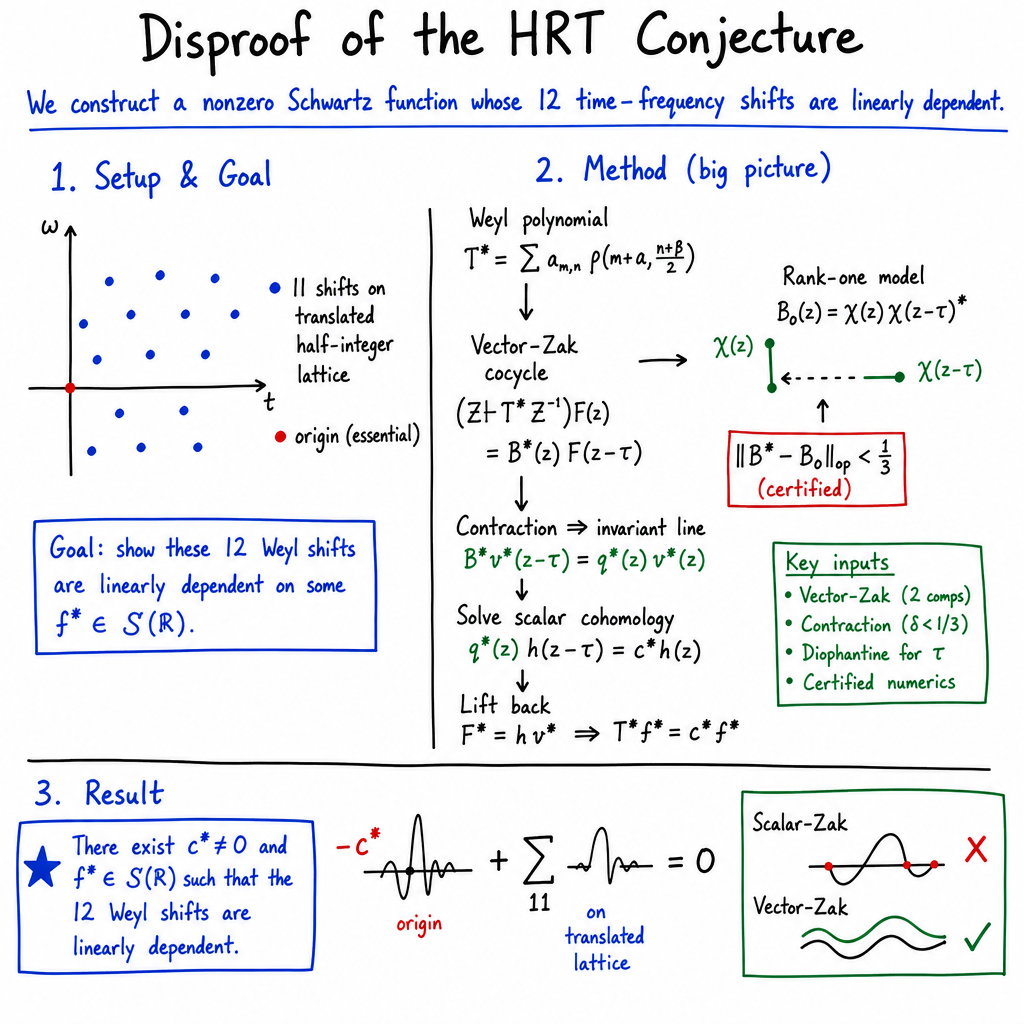
Instead of directly searching for 12 copies that cancel, the researchers first build an operator made from 11 time-frequency shifts:
They then search for a function and a number satisfying
This is called an eigenvalue problem. It is similar to finding a special shape that remains the same after a machine transforms it, except that its size or phase may change.
Rearranging the equation gives
The term can be viewed as a 12th copy of the function located at the origin. Therefore, the equation gives a dependence involving 12 time-frequency shifts.
Using the Zak transform
The researchers use a mathematical tool called the Zak transform. It changes a function from its usual form into a two-dimensional picture showing both position and frequency.
This is somewhat like changing a complicated recipe into a table that records:
- where each ingredient appears, and
- how strongly it contributes at different frequencies.
The ordinary Zak transform has a serious problem: smooth versions of it must become zero somewhere. That makes it unsuitable for constructing the desired function.
To fix this, the authors use a vector-valued Zak transform. Instead of representing each point by one number, it represents it by a pair of numbers:
This extra component gives the construction enough flexibility to avoid unwanted zeros.
Replacing shifts by matrices
After applying the vector Zak transform, the time-frequency shifts become operations involving:
- a movement of the point , and
- multiplication by a matrix.
Thus, a difficult problem about functions becomes a more organized problem about vectors and matrices:
The authors first construct a simpler matrix whose behavior is understood. They then show that the actual matrix is very close to :
This closeness allows them to use a contraction argument. A contraction is a process that brings things closer together, like repeatedly folding a paper toward a fixed point. Such arguments can prove that a solution exists and is smooth.
Computer-assisted verification
Some numerical inequalities in the proof are too complicated to check easily by hand. The authors use interval arithmetic, a type of computer calculation that keeps track of guaranteed error ranges.
For example, instead of saying that a number is approximately $0.32$, interval arithmetic might prove that it lies inside
If the whole interval is below $1/3$, then the computer has rigorously verified the needed inequality, not merely guessed it from decimal calculations.
The paper reports that all such computer-assisted parts use rigorous enclosures and high precision.
4. What did they find?
The main result is that there exist:
- a nonzero Schwartz function ,
- 12 pairwise different time-frequency shifts, and
- 12 nonzero coefficients,
such that
The function is a Schwartz function, meaning it is infinitely smooth and decreases extremely quickly as one moves far away. It is much nicer than merely being square-integrable.
The 12 points are arranged in a carefully chosen pattern:
- 11 points lie in a translated half-integer lattice,
- the 12th point is the origin.
The translation uses special irrational numbers, including . The authors also use specifically chosen complex coefficients. These choices are not simple or natural-looking; they are designed so that the required cancellation occurs.
The result is important because it contradicts the HRT conjecture:
The conjecture claimed that such a dependence was impossible, but the paper gives an explicit example with 12 shifts.
The paper also explains that 12 shifts are enough for a counterexample, although it does not claim that 12 is the smallest possible number.
5. Why does this matter?
The HRT conjecture had been an important open problem in time-frequency analysis, an area used to study signals, sound, images, and communications.
The result changes what mathematicians know about collections of shifted and frequency-modified signals. It shows that even very smooth functions can have hidden exact relationships among their time-frequency copies.
This could affect:
- the theory of signal representations,
- the study of Gabor systems and wave packets,
- methods for analyzing sound and image data,
- questions about when signal components are uniquely distinguishable.
The result does not mean that all time-frequency shifts are dependent. In many important situations, they are still independent. It means only that independence is not guaranteed in every possible situation.
The paper also discusses the role of LLMs. According to the authors, LLMs helped develop the counterexample and suggest the proof strategy, but the authors independently checked, repaired, rewrote, and took responsibility for the mathematics.
Overall, the paper is significant because it overturns a long-standing mathematical conjecture by constructing a carefully designed example where 12 different time-frequency copies of one smooth function cancel exactly.
Knowledge Gaps
Knowledge gaps, limitations, and open questions
The paper establishes one explicit 12-term counterexample, but leaves the following issues unresolved:
- Minimal number of shifts: It does not determine whether 12 is the smallest possible number of time-frequency shifts that can be linearly dependent. In particular, it leaves open whether counterexamples exist with 2–11 shifts.
- Classification of dependent configurations: The paper gives one configuration involving a translated half-integer lattice plus the origin, but does not characterize which finite phase-space configurations can support linear dependence.
- Role of the origin: The construction requires adding the origin to a translated lattice because of Linnell’s theorem, but it does not establish whether every counterexample must have a similar geometric feature or whether qualitatively different configurations exist.
- Generality beyond the exhibited coefficients: The argument uses a highly specific set of dyadic coefficients and algebraic translation parameters. It remains unknown whether there are continuous families, parametrized families, or structurally simpler coefficient choices producing counterexamples.
- Optimality of the vector-Zak dimension: The paper shows that the scalar Zak transform is insufficient for this construction and that a two-component transform works, but it does not establish whether other representations or transforms could yield simpler counterexamples or more general constructions.
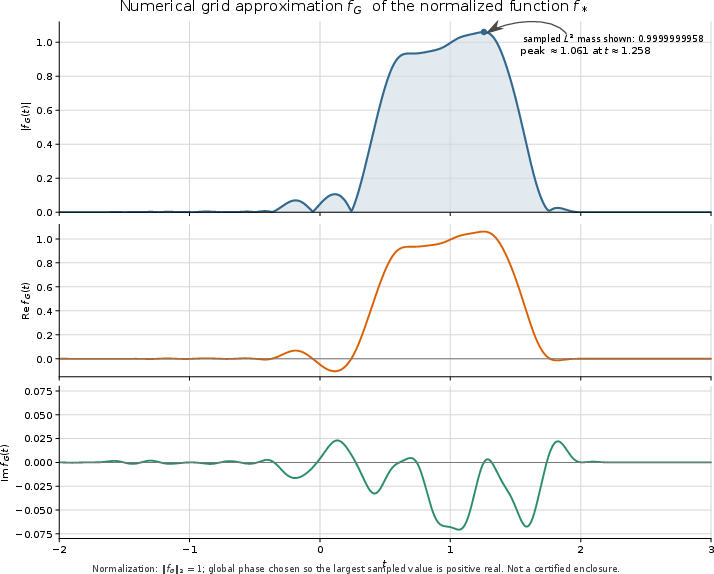
- Explicit form of the eigenfunction: The resulting Schwartz function is obtained through fixed-point and cohomological arguments. The paper does not provide a simple closed-form expression for , nor a readily evaluable exact formula for its time-domain behavior.
- Quantitative properties of the eigenfunction: Important characteristics of —such as decay rates, localization, regularity constants, norms, zeros, and time-frequency concentration—are not quantified beyond membership in the Schwartz class.
- Dependence on computer-assisted certification: A crucial bound, , is established using interval arithmetic. The mathematical construction therefore depends on a substantial validated computation, while the extent to which the certificate can be replaced by a shorter exact analytic proof remains unresolved.
- Robustness of the counterexample: The paper does not determine whether the dependence persists under perturbations of the phase-space points, coefficients, or translation parameters. It is unclear whether the example is isolated or belongs to a stable region of counterexamples.
- Multiplicity and spectral structure: The construction proves existence of a nonzero eigenfunction for one Weyl polynomial, but does not analyze the dimension of the corresponding eigenspace, the multiplicity of the eigenvalue, or the rest of the operator’s spectrum.
- Other function classes: The paper provides a Schwartz-class counterexample, but does not determine the strongest or weakest natural regularity and decay assumptions under which counterexamples exist. For example, the behavior in compactly supported, real-valued, analytic, Gevrey, or modulation-space classes remains open.
- Real-valued windows: The constructed function and coefficients are complex-valued. The paper does not establish whether an HRT counterexample can be obtained with a real-valued, nonnegative, or otherwise structurally restricted window.
- Higher-dimensional extensions: The results concern and phase space . It remains unknown whether analogous counterexamples exist in for , and how the required number and geometry of shifts scale with dimension.
- Interaction with discrete subgroup results: Linnell’s theorem rules out dependence for finite subsets of a discrete subgroup, but the paper does not provide a broader boundary between configurations covered by positive HRT results and configurations capable of supporting dependence.
- Algorithmic discovery of counterexamples: Although the construction was obtained with computational and LLM assistance, the paper does not give a systematic search algorithm, complexity analysis, or principled parameter-selection method for finding further counterexamples.
- Independent reproducibility of the numerical certificate: The paper describes the use of Arb and provides exact coefficient data, but broader reproducibility would require a complete, independently tested computational supplement and sensitivity analysis with respect to precision, grid size, and implementation choices.
- Consequences for finite Gabor systems: The paper does not fully examine how the counterexample affects finite-section conditioning, lower Riesz bounds, numerical rank detection, or stability of related Gabor systems outside the specific constructed operator.
- Revised form of the HRT conjecture: The paper disproves the unrestricted conjecture but does not formulate or prove a sharp replacement conjecture identifying natural assumptions on the window or point set that restore linear independence.
Practical Applications
Immediate Applications
- Validated numerical analysis for mathematical proofs — academia/software.
- Potential tools/workflows: Python interfaces to Arb or comparable validated-numerics libraries; automated grid subdivision; derivative-based global error bounds; machine-checkable numerical certificates.
- Dependency: The target function must have an explicit computable representation, and reliable derivative or Lipschitz bounds must be available. Certified numerics verifies the stated computation but does not automatically validate modeling assumptions or preceding algebra.
- Construction and testing of time-frequency dictionaries — signal processing.
- Potential products: Dependency-detection routines for Gabor dictionaries; rank-revealing QR or SVD preprocessing; warnings for ill-conditioned time-frequency dictionaries; benchmark datasets for sparse coding and matching-pursuit implementations.
- Dependency: The exact counterexample is highly specialized, involving particular phase-space points, coefficients, and a specially constructed window. Approximate numerical representations may exhibit near-dependence rather than exact dependence.
- Robustness checks for Gabor-frame and modulation-based algorithms — communications, audio, radar, and imaging.
- Potential workflow: Generate the constructed window numerically, apply the twelve shifts, calculate the smallest singular value of the resulting finite synthesis matrix, and evaluate reconstruction or estimation failure.
- Dependency: A sufficiently accurate discretization of the Schwartz function and the continuous shifts is required; finite sampling can obscure exact functional dependence.
- Improved teaching materials for harmonic analysis and operator theory — education.
- Potential outputs: Lecture examples, computational notebooks, exercises on Zak-transform covariance, and projects comparing scalar and vector Zak representations.
- Dependency: The paper’s source contains substantial notation corruption and incomplete excerpts; educational use requires a clean, verified version of the definitions and proof.
- Benchmarks for computer-assisted theorem proving and AI-assisted mathematics — academia/AI research.
- Potential workflow: Compare LLM-generated derivations against interval certificates, symbolic checks, proof assistants, and independently implemented numerical computations.
- Dependency: Human review remains essential. The paper explicitly reports substantial gaps and at least one nontrivial error in the initial LLM-generated material.
- Numerical rank and conditioning diagnostics — scientific computing.
- Potential tools: Adaptive precision, interval enclosures for singular values, residual certification, and comparisons between standard floating-point and arbitrary-precision results.
- Dependency: Exact dependence in the continuous setting does not imply exact dependence after discretization or floating-point sampling.
- Policy and research-practice guidance for computational mathematics — research governance.
- Dependency: Adoption requires institutional standards for provenance, reproducibility, software archiving, and attribution.
Long-Term Applications
- Revised theory and design principles for Gabor frames and time-frequency representations — signal processing/communications.
- Possible products: Frame-design software that rejects or penalizes configurations with certified low lower-Riesz bounds; dictionary optimization under robustness constraints.
- Dependencies: The paper establishes existence of one exceptional twelve-term dependence, not a general characterization of dependent systems. Additional theory is needed to determine prevalence, stability, and perturbation behavior.
- Certified dependence and stability analysis for continuous operator models — engineering and applied mathematics.
- Possible workflow: Convert an operator problem into a matrix cocycle under a suitable transform, approximate it by a tractable rank-one field, and use contraction plus validated bounds to prove existence or stability.
- Dependencies: Appropriate transform representations, regularity estimates, and contraction margins must be derived for each new operator family.
- Extensions to higher-dimensional and vector-valued time-frequency systems — harmonic analysis/quantum information.
- Potential outcomes: Generalized Zak bundles, multi-component frame representations, and algorithms for matrix-valued time-frequency operators.
- Dependencies: Higher-dimensional sewing relations, topological obstructions, and suitable generalizations of the contraction and cohomological arguments remain to be developed.
- Quantitative theory of near-dependence and adversarial dictionaries — machine learning and inverse problems.
- Potential tools: Perturbation bounds for singular values, certified condition-number estimates, adversarial dictionary generators, and robustness-aware training procedures.
- Dependencies: Exact dependence alone does not establish poor performance in a particular application; the effect depends on sampling, regularization, noise levels, and the chosen recovery algorithm.
- Formal verification pipelines for computer-assisted mathematics — academia/software engineering.
- Potential products: Proof-producing numerical libraries, verified Python-to-proof-assistant pipelines, and repositories of reusable certificates.
- Dependencies: Formal libraries for Arb-like ball arithmetic, transcendental-function bounds, matrix norms, and the paper’s analytic reductions must be developed and maintained.
- Automated discovery of operator counterexamples — AI for science.
- Possible workflow:
- 1. Search over finite operator supports and coefficients.
- 2. Transform the problem into a matrix or cocycle equation.
- 3. Propose approximate invariant sections numerically.
- 4. Convert approximations into rigorous interval certificates.
- 5. Produce a human-readable and formally checkable proof.
- Dependencies: Automated systems must address hallucinated arguments, hidden regularity assumptions, numerical instability, and the need for independent verification. The paper itself shows that LLM-generated strategies can be productive but are not sufficient as proofs.
- Potential applications to quantum and wave systems — long-term theoretical physics.
- Dependency: The paper concerns mathematical linear dependence of shifted functions; physical relevance requires mapping the special Schwartz function and phase-space configuration to experimentally meaningful states or measurement schemes.
Glossary
- Arb: A computer arithmetic library that provides rigorous ball-arithmetic computations and validated numerical enclosures. “For the computation below, we use the ball arithmetic implemented by Arb.”
- Cocycle: A function or operator-valued structure satisfying a composition rule over transformations, often used to describe dynamical systems. “The matrix field associated with the Weyl operator”
- Conjugate transpose: The transpose of a complex matrix after taking the complex conjugate of each entry. “For a matrix , we denote its conjugate transpose by .”
- Contraction argument: A proof technique based on a contraction mapping to establish existence and often uniqueness of a fixed point. “this estimate is crucial in a contraction argument to show the existence of a smooth, nowhere-vanishing vector-Zak function”
- Covariance principle: A transformation law describing how an operator behaves under a change of variables or another transformation. “we obtain the following covariance principle for Weyl shifts and the Zak transform.”
- Dyadic coefficient: A coefficient represented using integers and powers of two, often enabling exact computer arithmetic. “Exact dyadic coefficients in \eqref{eq:amn-dyadic}.”
- Eigenfunction: A nonzero function that is mapped to a scalar multiple of itself by an operator. “we explicitly construct a Schwartz eigenfunction for an eleven-term Weyl polynomial.”
- Enclosure principle: A mathematical principle guaranteeing that interval-valued computations contain the exact range of a function. “let us recall the enclosure principle underlying the certified computation.”
- Floating-point interval arithmetic: Numerical computation in which quantities are represented by intervals that rigorously contain their exact values. “Floating-point interval arithmetic constructs such enclosures by propagating intervals through the operations occurring in an expression.”
- Fourier analytic argument: A proof method that uses Fourier transforms, Fourier series, or frequency-domain analysis. “using a Fourier analytic argument.”
- Fundamental domain: A region containing exactly one representative of each point under a specified periodic or group action. “Then has a zero in every fundamental domain of .”
- Gabor frame: A structured family of time-frequency shifts used to represent functions and signals. “on the asymptotics of lower Riesz bounds of finite sections of Gabor frames.”
- Heisenberg group: A noncommutative group underlying the composition laws of time-frequency translations and modulations. “The Weyl shifts closely follow the composition law of the Heisenberg group”
- HRT conjecture: The conjecture that distinct time-frequency shifts of a nonzero square-integrable function are linearly independent. “The following conjecture of Heil, Ramanathan, and Topiwala ... is widely known as the HRT conjecture.”
- Interval analysis: A numerical-analysis framework that uses intervals to obtain rigorous bounds on computed quantities. “A standard form of the fundamental theorem of interval analysis states that an interval-valued map provides such enclosures”
- Interval enclosure: An interval containing every value of a function on a specified set. “An interval is called an enclosure of on if .”
- Irrational Weyl shift: A Weyl shift whose phase-space parameters include irrational values, preventing reduction to an ordinary integer lattice. “The factorization \eqref{eq:weyl_factorization} separates the lattice-based component ... from the irrational Weyl shift”
- Lattice: A discrete, regularly spaced subgroup of a Euclidean vector space. “the eleven points in Theorem~\ref{thm:main} are elements of a translated lattice”
- Modulation: Multiplication of a function by a complex oscillatory exponential, shifting its frequency content. “a modulation by in the dual frequency variable.”
- Operator norm: A norm measuring the maximum amplification of vectors by a linear operator or matrix. “The operator norm of a matrix will be denoted by .”
- Orthogonal projection: A linear operator projecting vectors onto a subspace while preserving the component in that subspace and eliminating the orthogonal component. “Thus, and are orthogonal projections.”
- Phase factor: A complex scalar of modulus one that records a change in phase. “for some new coefficients involving the phase factors of the composition rule for Weyl shifts.”
- Phase space: A space whose coordinates jointly represent a physical variable and its dual frequency variable. “The term phase space reflects that records both a translation by in the physical variable and a modulation by in the dual frequency variable.”
- Quasi-periodicity: A generalized periodicity in which a function reproduces after a shift up to a prescribed multiplicative factor. “it is straightforward to check that satisfies the quasi-periodicity relations”
- Rank-one projection: A projection whose image is one-dimensional. “which generates a rank-one projection”
- Schwartz function: A smooth function whose derivatives decay faster than any polynomial at infinity. “a nonzero Schwartz function ”
- Sewing relations: Compatibility conditions that specify how a function-valued object is identified across the boundaries of a fundamental domain. “The relations \eqref{eq:x-sewing} and \eqref{eq:omega-sewing} are sometimes referred to as sewing relations”
- Smooth step function: A smooth function transitioning between constant values while having derivatives that vanish at the transition endpoints. “Define the smooth step function ”
- Support: The set of points where a function or operator-valued coefficient is nonzero. “The support of a finite Weyl polynomial is defined as”
- Time-frequency shift: An operator combining translation in the input variable with modulation in frequency. “its associated time-frequency shift is defined by”
- Unitarity: The property of an operator preserving inner products or norms. “The vector Zak transform is thus given by”
- Validated numerics: Numerical computation designed to provide mathematically rigorous error bounds. “Standard references for interval arithmetic and validated numerics include”
- Vector-Zak function: A vector-valued function satisfying the boundary-identification conditions associated with the vector Zak transform. “A measurable function satisfying the relations ... is said to be a vector-Zak function.”
- Vector-Zak transform: A two-component version of the Zak transform that avoids the zero obstruction of the scalar transform. “we employ the vector-Zak transform”
- Weyl operator: A unitary operator implementing a symmetrized combination of translation and modulation. “For a point , the Weyl shift is the unitary operator”
- Weyl polynomial: A finite linear combination of Weyl shifts. “a finite Weyl polynomial is an operator of the form”
- Weyl shift: A symmetrized time-frequency shift with a phase convention adapted to the Heisenberg-group composition law. “The Weyl shift is the unitary operator”
- Zak transform: An integral- or series-based transform converting a function into a quasi-periodic function on phase space. “For and , define the scalar Zak transform”
- Zero set: The collection of points at which a function takes the value zero. “the zero set of is invariant under translations by .”
Collections
Sign up for free to add this paper to one or more collections.