The period-index conjecture is false
Abstract: For any uncountable algebraically closed field $k$ of characteristic $0$ and any $d \geq 3$, we construct a variety over $k$ of dimension $d$ with a Brauer class which violates the period-index conjecture for Hodge-theoretic reasons. When $d = 3$, our construction works even without the assumption that $k$ is uncountable; in particular, the period-index conjecture fails over $\overline{\mathbf{Q}}$.
Paper Prompts
Sign up for free to create and run prompts on this paper using GPT-5.
Top Community Prompts
Explain it Like I'm 14
Explaining “The Period-Index Conjecture Is False” in Simple Terms
What is this paper about?
This paper shows that a long-standing mathematical belief, called the period–index conjecture, is not always true. The author builds a specific 3‑dimensional geometric object (a “threefold”) and a special kind of hidden “twist” on it (a “Brauer class”) that breaks the rule the conjecture predicted.
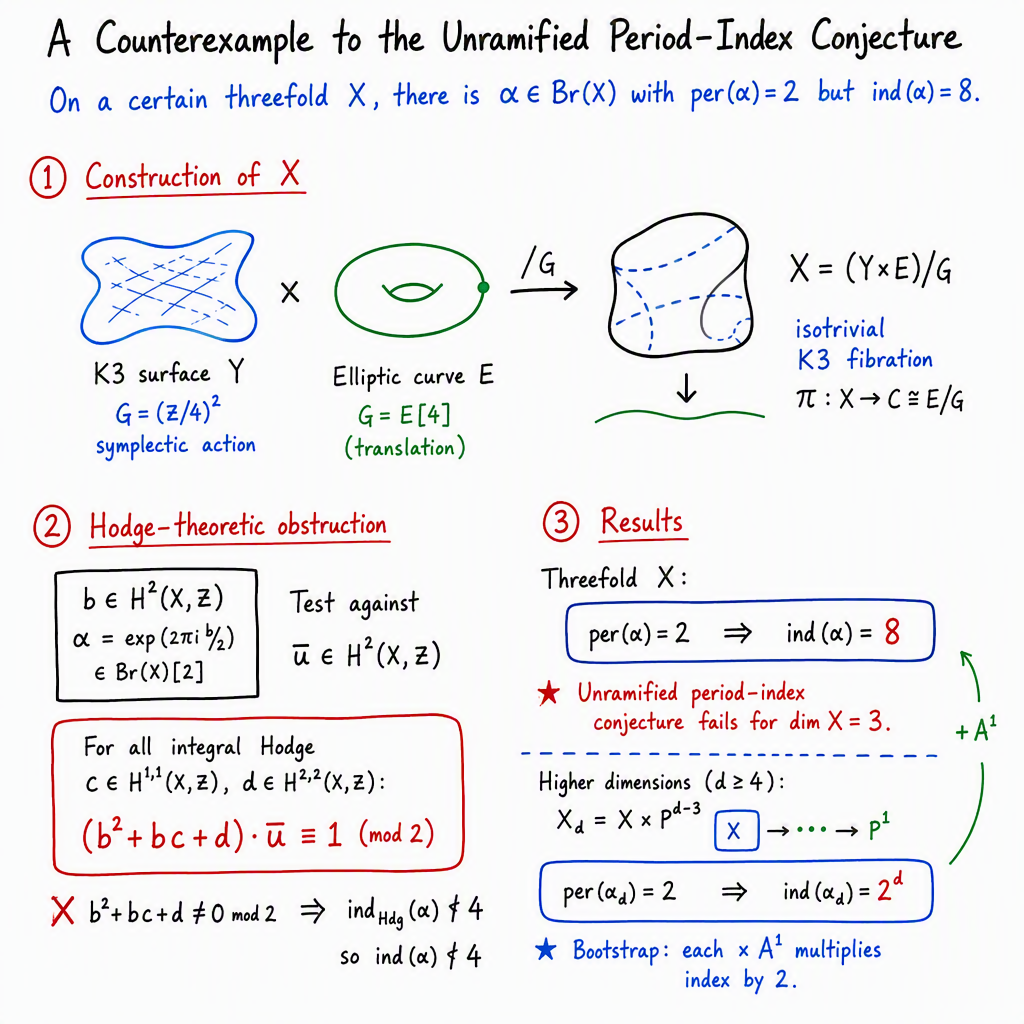
In numbers: on the author’s threefold X, there is a Brauer class with period 2 but index 8. The conjecture would have forced the index to divide 4 in dimension 3—so 8 is impossible if the conjecture were true. Therefore, the conjecture is false in general. The paper also shows how to make higher‑dimensional counterexamples.
What were the goals or questions?
- Build a clear, concrete counterexample to the period–index conjecture in dimension 3.
- Understand why the conjecture fails by using Hodge theory (a way of studying shapes using how their “nice” functions and surfaces behave).
- Extend the failure to higher dimensions and over many fields, including over the rational numbers Q.
What methods did the paper use?
The author uses a mix of symmetry, geometry, and cohomology (a kind of bookkeeping system for shapes).
Here’s the roadmap, with ideas in everyday terms:
- Geometric building blocks:
- A K3 surface is a special, highly symmetric 2D surface living in 3D complex space that has very rich geometry. Think of it as a “perfectly balanced” shape that mathematicians love to study.
- An elliptic curve is a doughnut-shaped curve with a natural “addition” operation on its points (like adding arrows tip-to-tail).
- A group G = (Z/4)2 acts as a system of 4-step symmetries.
- Step 1: Start with a K3 surface S with a nice G‑symmetry that is easy to analyze.
- Step 2: “Deform” S to a more classical K3 surface Y (a “Dwork quartic”), which still carries the same symmetry but has simpler “visible” algebraic surfaces inside it. In particular, the part of Y’s geometry that is fixed by G is as small as possible (rank 1), making later congruence checks simpler.
- Step 3: Form a product Y × E with an elliptic curve E, then divide by the group action: X = (Y × E)/G. This quotient is a smooth 3‑dimensional space (a threefold) that fibers over a curve with K3 fibers, and it keeps the crucial symmetry information.
- Tracking which classes descend to X:
- Cohomology is used to track “classes,” which you can think of as tags that record how hidden twists and surfaces live inside a space.
- A spectral sequence is like a multi-step ledger that tells you, stage by stage, which classes survive when you pass to a quotient by symmetries. A key “transgression” map in this ledger detects an obstruction: a kind of toll that must be paid by classes to descend.
- Using this, the author pinpoints exactly which degree‑2 cohomology classes on Y × E come from X. This precision lets them choose a special class b on X.
- Turning a degree‑2 class into a Brauer class:
- A Brauer class is a way to encode a hidden “noncommutative twist,” like a rule for multiplying that doesn’t commute (AB ≠ BA). Two numbers measure it: the period (how many times you must repeat it to get back to zero) and the index (the minimal “matrix size” needed to realize it).
- There’s a standard map that turns a degree‑2 cohomology class b into a 2‑torsion Brauer class a (period 2)—this is often called taking a “B‑field” b/2.
- The Hodge‑theory test that breaks the conjecture:
- A recent idea (due to Hotchkiss and developed further by de Jong–Perry) links period–index questions to congruence identities among Hodge classes (the “nicest,” symmetry-respecting classes).
- In dimension 3 with period 2, the period–index conjecture would force a congruence relation of the form:
- b2 + b c + d ≡ 0 mod 2,
- where c and d are integral Hodge classes of the right types.
- The author computes that, on their X, for every possible Hodge pair (c, d), the expression b2 + b c + d is never 0 mod 2. In other words, the required congruence can’t happen.
- Drawing the conclusion:
- Because that Hodge‑theory test must pass if the index were ≤ 4, failing the test forces the index to be at least 8.
- A known general upper bound shows the index is at most 8, so it must be exactly 8. Since the period is 2, we get per(a) = 2 and ind(a) = 8, violating the conjecture in dimension 3.
What did the paper find, and why does it matter?
- Main finding in dimension 3:
- There exists a smooth projective threefold X over the complex numbers (and even over Q) with a Brauer class a of period 2 and index 8.
- The period–index conjecture predicts in dimension 3 that ind should divide per3−1 = 22 = 4. But 8 does not divide 4, so the conjecture is false.
- Higher dimensions:
- From this 3D example, the paper builds examples in all higher dimensions d ≥ 4.
- Each time you go up one dimension, the index doubles. So in dimension d, you get period 2 and index 2d, still contradicting the conjecture (which would allow at most 2{d−1}).
- Why it matters:
- The conjecture was known for dimension 2 but open for higher dimensions. This paper shows it fails already in dimension 3, even over Q, which reshapes the landscape of what number-theoretic bounds we can expect.
- It highlights the power of Hodge theory to detect subtle arithmetic obstructions and gives a blueprint for constructing more counterexamples.
What are the broader implications?
- A more realistic version of the conjecture:
- The paper suggests the conjecture might still hold when the period is “free of small primes,” more precisely when per is coprime to (dim − 1)!. In the authors’ counterexample, the period is 2, and 2 divides (3−1)! = 2, exactly the dangerous situation.
- Future directions:
- Find counterexamples for other small primes and in positive characteristic.
- Understand exactly how to modify the conjecture so it’s true in the widest possible setting.
- A fun note:
- The author acknowledges that an early (incorrect) idea from ChatGPT nudged the research toward the final, correct construction—an interesting example of AI assisting discovery while the rigorous mathematics remains fully human-verified.
Key takeaways in one place
- The period–index conjecture claims: in dimension d, index should divide periodd−1.
- This paper builds a 3D example with period 2 and index 8, disproving the conjecture.
- The method uses symmetry (group actions), special K3 surfaces, and Hodge‑theory congruences to force the index to be large.
- The construction extends to all higher dimensions, with index growing like a power of 2.
Knowledge Gaps
Below is a consolidated list of concrete knowledge gaps, limitations, and open questions left by the paper. Each item is phrased to be actionable for future work.
- Extend beyond p = 2: Construct explicit counterexamples realizing the Hodge-theoretic obstructions for other primes p ≤ dim(X) − 1 (e.g., p = 3), ideally with per(a) = p and ind(a) > per(a){dim(X)−1}, and clarify the optimal growth of ind relative to per and dimension.
- Positive characteristic: Produce counterexamples over algebraically closed fields of positive characteristic, addressing technical replacements for Hodge-theoretic tools (e.g., via crystalline/ℓ-adic methods) and controlling issues when p divides the characteristic.
- Uncountability in bootstrapping: Remove the uncountability hypothesis from Proposition 6.1 to obtain higher-dimensional counterexamples over countable algebraically closed fields (e.g., Q̄), or provide a different bootstrapping mechanism avoiding “very general” arguments.
- Explicit higher-dimensional unramified examples: Move beyond the nonconstructive discriminant-avoidance argument and explicitly exhibit smooth projective varieties of dimension d ≥ 4 with unramified Brauer classes violating Conjecture 1.2 (not just function-field counterexamples to Conjecture 1.1).
- Exact Hodge-theoretic index: Compute ind_Hdg(a) for the constructed (X, a), determine whether ind_Hdg(a) = ind(a) = 8, and establish criteria guaranteeing equality or strict inequality between ind_Hdg and ind in similar constructions.
- Salvaged/modified conjecture: Formulate and test a corrected period-index bound that excludes small primes dividing (dim(X) − 1)!, e.g., prove Conjecture 1.2 for classes with per(a) coprime to (dim(X) − 1)! or quantify the minimal extra prime-power factor required when small primes occur.
- Systematic construction framework: Generalize the spectral-sequence/transgression strategy (Leray–Serre computations like d3 and the pairing with fiber classes) to other group actions and varieties (e.g., families with E[p]-actions) to systematically generate failures of period-index bounds.
- Arithmetic descent details: Provide a fully rigorous and explicit descent of the construction to Q (or minimal number fields), including:
- Choosing λ with rk NS(Y) = 19 and a G-action defined over the base field (noting that the PGL(4)-automorphisms used involve i).
- Ensuring the (Z/4)2-action on E via E[4] is defined over the chosen field or clarifying descent via finite subgroup schemes and quotient formation.
- Writing explicit equations for the descended quotient X0 and verifying that Br(X0) → Br(X) preserves period and index.
- Catalog of Br(X): Determine the structure of Br(X) in the constructed example, beyond the single class a—e.g., compute its 2-torsion subgroup, topologically trivial part, and possible indices realized by other Brauer classes.
- Non–topologically trivial classes: Find counterexamples where the violating Brauer class is not topologically trivial (i.e., not arising from H2(X, Z) via the exponential sequence), thereby demonstrating obstructions beyond the Hodge-theoretic framework.
- Larger violations for other per: For periods per(a) > 2 (especially primes), construct examples on suitable dimensions with ind(a) as large as possible (e.g., ind(a) = pd when dim = d), and compare to known upper bounds (refining or extending results like Matzri’s).
- Direct Azumaya realizations: Replace reliance on the general upper bound ind(a) | 8 by constructing explicit Azumaya algebras of minimal possible degree representing a on X, thereby certifying ind(a) = 8 geometrically.
- Geometric nature of u (Lemma 3.8): Make the class u explicit (e.g., as an algebraic class where possible), understand its G-invariance and pairings mod 2 in geometric terms, and develop a general recipe for producing such classes in analogous setups.
- Deformation and stability of the phenomenon: Analyze whether the property ind(a) = 8 persists under deformations of X (e.g., varying λ within the Dwork pencil while maintaining rk NS(Y) = 19 and the G-action), and characterize loci in moduli where the Hodge-theoretic obstruction (failure of equation (1.3)) holds.
- Broader geometric families: Investigate whether similar counterexamples can be realized in other classes of threefolds (e.g., non-isotrivial K3 fibrations, Calabi–Yau or Fano threefolds) and identify structural features essential to forcing the mod 2 obstruction.
- Explicit unramified counterexamples in dimension d ≥ 4 with controlled ramification: In Theorem 1.4 (function-field setting), give explicit control of ramification and the discriminant of the produced Brauer classes, and then construct explicit unramified classes promised by discriminant avoidance on concrete projective models.
Practical Applications
Immediate Applications
The results below can be acted on now by building tools, datasets, or workflows that operationalize the paper’s constructions and Hodge-theoretic tests.
- Counterexample-driven research planning and conjecture refinement
- Sector: Academia; Policy
- Application: Update research agendas and seminar curricula to reflect that the unramified period–index conjecture fails in dimension ≥3 and that salvageable versions likely require the “prime-to (dim−1)!” hypothesis. Prioritize programs testing the Hotchkiss–de Jong–Perry Hodge-theoretic index as a filter before attempting explicit Azumaya constructions.
- Tools/Workflows: Reading groups and problem banks centered on the (K3 × E)/G construction; grant calls emphasizing modified conjectures and systematic counterexample searches.
- Assumptions/Dependencies: Community buy-in to pivot from “true in general” heuristics; awareness of bounds like Matzri’s and Hotchkiss’ index.
- Human–AI collaborative workflows for pure-math discovery
- Sector: Software/AI; Academia; Policy
- Application: Codify practices where LLMs propose candidate constructions (e.g., quotient geometries, group actions) and humans perform rigorous filtration via Hodge-theoretic obstructions, as showcased in the paper’s AI disclosure.
- Tools/Products:
- Prompt libraries tailored to algebraic geometry (e.g., “find symplectic G-actions on K3 with prescribed invariant lattices”).
- Orchestration pipelines connecting LLM ideation → computer algebra prototyping (SageMath/Magma) → formal verification (Lean/Isabelle).
- Assumptions/Dependencies: Clear attribution/validation protocols; availability of symbolic and numerical backends; institutional norms for AI-assisted authorship.
- Computational “Hodge-index gate” for period–index obstruction testing
- Sector: Software; Academia
- Application: Implement automated checks of the Hodge-theoretic divisibility constraints (e.g., compute ind_Hdg, test b2 + b·c + d ≡ 0 mod 2) before investing in constructing Azumaya algebras.
- Tools/Products:
- A SageMath/Magma package that: (1) builds Dwork quartics with prescribed Picard rank; (2) constructs (Y × E)/G; (3) computes invariant lattices; (4) executes Leray–Serre d3 transgressions; (5) verifies congruences like H·f ≡ 0 mod 16 and b-pullback conditions.
- A spectral-sequence utility for finite group actions (APIs for cohomology with coefficients, transgression maps).
- Assumptions/Dependencies: Effective lattice arithmetic and Hodge-number computation; robust NS-rank specialization routines (leveraging MP12).
- Public database of explicit Calabi–Yau 3-folds via free finite-quotients
- Sector: Academia; Mathematical physics
- Application: Curate a dataset of Calabi–Yau threefolds X = (Y × E)/G (with G = (Z/4)2 acting freely) together with K3-fibration structure, fundamental group, and cohomological invariants; useful as testbeds in string compactification and enumerative geometry.
- Tools/Products: Hosted repository with tuples (X, π: X→C, Hodge numbers, Picard data, Brauer classes, ind_Hdg outcomes).
- Assumptions/Dependencies: Correctness of “free action implies CY” transfer; reliable computation of invariants for chosen λ ∈ Q with rk NS(Y)=19.
- Teaching modules and interactive notebooks on the period–index problem
- Sector: Education; Academia; Daily life (advanced learners)
- Application: Course units and Jupyter notebooks that walk through: (i) Brauer group basics; (ii) period vs. index; (iii) Hotchkiss’ ind_Hdg; (iv) constructing the paper’s counterexample.
- Tools/Products: Executable notebooks (SageMath kernel), visualization of lattices and spectral sequences, worksheet on the congruence b2 + b·c + d.
- Assumptions/Dependencies: Access to open-source CAS; appropriate background materials for students.
- “Bootstrapping” scripts for increasing index via Kummer extensions
- Sector: Software; Academia
- Application: Implement Proposition 6.1 as a computational routine that, given (X, α), produces α′ over k(X × A1) with ind(α′) = p·ind(α), automating dimension-lifting counterexamples and stress-testing conjectures over function fields.
- Tools/Products: CAS functions for constructing xp = 1 + tf covers, tracking unramified classes, and controlling index through specialization (CT02).
- Assumptions/Dependencies: Uncountable, algebraically closed base fields in char 0; effective specialization control.
- Derived-category and twisted-sheaf benchmarks
- Sector: Academia (AG/derived/DT theory)
- Application: Use explicit α ∈ Br(X) with per(α)=2, ind(α)=8 as benchmarks for twisted derived categories, stability conditions, and DT invariants on twisted K3 fibrations.
- Tools/Products: Example suites for software exploring Bridgeland stability and hyperholomorphic bundles in settings known to violate period–index expectations.
- Assumptions/Dependencies: Availability of twisted K-theory and cohomological transforms in CAS; recent advances (Hotchkiss, HMS+).
Long-Term Applications
The items below are plausible but require further mathematical advances, scaling, or cross-domain integration.
- Cryptographic constructions informed by division algebras and symbol length
- Sector: Cryptography; Communications
- Application: Explore whether refined control of index/period over function fields guides the synthesis of division algebras used in space–time coding or cryptographic primitives (e.g., optimizing minimal matrix sizes, symbol lengths).
- Tools/Products: Libraries generating central simple algebras with targeted index/period; code-design toolkits using explicit crossed products.
- Assumptions/Dependencies: Translation from geometric to number-field settings; security analyses; efficient arithmetic in constructed algebras.
- Automated counterexample discovery platforms across pure mathematics
- Sector: Software/AI; Academia
- Application: Generalize the “LLM proposes → Hodge/cohomology filters → formal verification” pipeline to mine counterexamples to broad conjecture classes (e.g., bounds involving torsion primes ≤ dim−1).
- Tools/Products: “ConjectureBreaker” platform combining LLMs, SMT/constraint solvers, CAS, and proof assistants; leaderboard of verified counterexamples.
- Assumptions/Dependencies: Scalable interfaces between natural language and symbolic backends; community curation; compute resources.
- Positive-characteristic extensions and implications for arithmetic geometry
- Sector: Academia; Cryptography (isogeny/coding over finite fields)
- Application: Extend the Hodge-theoretic obstruction framework (per [dJP22]) to char p > 0, potentially affecting heuristics in moduli over finite fields and informing protocol assumptions in isogeny-based cryptography.
- Tools/Products: p-adic/cohomological toolkits parallel to the complex Hodge setup; databases over finite fields.
- Assumptions/Dependencies: Viable replacements for Hodge-theory inputs; control of specialization; computational tractability in char p.
- Physics-motivated exploration of K3-fibered Calabi–Yau quotients
- Sector: Mathematical physics
- Application: Study flux vacua, dualities, and BPS spectra on explicit X = (Y × E)/G with nontrivial fundamental groups; investigate twisted B-fields (Brauer classes) with constrained periods/indices.
- Tools/Products: Pipelines computing topological string invariants and spectra on the curated database; integration with string-phenomenology toolchains.
- Assumptions/Dependencies: Matching physical consistency conditions; community interest in these topologies.
- Improved algorithms for Brauer-group computations in CAS
- Sector: Software; Academia
- Application: New routines that use transgression in Leray–Serre sequences and invariant-lattice control to compute Br(X), per(α), and ind_Hdg(α) more reliably in practice.
- Tools/Products: Next-gen Magma/Sage modules for Br and Azumaya classification over higher-dimensional varieties; spectral-sequence engines with caching and certificate outputs.
- Assumptions/Dependencies: Standardized interfaces for cohomology with finite coefficients; verified arithmetic of lattices and G-actions.
- Policy frameworks for AI use and attribution in theorem discovery
- Sector: Policy; Academia
- Application: Establish norms for disclosure, data retention, and verification when LLMs materially influence mathematical ideas; design funding programs for human–AI research pairs in pure math.
- Tools/Products: Policy templates; reproducibility checklists; artifact evaluation tracks for math results with software components.
- Assumptions/Dependencies: Community consensus; publisher adoption; legal/ethical review.
- Educational pipelines from research frontiers to advanced coursework
- Sector: Education; Daily life (STEM learners)
- Application: Incorporate modern counterexample culture (and the role of AI) into advanced undergraduate/graduate curricula, strengthening students’ capacity to navigate evolving conjectural landscapes.
- Tools/Products: Modular courses with interactive CAS/LLM components; capstone projects replicating aspects of the paper’s construction.
- Assumptions/Dependencies: Instructor training; accessible tooling; curricular flexibility.
Notes on feasibility and dependencies common to multiple items:
- Many constructions assume algebraically closed fields of characteristic 0; higher-dimensional bootstrapping uses uncountability (workarounds over countable fields may require alternate techniques).
- Hodge-theoretic inputs rely on complex geometry; positive-characteristic analogs need refined p-adic or crystalline tools.
- Robust, validated computational backends (Sage/Magma/Macaulay2) and, for formal assurance, proof assistants (Lean/Isabelle) are critical for scale-up.
- For physics or cryptographic impacts, translation from geometric existence to efficient, secure, and physically consistent implementations is nontrivial and long-term.
Glossary
Below is an alphabetical list of advanced domain-specific terms from the paper, each with a brief definition and a verbatim example from the text.
- Abelian threefolds: A 3-dimensional abelian variety (a projective complex torus with a polarization). "Recently, this conjecture has been established for abelian threefolds when per(a) is prime to the characteristic [HP24],"
- Algebraically closed field: A field in which every non-constant polynomial has a root. "Let k be an algebraically closed field of characteristic 0."
- B-field: A degree-2 cohomology class used to define (twisted) Brauer classes via exponential sequences. "Let a E Br(X)[2] be the 2-torsion Brauer class with B-field b/2,"
- Bootstrapping argument: A method to elevate results (e.g., on period–index) to higher dimensions step by step. "The proof relies on a standard bootstrapping argument (see Proposition 6.1),"
- Brauer class: An element of the Brauer group, classifying certain Azumaya algebras or gerbes. "For any Brauer class & E Br(K), there are two fundamental integer invariants,"
- Brauer group: The group of equivalence classes of central simple algebras (or Azumaya algebras) over a field or scheme. "[d.J04] Aise Johan de Jong, The period-index problem for the Brauer group of an algebraic surface, Duke Math. J. 123 (2004), no. 1, 71-94."
- Central division algebra: A division algebra with center equal to the base field. "ind(a) = vdimK(D) where D is the unique central division algebra of class a."
- Central simple algebra: A finite-dimensional simple algebra whose center is the base field. "Write a = [D] for a central simple algebra D over K,"
- Cyclic algebra: A class of central simple algebras constructed from cyclic Galois extensions and a parameter. "let (a, t)p denote the standard p-cyclic algebra over K(t),"
- Discriminant avoidance: A technique to pass from local to global statements by avoiding discriminant loci. "By discriminant avoidance [dJS10], Conjecture 1.1 is implied by the following a priori weaker conjecture."
- Dwork pencil: A one-parameter family (pencil) of hypersurfaces of Dwork type. "every member in the Dwork pencil (3.1) has Picard rank at least 19,"
- Dwork quartic: A quartic K3 surface given by a specific symmetric equation (Dwork family). "We consider the corresponding Dwork quartic"
- Edge map: The canonical map from the abutment to a term on the E2-page in a spectral sequence. "the image of the edge map"
- Elliptic fibration: A fibration whose general fibers are elliptic curves. "There exist two independent 4-torsion sections of the elliptic fibration S -> P1"
- Elliptic K3 surface: A K3 surface equipped with an elliptic fibration. "There is an elliptic K3 surface S -> P1 with the following properties:"
- Equivariant cohomology: Cohomology of the homotopy quotient encoding a space with group action. "the right-hand side denotes G-equivariant cohomology, i.e. the cohomology of the homotopy quotient ShG of S by G."
- Equivariant deformation: A deformation of varieties compatible with a group action. "we study a G-equivariant deformation of S to a Dwork quartic K3 surface Y."
- Function field: The field of rational functions on an irreducible variety. "If X is a smooth projective variety over k with function field K,"
- Gram matrix: The matrix of pairings with respect to a chosen basis in a lattice. "form a basis with Gram matrix"
- Hodge-theoretic index: An integer invariant indHdg(a) defined via Hodge-theoretic data, bounding the index. "Hotchkiss defined a Hodge-theoretic index ind Hdg (a) E Z,"
- Homotopy quotient: The Borel construction ShG modeling a space with group action for equivariant cohomology. "the cohomology of the homotopy quotient ShG of S by G."
- Hyperkähler varieties: Simply connected holomorphic symplectic manifolds with a Ricci-flat metric. "For hyperkähler varieties, Huybrechts conjectured the stronger bound ind(a) | per(a)dim(X)/2 [Huy25],"
- Hyperplane class: The cohomology class of a hyperplane section on a projective variety. "We denote by H E H2(Y, Z) the hyperplane class."
- Index (of a Brauer class): The minimal degree of a division algebra representing the class; the degree of its underlying division algebra’s vector space dimension square root. "known as the period per(a) and index ind(a),"
- Integral Hodge classes: Cohomology classes lying in Hodge types with integral coefficients. "there exist integral Hodge classes c € H1,1(X, Z) and d € H2,2(X, Z) such that"
- Isotrivial fibration: A fibration whose smooth fibers are all isomorphic. "T is an isotrivial K3 fibration with fiber Y ."
- K3 surface: A simply connected, smooth, projective surface with trivial canonical bundle and H1=0. "This is a K3 surface S"
- K3[2]-type: Irreducible holomorphic symplectic manifolds deformation-equivalent to the Hilbert scheme of two points on a K3 surface. "hyperkähler varieties of K3[2]-type [BH25, HMS+25]."
- Künneth formula: A theorem computing (co)homology of a product from those of factors. "which follows for instance from the Kunneth formula"
- Lattice (in algebraic geometry): A free abelian group with an integral bilinear form (intersection pairing). "there exists an isomorphism of lattices"
- Leray–Serre spectral sequence: A spectral sequence computing (co)homology of a fibration or Borel construction. "the Leray-Serre spectral sequence for the action of G on S."
- Mordell–Weil group: The group of sections of an elliptic fibration over a base. "MW(S/p1)~(Z/4)2."
- Néron–Severi group: The group of divisor classes modulo algebraic equivalence on a smooth projective variety. "The G-invariant subgroup NS(S)G of the Néron-Severi group has rank 2;"
- Period (of a Brauer class): The order of the class in the Brauer group. "per(a) is the order of a in Br(K),"
- Period-index conjecture: The conjecture bounding the index by a power of the period in terms of transcendence degree or dimension. "Conjecture 1.1 (Period-index conjecture)."
- Picard rank: The rank of the Néron–Severi group of a variety. "Y is a Dwork quartic K3 surface of Picard rank 19,"
- Point class: The generator of top-degree cohomology corresponding to a point. "Let NE E H2(E, Z) be the point class."
- Primitive class: A class not divisible by any integer >1 in the lattice. "the class f is primitive because it has intersection 1 with the 0-section of S -> P1."
- Projective variety: A variety embedded in projective space. "If X is a smooth projective variety over k"
- Spectral sequence transgression: A higher differential mapping from fiber cohomology to base/group cohomology in a spectral sequence. "We consider the transgression X := d3"
- Symplectic action: A group action preserving the holomorphic symplectic form on a K3 or hyperkähler variety. "whose actions on S by translation generate a G-action which is faithful and symplectic."
- Topologically trivial (Brauer class): A Brauer class lying in the image of H2(X, Z) under the exponential sequence; trivial in topological classification. "The Brauer classes that arise in this way are precisely those that are topologically trivial."
- Transcendence degree: The maximum number of algebraically independent elements over a base field. "Let K be a field of finite transcendence degree d over an algebraically closed field k."
- Transcendental lattice: The orthogonal complement of the Néron–Severi group in H2, capturing the “transcendental” part of cohomology. "the Néron-Severi group NS(S) and transcendental lattice T(S) are primitive in H2(S, Z)."
- Torsion (n-torsion): Elements annihilated by a fixed integer n in an abelian group. "there is an associated n-torsion Brauer class & E Br(X) given by the image of b under the composition"
- Unramified class: A Brauer class extending across codimension-1 points; in Br(X) rather than only Br(K). "is an isomorphism onto the subgroup of unramified classes."
- Unramified period-index conjecture: The period-index conjecture restricted to unramified Brauer classes on smooth projective varieties. "Conjecture 1.2 (Unramified period-index conjecture)."
Collections
Sign up for free to add this paper to one or more collections.