$0/1$-Polytopes with Exponentially Small Edge Expansion
Abstract: We present a construction of a family of $0/1$-polytopes whose edge expansion decreases exponentially with the dimension, which disproves the Mihail-Vazirani conjecture that the graph of every $0/1$-polytope has edge expansion at least one.
Paper Prompts
Sign up for free to create and run prompts on this paper using GPT-5.
Top Community Prompts
Explain it Like I'm 14
What is this paper about?
This paper builds special geometric shapes called 0/1-polytopes and studies how well their “corner-to-corner” networks stay connected. It shows, with an explicit example, that some of these networks can be much less connected than many people believed—so much so that they disprove a famous conjecture (the Mihail–Vazirani conjecture) that claimed all such networks are at least “medium connected.”
The big idea in simple terms
- A 0/1-polytope is a shape whose corners (vertices) are points made only of 0s and 1s, like (0,1,0,1,...).
- Imagine the “wireframe” of this shape: connect two corners with a line if they form an edge of the shape. This gives you a network (a graph).
- Edge expansion (also called the Cheeger constant) measures how hard it is to split this network into two big parts without cutting many connections. Bigger expansion = more globally connected; smaller expansion = easier to separate.
The long-standing Mihail–Vazirani conjecture said: every 0/1-polytope’s network has edge expansion at least 1. This paper gives a counterexample: a family of 0/1-polytopes whose edge expansion shrinks exponentially as the dimension grows—far below 1.
What questions does the paper ask?
- Can we find 0/1-polytopes whose edge expansion is less than 1?
- How small can the edge expansion get as the dimension increases? Could it go down exponentially?
- If so, can we construct such shapes explicitly (not just prove they exist)?
How did the authors approach it?
The authors construct a very structured family of polytopes built from simple, repeated building blocks and then carefully analyze how their networks behave.
Building the shape
- Start with two tiny 2D shapes:
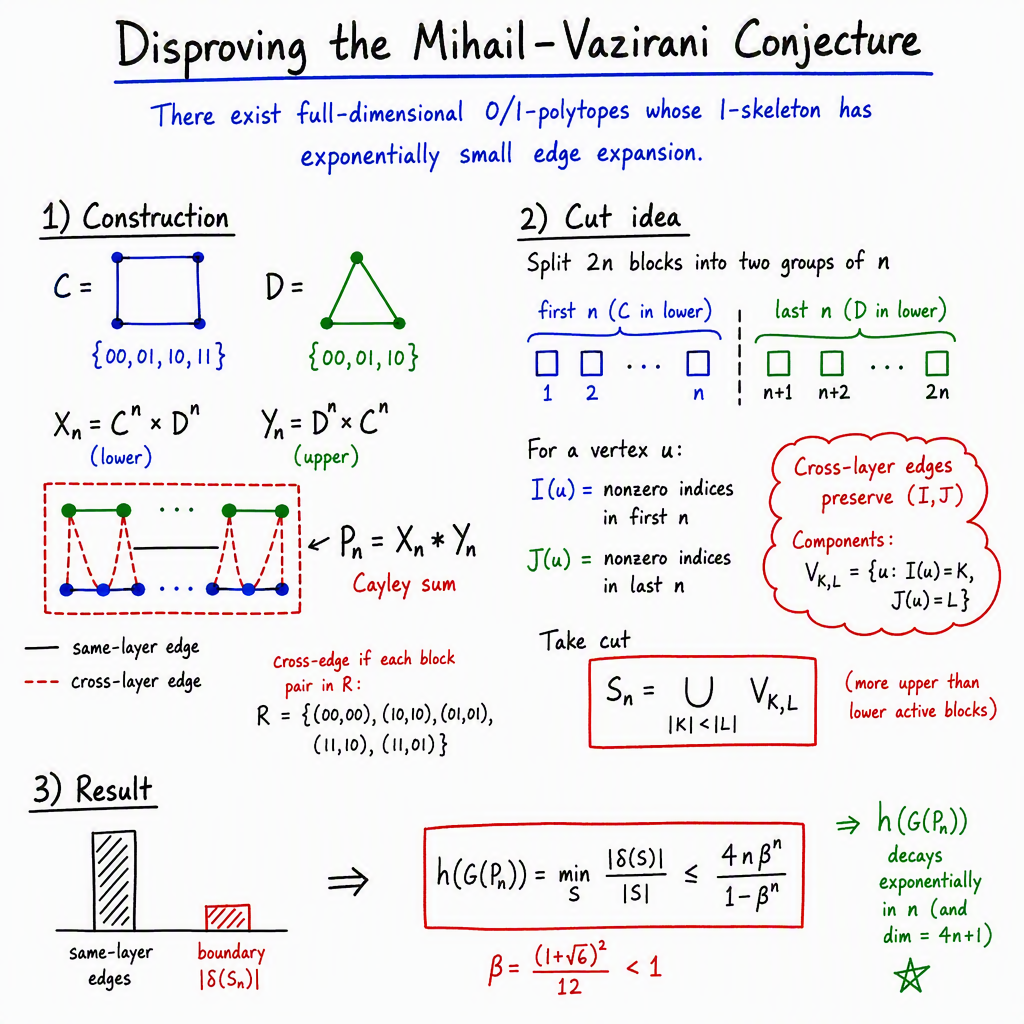
- A square Q whose corners are the 2-bit strings C = {00, 01, 10, 11}.
- A triangle Δ whose corners are D = {00, 01, 10}.
- Make two big “layers,” each formed by gluing together many copies (n copies of each block), but in opposite order:
- Lower layer: “square blocks × triangle blocks”
- Upper layer: “triangle blocks × square blocks”
- Stack these two layers one unit apart (think of floors in a building). Then allow some edges that connect matching corners between the layers. This “stacking and connecting” is a standard operation called the Cayley sum.
Each point in the shape is built from 2-bit “tiles” (blocks). The whole construction lives in dimension about 4n+1 (and grows as n grows).
Understanding its network of edges
There are two kinds of edges in the network:
- Same-layer edges: move within the lower layer or within the upper layer by changing only one block at a time in the allowed way (like moving to a neighboring corner in just one tile).
- Cross-layer edges: jump from the lower layer to the upper layer. A jump is allowed only if, in every block, the pair of 2-bit values matches one of a few specific “compatible” pairs:
- Allowed per block: (00↔00), (10↔10), (01↔01), (11↔10), (11↔01)
- Intuition: each cross-layer edge must look like one of these pairs in every block, at the same time.
The authors track which blocks are “active” (not 00) in the first group of blocks and in the second group. Let I(u) be the set of active blocks in group 1, and J(u) for group 2. A key property: if you take a cross-layer edge, I(u) and J(u) do not change. So the cross-layer part of the network splits into separate islands (components), each labeled by the pair (I, J).
A smart way to “cut” the network
To show the expansion is small, you need to find a big set of vertices S whose boundary (the edges leaving S) is not too large. The authors pick:
- S = all vertices where the second group has more active blocks than the first group, i.e., |J(u)| > |I(u)|.
- Because cross-layer edges preserve I and J, none of them cross the boundary of S. So the boundary comes only from same-layer edges, which are easier to count.
- The authors then do careful counting to compare:
- How many vertices are in S (the “volume” inside), and
- How many edges leave S (the “boundary”).
They show the boundary grows much slower than the size of S as dimension increases.
What did they find?
- They prove the edge expansion h(G(P_n)) of their polytopes P_n is at most a quantity of the form 4n·βn / (1 − βn), where β is a constant strictly less than 1.
- This means the expansion goes down exponentially fast as n grows.
- Since the dimension is roughly 4n+1, this also means the expansion is exponentially small in the dimension.
- Therefore, for large enough dimension, the expansion is below 1, directly contradicting the Mihail–Vazirani conjecture.
In short: they give a clear, explicit family of 0/1-polytopes whose edge expansion becomes tiny very quickly.
Why is this important?
- It overturns a long-standing belief (the Mihail–Vazirani conjecture) that all 0/1-polytopes have robustly connected networks (expansion ≥ 1).
- Edge expansion is central in analyzing the speed of certain random walks (Markov chains) used for approximate counting and sampling in algorithms. Small expansion can mean very slow mixing (slow convergence), so this result warns that you cannot rely on a universal connectivity guarantee for all 0/1-polytopes.
- The result draws a sharper line: while many special families of 0/1-polytopes do have good expansion (and random ones often do, too), worst-case 0/1-polytopes can be extremely poorly connected.
Final takeaway
The paper constructs a simple, repeated, two-layered family of 0/1-polytopes and proves their edge expansion shrinks exponentially with dimension. This not only shows the edge expansion can be much smaller than 1, but it also definitively disproves the Mihail–Vazirani conjecture. It changes how we think about the worst-case connectivity of these geometric/combinatorial objects and about the algorithmic techniques that depend on that connectivity.
Knowledge Gaps
Unresolved gaps, limitations, and concrete open questions
The paper establishes an explicit family of 0/1-polytopes with exponentially small edge expansion and provides an explicit upper bound via a specific cut. Several aspects remain open or only partially addressed:
- Tightness of the bound: Determine whether the constructed cut set is (asymptotically) optimal. Can one compute exactly or prove matching lower bounds that show the true edge expansion is with a sharp base?
- Exact asymptotics of the “diagonal” sum: The proof upper-bounds by . Derive exact asymptotics (e.g., via saddle-point or hypergeometric identities) to tighten the constant in the exponential decay and potentially improve the factor in Theorem 4.1.
- Optimizing the block size m: The remark states that using and can yield sharper decay. Quantify the decay as a function of , derive a closed-form for the analogue of , and find the that maximizes the exponential constant in .
- Minimal dimension threshold: Provide an explicit, computed threshold (and thus a dimension bound ) for which first holds, by exact enumeration or tighter analysis.
- Degree profile and regularity: The graph is not regular. Compute the cross-layer degree distribution as a function of the active-block profile and quantify the maximum, minimum, and average degrees. This is needed for precise conductance/spectral estimates for natural random walks.
- Spectral gap and mixing-time implications: Translate the edge-expansion upper bound into rigorous lower bounds on the spectral gap and mixing time for standard local Markov chains (e.g., lazy simple random walk on , Metropolis-with-uniform-target). Identify which walk variants mix slowly and give explicit exponential-in- lower bounds.
- Vertex expansion on the same family: Determine whether the vertex expansion of is also exponentially small or behaves differently. Provide exact or asymptotic bounds.
- Structure of minimum cuts: Classify all minimum (or near-minimum) edge cuts in . Is the imbalance in active-block counts the unique global isoperimetric bottleneck, or are there qualitatively different sparse cuts?
- Facet structure and extension complexity: Describe the facets (or give bounds on the number of facets) of . What is the extension complexity of ? Does the Cayley-sum construction admit polynomial-size extended formulations despite poor expansion?
- Simplicity and local geometry: Characterize which vertices are simple/non-simple; quantify how far is from being simple or simplicial. Can one construct 0/1 counterexamples with additional constraints (e.g., near-simple, bounded degeneracy)?
- Projections, faces, and “natural” families: Can (or a variant) be realized as a face or projection of “natural” combinatorial polytopes (e.g., TSP, cut, or assignment polytopes)? More broadly, identify natural 0/1-polytope classes beyond those already known where the Mihail–Vazirani bound still holds or fails.
- Robustness under perturbations: Analyze stability of the small-expansion phenomenon under small perturbations to and (adding/removing a vanishing fraction of vertices, or random bit flips). Does poor expansion persist with high probability under such perturbations?
- Alternative constructions: Explore whether other polytope operations (free sum, wedge, pyramid, joins beyond the 2-layer Cayley sum) yield stronger counterexamples (larger constant ) or lower-dimensional counterexamples.
- General theorems for Cayley sums: The boundary analysis hinges on invariants preserved across layers. Develop general criteria for when Cayley sums of structured 0/1-sets force sparse cross-layer boundaries and small edge expansion.
- Limit shapes and large deviations: Develop a large-deviations framework for the active-block profile to obtain refined asymptotics for the boundary-to-volume ratio and to identify the most probable profiles contributing to the bottleneck.
- Worst-case decay rate among all 0/1-polytopes: Determine the optimal asymptotic rate infimum of over all -dimensional 0/1-polytopes. Is the worst-case base strictly smaller than the one achieved here (after optimizing )?
- Comparisons with random 0/1-polytopes: Quantify the “distance” (combinatorial or geometric) from typical random 0/1-polytopes (which expand well) to the constructed bad family. What minimal structural features distinguish the expanding from non-expanding regimes?
- Algorithmic certification: Devise efficient algorithms to certify small edge expansion (or find sparse cuts) in polytopal graphs arising from Cayley sums/products, going beyond ad hoc cut constructions.
- Empirical validation: For small , compute exactly (or with certified bounds), degrees, and spectra to benchmark tightness of the theoretical bounds and guide conjectures about optimal constants and cut structure.
Practical Applications
Practical Applications of “0/1-Polytopes with Exponentially Small Edge Expansion”
The paper constructs explicit families of 0/1-polytopes whose 1-skeletons have exponentially small edge expansion, refuting the Mihail–Vazirani conjecture. This has immediate consequences for the design, testing, and theory of Markov-chain Monte Carlo on combinatorial structures, and it suggests concrete directions for new algorithms, diagnostics, and benchmarks.
Below are applications grouped by deployment horizon. Each item names sectors, potential tools/workflows, and key assumptions/dependencies.
Immediate Applications
The following can be deployed now, leveraging the paper’s explicit construction and combinatorial analysis.
- Hard-instance generators for MCMC on combinatorial spaces
- Sectors: software, academia, data science/ML (sampling over discrete feasible sets), operations research
- What: Implement generators for the family P_n (with m=2 as in the paper) to produce explicit “anti-expander” state graphs for stress-testing random walk samplers and stopping rules.
- Tools/workflows:
- PnGen: a small library to output vertices, edges, and the known low-conductance cut S_n for n up to the largest feasible size (e.g., n ≤ 4–5; 2·125 ≈ 5×10⁵ vertices).
- MixDiag: scripts to compare empirical mixing (autocorrelation, conductance surrogates, spectral estimates) against the known theoretical bottleneck.
- CI benchmarks: integrate as regression tests for sampler libraries.
- Assumptions/dependencies: Practically bounded by graph size; benefits most algorithms that use edge-based local moves or variants of random-edge walks.
- Stress tests for pivot rules and local-search heuristics on 0/1 polytopes
- Sectors: optimization software, operations research
- What: Use P_n 1-skeletons to probe behavior of random-edge simplex-like pivoting, hill-climbing, and local-search heuristics that follow edges of feasible polyhedra.
- Tools/workflows:
- Add P_n instances to solver test suites to measure path lengths, cycling risk, and sensitivity to restart policies.
- Assumptions/dependencies: Adjacency in general 0/1 polytopes may not coincide with single-bit flips; the adverse effect targets edge-following algorithms in particular.
- Evidence-based guidance for practitioners using local MCMC on discrete 0/1 models
- Sectors: data science/ML (feature selection, subset sampling), network science, computational biology (combinatorial model spaces)
- What: Documented failure modes of local edge-walks on general 0/1 polytopes; recommend mitigations.
- Tools/workflows:
- Move-set augmentation (block updates; occasional global proposals).
- Tempering/annealing and non-reversible lifts to boost conductance.
- Pre-deployment stress tests on P_n to detect torpid mixing.
- Assumptions/dependencies: Not all real-world feasible sets are worst-case; classes like matroid base polytopes remain safe (rapid expansion known). This is a worst-case caution.
- Counterexample modules for courses and seminars
- Sectors: education
- What: Use P_n as a clean, verifiable counterexample to a famous conjecture; assignments on Cayley sums, Cartesian products, expansion, and conductance-based mixing bounds.
- Tools/workflows:
- Teaching notebooks that build P_n, visualize layers, and replicate the cut S_n and its boundary count.
- Graph-analytics benchmarks for low-expansion networks
- Sectors: software (graph mining), network science
- What: Synthetic, controllable graphs with high degree yet exponentially small edge expansion to challenge Cheeger-cut, spectral clustering, and flow-based methods.
- Tools/workflows:
- Graph export from PnGen; evaluate community detection and cut-quality algorithms against the known bottleneck cut.
- Assumptions/dependencies: Practical n limited by size; useful for algorithm behavior insights rather than production-scale benchmarks.
- Lower-bound gadgets for mixing-time and conductance research
- Sectors: academia (theory of Markov chains, mixing times)
- What: A reusable, parameterizable family to instantiate torpid-mixing examples and reductions.
- Tools/workflows:
- Compose P_n with problem-specific constraints; embed as substructure to force bottlenecks.
- “Conductance pre-check” before claiming general-purpose rapid mixing
- Sectors: academia/software policy
- What: Add a policy that new samplers for general 0/1 polytopes must pass P_n stress tests or provide structural guarantees (e.g., log-concavity, matroid base structure).
- Tools/workflows:
- Template checklists in paper/software artifacts (stopping rules, diagnostics, adverse-instance tests).
- Assumptions/dependencies: Community/journal buy-in; complements, not replaces, theoretical guarantees.
- Guardrails for MCMC in applied domains with 0/1 constraints
- Sectors: social sciences/healthcare/public policy (e.g., synthetic data via MCMC over binary tables), survey statistics
- What: Encourage the use of chains with proven spectral gaps in the target class (e.g., fixed-margin swap chains) or verified empirically on anti-expansion instances; avoid generic edge-walks on arbitrary 0/1 polytopes.
- Assumptions/dependencies: Mapping of the application’s feasible set to a class with known positive results or adoption of robust diagnostics.
Long-Term Applications
The following require further research, scaling, or engineering.
- Expansion-aware sampler design that avoids edge-walk bottlenecks
- Sectors: software, academia
- What: Develop samplers with provable guarantees on broader 0/1 classes by incorporating:
- Non-local/block proposals that alter multiple “active blocks” at once (bridging the paper’s I/J invariants).
- Non-reversible dynamics, lifting, and teleportation kernels to increase conductance.
- Hybrid discrete–continuous approaches (e.g., hit-and-run on relaxations, then rounding).
- Dependencies: New theory (spectral/cheeger bounds) and practical implementations.
- Static analysis to detect latent invariants and bottlenecks
- Sectors: software tooling, academia
- What: Automated detection of Cayley-sum-like decompositions, product structures, and invariants (e.g., I(u), J(u)) that imply bottlenecks; guide chain selection or move-set augmentation.
- Tools/products:
- Constraint-to-graph analyzers that flag profile-preserving subgraphs akin to the paper’s cross-layer components.
- Dependencies: Symbolic/combinatorial analysis pipelines for input constraints.
- Certified expansion for favorable subclasses with deployable certifiers
- Sectors: academia, software
- What: Extend certifiable classes (e.g., matroid base polytopes via log-concavity/high-dimensional expanders) and build certifiers that recognize when an input belongs to such a class.
- Tools/products:
- “Expansion certificate” modules attached to samplers; fallback to tempered/non-local chains if no certificate found.
- Dependencies: Progress on structural characterization and efficient recognition.
- Libraries of positive and negative instances for robust algorithm evaluation
- Sectors: software, academia
- What: Curate both high-expansion (typical/random) and low-expansion (P_n-like) families across application templates (assignment, scheduling, subset selection).
- Tools/products:
- BenchPoly: standardized repository with generators, metadata (dimension, degree, known cuts), and interfaces.
- Predictive models of mixing using polytope descriptors
- Sectors: data science for algorithms
- What: Learn mappings from structural descriptors (product/Cayley composition, degree profiles, local curvature proxies) to mixing-time predictions; auto-select samplers and hyperparameters.
- Dependencies: Datasets from the instance library; reliable ground-truth or high-confidence mixing proxies.
- Expansion-aware pivoting and local-search heuristics
- Sectors: optimization software
- What: Design pivot rules and restart/perturbation schemes that proactively cross low-conductance cuts (e.g., profile-jump moves suggested by the paper’s compatibility relation R).
- Dependencies: Integration into solvers; empirical tuning.
- Scalable conductance estimation and flow-based diagnostics
- Sectors: HPC, software
- What: Develop approximate conductance and multi-commodity-flow tools to flag bottlenecks in very large state graphs; calibrate against P_n and its known bottleneck S_n.
- Dependencies: Algorithmic advances and parallel implementations.
- Educational ecosystems for advanced topics in expansion and MCMC
- Sectors: education
- What: Deep-dive course modules connecting Cheeger inequalities, mixing times, log-concavity, and counterexamples; interactive visualizations of layer structures and cuts.
- Dependencies: Curriculum development and visualization tooling.
Cross-cutting assumptions and dependencies
- Worst-case vs typical-case: The construction is a worst-case negative result; many important subclasses (e.g., matroid base polytopes) do have guaranteed expansion. Random 0/1 polytopes are often high-expansion in typical regimes.
- Scale limits: P_n grows with 2·12n vertices (dimension 4n+1); practical testing requires modest n (e.g., n ≤ 4–5), or sampling-based approximations to avoid full graph materialization.
- Chain specificity: The most direct impact is on edge-based local walks on the 1-skeleton. Other chains (e.g., bit-flip Glauber on unconstrained cubes, swap chains on fixed-margin tables) may not inherit the same bottlenecks and can have positive results.
- Exponential decay constant: The conductance decays exponentially with a small base (~0.991n), so extreme torpidity emerges at moderate-to-large n; for small n it still serves as a reliable negative-control benchmark.
Glossary
- $0/1$-polytope: A polytope whose vertices are 0–1 vectors; equivalently, the convex hull of a subset of . "A $0/1$-polytope in is the convex hull of a nonempty subset of the Boolean cube ."
- $1$-skeleton: The graph of a polytope whose vertices are the polytope’s vertices and edges are its 1-dimensional faces. "let denote its graph, or $1$-skeleton, which is the graph whose vertices are the 0-dimensional faces of , and whose edges are its 1-dimensional faces."
- affine combination: A linear combination of points with coefficients summing to one (coefficients may be negative). "an affine combination is the same sum whose coefficients sum to one but need not be nonnegative."
- affine hull: The smallest affine subspace containing a set; all finite affine combinations of its points. "the affine hull is the set of all finite affine combinations of points of ."
- balanced matroids: A class of matroids with strong negative-correlation properties, for which several polyhedral results hold. "base polytopes of balanced matroids."
- base polytope: The convex hull of incidence vectors of the bases of a matroid. "the base polytope of an arbitrary matroid"
- binomial random-polytope model: A random model where vertices are included independently to form a polytope; used to study typical expansion. "binomial random-polytope model."
- binary fixed-margin swap chain: A Markov chain on binary matrices with fixed row/column sums, using swap operations. "the binary fixed-margin swap chain."
- Boolean cube: The set viewed as vertices of the -dimensional hypercube. "A $0/1$-polytope in is the convex hull of a nonempty subset of the Boolean cube ."
- Cartesian product (of polytopes/graphs): The product whose vertices/edges arise blockwise from factors; graph product preserves adjacency in one factor. "Thus Cartesian products of polytopes are polytopes."
- Cayley sum: For point sets , the polytope , layering and in one higher dimension. "The final construction needed later is the Cayley sum."
- Cheeger constant: Another name for edge expansion of a graph; measures bottlenecks in connectivity. "its edge expansion, also called its Cheeger constant, is"
- conductance-based bounds: Mixing-time bounds for Markov chains derived from isoperimetric/expansion (conductance) properties. "conductance-based bounds for the mixing times of random walks."
- convex combination: A linear combination with nonnegative coefficients summing to one. "a convex combination is a point of the form , where for every and ;"
- convex hull: The set of all convex combinations of points in a set. "its convex hull is the set of all finite convex combinations of points of ;"
- edge expansion: The minimum ratio of boundary edges to set size over all small vertex subsets; quantifies expansion. "edge expansion decreases exponentially with the dimension"
- exposed face: A face obtained as the set of maximizers of a linear functional. "the face exposed by is ."
- fixed-margin $0/1$-matrix polytopes: Polytopes of $0/1$ matrices with prescribed row/column sums. "fixed-margin $0/1$-matrix polytopes"
- full-dimensional: A polytope whose dimension equals that of its ambient space. "The polytope is full-dimensional, i.e., ."
- half-integral polytopes: Polytopes with vertices in . "half-integral polytopes, i.e., polytopes with vertices in "
- Hamming distance: The number of coordinates on which two binary vectors differ. "where denotes Hamming distance."
- handshaking lemma: In any finite graph, the sum of degrees equals twice the number of edges. "The handshaking lemma therefore gives"
- Harper's inequality: A classical isoperimetric bound on the hypercube implying optimal edge expansion of the Boolean cube. "It is well known that the edge expansion of the Boolean cube is one, following directly from Harper's inequality~\cite{Har66Optimal}."
- high-dimensional expanders: Higher-order analogues of expander graphs with strong expansion in simplicial complexes. "high-dimensional expanders."
- hypersimplices: Polytopes that are slices of the hypercube at fixed coordinate sum (uniform matroid base polytopes). "hypersimplices, stable-set polytopes, and perfect-matching polytopes."
- independent-set polytopes: Convex hulls of incidence vectors of independent sets of a graph. "independent-set polytopes"
- log-concave polynomials: Polynomials whose logarithm is concave on the positive orthant; central in recent combinatorial optimization advances. "the theory of log-concave polynomials and high-dimensional expanders."
- Markov chain: A memoryless stochastic process used for sampling/counting via random walks on state graphs. "Markov-chain approaches to approximate sampling and counting."
- matroid: An abstraction of independence (e.g., linear or graphic), whose bases yield important polytopes. "an arbitrary matroid"
- Mihail--Vazirani conjecture: The conjecture that every $0/1$-polytope’s graph has edge expansion at least one. "the Mihail--Vazirani conjecture that the graph of every $0/1$-polytope has edge expansion at least one."
- mixing times: The time required for a Markov chain to get close to its stationary distribution. "mixing times of random walks."
- perfect-matching polytopes: Convex hulls of incidence vectors of perfect matchings of a graph. "perfect-matching polytopes."
- polyhedral combinatorics: The study of polyhedral structures arising in combinatorial optimization. "polyhedral combinatorics and combinatorial optimization:"
- simple $0/1$-polytopes: $0/1$-polytopes where each vertex is incident to exactly edges. "simple $0/1$-polytopes"
- spectral gap: The eigenvalue gap governing convergence rates of Markov chains and expansion properties. "spectral-gap bound for the binary fixed-margin swap chain."
- stable-set polytopes: Convex hulls of incidence vectors of stable (independent) sets of a graph. "stable-set polytopes"
- standard $2$-simplex: The 2-dimensional simplex (triangle) spanned by three affinely independent points. "the standard $2$-simplex in "
- vertex expansion: Expansion notion measuring how many new vertices are reached from a subset. "very poor vertex expansion."
Collections
Sign up for free to add this paper to one or more collections.

