The Maxwell Conjecture is False
Abstract: We exhibit a configuration of five point charges in Euclidean space whose electrostatic potential admits at least 24 critical points all of which are non-degenerate. Maxwell's conjecture that the field of (n) point charges has at most ((n-1)2) critical points which are all non-degenerate is therefore false.
Paper Prompts
Sign up for free to create and run prompts on this paper using GPT-5.
Top Community Prompts
Explain it Like I'm 14
Overview
This paper proves that a long-standing idea (a “conjecture”) from James Clerk Maxwell is wrong. Maxwell’s idea said: if you put n point charges in space and look at the places where the electric field is perfectly balanced (called equilibrium or “critical points”), then, as long as those points are nicely behaved, there can be at most n − 1 of them. The authors build a specific setup with 5 point charges that creates at least 24 such balanced points—all nicely behaved—so Maxwell’s bound is false.
What questions does the paper ask?
- Can we find a concrete example of point charges that breaks Maxwell’s claimed upper limit (n − 1) on the number of equilibria?
- Can all these extra equilibria be “non-degenerate” (meaning each one is a clear, isolated balance point, not a flat, fuzzy, or borderline case)?
- Can the construction be repeated to make many more equilibria by adding more charges?
How did they do it? (Methods in simple terms)
Think of the electric potential like a landscape:
- Hills are high potential, valleys are low potential, saddles are in between.
- A “critical point” is a perfectly flat spot where the slope is zero.
- “Non-degenerate” means the flat spot is clearly a hill, a valley, or a saddle—not a weird flat plateau—so small nudges don’t destroy it.
Here’s the step-by-step idea:
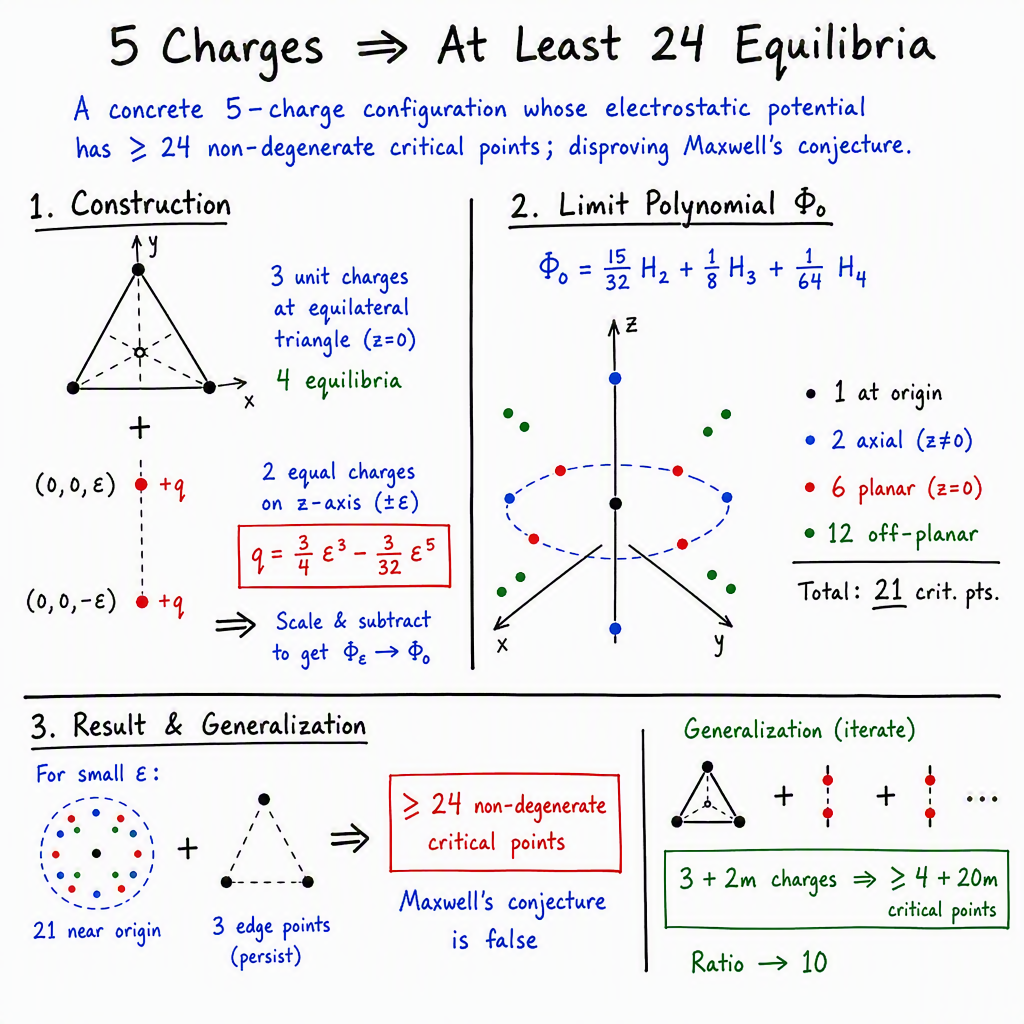
- Start simple: Put three equal positive charges at the corners of an equilateral triangle (a perfectly symmetric triangle). This setup has 4 equilibria: one at the triangle’s center and three others near the edges.
- Add two tiny charges on a line going straight up and down through the triangle’s center (one slightly above, one slightly below), very close to the center. This makes a shallow “triangular bipyramid.”
- Carefully choose how strong those two tiny charges are compared to how close they are. The authors use a math “zoom-in” trick (a Taylor expansion) to study what the potential looks like very near the center. By tuning the tiny charges just right, they make the math simplify to a clean “model” formula near the center.
- Analyze the simplified model: In that zoomed-in model, the single central equilibrium doesn’t just move—it splits into 21 separate equilibria. This splitting is called a “bifurcation,” like one river branching into many streams.
- Keep the old ones too: The three original edge equilibria from the triangle don’t disappear when the tiny charges are added; they survive. So now we have 21 new ones near the center + 3 old ones = 24 in total.
- Check that they’re all “non-degenerate”: Using standard tools from advanced calculus and topology (the implicit function theorem and transversality), the authors show these equilibria are isolated and stable under small tweaks—exactly what “non-degenerate” requires.
A few technical terms made simple:
- Taylor expansion: Zooming in on a point and replacing a complicated function with a simpler “polynomial snapshot” that behaves the same near that point.
- Cylindrical coordinates: A way to describe 3D points using radius r, angle θ, and height z (handy for symmetric shapes).
- Implicit function theorem: A stability rule that says solutions (like equilibria) move smoothly when you make small changes, instead of suddenly vanishing.
- Transversality: A “no-accidents” principle ensuring solutions are generically non-degenerate if you allow tiny adjustments.
Main findings and why they matter
- A counterexample to Maxwell’s conjecture: With just 5 positive charges, the authors construct at least 24 non-degenerate equilibria. Maxwell’s bound would allow at most 4, so the conjecture is false.
- The construction is robust: Small adjustments to the charge strengths don’t destroy these equilibria. So this isn’t a fragile, one-in-a-million setup.
- You can scale this up: By repeating the same trick—adding pairs of tiny charges in the right spots—you can keep creating many new equilibria. After every extra pair of charges, you can add about 20 more equilibria. This leads to an impressive “equilibria per charge” ratio of about 10, which beats earlier known results.
Why it’s important:
- It overturns a classical belief from a foundational figure in electromagnetism.
- It shows that even with only positive charges, electric fields can have surprisingly many balance points.
- It introduces techniques that could be useful in other areas where we study critical points and energy landscapes (like physics, geometry, and optimization).
Implications and potential impact
- Rethinking limits in electrostatics: The number of equilibria can be much larger than once thought, even in very symmetric, positive-charge-only setups.
- New mathematical tools and ideas: The paper blends symmetry, careful scaling, and stability theorems to control and count critical points. These ideas may influence research in:
- Physics (complex field patterns and stability)
- Geometry and topology (Morse theory and critical point counting)
- Computational geometry and algorithms (counting and locating equilibria)
- A roadmap for building many equilibria: The method gives a recipe to keep adding charges in a controlled way to create lots of new balance points, setting new benchmarks for how complicated such fields can be.
Fun note: The authors mention that the initial idea for this construction was suggested by a LLM, and they then rigorously checked and wrote up the mathematics themselves—an interesting example of human–AI collaboration in research.
Knowledge Gaps
Knowledge gaps, limitations, and open questions
The paper establishes a concrete counterexample to the Maxwell conjecture and introduces an iterative scheme yielding an asymptotic critical-point-to-charge ratio of 10. The following issues remain unresolved and suggest directions for further research:
- Exact maxima for small n: Determine the true maximum number of non-degenerate equilibria for n = 3, 4, 5 (e.g., is 24 maximal for n = 5?), and more generally for each fixed n.
- Asymptotic growth rate: Close the gap between current lower bounds (≥ 10n/2 = 5n via the paper’s iteration) and known upper bounds; identify the true asymptotic order and constant of the maximal number of equilibria as n → ∞.
- Explicit parameter ranges: Provide explicit, verifiable bounds on ε and the axial charge magnitudes ensuring the existence of at least 24 equilibria (moving beyond “sufficiently small”).
- Exact counts for finite ε: Certify the exact number and locations of equilibria for concrete, non-asymptotic parameter choices (e.g., ε = 1/6), using certified numerics (interval arithmetic, Smale’s α-theory) or purely analytic estimates.
- Robustness to perturbations: Quantify how large perturbations of charge strengths or positions can be while preserving the 24 (or more) equilibria; characterize the measure/structure of parameter sets yielding a given count.
- Symmetry dependence: Assess how crucial the D3 × Z2 symmetry is—do similar counts persist under symmetry breaking, and what is the minimal symmetry needed for the construction?
- Mixed-sign charges: Extend the construction to allow negative charges; evaluate whether mixed signs can produce strictly larger counts and how the loss of convex-hull containment affects existence and localization of equilibria.
- Higher and lower dimensions: Generalize to R2 (logarithmic kernel) and Rd with d ≠ 3; determine whether analogous counterexamples and iteration schemes produce comparable or improved counts.
- Alternative kernels: Investigate whether Yukawa/screened Coulomb or other physically relevant kernels admit analogous constructions and bounds.
- Bifurcation classification: Rigorously classify the central “21-fold” bifurcation using singularity theory (normal forms, versal unfoldings), and characterize its genericity.
- Asymptotic locations and indices: Derive explicit asymptotic expansions (in ε) with error bounds for the positions and Morse indices of the 21 equilibria spawned near the origin.
- Transversality details: Provide a detailed proof and general criteria for the submersion claim used in the transversality argument, and characterize when families of charge configurations are Morse generically.
- Iterative scheme optimization: Determine whether one can add more than 20 equilibria per two added charges (improving the “per-charge yield”), possibly via different base configurations or perturbation patterns.
- Interaction control across iterations: Give quantitative separation/energy-barrier estimates ensuring that equilibria created in earlier steps persist without interference when later charges are added; rule out accumulation.
- Structural constraints: Study bounds when imposing physical constraints (e.g., bounded charge ratios, minimal inter-charge distances); quantify the trade-off between constraints and achievable counts.
- Alternative base geometries: Explore whether starting from other symmetric seeds (regular polygons, Platonic solids) yields larger initial or iterative gains than the equilateral triangle.
- Global topology checks: For finite ε (and after perturbation), rigorously verify Morse index distributions and Euler-characteristic constraints for the full set of equilibria, not only in the limiting polynomial model.
- Potential additional equilibria: Determine whether configurations constructed here actually have more than 24 equilibria for small ε (beyond those proved to persist by IFT), and characterize where such extra critical points could occur.
- Algorithmic discovery: Develop systematic, certified search algorithms to find and verify high-equilibria configurations for a given n, leveraging symmetry, continuation, and certification methods.
- Tightness of coefficient choices: Analyze the allowable coefficient ranges (e.g., the H4 coefficient bound mentioned) more sharply and assess whether alternative coefficient scalings can further increase the number of spawned equilibria.
Practical Applications
Immediate Applications
The paper constructs a concrete 5–charge configuration with at least 24 non-degenerate critical points of the Coulomb potential and provides an iterative recipe that adds 20 new non-degenerate critical points per 2 added charges. These findings can be used right away in the following ways:
- Benchmark suites for equilibrium-finding and PDE solvers
- Sector: software/CAE, computational physics
- Use case: Ship standardized “hard instances” to stress-test root-finding, gradient/Hessian computation, and continuation methods in packages like COMSOL, Ansys, FEniCS, and homotopy libraries.
- Tools/workflows: Provide analytic expressions (harmonic polynomial expansions), reference counts (24 equilibria), and Hessian signatures; golden-reference data for unit tests; Jupyter notebooks replicating the derivations.
- Assumptions/dependencies: Ideal point charges in unbounded 3D space; no boundaries, screening, or dielectrics; equilibria verified up to numerical precision.
- Hard instances for optimization and machine learning
- Sector: optimization, ML
- Use case: Evaluate robustness of nonconvex optimizers to many saddles; analyze basin-of-attraction structure and saddle-escaping heuristics.
- Tools/workflows: Gradient-flow simulations from random initializations; Hessian-based landscape diagnostics; benchmark leaderboards.
- Assumptions/dependencies: Landscape is physical (harmonic) and differs from typical ML losses; translation to ML insights is heuristic.
- Safer robotics path planning with potential fields
- Sector: robotics/autonomy
- Use case: Redesign potential-field planners to avoid/escape a proliferation of spurious equilibria even with few sources; integrate topology-aware planning.
- Tools/workflows: “Morse-aware planner” modules adding random restarts, homotopy continuation, switching potentials, navigation-function guarantees, and Hessian-based saddle detection.
- Assumptions/dependencies: Artificial potentials differ from Coulomb fields; guarantees depend on workspace topology and dynamics.
- Laboratory demonstrations and instructional modules
- Sector: education, physics labs
- Use case: Undergraduate/graduate labs visualizing equilibria with electrode arrays/electrolytic tanks; courses on Morse theory, symmetry, and bifurcation.
- Tools/workflows: Mathematica/Maple scripts to reproduce expansions; 3D visualizations of field lines and equilibria; stepwise construction starting from an equilateral triangle and adding axial charges.
- Assumptions/dependencies: Finite electrodes and boundaries approximate, not equal, to point-charge fields; measurements sensitive to noise and fringe effects.
- Topology-in-the-loop algorithm design
- Sector: scientific computing, applied math
- Use case: Incorporate transversality and parametric perturbations to remove degeneracies automatically in simulations (ensuring Morse functions “almost surely”).
- Tools/workflows: Small randomized parameter jitters; checks of regular values; automated Hessian non-degeneracy certification.
- Assumptions/dependencies: Requires access to differentiable models and stable numerical Hessians.
- Research methodology and policy templates for AI-assisted mathematics
- Sector: academia, research policy
- Use case: Immediate adoption of transparent LLM-disclosure practices, provenance tracking, and verification checklists, as modeled by the paper’s acknowledgments.
- Tools/workflows: Version-controlled notebooks; “AI contribution statements”; replication packages separating AI suggestions from human proofs.
- Assumptions/dependencies: Institutional/journal policy alignment; data and code availability.
Long-Term Applications
The constructive method (symmetry + small-charge perturbations + limiting polynomial control + implicit function theorem) opens routes to design, analysis, and control of complex potential landscapes across domains:
- Inverse design of electrostatic landscapes with prescribed equilibrium counts/placements
- Sector: CAD/EDA, advanced manufacturing
- Use case: Given target equilibrium density or pattern, synthesize minimal source configurations (electrodes) using harmonic cancellation and symmetry-based bifurcations.
- Tools/products: Inverse-design solvers embedding the paper’s iterative scheme; COMSOL/Ansys plugins that optimize source positions/strengths under constraints.
- Assumptions/dependencies: Translation from point charges to realizable electrode geometries; boundary conditions dominate in practical devices; safety and breakdown limits.
- Dielectrophoretic microfluidics for cell/particle sorting and patterning
- Sector: healthcare/biotech
- Use case: Engineer electrode arrays producing many stable “effective” wells (via |E|2 gradients) to create multiplexed traps/sorting lanes on chips.
- Tools/products: AC-driven microelectrode lattices designed via the paper’s equilibrium-multiplication motif; lab-on-chip sorters with tunable “multistability.”
- Assumptions/dependencies: Static Coulomb equilibria are saddles (Earnshaw); practical trapping relies on AC fields, medium permittivity/conductivity, and |E|2—not V—so mapping requires careful translation and simulation.
- Dense trap arrays for ion manipulation and mass spectrometry; heuristics for RF pseudopotentials
- Sector: quantum tech, analytical instrumentation
- Use case: Inform layouts that yield many pseudopotential minima for ion chains/arrays by adapting the equilibrium-multiplying design to RF Paul/Penning traps.
- Tools/products: Layout design heuristics; multipole-expansion matching; multi-well RF trap prototypes.
- Assumptions/dependencies: DC impossibility of stable charge trapping (Earnshaw) necessitates RF/combined fields; stability regions and micromotion constraints dominate feasibility.
- Field-shaped charged aerosol steering and electrostatic printing
- Sector: manufacturing, environmental tech, printing
- Use case: Use multi-equilibria fields to steer streamlines and split flows without moving parts; programmable routing by switching source strengths.
- Tools/products: Electrode metasurfaces enabling switchable flow topologies; multi-nozzle electrohydrodynamic printers with passive field-based multiplexing.
- Assumptions/dependencies: Charged particles follow E-field lines but equilibria are typically saddles; viscous/space-charge effects and boundaries can override ideal behavior.
- Topology-robust global planners and exploration policies
- Sector: robotics/software
- Use case: New planners that infer workspace homology/homotopy and provably avoid/get out of saddle networks in complex potential landscapes.
- Tools/products: “Morse-aware” global planners; hybrid graph + potential methods; learning-augmented saddle detectors.
- Assumptions/dependencies: Sensor noise and model mismatch; computational cost of global topology inference.
- Cross-domain extensions to gravitational, acoustic, and magnetic scalar potentials
- Sector: astrophysics, geophysics, NDE
- Use case: Reassess bounds and constructions for numbers of equilibria/critical points in other inverse-square or harmonic contexts; design “many-critical-point” benchmarks for inversion problems.
- Tools/products: Analytical recipes ported to Newtonian potentials; synthetic datasets for gravitational inversion or acoustic cavity design.
- Assumptions/dependencies: Source physics differ (e.g., only positive masses; magnetic scalar potentials limited by current-free regions); boundaries and media properties are decisive.
- Metasurface and haptics components with programmable multistability
- Sector: consumer devices, AR/VR haptics
- Use case: Create electrostatic haptic surfaces where mechanical response couples to engineered multi-equilibria fields for rich tactile states.
- Tools/products: Thin-film electrode patterns; driver ICs controlling equilibria count/locations.
- Assumptions/dependencies: Pure electrostatic equilibria are saddles; usable haptic “wells” require electromechanical coupling and careful safety constraints.
- Verification frameworks for genericity and transversality in multiphysics solvers
- Sector: CAE software
- Use case: Automated perturbation engines that ensure Morse-type genericity, certify non-degeneracy, and catalog equilibria classes under symmetry.
- Tools/products: CAE plugins providing parameter homotopies, regular-value checks, and Hessian certificates across parameter sweeps.
- Assumptions/dependencies: Access to solver internals/Jacobians; numerical conditioning.
Global assumptions and dependencies that affect feasibility
- Physical model: Ideal point charges in unbounded, homogeneous, isotropic Euclidean space using Coulomb’s law; ignores conductors, dielectrics, screening, thermal noise, and boundaries.
- Stability: Electrostatic potential equilibria in 3D are generically saddles (Earnshaw’s theorem); stable trapping of charges requires time-varying fields or additional physics.
- Scaling/tunability: Constructions rely on small-parameter asymptotics and precise charge-strength ratios; hardware realizations must approximate these within tolerances.
- Symmetry: The method leverages D3 × Z2 symmetry; breaking symmetry alters counts/locations but genericity (via transversality) can restore non-degeneracy after perturbations.
- Computation: Reliable Hessian evaluation and continuation require high-precision numerics; certification of non-degeneracy is sensitive to noise and discretization.
Glossary
- Axial charges: Charges placed along the symmetry (z) axis of the triangular configuration. Example: "when two axial charges are added with ε = 1/6:"
- Axial equilibria: Equilibria (critical points) located on the symmetry axis of the system. Example: "(c) the potential along the z-axis showing 3 axial equilibria;"
- Bifurcation: A qualitative change where one equilibrium splits into several as a parameter varies. Example: "the central equilibrium bifurcates into a family of 21 equilibria."
- Bipyramid: A polyhedron formed by joining two pyramids base-to-base; here, a triangular bipyramid arrangement of charges. Example: "to form a shallow triangular bipyramid."
- Compact convex hull: The smallest closed and bounded convex set containing a given set of points. Example: "all critical points of V ε belong to the compact convex hull of {a ,...,a }"
- Coulomb potential: The potential generated by point charges, proportional to the inverse distance. Example: "The Coulomb potential generated by these charges has the following Taylor expansion around the origin"
- Critical point: A point where the gradient of a function (here, the potential) is zero. Example: "admits at least 24 non-degenerate critical points."
- Cylindrical coordinates: A coordinate system (r, θ, z) useful for axial symmetry. Example: "In cylindrical coordinates"
- Deformed potential: A rescaled difference of potentials designed to study limiting behavior. Example: "we introduce a deformed potential Φ , defεned as"
- Electrostatic potential: The scalar potential field produced by static charges. Example: "whose electrostatic potential admits at least 24 critical points"
- Equilibria: Points where the electric field vanishes; critical points of the potential. Example: "the number of equilibria of the electric field generated by n point charges"
- Euler characteristic equation: A topological identity relating counts of critical points by index. Example: "These satisfy the Euler characteristic equation"
- Harmonic polynomial: A polynomial satisfying Laplace’s equation (∆H = 0). Example: "are harmonic polynomials"
- Hessian: The matrix of second derivatives of a function, characterizing local curvature at a point. Example: "and their Hessians evaluated"
- Implicit function theorem: A theorem ensuring solutions persist and vary smoothly under small perturbations. Example: "the implicit function theorem implies that the 21 non-degenerate critical points"
- Maxwell conjecture: The claim that an n-point-charge field has at most (n−1) non-degenerate critical points. Example: "‘Maxwell conjecture’ which states that if the critical points of the electrostatic potential generated by n point charges are all non-degenerate then their number cannot exceed (n − 1) ."
- Morse function: A smooth function whose critical points are all non-degenerate. Example: "V ε is a Morse function for almost every q"
- Morse index: The number of negative eigenvalues of the Hessian at a critical point. Example: "has Morse index 1"
- Morse inequalities: Inequalities relating the number of critical points to topological invariants. Example: "The Morse inequalities therefore remain consistent"
- Non-degenerate: Having an invertible Hessian at a critical point (no zero eigenvalues). Example: "all of which are non-degenerate."
- Parametric transversality theorem: A result ensuring that for generic parameters, maps are transverse, yielding properties like Morse functions. Example: "the parametric transversality theorem implies that 0 is a regular value"
- Real-analytic: Representable locally by a convergent power series. Example: "real-analytic on U"
- Regular value: A value whose preimages have Jacobians of full rank (no critical points at those preimages). Example: "0 is a regular value"
- Signature (of a critical point): The signs of the Hessian’s eigenvalues, indicating local type of the critical point. Example: "with signature (+ + −)."
- Submersion: A smooth map whose differential is surjective at each point. Example: "F is a submersion (cf. [4, Ex. 1.7.22])"
- Taylor expansion: A series expansion of a function around a point. Example: "Taylor expansion around the origin"
Collections
Sign up for free to add this paper to one or more collections.