How to read Mathematics? A study guide
Abstract: Reading a math textbook isn't like reading a novel. You've probably already figured that out on your own. But how do you read mathematical texts? And how can you actually learn from a book or lecture notes? This document is a guide to independently reading and working through mathematical texts. Originally written as supplementary material for a flipped classroom course for first year math students it may serve as a detailed reading guide for anybody interested in math.
Paper Prompts
Sign up for free to create and run prompts on this paper using GPT-5.
Top Community Prompts
Explain it Like I'm 14
Plain-language summary of “How to Read Mathematics? A study guide” by Petra Schwer
What is this paper about?
This paper is a friendly guide that teaches you how to read and learn from math books, papers, and class notes. It explains why math reading feels slow and tough—and shows a clear, step-by-step way to make real progress and understand ideas deeply.
What questions is the paper trying to answer?
In simple terms, the guide focuses on:
- How do you read math so you actually understand it?
- What should you do when you get stuck?
- How do definitions, theorems, and proofs fit together?
- How can practice problems help you learn?
- How should you use tools like AI without hurting your own thinking?
How does the paper approach the topic?
Instead of running experiments, the paper gives a practical method you can follow. Think of it like a roadmap for learning math on your own. It also explains key math words using everyday ideas:
- Definition: the exact “rules of the game” for a new idea.
- Theorem/Lemma/Corollary: facts that must be true if the rules (assumptions) are met. A lemma is a helpful stepping stone; a theorem is a main result; a corollary is a quick bonus result that follows from a theorem.
- Proof: a careful, step-by-step explanation showing why a statement must be true. Like a detective story where every clue is checked.
The guide offers:
- General habits (read slowly, ask precise questions, talk to others, write things down).
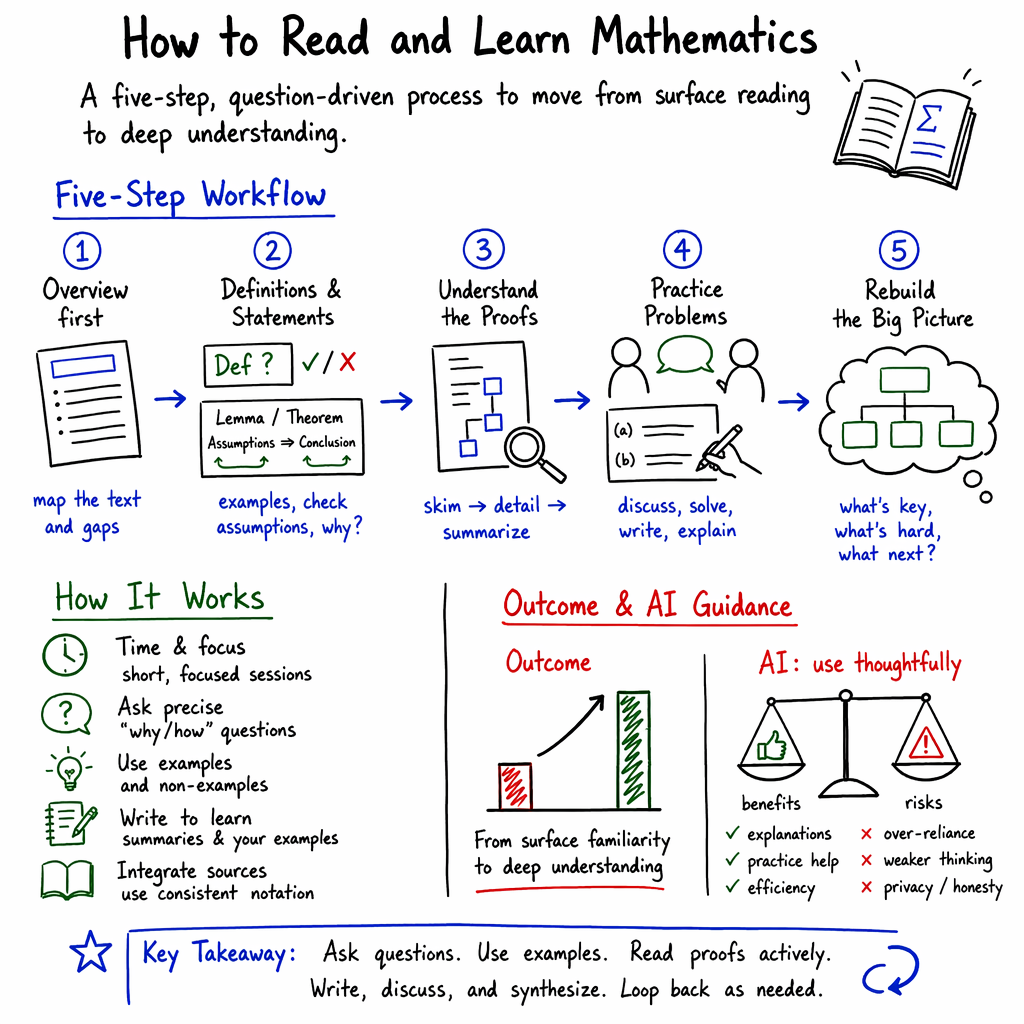
- A 5-step process for reading and learning math.
- A short discussion on AI: it can help, but overusing it may weaken your own thinking.
What are the main takeaways, and why do they matter?
Here are the core ideas, with a short note on why each matters:
- Read slowly and give yourself time. This prevents you from skimming past important details. In math, one line can carry a lot of meaning.
- Ask precise questions. Specific questions (“Where is assumption X used?”) lead to real understanding, not just a vague feeling of confusion.
- Talk to others and write things down. Explaining and writing force your brain to be clear. That’s when you notice gaps and fix them.
- Balance “keep going” with “move forward.” Try hard to understand a tough part, but if you’re stuck, keep reading and return later—later parts often unlock earlier ones.
- Use a 5-step method to study: 1) Get a quick overview: skim to see the big picture and find the hard spots. 2) Understand definitions and statements: learn the “vocabulary” and what each result is saying. Always find examples and non-examples. 3) Understand the proofs: first skim for the main idea, then read line by line, then summarize how it works. 4) Do practice problems: this is where learning really sticks. Read the problem carefully, connect it to definitions/theorems, write a full solution, and explain it to someone. 5) Rebuild the big picture: at the end, step back and summarize the main ideas so you don’t “miss the forest for the trees.”
- Be thoughtful about AI. The paper cites studies suggesting that heavy reliance on AI can reduce your brain’s engagement and sense of ownership of your work. Other studies find AI can help with personalization and motivation. The message: use AI carefully and always keep your own thinking active.
These points matter because they turn math from “mystery and memorizing” into “step-by-step understanding.” They help you become independent, confident, and better at solving new problems—not just repeating old ones.
What impact could this have?
- For students: Following this guide can make math less scary and more manageable. You’ll build strong habits that improve grades, confidence, and long-term skills.
- For teachers/tutors: The steps offer a simple structure for lessons and study advice.
- For learning with technology: The balanced view helps you get the benefits of AI without letting it do the thinking for you.
In short, the paper shows that reading math is a skill you can learn. Go slowly, ask sharp questions, practice actively, and keep your own brain in the driver’s seat.
Knowledge Gaps
Knowledge Gaps, Limitations, and Open Questions
Below is a concise, actionable list of what the paper leaves missing, uncertain, or unexplored.
- Empirical efficacy: What is the causal impact of the proposed five-step method on proof comprehension, problem-solving performance, and long-term retention compared with alternative study strategies?
- Learner heterogeneity: How should the approach be adapted for novices vs. advanced students, undergraduates vs. graduates, or returning learners with uneven backgrounds?
- Domain specificity: Do optimal reading strategies differ across subfields (e.g., analysis vs. algebra vs. probability vs. applied/computational math), and how should guidance vary by domain?
- Genre differences: What modifications are needed when reading original research papers (with elided steps and dense references) versus textbooks, lecture notes, or survey articles?
- Time budgeting: What evidence-based time allocations per step (overview, definitions, proofs, problems, synthesis) maximize learning under realistic course loads and work constraints?
- Decision thresholds: What concrete criteria or diagnostics can guide “keep going” vs. “move forward” choices to balance depth with progress without derailing momentum?
- Prerequisite detection: How can readers efficiently diagnose and remediate missing background knowledge encountered mid-reading (e.g., quick prerequisite checks, minimal refreshers)?
- Example generation: What systematic heuristics help students construct informative examples and non-examples that target the boundary of a definition’s conditions?
- Checking well-definedness: What step-by-step procedures or checklists reliably help students verify that a definition is well-defined in typical contexts?
- Proof-technique scaffolds: Which cues and workflows best support reading and reconstructing standard proof styles (induction, contradiction, construction, ε–δ, extremal, invariants)?
- Handling gaps in papers: What strategies most effectively bridge omitted “obvious” steps, cross-references, and folklore results in research-level texts?
- Notation management: What reproducible workflows help reconcile conflicting notation across multiple sources without introducing new errors?
- Assessment of understanding: Which validated instruments or rubrics can measure “understanding” of definitions, theorems, and proofs beyond problem correctness?
- Memory and scheduling: How should spaced repetition, retrieval practice, and interleaving be integrated with the proposed steps, and with what measured benefits in mathematics specifically?
- Note-taking/writing methods: Which note-taking systems (e.g., structured worked examples, concept maps, Zettelkasten) most improve mathematical understanding and transfer?
- Group work design: What group sizes, roles, and protocols (e.g., peer instruction, think–pair–share) optimize collective reading and problem solving in math?
- Accessibility and inclusivity: How should strategies be adapted for students with dyslexia, ADHD, visual impairments, or for non-native speakers; what universal design practices are most effective?
- Digital tooling (non-AI): What is the impact of annotation tools, CAS, proof assistants, and computational notebooks on reading comprehension and proof construction?
- AI integration: For which math-reading tasks (summarization, example generation, proof sketching) do LLMs help or harm learning, and what guardrails and evaluation metrics are appropriate?
- External validity of AI studies: Do reported neural/behavioral effects of LLM use replicate for math-specific reading and proof tasks over longer horizons and diverse populations?
- Transfer to creation: How does improved proof-reading skill translate to original proof construction and research problem solving, and what training bridges are most effective?
- Affective factors: How does the method interact with math anxiety, motivation, and persistence; which interventions mitigate avoidance while preserving productive struggle?
- Course-level integration: How can instructors embed and assess these reading practices in curricula (e.g., graded reading logs, proof diaries, oral checks) without unsustainable overhead?
- Problem selection: What principles best calibrate problem difficulty and sequencing (blocked vs. interleaved) to consolidate new definitions and theorems?
- Multimodal resources: How should the method adapt when learning via videos, recorded talks, or interactive texts, and how do outcomes compare to print-based reading?
- Media effects: Do outcomes differ between screen, tablet, and paper reading for mathematics, and what design features (e-ink, stylus, margin size) matter?
- Cross-linguistic/cultural issues: How do language and regional notation conventions affect comprehension, and which bilingual or cross-notation supports are most effective?
- Academic integrity boundaries: What clear norms should govern collaboration, use of solution manuals, and AI tools to preserve learning while enabling support?
Practical Applications
Immediate Applications
Below are concrete ways to apply the paper’s methods right away across sectors. Each item lists sectors, potential tools/workflows, and assumptions or dependencies that affect feasibility.
- Structured “Read–Understand–Prove–Practice–Synthesize” assignments — Convert the five-step method into weekly graded tasks (overview pass, definitions/examples, proof walk-throughs, problem set attempts, end-of-week synthesis).
- Sectors: Education (secondary, undergraduate, graduate)
- Tools/workflows: LMS checklists, reflection prompts, rubrics for definitions/examples/non-examples, proof-summary templates
- Assumptions/dependencies: Instructor buy-in; time for grading short reflections; alignment with course outcomes
- Math reading boot camp (first 2–3 weeks of term) — Short, skills-focused module training students to read slowly, ask precise questions, write examples/non-examples, and present proof skeletons.
- Sectors: Education; Teacher training
- Tools/workflows: Slides, role-play exercises (explainer/skeptic/scribe), in-class micro-tasks
- Assumptions/dependencies: Timetable space; departmental support to allocate early-term instructional time
- TA/peer-tutor question bank — A bank of “coaching questions” mapped to the paper’s stages (e.g., identify assumptions vs. conclusions, locate use of hypotheses).
- Sectors: Education; Academic support centers
- Tools/workflows: Shared doc/wiki; printable cards; tagging by course topic
- Assumptions/dependencies: Initial authoring effort; periodic updates by staff
- Problem-set release policy and workflow — Release problem sets early (as the guide suggests), require a day-1 skim submission, a midweek “definition check,” and a final write-up plus a short oral explanation to a peer.
- Sectors: Education
- Tools/workflows: Staged submissions in LMS; peer-discussion slots; short viva-style checks
- Assumptions/dependencies: Scheduling flexibility; clear grading criteria to keep workload manageable
- Annotation and note-taking templates for math — Provide ready-to-use templates with sections for assumptions, definitions, examples/non-examples, proof map, and “where each assumption was used.”
- Sectors: Education; Daily learning
- Tools/workflows: PDF/OneNote/Notion/Obsidian templates; stylus-enabled PDFs for tablets
- Assumptions/dependencies: Student device access; minimal onboarding to the template
- Reading groups and journal clubs with roles — Adopt roles aligned with the guide: overviewer (step 1), definitions anchor (step 2), proof navigator (step 3), exerciser (step 4), synthesizer (step 5).
- Sectors: Academia; R&D teams in industry
- Tools/workflows: Rotating roles; 60–90 minute meetings with timeboxed segments
- Assumptions/dependencies: Regular attendance; facilitator to keep time and scope
- Spec/RFC reading protocol for engineers — Map the paper’s steps to technical specifications: overview pass, term/definition inventory, statement-to-requirement mapping, rationale/proof-of-correctness tracing, system-level synthesis.
- Sectors: Software, networking, fintech, medtech (regulatory specs)
- Tools/workflows: Confluence templates; PRD/ADR fields for “assumptions used where”; checklists in pull requests
- Assumptions/dependencies: Team culture supports slower, deeper reading; leads enforce checklists
- Code and proof review checklists — Borrow “identify assumptions and where they’re used” for PR reviews and formal verification reviews (Lean/Coq/Isabelle).
- Sectors: Software engineering; Formal methods; Security
- Tools/workflows: GitHub/GitLab issue/PR templates; Diffs annotated with “assumption use” comments
- Assumptions/dependencies: Reviewers trained to apply the checklist without inflating cycle time
- Anki/spaced-repetition decks focused on definitions and non-examples — Turn “no definition without examples” into flashcards with minimal pairs and counterexamples.
- Sectors: Education; Daily study
- Tools/workflows: Public decks per course; tagging by chapter; scheduled reviews
- Assumptions/dependencies: Initial deck curation; student adherence to review cadence
- Course AI-use policy with “active-first” guardrails — Encourage brain-first passes and delayed AI use; require source-of-truth citations and independent verification notes, reflecting the paper’s AI caution and cited findings.
- Sectors: Education; Institutional policy
- Tools/workflows: Syllabus language; assignment sections for “what I verified and how”
- Assumptions/dependencies: Institutional alignment on academic integrity; consistent enforcement
- Onboarding packs for new grad students/postdocs — A short guide + templates for reading groups, with examples of “assumptions mapping” from seminal papers in the field.
- Sectors: Academia; Industrial research labs
- Tools/workflows: Starter kits in a shared drive; kickoff workshop
- Assumptions/dependencies: Faculty/PI sponsorship; discipline-specific exemplars
- Personal study schedule with “hours per page” pacing — Implement the “read slowly” and multi-day simmering advice as calendar blocks and a daily “return to the hard line” reminder.
- Sectors: Daily life; Self-learners; Bootcamps
- Tools/workflows: Calendar templates; Pomodoro timers; daily review prompts
- Assumptions/dependencies: Realistic time budgeting; prioritization literacy
Long-Term Applications
These ideas extend the guide’s methods into products, standards, and research that require further development, validation, or scaling.
- AI tutor that enforces active engagement — An “active-first” co-pilot that withholds answers, scaffolds the five steps, prompts for examples/non-examples, highlights where assumptions are used, and logs verification steps.
- Sectors: Edtech; Software for higher ed
- Tools/products: LMS-integrated copilots; PDF/LaTeX readers with embedded prompts; proof-structure detectors
- Assumptions/dependencies: Reliable math parsing; hallucination mitigation; pedagogy-aligned UX; data privacy compliance
- Adaptive analytics for reading-to-learning pipelines — Instrumentation that measures step completion (overview, definitions, proof map), predicts stumbling points, and recommends targeted practice.
- Sectors: Edtech; Learning analytics
- Tools/products: Event logging SDKs for e-readers; dashboards for instructors
- Assumptions/dependencies: Ethical data collection; IRB where applicable; models validated for math learning contexts
- “Active margins” textbooks and digital editions — Redesign textbooks with structured, in-margin prompts: find assumptions, produce counterexamples, identify proof techniques, and end-of-section synthesis pages.
- Sectors: Academic publishing
- Tools/products: Interactive e-text formats; instructor editions with exemplar answers
- Assumptions/dependencies: Publisher investment; author adoption; accessibility compliance (MathML)
- Proof-assistant pedagogy mode — Extensions to Lean/Coq/Isabelle that annotate proof scripts with “assumptions used here,” generate example/non-example tasks from definitions, and export student-friendly proof maps.
- Sectors: Formal methods; Edtech
- Tools/products: IDE plugins; curriculum-aligned libraries
- Assumptions/dependencies: Dev cycles in open-source communities; educator–developer collaboration
- Enterprise “critical reading of technical materials” standard — A cross-industry standard (or internal playbook) mapping the guide’s steps to compliance documents, safety cases, and risk analyses.
- Sectors: Aerospace, automotive, medical devices, finance (model risk), energy
- Tools/products: Audit templates; training modules; certification pathways
- Assumptions/dependencies: Regulator recognition; alignment with ISO/IEC or internal QA frameworks
- Neurocognitive evaluation of active vs. AI-assisted reading in math — Longitudinal studies extending the cited EEG findings to mathematical reading and proof learning, with interventions based on the guide.
- Sectors: Academia; Learning science; Policy
- Tools/products: EEG/fNIRS protocols; open datasets; intervention toolkits
- Assumptions/dependencies: Funding; IRB; reproducible pipelines; diverse learner populations
- National or institutional policy on AI in math education — Evidence-based guidelines that prioritize verified, student-owned work and define acceptable AI scaffolding phases (e.g., post–first-pass only).
- Sectors: Education policy; Accreditation bodies
- Tools/products: Policy frameworks; compliance rubrics; audit tooling
- Assumptions/dependencies: Consensus-building among stakeholders; legal review (privacy, IP)
- Credentialing: Mathematical Reading Literacy micro-credential — Assess the ability to identify assumptions, produce non-examples, map proof structures, and synthesize topics.
- Sectors: Higher education; Professional certification
- Tools/products: Scenario-based assessments; digital badges
- Assumptions/dependencies: Valid, reliable assessment design; employer/institutional recognition
- Accessibility and neurodiversity supports — Adaptive reading paths, chunking aids, and time-estimation coaching (“hours per page”), tuned for ADHD/dyslexia profiles.
- Sectors: Accessibility; Edtech
- Tools/products: Adjustable pacing UIs; audio plus structured prompts; tactile/visual organizers
- Assumptions/dependencies: Co-design with target users; efficacy studies; compatibility with assistive tech
- Cross-disciplinary transfer to law and policy analysis — Apply the “assumptions-to-conclusions” and non-example method to statutes, contracts, and regulatory guidance to surface implicit conditions and failure modes.
- Sectors: Legal; Public policy; Compliance
- Tools/products: Document analysis checklists; training workshops
- Assumptions/dependencies: Domain adaptation; buy-in from legal teams to adopt slower, deeper reading
- Workplace upskilling programs at scale — Company-wide curricula teaching spec/protocol reading, with mentored reading groups and capstones converting a complex document into a validated implementation plan.
- Sectors: Tech, telecom, energy, finance
- Tools/products: LMS programs; mentor playbooks; outcome rubrics
- Assumptions/dependencies: Demonstrated ROI (fewer defects, better audit outcomes); executive sponsorship
- Multi-source integrator tools — Systems that ingest multiple texts on the same topic and guide users to write a unified summary with uniform notation and reconciled definitions, as recommended in the guide.
- Sectors: Research; Edtech
- Tools/products: Knowledge integration workspaces; notation-normalization assistants
- Assumptions/dependencies: Reliable math-aware parsing; citation integrity; user training to avoid over-automation
These applications translate the guide’s principles—slow, structured reading; precision in questioning; writing and example-driven understanding; and verification-first habits—into deployable practices, products, and policies. Each assumes a shift from speed to depth and benefits most where leadership, tooling, and assessment reinforce the behaviors.
Glossary
- Alpha and beta connectivity: Patterns of functional coupling in EEG data corresponding to the alpha (8–12 Hz) and beta (13–30 Hz) frequency bands. "reduced alpha and beta connectivity, indicating under-engagement."
- arXiv: An open-access repository for research preprints, primarily in STEM fields. "preprint 2025, \url{https://arxiv.org/abs/([2506.08872](/papers/2506.08872))}"
- Bijective: A function that is both one-to-one (injective) and onto (surjective), hence invertible with a two-sided inverse. "Why must the inverse function itself be bijective in the definition?"
- Brain connectivity: The network of functional or structural relationships among brain regions. "EEG revealed significant differences in brain connectivity:"
- Corollary: A result that follows with little additional effort from a previously proven theorem. "Reading lemmas/theorems/corollaries:"
- Creative Commons Licence CCBY1: An open license variant permitting reuse with attribution. "This text is licenced under Creative Commons Licence CCBY1."
- EEG: Electroencephalography; a method for recording electrical activity of the brain via scalp electrodes. "EEG revealed significant differences in brain connectivity:"
- Inverse function: A function that reverses another function’s mapping, sending outputs back to their original inputs. "Why must the inverse function itself be bijective in the definition?"
- KOMA-article class: A LaTeX document class from KOMA-Script tailored for European typographic conventions. "% , twocolumn KOMA-article class"
- Lemma: An auxiliary proposition used to prove a larger result (typically a theorem). "Why is this a lemma/theorem/corollary?"
- Lettrine: A LaTeX command/package for creating dropped capital letters at the start of a paragraph. "\lettrine[lines=3,lhang=0.3,nindent=0em]{"
- LLM: LLM; a machine learning model that processes and generates human-like text. "LLMs offer immediate convenience,"
- Occipito-parietal: Pertaining to the occipital and parietal lobes of the brain. "activation of occipito-parietal and prefrontal areas,"
- Prefrontal: Relating to the prefrontal cortex, a frontal lobe region involved in executive functions. "activation of occipito-parietal and prefrontal areas,"
- Preprint: A scholarly manuscript made publicly available before peer review. "preprint 2025"
- Proof technique: A structured method for establishing mathematical truth (e.g., induction, contradiction, contrapositive). "What proof technique is being used?"
- Theorem: A central mathematical statement proven from axioms and prior results. "Reading lemmas/theorems/corollaries:"
- Well-defined: A property ensuring a concept or operation is unambiguous and independent of representation choices. "Why is this concept well-defined?"
Collections
Sign up for free to add this paper to one or more collections.

