LLMs Get Lost in Evolving User Intent
Abstract: As LLMs become more capable, they are increasingly deployed as collaborative agents, taking on user-delegated tasks through iterative interaction. Yet genuine interaction is inherently dynamic: users rarely specify their intent upfront, instead disclosing, revising, and reshaping it as the conversation unfolds. Despite this, LLMs are still predominantly evaluated or trained in single-turn, fully-specified settings, leaving open a fundamental question: how well do LLMs track and act on user intent as it evolves over the course of a conversation? To study this, we introduce a framework that transforms static, single-turn tasks into dynamic multi-turn conversations in which the user's intent evolves across turns--incrementally revealed, revised, and at times redirected mid-conversation--while preserving each task's original evaluation protocol, enabling existing benchmarks to be reused as controlled testbeds without new annotation. Across multiple tasks, we surface a consistent phenomenon: strong static-setting performance does not transfer to the evolving-intent setting, with substantial drops across model families. Our findings point to a fundamental gap: today's LLMs do not yet faithfully track and act on the user's evolving intent, a capability invisible to static evaluation yet critical for future collaborative agents.

Paper Prompts
Sign up for free to create and run prompts on this paper using GPT-5.
Top Community Prompts
Explain it Like I'm 14
Overview
This paper looks at how AI chatbots (LLMs) handle real conversations where people change their minds. In real life, we don’t always say exactly what we want at the start. We reveal more details, correct ourselves, or even switch to a related task mid-chat. The authors show that today’s strong LLMs often get confused when user intent evolves like this, even if they do great on one-shot, fully specified questions.
What questions does the paper ask?
- Can LLMs keep track of what a user wants as that goal changes over multiple turns?
- Which kinds of changes are hardest for LLMs to handle?
- Does performance drop as conversations get longer or more complex?
- Do simple “memory” tricks help models keep up?
- Are hard problems hit even harder by these evolving conversations?
How did they study it?
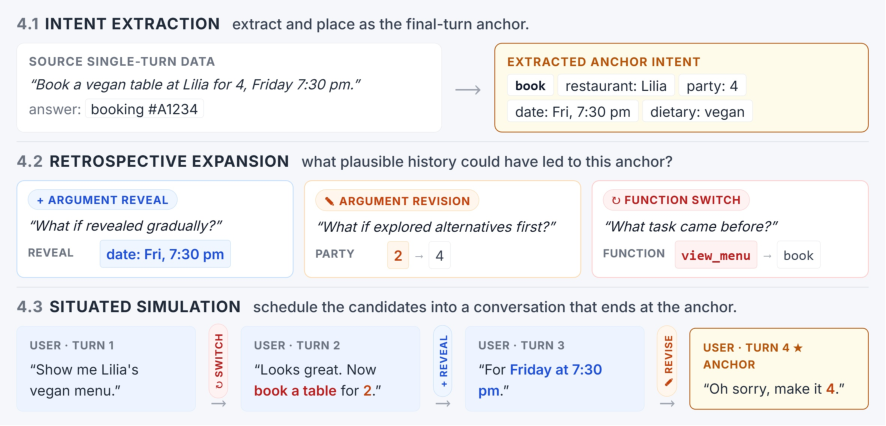
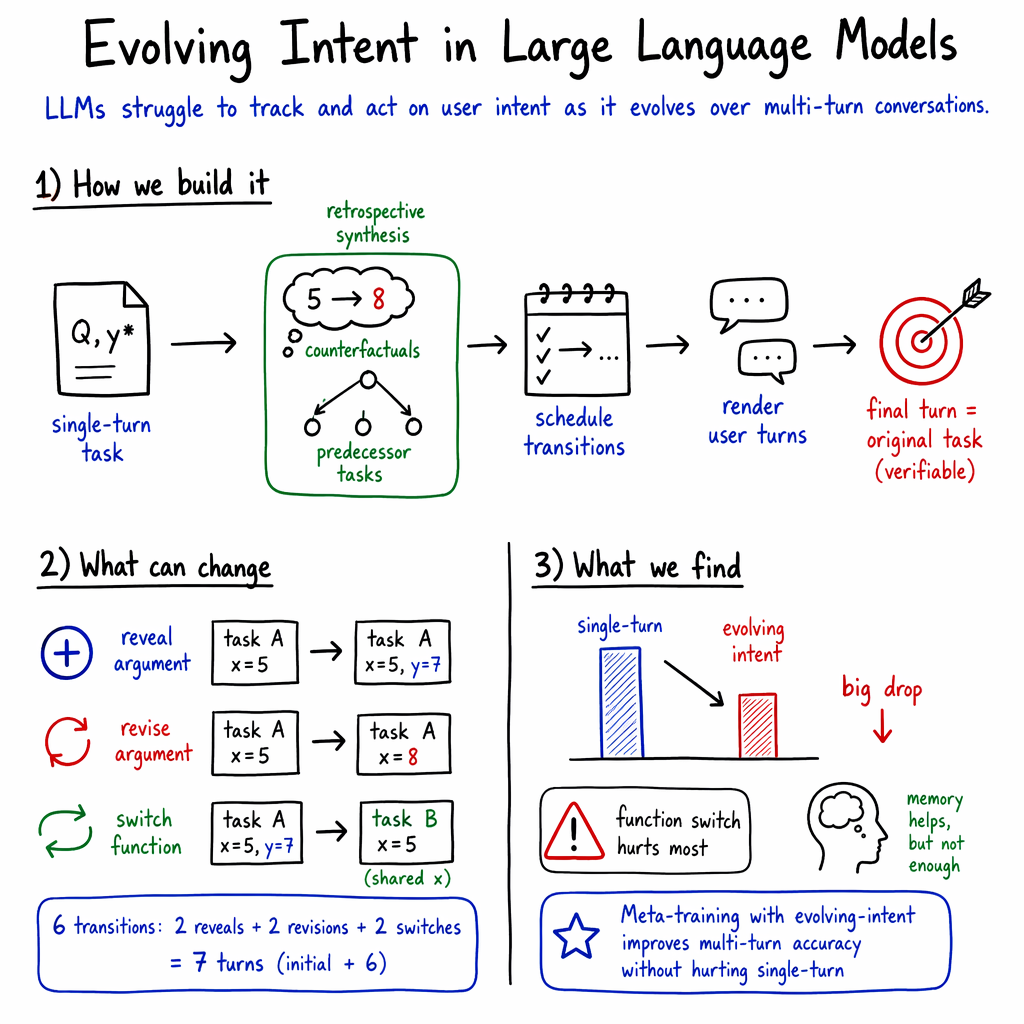
The big idea: turn ordinary one-step problems (where you ask once and get an answer) into realistic multi-turn chats with changing intent—while still keeping an automatic way to check if the final answer is correct.
Turning one-step tasks into conversations
Imagine a mystery movie that starts at the end. The authors:
- Take a regular, verifiable problem with a known correct answer (like a math question with the right solution).
- Treat that as the final turn of a conversation—the “anchor.”
- Build a believable story backwards: earlier turns gradually reveal info, make changes, or pivot tasks so the chat naturally ends at the original problem.
Because the last turn is the same as the original problem, the answer can be auto-checked using the original dataset’s checker.
Three ways intent can change
The paper models user intent changes in three simple, realistic ways:
- Argument reveal: share a missing detail later (e.g., “Find me a restaurant” → “It should be vegan”).
- Argument revision: correct or change a detail (e.g., “In New York” → “Actually, make that Brooklyn”).
- Function switch: switch to a related task that reuses some context (e.g., “Find a restaurant” → “Now book a table at that restaurant”).
To make these work, the authors sometimes start with a “counterfactual” detail (a reasonable but different value) and later revise it to the true one, or they add a “predecessor” task that naturally leads to the final task.
Making sure answers can be checked
They use existing datasets with automatic checkers (so no human grading needed), including:
- GSM8K (math)
- BIRD-SQL (turn text into SQL queries)
- BrowseComp+ (web search tasks)
- SWE-Bench Verified (coding/bug fixing with tests)
Each conversation ends at the original problem so the final answer can be scored automatically.
What did they find?
Here are the main takeaways:
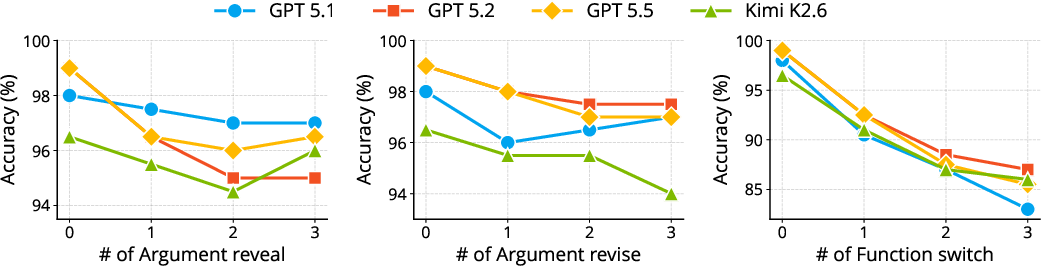
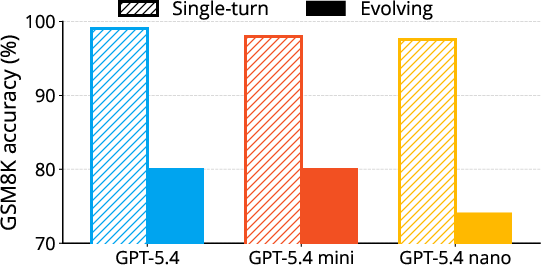
- Big drop from one-turn to multi-turn: Even top models that score ~99% on single-turn math dropped to about 80% after just six intent changes. Drops were often larger for web search and coding tasks.
- More changes, worse performance: Increasing the number of intent changes steadily lowers accuracy.
- Task switching is hardest: Switching to a related task (like “find” → “book”) causes the biggest problems—especially when combined with revealing and revising details.
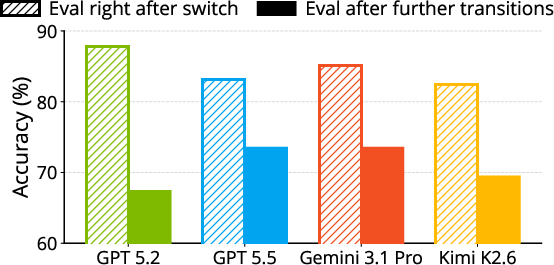
- After a switch, models forget useful context: If you switch tasks and then add more small updates, models have trouble mixing old and new info correctly.
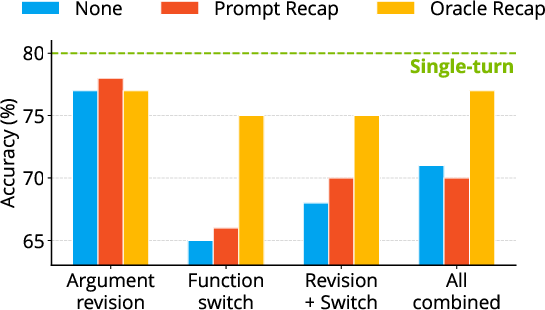
- Simple memory helps but doesn’t fix it: Reminding the model to re-check the conversation helps a bit; giving a perfect recap of the currently known intent helps more—but still doesn’t reach single-turn performance.
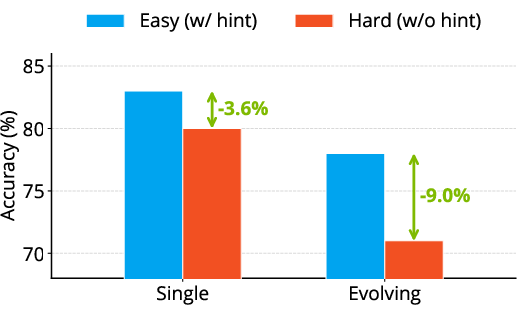
- Hard problems suffer more: When the original task is harder, the extra damage from multi-turn changes is bigger.
Why this matters: Real users rarely give perfect instructions upfront. If strong models still falter when intent evolves, they’ll struggle as dependable assistants for complex, real-world tasks.
What does this mean going forward?
- Evaluation needs to change: Testing only with one-turn, fully specified tasks hides a major weakness. Benchmarks should include evolving-intent, multi-turn setups.
- Better “belief tracking” is needed: Models must keep an up-to-date internal picture of what the user currently wants, update it when details change, and ignore outdated info.
- Smarter memory and filtering: Helpful tools might include active recaps (“Here’s what you want so far”), highlighting only relevant past details, and detecting when the task has switched.
- Scalable testing: The framework lets researchers convert many existing datasets into multi-turn conversations without new labels, making it easy to measure progress.
In short: Today’s LLMs are powerful in one-shot tests but often get “lost” when the user’s goal evolves. Fixing this will be key for reliable AI assistants that can truly collaborate over longer, realistic conversations.
Knowledge Gaps
Below are concrete knowledge gaps, limitations, and open questions the paper leaves unresolved. They are phrased to be directly actionable for future research.
Methodology and Simulation Validity
- Validate LLM-based intent extraction: No systematic audit of accuracy/consistency when mapping single-turn questions to structured intents (functions/arguments). Needed: human validation, inter-annotator agreement, and failure-case taxonomy across domains.
- Check counterfactual generation quality: Counterfactual argument values and predecessor functions are LLM-generated without guarantees of plausibility, domain validity, or consistency with schemas. Needed: constraints (schema/ontology/KB checks), automatic sanity tests, and human spot-checks to quantify realism.
- Avoid circularity/model bias in simulation: The same or similar LLM family is used to extract intents, generate counterfactuals, render dialogue, and, in some analyses, judge intent tracking. Needed: cross-model simulation/judging, ablations with weaker/stronger simulators, and bias quantification.
- Assess renderer effects: The paper uses templated/prefix-based rendering (and optionally an LLM rephraser); no ablation shows how wording/style/noise affect outcomes. Needed: controlled perturbations (paraphrase, disfluency, typos, code-mixing, multilingual prompts) and sensitivity analyses.
- Realism of transition rules: “Reveal-before-switch,” single-transition-per-turn, and retrospective pivots may not mirror real user behavior. Needed: variants that allow multi-intent/multi-revision turns, mid-task pivots before full specification, and evaluation protocols that remain verifiable under these relaxations.
- Final-turn-only verifiability: Intermediate turns are not verifiable, so errors earlier in the trajectory are only reflected indirectly at the end. Needed: lightweight per-turn verifiers (slot-filling checks, partial-credit metrics, oracle state checks) that preserve scalability.
- Anchor-dependence of revision: Revisions are designed to eventually return to the source intent (back to c_i*). Needed: scenarios where revisions move away from the original target, and evaluation supports multiple valid final intents/answers.
- Task graph validity for function switches: Predecessor–successor chains are LLM-induced with only argument-overlap constraints. Needed: curated or learned task-graph ontologies per domain, with coverage/validity guarantees and diagnostics for ill-posed switches.
Evaluation Design and Metrics
- Confounds from tool-call budgets: Multi-turn increases total tool opportunities yet shows greater failure; per-turn vs global budgets may bias results. Needed: matched-budget and matched-wall-clock comparisons, and analyses of search vs execution call mix.
- Single end-task accuracy as sole metric: No measures of per-turn intent faithfulness, correction handling, helpfulness, or user satisfaction. Needed: multi-dimensional metrics (intent-tracking accuracy, latency to correct intent, robustness to conflict, minimality of context use).
- Judge reliability for intent-tracking: Turn-wise intent-tracking uses an LLM judge; reliability is unverified. Needed: cross-judge agreement, rubric-based evaluation, and partial automation with structured matching.
- Distractor sensitivity is not isolated: Degradation may arise from longer context rather than intent evolution per se. Needed: control experiments with length-matched but semantically stable histories and with intentionally injected irrelevant distractors.
- Order effects beyond one analysis: Only a limited look at post-switch degradation. Needed: systematic counterbalancing of transition orders and Markov blankets of relevant turns to quantify where belief updates fail.
- No analysis of multiple valid answers: Many tasks admit answer sets or equivalence classes (e.g., SQL). Needed: canonicalization/equivalence-checking to avoid penalizing different-but-correct outputs in evolving settings.
Scope and External Validity
- Limited domains and sample sizes: Four domains (e.g., 50 SWE-Bench Verif., 100 BrowseComp+) may not be representative. Needed: larger, diverse domains (planning, robotics, dialogue), bigger samples, and stratified difficulty coverage.
- Short horizons: Up to six transitions; long-horizon behavior remains uncertain. Needed: experiments with dozens of transitions and explicit stress-tests of memory/context-window limits.
- Homogeneous user population: No modeling of persona, dialect, style, politeness, or adversarial users; English-only setting. Needed: persona-conditioned simulation, multilingual/cross-cultural prompts, and robustness to informal/abusive/ambiguous language.
- Limited interaction dynamics: Users do not adapt to model outputs except optional rephrasing. Needed: reactive users who correct, challenge, and re-goal the agent based on its actions; measure the impact on intent tracking and recovery.
- Non-deterministic and multimodal tasks: Benchmarks are text-only and largely deterministic. Needed: image/multimodal inputs and stochastic environments to evaluate belief updates under uncertainty.
Mitigation and Modeling Gaps
- Naive memory mechanisms: Only “prompt recap” and “oracle recap” are tested. Needed: structured belief-state tracking (slot/value stores), selective context retrieval, intent diffing/highlighting, and learned summarizers with factuality constraints.
- Lack of training-time interventions: Models are not trained for evolving intent. Needed: supervised/RL finetuning on evolving-intent dialogues, counterfactual augmentation, curricula over transition complexity, and auxiliary losses for belief-state consistency.
- No principled forgetting/selective attention: Agents fail to downweight stale intent. Needed: mechanisms for source-of-truth grounding, recency/relevance weighting, or attention masking guided by predicted current intent.
- Absence of error taxonomy: Failures are not categorized (e.g., anchoring bias, premature commitment, context dilution, tool over-use). Needed: labeled error corpora and causal probes linking error types to transition types/domains.
- Clarification strategies untested: Agents rarely ask clarifying questions in response to under-specification/revision. Needed: protocols and metrics for question-asking, turn efficiency, and correction latency.
Reproducibility and Comparability
- Incomplete sensitivity analyses: Decoding temperature, system prompts, scaffolding, and tool stacks could drive results. Needed: thorough hyperparameter/scaffold ablations and reporting standards for agent configurations.
- Closed-model dependence: Heavy reliance on proprietary models risks non-reproducibility. Needed: fully open-weight baselines with comparable strength and release of simulation artifacts to enable community benchmarking.
- Simulator generalization: It is unclear how results change if different LLMs power the simulator (intent extraction, counterfactuals, rendering). Needed: cross-simulator robustness studies and transfer tests.
Safety and Responsible Deployment
- Acting on stale or conflicting intent: The work shows degradation but does not quantify downstream harm. Needed: safety metrics for inappropriate actions under outdated intent and guardrail strategies (e.g., confirm-before-act thresholds).
- Privacy and sensitive content: Simulation does not include private or regulated data where intent drift has higher stakes. Needed: domain-specific studies (medical, finance, legal) with red-team evaluations of intent misalignment risks.
Practical Applications
Immediate Applications
The following applications can be deployed now by leveraging the paper’s framework (anchored, verifiable evolving-intent simulations; structured intent state; reveal/revise/switch transitions) and findings (LLMs degrade significantly under evolving intent, with function switches most harmful; recap helps but does not close the gap; tool budgets are easily exhausted in agentic settings).
- Enterprise model evaluation for multi-turn robustness
- Sectors: software platforms, AI vendors, procurement
- Tools/Products/Workflows: plug-and-play “Evolving-Intent Eval Harness” built atop the released code (microsoft/evolving-intent); convert internal single-turn datasets (Q&A, SQL, coding) into verifiable multi-turn suites; report degradation metrics by transition type (reveal/revise/switch)
- Assumptions/Dependencies: source tasks must have verifiable end states; intent extraction quality affects fidelity
- Pre-deployment red teaming and QA for assistants
- Sectors: customer support, consumer assistants, enterprise chatbots
- Tools/Products/Workflows: scripted trajectories that stress-test function switches and revisions; failure dashboards highlighting where the assistant anchored to stale context; RAG- or tool-use agents tested under 6+ transitions
- Assumptions/Dependencies: realistic user personas not modeled by default; one transition per turn in current framework
- CI regression tests for tool-using agents
- Sectors: software engineering, web-browsing/search, data engineering
- Tools/Products/Workflows: “Evolving-Intent Unit Tests” for SWE agents (SWE-Bench Verified lift) and browsing agents (BrowseComp+ lift); budget guards (detect search-vs-execute imbalance), timeouts, and fail-fast policies triggered by detected switches
- Assumptions/Dependencies: access to tool-call telemetry; per-turn budget limits affect pass/fail rates
- Prompt/middleware “recap” layer
- Sectors: all assistant products
- Tools/Products/Workflows: add a recap middleware that (a) instructs the model to re-check evolving constraints and (b) optionally restates the current intent (oracle-style recap) before action; auto-insert “confirm-on-switch” prompts
- Assumptions/Dependencies: recap helps but does not restore single-turn parity; requires careful UX to avoid user fatigue
- Conversation analytics and “intent ledger”
- Sectors: product analytics, contact centers
- Tools/Products/Workflows: maintain a structured “intent ledger” per session (function, revealed args, revisions, switches); compute per-turn intent-tracking scores; trigger interventions when function-switch confusion is likely
- Assumptions/Dependencies: robust NER/slot extraction; privacy controls for logging
- Data augmentation for multi-turn training
- Sectors: model training, LLM ops
- Tools/Products/Workflows: synthesize counterfactual arguments and predecessor functions to create multi-turn corpora; fine-tune or RL-train policies to discount stale context and handle function switches
- Assumptions/Dependencies: training may overfit simulator style; benefit size depends on domain/task diversity
- Risk and compliance “readback before act” in high-stakes domains
- Sectors: finance, healthcare, HR, legal ops
- Tools/Products/Workflows: enforce explicit readback of current function and constraints before final execution; block actions after a switch unless reconfirmed; attach the “final anchor” summary to audit logs
- Assumptions/Dependencies: latency and user friction trade-offs; requires verifiable execution targets or policy-compliant proxies
- Tutoring and educational assistants with change-aware guidance
- Sectors: education
- Tools/Products/Workflows: tutors that detect when a learner pivots problems, recap the new target, and revise hints accordingly; use evolving-intent lifts of math/SQL datasets for tutor QA
- Assumptions/Dependencies: pedagogy-aligned switch thresholds; domain adaptation beyond math/SQL
- Customer support playbooks that detect pivots and escalate
- Sectors: CX/BPO, IT helpdesk
- Tools/Products/Workflows: switch detectors route to suitable flows/teams; dynamic re-qualification of issue constraints; recap banners presented to agents and end-users
- Assumptions/Dependencies: accurate domain ontology and slot schema; integration with CRM workflows
- UX affordances for trust: “current intent” chip and history diffs
- Sectors: all conversational products
- Tools/Products/Workflows: surface a live, user-editable “Current intent” panel; highlight revisions and function-switch diffs; one-click reset plan after a switch
- Assumptions/Dependencies: clear, compact summaries; accessibility and localization support
Long-Term Applications
The following applications will benefit from further research, scaling, or productization beyond the current framework’s scope (e.g., richer user personas, intermediate verifiers, multi-intent turns).
- Standardized multi-turn robustness benchmarks and certifications
- Sectors: industry consortia, regulators, procurement
- Tools/Products/Workflows: an “Evolving-Intent Certification Suite” with sector-specific tracks (healthcare triage, fintech actions, developer agents); model cards report an “Evolving-Intent Degradation Index” and function-switch resilience
- Assumptions/Dependencies: governance bodies and shared verifiers; standardized schemas across domains
- Agent architectures with explicit belief-state and intent graphs
- Sectors: general AI platforms, agent frameworks
- Tools/Products/Workflows: modules that maintain a structured intent state machine, compute intent-diff, and re-plan on switch; learned “selective forgetting” to reduce stale-context interference
- Assumptions/Dependencies: scalable memory abstractions; alignment with tool-use and planning loops
- Training objectives for intent stability and switch handling
- Sectors: model training
- Tools/Products/Workflows: supervised/RL objectives that penalize reliance on obsolete context; curriculum over reveal→revise→switch; contrastive training on counterfactual turns
- Assumptions/Dependencies: high-quality synthetic conversations across domains; stable reward design
- Intermediate, scalable verifiers for multi-turn trajectories
- Sectors: benchmarking, evaluation tooling
- Tools/Products/Workflows: partial-credit and per-turn verifiers aligned with the final ground truth; probabilistic scoring of intent-tracking accuracy at each step
- Assumptions/Dependencies: avoiding LLM-as-judge pitfalls; domain-specific formalizations
- Persona- and noise-conditioned simulators
- Sectors: UX research, safety, localization
- Tools/Products/Workflows: simulators that inject typos, dialects, varied communication styles, and cultural norms; stress-test robustness under realistic variance
- Assumptions/Dependencies: data for persona modeling; bias and fairness audits
- Cross-modal and embodied agents robust to evolving goals
- Sectors: robotics, voice assistants, AR/VR
- Tools/Products/Workflows: intent state tracked across speech, gesture, and environment cues; “switch-aware” task replanning with safety confirmations
- Assumptions/Dependencies: multi-modal grounding; real-time constraints and safety certification
- Dynamic tool-budget optimization and action arbitration
- Sectors: engineering agents, search agents
- Tools/Products/Workflows: learned policies that rebalance search vs execution after a switch; budget lenders/borrowers across turns; early-abandon and re-plan strategies
- Assumptions/Dependencies: rich telemetry; offline/online learning loops
- Market products: Evolving-Intent Testbed-as-a-Service
- Sectors: MLOps, QA vendors, data providers
- Tools/Products/Workflows: SaaS that ingests client datasets, auto-generates evolving-intent variants, and serves dashboards, APIs, and CI integrations
- Assumptions/Dependencies: dataset licensing; privacy-preserving ingestion
- Governance patterns for high-stakes actions post-switch
- Sectors: healthcare, finance, critical infrastructure
- Tools/Products/Workflows: policy primitives (mandatory dual confirmation, cool-down windows, provenance logging) that trigger on function switches or conflicting revisions
- Assumptions/Dependencies: sectoral regulation alignment; human-in-the-loop escalation capacity
- Developer tooling: IDE and notebook “intent diff” controls
- Sectors: software engineering, data science
- Tools/Products/Workflows: show proposed intent changes, reset plan, flush caches on switch; integrate with unit tests that assert current intent before execution
- Assumptions/Dependencies: extension APIs; cultural adoption by teams
Notes on Core Dependencies and Assumptions Across Applications
- Verifiable endpoints are key: the framework assumes tasks with objective, checkable final states; subjective tasks need proxy verifiers.
- Intent extraction and synthesis rely on LLMs: mis-extractions can propagate; human spot checks or constraints may be required in safety-critical settings.
- One transition per turn and final-turn-only exact verification: richer, real-world interleavings will need new intermediate verifiers.
- Domain schemas matter: sectors without clear function-argument structures need additional modeling work.
- Compute and latency budgets: multi-turn testing/training is costlier; budget-aware policies are necessary for large-scale deployment.
Glossary
- Agentic LLMs: LLMs designed to act as autonomous agents that plan, use tools, and interact over multiple steps. "With the rise of agentic LLMs, users increasingly accomplish tasks through multi-turn interactions rather than a single fully-specified query"
- Anchor intent: The final-turn target intent extracted from a single-turn problem and used to anchor and verify the conversation outcome. "We first describe how we extract anchor intent from a single-turn verifiable dataset"
- Argument reveal: An intent transition where the user discloses a previously unrevealed argument slot/value. "Argument reveal."
- Argument revision: An intent transition where the user changes the value of an already revealed argument. "Argument revision."
- Automatic verifiability: Ability to automatically score outputs against ground truth without human judgment. "while preserving automatic verifiability against the original answer."
- Backward-synthesizing: Constructing prior conversation turns retroactively so they lead to the anchored final intent. "backward-synthesizing preceding turns"
- Belief state: The agent’s internal representation of the user’s current intent; updated as the conversation evolves. "the larger belief state update it demands"
- Compositional complexity: The difficulty arising from combining multiple types of intent transitions within one dialogue. "we progressively increase the compositional complexity of evolving-intent interactions"
- Counterfactual argument: A plausible but non-target argument value introduced earlier, later revised to the source value. "Counterfactual argument."
- Evolving user intent: User goals that change over time through disclosure, revision, or pivots during a conversation. "LLMs get lost in evolving user intent."
- Evolving-intent interactions: Multi-turn interactions where the user’s intent changes across turns. "evolving-intent interactions"
- First turn initialization: A scheduling rule requiring the initial turn to contain a function and at least one revealed condition. "First turn initialization."
- Function switch: An intent transition where the user pivots to a different task/function, possibly reusing shared arguments. "Function switch."
- Ground-truth evaluation: Scoring model outputs against definitive correct answers provided by the dataset. "while preserving the original ground-truth evaluation."
- Intent Extraction: The process of deriving a function and its arguments from a single-turn problem to form the final-turn anchor. "Intent Extraction"
- Intent state transitions: The formal transitions—argument reveal, argument revision, function switch—that govern intent evolution. "Intent state transitions."
- Intent-tracking: The capability to infer and maintain the user’s current intent from the conversation history. "intent-tracking"
- Last turn anchor: A scheduling rule ensuring the conversation ends at the source (fully specified) intent for verifiable scoring. "Last turn anchor."
- LLM-as-judge: An evaluation approach where an LLM is used to grade outputs instead of a concrete verifier. "LLM-as-judge protocols"
- LLM-based judgment: Using a LLM to provide correctness judgments in place of ground-truth verification. "LLM-based judgment."
- LLM-based renderer: A LLM that verbalizes intent updates into natural language user turns. "LLM-based renderer"
- Long-horizon: Involving many steps or turns, often requiring sustained planning and memory. "long-horizon multi-turn interactions"
- Oracle intent: The ground-truth current intent state (function and revealed arguments) used to guide or recap the agent. "full oracle intent"
- Oracle recap: A memory mechanism that restates the full oracle intent revealed so far at each turn. "oracle recap, which re-states the full revealed intent at each turn."
- Predecessor chain: A sequence of predecessor functions constructed backward to lead into the source function. "longer predecessor chains are constructed by recursively applying this procedure"
- Predecessor function: A prior function that naturally precedes and shares context with the target (source) function. "Predecessor function."
- Prompt recap: A memory mechanism that prepends a reminder instructing the agent to revisit the prior conversation. "prompt recap, which prepends a reminder at every turn"
- Reveal-before-switch: A scheduling rule allowing a function switch only when the current task is fully specified. "Reveal-before-switch."
- Retrospective expansion: The synthesis of earlier turns (functions/arguments) after anchoring the final intent. "Retrospective Expansion"
- Retrospective rule: A scheduling rule requiring counterfactuals or predecessors to appear before their corresponding revisions/switches. "Retrospective rule."
- Scaffold (agent): A structured wrapper that orchestrates tool calls and interactions for an LLM agent. "mini-SWE-agent v2 scaffold"
- Situated simulation: Simulating a conversation by scheduling intent transitions and rendering only the incremental updates per turn. "situated simulation"
- Task switching: Pivoting to a related but different task during a conversation, possibly carrying over shared arguments. "task switching"
- Text-to-SQL: Translating natural language questions into SQL queries. "text-to-SQL"
- Tool-call budget: The limit on how many tool invocations an agent can make per turn or episode. "100 tool-call budget"
- Under-specification: A state where the user’s request lacks sufficient details to determine a unique solution. "under-specification"
- Unit-test suite: A set of executable tests used to verify correctness in coding tasks. "unit-test suite"
- User simulation environment: A benchmark setup with a simulated user to study agent behavior in multi-turn interactions. "User simulation environment."
- Verifiable supervision: Supervision that provides programmatically checkable signals at scale. "scalable and verifiable supervision"
- Verifier: An automatic checker that scores the agent’s final action against the ground truth. "the dataset's verifier"
- Within-turn uniqueness: A scheduling rule prohibiting conflicting argument values within the same turn. "Within-turn uniqueness."
Collections
Sign up for free to add this paper to one or more collections.

